In this guide
The Short Version: Modelled on the Palais Garnier in Paris and completed in 1911, the yellow neoclassical Hanoi Opera House anchors August Revolution Square at the eastern end of Trang Tien boulevard. The best way to experience the interior is by booking an evening concert or ballet ticket ranging from 300,000 VND to 1,500,000 VND. Take a daytime architectural walking tour through the surrounding French Quarter to admire wide tree-lined avenues, stop at the Kem Trang Tien ice cream parlour for a 12,000 VND young rice popsicle, and explore the nearby National Museum of Vietnamese History. Or book a tour: To uncover the architectural secrets and colonial history of the quarter with a specialist, book the Hanoi French Quarter: Walking Tourad (VND 253,800) or the Hanoi French Quarter Walking Tourad (VND 1,328,000).
While the Old Quarter to the north is a labyrinth of 36 ancient guild streets, the French Quarter south and east of Hoan Kiem Lake offers an entirely different urban character: grand boulevards lined with African mahogany trees, spacious pavements, and cream-and-yellow colonial administrative buildings.
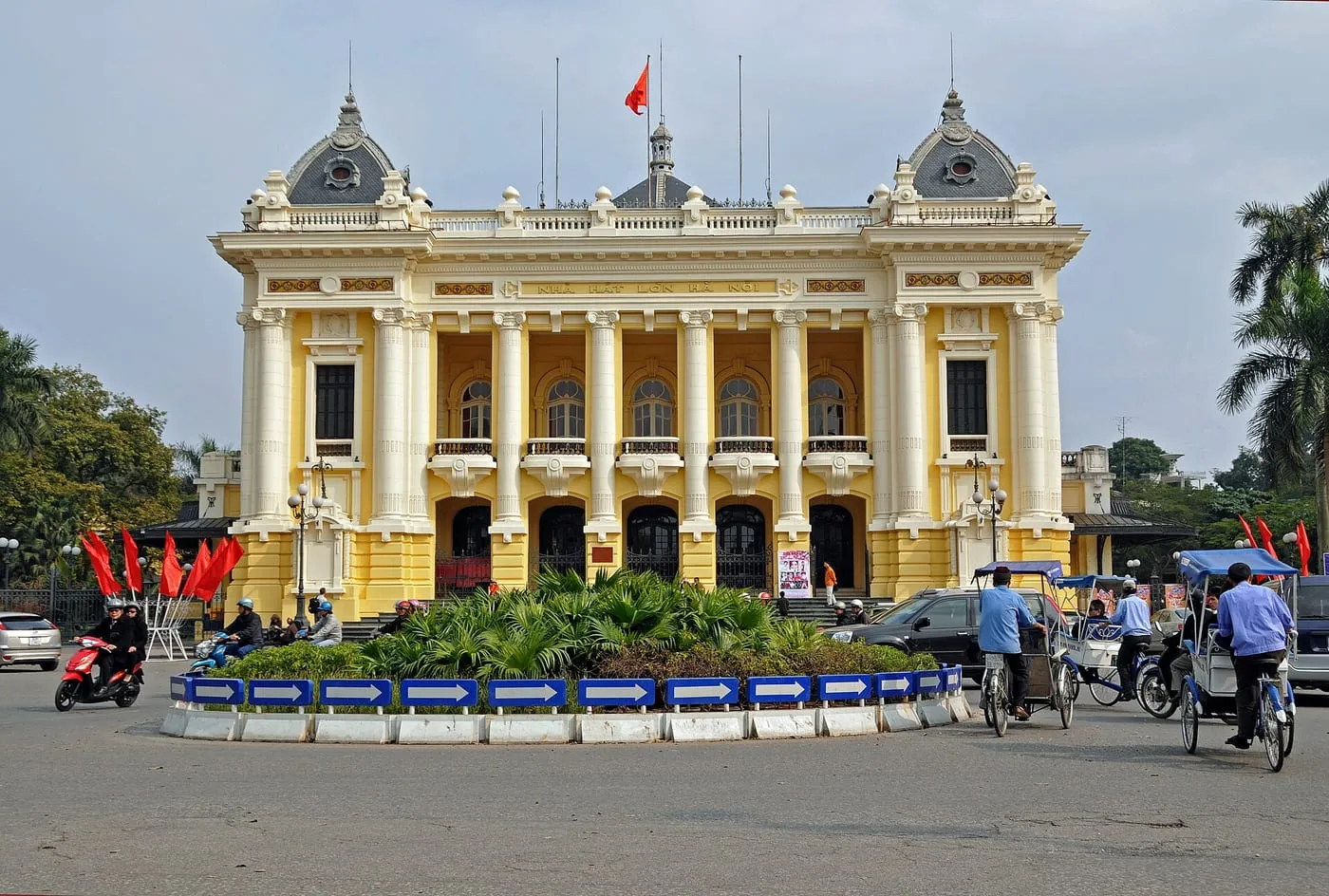
At the focal point of this district stands the Hanoi Opera House (Nha Hat Lon Ha Noi), one of Southeast Asia’s most prominent neoclassical monuments, presiding over August Revolution Square (Quang Truong Cach Mang Thang Tam).
History and Palais Garnier architecture
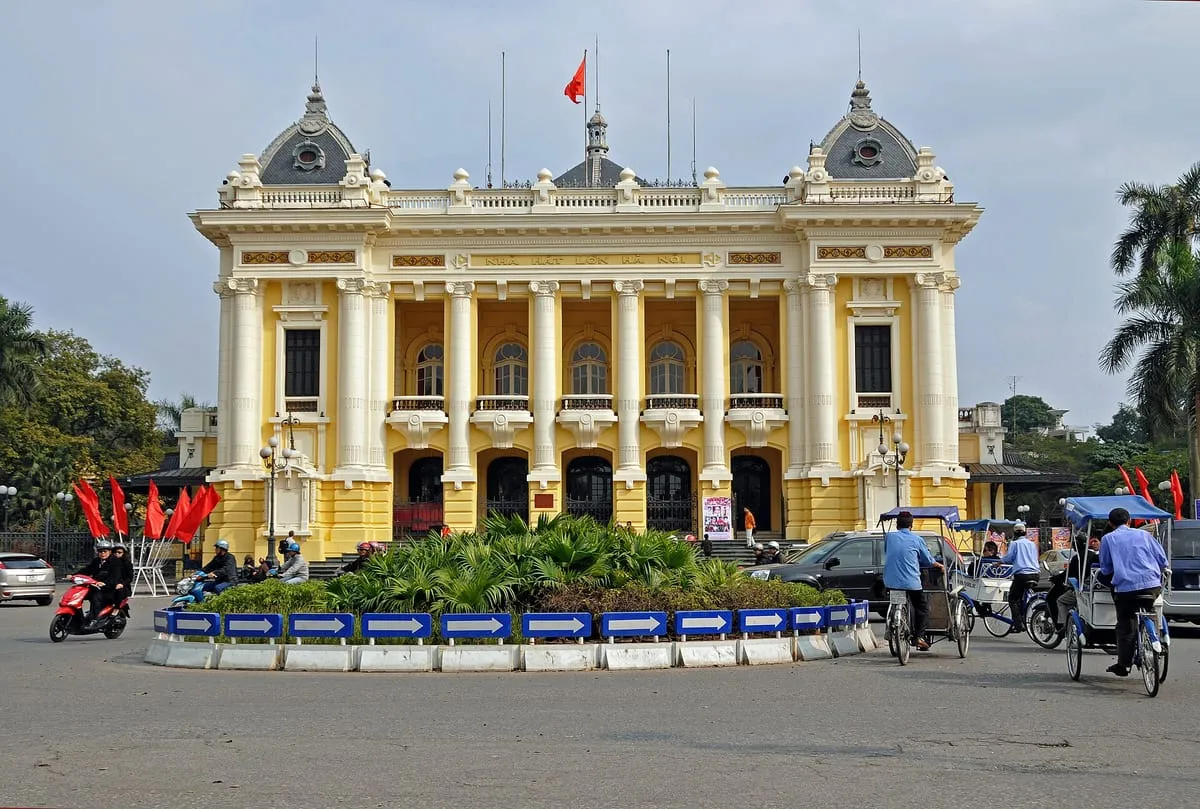
The neoclassical facade and ionic colonnade of the Hanoi Opera House. Photo: Dennis G. Jarvis, Wikimedia Commons, CC BY-SA 2.0.
Commissioned by French colonial authorities in 1901 and completed in 1911, the opera house was designed by architects Charles Harley and Broyer. To secure the swampy ground near the Red River, engineers drove 35,000 bamboo stakes into the soil before pouring massive concrete foundations.
Drawing heavy inspiration from Charles Garnier’s Paris Opera, the building incorporates:
- Neoclassical facade: Symmetrical yellow stucco walls, Corinthian porticoes, ionic columns, and tall arched shuttered windows.
- Eclectic roofing: Dark Ardoise slate mansard roofs imported from France, crowned with copper dormers and balustrades.
- Grand foyer: Italian marble stairways, crystal chandeliers, wrought-iron balustrades, and high mirrors.
- Main auditorium: An 870-seat horseshoe hall upholstered in deep red velvet, topped with a neoclassical dome mural depicting classical French muses and composers.
On 19 August 1945, the square in front of the Opera House served as the staging ground for a massive rally of hundreds of thousands of Vietnamese citizens organised by the Viet Minh, launching the historic August Revolution that led to the declaration of national independence.
Visiting the Opera House: tours and tickets
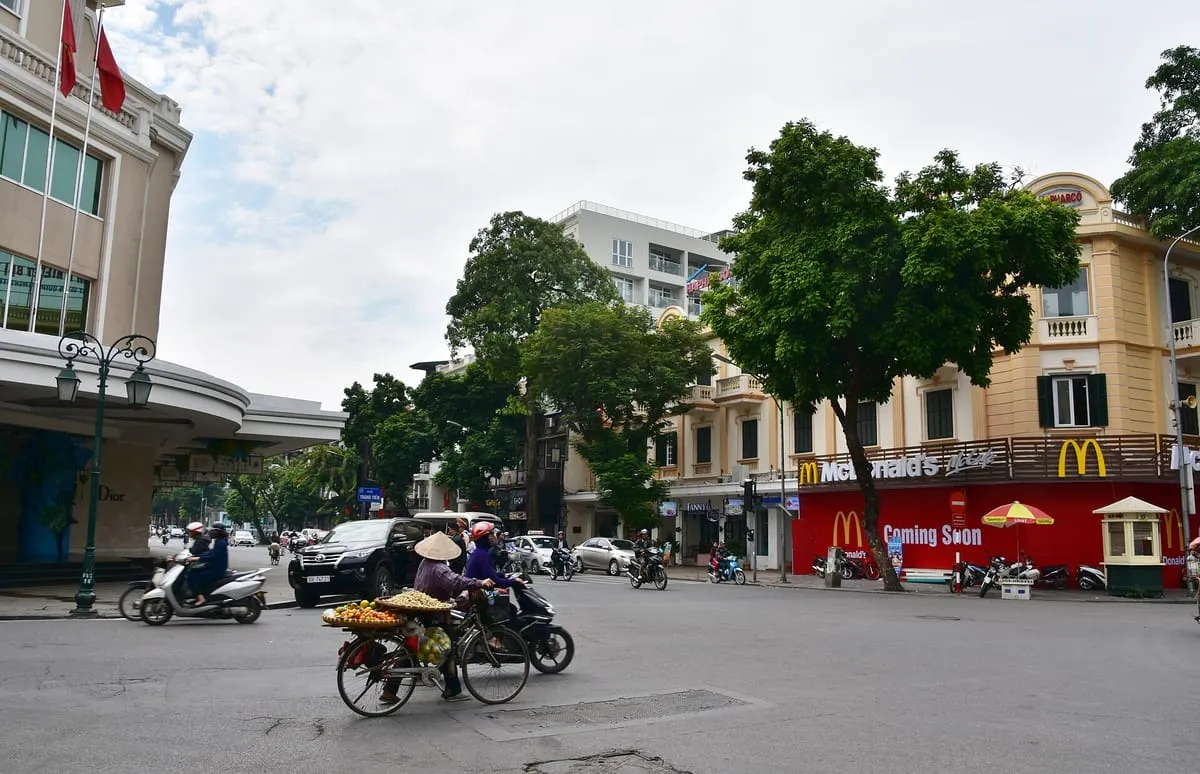
Tree-lined boulevards and French colonial architecture in the French Quarter. Photo: Richard Mortel from Riyadh, Saudi Arabia, Wikimedia Commons, CC BY 2.0.
Because the Opera House remains a functioning national performance theatre, public access is managed carefully:
| Access method | Schedule | Estimated cost | Booking details |
|---|---|---|---|
| Evening performance (VNSO / Ballet) | Select evenings, typically 20:00 | 300,000 to 1,500,000 VND | Purchase via the official box office on Phan Chu Trinh or online ticket agents |
| Guided interior heritage tour | Select mornings (09:00 to 11:00) | 120,000 to 400,000 VND | Schedule varies by production timetable; verify at front security desk |
| Exterior viewing and photography | Open 24 hours daily | Free | Beautifully illuminated after 18:30 from August Revolution Square |
Attending an evening concert
Experiencing an acoustic performance by the Vietnam National Symphony Orchestra (VNSO) or the Vietnam National Opera and Ballet is the finest way to take in the historic auditorium. Dress code for evening shows is smart casual (collared shirts and trousers; avoid athletic shorts and flip-flops).
The French neoclassical facade of Hanoi Opera House illuminated at dusk. Photo: Vuong Tri Binh, Wikimedia Commons, CC BY-SA 4.0.
Exploring the French Quarter: key landmarks
A stroll through the French Quarter reveals a rich tapestry of colonial history, museums, and high-end hospitality.
1. Trang Tien boulevard and Kem Trang Tien
Trang Tien Street connects the southern tip of Hoan Kiem Lake to the Opera House. Originally named Rue Paul Bert, it was colonial Hanoi’s main European shopping street.
At 35 Trang Tien Street sits Kem Trang Tien, an ice cream establishment operating since 1958. Locals pull motorbikes right into the cavernous indoor hall to buy freshly made popsicles and waffle cones:
- Kem Com: Made with young green sticky rice flakes from Vong village (12,000 VND).
- Kem Dau Xanh: Sweet mung bean popsicle (12,000 VND).
- Kem Dua: Rich coconut cream ice cream with fresh coconut shavings (15,000 VND).
2. Sofitel Legend Metropole Hanoi
Situated one block west of the Opera House on Ngo Quyen Street, the Sofitel Legend Metropole opened in 1901. Its whitewashed facade, green timber louvres, and wrought-iron balconies have hosted figures including Charlie Chaplin, Somerset Maugham, and Graham Greene. In 2011, hotel renovators rediscovered a bomb shelter beneath the poolside Bamboo Bar used by guests during American air raids in 1972, now preserved for guided guest tours.
3. National Museum of Vietnamese History
Located behind the Opera House at 1 Pham Ngu Lao, this striking mustard-yellow building was constructed between 1926 and 1932 by architect Ernest Hebrard. It is an example of the Indochinese architectural movement, combining French neoclassical geometry with double-tiered Vietnamese ceramic roof tiles and natural cross-ventilation eaves designed for monsoon rains.
Inside, exhibits span from prehistoric times to the 1945 revolution, housing Dong Son bronze kettledrums, Cham stone carvings, and imperial Nguyen dynasty gold seals (admission: 40,000 VND; open 08:00 to 12:00 and 13:30 to 17:00, closed first Monday of the month).
4. Cultural museums on Ly Thuong Kiet
Two blocks south of Trang Tien run wide boulevards housing major national museums:
- Vietnamese Women’s Museum: Located at 36 Ly Thuong Kiet, offering four floors detailing wartime resistance and ethnic craft; see our complete Vietnamese Women’s Museum guide.
- Hoa Lo Prison Memorial: Situated on the corner of Hoa Lo and Ly Thuong Kiet, documenting colonial incarceration and American POW history; consult our Hoa Lo Prison memorial guide.
Recommended French Quarter walking route
This self-guided two-hour walking route connects the French Quarter’s top architectural and cultural landmarks:
| Stop | Distance from previous stop | Notable architectural highlights |
|---|---|---|
| 1. Trang Tien Plaza | Starting point at lake | Restored department store facade facing Hoan Kiem Lake |
| 2. Kem Trang Tien | 250 metres east | Historic 1958 ice cream hall at 35 Trang Tien |
| 3. Hanoi Opera House | 350 metres east | Neoclassical facade and August Revolution Square |
| 4. National History Museum | 200 metres east | Ernest Hebrard’s Indochinese style multi-tiered pagoda roofs |
| 5. Sofitel Metropole Hanoi | 300 metres northwest | 1901 colonial hotel exterior and courtyard garden |
| 6. St. Joseph’s Cathedral | 700 metres west | Neo-Gothic twin towers and lively cafe piazza |
Guided tours of the Hanoi Opera House and French Quarter
Walking through the French Quarter with an architectural historian brings the district’s colonial, revolutionary, and diplomatic history to life:
Hanoi French Quarter: Walking Tour
From VND 253,800 · 4.8 stars from 25 reviews · 2.5 hours · Small group
Book the Hanoi French Quarter: Walking Tourad for a structured walk starting outside the Hanoi Opera House and August Revolution Square. Highlights include the Sofitel Metropole, the Government Guest House (former Residence of the French Governor of Tonkin), and French neoclassical villas.
Hanoi: French Quarter Walking Tour
From VND 1,328,000 · 4.7 stars from 12 reviews · 3.5 hours · In-depth cultural tour
Book the Hanoi French Quarter Walking Tourad for an extended exploration of French and Indochinese architectural styles. The route compares Ernest Hebrard’s National History Museum with classical French edifices, concluding with traditional pastries and Vietnamese drip coffee.
Hanoi City Highlights Walking Tour – Landmarks & History
From VND 699,800 · 5.0 stars from 206 reviews · 4.5 - 5 hours · Full-city overview
Book the Hanoi City Highlights Walking Tourad to see the French Quarter alongside the Old Quarter guild streets, St. Joseph’s Cathedral, and Hoan Kiem Lake, accompanied by a knowledgeable licensed guide.
Practical tips for visitors
- Photography timing: The Opera House facade faces westward towards August Revolution Square, making mid-morning ideal for bright front illumination. In the evening, architectural floodlights highlight the ionic columns and stone pediments.
- Accommodation considerations: The French Quarter offers wide, tranquil sidewalks and luxury boutique hotels that provide a quieter alternative to the dense bustle of the northern guild streets. See our overview of where to stay in Hanoi and detailed guide to hotels in the Old Quarter and French Quarter.
- Continuing your explorations: If you enjoy walking tours, follow our curated French Quarter and Ba Dinh walk or cross north to wander the Old Quarter and Hoan Kiem walking route.
- For a broader travel plan, see our curated master itinerary for 3 days in Hanoi.
Common questions
Can you go inside the Hanoi Opera House?
Visitors can enter the interior by purchasing tickets to an evening classical concert, ballet, or opera performance, or by booking a designated morning heritage tour when scheduled by theatre management. Casual walk-ins outside of performances or scheduled tours are not permitted.
How much are tickets to see a performance at Hanoi Opera House?
Ticket prices vary depending on the production, typically ranging from 300,000 VND for upper balcony seats during orchestral concerts to 1,500,000 VND for premium stalls seats during international opera or ballet tours.
When was the Hanoi Opera House built?
Construction began in 1901 and concluded in 1911 under French colonial rule, designed by architects Charles Harley and Broyer. The building was heavily modelled on the Palais Garnier in Paris.
Where is the French Quarter in Hanoi?
The French Quarter occupies the district south and east of Hoan Kiem Lake, centred around Trang Tien, Phan Chu Trinh, Ly Thuong Kiet, and Hai Ba Trung boulevards, characterized by wide tree-shaded avenues, colonial villas, and government embassies.
What is Trang Tien Ice Cream and why is it famous?
Founded in 1958 at 35 Trang Tien Street, Kem Trang Tien is a Hanoi institution famous for its traditional ice cream popsicles flavoured with young sticky rice (com), coconut, mung bean, and taro, costing between 12,000 VND and 15,000 VND each.