In this guide
💡 The Short Version: Split has hot summers and mild winters. July and August bring daily highs of 30.9°C to 31.0°C, sea temperatures of 23.2°C to 23.6°C and the biggest crowds. May, June, September and October suit sightseeing, with highs of 20.5°C to 28.1°C, seas of 19.3°C to 21.7°C (17.3°C in May) and Krka tickets at €20 against €40 in summer. November is the wettest month (119.8 mm of rain). December to February brings highs of 10.7°C to 11.8°C and Krka at €7. Or book a tour: the Split: Diocletian’s Palace & Old Town Small Group Tourad is a guided walk through the Roman palace that works in summer heat and winter alike.
⚠️ High-speed catamaran schedules contract sharply after mid-October. Tourist catamarans linking Split to Hvar town, Bol, and Korčula conclude seasonal operations in mid-October. Slower, year-round Jadrolinija vehicle and passenger ferries continue daily service to Stari Grad on Hvar and Supetar on Brač.
| Months | Highs | Sea | What to expect |
|---|---|---|---|
| May to June | 23° to 28°C | 17° to 21°C | Shoulder season, moderate crowds |
| July to August | 31°C | 23° to 24°C | Peak summer, festivals and high fares |
| September to October | 20° to 25°C | 19° to 22°C | Shoulder season, sea still warm |
| November to April | 11° to 18°C | 12° to 14°C | Mild low season, Krka at its winter price and Advent |
Monthly weather and sea temperature data
Climate normals recorded at the Split Marjan meteorological station for 1991–2020 by the National Oceanic and Atmospheric Administration (NOAA), paired with sea surface temperatures from the Croatian Meteorological and Hydrological Service (DHMZ).
| Month | Daily maximum | Daily minimum | Rainfall | Rainy days | Sunshine hours | Sea temperature |
|---|---|---|---|---|---|---|
| January | 10.7°C | 5.9°C | 72.7 mm | 10.5 | 139.5 | 12.0°C |
| February | 11.5°C | 6.0°C | 63.8 mm | 9.4 | 151.7 | 11.5°C |
| March | 14.5°C | 8.5°C | 58.4 mm | 9.6 | 195.1 | 11.9°C |
| April | 18.4°C | 11.8°C | 62.0 mm | 10.4 | 221.5 | 13.8°C |
| May | 23.4°C | 16.1°C | 57.8 mm | 9.4 | 277.9 | 17.3°C |
| June | 28.1°C | 20.2°C | 49.2 mm | 7.8 | 317.8 | 21.1°C |
| July | 31.0°C | 22.8°C | 24.6 mm | 5.1 | 358.7 | 23.2°C |
| August | 30.9°C | 22.9°C | 31.7 mm | 4.6 | 335.0 | 23.6°C |
| September | 25.4°C | 18.4°C | 82.3 mm | 8.2 | 246.3 | 21.7°C |
| October | 20.5°C | 14.7°C | 79.6 mm | 9.3 | 197.8 | 19.3°C |
| November | 15.6°C | 10.8°C | 119.8 mm | 11.7 | 129.3 | 16.4°C |
| December | 11.8°C | 7.2°C | 98.7 mm | 11.9 | 127.9 | 13.7°C |
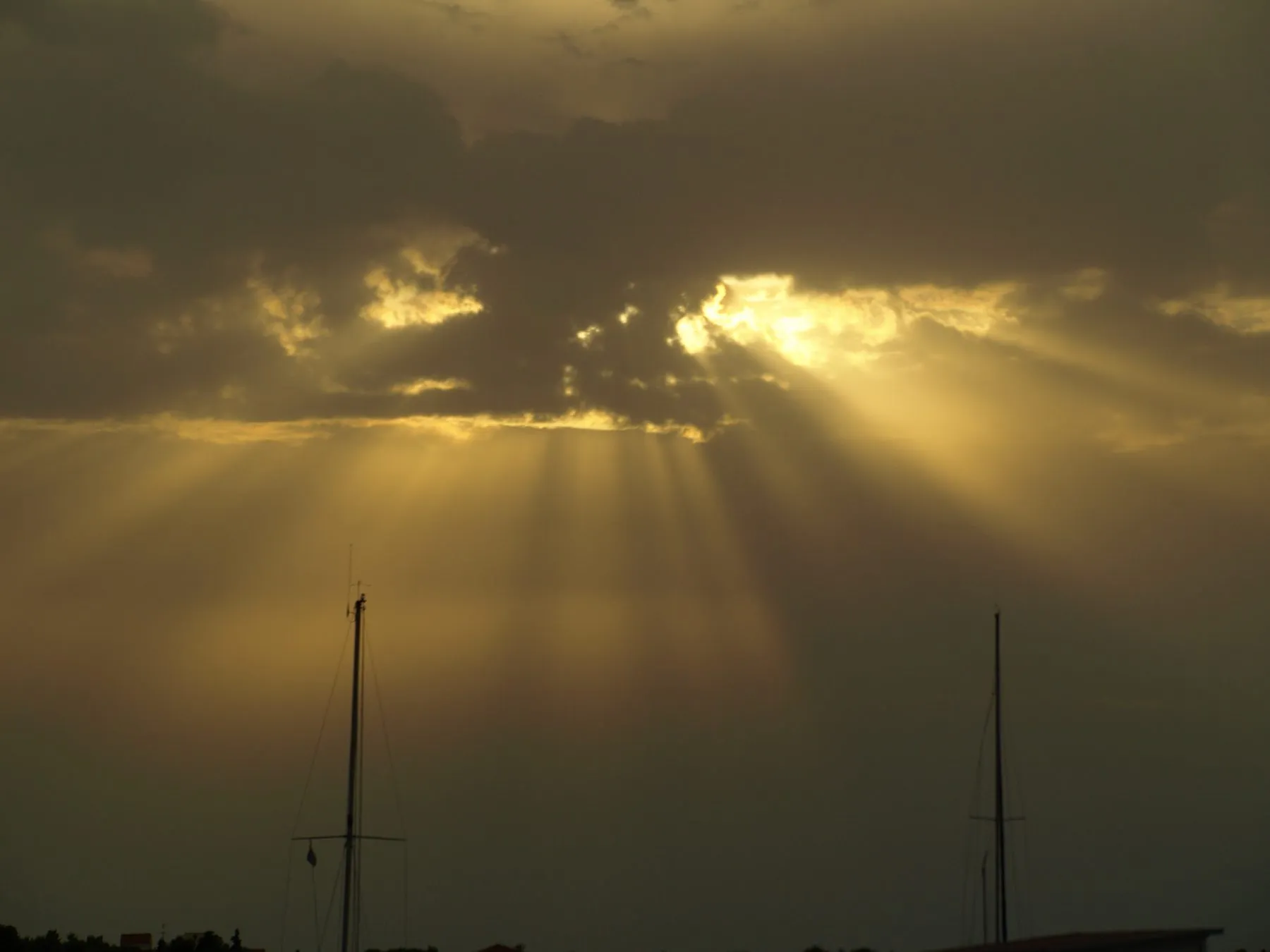 Sunset over Split harbour. Photo: Javier Losa, Wikimedia Commons, CC BY 2.0.
Seasonal guide: what to expect
Peak Summer (July and August)
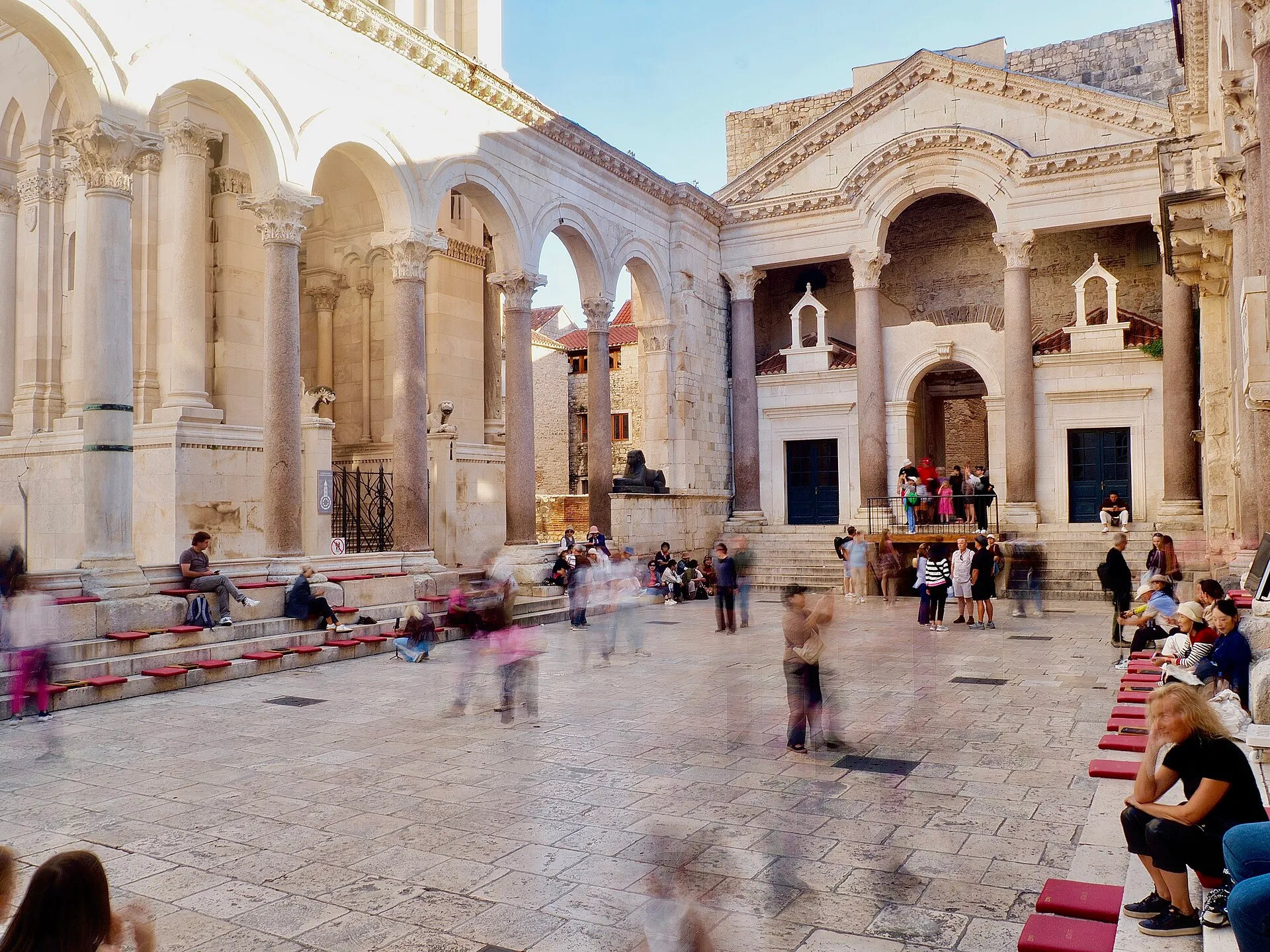
Daily maximums average 31.0°C, and heat spikes above 35°C are common. The stone alleys of Diocletian’s Palace are hot at midday, so sightsee before 10:00 or after 18:00 and spend the middle hours on the beaches of Bačvice or Marjan.
- Major events: The Split Summer Festival (Splitsko ljeto) runs from mid-July to mid-August, with open-air opera, ballet and drama in the Peristyle and at the Meštrović Gallery.
- Logistics: Adult entry to Krka National Park costs €40 (€30 after 15:00). Book accommodation, ferries and popular konobas weeks in advance.
The Spring Shoulder (May and June)
Highs climb from 23.4°C in May to 28.1°C in June. The hillsides around Split are green, with wild sage and broom in flower.
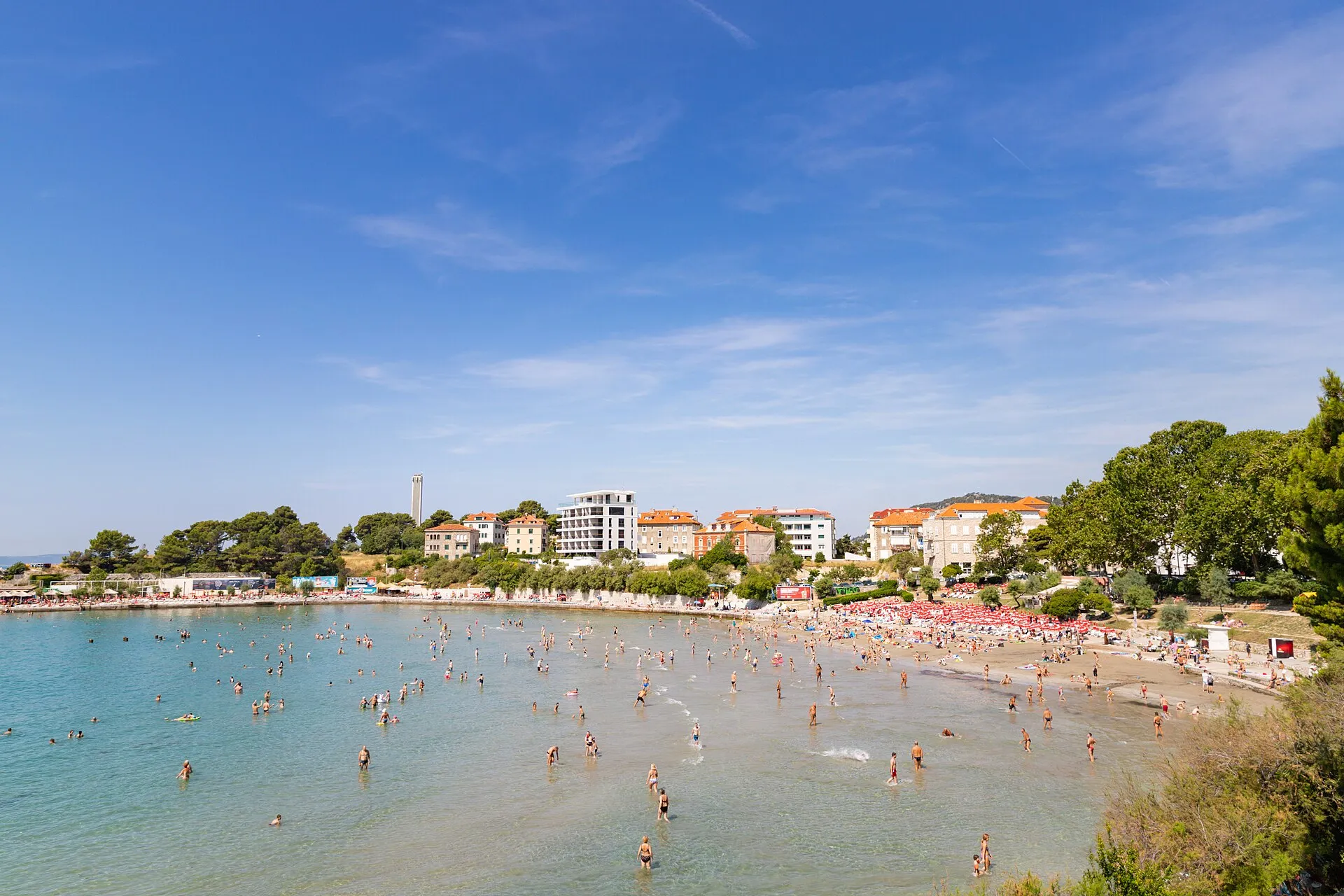
- Sightseeing: The alleys and the Peristyle are easier to walk than in July and August. The sea averages 21.1°C in June, warm enough for swimming and sea kayaking around Marjan.
- Cost: Krka National Park tickets cost €20 in May, half the July rate.
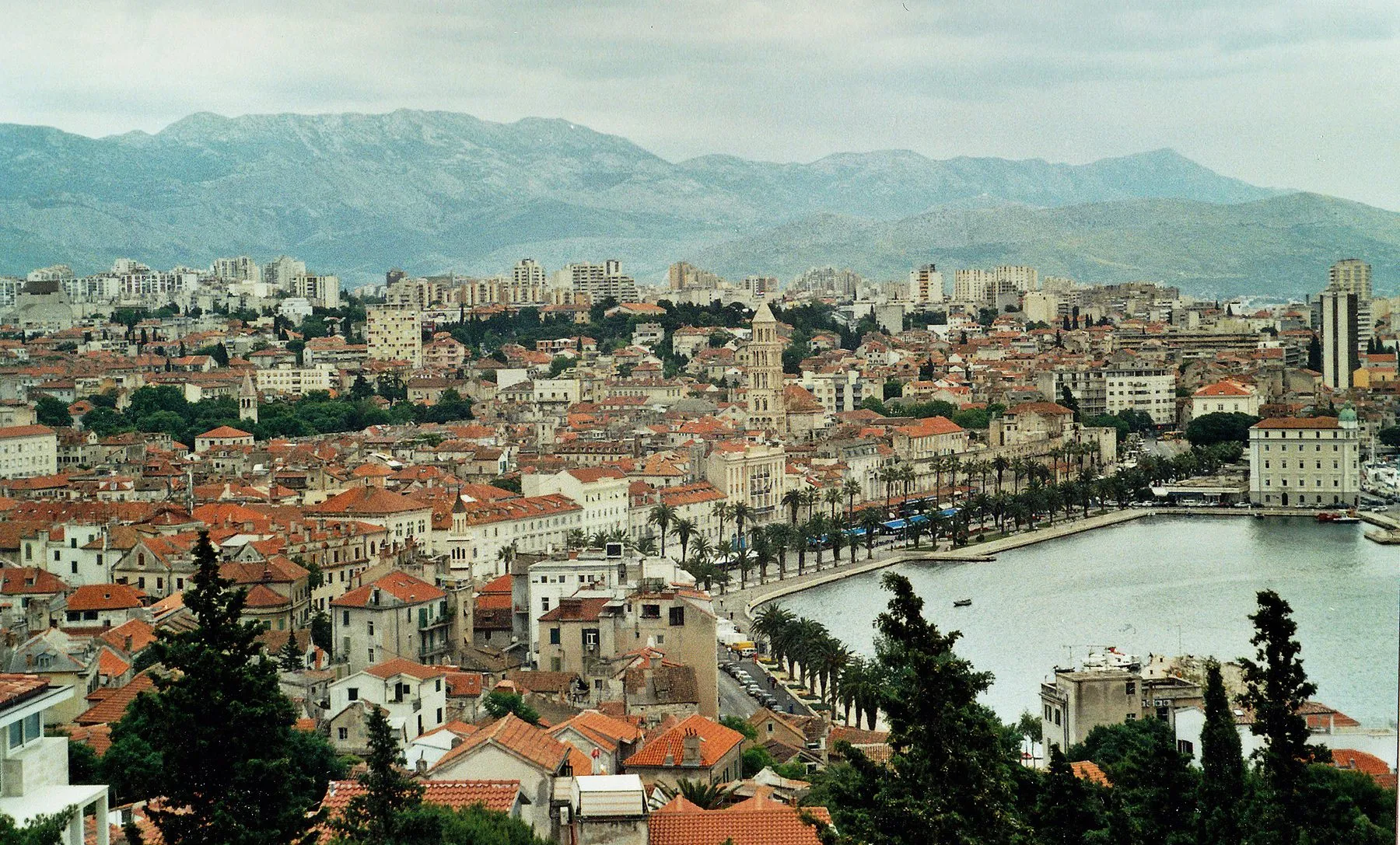 Split’s main ferry harbour and quayside terminal. Photo: SchiDD, Wikimedia Commons, CC BY-SA 4.0.
The Autumn Shoulder (September and October)
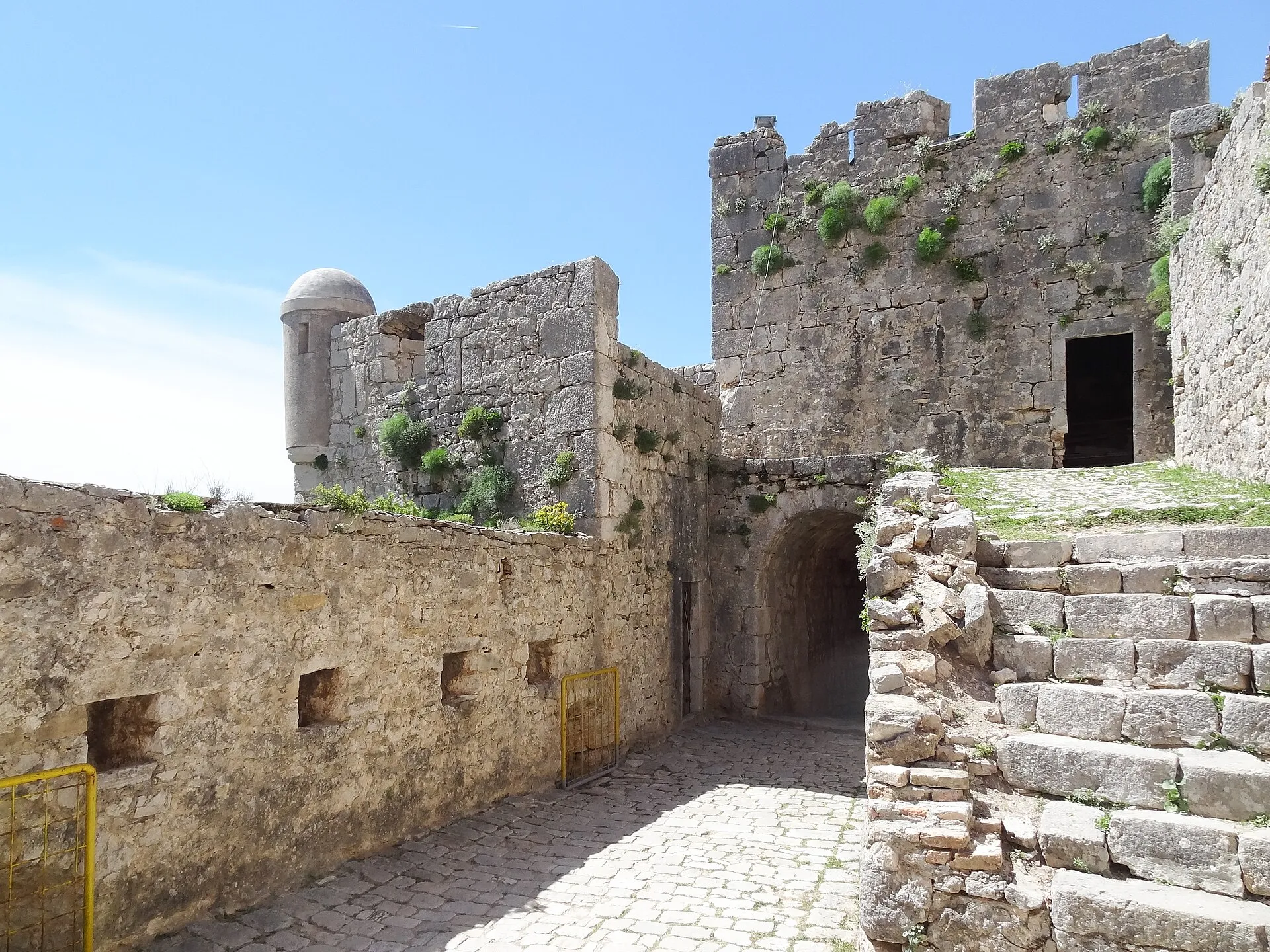
September has summer’s sea (21.7°C on average), highs of 25.4°C and the full ferry timetable, with fewer family holidaymakers. October’s highs of 20.5°C suit walking tours, cycling around Marjan and the climb to Klis Fortress.
- Grape harvest: September is grape harvest time in Dalmatia, the month for winery tours and tastings at Split wine bars.
- Seasonal changes: Krka National Park entry drops back to €20 in October. Skradinski buk waterfall opening hours reduce from 20:00 in summer to 18:00 (1–15 October) and 17:00 (16–31 October).
Low Season and Winter (November to April)
In winter Split is a working city with few visitors. Daily highs are around 11°C to 15°C, and on sunny days the cafe terraces along the south-facing Riva fill with locals.
- The bura wind: The main weather hazard is the bura, a dry north-easterly wind off the Mosor and Kozjak mountains. It clears the cloud, but gusts can exceed 100 km/h and halt island catamaran crossings.
- Park discounts: Krka National Park charges just €7 per adult from November through March.
- Advent in Split: Running from late November through early January, the Riva and Prokurative fill with lights and wooden chalets selling mulled wine (kuhano vino) and fried pastries (fritule), with open-air concerts.
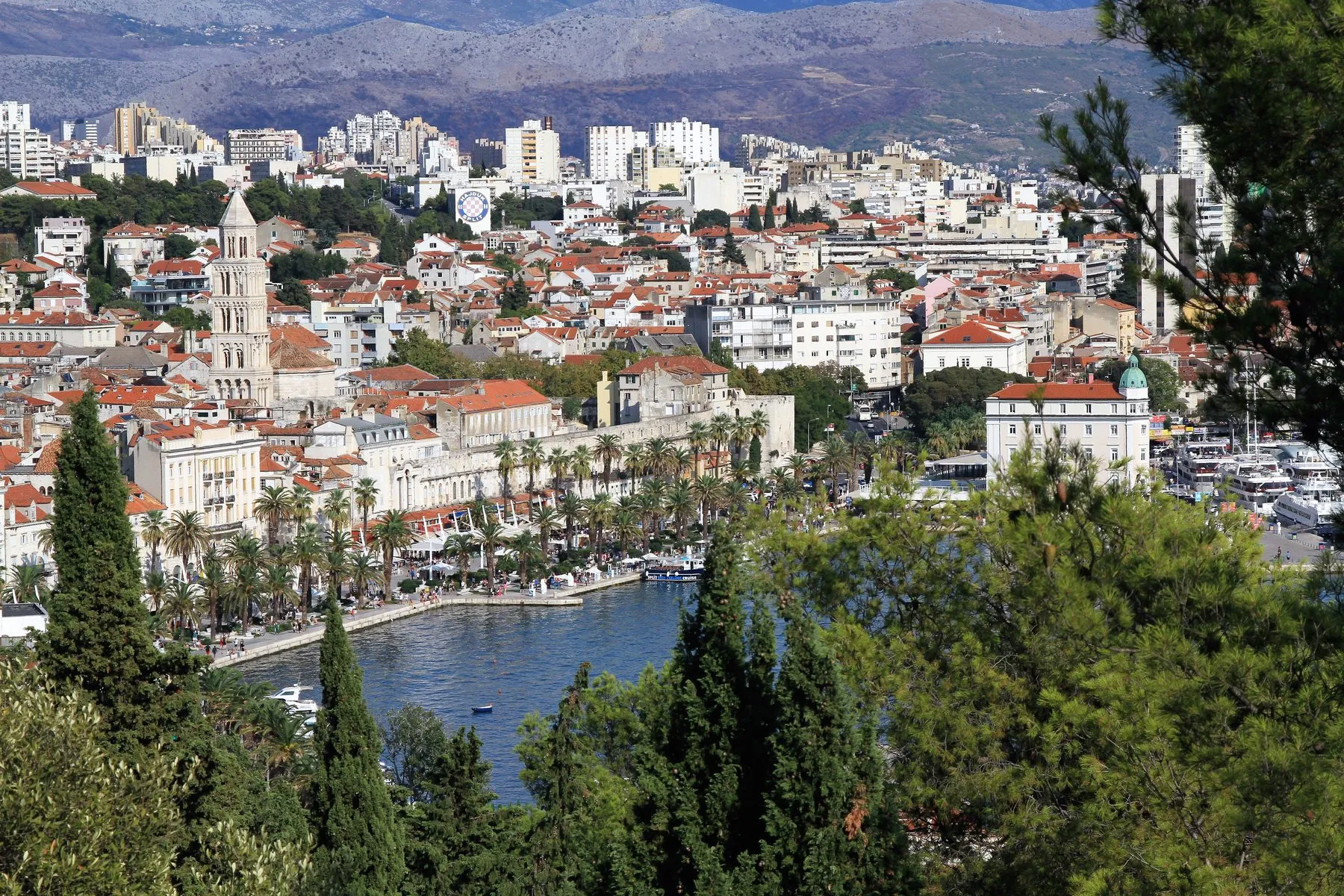 Tiled rooftops of the historic core and the Cathedral bell tower. Photo: Rob Hodgkins, Wikimedia Commons, CC BY-SA 2.0.
Seasonal ticket prices and opening hours comparison
| Attraction / Service | High Summer (Jul–Aug) | Shoulder (May–Jun / Sep–Oct) | Low Season (Nov–Apr) | Official source / booking rule |
|---|---|---|---|---|
| Krka National Park | €40 adult (€30 after 15:00) | €20 adult (Apr–May, Oct) | €7 adult (Nov–Mar) | Includes excursion boat from Skradin; np-krka.hr |
| Klis Fortress | €12 adult; daily 09:00–19:00 | €12 adult; daily 09:00–19:00 | €12 adult; daily 09:00–19:00 | tvrdavaklis.com |
| Diocletian Cellars | €10 adult | €10 adult | €10 adult; 09:00–17:00 until 28 March 2027 | Split City Museum |
| Cathedral Bell Tower | €7 single (€15 for everything) | €7 single (€15 for everything) | €7 single (€12 with cathedral and treasury) | Diocesan box office; splitska-nadbiskupija.hr |
| Meštrović Gallery | €12 adult; Tue–Sun 09:00–17:00 | €12 adult; Tue–Sun 09:00–17:00 | €12 adult; Tue–Sun 09:00–17:00 | Closed Mondays and holidays; mestrovic.hr |
| Jadrolinija catamarans | Daily, frequent, to Hvar, Vis and Bol | Reduced frequency | Suspended (car ferries operate) | jadrolinija.hr |
Key closing dates and holidays to plan around
- Diocletian’s Palace Cellars: Open daily year-round, except for closures on 18 November (Day of Remembrance), 25 and 26 December (Christmas), 1 January (New Year’s Day), 6 January (Epiphany), and Easter Sunday.
- Ivan Meštrović Gallery and Meštrović’s Crikvine: Closed every Monday throughout the year, as well as official Croatian national public holidays.
- Split City Museum and Emanuel Vidović Gallery: Closed on Mondays and state holidays; open Tuesday to Sunday.
- Archaeological Museum of Split: Summer hours (1 June–30 September): Monday to Saturday 09:00–14:00 and 15:00–20:00. Winter hours (1 October–31 May): Monday to Friday 09:00–14:00 and 15:00–20:00, Saturday 09:00–14:00; closed Sundays and state holidays.
- Krka National Park: Closed on 25 and 26 December; open until 12:00 on 24 and 31 December.
Guided tours across the seasons
Guided walking tours run all year, with start times that shift with daylight and heat.
Split: Diocletian’s Palace & Old Town Small Group Tour
From €15 · 4.9 stars from 1,034 reviews · 1.5 - 5.5 hours · free cancellation
Split: Diocletian’s Palace & Old Town Small Group Tourad: Explore 1,700 years of Roman and medieval history. In high summer, tours stick to shaded passageways and cool subterranean vaults; in winter, departures take advantage of mild midday sunshine.
Diocletian’s Palace & Split Old Town Guided Tour – Since 2007
From €15 · 4.8 stars from 868 reviews · 1.5 - 5 hours · free cancellation
Diocletian’s Palace & Split Old Town Guided Tour – Since 2007ad: A classic 150-minute historical walk covering Diocletian’s Palace, the morning Fish Market, Pjaca, and the Riva with an experienced local licensed guide.
Split: Diocletian Palace, Marjan Hill Viewpoint & Local Eats
From €29 · 4.9 stars from 81 reviews · 1.5 - 2.5 hours · free cancellation
Split: Diocletian Palace, Marjan Hill Viewpoint & Local Eatsad: Combine historic Roman architecture with a stroll up the Marjan stone stairs to the First Belvedere, concluding with local food tastings.
Seasonal touring comparison
| Feature | Peak Summer (Jul–Aug) | Shoulder (May–Jun / Sep–Oct) | Low Season (Nov–Mar) |
|---|---|---|---|
| Best tour time | 09:00 or 18:30 (avoid noon heat) | 10:00 or 16:00 | 11:00 to 14:00 (warmest hours) |
| Comfort level | High heat; carry water | Good walking climate | Cool; light jacket required |
Practical packing advice by season
- Summer (June to August): Pack breathable linen or cotton garments, high-SPF sunscreen, UV sunglasses, and a wide-brimmed hat. Pack neoprene water shoes if swimming on pebble beaches like Kašjuni or Trstenik. A lightweight scarf is handy to cover shoulders when entering Saint Domnius Cathedral.
- Shoulder Season (May, September, October): Bring layers: t-shirts for sunny afternoons, a denim jacket or wool cardigan for breezy coastal evenings, and swimwear for midday dips. A compact umbrella is wise for occasional autumn thunderstorms.
- Winter (November to February): Pack a windproof and waterproof jacket to combat the bura wind, comfortable walking shoes with rubber soles for wet limestone paving, and a light fleece or warm wool sweater.
What to see next
- Day Trips from Split: Excursions to Krka, Hvar, Brač and Klis compared.
- Krka National Park Day Trip: Ticket prices by season, boat timetables and walking routes.
- Getting Around Split: Bus routes, ferry piers and airport connections.
- 3 Days in Split: A three-day itinerary that works in any season.
- Where to Stay in Split: Neighbourhoods and hotels.
- Split City Break Hub: Every Split guide in one place.
Common questions
What is the best month to visit Split overall?
May, June and September combine daytime highs of 23°C to 28°C with sea temperatures of 17°C in May and 21°C to 22°C in June and September, and have fewer visitors than July and August.
When is the sea warm enough for swimming in Split?
The sea reaches comfortable swimming temperatures from June through October. Official Croatian Meteorological Service records show Adriatic surface temperatures averaging 21.1°C in June, 23.2°C in July, 23.6°C in August, 21.7°C in September, and 19.3°C in October.
What is the hottest month in Split?
July is the hottest month, with an average daily maximum of 31.0°C and 358.7 hours of sunshine. It is also the driest month, recording just 24.6 mm of rain across an average of 5 rainy days.
Is Split worth visiting during winter?
Yes. Diocletian's Palace Cellars, St Domnius Cathedral and Klis Fortress stay open through the winter. Krka National Park costs €7 from November to March against €40 in July and August, and Advent markets run along the Riva in December.
Do passenger ferries run to the islands in winter?
Yes, though high-speed tourist catamarans conclude their seasonal runs by mid-October. Year-round Jadrolinija car ferries maintain daily lifeline connections between Split and Supetar on Brač, Stari Grad on Hvar, and Vis island.