In this guide
💡 The Short Version: The Riva is Split’s pedestrian seafront esplanade along the southern wall of Diocletian’s Palace, lined with palms, cafe terraces and white stone paving. The Roman cellars are entered through the Bronze Gate in the middle of the seawall (side halls €10; the central passage is free). Walking west takes you through Fruit Square (Voćni trg) with its Venetian tower, Pjaca (People’s Square) with the 15th-century Old Town Hall, the Peškarija fish market on Obrov, pedestrian Marmontova street and the neo-Renaissance colonnades of the Prokurative. Or book a tour: the Split: Diocletian’s Palace & Old Town Small Group Tourad covers the Riva, Pjaca, Fruit Square and the palace gates with a licensed guide.
⚠️ The historic centre and the Riva are pedestrian only. The intercity bus station, railway station and Jadrolinija ferry port are at the eastern end of the harbour, a five-minute flat walk from the palace walls.
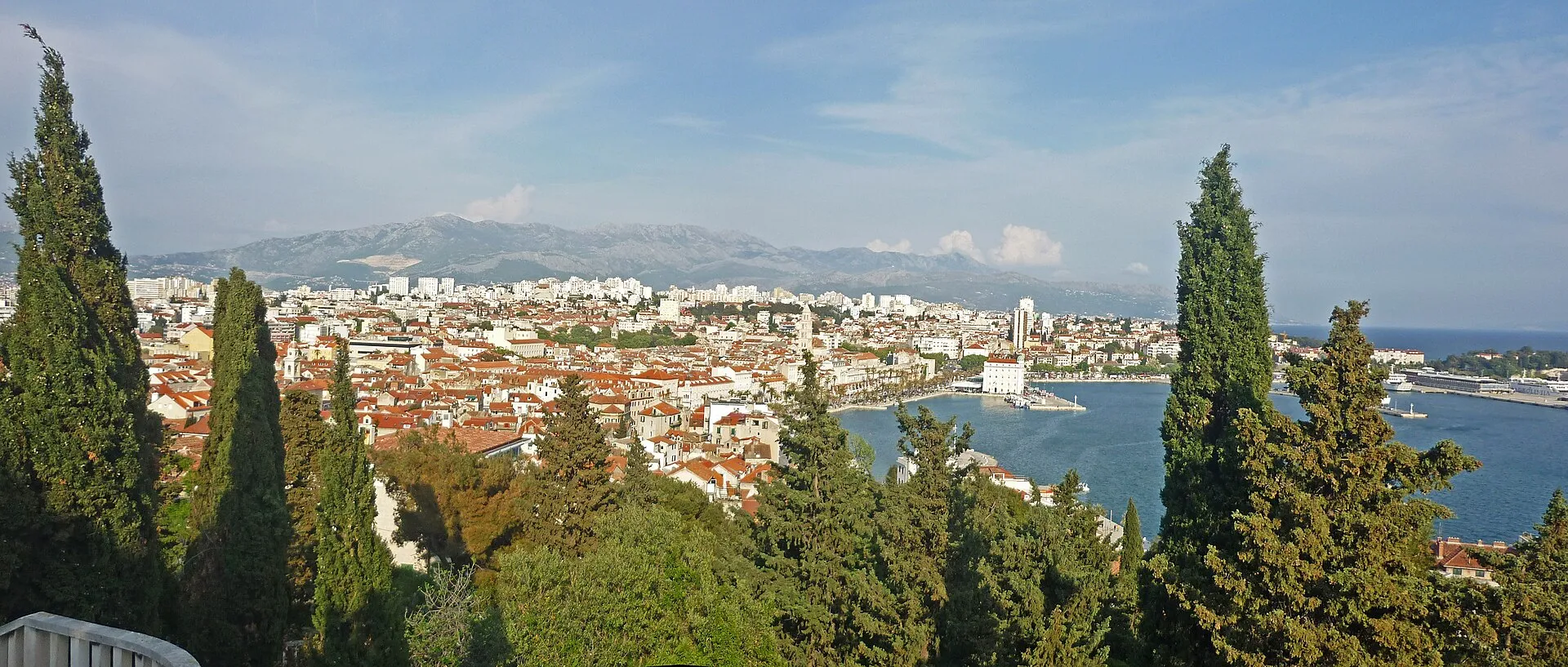
The walk runs from the ferry port and bus terminal at the east end of the Riva west along the promenade, past the Bronze Gate and the Palace cellars, Pjaca (People’s Square), Fruit Square and Sv. Frane church, to the West Coast Walk of Fame and Matejuška fishing port. Prokurative (Republic Square) and the Peškarija fish market on Marmontova branch off the route.
History of the Riva
The Riva (Obala Hrvatskog narodnog preporoda) has been Split’s waterfront for seventeen centuries. When the Roman emperor Diocletian completed his retirement residence in 305 AD, the southern facade rose straight out of the sea, and supply galleys and imperial barges docked into the vaulted cellars through the Bronze Gate (Porta Aenea).
The modern promenade took shape during the French administration of Dalmatia between 1806 and 1813. Marshal Auguste Marmont had the medieval Venetian seawalls and south bastions demolished in 1807 to lay out a wide seafront avenue. Canary Island date palms were planted along the water’s edge in the 1920s.
Road traffic and delivery lorries shared the waterfront until the late 20th century. The city pedestrianised it in the 1990s, and in 2007 the Croatian studio 3LHD redesigned it, resurfacing it in pale concrete flags and adding motorised textile shade pergolas, teak benches and low bronze light masts.
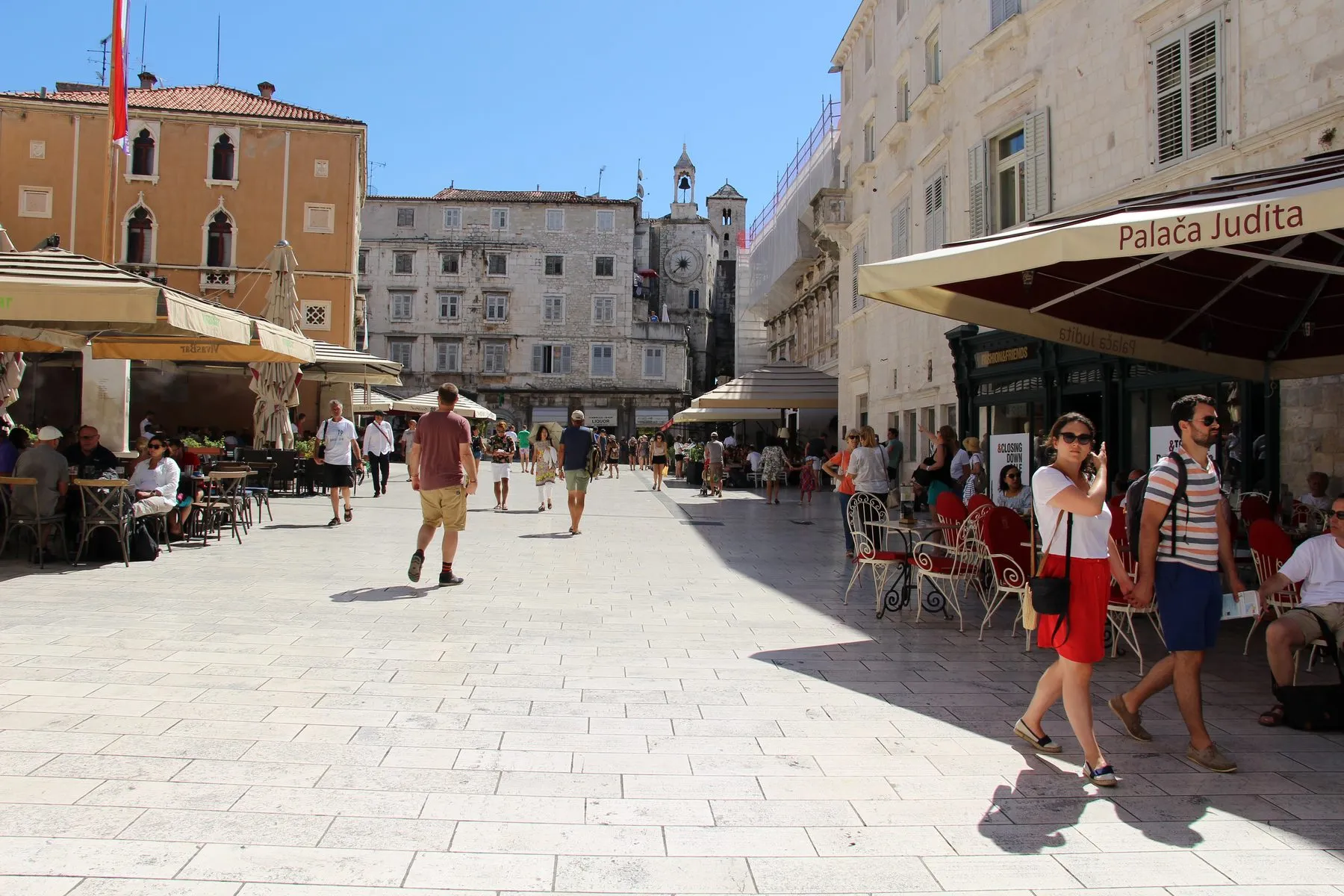 Pjaca (Narodni trg) with the 15th-century Old Town Hall. Photo: Fred Romero, Wikimedia Commons, CC BY 2.0.
Step-by-step walking itinerary
This walk of about 2 kilometres starts at the eastern end of the Riva and runs west through the squares, markets and seafront that grew up outside Diocletian’s walls.
| Stop | Distance / Location | Notable highlight | Practical details |
|---|---|---|---|
| Bronze Scale Model | Eastern Riva | 3D bronze relief showing the 4th-century palace layout vs modern city | Free outdoor display beside the Port Authority building |
| Bronze Gate & Cellars | Midpoint of southern facade | Roman sea gate leading directly into the subterranean vaults | Cellars admission €10 adult; central tunnel is free to walk through |
| Fruit Square (Voćni trg) | 100 m west of palace wall | 1435 Venetian octagonal tower, baroque Milesi Palace, and Marulić statue | Pedestrian square lined with cafes and independent shops |
| Pjaca (Narodni trg) | Just outside the Iron Gate | 15th-century Gothic Old Town Hall, 24-hour clock tower, and Morpurgo bookshop | Civic centre of Split since the Middle Ages |
| Peškarija (Fish Market) | Obrov street off Marmontova | 1890 Secession covered hall | Open daily 06:30–13:00 |
| Marmontova Street | North–south pedestrian spine | Limestone shopping avenue named after Marshal Marmont | Links the Riva with the Croatian National Theatre (HNK) |
| The Prokurative | West of Marmontova | Neo-Renaissance square modelled on the Procuratie of Piazza San Marco in Venice | Conceived by the 19th-century mayor Antonio Bajamonti |
| Matejuška & West Coast | Western harbour curve | Fishermen’s inlet and the Olympic Walk of Fame | A sunset spot with stone seating |
1. The Bronze Scale Model and Eastern Riva
Begin at the eastern tip of the Riva, beside the ferry quay. A bronze tactile model of Split stands on a stone plinth. It shows how the rectangular Roman fortress was built over with medieval and Renaissance housing, which helps before you enter the alleys.
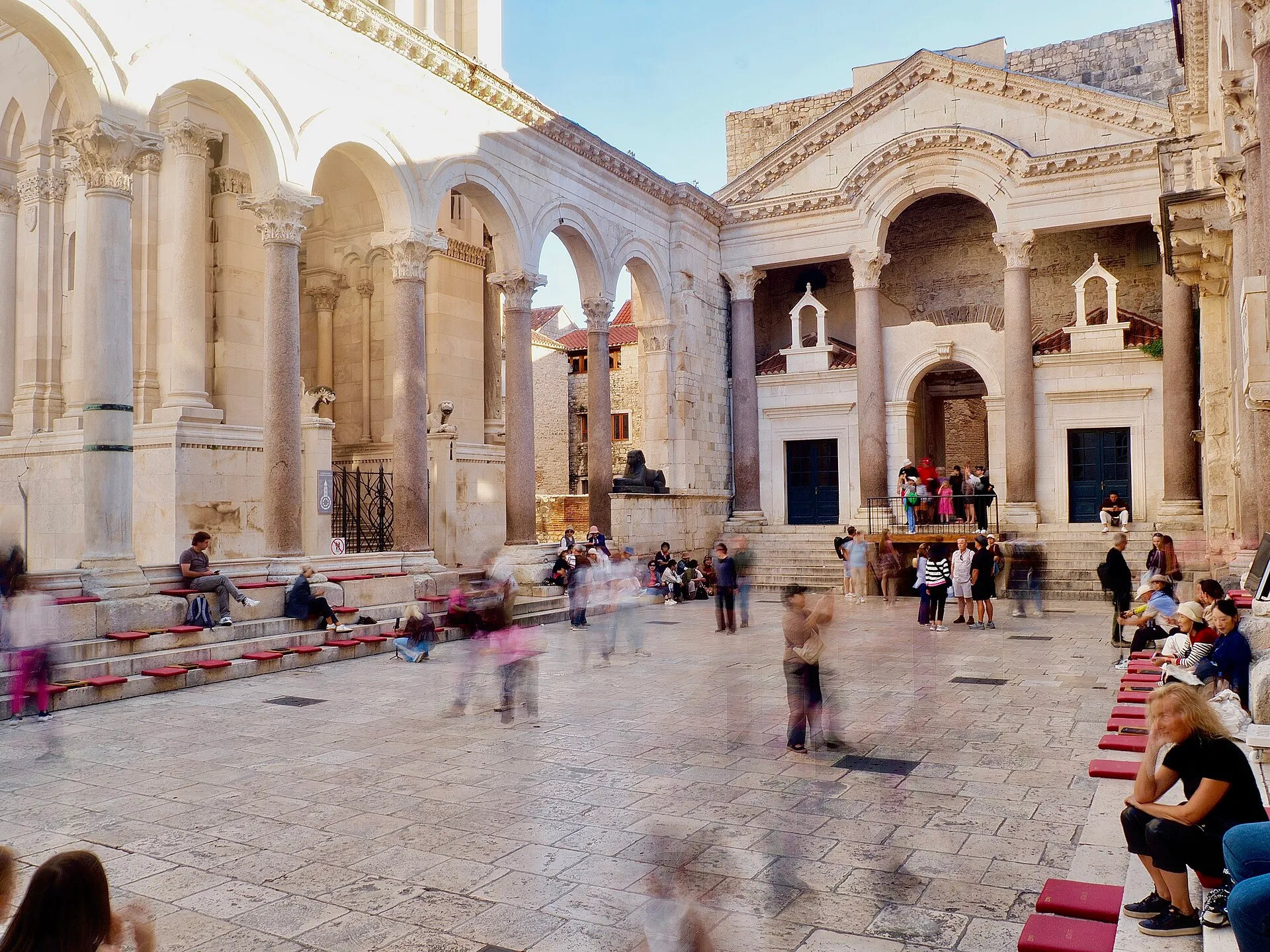
Walk west along the wide pedestrian concourse under the palms. On your right is the 180-metre southern facade of Diocletian’s Palace. The upper loggia arches were walled up in medieval conversions, but the 3rd-century masonry is intact. In the middle of the wall, go through the modest opening of the Bronze Gate (Porta Aenea). The central barrel-vaulted corridor of the Diocletian Palace Cellars is a free passage from the Riva to the Roman Peristyle.
2. Fruit Square (Trg braće Radić)
From the cellars, follow the palace wall west to Trg braće Radić, which everyone calls Voćni trg (Fruit Square). For centuries women from the surrounding villages came here at dawn to sell figs, cherries, lemons and grapes from wooden carts.
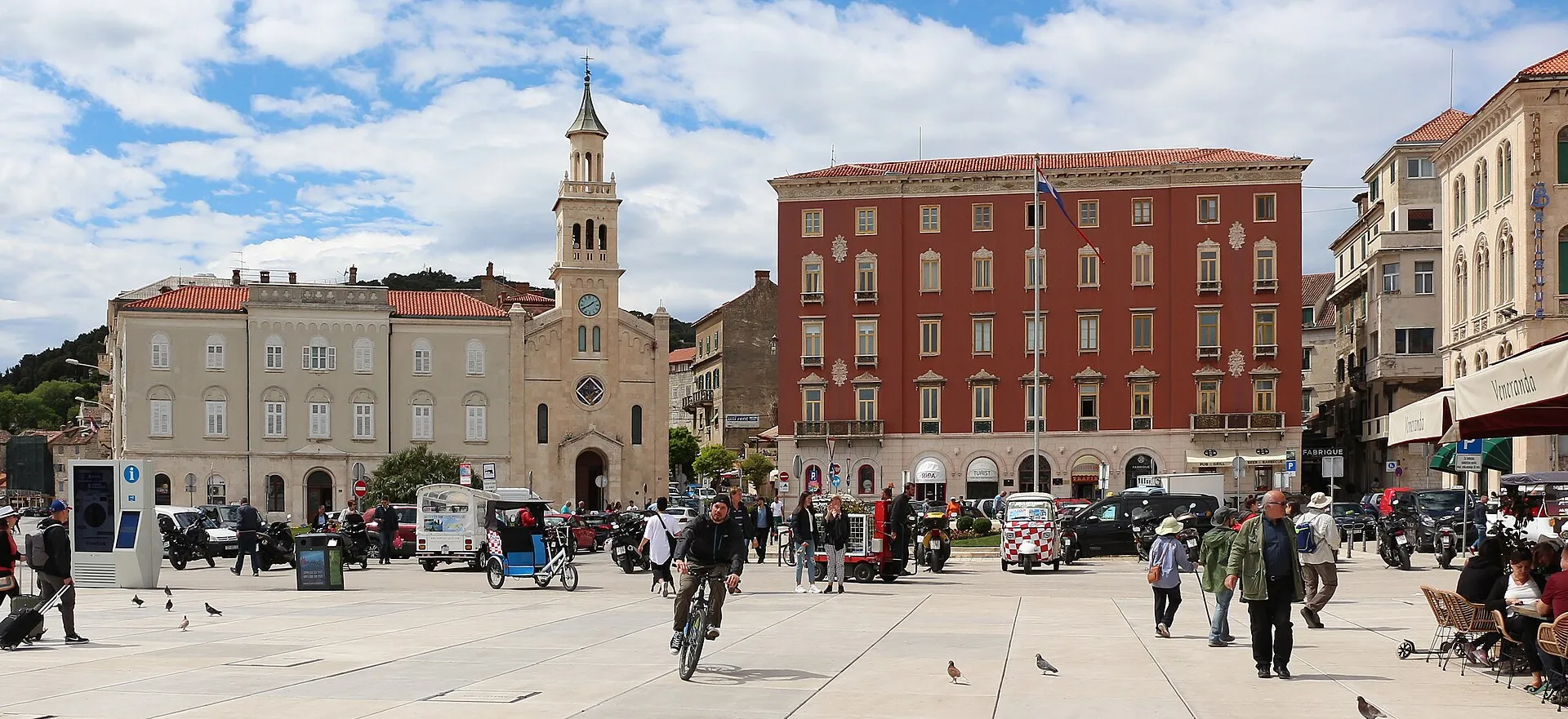
The octagonal Venetian tower (Mletačka kula) on the southern edge of the square was built in 1435 to defend the harbour against Ottoman raids and local rebellions. Across from it is the 17th-century Milesi Palace, a Baroque building with carved stone balconies. In the centre stands Ivan Meštrović’s bronze monument to Marko Marulić (1450–1524), the Split poet and humanist regarded as the father of Croatian literature.
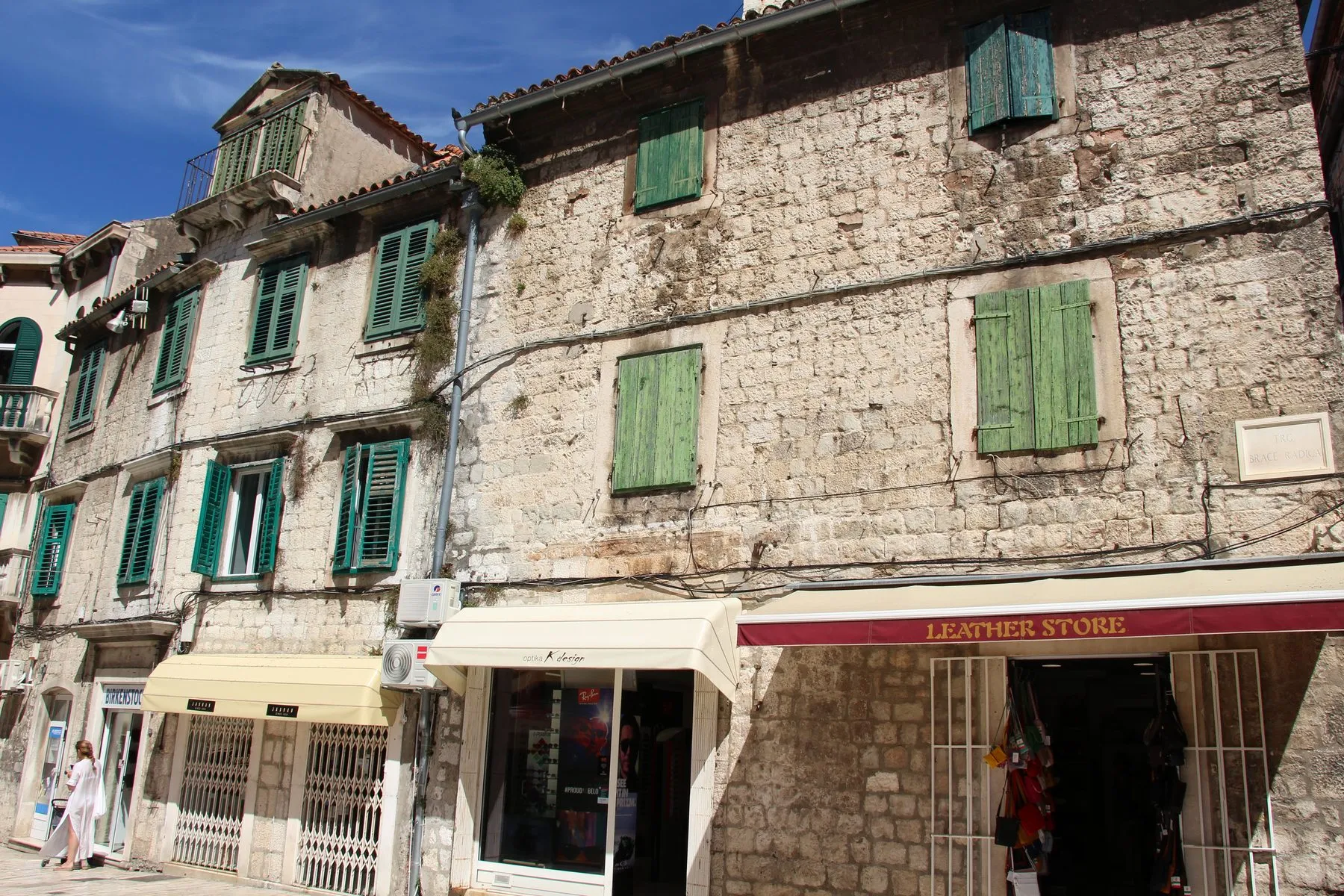 Fruit Square (Trg braće Radić) featuring the 15th-century Venetian tower and Milesi Palace. Photo: Fred Romero, Wikimedia Commons, CC BY 2.0.
3. Pjaca (Narodni trg)
A short walk north along Marulićeva street leads to Narodni trg, known as Pjaca. As the medieval city grew outside Diocletian’s walls, civic life moved west to this square in the 13th century. Pjaca was paved in stone in 1455 and became the political and commercial centre of Venetian Split.
On Pjaca:
- The Old Town Hall (Stara gradska vijećnica): Built in 1443 on the northern side, with pointed Gothic arcade windows and a stone loggia. It holds temporary art and history exhibitions.
- The City Clock Tower: Beside the Iron Gate (Porta Ferrea), with a 24-hour dial of Roman numerals I to XXIV, running since the 15th century.
- Knjižara Morpurgo: A bookshop founded on the western side of Pjaca in 1861 by Vid Morpurgo, which keeps its original dark wooden shopfront and signboards.
4. The Peškarija Fish Market and Marmontova
From Pjaca, take Kralja Tomislava street west to Marmontova, Split’s main shopping street, paved with white Brač limestone. Just off it on Obrov street is the Peškarija, the covered municipal fish market.
Designed in Secession style by the architect Ante Bezić and opened in 1890, the Peškarija sells the morning’s Adriatic catch from marble slabs between 06:30 and 13:00: sea bass, gilthead bream, dentex, red mullet, squid, cuttlefish and sardines. Locals say there are no flies, because the sulphur springs that supply the adjacent municipal bathhouse give off a vapour that repels insects.
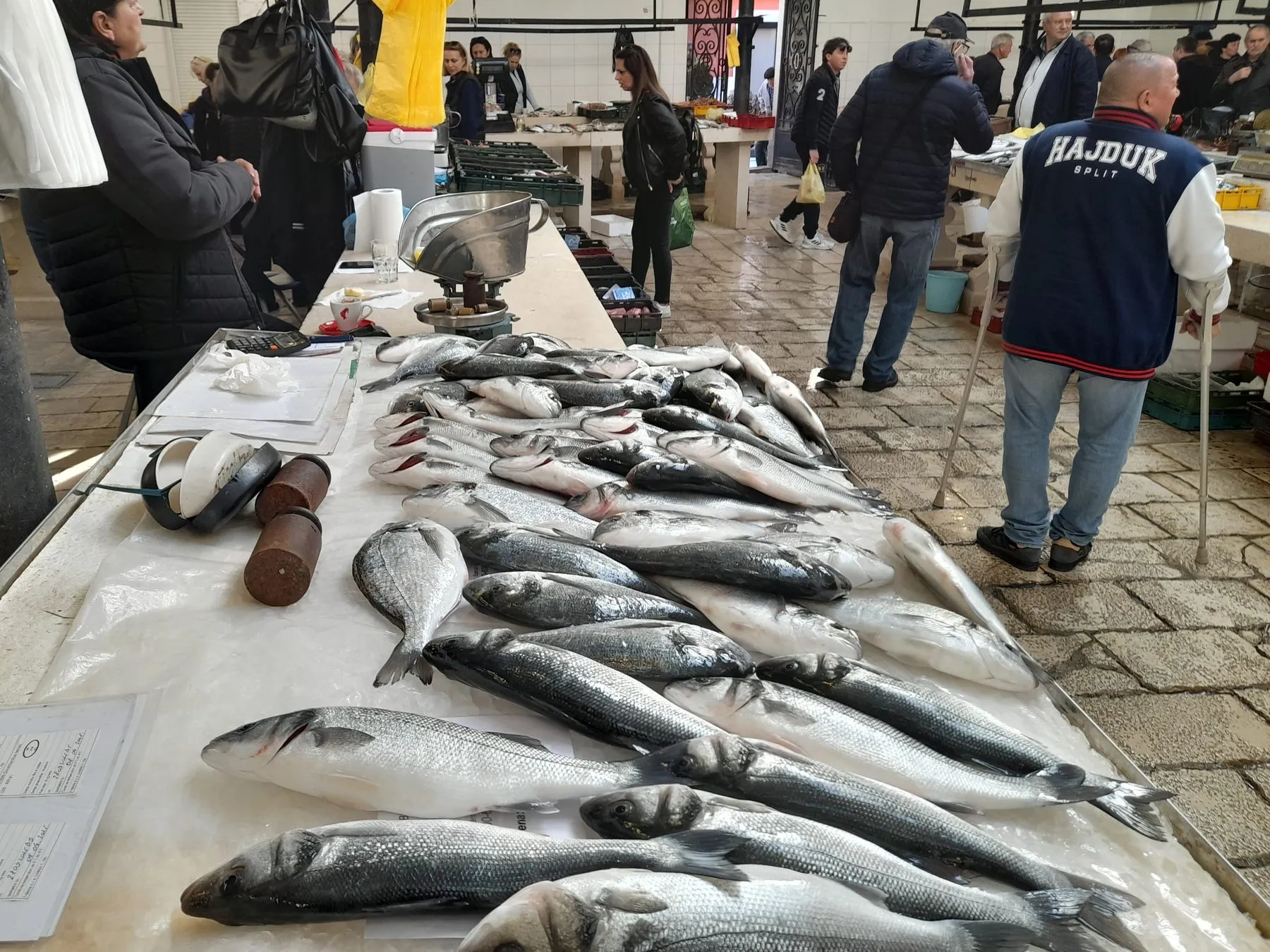 The Secession-style Peškarija fish market on Obrov street. Photo: Argo Navis, Wikimedia Commons, CC BY-SA 4.0.
5. The Prokurative (Republic Square)
Continue south along Marmontova towards the water and turn west into Trg Republike, called the Prokurative. Split’s mayor Antonio Bajamonti conceived it in the mid-19th century. Red neo-Renaissance administrative palaces with arched ground-floor colonnades flank three sides, patterned on the Procuratie around Piazza San Marco in Venice.
The southern side is open to the sea. The arcades now hold restaurants and bars, and the square hosts the Split Music Festival (Splitski festival) every summer.
6. Matejuška and the West Coast Walk of Fame
Go west past the Church and Monastery of St Francis (Sv. Frane), which holds the tombs of Marko Marulić and the 19th-century statesman Ante Trumbić, to reach Matejuška. This small semi-circular stone harbour has sheltered Split’s fishing boats for hundreds of years, with fishing nets, wooden dinghies and stone mooring posts along the quay. In the late afternoon and evening locals and students sit on the outer breakwater with beers and takeaway pizza to watch the sun set behind the Marjan peninsula.
The West Coast (Zapadna obala) is a marina promenade completed in 2012 that runs south from Matejuška. Large bronze plaques set in the white stone walkway honour Split’s Olympic and Paralympic medal winners, including the tennis player Goran Ivanišević, the high jumper Blanka Vlašić, the basketball players Toni Kukoč and Dino Rađa, and water polo champions.
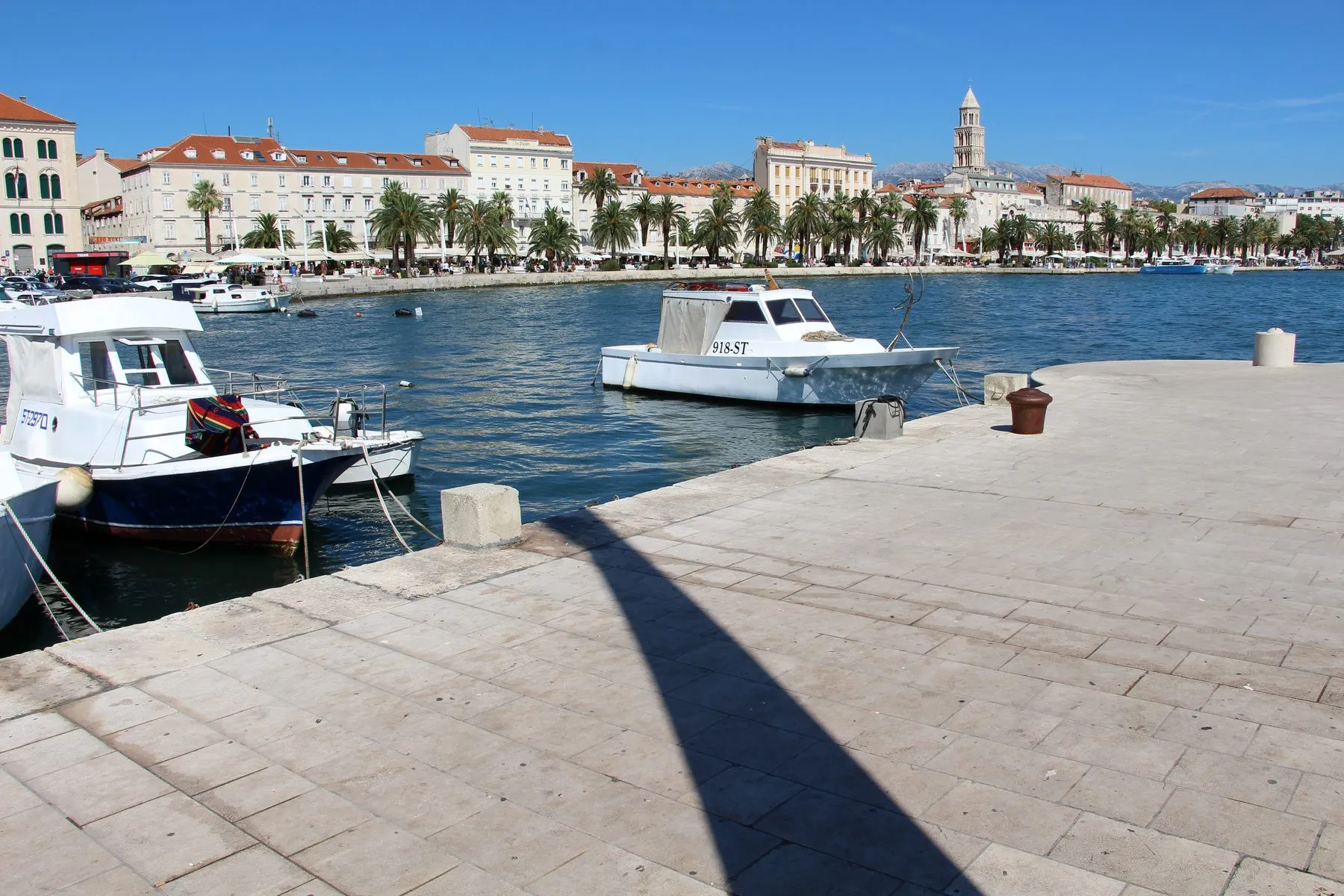 Matejuška fishing port at the western end of the Riva. Photo: Fred Romero, Wikimedia Commons, CC BY 2.0.
Tours and guided walks
A guide points out Roman mason marks and Venetian inscriptions that are easy to miss on your own.
Split: Diocletian’s Palace & Old Town Small Group Tour
From €15 · 4.9 stars from 1,034 reviews · 1.5 - 5.5 hours · free cancellation
Split: Diocletian’s Palace & Old Town Small Group Tourad: A walking tour with a choice of departure times, from the Riva through Fruit Square, Pjaca and the palace gates.
Diocletian’s Palace & Split Old Town Guided Tour – Since 2007
From €15 · 4.8 stars from 868 reviews · 1.5 - 5 hours · free cancellation
Diocletian’s Palace & Split Old Town Guided Tour – Since 2007ad: A 150-minute walk with a local guide through Diocletian’s Palace and the Old Town, Green Market, Riva, Fish Market, Marmontova Street, Prokurative and Varoš.
Split: Diocletian Palace, Marjan Hill Viewpoint & Local Eats
From €29 · 4.9 stars from 81 reviews · 1.5 - 2.5 hours · free cancellation
Split: Diocletian Palace, Marjan Hill Viewpoint & Local Eatsad: A walking tour of the Old Town and waterfront promenade, through Roman passageways, with local legends and an extended option that adds the view from the First Belvedere on Marjan Hill.
Independent stroll vs guided walking tour
| Detail | Independent walk | Small group guided tour (t862564) | Walking and viewpoint tour (t1300436) |
|---|---|---|---|
| Cost | Free | From €15 per person | From €29 per person |
| Duration | 1 to 2 hours, flexible | 1.5 to 5.5 hours | 1.5 to 2.5 hours |
| Route covered | Riva, Fruit Square, Pjaca, Peškarija, Matejuška | Palace core, gates, Riva and Pjaca | Palace, squares and the Marjan viewpoint climb |
| Historical context | Your own reading | Licensed local guide | Guide, with a food tasting option |
Coffee culture and practical advice
Locals call the Riva dnevni boravak Splita (Split’s living room). A coffee (kava) on the waterfront is a social ritual that lasts 45 minutes to two hours.
- Ordering: Ask for an espresso (kava) or a white coffee (kava s mlijekom). Servers bring a glass of tap water with it at no charge, and you can sit as long as you like without ordering more.
- Sun and shade: The Riva faces south into the Brač Channel. In spring, autumn and winter the terraces are in sun all day. In July and August take a table under the pergolas or find shade along Marmontova.
- Toilets: Coin-operated public toilets are at the eastern end of the Riva beside the railway station and near the Matejuška breakwater on the west.
- Cash and card: Waterfront cafes accept contactless cards and phones, but the stalls in the Peškarija need euro cash.
What to see next
- Diocletian’s Palace Cellars Tickets: Ticket prices, opening hours and Roman history of the vaults entered from the Riva.
- Diocletian’s Palace Split Guide: The Peristyle, gates and alleys behind the promenade.
- Marjan Forest Park and Viewpoints: The steps uphill from Veli Varoš to the pine-clad viewpoints over Split.
- Bačvice Beach and Coastal Walks: 10 minutes east around the ferry port to Split’s sandy beach.
- Free Things to Do in Split: The palace, waterfront and hill parks at no cost.
- Where to Eat in Split: Dalmatian konobas and seafood spots in Veli Varoš and Lučac.
Common questions
What is the official name of the Split Riva?
Officially it is Obala Hrvatskog narodnog preporoda (Coast of the Croatian National Revival). Everyone calls it the Riva.
How long is the Split Riva?
About 350 metres along the southern facade of Diocletian's Palace, and further west around the harbour towards Matejuška and the West Coast (Zapadna obala).
Where does the walking route through the old town lead?
From the Bronze Gate on the Riva it passes Fruit Square (Voćni trg), People's Square (Pjaca), the 1890 Peškarija fish market on Obrov, Marmontova street and the neo-Renaissance Prokurative square, and ends at the fishermen's harbour at Matejuška.
Why are there no flies in Split's fish market?
Locals say the Peškarija fish market on Obrov street, built next to the sulphur springs that supply the municipal thermal spa, stays fly-free because the faint sulphur smell repels insects.
Is the Riva close to the bus and ferry terminals?
Yes. The intercity bus terminal, the train station and the ferry port at Gat Sv. Duje sit next to each other at the eastern end of the Riva, less than five minutes' flat walk away.