In this guide
💡 The Short Version: For wine, go to Zinfandel Food & Wine Bistro inside Diocletian’s Palace (over 100 Croatian bottles, 30 by the glass), the Hvar Hills Wine Corner on the West Coast promenade (open daily 10:30–22:00), or the stone-walled Markus Wines tasting room on Marasovića. For craft beer, drink beers from LAB Split (makers of Barba pale ale) and Nova Runda at Sanctuary Bar, Leopold’s Delicatessen Bar and Plan B Pub. Or book a tour: the Split&Sip: Educational Wine Tastingad is led by a certified sommelier and pairs indigenous Dalmatian wines with cheese and olive oil.
⚠️ Book Markus Wines in advance. The tasting room at Marasovića 2 requires online booking, and Zinfandel Bistro recommends booking its tasting flights.
| Style | Grapes | Where they come from |
|---|---|---|
| White: crisp and saline | Pošip | Korčula and Čara |
| Grk | Lumbarda sands | |
| Bogdanuša | Stari Grad Plain | |
| Red: sun-drenched karst | Plavac Mali | Dingač, Postup and Hvar |
| Babić | Primošten stone terraces | |
| Tribidrag / Crljenak | The original Kaštela vine |
| Where to taste in Split | Area |
|---|---|
| Zinfandel Bistro | Palace core |
| Hvar Hills Wine Corner | West Coast |
| Markus Wines Tasting Room | Varoš |
| Sanctuary Bar (craft beer) | Old Town |
| Leopold’s Delicatessen Bar (craft beer) | Tomislava |
| Plan B Pub (craft beer) | Slobode ulica |
The Dalmatian wine heritage and the Zinfandel discovery
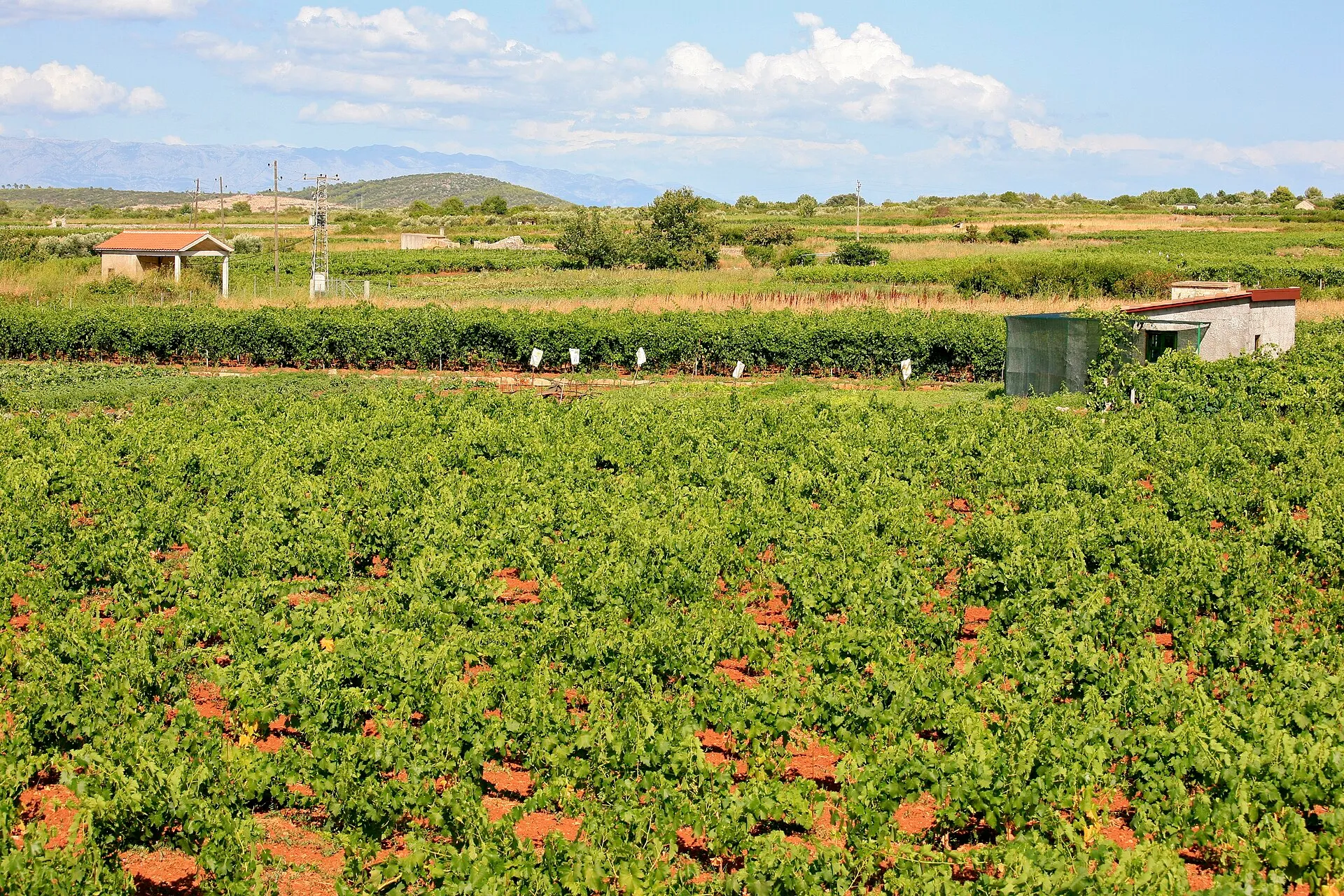
Vines have grown on the central Dalmatian coast for more than 2,400 years, since Greek colonists founded settlements on the islands of Vis (Issa), Hvar (Pharos) and Korčula (Korkyra Melaina) in the 4th century BC. Wine stayed the main crop of the coast under Roman and Venetian rule.
For decades wine historians debated where California’s Zinfandel and southern Italy’s Primitivo came from. In 2001 DNA fingerprinting led by professor Carole Meredith of the University of California, Davis, with the Croatian geneticists Ivan Pejić and Edi Maletić of the University of Zagreb, solved it. Researchers found an old vine in a vineyard in Kaštel Novi, on the bay north-west of Split, whose DNA matched Zinfandel exactly. Known locally as Crljenak Kaštelanski and recorded in 15th-century Dalmatian monastic manuscripts as Tribidrag, the grape proved to be the ancestor of both varieties.
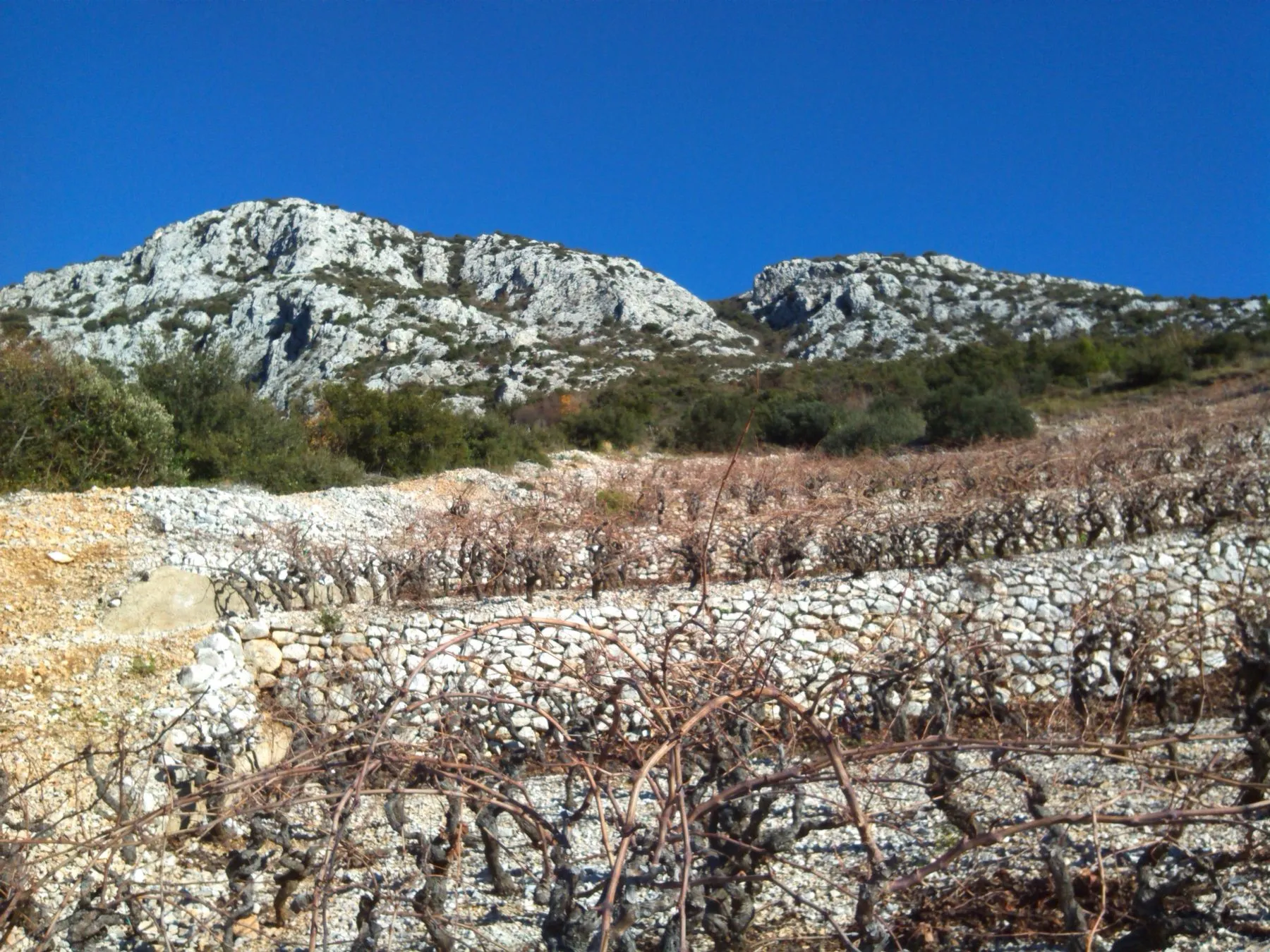 Steep karst vineyards on the southern slopes of Dingač on the Pelješac peninsula. Photo: Quahadi Añtó, Wikimedia Commons, CC BY-SA 3.0.
The native Dalmatian grapes
Dalmatian growers favour native grapes adapted over centuries to dry limestone soil (karst) and strong sun, rather than Cabernet Sauvignon or Chardonnay.
| Grape variety | Style / Region of origin | Flavour profile |
|---|---|---|
| Pošip | Dry white; from Smokvica and Čara on Korčula | Ripe apricot, dried fig, Mediterranean herbs, crisp mineral finish; 13–14% ABV |
| Grk | Aromatic white; grown almost only on the sandy soils of Lumbarda, Korčula | Golden colour, pine resin, ripe pear, salinity; high acidity |
| Bogdanuša | Fresh white; native to the UNESCO-listed Stari Grad Plain on Hvar | Light, floral, citrus blossom, delicate minerality; 11.5–12.5% ABV |
| Plavac Mali | Powerful dry red; grown across the Pelješac peninsula and Hvar | Blackberries, dried plum, carob, dark chocolate, firm tannins |
| Babić | Structured red; grown in drystone pockets around Primošten | Dark cherry, Mediterranean scrub, crushed stone, vivid acidity |
| Tribidrag / Crljenak | Red; the ancestral Zinfandel of Kaštela | Blackberry, black cherry, white pepper, velvety tannins |
Pošip and Grk
Pošip is a white grape of Korčula. It was the first Croatian white wine to receive protected geographical origin status, in 1967. Grown on sunny karst terraces, it gives full-bodied whites with ripe yellow peach and almond notes and brisk acidity.
Grk grows in small plots on the sandy plains of Lumbarda, on Korčula’s eastern tip. The vine has only female functional flowers and cannot self-pollinate, so growers interplant rows of red Plavac Mali for cross-pollination. Grk makes aromatic whites with structure and a saline, savoury finish.
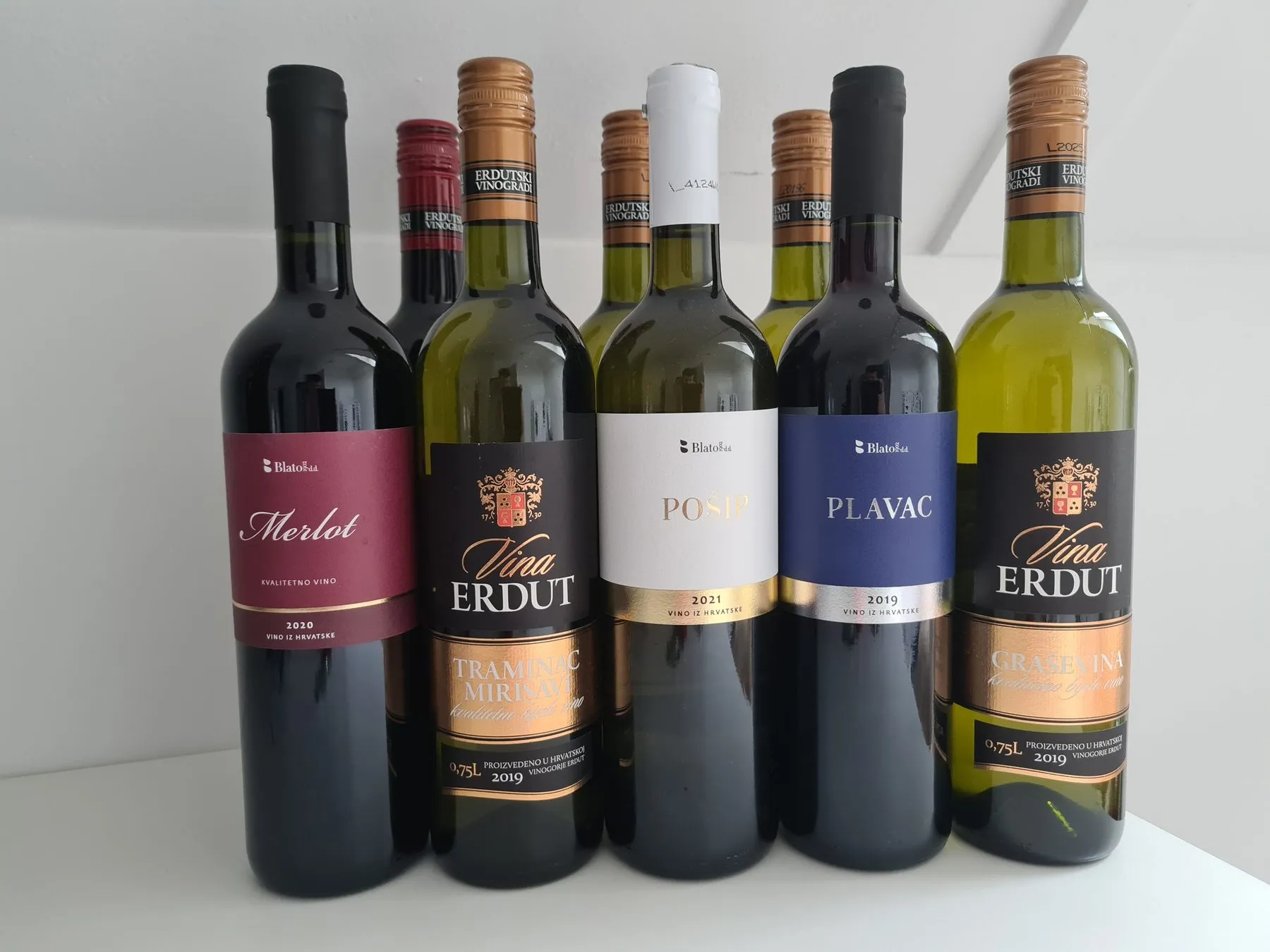 Croatian wines, including Pošip and Plavac. Photo: Cro-Cop, Wikimedia Commons, CC BY-SA 4.0.
Plavac Mali and Babić
Plavac Mali (“Little Blue”, for its small, dark berries) is a natural cross between Tribidrag and Dobričić and the main red grape of central and southern Dalmatia. It thrives in scorching sun, high wind and barren limestone where roots reach deep into rock fissures. The main vineyards are near-vertical slopes dropping into the sea at Dingač and Postup on the Pelješac peninsula, and at Ivan Dolac on the southern shore of Hvar. The wines are full-bodied, often 14.5% to 15.5% ABV, with aromas of dried prunes, dark cherries, leather, sage and carob.
Further north towards Primošten, the Babić grape makes a different red. It is grown in tiny drystone-wall pockets (čipka od kamena, “stone lace”) that stop the topsoil eroding, and has higher acidity than Plavac Mali, with sour cherry, brambleberry and flinty mineral notes.
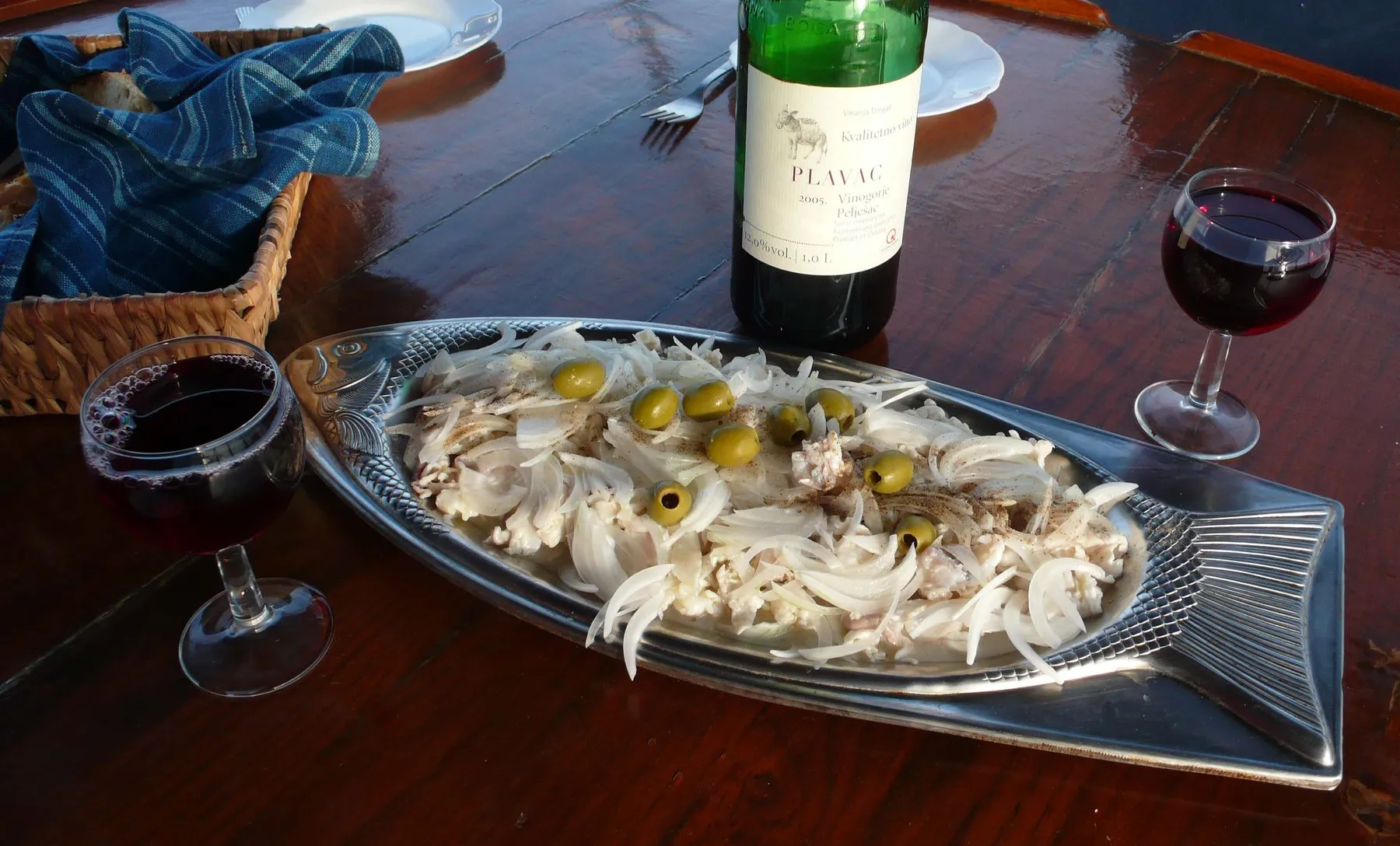 Plavac Mali, a full-bodied Dalmatian red wine. Photo: Sl-Ziga, Wikimedia Commons, Public Domain.
Split’s wine bars
Zinfandel Food & Wine Bistro
Zinfandel Bistro is in the pedestrian core of Diocletian’s Palace on Marulićeva street, named for the grape’s Dalmatian origin. It has a curved stone-and-timber bar and an outdoor terrace beneath Roman masonry. The cellar carries over 100 bottled Croatian wines, with more than 30 by the glass from temperature-controlled dispensers. Tasting flights (three whites or three reds with local cheeses and prosciutto) run from noon to night.
- Address: Marulićeva ulica 2
- Hours: Daily 08:00–23:00
- Reservations: Recommended via website or +385 21 355 135
Hvar Hills Wine Corner
Opened in June 2024 on the West Coast promenade (Zapadna obala) overlooking the harbour, this tasting bar is the Split showroom of the Hvar Hills winery, which farms vineyards at Sveta Nedjelja and Poljica on Hvar. You can taste its Pošip, Bogdanuša and Pharos Maximvs Plavac Mali, with cured ham and cheese to go with them (hvarhills.com).
- Address: Obala kneza Branimira 14A
- Hours: Daily 10:30–22:00
- Reservations: Available via +385 99 306 3584
Markus Wines Tasting Room
Markus Wines opened this tasting room in May 2024, steps from the Marjan stone stairs in Veli Varoš, in a restored stone tavern. The family-owned winery focuses on indigenous grape varieties and says it is the first producer in Split with its own branded tasting room (markuswines.com).
- Address: Marasovića ulica 2
- Reservations: Advance booking required on the winery website
Vinoteka Terra
Vinoteka Terra is the place to buy bottles to take home. It has traded since the 1990s under the wine merchant Edico, just south of the old town near Bačvice, and stocks over 500 Croatian labels, including small-producer bottles from Pelješac and Korčula that rarely reach supermarkets.
- Address: Prilaz braće Kaliterna 6
- Hours: Monday to Friday 09:00–20:00, Saturday 09:00–14:00
Split’s craft beer scene
Croatia’s mainstream beer is pale lager (Ožujsko, Karlovačko). Independent craft brewing began in Zagreb and Split around 2013, and Split now has several microbreweries and taphouses pouring unfiltered, unpasteurised IPAs, stouts, sours and seasonal ales.
Local breweries: LAB Split and Mandrill
- LAB Split Brewery: Established in 2015. The signature beer is Barba, an English-style pale ale (5.4% ABV) brewed with British malt and American hops. LAB also makes Barba Imperial IPA, seasonal oatmeal stouts and summer wheat beers. The brewery is in the northern Kopilica district, and its bottles and kegs are sold in pubs across Split.
- Mandrill Nano-Brewing: A Split nano-brewery making experimental batches, including dry-hopped session ales and fruited sours, sold at independent bars around town.
Craft beer taphouses and pubs
- Sanctuary Bar (Poljana Stare Gimnazije 1): In a courtyard near the Golden Gate. Rotating draught lines from Croatian breweries (including Nova Runda and Zmajska Pivovara), plus a long list of craft cocktails and bourbon.
- Leopold’s Delicatessen Bar (Ulica kralja Tomislava 15): Just outside the northern palace wall, a small bar with eight rotating craft taps and over 50 domestic and Belgian bottled beers.
- Plan B Pub (Slobode ulica 16A): A 10-minute walk east of the palace walls. A modern pub with a large outdoor terrace, burgers and 12 draught taps of Croatian craft beer such as Nova Runda C4 (a 6.1% American IPA) and APA.
- Caffe Bar Basket (Domovinskog rata 42): Open since 1980. A vinyl-playing neighbourhood bar in a retro setting that pours Croatian craft ales on keg.
- The Flag Pub (Domovinskog rata 10): A British-style taphouse with regional craft beers and European stouts.
Tours and tasting experiences
Guided tastings cover regional terroir, food pairing and the history of Dalmatian wine.
Split&Sip: Educational wine tasting
From €55 · 4.9 stars from 94 reviews · 1 - 2 hours · free cancellation
Split&Sip: Educational wine tastingad: A wine tasting in central Split led by a certified sommelier: four regional labels from indigenous Dalmatian grapes, paired with sheep’s cheese, cured prosciutto and local olive oils.
Split: Taste 7 Croatian Wines with Bites from Chops Grill
From €80 · 5 stars from 4 reviews · 2 hours · free cancellation
Split: Taste 7 Croatian Wines with Bites from Chops Grillad: An evening in Old Town Split tasting seven Croatian wines from different wine regions, with bites from the chefs at Chops Grill.
Split’s Ultimate Walking Food Tour with Full Meal & Drinks
From €79 · 4.8 stars from 120 reviews · 3 hours · free cancellation
Split’s Ultimate Walking Food Tour with Full Meal & Drinksad: A guided food and drinks tour through Split’s historic core, with Dalmatian dishes such as cuttlefish risotto (crni rižot), cured ham and chocolate, paired with local wines and liqueurs.
Wine tasting options comparison
| Experience | Sommelier tasting (t660541) | 7-wine tasting (t1372657) | Self-guided bar crawl |
|---|---|---|---|
| Price | From €55 per person | From €80 per person | Pay per glass |
| Wines sampled | 4 regional Dalmatian wines | 7 Croatian wines | Whatever you choose |
| Food included | Cured meats, cheese and olive oil | Bites from Chops Grill | Order bar snacks separately |
| Duration | 1 to 2 hours | 2 hours | Flexible |
Practical advice for wine and beer lovers
- House wine (otvoreno vino): Konobas serve house wine by the carafe (bocun) or by the fraction of a litre: dva deca is 0.2 L and pola litre is 0.5 L. Quality varies; for a serious meal order a bottled Pošip or Plavac Mali with protected geographical origin (ZOI).
- Bevanda and gemišt: In rural Dalmatia some older locals drink bevanda (red wine diluted with tap water) in summer heat. In northern Croatia white wine is mixed with sparkling mineral water to make gemišt. Wine bars serve wine undiluted.
- Tipping: Leave 5% to 10% in cash in wine bars and pubs if you are served at the table, rounded up to the next euro.
- Getting home: The centre inside Diocletian’s walls is pedestrian. If you are staying outside it, Promet Split night buses, Bolt and Uber serve the perimeter roads (Zagrebačka and Trg Republike).
What to see next
- Where to Eat in Split: Konobas, seafood taverns and market bistros to pair with Dalmatian wine.
- Hvar Island Day Trip from Split: The island of Hvar and the Stari Grad Plain vineyards.
- Brač Island and Bol Day Trip: The Stina winery on the Bol waterfront, known for Pošip and Plavac Mali.
- Where to Stay in Split: Neighbourhoods near wine bars and evening dining.
- Diocletian’s Palace Split Guide: The Roman core around the palace wine bars.
Common questions
Is California Zinfandel actually from Dalmatia?
Yes. In 2001, DNA profiling led by the University of California, Davis, showed that California Zinfandel and Italian Primitivo are identical to Crljenak Kaštelanski (historically also called Tribidrag), a red grape grown for centuries in Kaštela, on the bay north-west of Split.
Which native Dalmatian grape varieties should you know?
The native whites are Pošip (crisp, mineral, stone fruit, from Korčula), Grk (saline and aromatic, from Lumbarda) and Bogdanuša (light and floral, from Hvar). The main native red is Plavac Mali (high-tannin, with blackberry and fig notes), alongside Babić (mineral, from Primošten) and Tribidrag (Crljenak Kaštelanski).
Where can you sample Croatian craft beer in Split?
Sanctuary Bar near the Golden Gate, Leopold's Delicatessen Bar on Kralja Tomislava, Plan B Pub on Slobode ulica and Caffe Bar Basket on Domovinskog rata all pour Croatian craft beer from breweries such as Nova Runda, Zmajska Pivovara and Split's own LAB.
Do you need advance reservations for wine tastings in Split?
Yes for Markus Wines, which requires advance booking on its website, and Zinfandel Food & Wine Bistro recommends booking by website or phone. Book ahead from June to September.