In this guide
💡 The Short Version: The Temple of Jupiter is a Roman temple in Diocletian’s palace, which the Split City Museum dates to 295 to 305 (Split City Museum), and is now the Baptistery of St John. The ticket is €3, or it comes in the combined tickets with the cathedral (€9 with the crypt, €15 for everything). Look for the headless sphinx at the door, the coffered barrel vault, and Ivan Meštrović’s statue of John the Baptist (Split Tourist Board). It is on the Peristyle in Diocletian’s Palace. Or book a tour: Diocletian’s Palace - Split Old Town Guided SMALL GROUP Tourad (from €15, 4.9 stars from 5,865 reviews) walks past the temple and explains the sphinx and the Peristyle, so you know what you are paying €3 to enter.
⚠️ The baptistery is priced separately. It is €3 on its own, or part of a combined ticket with the cathedral: the cathedral alone is €5.
Tickets
| Ticket | Price |
|---|---|
| Baptistery (the former Temple of Jupiter) | €3 |
| Crypt | €3 |
| Cathedral, crypt and baptistery | €9 |
| Everything except the crypt | €13 |
| Everything | €15 |
The exterior, the sphinx and the street beside the temple cost nothing: the paid part is the interior (Split Tourist Board). The cathedral next door has its own page with the full price list and the bell tower (cathedral and bell tower).
Tours and the temple
A guide explains why a Roman temple sits beside a cathedral that was once a mausoleum. You buy the temple ticket at the door, so a tour adds the story, not the entry.
Palace and Old Town walk
From €15 · 4.9 stars from 5,865 reviews · 1.5 to 5 hours · private option available
Diocletian’s Palace - Split Old Town Guided SMALL GROUP Tourad: a local guide covers the palace, the cathedral and the Riva. The listing offers a private option and can be booked up to 30 minutes ahead.
Walking tour of the palace
From €21 · 5 stars from 43 reviews · 1.5 hours · free cancellation
Split: Walking Tour of Diocletian’s Palacead: a 90-minute walk of the palace, bookable five hours ahead.
Palace and Old Town small group
From €15 · 4.9 stars from 1,034 reviews · 1.5 to 5.5 hours · free cancellation
Split: Diocletian’s Palace & Old Town Small Group Tourad: a small-group walk with a private option, booked at least 10 hours ahead.
The temple
The Tourist Board describes a rectangular temple on a raised podium with a six-column porch in front, dedicated to the cult of Jupiter. The Scottish architect Robert Adam considered it one of the most beautiful monuments in Europe. The embossed images on its portal and the coffered barrel vault inside influenced the early Renaissance architecture of Andrija Alessi and Nikola Firentinac in Trogir (Split Tourist Board). Coffered means the vault is cut into sunken square panels, and the panels are the first thing to look at when you step inside.
The temple stands by the Peristyle, the ceremonial square where, the Tourist Board says, Diocletian was known as the living son of Jupiter (Peristyle).
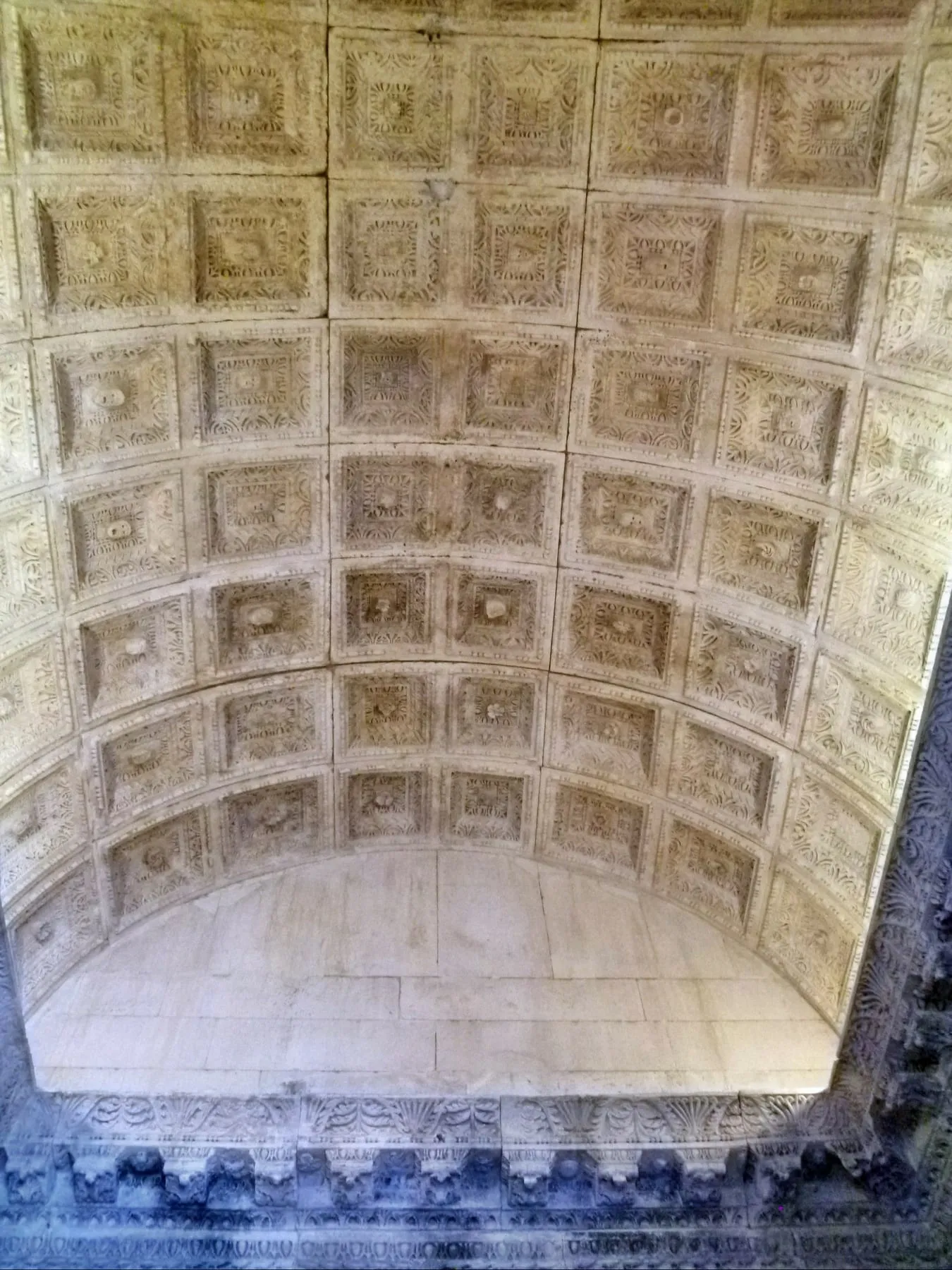
The coffered ceiling. Photo: Gaius Cornelius, Wikimedia Commons, CC BY-SA 4.0.
The baptistery
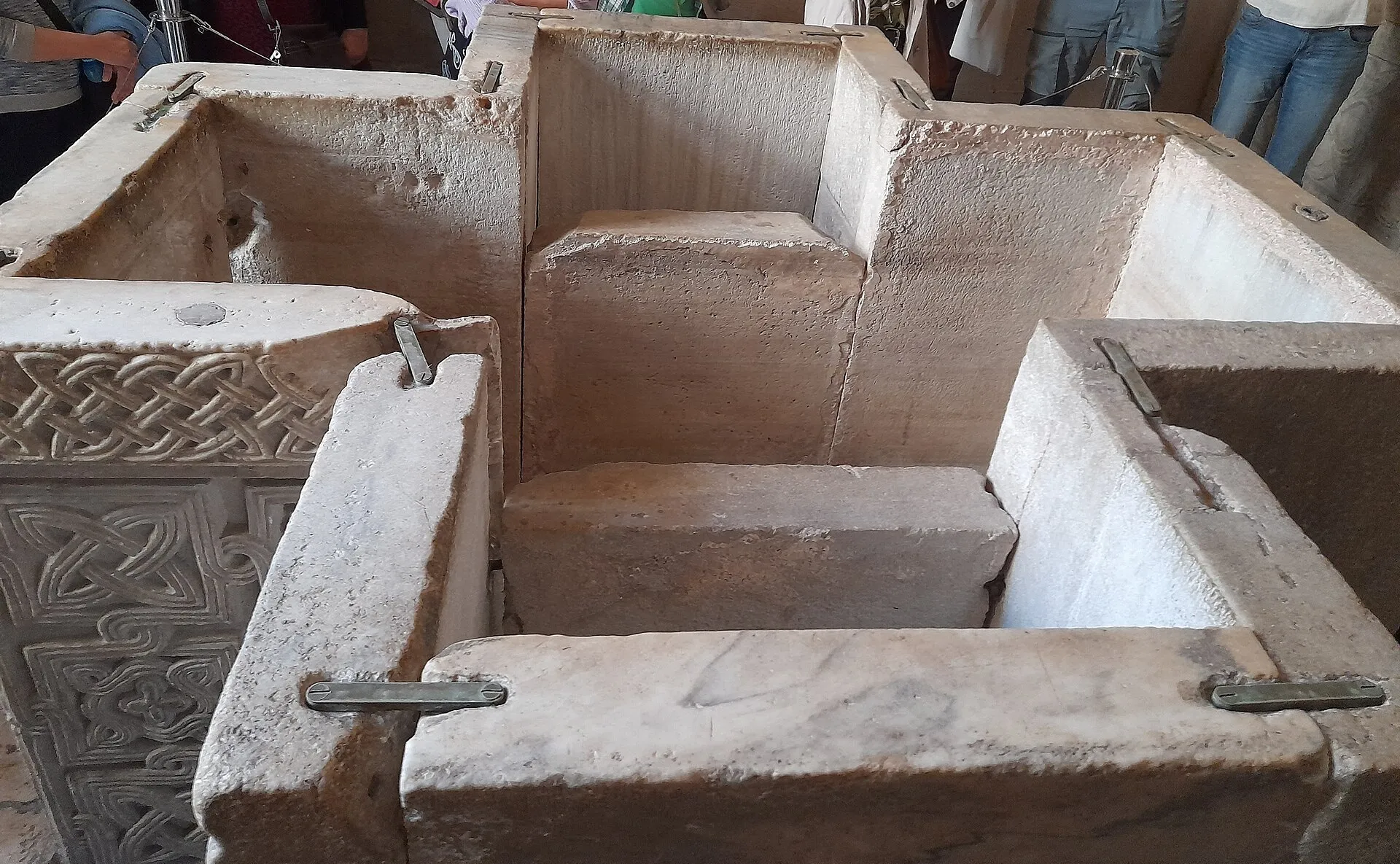
In late antiquity the temple became a baptistery, named for St John the Baptist, and a crypt dedicated to St Thomas was built under it. At the start of the 13th century a baptismal font was made from an altar screen of the 11th century that had stood in the cathedral. One of its panels shows a Croatian king, Petar Krešimir IV or Zvonimir, which the Tourist Board calls the earliest presentation of a European king on a medieval stone sculpture (Split Tourist Board).
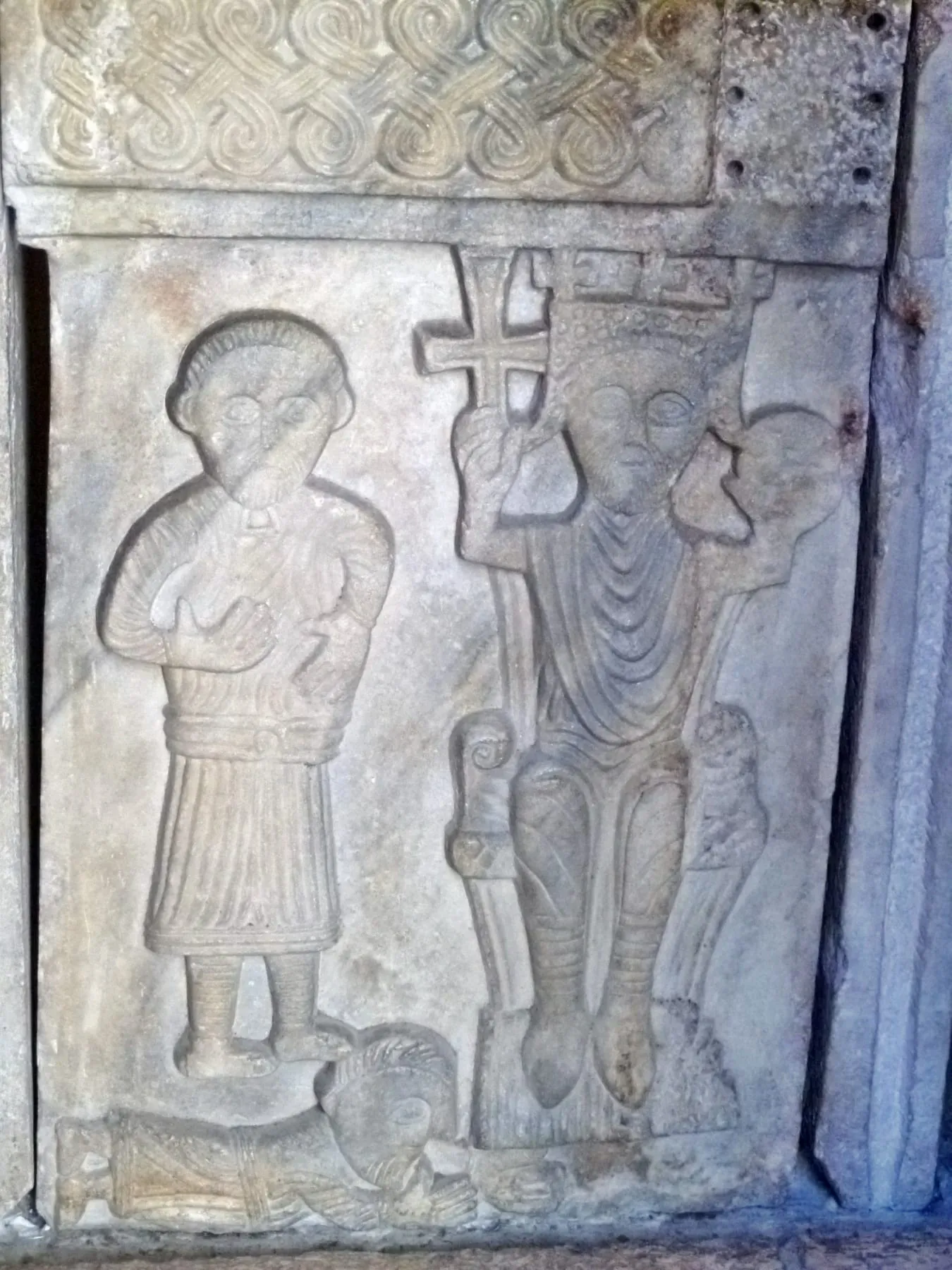
The king on the baptismal font. Photo: JoJan, Wikimedia Commons, CC BY 3.0.
The baptistery is dominated by a Secession statue of St John the Baptist by Ivan Meštrović. The Meštrović Museums’ biography lists a bronze St John the Baptist for the interior of the Split baptistery among his work of the early 1950s, the years he lived in the United States (Meštrović Museums). He is the sculptor of the Gregory of Nin statue at the Golden Gate and of the works in the Meštrović Gallery.
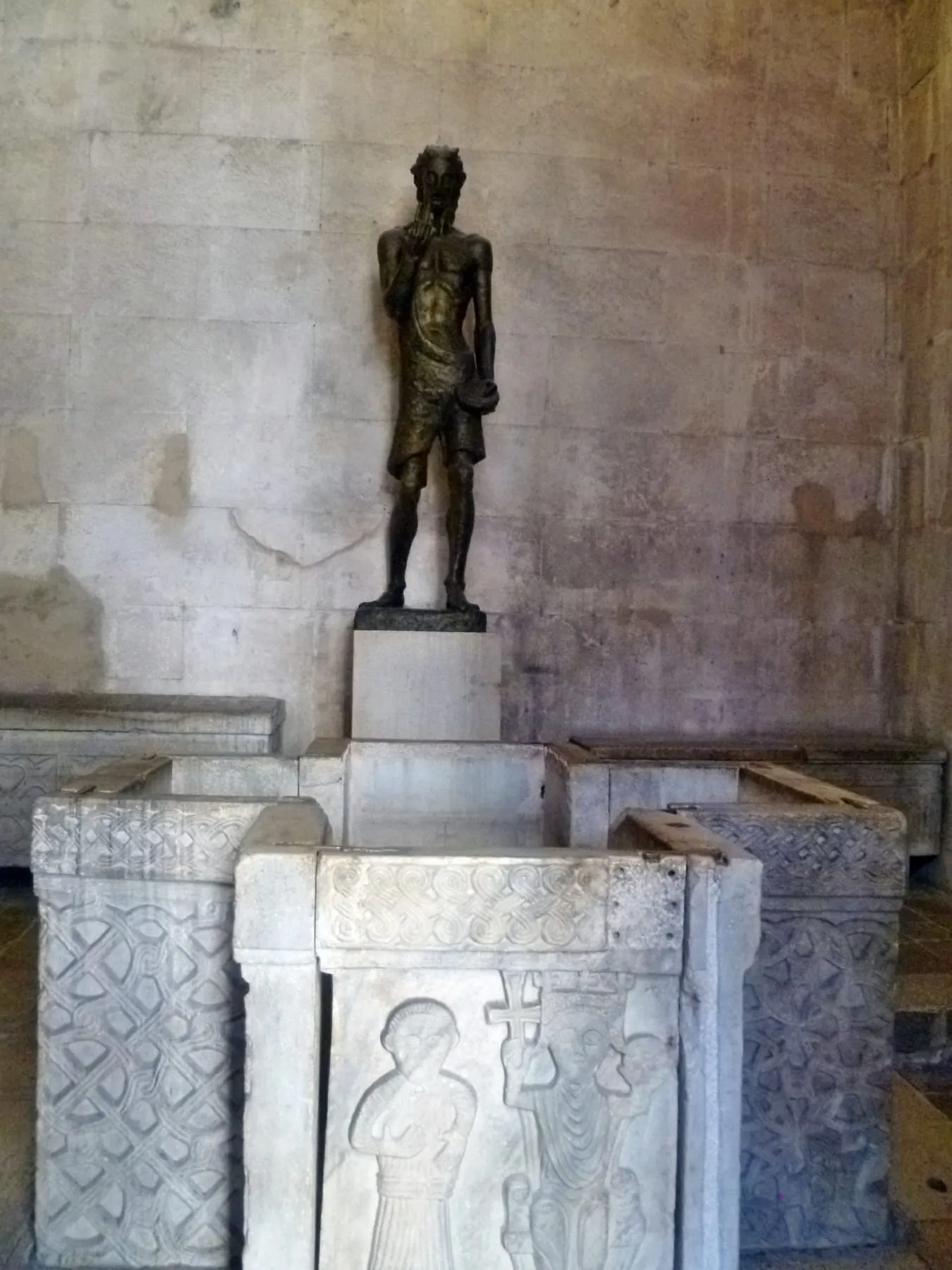
The bronze St John above the font. Photo: JoJan, Wikimedia Commons, CC BY 3.0.
The sphinx
Diocletian brought granite sphinxes from Egypt to decorate the palace, and the Tourist Board says several survive, whole or in part. One is placed in front of the temple. The Peristyle has another, which the Tourist Board calls 3,500 years old and perfectly preserved (Split Tourist Board).
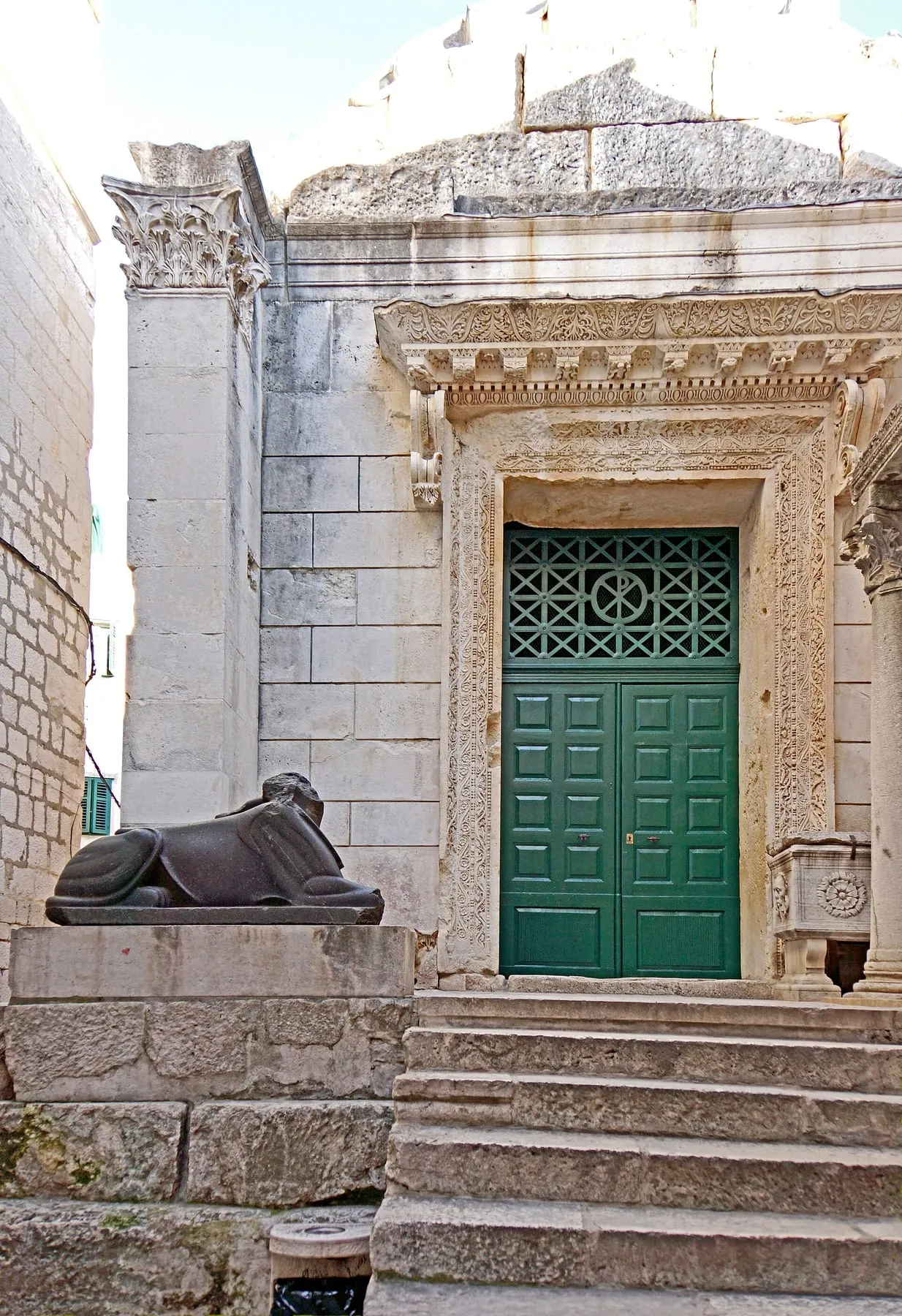
The headless sphinx at the temple door. Photo: Dennis G. Jarvis, Wikimedia Commons, CC BY-SA 2.0.
Let Me Pass
The Tourist Board’s route for a day in Split passes the narrowest street in the city, called Let Me Pass, right next to the Temple of Jupiter (Split in 1 day). It costs nothing to walk.
Around the Peristyle
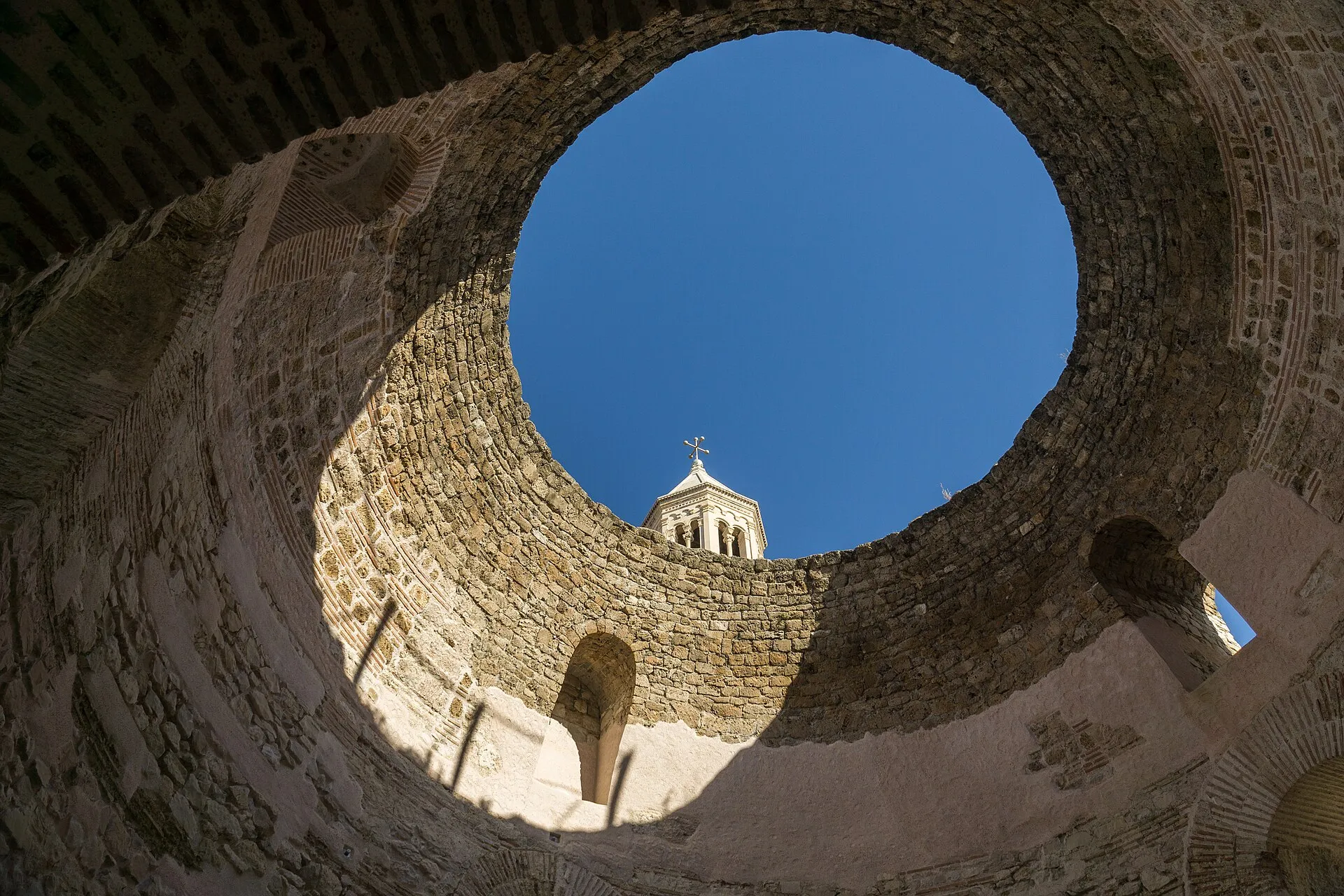
The Peristyle’s columns are red granite, a colour the Tourist Board links to the imperial purple. Its west side is lined with the palaces of the Split noble families Grisogono, Cipci and Skočibušić, which lean on the original columns and arches, and the steps round the square are where people sit with a coffee. The Tourist Board also notes the unusual acoustics, which make the square a stage for opera and ancient drama (Peristyle). The Vestibule, rectangular outside and circular inside, is the entrance to the former residential part of the palace, directly south of the square (Vestibule).
Where it fits
The temple and the cathedral are both on the Peristyle, so visit them together, and the cellars begin a few steps south through the Vestibule. UNESCO lists the whole historic core of Split, with the Palace of Diocletian, as a World Heritage property inscribed in 1979 (UNESCO).
What to see next
- Split cathedral and bell tower: across the Peristyle, in Diocletian’s mausoleum.
- Diocletian’s Palace guide: the gates, the Peristyle and the Vestibule.
- Diocletian’s Palace cellars: €10, below the emperor’s apartments.
- Ivan Meštrović Gallery: more of the sculptor’s work.
- Archaeological Museum: stone finds from Salona, the Roman city that stood on the road from the palace’s north gate.
- Free things to do in Split: the squares and gates around the temple.
Common questions
How much is a ticket to the Temple of Jupiter?
€3 for the baptistery, which is the former Temple of Jupiter. A ticket for the cathedral, crypt and baptistery together is €9, and one for everything is €15.
What is inside the baptistery?
A bronze statue of St John the Baptist by Ivan Meštrović and a baptismal font from the 13th century, made from an 11th-century altar screen. Under the building is a crypt dedicated to St Thomas (Split Tourist Board).
Where does the sphinx come from?
The Split Tourist Board says Diocletian brought granite sphinxes from Egypt, and that one of those that survive, whole or in part, stands in front of the temple. Another, said to be 3,500 years old, is on the Peristyle.
What is the building's other name?
The Baptistery of St John, after the church it became in late antiquity.
Where is the narrowest street in Split?
Next to the Temple of Jupiter. The Tourist Board of Split calls the street Let Me Pass.