In this guide
💡 The Short Version: Trogir is a medieval island town 28 km west of Split, a UNESCO World Heritage site since 1997 (UNESCO list). It is 50 minutes away on Promet Split bus line 37 (€2.50 in the app, €5.00 from the driver) or on the summer Bura Line ferry (€6–€8), and the old town fills an island 500 by 250 metres. Kamerlengo Fortress is €5 and the Cathedral of St Lawrence complex is €8 (Trogir Tourist Board). Or book a tour: Trogir: City Highlights Guided Walking Tourad (from €12, 4.9 stars from 326 reviews) is a 90-minute historical walk, and you can combine Trogir with the islands on From Split: Half-day Trogir Tour & Speedboat to Blue Lagoonad (from €69, 4.9 stars from 168 reviews).
⚠️ The cathedral complex closes to tourist sightseeing on Sunday mornings. On a Sunday you cannot see Master Radovan’s portal, the Renaissance chapel or the bell tower. Go on a Saturday.
Admission fees and opening hours
Prices and hours are from the Trogir Tourist Board (visittrogir.hr) and the Parish of St Lawrence.
| Heritage site | Standard adult | Concession / Child | Operating hours | Highlights included |
|---|---|---|---|---|
| Cathedral of St Lawrence complex | €8 | €4 (children 7–18, students) | Mon–Sat 08:00–18:00 (winter to 16:00); closed Sun AM | Radovan’s portal, bell tower climb, baptistery, Renaissance chapel |
| Kamerlengo Fortress | €5 | €2.50 (students & under 18) | Daily; Jun–Aug 09:00–22:00, May and Sep 09:00–20:00, Apr, Oct and Nov 10:00–18:00 | Ramparts, corner towers, open courtyard |
| Trogir Town Museum (Garagnin Palace) | €4 | €3 (children, students, seniors) | Mon–Fri 10:00–14:00 (Oct–May); Mon–Sat 09:00–19:00 (Jun–Sep) | Archaeological artifacts, library, lapidarium |
| Benedictine Monastery of St Nicholas | €4 | €2 (children) | Mon–Sat 09:00–12:30, 15:00–18:00; closed Sun | 4th-century BC Greek Kairos marble relief, sacred art |
Tickets for the cathedral are sold at the Sacred Art Collection office opposite the main portal. The last entry for the bell tower climb is 30 minutes before closing.
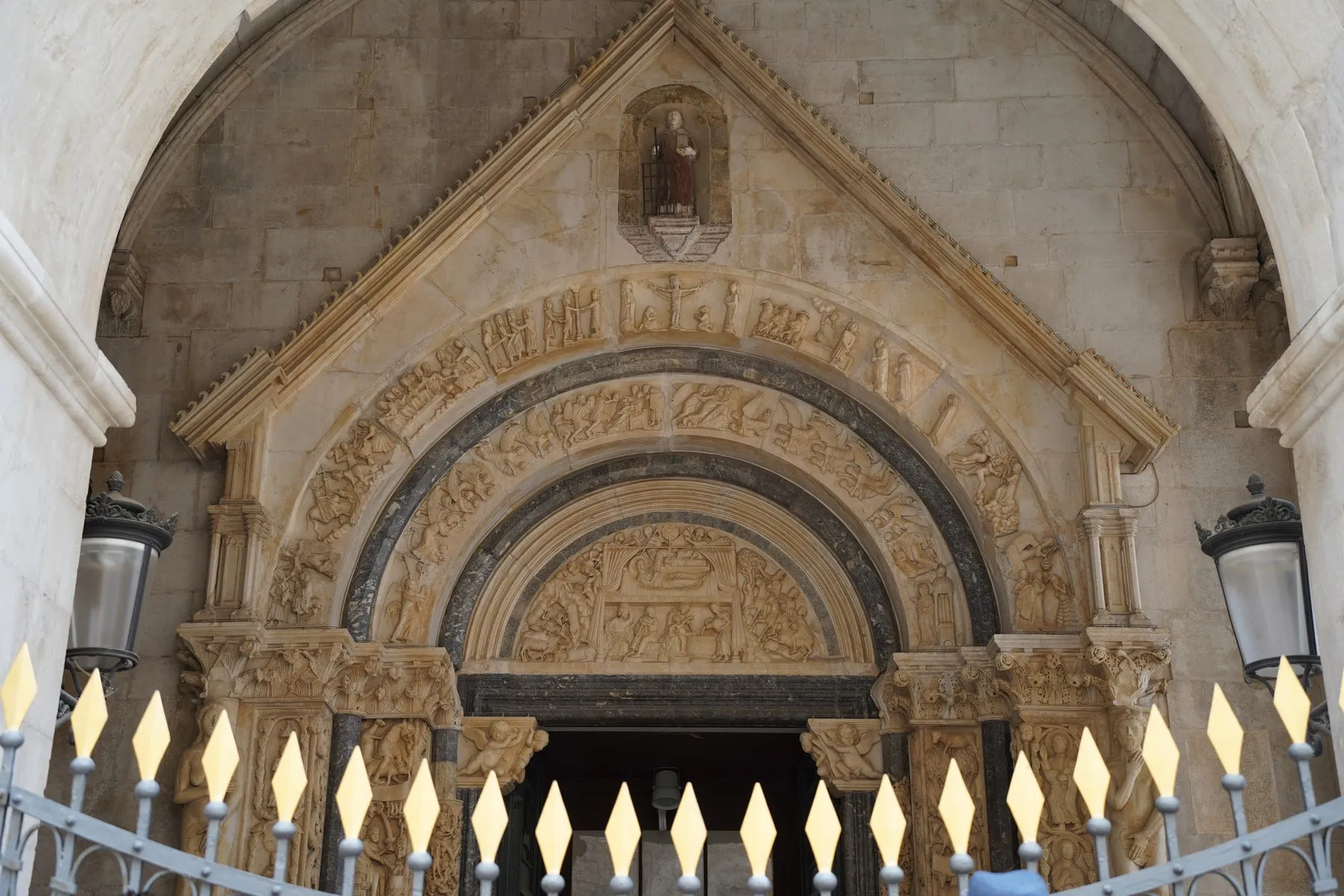
Master Radovan’s 13th-century carved portal at the cathedral. Photo: TimeTravelRome, Wikimedia Commons, CC BY 2.0.
Tours of Trogir
A guided walk explains the Romanesque masonry, Venetian civic palaces and Renaissance carving packed into the town’s lanes.
City highlights guided walking tour
From €12 · 4.9 stars from 326 reviews · 1.5 hours · free cancellation
Trogir: City Highlights Guided Walking Tourad: A walking tour of Trogir with a local guide, past the town’s UNESCO World Heritage monuments.
Old Town walking tour with a resident guide
From €15 · 4.9 stars from 41 reviews · 1.5 hours · free cancellation
Trogir: Old Town Walking Tour with Local Guidead: A walking tour of Trogir’s UNESCO Old Town with a guide who lives there, covering the landmarks, the narrow streets and the town’s history.
Half-day Trogir & Blue Lagoon speedboat trip
From €69 · 4.9 stars from 168 reviews · 5 hours · free cancellation
From Split: Half-day Trogir Tour & Speedboat to Blue Lagoonad: A speedboat tour to Šolta Island, the Blue Lagoon at Drvenik Veli and the old town of Trogir, with swimming and snorkelling, run by a local crew.
Getting there from Split
Trogir is 28 km west of Split, between the mainland and the island of Čiovo.
1. By Promet Split bus 37
Local bus line 37 is run by Promet Split (Promet line 37 timetable).
- Departure point in Split: Sukoišan bus terminal (Lička ulica), 1 km north of Diocletian’s Palace (a 12-minute walk from the Golden Gate).
- Route: along the Kaštela coastal highway, with a stop on the main road outside Split Airport, ending at Trogir Bus Station (Autobusni kolodvor Trogir).
- Frequency: every 20 minutes on weekdays and every 30 minutes at weekends, between 04:00 and 00:00.
- Duration: 50 to 55 minutes from Split to Trogir; 10 minutes from the airport.
- Fares: a single costs €2.50 in the Promet app or €5.00 in cash from the driver.
Trogir bus station is on the mainland opposite the island old town. Cross the short stone bridge (Mali most) and you reach the town gate in 2 minutes.
2. By Bura Line passenger ferry (May to October)
From mid-May to mid-October Bura Line runs passenger catamarans linking Split, Slatine (Čiovo) and Trogir (Bura Line).
- Split departure: the western end of the harbour quay near the Riva.
- Trogir arrival: the southern quayside promenade (Trogirska riva) beside Kamerlengo Fortress.
- Duration and fare: 60 minutes; a one-way adult fare is €6.00 to €8.00. The route passes the Marjan peninsula and Kaštela Bay.
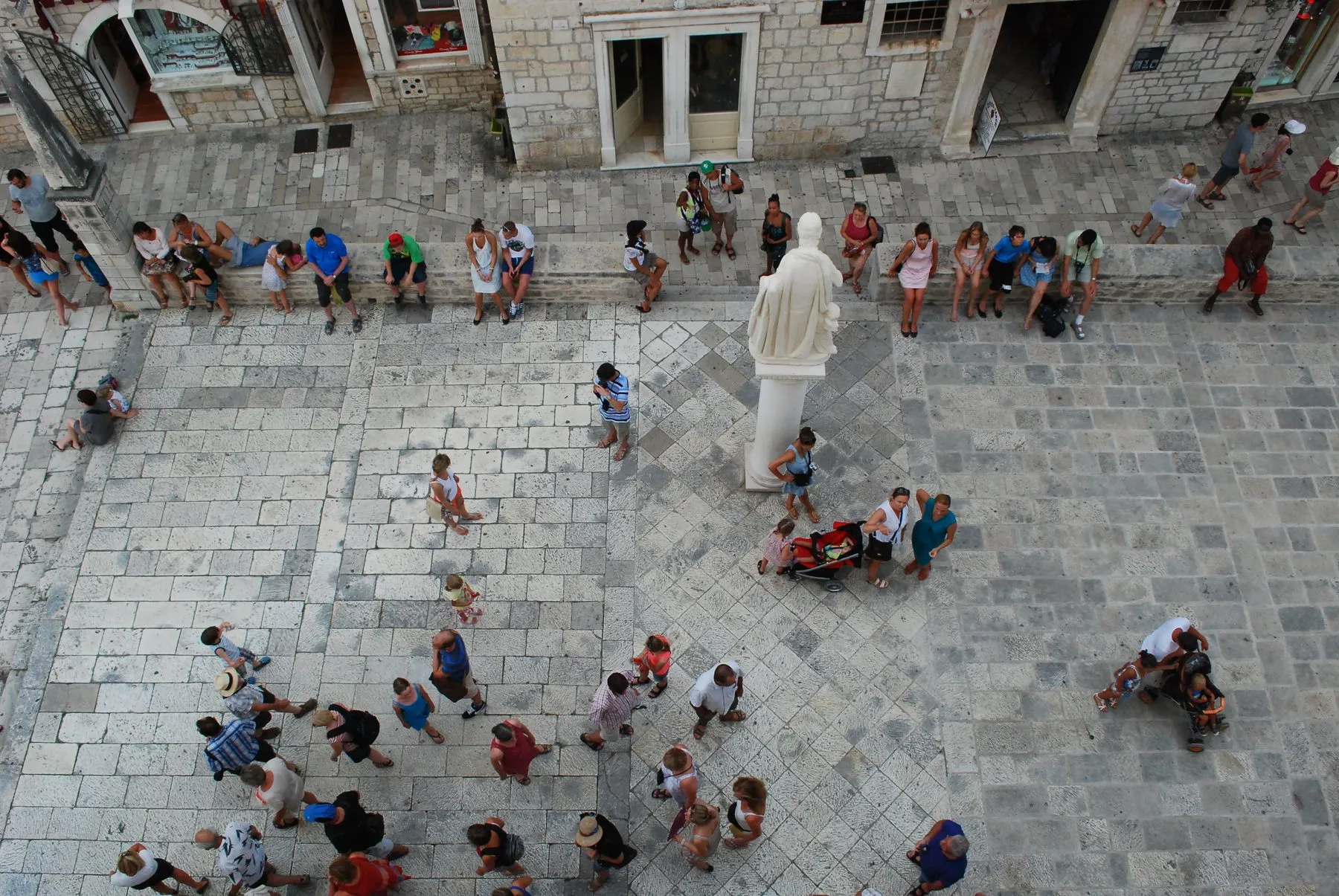
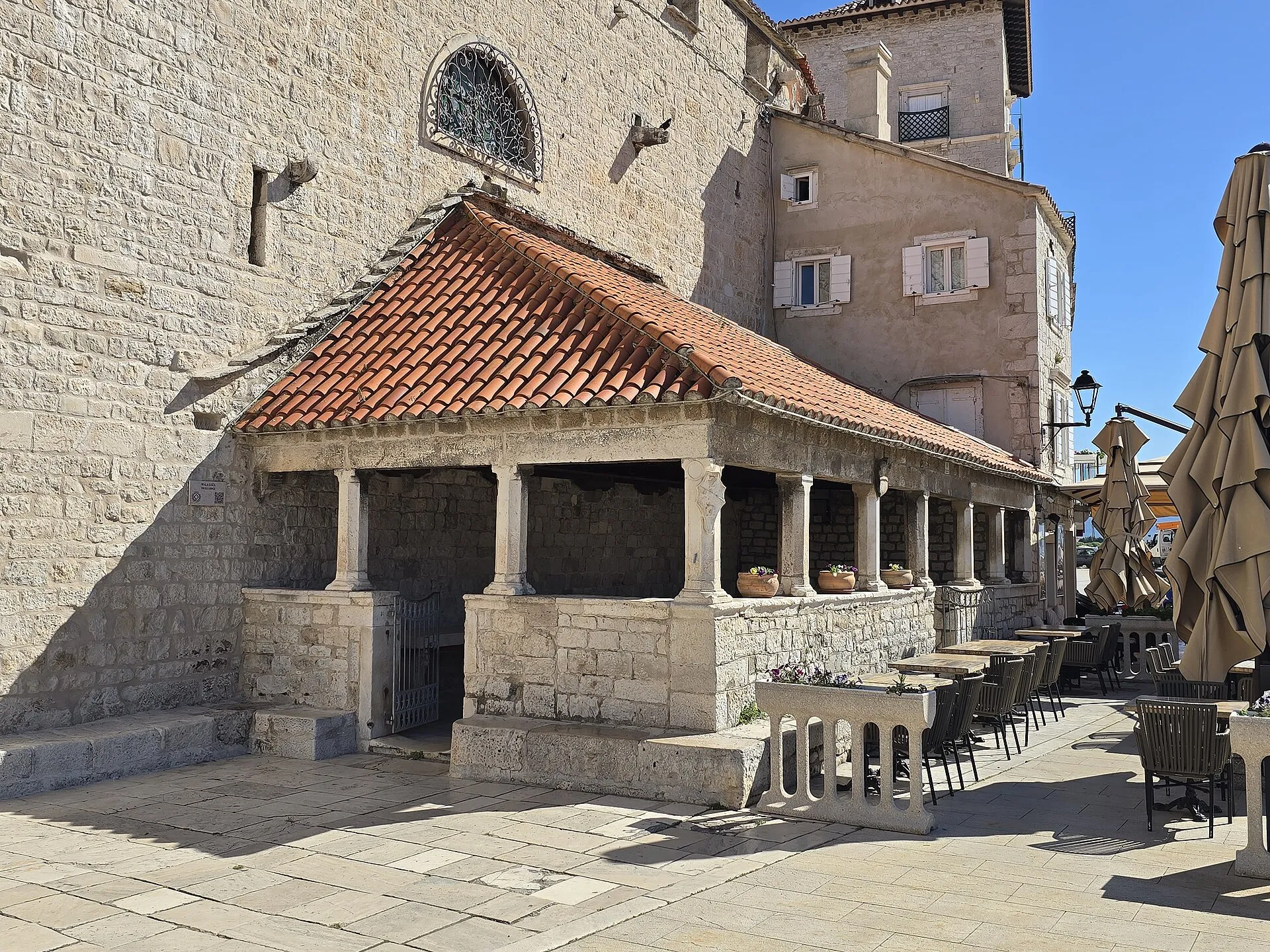
The Town Loggia and Clock Tower on John Paul II Square. Photo: Kris Sliver, Wikimedia Commons, CC BY-SA 3.0.
Independent travel vs guided tour
| Travel style | Travel expense | Admissions | Total per adult | Logistics summary |
|---|---|---|---|---|
| Independent bus (line 37) | €5 round trip (app) | €13 (Cathedral + Kamerlengo) | €18 | Set your own schedule, departures every 20 minutes |
| Independent ferry (summer) | €12–€16 round trip | €13 | €25–€29 | Sea route, lands beside the fortress |
| Walking tour with local guide | €5 bus fare + €12 tour | €13 admissions | €30 | Guide explains the stone carvings and town history |
| Speedboat tour with Blue Lagoon | From €69 tour | Included or free time | From €69 | Island swimming and snorkelling plus a Trogir walking stop |
Exploring Trogir Old Town
Trogir’s historic centre is separated from the mainland by a narrow canal spanned by a stone bridge, and from the larger island of Čiovo by a bascule bridge across the Trogir Channel.
The Cathedral of Saint Lawrence (Katedrala sv. Lovre)
Construction of the cathedral began in 1213 on the foundations of an early Christian basilica destroyed by Saracen raiders, and ran for nearly four centuries until 1598, so the building mixes Romanesque, Gothic and Renaissance elements.
- Radovan’s Portal (1240): the main west entrance, signed by Master Radovan in 1240. It shows the Nativity of Christ, the labours of the twelve months, hunting scenes, and Adam and Eve standing on lions.
- Chapel of Blessed John of Trogir: built between 1468 and 1497 by Nikola Firentinac (Niccolò di Giovanni Fiorentino) and Andrija Alessi. It has a coffered ceiling with sculpted seraph heads in square panels, marble niches with life-sized apostle statues, and a sarcophagus holding the town’s patron saint.
- The Bell Tower: 47 metres tall, with a Romanesque first level, a Gothic second level with pierced tracery, and a Renaissance third level crowned by four statues by Alessandro Vittoria. The climb up narrow stone and metal stairs ends in views over the terracotta rooftops, Kamerlengo and the channel.
John Paul II Square (Trg Ivana Pavla II)
The main civic square sits at the intersection of the ancient Greek cardo and decumanus. Surrounding the square:
- The Town Loggia (Gradska lođa): an open stone pavilion built in the 14th century as a public court of justice. The rear wall features a large stone relief of Justice sculpted by Nikola Firentinac in 1471, alongside a 20th-century relief by Ivan Meštrović commemorating Petar Berislavić, Ban of Croatia.
- The Clock Tower: attached to the Loggia, originally part of the 15th-century Church of Saint Sebastian.
- The Town Hall (Knežev dvor / Rector’s Palace): a 13th-century Gothic palace with a central stone courtyard and carved exterior staircase displaying Venetian heraldic coats of arms.
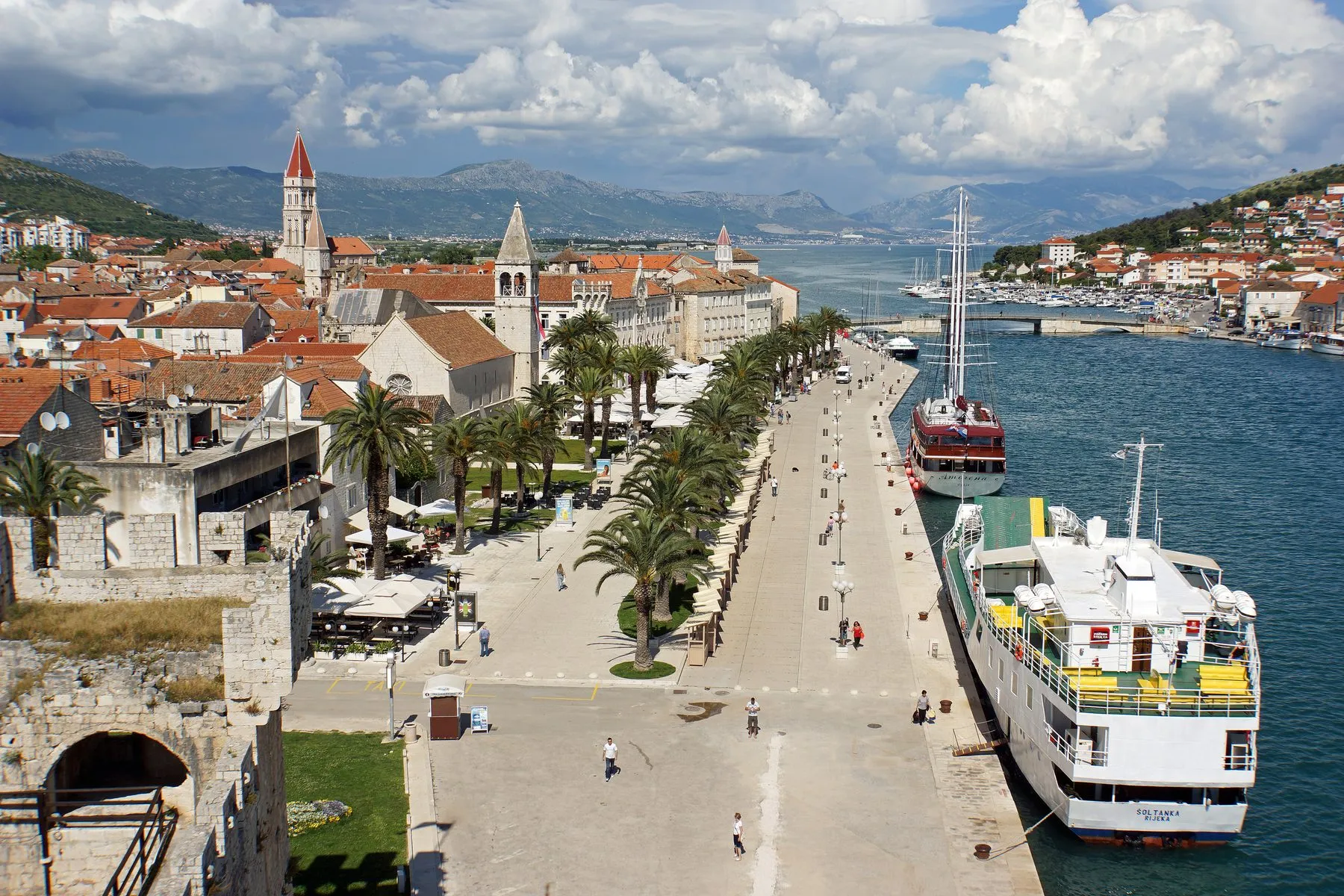
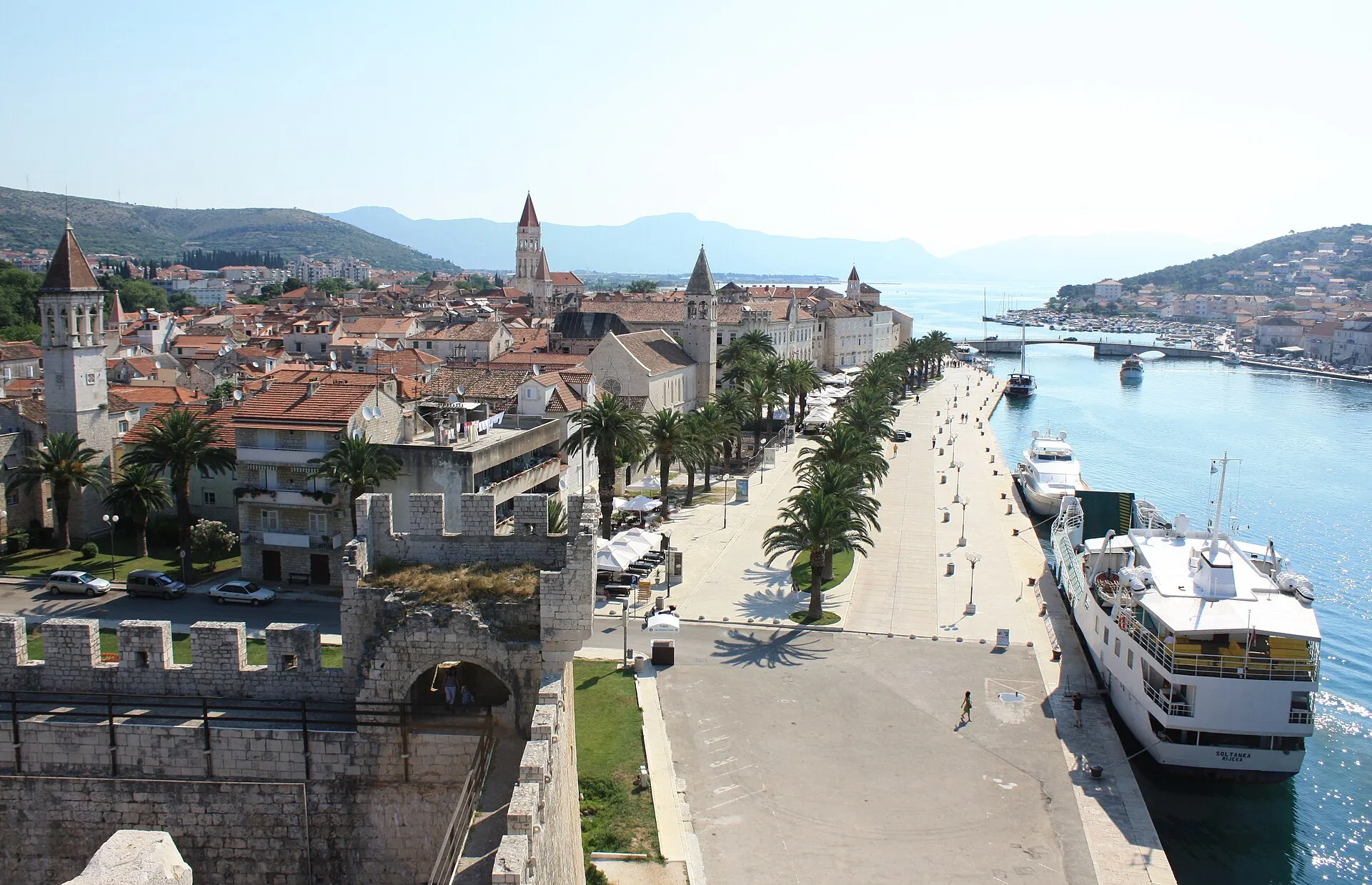
View from the battlements of Kamerlengo Fortress. Photo: Dennis G. Jarvis, Wikimedia Commons, CC BY-SA 2.0.
Kamerlengo Fortress and Saint Mark’s Tower
Kamerlengo Fortress (Kaštel Kamerlengo) stands at the south-western tip of the island. The Republic of Venice built it between 1420 and 1437 to designs by the military engineer Marin Radoj, and it housed the Venetian garrison and the camerlengo (financial administrator).
- The polygonal fortress has high stone curtain walls, an octagonal keep and three smaller corner towers.
- You can climb the stone steps to the perimeter ramparts, which overlook the channel where Venetian galleys once anchored.
- Nearby on the north-west quayside is Saint Mark’s Tower (Kula sv. Marka), a round Renaissance artillery bastion built in 1470 with three-metre-thick walls.
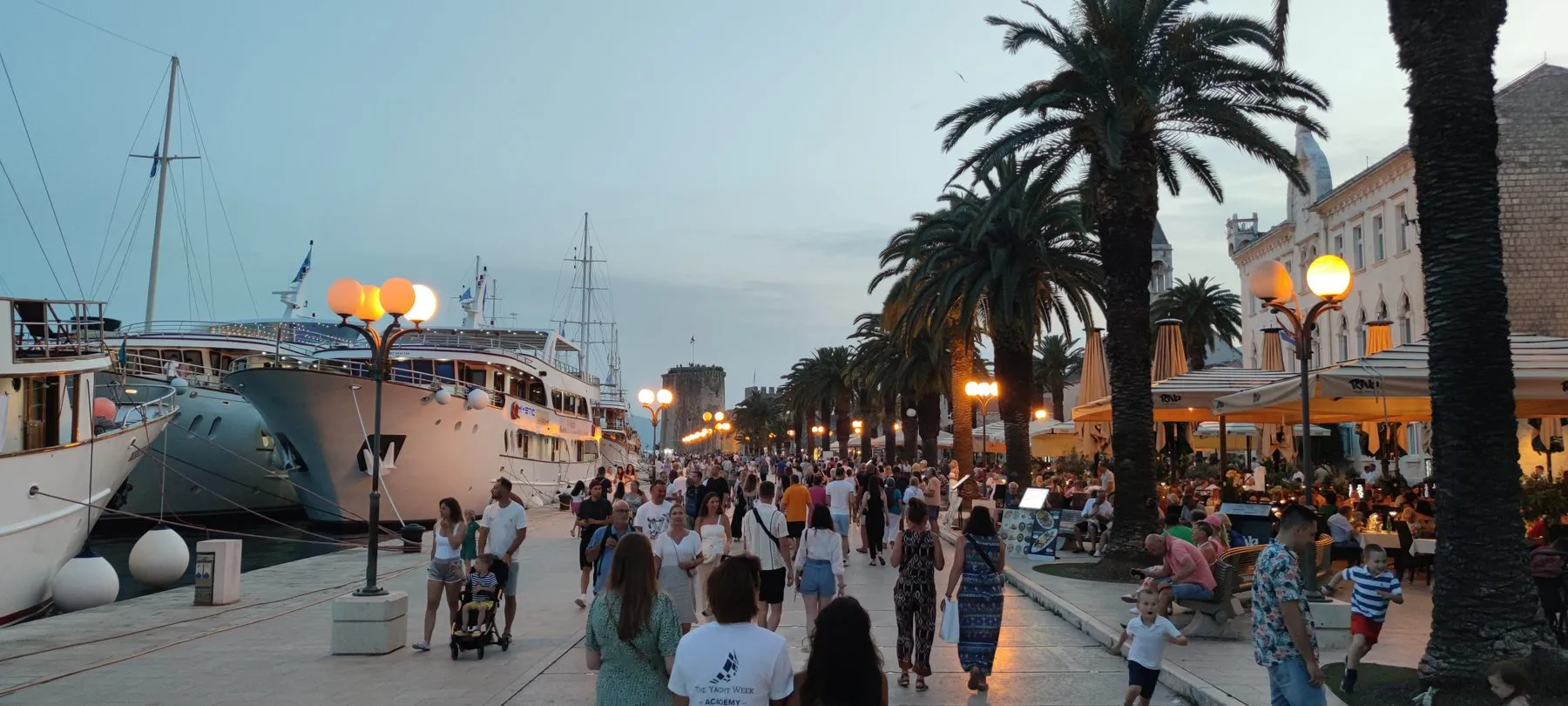
The palm-lined Riva along the southern quayside. Photo: Mini1300, Wikimedia Commons, CC0.
The Kairos relief at Saint Nicholas Monastery
Near the southern quayside, the Benedictine Convent of Saint Nicholas (Samostan sv. Nikole) has housed a community of nuns since 1064. Its museum holds the Kairos Relief, an orange-tinted Greek Hellenistic marble relief from the 4th or 3rd century BC.
The relief shows Kairos, the Greek personification of the fleeting right moment, as a winged youth with winged heels balancing on a sphere. He carries a scale and has a lock of hair across his forehead and a shaved back of the head: the proverb says an opportunity must be seized by the forelock as it approaches, because once it has passed you cannot grasp it from behind.
The Riva and waterfront
The southern edge of the island is the palm-lined quayside promenade (Trogirska riva), with stone facades, cafe terraces and sailing berths. It is an unbroken walk between Kamerlengo Fortress and the Čiovo Bridge.
Practical itinerary: 4 hours in Trogir
- 09:00: Arrive via bus 37 at Trogir bus station, cross the north bridge through the Land Gate (Kopnena vrata), guarded by the statue of Saint John of Trogir.
- 09:15: Visit the Cathedral of St Lawrence: Radovan’s Portal, the Chapel of Blessed John and the 47-metre bell tower.
- 10:30: Cross John Paul II Square to see the reliefs in the Town Loggia and the Rector’s Palace courtyard.
- 11:00: Walk the pedestrian alleys south to the Kairos relief at the Convent of Saint Nicholas.
- 11:45: Follow the palm-lined Riva to Kamerlengo Fortress and walk the battlements for views over the channel.
- 12:45: Have lunch on the quayside or catch the return bus 37 / Bura Line ferry back to Split.
What to see next
- Day trips from Split: Trogir compared with Krka, Hvar and the Blue Cave.
- Klis Fortress and Salona day trip: the inland alternative, with Roman ruins and mountain ramparts.
- Split airport to the city: bus 37 runs between Split and Trogir via the airport.
- Diocletian’s Palace guide: the Roman palace back in Split.
- 3 days in Split itinerary: where Trogir fits in three days.
- Getting around Split: bus tickets, suburban routes and ferry terminals.
Common questions
How do you get from Split to Trogir by public transport?
Promet Split bus line 37 leaves the Sukoišan terminal in Split every 20 to 30 minutes, calls at the airport and ends at Trogir bus station. The journey takes 50 to 55 minutes and a single costs €2.50 in the Promet app or €5.00 from the driver. In summer the Bura Line catamaran sails between the Split Riva and Trogir harbour in 60 minutes for €6 to €8.
How much does Kamerlengo Fortress cost?
An adult ticket is €5, and students and children aged 7 to 18 pay €2.50; children under 7 enter free. It is open daily from 10:00 to 18:00 in April, October and November, 09:00 to 20:00 in May and September, and 09:00 to 22:00 from June to August (Trogir Tourist Board).
How much is entry to Trogir Cathedral?
One adult ticket for €8 covers the Cathedral of St Lawrence, Master Radovan's Romanesque portal, the baptistery, the Chapel of Blessed John of Trogir and the 47-metre bell tower climb. The ticket office is at the entrance to the Sacred Art Collection.
When is Trogir Cathedral open to visitors?
The cathedral complex is open Monday to Saturday from 08:00 to 18:00 (to 20:00 in July and August, and 08:00 to 16:00 in winter). It is closed to sightseeing on Sunday mornings during church services.
How long should you spend on a day trip to Trogir?
Trogir's UNESCO historic centre is a small oval island, 500 by 250 metres. Half a day (3 to 4 hours) is enough for the cathedral, the bell tower, the battlements of Kamerlengo Fortress and the waterfront.
Why is Trogir a UNESCO World Heritage Site?
UNESCO inscribed Trogir in 1997 as an example of urban continuity. Greek colonists founded it in the 3rd century BC as Tragurion, and its medieval street grid keeps Romanesque, Gothic, Renaissance and Baroque buildings.