In this guide
💡 The Short Version: Klis Fortress sits 12 km north-east of Split, commanding the mountain pass between the coast and the hinterland; adult admission is €12 (Klis Fortress) and it opens daily from 09:00 to 19:00. Salona, the capital of the Roman province of Dalmatia, sits 5 km down the valley in Solin; entry is €8 alone or €10 on a combined 7-day ticket with the Archaeological Museum in Split (Archaeological Museum Split). Promet Split bus line 22 links both sites to Split city centre for €2.00 a single. Or book a tour: Split: Diocletian’s Palace, Salona and Klis Fortress – 6had (from €60, 4.8 stars from 32 reviews) combines private van transfers, site entrance and an archaeologist guide across both ancient sites.
⚠️ Salona is closed on Croatian public holidays. The archaeological park also closes at 18:00 from October to May. Klis Fortress remains open daily until 19:00, so visit Salona first when combining the two in a single day trip.
Opening hours and ticket prices
Klis Fortress is operated by the Municipality of Klis, while the archaeological park of Salona is managed by the Archaeological Museum in Split.
| Sight | Operating hours | Standard adult | Concession / Child | Ticket details |
|---|---|---|---|---|
| Klis Fortress | Daily, 09:00 to 19:00 | €12 | €4 (children up to 15) | Includes fortress, museum, armoury and exhibition |
| Salona (Solin) | 09:00 to 18:00 (Oct–May); 09:00 to 20:00 (Jun–Sep) | €8 | €4 (pupils & students) | Entry to Manastirine, Tusculum and ruins; closed holidays |
| Salona & Split Museum combo | Same as above | €10 | €5 (pupils & students) | Covers Salona and Archaeological Museum Split; valid 7 days |
| Archaeological Museum Split | Mon–Fri 09:00–14:00, 15:00–20:00; Sat 09:00–14:00 | €8 | €4 (pupils & students) | Closed Sundays and public holidays |
Tickets at Klis can be purchased with cash or contactless bank cards at the outer ticket pavilion on the approach path. At Salona, tickets are sold at the Tusculum entrance building at Manastirine.
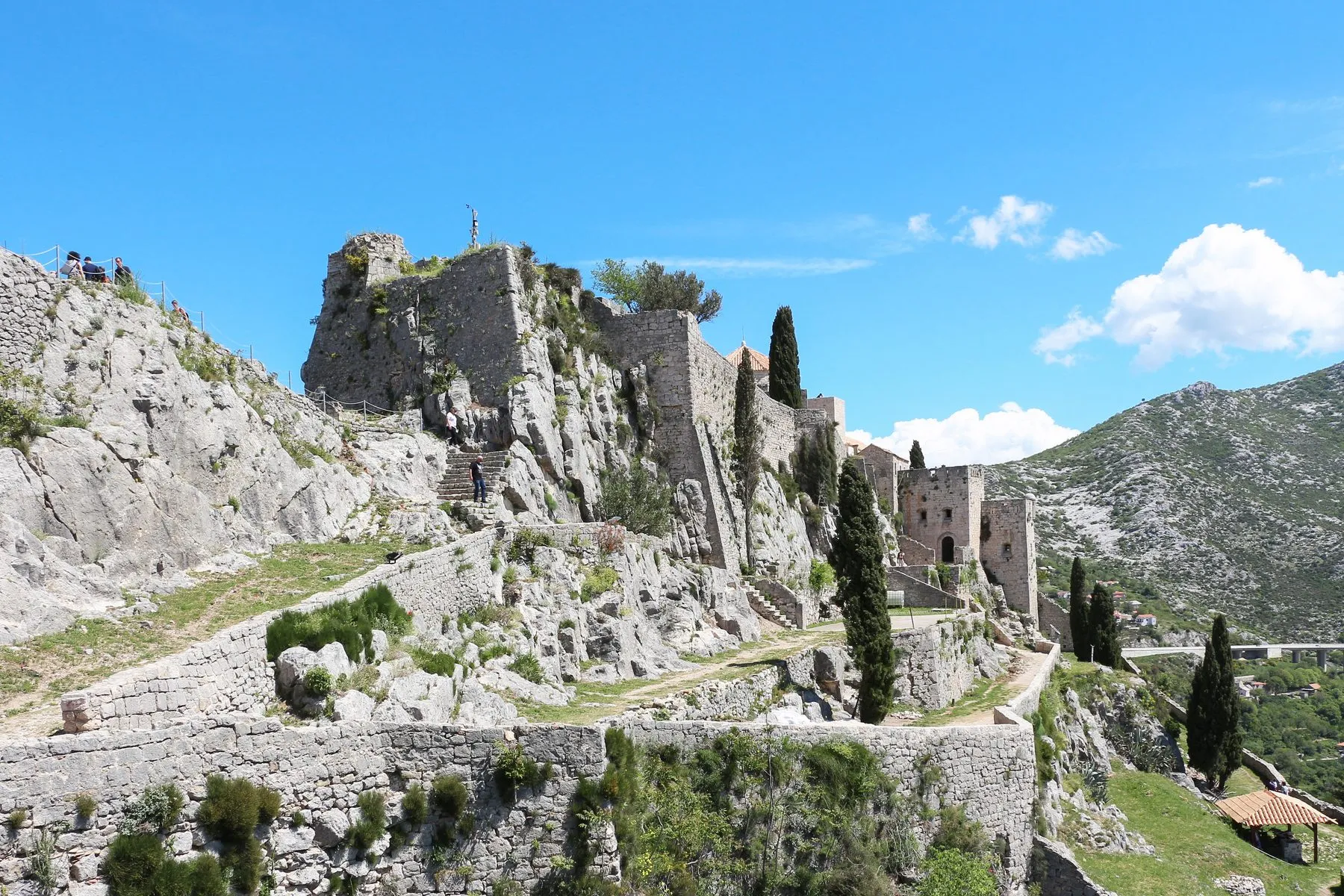
Klis Fortress on its mountain ridge. Photo: Bernard Gagnon, Wikimedia Commons, CC BY-SA 4.0.
Tours and guided visits
Klis and Salona are 5 km apart and buses between them are infrequent, so the day tours use a private minivan between Split, Solin and the fortress ridge.
Palace, Salona and Klis Fortress tour
From €60 · 4.8 stars from 32 reviews · 4 - 6 hours · free cancellation
Split: Diocletian’s Palace, Salona and Klis Fortress – 6had: A guided tour of Diocletian’s Palace, the Roman ruins of Salona and the medieval Klis Fortress.
Private Salona and Klis tour
From €400 · 4.8 stars from 8 reviews · 5 hours · free cancellation
From Split: Private Salona and Fortress of Klis Tour – 4.5had: A private tour of the Roman town of Salona and the medieval fortress of Klis.
Salona and Klis Fortress e-bike tour
From €95 · 5 stars from 1 reviews · 5 hours · free cancellation
From Solin: Salona and Klis Fortress E-Bike Tourad: An e-bike tour from Solin to the Roman city of Salona, with its amphitheatre and city walls, and on to Klis Fortress, with views over Split.
Public transport vs guided tour: prices compared
| Method | Transport cost | Entry fees | Total per adult | Notes |
|---|---|---|---|---|
| Independent bus (line 22) | €2.00 per ride | €12 Klis + €8 Salona | €20 plus bus fares | Walk between Solin and Klis or time the bus transfers |
| Split Museum combo + bus | €2.00 per ride | €12 Klis + €10 combo | €22 plus bus fares | Includes the Archaeological Museum Split within 7 days |
| Taxi or ride-hailing | Priced in the app | €12 Klis + €8 Salona | €20 plus the fare | Door to door, no waiting for buses |
| Small group guided tour | From €60 (transport and guide) | Included or €18 | €60–€78 | Direct transport, guide, palace tour included |
Getting there independently
Bus line 22 from Split
Promet Split operates urban bus line 22 from Split to Klis Megdan (Promet Split line 22). Departures run roughly every 45 to 60 minutes from the HNK bus stop (opposite the Croatian National Theatre) and the Sukoišan suburban bus hub on Lička ulica. The ride up the mountain takes 30 to 35 minutes.
- Tickets: buy in the Promet app or pay with a contactless bank card; a single from Split to Klis costs €2.00 and €4.00 in cash from the driver, according to the Promet Split price list valid from 1 June 2026.
- Stop for Klis: alight at Klis Megdan square. The pedestrian path to the fortress gate begins 150 metres uphill from the bus turnaround.
- Stop for Salona: on the return journey towards Split, alight at Solin Širina or Hrvatskih ratnika, from where the Manastirine entrance is a 10-minute walk (800 metres).
Lines 1, 16 and 37 also connect Split to Solin directly, dropping passengers within walking distance of Salona.
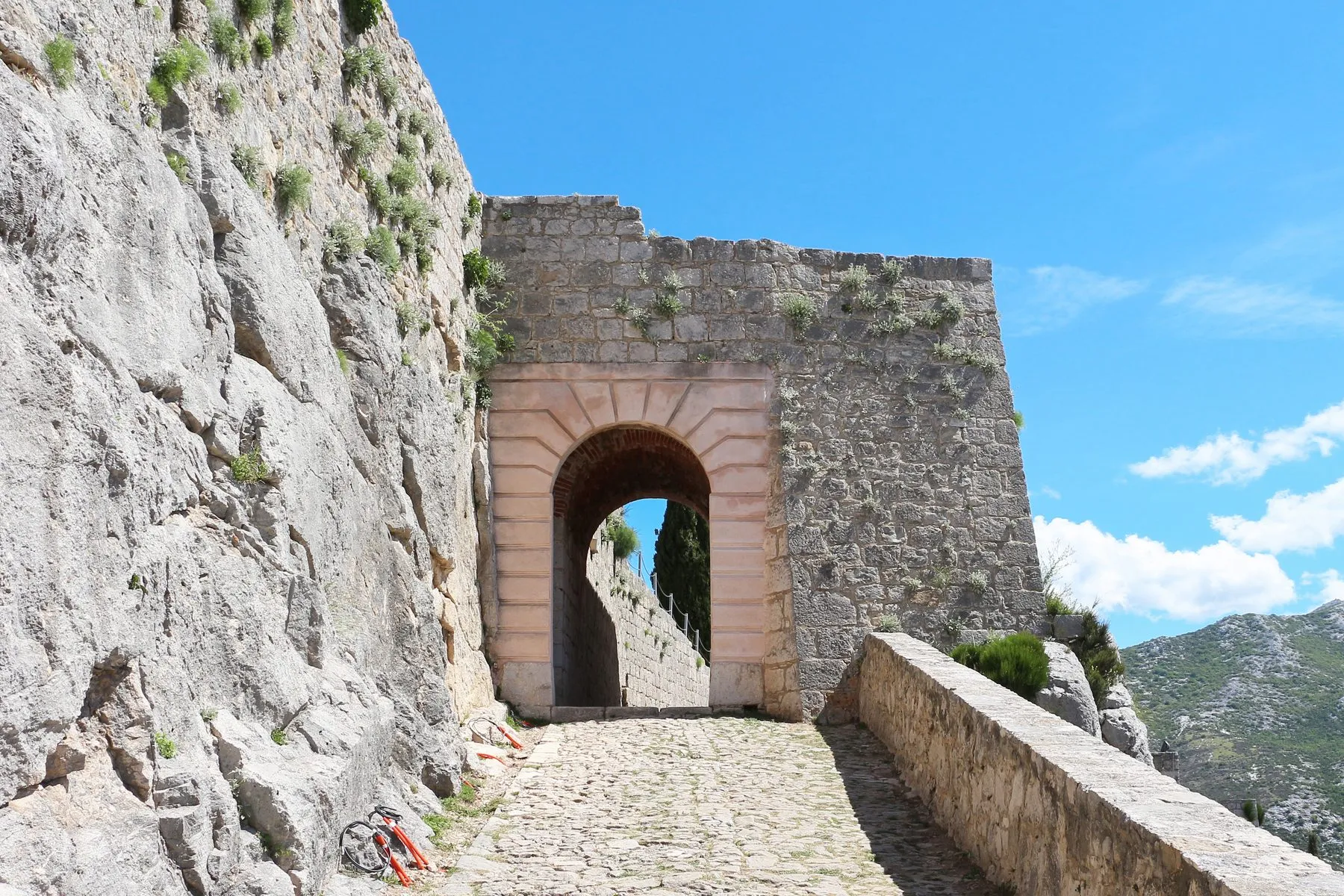
The second gate of Klis Fortress. Photo: Bernard Gagnon, Wikimedia Commons, CC BY-SA 4.0.
Exploring Klis Fortress
Klis Fortress stands on a limestone ridge 360 metres above sea level, on the narrow saddle between Mount Mosor (1,339 m) and Mount Kozjak (779 m). Whoever held it controlled the route between the Adriatic coast and the interior.
Fortress layout and architecture
The stronghold is structured across three concentric stone enclosures on stepped rocky terraces:
- The First Enclosure (Lower Fortress): entered via an Austrian stone gatehouse built in the 1820s over older Venetian fortifications. A zigzagging ramp leads past outer gun embrasures.
- The Second Enclosure (Middle Fortress): accessed through the Second Gate, protected by the Oprah Tower (Kula Oprah), a medieval bastion. The Austrian officers’ barracks hold medieval swords, shields, chainmail and 16th-century muskets.
- The Third Enclosure (Upper Fortress): the highest redoubt. Here stands the Church of St Vitus (Crkva sv. Vida), originally built in 1537 by the Ottoman Turks as a domed mosque with a minaret after the fortress fell. When Venetian forces recaptured Klis in 1648, they demolished the minaret, consecrated the building as a Catholic chapel, and added a holy water font carved from a Turkish mortar.
The Uskoks and the defence against the Ottomans
In the early 16th century, Klis was held by Captain Petar Kružić and his band of irregular Croatian Christian soldiers known as the Uskoks (uskoci, meaning “those who jumped in”). For more than two decades, Kružić and his garrison resisted repeated Ottoman sieges despite being cut off from Austrian and Venetian supplies. In March 1537, Ottoman commander Murat-beg Tardić captured Kružić during a sortie, beheaded him, and paraded his head on a lance before the ramparts, forcing the fortress to surrender. The Ottomans held Klis for 111 years until the Venetians recaptured it in 1648 during the Candian War.
Game of Thrones at Klis
In season four of HBO’s Game of Thrones, Klis Fortress was transformed into the city of Meereen, the largest of the three slave cities in Slaver’s Bay. Daenerys Targaryen marches her Unsullied army up the fortress road, takes the city, and crucifies 163 Great Masters along the battlements. A permanent exhibition in the former Austrian quarters shows set photographs, props and panels on the filming locations.
Salona: the Roman capital of Dalmatia
Salona (Colonia Martia Iulia Valeria Salona Felix) was an ancient Illyrian settlement that became the political, administrative and military capital of the Roman province of Dalmatia under Julius Caesar and Emperor Augustus. In the 3rd and 4th centuries AD it had an estimated 60,000 residents.
When the Roman emperor Diocletian decided to retire, he chose a site 6 km south along the coast to build his retirement palace, sourcing marble, water via an aqueduct, and skilled labour directly from Salona.
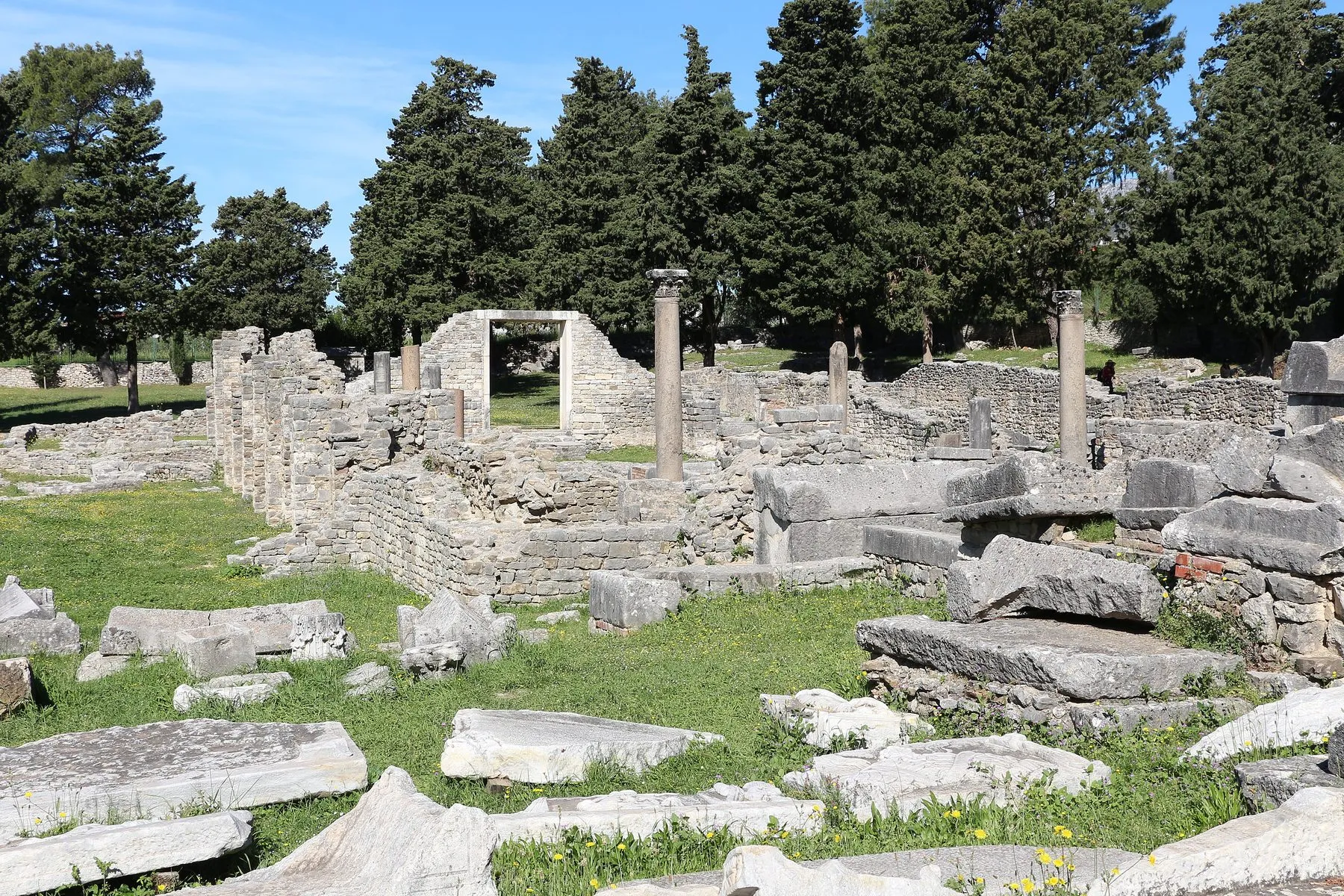
The early Christian basilica at Manastirine, Salona. Photo: Bernard Gagnon, Wikimedia Commons, CC BY-SA 4.0.
Manastirine and Tusculum
The primary entrance to Salona is at Manastirine in northern Solin. Manastirine is one of the largest early Christian necropolises in the Mediterranean. Under Roman law, burials were forbidden within city walls, so Christians buried their martyrs in underground family vaults outside the northern gate. Saint Domnius (Sveti Dujam), Bishop of Salona, was executed during Diocletian’s persecutions in 304 AD and interred here before his relics were moved into Split Cathedral in the 7th century.
Beside the cemetery stands the Tusculum, a stone villa built in 1898 by Monsignor Frane Bulić, the father of Croatian archaeology. Bulić directed the excavations of Salona for four decades and built the house as a research headquarters, embedding ancient capitals, inscriptions and Roman sculptures into its garden walls.
The Roman Amphitheatre
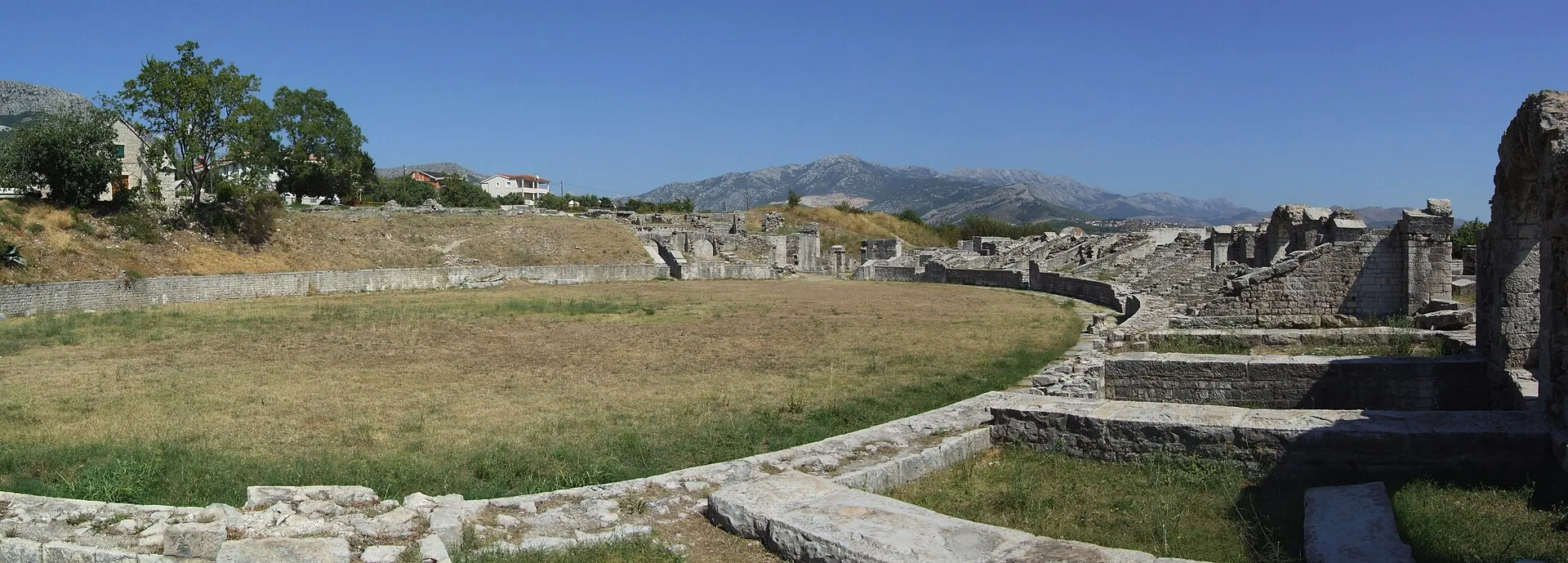
Located at the far western boundary of Salona, the stone amphitheatre was erected in the latter half of the 2nd century AD during the reign of Marcus Aurelius. Elliptical in plan (125 metres by 100 metres), it accommodated 15,000 to 18,000 spectators across three tiers of stone seating. Gladiatorial combats and public executions of early Christians took place in the arena. Although Venetian engineers deliberately demolished the upper arcades in the 17th century to deny shelter to invading Turkish cavalry, the subterranean arena channels, gladiator entrances and foundation tiers remain visible.
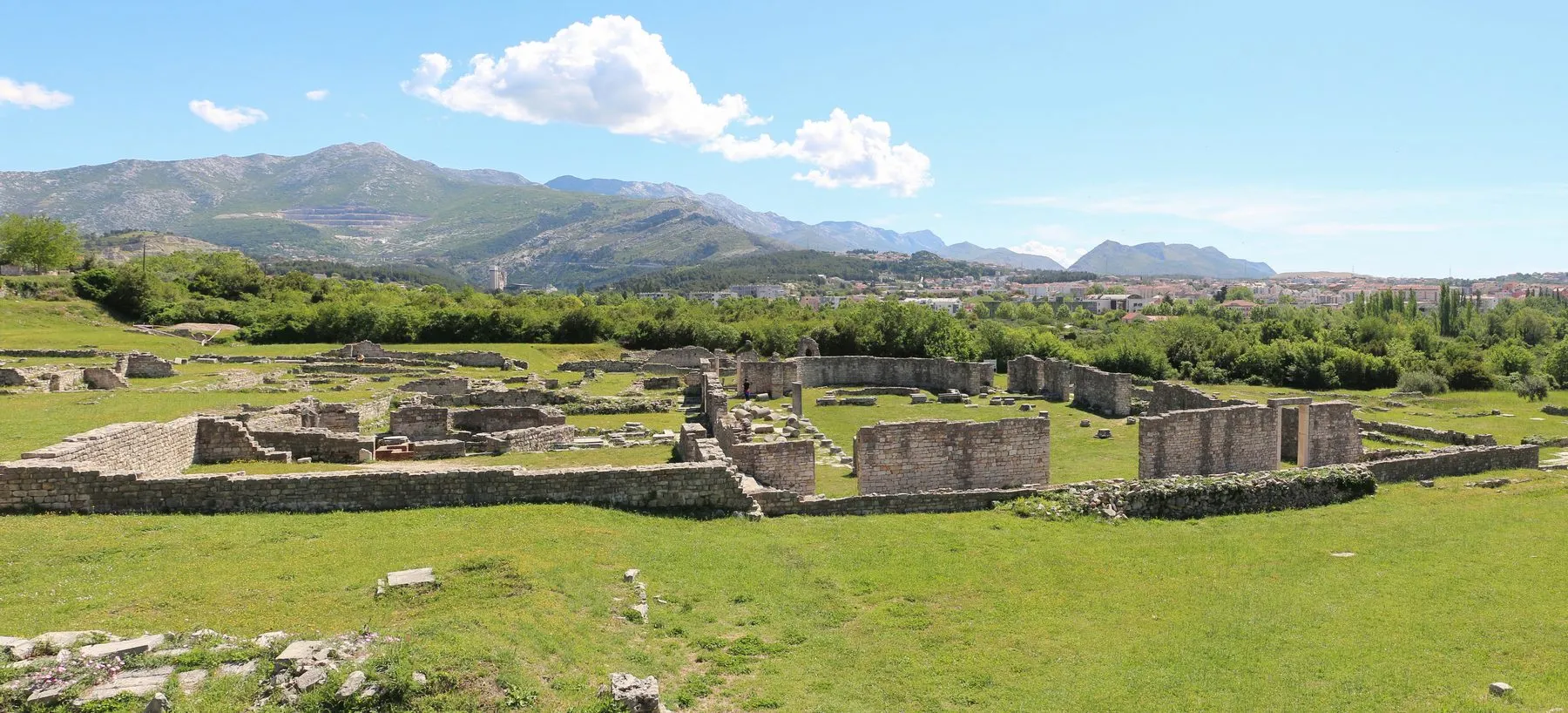
Ruins of the Episcopal Centre in Salona. Photo: Bernard Gagnon, Wikimedia Commons, CC BY-SA 4.0.
The Episcopal Centre and city walls
Between Manastirine and the amphitheatre lies the central urban core of Salona:
- The Episcopal Centre (Episkopalni centar): a vast complex comprising two parallel basilicas (the Cathedral of Saint Domnius and the Basilica Orientalis), an octagonal baptistery with internal marble columns, and the bishop’s palace.
- Porta Caesarea: the monumental eastern gatehouse of the 1st century AD, with twin octagonal towers and three archways for chariots and pedestrians. Traces of the Roman aqueduct that supplied Diocletian’s Palace run past the gate.
- Thermal baths (Thermae): the public Roman baths situated near the episcopal complex, displaying surviving hypocaust brick heating pillars and mosaic flooring.
The fall of Salona
In the early 7th century AD (around 614), confederations of Avars and Slavs sacked and burned Salona. The surviving Roman citizens evacuated the destroyed city, fleeing first to the Adriatic islands of Brač and Hvar, and subsequently taking refuge inside the stone fortifications of Diocletian’s Palace down on the coast. That relocation transformed the emperor’s private retirement villa into the living medieval city of Split.
Tips for combining Klis and Salona
- Visit Salona in the morning: the ruins cover several square kilometres with little shade, so go before midday in summer.
- Take bus 22 or a taxi to Klis: the 5 km climb between Solin and Klis takes over an hour on foot. Take line 22 from Solin or book a taxi.
- Footwear: Klis Fortress has steep, polished limestone ramparts with unfenced drops; wear shoes with rubber grip.
- Combined museum ticket: if you intend to visit the Archaeological Museum in Split on Zrinsko-Frankopanska, buy the €10 combo ticket at Salona’s Tusculum office to save €6.
What to see next
- Day trips from Split: Klis and Salona compared with Krka, Trogir, Hvar and Brač.
- Archaeological Museum Split: the sarcophagi and mosaics excavated from Salona.
- Diocletian’s Palace guide: the Roman retirement palace that Salona’s refugees settled in the 7th century.
- Game of Thrones Split guide: every filming location in Split, the cellars and Klis.
- Trogir day trip from Split: another coastal town, 50 minutes away by bus.
- 3 days in Split itinerary: where Klis and Salona fit into three days.
- Getting around Split: suburban bus lines, stops and ticket rules.
Common questions
How much does Klis Fortress cost?
An adult ticket is €12 and children up to 15 pay €4. The ticket covers the fortress ramparts, the armoury museum in the Austrian barracks, the artillery room and the Game of Thrones filming exhibition (Klis Fortress official price list).
How do you reach Klis from Split by bus?
Promet Split bus line 22 runs from the HNK (National Theatre) stop or the Sukoišan terminal straight to Klis Megdan square, just below the fortress gates. A single to Klis costs €2.00 in the Promet Split app and €4.00 in cash from the driver.
How much is entry to Salona?
Admission to the archaeological site of Salona at Manastirine in Solin is €8 for adults and €4 for children and students. A combined ticket for €10 covers both Salona and the Archaeological Museum in Split on Zrinsko-Frankopanska, valid for 7 days.
What was filmed at Klis Fortress in Game of Thrones?
Klis Fortress was the exterior of the slave city of Meereen in season four. Its stone terraces and mountain pass were the setting where Daenerys Targaryen freed the enslaved population and crucified the Great Masters.
What are the opening hours at Salona and Klis?
Klis Fortress is open daily from 09:00 to 19:00. Salona is open daily from 09:00 to 18:00 between 1 October and 31 May, and 09:00 to 20:00 between 1 June and 30 September; it is closed on public holidays.
Can you walk between Salona and Klis Fortress?
It is 5 km uphill along the mountain pass road from Salona in Solin to Klis Fortress, over an hour on foot with no continuous footpath. Most visitors take bus 22 or a short taxi.