In this guide
💡 The Short Version: The Cathedral of St Domnius is the Roman emperor Diocletian’s mausoleum, turned into a church in the 7th century, and it stands on the Peristyle in Diocletian’s Palace (Split Tourist Board). The cathedral costs €5, the treasury €5, the 57-metre bell tower €7, and a ticket for everything €15. The cathedral and bell tower are open until 17:30. Or book a tour: Diocletian’s Palace - Split Old Town Guided SMALL GROUP Tourad (from €15, 4.9 stars from 5,865 reviews) names the cathedral among its stops, so a guide explains the mausoleum before you pay to go in.
⚠️ The bell tower is a separate ticket. On its own it costs €7, and the cathedral, bell tower and treasury together cost €12 against €17 bought separately, so the combined ticket is the better buy if you want both.
Tickets
Prices are from November 2026.
| Ticket | Price |
|---|---|
| Cathedral | €5 |
| Treasury | €5 |
| Bell tower | €7 |
| Crypt | €3 |
| Baptistery (the former Temple of Jupiter) | €3 |
| Cathedral, bell tower and treasury | €12 |
| Cathedral, crypt and baptistery | €9 |
| Everything except the bell tower | €10 |
| Everything except the crypt | €13 |
| Everything | €15 |
The cathedral and the bell tower are open until 17:30. The cathedral is a place of worship with a continuous tradition of the Sunday mass, according to the Tourist Board (Split Tourist Board). The Tourist Board lists the Treasury of Split Cathedral at Kraj Sv. Duje 3, which it also gives as Peristyle 5.
Tours and the cathedral
A guide tells the story of the building, from emperor’s tomb to cathedral, and how the palace plan around it fits together. The tickets on this page are bought at the cathedral, so a tour is for the commentary, not a way round the price.
Palace and Old Town walk
From €15 · 4.9 stars from 5,865 reviews · 1.5 to 5 hours · private option available
Diocletian’s Palace - Split Old Town Guided SMALL GROUP Tourad: the listing names the cathedral of St Domnius among its stops, along with the story of Gregory of Nin, and offers a private option.
Small-group walk with a history magister
From €25 · 4.9 stars from 138 reviews · 110 minutes · free cancellation
Split Small-Group Walking Tour with a Magister of Historyad: a walk of just under two hours led by a magister of history, according to the title, and bookable up to 15 minutes ahead.
First-time visitors’ palace tour
From €45 · 4.9 stars from 119 reviews · 1.5 hours · free cancellation
Essential Diocletian’s Palace Tour for First-Time Visitorsad: a 90-minute tour of the palace, bookable 30 minutes ahead.
The mausoleum
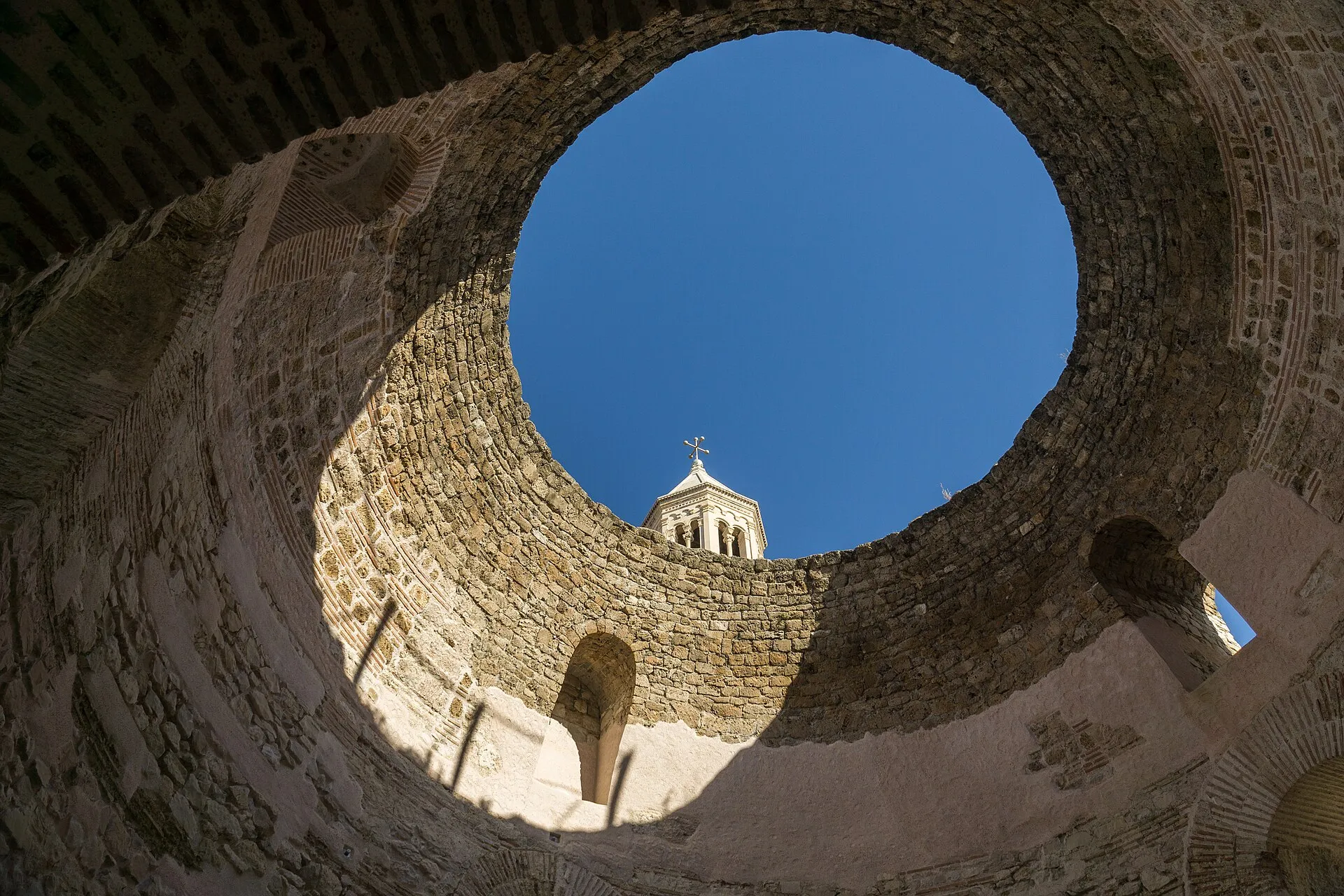
The building is octagonal outside, ringed by an aisle of 24 columns, and circular inside, with four semicircular niches and four rectangular ones. Eight red granite Corinthian pillars rise above the niches, with eight smaller ones above them. A frieze runs round the cornice with erotes hunting, masks and human heads, and two medallions of bows are taken to be portraits of the emperor Diocletian and his wife Prisca. The dome has a fan-shaped arrangement of bricks in its lower part and a circular one in its upper third (Split Tourist Board).
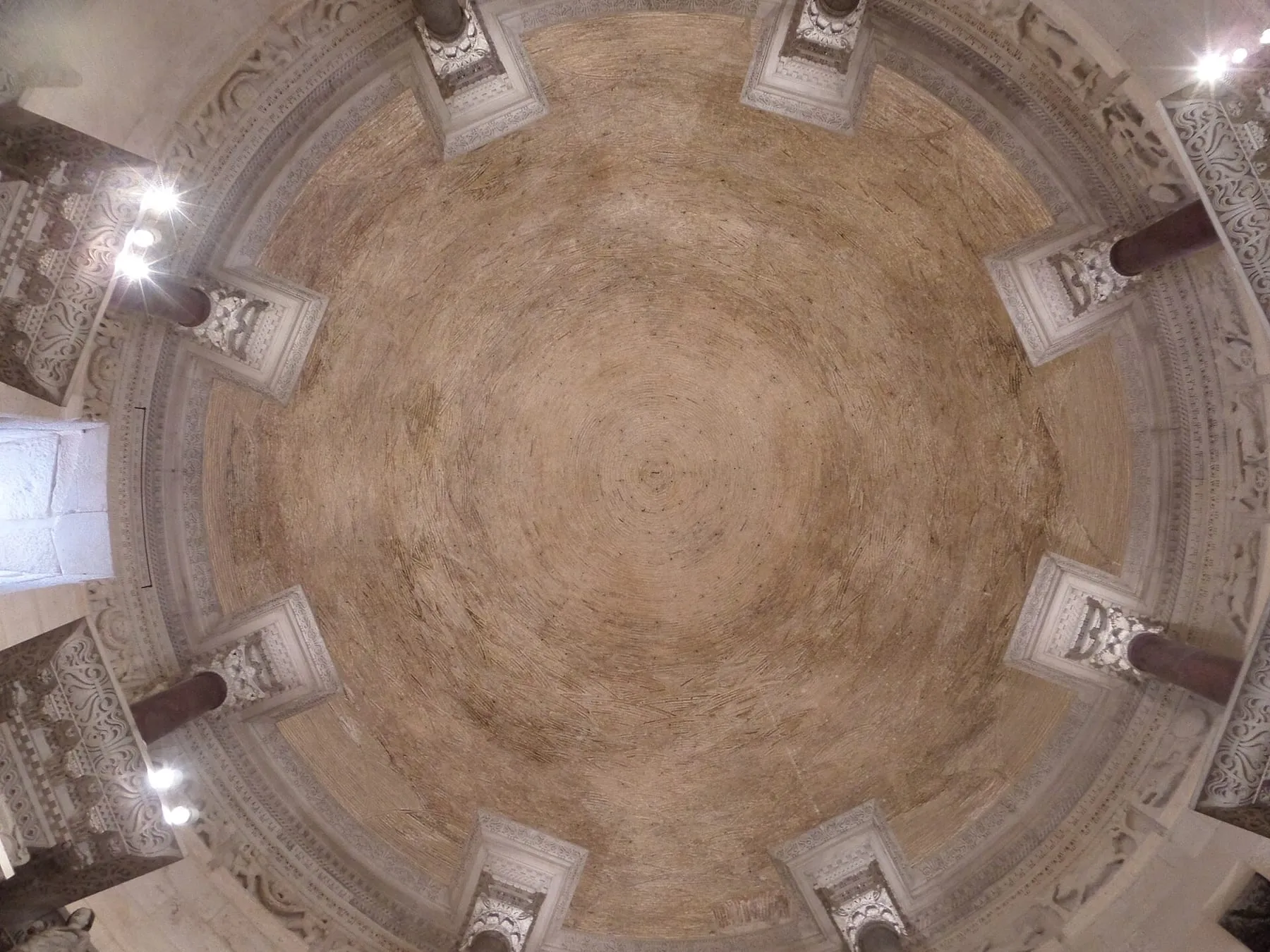
The brick dome of the mausoleum. Photo: Gaius Cornelius, Wikimedia Commons, CC BY-SA 4.0.
The mausoleum became a cathedral in the 7th century, when the relics of St Domnius and St Anastasius, who were executed in Solin, were brought into it. UNESCO describes the cathedral as a medieval building that reuses materials from the ancient mausoleum, and lists the historic core of Split with the Palace of Diocletian as a World Heritage property since 1979 (UNESCO). At the end of the second millennium the Tourist Board says the cathedral reconciles ancient pagan, Christian medieval and modern heritage.
What to look for inside
- The doors: carved in walnut by Andrija Buvina of Split. Each door post has 14 tablets with scenes from the Gospels, from the Annunciation to the Resurrection.
- The pulpit: hexagonal, 13th century, made of green porphyry that was once gilded all over. It is on the left of the entrance.
- The altar of St Domnius: on the right, with a late Gothic ciborium of 1427 by Bonino da Milano and frescoes of the four evangelists painted in 1429 by Dujam Vušković.
- The altar of St Anastasius: on the left, made in 1448 by the architect and sculptor Juraj Dalmatinac. The central relief on the sarcophagus shows the Flagellation of Christ.
- The choir benches: wooden, from the first half of the 13th century, in the Baroque choir. The Tourist Board names them as the most important work in the choir.
- The main altar: built from 1685 to 1689. The remains of St Domnius lie in the northern niche, in an altar by the Venetian sculptor Morlaiter of 1767.
All of this is from the Tourist Board’s cathedral page.
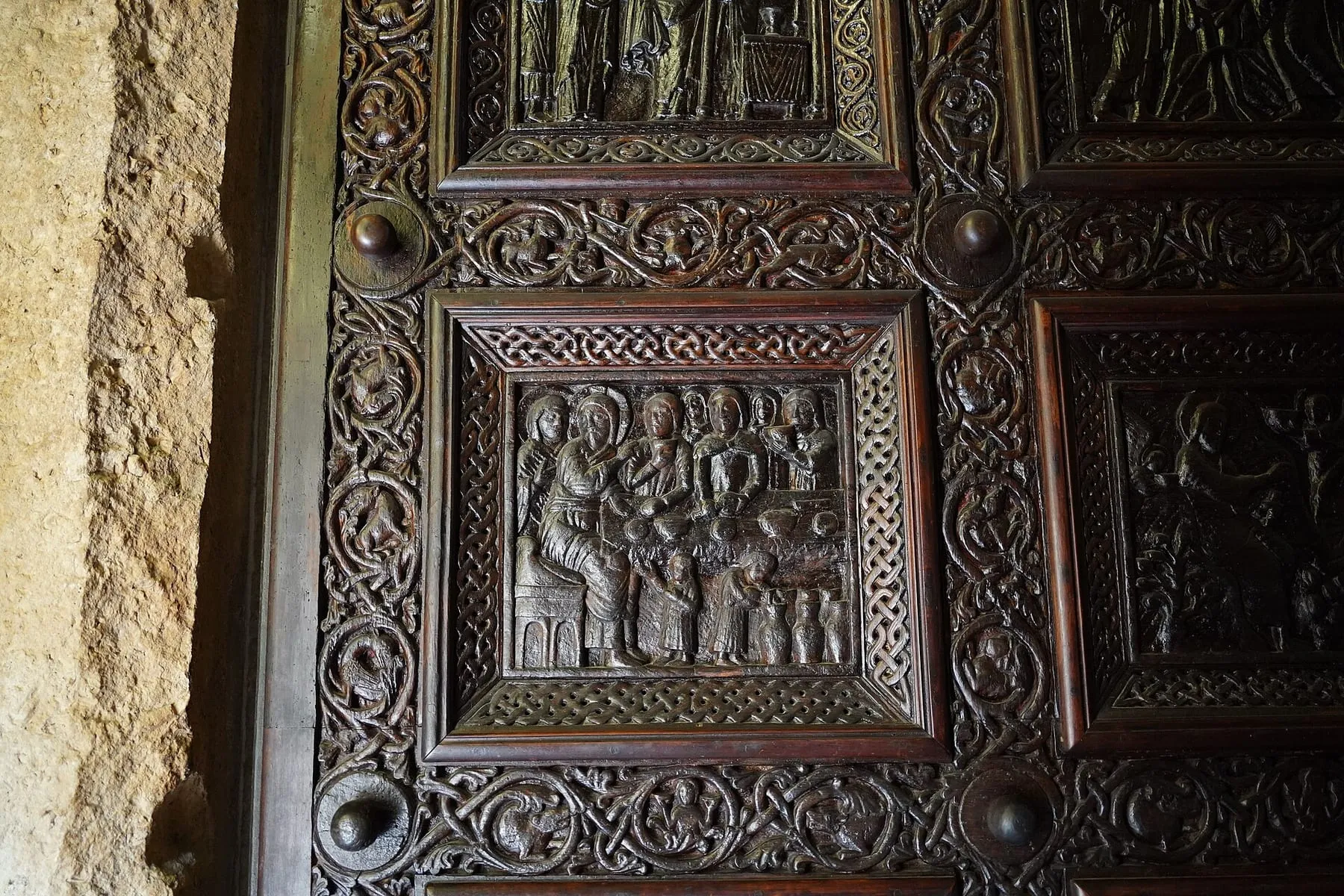
The carved doors. Photo: TimeTravelRome, Wikimedia Commons, CC BY 2.0.
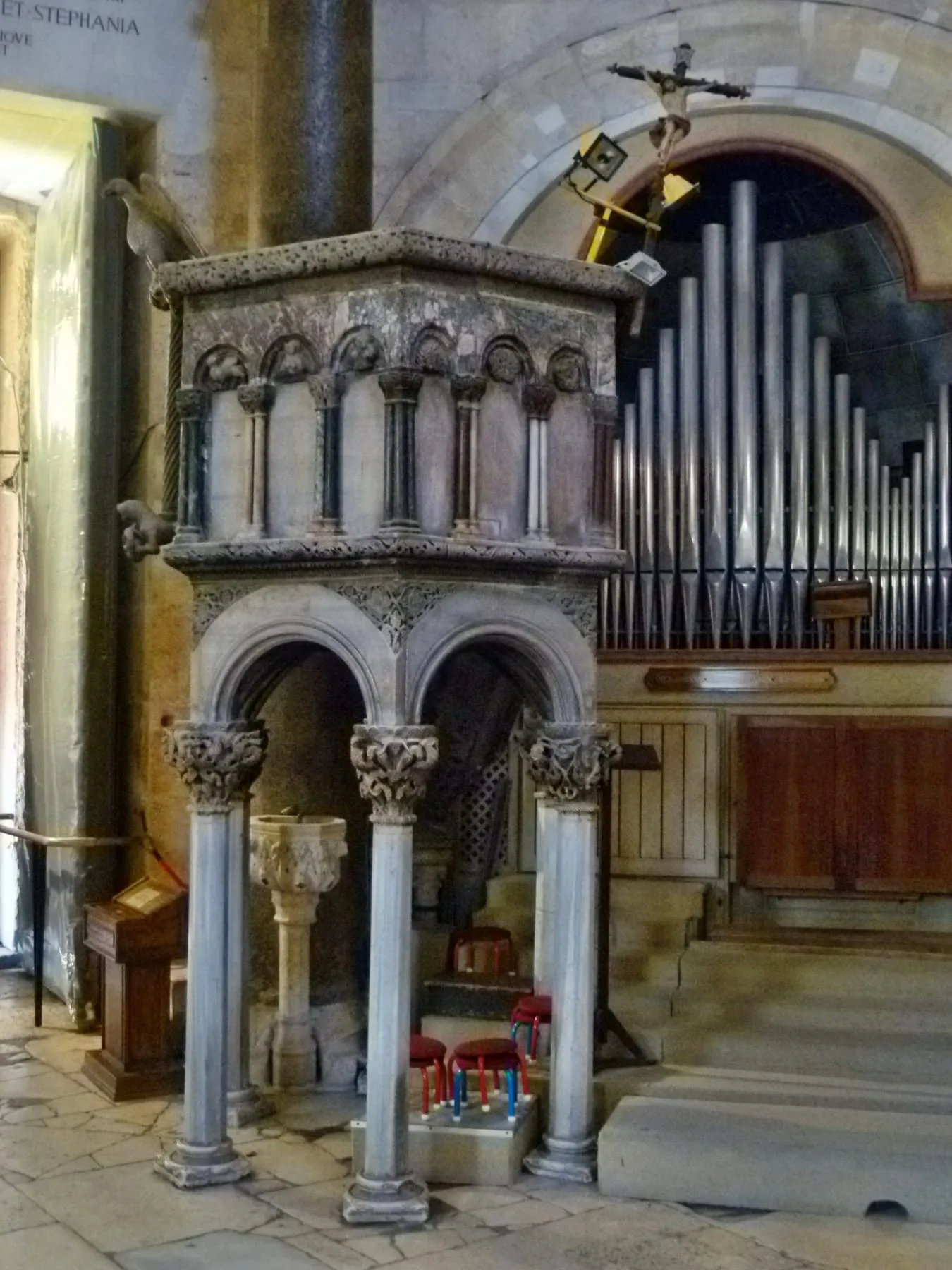
The 13th-century pulpit. Photo: JoJan, Wikimedia Commons, CC BY 3.0.
The bell tower
The bell tower is 57 metres high, started in the 13th century and rebuilt at the turn of the 20th century, when it was somewhat altered. The Tourist Board calls it the most original Dalmatian medieval architecture and says you can climb the steps all the way to the top for a view over the whole of Split (Split Tourist Board). From the top the view takes in the old town roofs, the harbour and the wooded slope of Marjan.
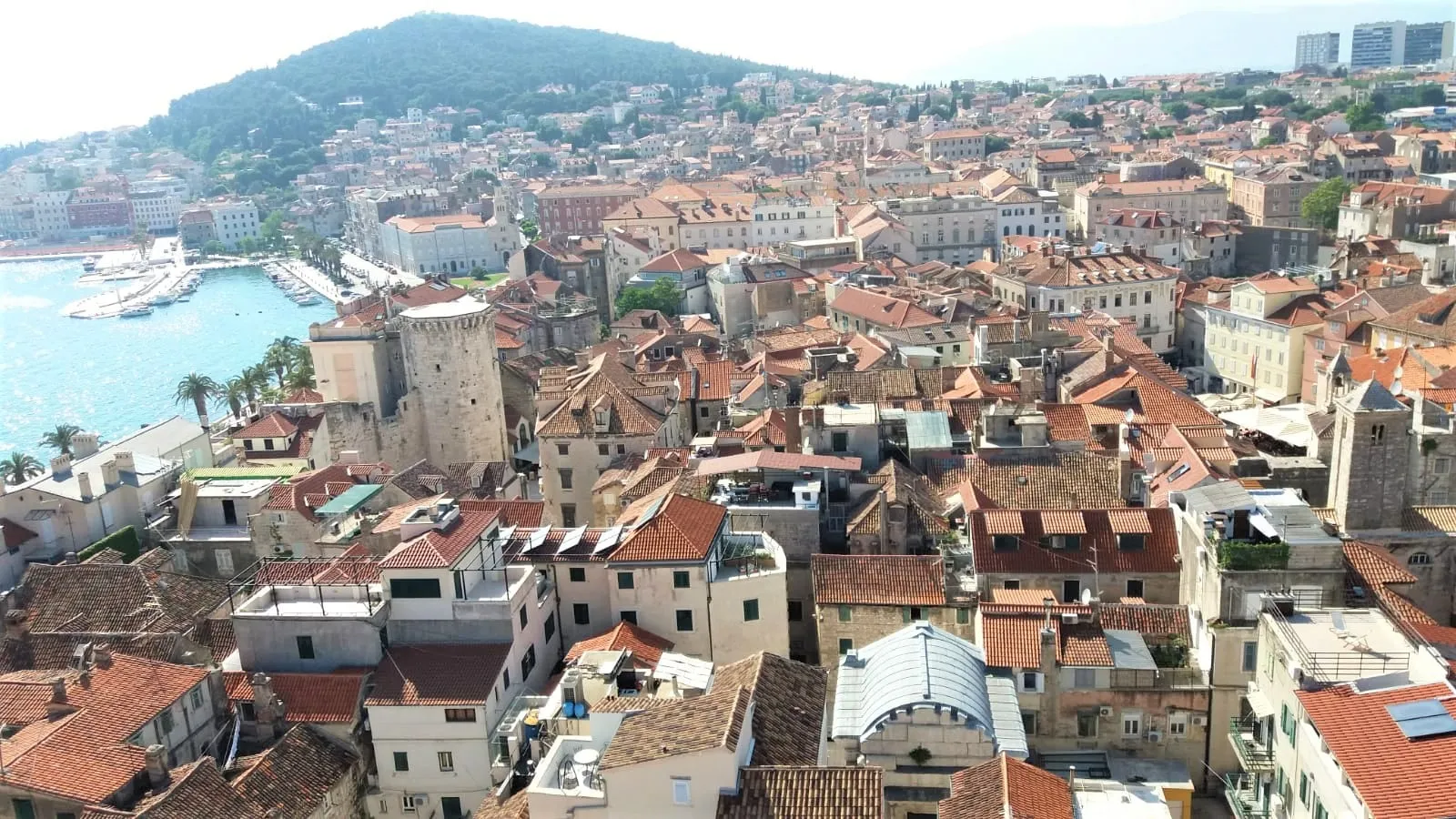
Split from the bell tower. Photo: Marko Klaić, Wikimedia Commons, CC BY-SA 4.0.
Around the cathedral
On the Peristyle the cathedral sits across the square from the baptistery and the sphinx, and the cellars begin through the Vestibule. The Riva is a short walk south. Once the town hall square, Pjaca, was built in the 13th and 14th centuries, the Peristyle became the city’s religious centre (Split Tourist Board). In 2000 Pope John Paul II walked in through the Silver Gate and prayed in the cathedral (Silver Gate). The Tourist Board points to the Sunday mass and the procession on St Domnius’s day, the day of Split’s patron saint, as the best expression of the cathedral’s liturgical life.
Fitting it into a day
The other paid sights close at different times, so order them by closing hour:
| Sight | Hours |
|---|---|
| Cellars | 09:00 to 17:00 daily until 28 March 2027, last entry 16:30 (Split City Museum) |
| Archaeological Museum | Closed to visitors 9 November to 11 December 2026 for a new exhibition; then, 1 October to 31 May, Monday to Friday 09:00 to 14:00 and 15:00 to 20:00, Saturday 09:00 to 14:00, closed Sundays and holidays (armus.hr) |
| Cathedral and bell tower | Open until 17:30 |
What to see next
- Temple of Jupiter and baptistery: the other ticket on the same combined price.
- Diocletian’s Palace guide: the Peristyle, the gates and the free streets.
- Diocletian’s Palace cellars: €10, open until 17:00.
- Marjan hill: the other view over the city, from the watchtower at Sedlo.
- Archaeological Museum: the stone monuments from Salona, the town where St Domnius was executed.
- Ivan Meštrović Gallery: the sculptor of the Gregory of Nin statue outside the Golden Gate.
Common questions
How much are tickets to Split Cathedral and the bell tower?
The cathedral is €5, the treasury €5, the bell tower €7, the crypt €3 and the baptistery €3. One ticket for everything is €15. Prices are from November 2026.
Which combined tickets are sold?
Cathedral, bell tower and treasury €12; cathedral, crypt and baptistery €9; everything except the bell tower €10; everything except the crypt €13; everything €15.
When are the cathedral and bell tower open until?
Both are open until 17:30.
Why is the cathedral unusual?
It is housed in the mausoleum of the Roman emperor Diocletian. The Tourist Board of Split says it sits in the oldest building of any cathedral in Europe, and that the mausoleum became a cathedral in the 7th century.
Who is St Domnius?
The patron saint of Split, a martyr executed in nearby Solin. His relics are in the cathedral together with those of St Anastasius, the second patron saint, who was also executed in Solin (Tourist Board of Split).
How tall is the bell tower and can you climb it?
The bell tower is 57 metres high, and the Tourist Board of Split says you can climb the steps to the top for a view over the whole of Split.