In this guide
💡 The Short Version: Diocletian’s Palace is a Roman imperial palace and fort of about 215 by 180 metres that Split’s old town is built around and inside (Split Tourist Board), on the UNESCO World Heritage List since 1979 (UNESCO). The streets, the Peristyle and the four gates are free to walk; the cellars cost €10 and are open 09:00 to 17:00 daily until 28 March 2027 (Split City Museum). The cathedral and bell tower and the baptistery have their own tickets. Start at the Golden Gate on the north side, walk the main street to the Peristyle, and leave through the cellars to the Riva. Or book a tour: Diocletian’s Palace - Split Old Town Guided SMALL GROUP Tourad (from €15, 4.9 stars from 5,865 reviews) puts a guide beside you for the gates, the Peristyle and the street plan, which a first visit does not explain on its own.
⚠️ The paid sights close early. The cellars shut at 17:00 with last entry at 16:30, and are closed on 18 November, 25 and 26 December, 1 and 6 January and 28 March (Split City Museum). The streets stay open at any hour.
What costs money
Prices are from November 2026.
| Sight | Ticket | Notes |
|---|---|---|
| Streets, Peristyle, gates | Free | Open at any hour |
| Cellars | €10 adult; €8 student, pensioner or Tourist Card | Daily 09:00 to 17:00 until 28 March 2027 |
| Cathedral | €5 | Cathedral and bell tower open to 17:30 |
| Cathedral treasury | €5 | Sold separately |
| Bell tower | €7 | |
| Crypt | €3 | |
| Baptistery (Temple of Jupiter) | €3 | |
| Cathedral, treasury, bell tower, crypt and baptistery | €15 | One combined ticket |
The cellar prices are the Split City Museum’s 2026 price list, and tickets can be bought on the museum’s online shop. The museum charges 50% more for a visit outside opening hours and 100% more on public holidays.
Tours of the palace
A guide makes the layout legible, because the Roman plan is hidden inside a living town. A tour beats walking alone on a first visit, in the heat of summer, or when you want the gates, the Peristyle and the cathedral in one 90-minute loop. The cellars, cathedral and bell tower are paid separately at their own ticket offices, so check each listing before you assume entry is included.
Small-group palace and Old Town walk
From €15 · 4.9 stars from 5,865 reviews · 1.5 to 5 hours · private option available
Diocletian’s Palace - Split Old Town Guided SMALL GROUP Tourad: a local guide takes you through the palace and the Riva, and the listing names the cathedral and Bishop Gregory of Nin among the stops.
Palace and Old Town, small group
From €15 · 4.9 stars from 1,034 reviews · 1.5 to 5.5 hours · free cancellation
Split: Diocletian’s Palace & Old Town Small Group Tourad: a small-group walk with a private option. It must be booked at least 10 hours ahead, so it suits a plan made the day before.
Guided tour since 2007
From €15 · 4.8 stars from 868 reviews · 1.5 to 5 hours · free cancellation
Diocletian’s Palace & Split Old Town Guided Tour - Since2007ad: the same ground with a different operator, bookable up to two hours ahead.
Official ticket or tour: the prices side by side
A GetYourGuide “from” price is the cheapest option in the product.
| What you want | Official | On GetYourGuide |
|---|---|---|
| Walk the streets, Peristyle and gates | Free | Walking tours from €15 |
| The cellars alone | €10 (Split City Museum) | Bought at the museum or on its online shop |
| A guide who explains the plan and the history | Not offered by the sights themselves | Palace walking tours from €15 |
What the palace is
The Split City Museum dates the palace to 295 to 305 (Split City Museum). The Tourist Board describes it as a luxury villa and a Roman military camp in one: a rectangle with four large towers at the corners, a gate on each side and four smaller towers on the walls. The southern part held the emperor’s apartments and the ceremonial buildings, and the northern part held the guard, the servants and the stores (Split Tourist Board). The road from the north gate led to Salona, the capital of the Roman province of Dalmatia.
Diocletian walked in through the north gate on 1 June 305 (Golden Gate page). People have lived inside the walls ever since, building houses into the Iron Gate and, in the early Middle Ages, living in part of the cellars (Iron Gate, Substructures). UNESCO lists the property under criteria (ii), (iii) and (iv), and describes the cathedral as a medieval building reusing materials from the ancient mausoleum (UNESCO).
The Peristyle and the Vestibule
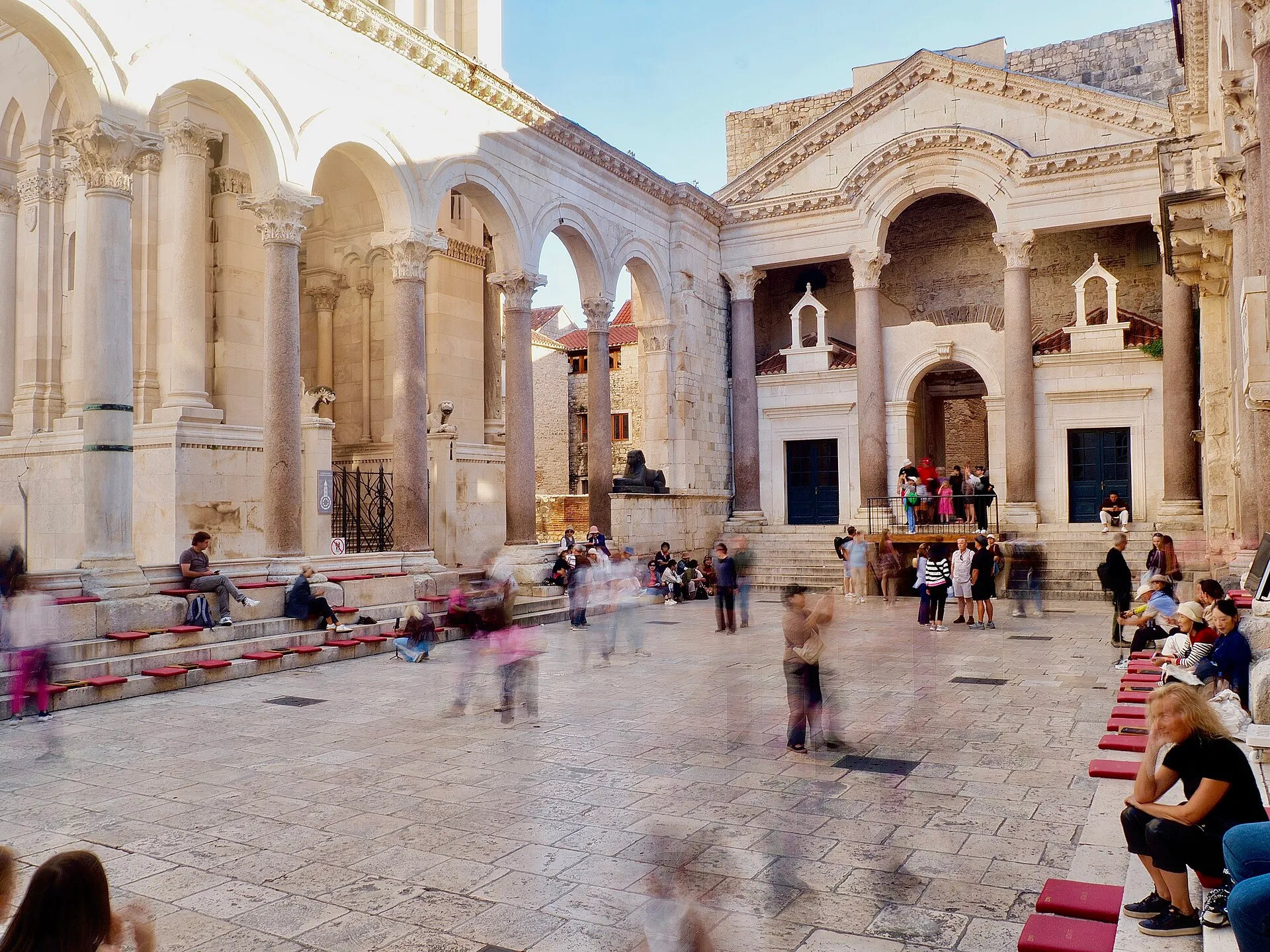
The Peristyle is the central square of the palace. Diocletian appeared under the central part of its southern porch, and his subjects knelt to kiss the hem of his scarlet cloak. The columns are red granite, a colour that stood for the imperial purple. Palaces of the Split noble families Grisogono, Cipci and Skočibušić lean on its columns and arches on the west side, and a 3,500-year-old Egyptian sphinx watches over the square (Split Tourist Board). The Tourist Board notes that the steps round the Peristyle make a place for a coffee, and that the acoustics suit open-air opera and drama. One of its two information centres is here, and the other is on the Riva (Split in 1 day).
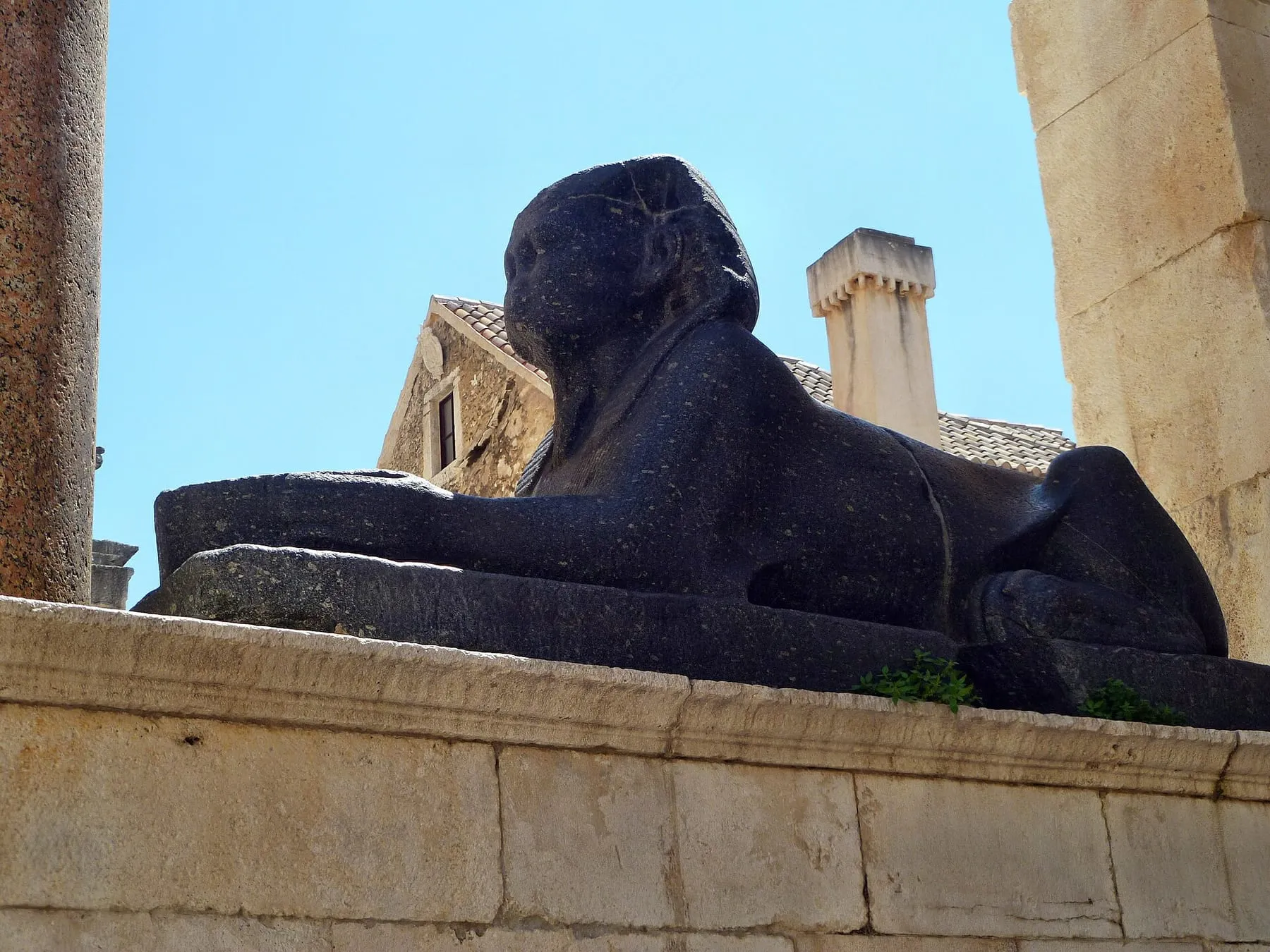
The Peristyle sphinx. Photo: JoJan, Wikimedia Commons, CC BY 3.0.
The Vestibule is directly south of the Peristyle: rectangular outside, circular inside, with a ring of niches and a dome that has gone. It was the way into the residential part of the palace. The Tourist Board says that a little over half a century ago people lived in it and kept poultry there (Vestibule). The cellars begin beside it, below the line of the emperor’s apartments, and the central hall is the main route between the Peristyle and the Riva (Substructures).
The four gates
- Golden Gate (north): the main gate, where the road led to Salona and which only the emperor and his family could use. It is a rectangle with double doors, and its facade has niches that held statues of the four tetrarchs, the co-rulers of the empire. The name Golden comes from the 16th century under Venetian influence. Bishop Gregory of Nin, a bronze by Ivan Meštrović, stands outside it, and touching his big toe is said to make wishes come true (Split Tourist Board). Meštrović’s biography says the statue was unveiled on the Peristyle in 1929, removed by the Italian authorities during the Second World War and set up by the Golden Gate in 1954 (Meštrović Museums). More of Meštrović’s work is in the Meštrović Gallery.
- Silver Gate (east): more modest than the Golden Gate, it was closed from the Middle Ages until 1952. Remains of its octagonal towers stand on each side, and the main east-west street, the decumanus, still has its ancient paving. The market is outside it (Split Tourist Board).
- Iron Gate (west): the only gate of the four that has stayed in continuous use. A Romanesque bell tower from the 11th century stands above it, and the city clock beside it has 24 digits instead of 12. It opens onto Pjaca, the People’s Square, with the Old Town Hall (Split Tourist Board).
- Bronze Gate (south): small and plain, it opened from the emperor’s rooms to the sea. It now leads through the cellars to the Riva, where the walk along the waterfront begins (Split Tourist Board).
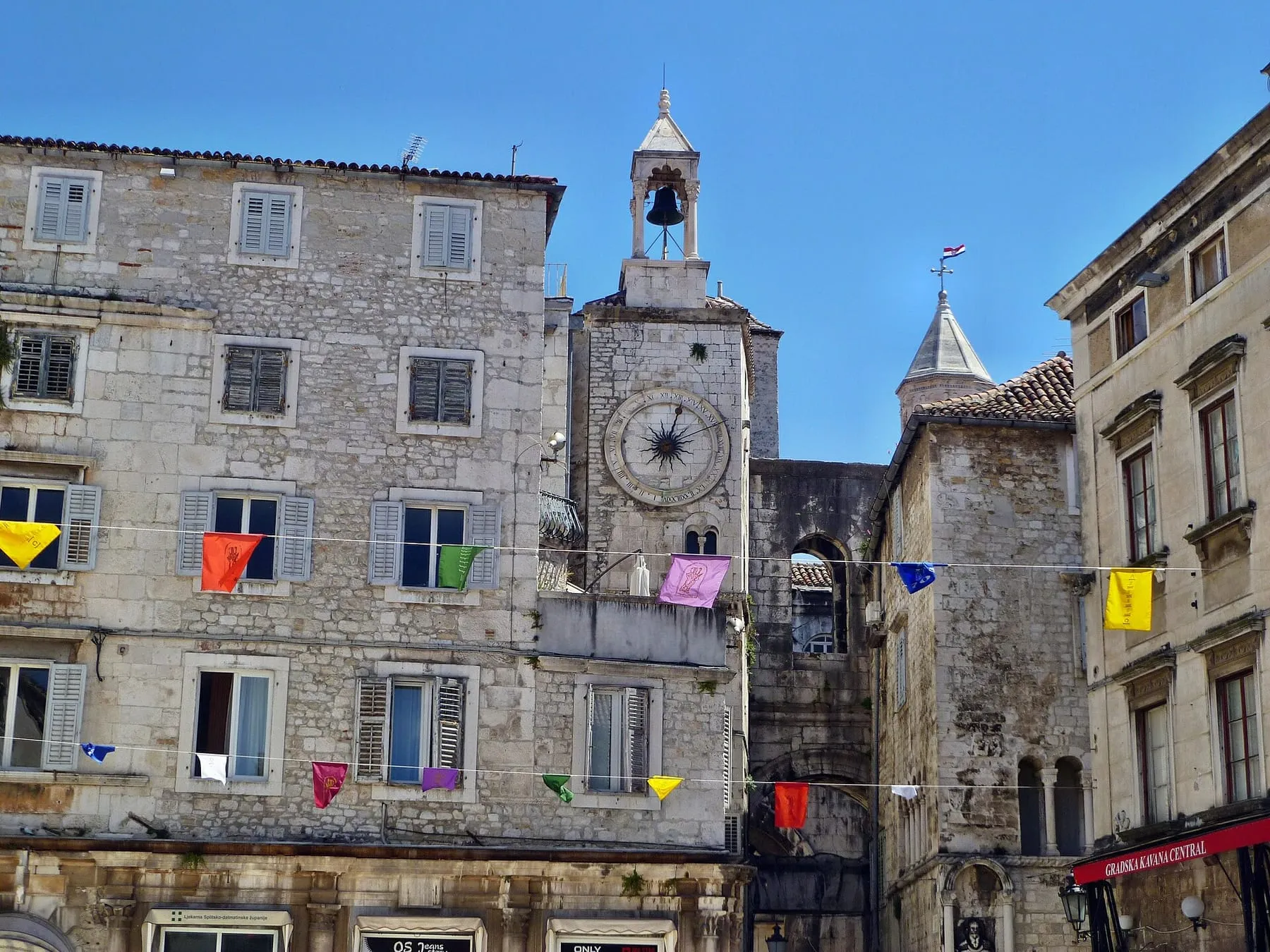
The Iron Gate bell tower and clock. Photo: JoJan, Wikimedia Commons, CC BY 3.0.
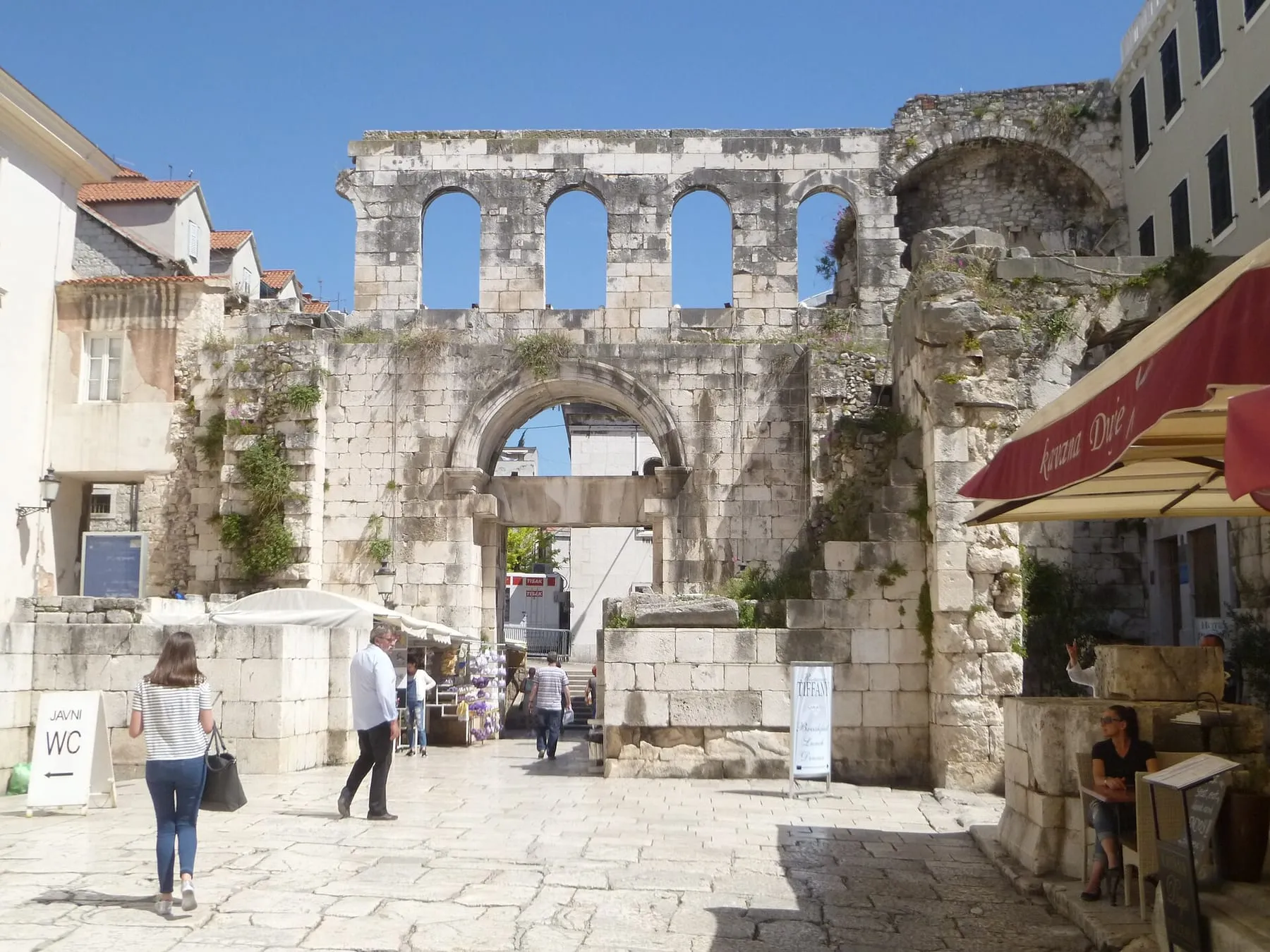
The Silver Gate. Photo: JoJan, Wikimedia Commons, CC BY 3.0.
Walking it
- Start at the Golden Gate and the Gregory of Nin statue.
- Walk south along the main street to the Peristyle. The cathedral and its bell tower are on the east side, and the baptistery and its headless sphinx are on the west.
- Find the narrowest street in the city, Let Me Pass, next to the Temple of Jupiter (Split in 1 day).
- Go through the Vestibule and down into the cellars, or out of the Bronze Gate to the Riva.
- The Tourist Board says that in summer the Diocletian guard changes every day at noon, with an appearance by the emperor.
- Finish by the market and the Silver Gate, then follow the decumanus west to the Iron Gate and Pjaca.
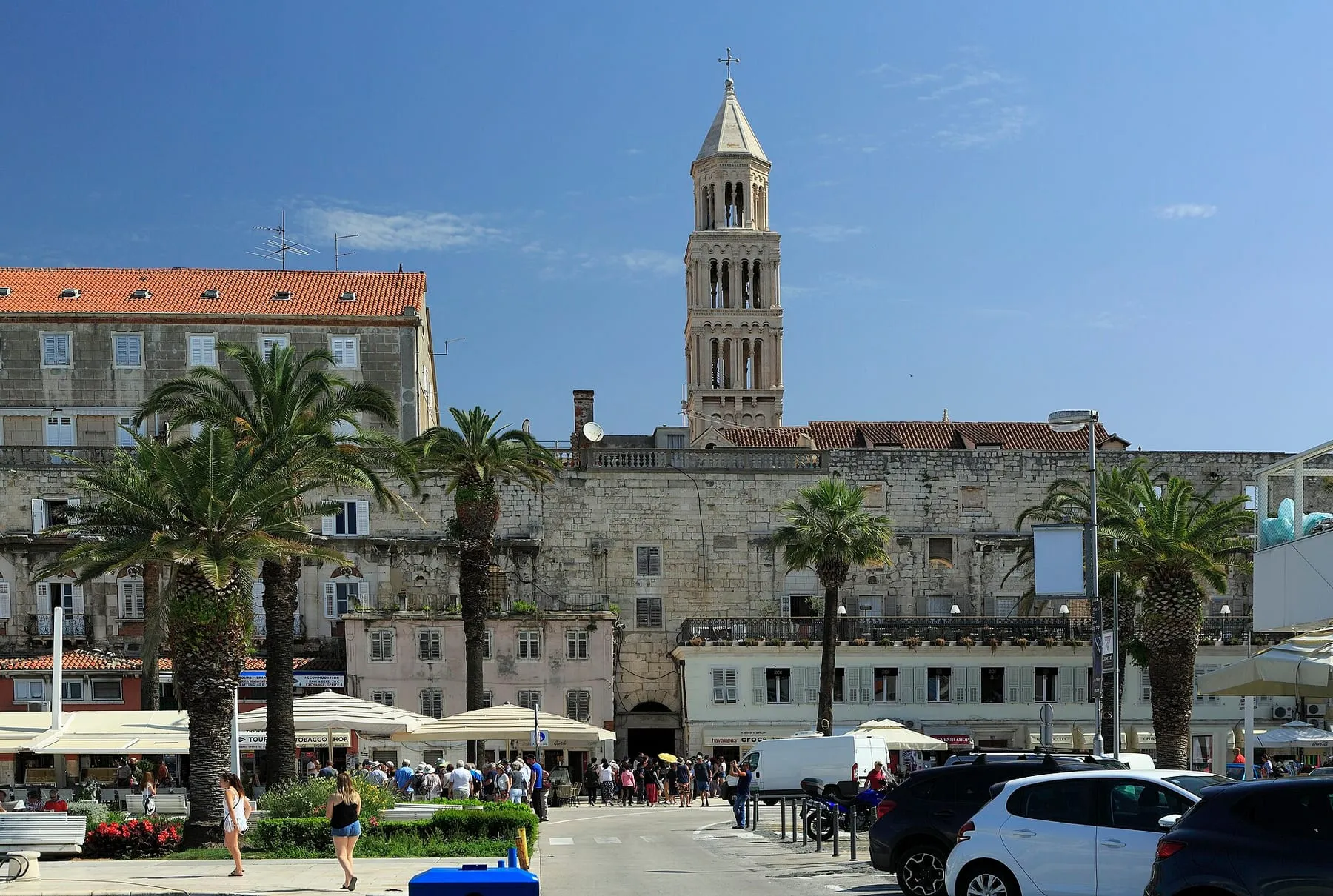
The south wall from the Riva, with the Bronze Gate at the centre. Photo: Falk2, Wikimedia Commons, CC BY-SA 4.0.
The palace is also the setting for the scenes filmed in Split for Game of Thrones. For longer plans, see 3 days in Split, and for the walk uphill to the viewpoints, the Marjan guide.
What to see next
- Diocletian’s Palace cellars: tickets, hours and the halls under the emperor’s apartments.
- Split cathedral and bell tower: the mausoleum turned church, with the 57-metre tower.
- Free things to do in Split: the gates, the squares and the viewpoints that cost nothing.
- Archaeological Museum: the finds from Salona and a second sphinx.
- 3 days in Split: the palace in a longer plan.
- Where to stay in Split: hotels in and around the palace.
Common questions
Is Diocletian's Palace free to enter?
Walking through the palace streets, the Peristyle and the four gates costs nothing. Tickets are sold for the cellars (€10 for adults, from the Split City Museum), the cathedral (€5) and its treasury (€5), the bell tower (€7), the crypt (€3) and the baptistery, the former Temple of Jupiter (€3). Prices are from November 2026.
Where are the four gates?
The Golden Gate is the north gate, on the road towards Salona. The Silver Gate is the east gate, next to the main market. The Iron Gate is the west gate and opens onto Pjaca, the People's Square. The Bronze Gate is the small south gate that leads through the cellars to the sea front, now the Riva.
Is there a guard to watch at the palace?
The Split Tourist Board says that in summer the Diocletian guard changes every day at noon, with an appearance by the emperor.
What is inside the palace walls today?
People live, shop and eat inside the walls: the Tourist Board says the Iron Gate has housing built into its walls, and the Vestibule was used for living until a little over half a century ago. The historic core of Split with the Palace of Diocletian has been on the UNESCO World Heritage List since 1979.
What are the cellars' opening hours?
From 1 November 2026 to 28 March 2027 the cellars are open every day from 09:00 to 17:00, with last entry 30 minutes before closing. They are closed on 18 November, 25 and 26 December, 1 and 6 January and 28 March (Split City Museum).
When did Diocletian enter the palace?
The Split Tourist Board gives 1 June 305 as the day he walked through the north gate, now the Golden Gate.