In this guide
💡 The Short Version: Bačvice is Split’s city sand beach, a 10-minute walk east of the ferry terminal. It has been the municipal beach since 1919 and is the birthplace of picigin, Croatia’s protected folk ball game played in ankle-deep water year-round. From the Bačvice Pavilion, a continuous seafront promenade (lungomare) heads east past the pebble coves of Ovčice, the sandy bay and tennis grounds of Firule, the deep harbour of Zenta, and the pebble beaches of Trstenik and Žnjan. Return to the centre using Promet Split bus line 7 or 8. Or book a tour: To explore Split’s coastline from the water at dusk, the Split: Sunset Cruise on a Traditional Wooden Boatad sails past the city beaches with a glass of local wine.
⚠️ Purchase public transport tickets before boarding to save money. Single bus fares cost €1.50 when bought via the Promet Split smartphone app or tapped on onboard card readers, compared to €3.00 in cash from the driver.
| Stop | From the previous stop | What it is |
|---|---|---|
| Split ferry port and bus station | Start | A 10-minute walk to the first beach |
| Bačvice sand beach | 10 min walk | Picigin shallows and the pavilion |
| Ovčice pebble cove | 500 m | Tamarisk shade and beach bars |
| Firule sandy bay | 800 m | The historic tennis academy |
| Zenta marina and port | 700 m | Sailing club and sea pool |
| Trstenik beach | 1 km | Blue Flag pebbles |
| Žnjan beach plateau | 1.5 km | Sports park, and Promet buses 7 and 8 back to the centre |
Bačvice Beach and the picigin tradition
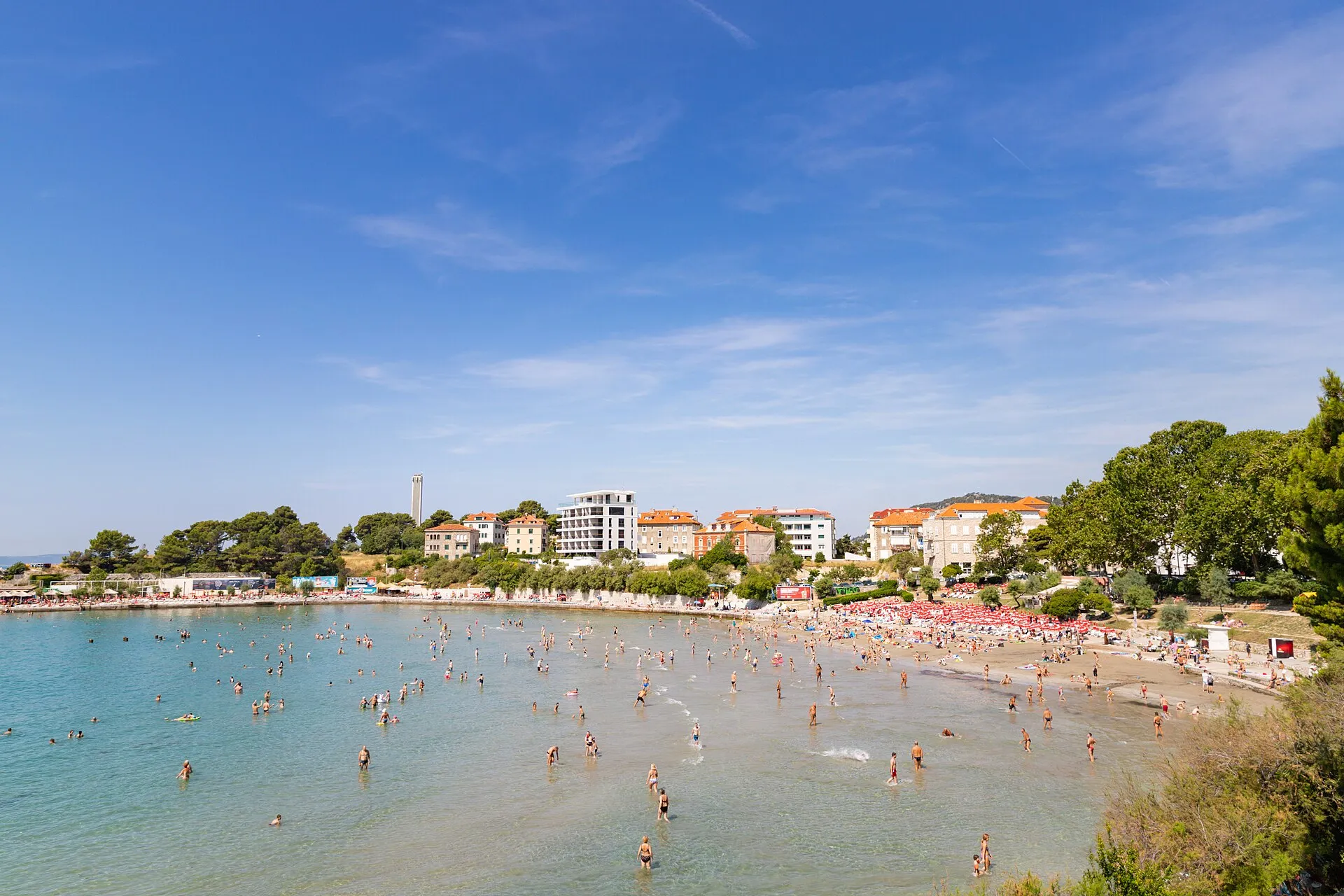
Bačvice sits in a semicircular bay just east of the passenger ferry piers and has been Split’s municipal bathing ground since 1919. Most of the Dalmatian coast is steep limestone and pebble coves; Bačvice is fine sand, and the water stays no deeper than your knees for nearly 100 metres from the shoreline.
The concrete bathing pavilion (Kupališni dom), built in the 1930s and reconstructed in 1997, anchors the eastern curve of the bay with cafe terraces, casual eateries and nightspots.
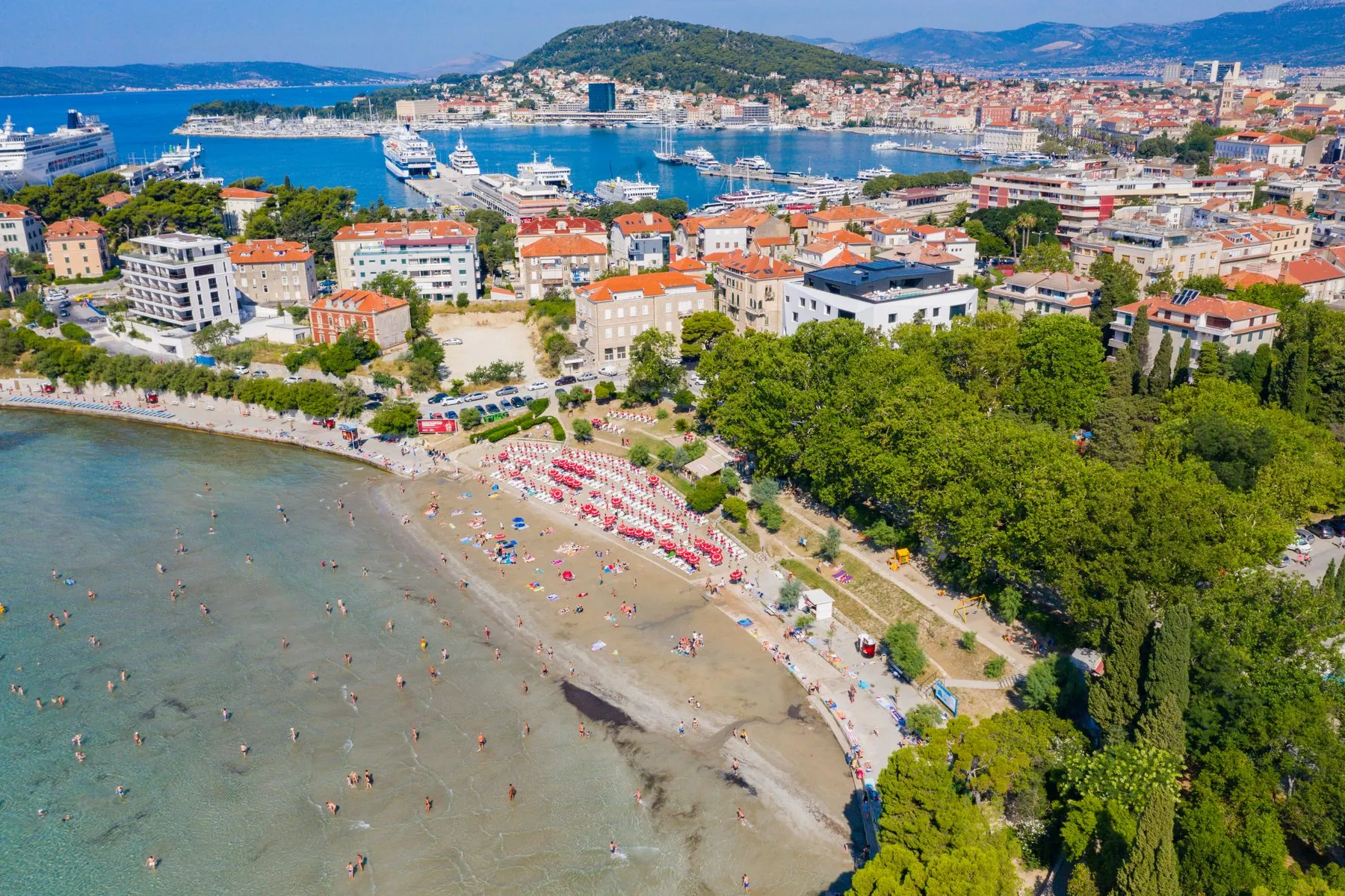 Aerial view of the shallow sandy bay at Bačvice. Photo: dronepicr, Wikimedia Commons, CC BY 2.0.
The art and rules of picigin
Bačvice is the birthplace of picigin, a non-competitive folk water game that dates from 1908. According to local lore, Croatian students home from university in Prague tried to play water polo here. The water was too shallow to swim in, so they swapped the water polo ball for a small one and batted it across the shallows.
In 2008, the Ministry of Culture officially registered picigin as a protected intangible cultural good of the Republic of Croatia (Nematerijalno kulturno dobro).
- Objective: Keep the ball in the air as long as possible using only open palms. Five players stand in ankle- to calf-deep water. There is no net, no scorekeeping, no opposing team and no winner.
- The players: Five players stand roughly as a pentagon. Two are sidruni (anchors), who stay fairly still and direct the returns. Three are trkači (runners), who sprint across the sand and dive headlong into the sea to save loose passes.
- The ball (balun): Players peel the felt off a tennis ball with a razor blade and sand the rubber core smooth, to a weight of 70 to 80 grams, so it skips off a wet palm.
- The dives: The showpiece of the game is the dive (skokovi). The seabed is soft sand with no sharp rocks or sea urchins, so players launch themselves horizontally, slap the ball upward and land full-length in the water.
- Year-round play: Players (piciginaši) enter the water in all twelve months. The traditional match is on 1 January, in sea water at 12 °C to 14 °C.
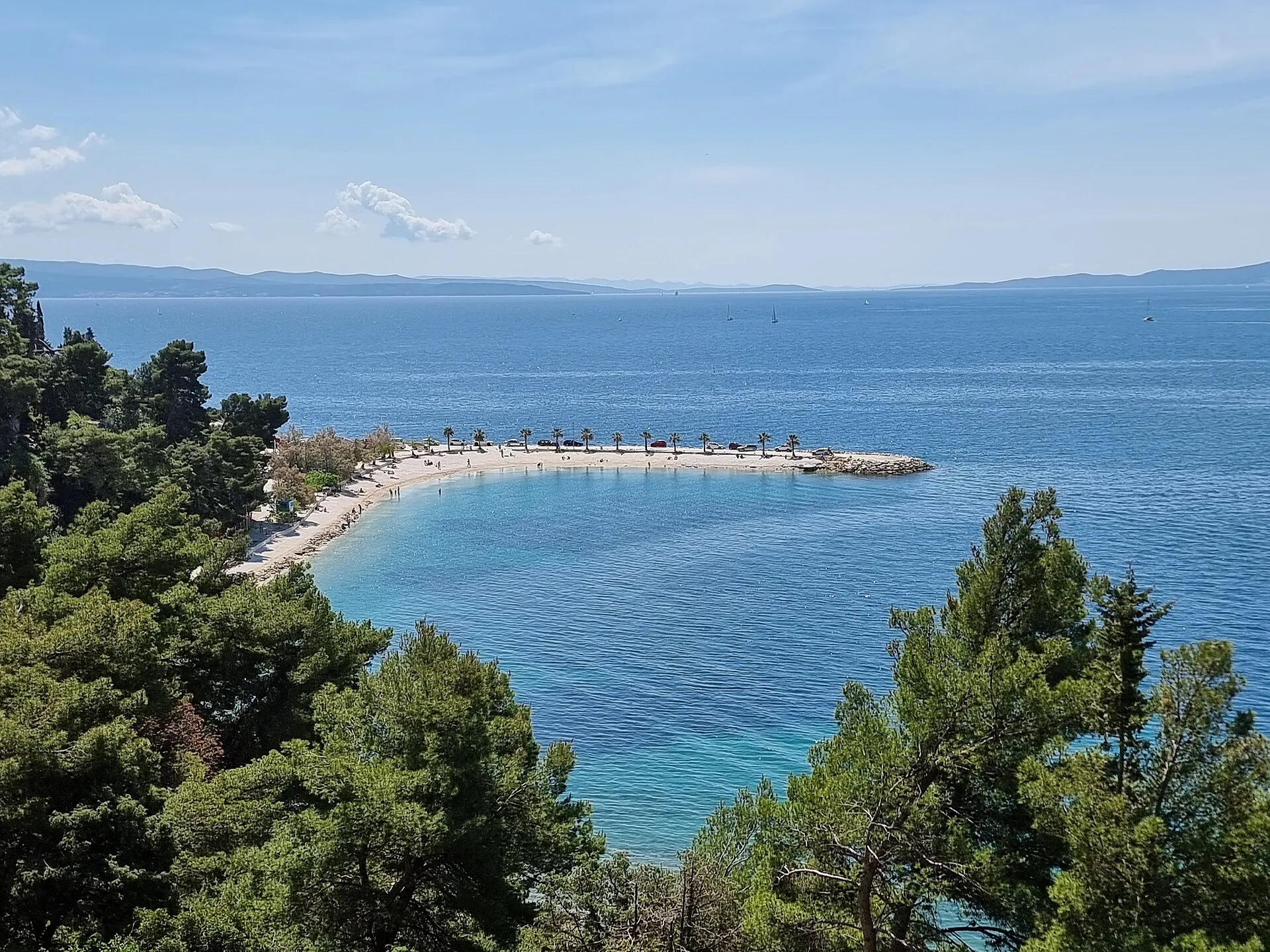
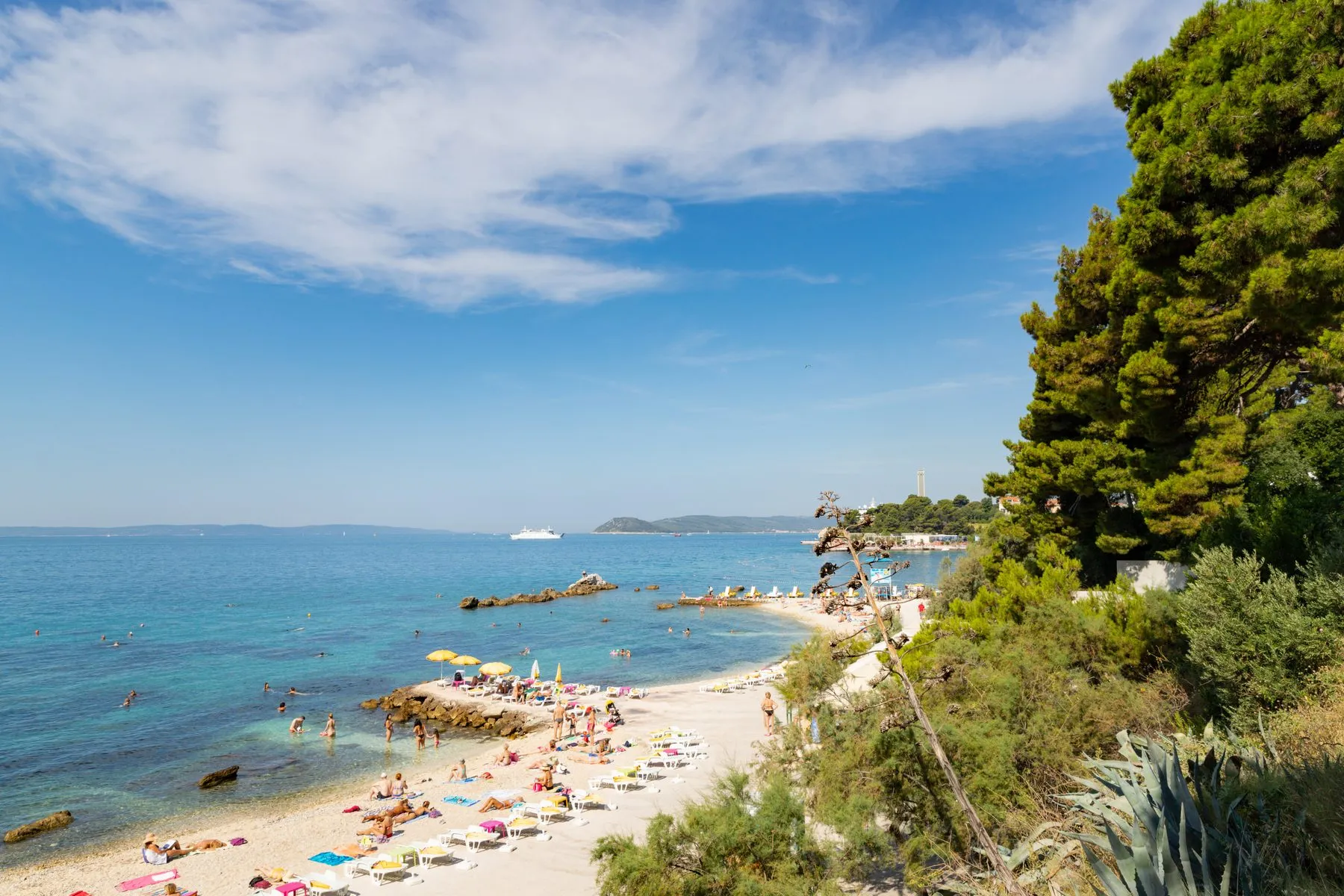 Ovčice pebble cove, the first bay east of Bačvice. Photo: dronepicr, Wikimedia Commons, CC BY 2.0.
The coastal walk east: Bačvice to Žnjan
Split’s eastern waterfront has a continuous pedestrian path (lungomare) of about 4.5 kilometres from Bačvice to Žnjan. It is paved throughout, closed to vehicles and lit at night, and it is a popular route for walkers and joggers.
| Coastal section | Distance from Bačvice | Beach substrate | Distinctive highlights |
|---|---|---|---|
| Bačvice | 0 km | Fine sand | Shallow seabed, picigin players, pavilion cafes |
| Ovčice | 0.5 km | Fine gravel / pebbles | Sheltered cove, tamarisk trees, seaside cafe |
| Firule | 1.3 km | Compact sand | Natural amphitheatre, historic tennis academy |
| Zenta Marina | 2.0 km | Concrete quay / marina | Recreational sailing harbour, swimming club pool |
| Trstenik | 3.0 km | Polished pebbles | Blue Flag clear waters, wide sunbathing areas |
| Žnjan | 4.5 km | Broad pebble beach | Modern sports park, promenade cafes, bus terminal |
1. Bačvice to Ovčice (500 metres)
From Bačvice a concrete seawall path leads east around a rocky point below the villas into Ovčice, a much smaller inlet with round pebbles rather than sand. Tamarisk trees and pine slopes frame it, and it is quieter than Bačvice. A cafe sits at the edge of the pebble shelf serving mineral water, espresso and Karlovačko beer.
2. Ovčice to Firule (800 metres)
Round the next point and you reach Firule bay. Like Bačvice it has natural sand, sheltered from the southern wind (jugo) by limestone bluffs. The shallow entry suits families with toddlers.
Above the eastern bluff is the Firule tennis club, whose clay courts overlook the sea. Wimbledon champion Goran Ivanišević, French Open finalist Nikola Pilić, Davis Cup winner Mario Ančić and WTA player Jelena Kostanić all learned to play on these courts.
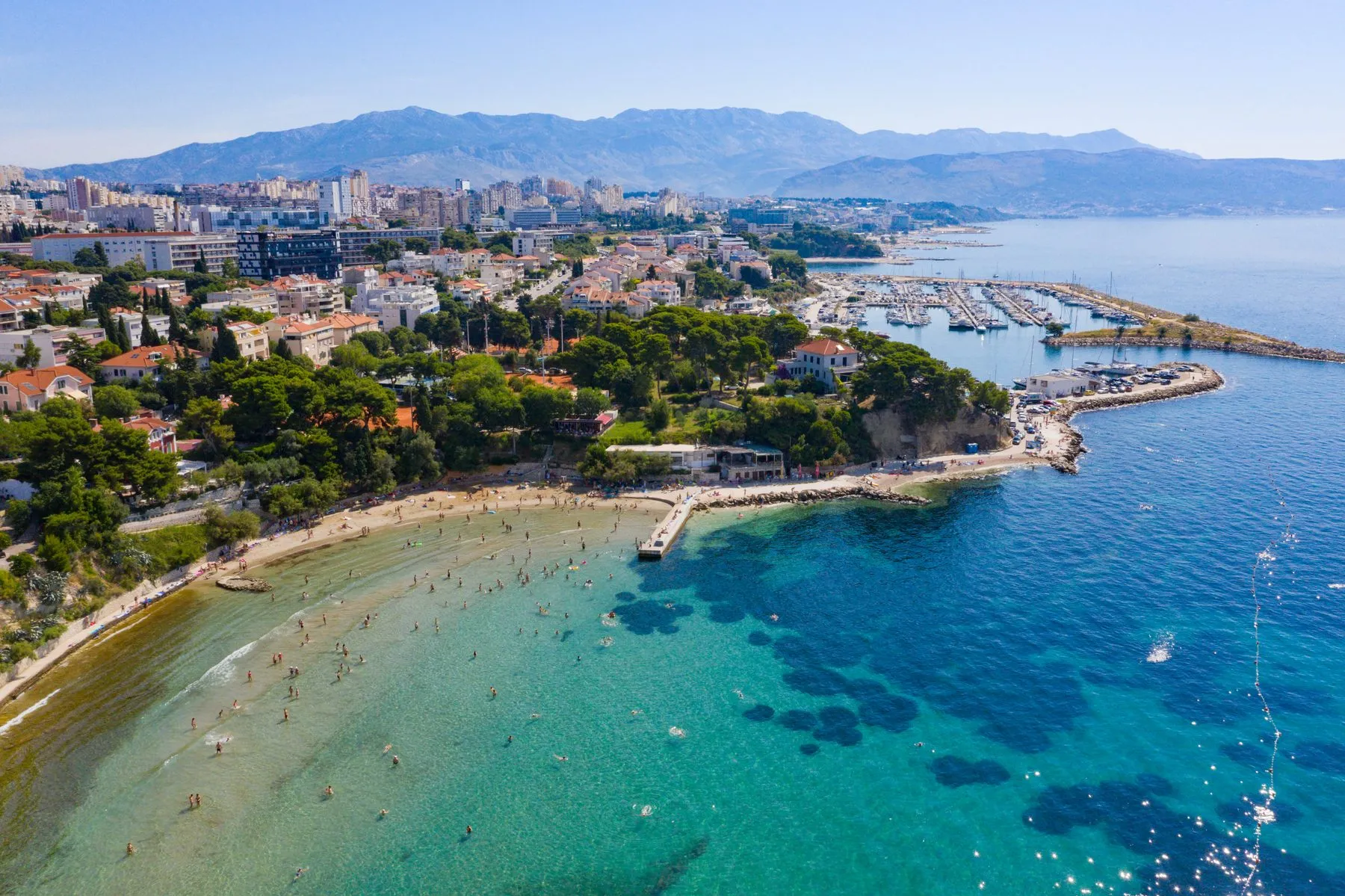 Firule bay and its fine sand shoreline facing Marina Zenta. Photo: dronepicr, Wikimedia Commons, CC BY 2.0.
3. Zenta Marina to Trstenik (1.7 kilometres)
From Firule the path passes through Marina Zenta, a boat harbour of yachts and pleasure craft with the training pool of the Pošk water polo club.
Further east is Trstenik, a long bay of white pebbles with Blue Flag status. It has wooden boardwalks, public freshwater showers and summer lifeguards. The eastern end of the bay fronts the terraces of the Radisson Blu Resort Split.
4. Žnjan Beach Plateau (1.5 kilometres)
Beyond Trstenik is Žnjan, a broad coastal plain that was cleared and paved in 1998 for Pope John Paul II’s open-air mass, which drew an estimated 500,000 people from Croatia and Bosnia and Herzegovina.
A renovation completed in 2025/2026 turned it into a sports and seafront park with cycling tracks, skate parks, outdoor gyms, beach volleyball courts, children’s water play areas and beach pavilions. The pebble shoreline runs for nearly two kilometres.
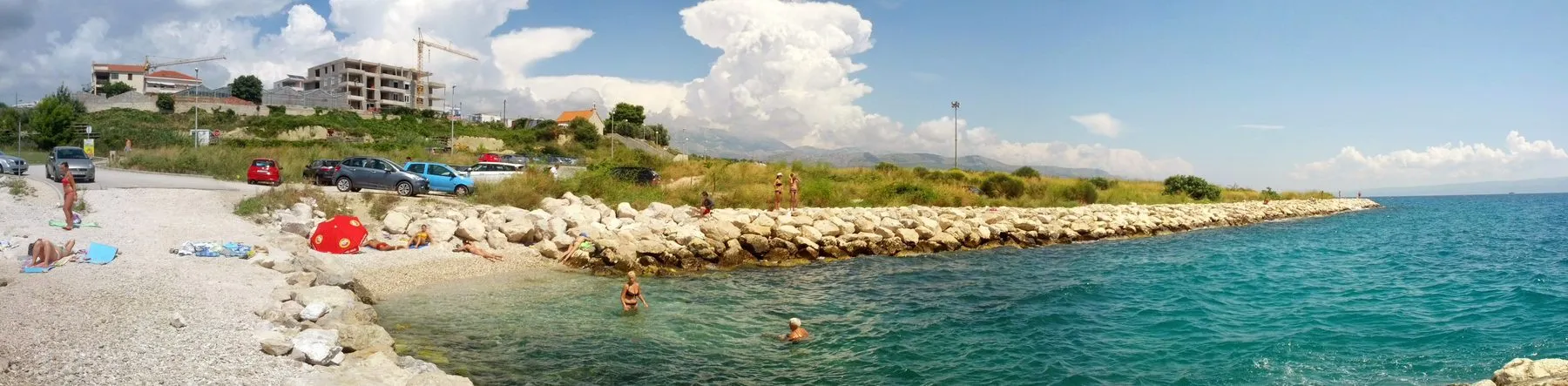 The renewed pebble seafront and sports promenade at Žnjan. Photo: Klapi, Wikimedia Commons, CC BY-SA 4.0.
Tours and coastal excursions
To see the coast from the water rather than the path, there are sunset boat cruises, and an e-bike tour covers the paths on land.
Split: Sunset Cruise on a Traditional Wooden Boat
From €30 · 5 stars from 67 reviews · 1.5 hours · free cancellation
Split: Sunset Cruise on a Traditional Wooden Boatad: Enjoy a relaxing sunset cruise along the Split coastline on a traditional wooden boat. Sip on a complimentary glass of local wine, feel the evening sea breeze, and admire panoramic views of the city beaches and coastal hills as the sun sets over the Adriatic.
Boutique Sunset Cruise with Live Music & Drinks
From €60 · 4.9 stars from 520 reviews · 2 hours · free cancellation
Boutique Sunset Cruise with Live Music & Drinksad: Cruise the Split Riviera aboard the motor yacht Polaris. Enjoy an intimate, uncrowded evening with live evergreen music, an open bar, and views of the southern beaches and Marjan headland from the water.
Split City Electric Bike Tour
From €65 · 4.8 stars from 220 reviews · 3 hours · free cancellation
Split City Electric Bike Tourad: Pedal through Split’s coastal paths, historic squares, and park trails with pedal-assist electric bicycles. An effortless way to cover both the eastern seaside promenade and the pine hills of Marjan in a single half-day ride.
Choosing your coastal itinerary
| Option | Coastal Lungomare on foot | Sunset boat cruise (e.g. t1443874) | E-Bike coastal tour (t662531) |
|---|---|---|---|
| Cost | Free (Bus return €1.50) | From €30 per person | From €65 per person |
| Activity type | Self-paced seaside walking / swimming | Relaxing cruise with wine | Active pedal-assist cycling |
| Duration | 2 to 4 hours | 1.5 hours | 3 hours |
| Swimming stops | Unlimited at any bay | Sea views only | Brief photo and scenic stops |
| Best time | Morning or late afternoon | 18:30 to 20:30 (summer) | 09:30 or 16:30 |
Practical advice for swimmers and walkers
- Getting back from Žnjan: Promet Split bus lines 7 and 8 end at the Žnjan turnaround directly above the beach. Buses leave every 20 minutes on weekdays and every 30 minutes at weekends, and reach the city centre in about 15 minutes. Tickets cost €1.50 via the Promet mobile app or card tap machine, or €3.00 cash from the driver.
- Sun protection: There is little shade between Firule and Trstenik. Bring sunscreen, sunglasses and a hat if you walk between 11:00 and 16:00.
- Footwear: Bačvice and Firule have sandy entries where bare feet are fine. Trstenik and Žnjan are rounded gravel and pebbles, so bring water shoes if you have sensitive feet.
- Showers: Freshwater showers stand along the promenade at Bačvice, Ovčice, Firule, Trstenik and Žnjan. Most are free; some take a small coin in peak summer.
What to see next
- Split Riva and Promenade Walk: Split’s palm-lined civic waterfront, 10 minutes west of Bačvice.
- Marjan Forest Park and Viewpoints: The pine-shaded pebble beaches of Kašjuni and Bene on Split’s western peninsula.
- Getting Around Split: Promet bus routes, ticketing apps and ferry terminals.
- 3 Days in Split: Where a beach walk fits in a three-day itinerary.
- Best Time to Visit Split: Sea temperatures, rainfall and sunshine hours by month.
- Free Things to Do in Split: No-cost sights across the coast and the old town.
Common questions
Is Bačvice a sandy or pebble beach?
Bačvice is a natural fine-sand beach situated in a protected shallow cove. The seabed slopes out gradually, so the water stays knee-deep for dozens of metres from the shore.
What is picigin and what are its basic rules?
Picigin is a traditional amateur ball game invented at Bačvice in 1908. Five players stand in a loose pentagon in ankle-deep water, cooperating to keep a peeled tennis ball in the air using only the open palms of their hands. There are no points, no opposing teams, and no winners.
Do people play picigin in winter?
Yes. Picigin is played year-round regardless of weather. Local players observe an annual New Year's Day tradition on 1 January, plunging into winter waters that typically hover between 12 °C and 14 °C.
How long is the coastal promenade walk from Bačvice to Žnjan?
The paved seaside footpath (lungomare) stretches approximately 4.5 kilometres from the Bačvice Pavilion eastward to the edge of Žnjan beach, taking 1 to 1.5 hours at a relaxed walking pace.
Which bus returns to Split centre from Žnjan?
Promet Split bus line 7 and line 8 depart from the Žnjan terminus and connect directly to the city centre. Single tickets cost €1.50 via the Promet mobile app or card validator, or €3.00 cash from the driver.