In this guide
The Short Version: Nicknamed “Osaka’s Kitchen” (Osaka no Daidokoro), Kuromon Ichiba Market is a covered 580-metre food arcade housing around 150 independent fishmongers, butchers, fruit vendors, and street grills. Head to Maguroya Kurogin for fatty tuna sashimi cut to order, Kuromon Sanpei for giant butter-grilled scallops and king crab legs, and Marusho for blowtorched A5 Wagyu beef skewers. Arrive between 10:30 and 13:00 for peak market energy, and remember to eat at the stall counters rather than walking through the crowd.
While Tokyo’s seafood legacy centres around Tsukiji Outer Market and Toyosu, Osaka’s culinary engine has been powered by Kuromon Ichiba since 1822. Originally called Enmyoji Market, it took its current name, Kuromon (“Black Gate”), from the charcoal-stained wooden entrance gates of the neighbouring Enmyoji Buddhist temple that once stood nearby.
For generations, Kuromon functioned primarily as a wholesale trading ground where master chefs from Dotombori’s ryotei and kappo restaurants purchased morning fish. Over recent decades, the market has welcomed visitors by adapting its stalls into interactive cook-to-order counters.
Market opening times and schedule
Kuromon Market operates daily, but individual stall hours vary:
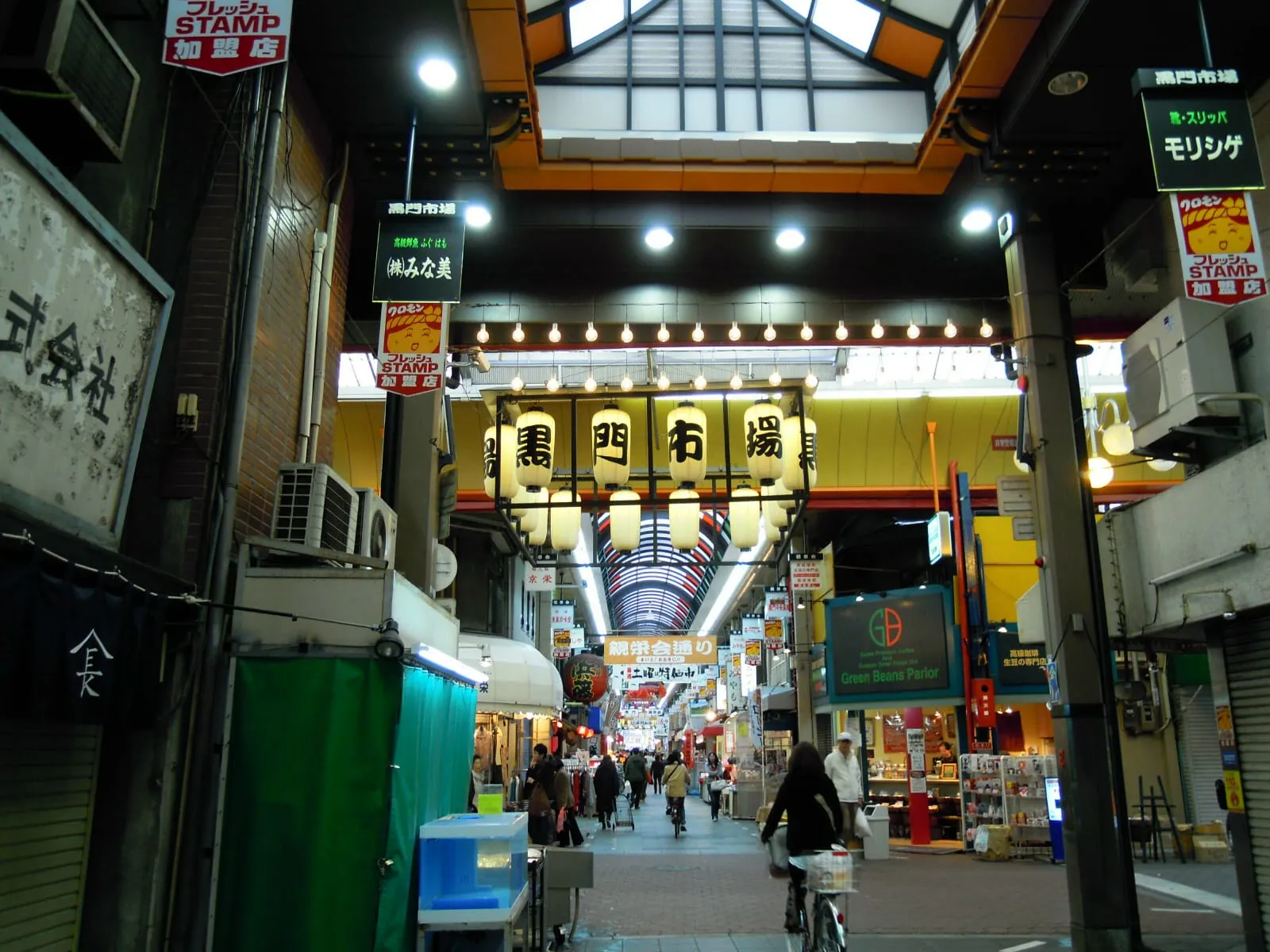
Lanterns hanging over the covered Kuromon Ichiba Market arcade at night, with a cyclist riding through. Photo: DVMG, Wikimedia Commons, CC BY 3.0.
- General trading hours: 9:00 to 17:00 or 18:00.
- Prime visiting window: 10:30 to 14:00. Arriving before 9:30 finds many vendors still setting out ice beds; arriving after 16:00 means popular seafood items like sea urchin and crab legs are sold out.
- Sundays and public holidays: The market remains open, but around 20% to 30% of traditional wholesale fish stalls and produce merchants close on Sundays. Visiting between Tuesday and Saturday guarantees the fullest selection.
What to eat: top stalls and specialties
Food in Kuromon is bought point-and-cook: you select an uncooked cut of fish, crab cluster, or wagyu steak from the chilled counter, and the vendor cooks it immediately on a teppan griddle or charcoal grill before handing it to you on a wooden tray.
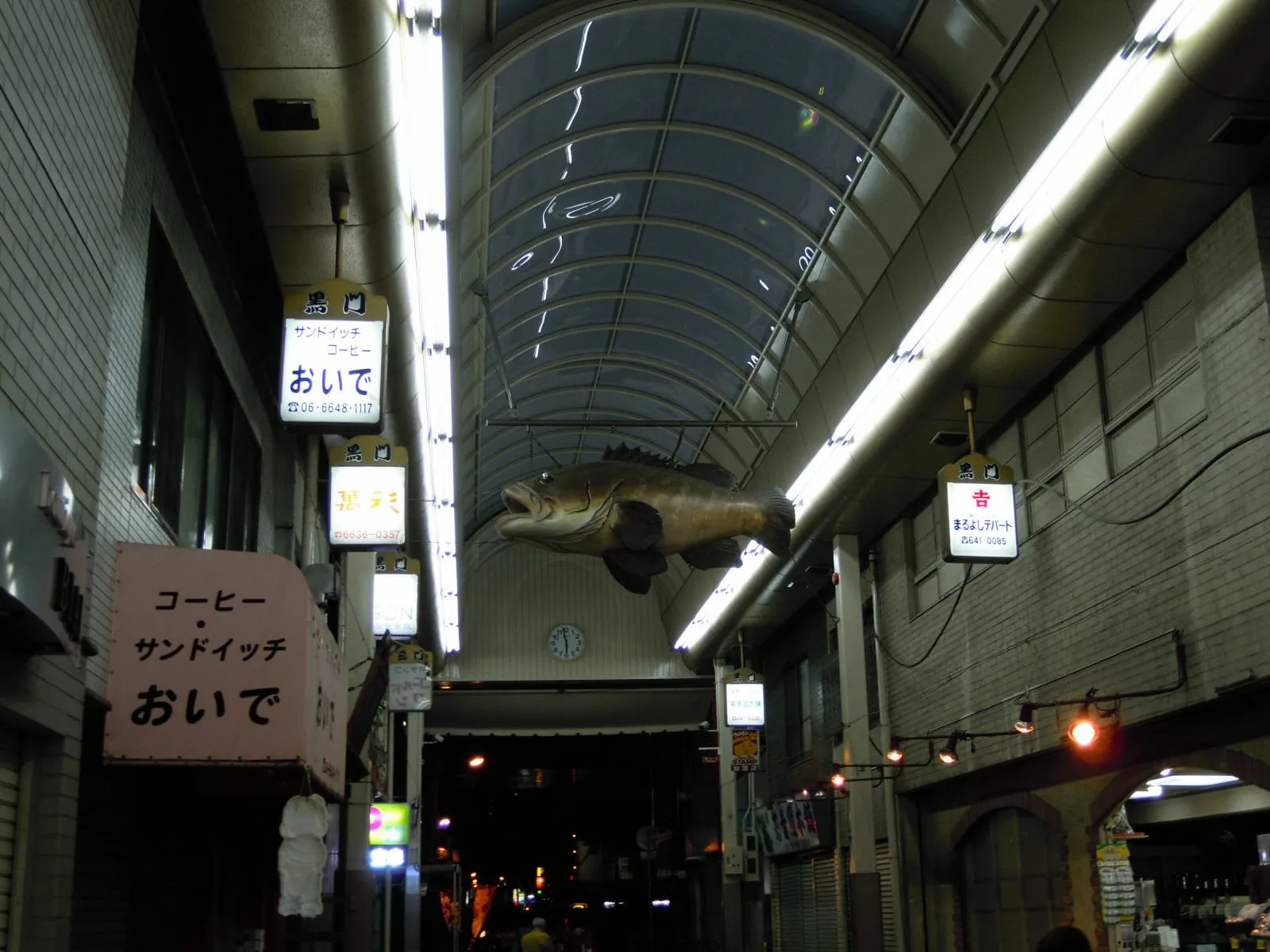
A large fish model hanging under the roof of a Kuromon Ichiba Market arcade at night. Photo: DVMG, Wikimedia Commons, CC BY 3.0.
| Stall name | Specialty dish | Typical price range | Details |
|---|---|---|---|
| Maguroya Kurogin | Otoro and Chutoro tuna rice bowls & nigiri | 1,500 yen to 3,800 yen | Master tuna butcher slicing Bluefin tuna to order |
| Kuromon Sanpei | Giant scallops, king crab legs, sea urchin | 1,000 yen to 4,500 yen | Large seafood supermarket with extensive indoor dining |
| Marusho Meat Shop | Blowtorched A5 Kobe and Matsusaka Wagyu skewers | 1,500 yen to 3,000 yen | Seared with garlic soy on flat teppans |
| Ishibashi Shokuhin | Dashi-simmered daikon and fish cake oden | 150 yen to 300 yen | Historic惣菜 (sozai) shop with giant bubbling dashi vat |
| Kushisei | Grilled unagi (freshwater eel) and oysters | 800 yen to 2,000 yen | Skewered seafood basted in sweet caramelized tare |
Fresh seafood counters
- Maguro (Pacific Bluefin Tuna): At Maguroya Kurogin, whole sides of Pacific Bluefin tuna are broken down at the front counter. You can point to specific blocks of otoro (fatty tuna belly), chutoro (medium fatty tuna), or akami (lean red meat). Staff will slice it into sashimi, press it into nigiri sushi, or pile it atop warm vinegared rice for a kaisen-don bowl.
- Hotate (Giant Hokkaido Scallops): Palm-sized Hokkaido scallops are grilled in their shells over open gas flames, basted with melted butter and rich soy sauce (800 yen to 1,200 yen each). The resulting broth collected in the shell is drunk like soup.
- Tarabagani (King Crab Legs): Massive red king crab legs are split down the centre, grilled over hot coals, and served with lemon wedges.
- Uni (Sea Urchin): Whole live sea urchins are cracked open on request, rinsed in cold saline water, and eaten with small wooden spoons straight from the spiny shell (1,200 yen to 2,500 yen depending on size and origin).
Wagyu and Kobe beef
High-end butcher stalls like Marusho display certified A5-grade Kobe beef and Matsusaka wagyu beef. Steaks are marbled with intricate webs of intramuscular fat. After you select your cut, the chef sears the meat on a sizzling flat griddle, finishing the crust with a roaring hand-held blowtorch and dusting the cubes with pink rock salt and fried garlic chips.
Traditional market comfort food
For a taste of traditional Japanese home-style cooking, look for Ishibashi Shokuhin. Operating for over 40 years, this family-run sozai (prepared food) shop centres around an enormous simmering rectangular vat of golden kelp dashi oden.
- Simmered Daikon: Thick rounds of white radish that have simmered for over six hours, fully saturated with umami-rich broth (150 yen).
- Hanpen and Chikuwa: Light, fluffy fish cakes and fish sausages (150 yen to 200 yen).
- Beef Tendon (Suji): Gelatinous skewers of tender braised beef tendon (200 yen).
Rare seasonal fruits
Kuromon’s produce stalls offer Japan’s famous luxury fruit:
- Shiroi Houseki (White Jewel Strawberries): Cultivated in Saga Prefecture with minimal sunlight to produce pale white berries with red seeds, famed for their aroma and pineapple-like sweetness (from 1,000 yen per pack).
- Shine Muscat Grapes: Seedless, crisp, intensely sweet green grapes (from 1,500 yen per bunch).
- Yubari and Shizuoka Melons: Slices of aromatic green musk melon served on wooden sticks (500 yen to 800 yen per slice).
Market dining etiquette and tips
- Do not walk while eating (aruki-gui): The alleys of Kuromon are narrow and crowded. Walking with skewers of oily beef or cups of hot soup poses a burn hazard and risks staining other visitors’ clothing. Always stand or sit at the stall’s designated seating area until you finish eating.
- Dispose of rubbish at the point of purchase: Public rubbish bins on Japanese streets are scarce. Return your wooden skewers, empty clam shells, and plastic trays directly to the vendor who sold them to you.
- Use the Kuromon Information Center: Located halfway down the main arcade, this free facility provides clean public restrooms, baby changing stations, hand-washing sinks, drink vending machines, and air-conditioned bench seating where you can rest.
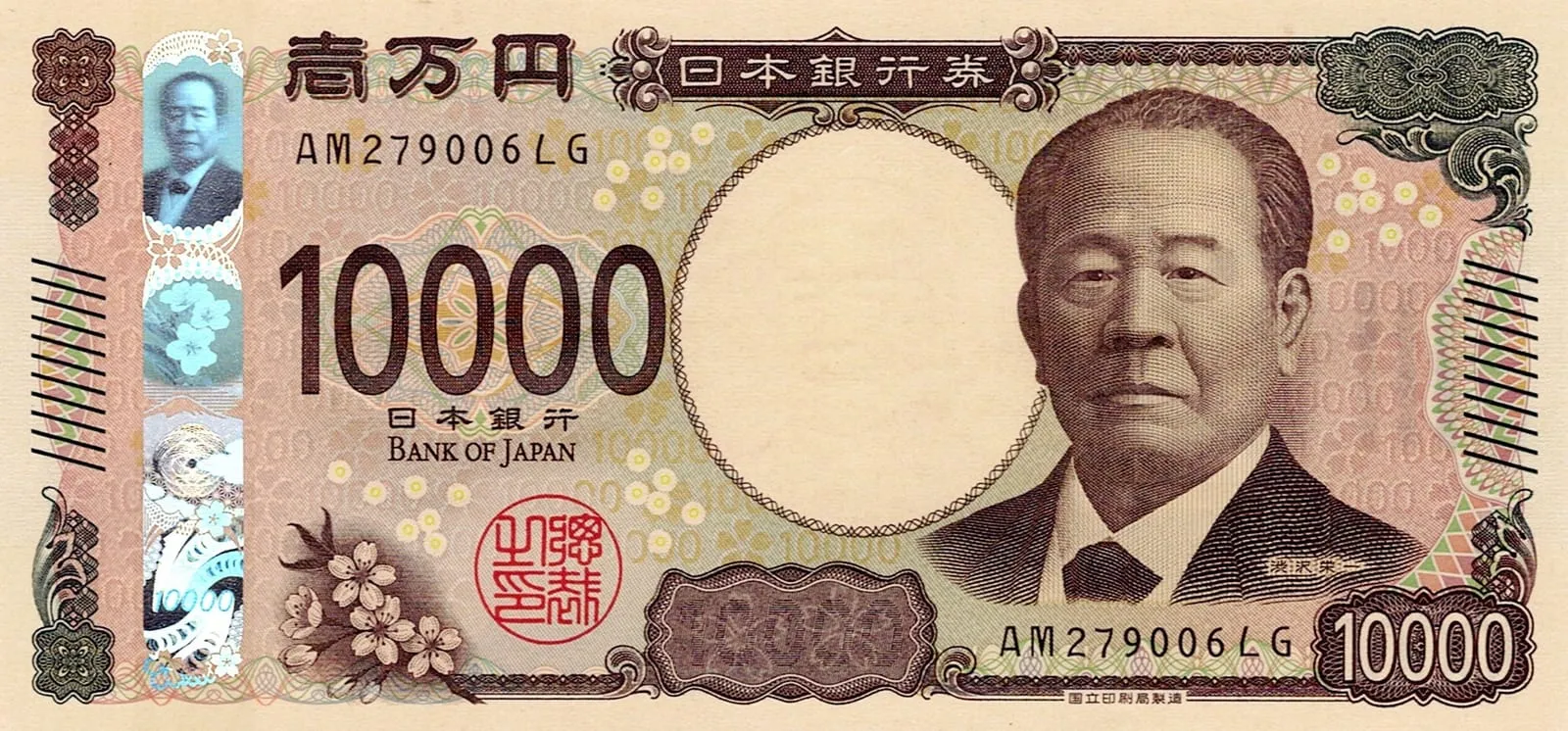
- Carry cash in small denominations: While credit cards are increasingly accepted at larger seafood operations, 1,000 yen notes and 100 yen coins will speed up transactions at small stalls.
How to get to Kuromon Market
- Osaka Metro: Ride the Sakaisuji Line or Sennichimae Line to Nippombashi Station. Take Exit 10, turn left, and walk two minutes south to enter the market under the giant black awning.
- Kintetsu Railway: Kintetsu-Nippombashi Station connects directly to the underground concourses of Exit 10.
- From Namba Station: Kuromon Market is an easy 8-minute walk east from Namba Station, crossing through the Sennichimae entertainment district.
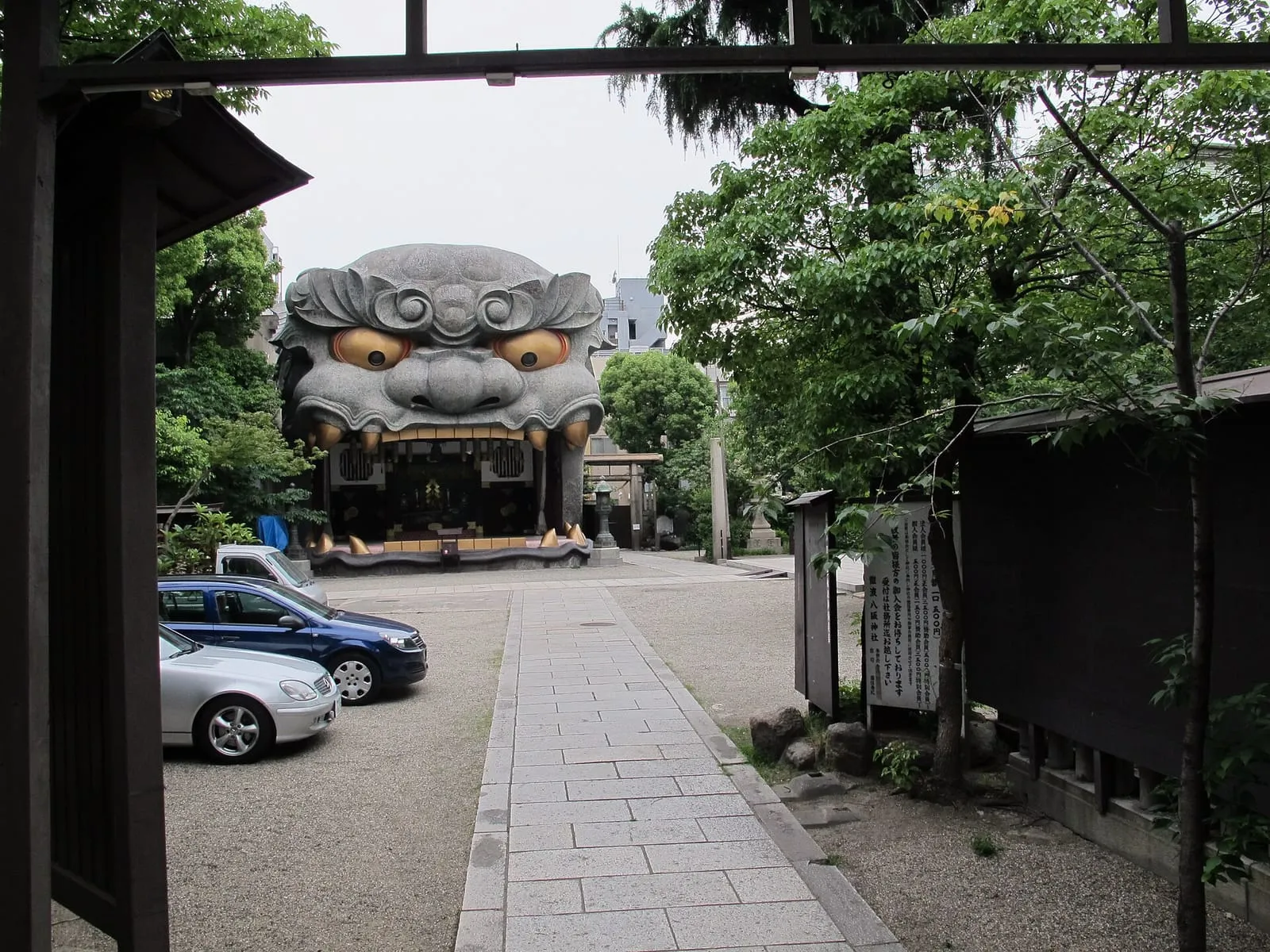
To explore the surrounding neighbourhood on foot, follow our Namba and Kuromon Market walk, which visits Namba Yasaka Shrine and Doguyasuji Kitchenware Street before arriving at the market stalls. For further dinner recommendations across the city, consult our comprehensive guide on where to eat in Osaka.
Common questions
What is Kuromon Ichiba Market famous for?
Kuromon Ichiba is known as 'Osaka's Kitchen' (Osaka no Daidokoro). It is famed for fresh seafood prepared on the spot: charcoal-grilled king crab legs, butter-seared giant scallops, raw sea urchin (uni), fatty tuna (otoro), and skewered A5 Wagyu beef.
What are the opening hours of Kuromon Market?
Most stalls operate from 9:00 to 17:00 or 18:00 daily. The best time to visit is between 10:30 and 14:00, when all vendors are open, displays are fully stocked, and grills are running.
Can you pay with credit cards at Kuromon Market?
Larger seafood merchants and wagyu counters accept credit cards and IC transit cards (like Icoca and Suica). However, smaller fruit vendors, traditional oden counters, and pickle shops remain cash only.
Is walking and eating allowed in Kuromon Market?
No. Walking while eating (aruki-gui) is strongly discouraged to avoid spills in crowded lanes. Diners should eat at the benches and counters behind each stall, or use the free Kuromon Information Center in the middle of the market.