In this guide
The Short Version: Founded in 211 AD, Sumiyoshi Taisha is the head shrine of over 2,300 Sumiyoshi shrines across Japan. Located in southern Osaka, this sacred site is completely free to enter and famed for the Sorihashi Bridge, a steep 44-degree arched red drum bridge spanning a reflection pond. Its four main halls are designated National Treasures, built in the ancient Sumiyoshi-zukuri style that predates Chinese and Buddhist architectural influence. Reach the shrine in just 9 minutes from Namba on the Nankai Main Line or take Osaka’s historic Hankai tram.
While Tokyo’s premier Shinto sanctuary is Meiji Jingu, built in 1920 in Shibuya’s forest, Osaka’s Sumiyoshi Taisha possesses more than 1,800 years of unbroken spiritual heritage. Established in 211 AD by Empress Jingu, the shrine is dedicated to the Sumiyoshi Sanjin—a triad of Shinto deities guarding seafarers, maritime commerce, and waka poetry. In ancient times, the shrine grounds sat directly upon the shores of Osaka Bay, where fleets departing on imperial diplomatic missions to mainland Asia stopped to pray for safe passage across the stormy inland sea.
Admission fees and opening times
Entrance to Sumiyoshi Taisha is free year-round.
| Area / Service | Cost | Hours |
|---|---|---|
| Shrine grounds and bridge | Free | 6:00 to 17:00 (April to September); 6:30 to 17:00 (October to March) |
| Shrine amulet counter (juyosho) | Free entry | 9:00 to 17:00 daily |
| Fortune-telling (omikuji) | 200 yen | 9:00 to 17:00 daily |
The shrine is particularly crowded during Hatsumode, the first three days of the New Year (1 to 3 January), when more than two million worshippers arrive to offer their first prayers of the year.
The arched Sorihashi Bridge (Taiko-bashi)
The most striking visual element of Sumiyoshi Taisha is the Sorihashi, commonly called the Taiko-bashi (drum bridge). Originally donated in the late 16th century by Yodogimi, the consort of military unifier Toyotomi Hideyoshi, the arched bridge forms a dramatic red semicircle reflected in the still waters below.
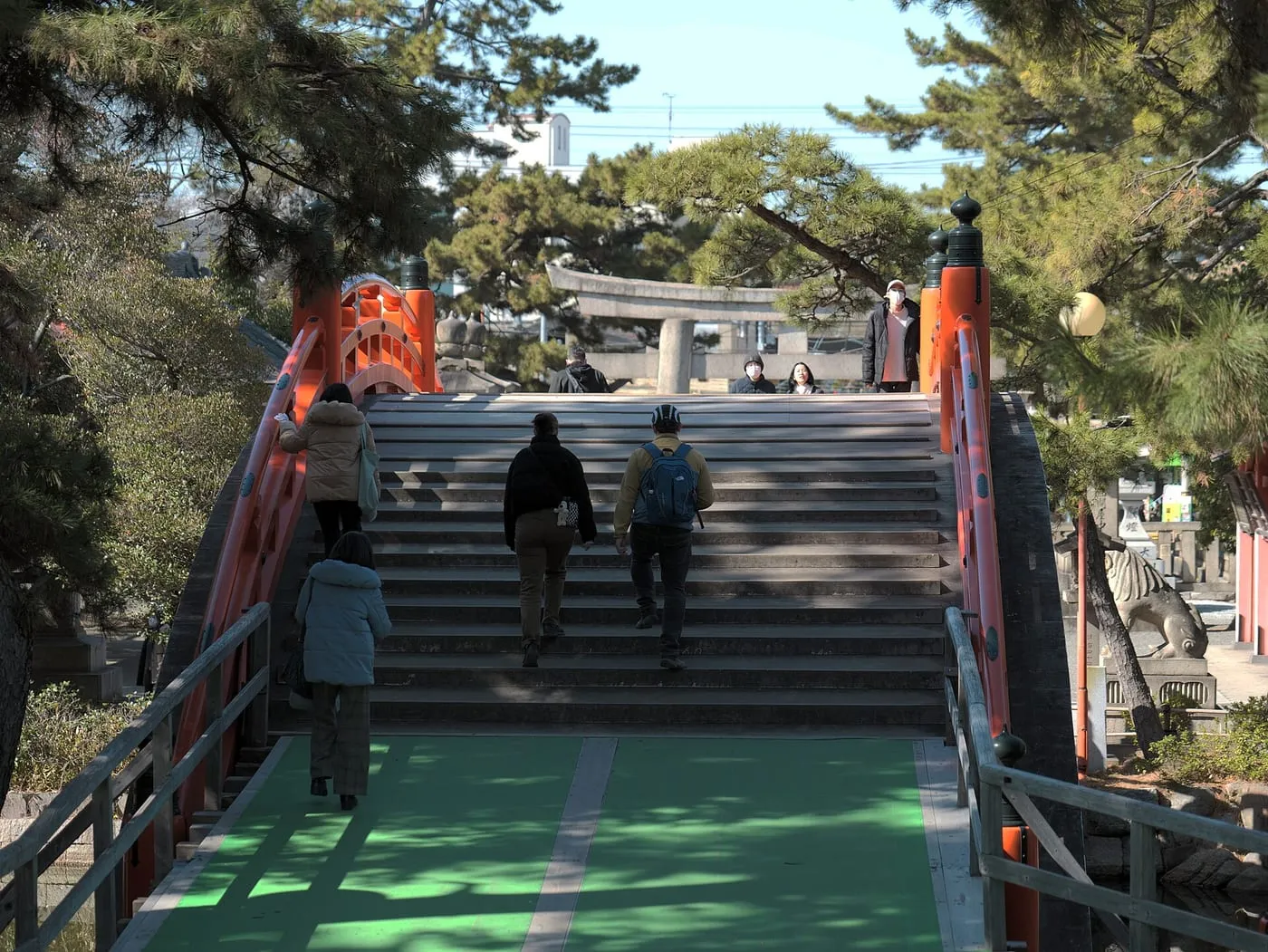
Steeply arched red wooden Sorihashi drum bridge reflected in the sacred pond at Sumiyoshi Taisha. Photo: Hyppolyte de Saint-Rambert, Wikimedia Commons, CC BY 4.0.
The bridge’s curved walkway rises at an acute 44-degree slope. Wooden battens are nailed across the planks to prevent shoes from slipping on the ascent and descent. In Shinto belief, crossing over the steep bridge represents a ritual purification, cleansing the pilgrim of physical and spiritual impurities before they step onto the inner sanctuary’s sacred ground. At night, the bridge is illuminated until 21:00.
Pure Sumiyoshi-zukuri architecture
The inner sanctuary features four main halls (Honden), each declared a National Treasure of Japan. The first three halls are laid out in a straight line running west toward the sea, while the fourth hall stands beside the third—an unusual nautical formation resembling a fleet of ships sailing in convoy.
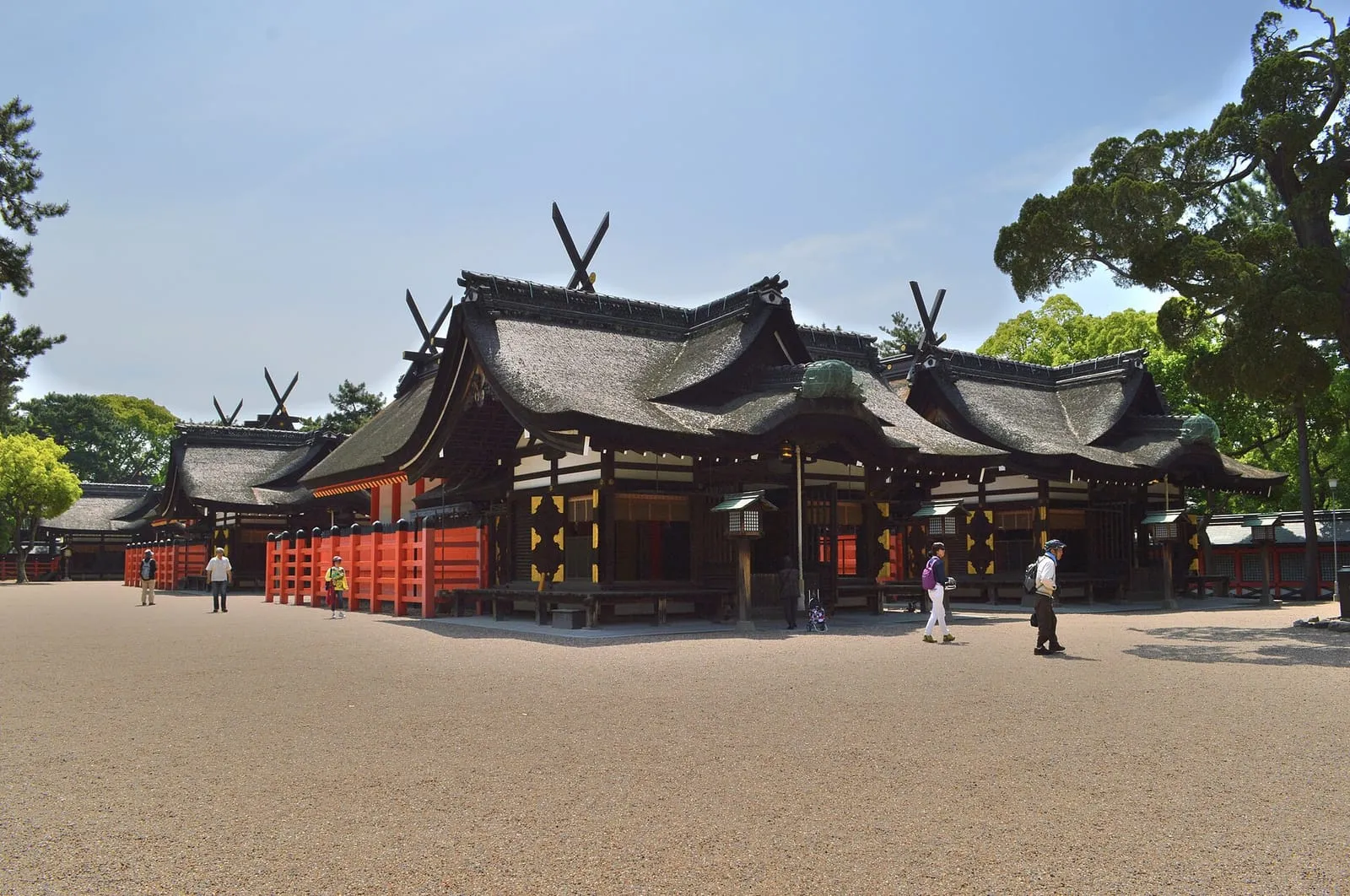
The main halls of Sumiyoshi Taisha, with crossed roof finials, red fences and a gravel court. Photo: Saigen Jiro, Wikimedia Commons, CC0.
Architecturally, these halls represent the Sumiyoshi-zukuri style, one of Japan’s three purest indigenous building traditions alongside Shinmei-zukuri (seen at Ise Grand Shrine) and Taisha-zukuri (at Izumo Grand Shrine). Because this style developed prior to the arrival of Buddhism in the 6th century, it is completely free from continental Asian influence:
- Rooflines: Straight gable roofs covered in thick layers of natural cypress bark thatch (hiwadabuki).
- Finish: Bold vermilion wooden pillars, chalk-white plaster walls, and jet-black timber bases.
- Details: Roofs are topped with crossed finials (chigi) and horizontal log weights (katsuogi), and the structures are raised off the ground on wooden stilts without verandas or curved eaves.
Sacred stones and fortune rituals
Beyond the main halls, several smaller shrines and stones within the complex draw visitors seeking fortune and answers to prayers.
The Omokaru-ishi stone at Gosho Gozen
Located in the Ototo-sha sub-shrine, the Omokaru-ishi (literally “heavy-light stone”) is a divination stone:
- Approach the stone, bow twice, clap your hands twice, and lift the stone to feel its baseline weight.
- Place the stone back down, place your hands together, and pray earnestly for your specific wish.
- Lift the stone a second time. If the stone feels lighter than the first time, your wish will be granted; if it feels heavier, more effort is needed before your goal can be realized.
Hunting for the Go-Ho-Riki pebbles
Just south of the main halls stands the Gosho Gozen, a gravel-filled sanctuary enclosed by an ancient stone fence, marking the exact spot where Empress Jingu first consecrated the shrine deities.
Visitors reach through the wooden slats of the fence to search through thousands of smooth river pebbles for three specific stones marked with ink characters:
- Go (五, meaning five)
- Ho (大, representing treasure or greatness)
- Riki (力, meaning power)
Finding all three pebbles and placing them in an amulet pouch purchased at the shrine counter is believed to grant the bearer divine strength, wisdom, and financial good fortune. When your wish is fulfilled, tradition dictates that you write the same characters on three new pebbles and return all six to the sacred enclosure.
How to get to Sumiyoshi Taisha
- Nankai Main Line: Board a local train at Namba Station and alight at Sumiyoshitaisha Station. The journey takes 9 minutes and costs 240 yen. Walk east through the station arcade and across the road directly into the shrine approach. Ensure you take a Local train, as Express and Limited Express services do not stop at Sumiyoshitaisha.
- Hankai Tramway: For a scenic journey, take the historic Hankai Tramway—Osaka’s last operating streetcar network. Board the tram at Tennoji-Ekimae or Ebisucho and disembark at Sumiyoshitorii-mae stop, located right in front of the giant stone torii gate. A flat fare of 240 yen applies.
- Nearby exploration: After exploring the shrine, take the tram north to Shinsekai to see Tsutenkaku Tower and enjoy deep-fried skewers following the Shinsekai kushikatsu guide, or sample Osaka’s street food classics in where to eat in Osaka.
Common questions
Is admission to Sumiyoshi Taisha Shrine free?
Yes. Admission to Sumiyoshi Taisha is completely free for all visitors. The shrine grounds, main halls, and Sorihashi bridge are open daily without an entrance fee.
What makes Sumiyoshi Taisha's architecture unique?
Sumiyoshi Taisha is built in the Sumiyoshi-zukuri style, one of the three oldest architectural styles in Shinto. It represents purely indigenous Japanese design developed before Buddhist and Chinese building techniques arrived in Japan in the 6th century.
How steep is the Sorihashi Bridge at Sumiyoshi Taisha?
The arched vermilion wooden drum bridge has an incline of 44 degrees. Small wooden cleats are fitted to the timber walkway to provide footing as you walk over the crest.
How do you reach Sumiyoshi Taisha from Namba Station?
Take the Nankai Main Line local train from Namba Station directly to Sumiyoshitaisha Station (9 minutes, 240 yen). The shrine entrance is a 3-minute walk east of the station.