In this guide
The Short Version: Takoyaki (crisp octopus batter balls) and okonomiyaki (savoury teppan pancakes) are the dual pillars of Osaka’s soul food culture (konamon, or flour-based cooking). For takoyaki, head to Takoyaki Doraku Wanaka in Sennichimae for thin, crispy shells with molten dashi centres, or Aizuya in Umeda to taste the original 1935 recipe served plain without sauce. For okonomiyaki, queue at Michelin-recognised Mizuno in Dotonbori for their flourless mountain yam pancake, or grab a counter seat at Kiji in Shin Umeda Shokudogai for noodles griddled into pancake batter (modan-yaki).
In Osaka, flour-based dishes are collectively referred to as konamon. While other regions of Japan view noodles and rice as the only proper meal foundations, Osakans elevated seasoned batter to an art form. The secret is kelp dashi: rather than mixing plain flour with water, Osaka cooks blend flour with rich broth brewed from Hokkaido kombu and dried bonito flakes, yielding savoury flavour throughout the batter.
Below is how each dish is made and where to eat it across Osaka.
The anatomy of takoyaki
Takoyaki are spherical dumplings baked in cast-iron or copper half-sphere moulds. A seasoned dashi-infused wheat batter is ladled across the hot dimples, followed by:
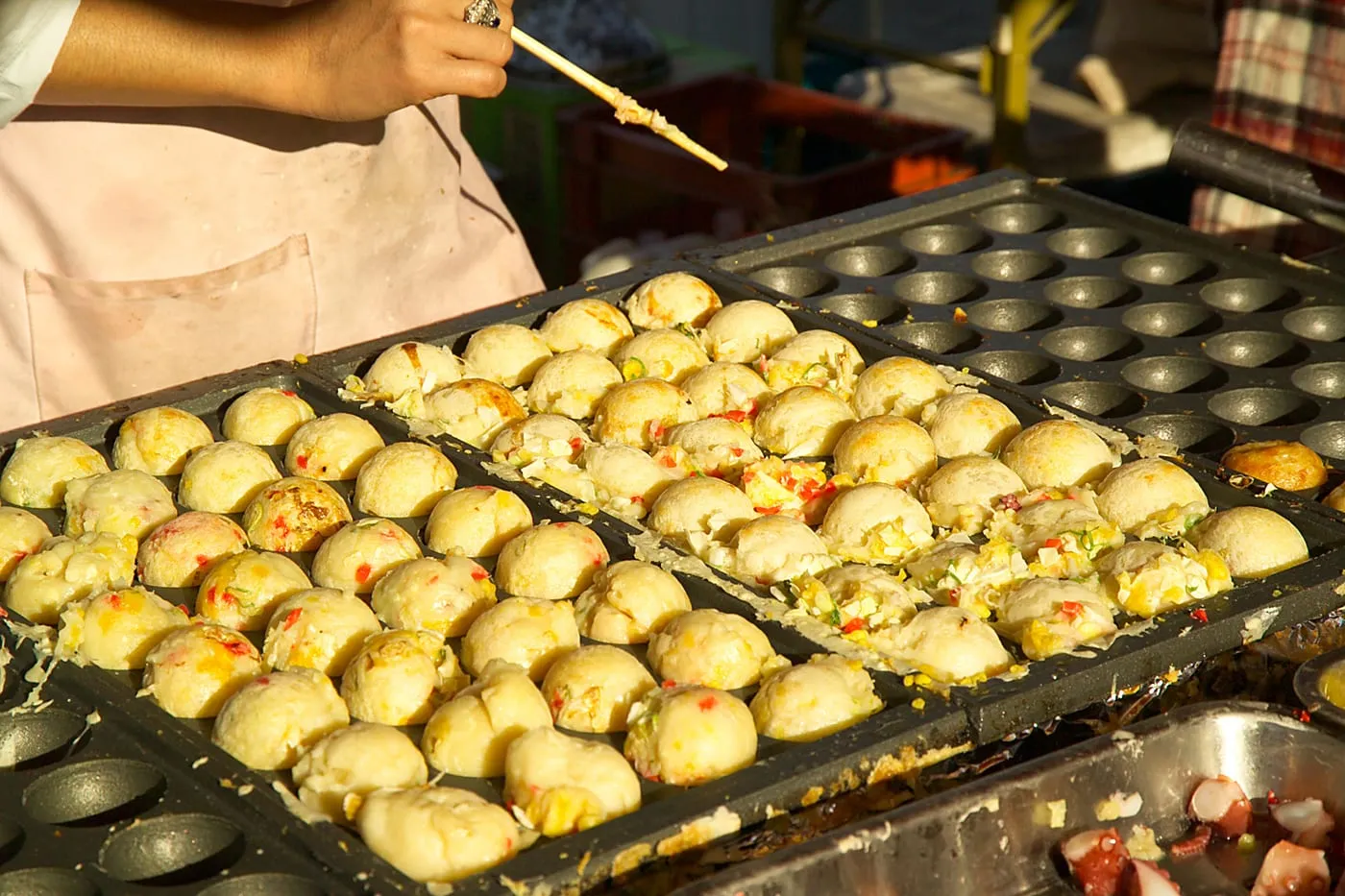
Takoyaki being turned with metal picks on an iron griddle. Photo: Fg2, Wikimedia Commons, Public domain.
- Tako: A plump chunk of boiled octopus, traditionally sourced from the fast currents of the Akashi Strait.
- Beni Shoga: Chopped red pickled ginger that cuts through the rich batter with an acidic punch.
- Tenkasu: Crisp, airy bits of fried tempura batter that add texture and richness as they melt into the dough.
- Negi: Finely chopped green spring onions.
Using thin metal picks, the chef swiftly flips and rolls the liquid batter inside each mould, tucking the edges in until perfectly golden, crisp spheres emerge.
Once placed in a shallow wooden paper boat, takoyaki are topped with:
- Takoyaki sauce: A thick, sweet, tangy brown sauce similar to Worcestershire sauce but richer in fruit and soy.
- Japanese mayonnaise: Squeezed in thin cross-hatch ribbons.
- Aonori: Fine powdered green sea lettuce.
- Katsuobushi: Paper-thin dried bonito flakes that curl and flutter in the rising steam.
The top takoyaki stalls in Osaka
Takoyaki Doraku Wanaka Sennichimae
Namba / Sennichimae · 11-19 Nanbasennichimae, Chuo-ku · Open daily 10:00 to 21:00 · Cash and IC cards · Wanaka site
Wanaka operates right beside Namba Grand Kagetsu comedy theatre. Their copper hotplates conduct heat faster than cast iron, producing an exceptionally thin, delicate outer crust that seals in a silken, molten interior.
- What to order: The Oiri plate (700 yen for 8 pieces), which divides your order into four flavours: traditional sweet sauce, soy sauce with spring onion, spicy salt, and the rotating monthly special.
- What it’s like: Watch the chefs flip hundreds of balls across six griddles through the open street window, then walk inside to the two-storey air-conditioned dining room.
- The deciding factor: The dashi profile in Wanaka’s batter is the benchmark for modern Osaka takoyaki.
Dotonbori Kukuru Konamon Museum
Dotonbori · 1-6-12 Dotonbori, Chuo-ku · Open Monday to Friday 11:00 to 22:00, Saturday and Sunday 10:00 to 22:00 · Cards and cash · Kukuru site
Unmissable thanks to the giant red mechanical octopus gripping the building facade above the Dotonbori canal walkway.
- What to order: Bikkuri Takoyaki (1,200 yen for 8 pieces), meaning “surprising takoyaki”, where long octopus tentacles trail out of each ball.
- What it’s like: Lively canal-side ordering with a basement dining room. Chefs splash white wine over the griddles before serving, enhancing the aroma.
- The deciding factor: The octopus pieces here are considerably larger and more succulent than at ordinary street vendors.
Kogaryu Honten
Shinsaibashi / America-mura · 2-18-4 Nishishinsaibashi, Chuo-ku · Open daily 11:00 to 20:00 · Cash only · Kogaryu site
Located on the corner of Sankaku Koen (Triangle Park) in America-mura, Kogaryu has catered to youth street culture since 1974.
- What to order: Sauce Mayo (500 yen for 8 pieces) or Negipon (600 yen), smothered under a mound of fresh green scallions with citrus ponzu.
- What it’s like: Takeaway only. Order at the corner window and carry your steaming paper boat over to sit on the concrete benches in Triangle Park.
- The deciding factor: Kogaryu was the first stall in Japan to put mayonnaise on takoyaki, using their proprietary egg-yolk and apple-vinegar blend.
Aizuya Umeda
Umeda · Umeda 3-2-136, Kita-ku (Eki Marche Osaka, JR Osaka Station) · Open daily 10:00 to 22:00 · Cards and cash · Aizuya site
Founded in 1935 by Endo Tomekichi, Aizuya is the historical inventor of takoyaki.
- What to order: Ganso Takoyaki (650 yen for 12 pieces) or Rajioyaki (750 yen for 12 pieces), filled with stewed beef tendon and konjac jelly.
- What it’s like: A small, clean 10-seat counter inside the Eki Marche concourse under JR Osaka Station.
- The deciding factor: Aizuya serves takoyaki completely plain: no brown sauce, no mayonnaise, and no bonito flakes. The savoury flavour comes entirely from beef stock and dashi concentrated in the batter.
The anatomy of okonomiyaki
The name okonomiyaki comes from okonomi (“what you like”) and yaki (“grilled”). Unlike Tokyo’s runny, spatula-eaten monjayaki, Osaka’s okonomiyaki is a structured, thick savoury pancake.
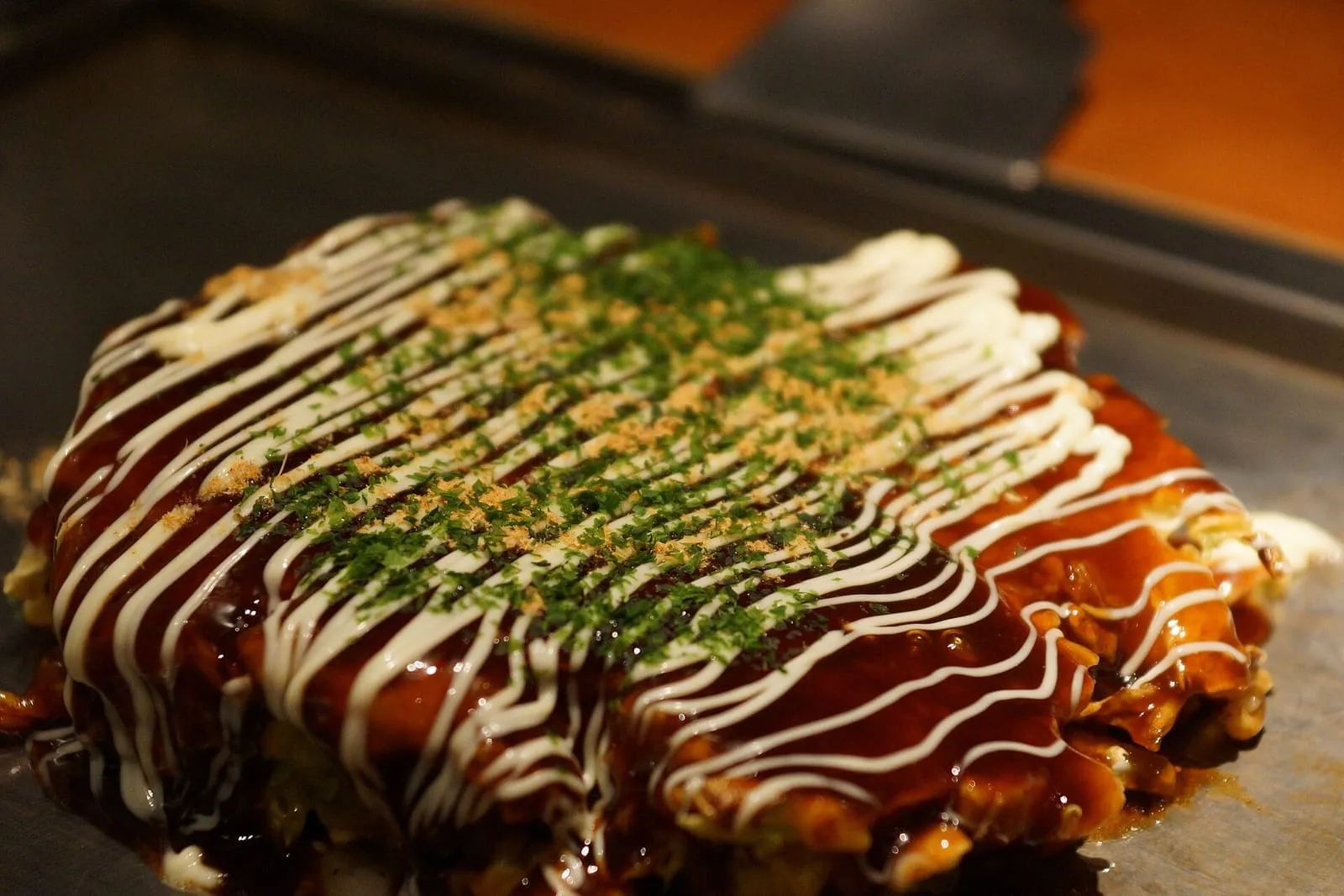
An okonomiyaki striped with mayonnaise and sauce and sprinkled with seaweed and bonito on a hot griddle. Photo: ume-y, Wikimedia Commons, CC BY 2.0.
The key component of Osaka okonomiyaki is grated mountain yam (nagaimo or yamaimo). When added to wheat flour, eggs, and dashi, yam creates an airy, souffle-like interior that puffs gently on the hot griddle without becoming dense.
Key variations to know:
- Kansai Okonomiyaki: The classic style where shredded cabbage, batter, pork belly slices, and seafood are mixed together in a stainless-steel bowl before hitting the hotplate.
- Modan-yaki (Modern-yaki): Incorporates a layer of boiled, seasoned yakisoba noodles bound with egg directly into the pancake.
- Negiyaki: Replaces shredded cabbage with huge quantities of chopped green scallions (negi), typically cooked with braised beef tendon (suji) and seasoned with light soy sauce and lemon rather than sweet sauce.
The top okonomiyaki grills in Osaka
Mizuno
Dotonbori · 1-4-15 Dotonbori, Chuo-ku · Open daily 11:00 to 21:30 · Cash only · Mizuno site
A Dotonbori landmark since 1945, Mizuno is featured in the Michelin guide as a Bib Gourmand.
- What to order: The signature Yamaimo-yaki (1,700 yen). Instead of wheat flour, the batter uses 100% grated mountain yam, griddled with thick pork belly strips, plump scallops, and fresh prawns.
- What it’s like: An intimate, multi-storey shop where you sit directly at the teppan counter watching your pancake sizzle and rise under metal cloches.
- The deciding factor: Because it contains no wheat flour, the yamaimo pancake melts on your tongue with a custard-like creaminess that regular okonomiyaki cannot replicate.
Kiji Umeda
Umeda · 9-20 Kakuda-cho, Kita-ku (Shin Umeda Shokudogai 1F/2F) · Open 11:30 to 21:30, closed Sundays · Cash only
Tucked inside the noisy rail-arch food warren of Shin Umeda Shokudogai, Kiji is overseen by veteran master chef Sugimoto.
- What to order: The Modan-yaki (1,000 yen), packed with thick yakisoba noodles, pork, squid, and shiso leaves.
- What it’s like: Squeeze onto narrow wooden benches around a well-worn teppan counter plastered with business cards and notes from travellers worldwide.
- The deciding factor: Master Sugimoto’s warm, welcoming hospitality and his subtle addition of aromatic shiso leaves to balance the rich yakisoba sauce.
Ajinoya
Namba · 1-7-16 Nanba, Chuo-ku · Open Tuesday to Sunday 11:00 to 22:00, closed Mondays · Cards and cash · Ajinoya site
A Michelin Bib Gourmand favourite located behind Osaka Shochikuza theatre in Namba.
- What to order: The Ajinoya Mix (1,600 yen), featuring pork, squid, shrimp, and octopus, or the Ajinoya Set (3,600 yen for two) combining a mix pancake, yakisoba, and negiyaki.
- What it’s like: Comfortable booth seating, with a sunken teppan griddle at every table. Staff prepare and finish the pancakes for you.
- The deciding factor: Ajinoya uses finely shredded, sweet winter cabbage and a high proportion of dashi, resulting in an exceptionally light, digestible pancake.
Fukutaro
Namba / Sennichimae · 2-5-2 Sennichimae, Chuo-ku · Open Monday to Friday 17:00 to 23:00, Saturday and Sunday 12:00 to 23:00 · Cards and cash · Fukutaro site
Located just south of Doguyasuji Kitchenware Street, Fukutaro is Osaka’s undisputed king of negiyaki.
- What to order: Suji Negiyaki (1,380 yen), an all-scallion pancake stuffed with slow-simmered beef tendon and brushed with fragrant soy sauce.
- What it’s like: Diners sit along an expansive horseshoe-shaped teppan counter, watching chefs chop ingredients and flip pancakes under heavy spatulas.
- The deciding factor: The sweet, melt-in-the-mouth tenderness of the braised beef tendon paired with the sharp, charred green scallions.
Botejyu Dotonbori
Dotonbori · 1-6-15 Dotonbori, Chuo-ku · Open daily 11:00 to 22:00 · Cards and cash · Botejyu site
Founded in Tamade in 1946, Botejyu gets its name from the rhythmic sound of flipping an okonomiyaki (bote) and the sizzle of the griddle (jyu).
- What to order: Botejyu Premium Mix Modan-yaki (1,880 yen) with pork, beef, shrimp, and squid.
- What it’s like: A modern, polished multi-storey restaurant overlooking Dotonbori Canal with English digital menus.
- The deciding factor: Botejyu is the restaurant that first invented modan-yaki in 1955 and popularized adding white mayonnaise to okonomiyaki.
How to eat okonomiyaki from the teppan
When dining at a counter or a table with a hotplate, chefs transfer your finished okonomiyaki directly onto your personal griddle section to keep it piping hot.
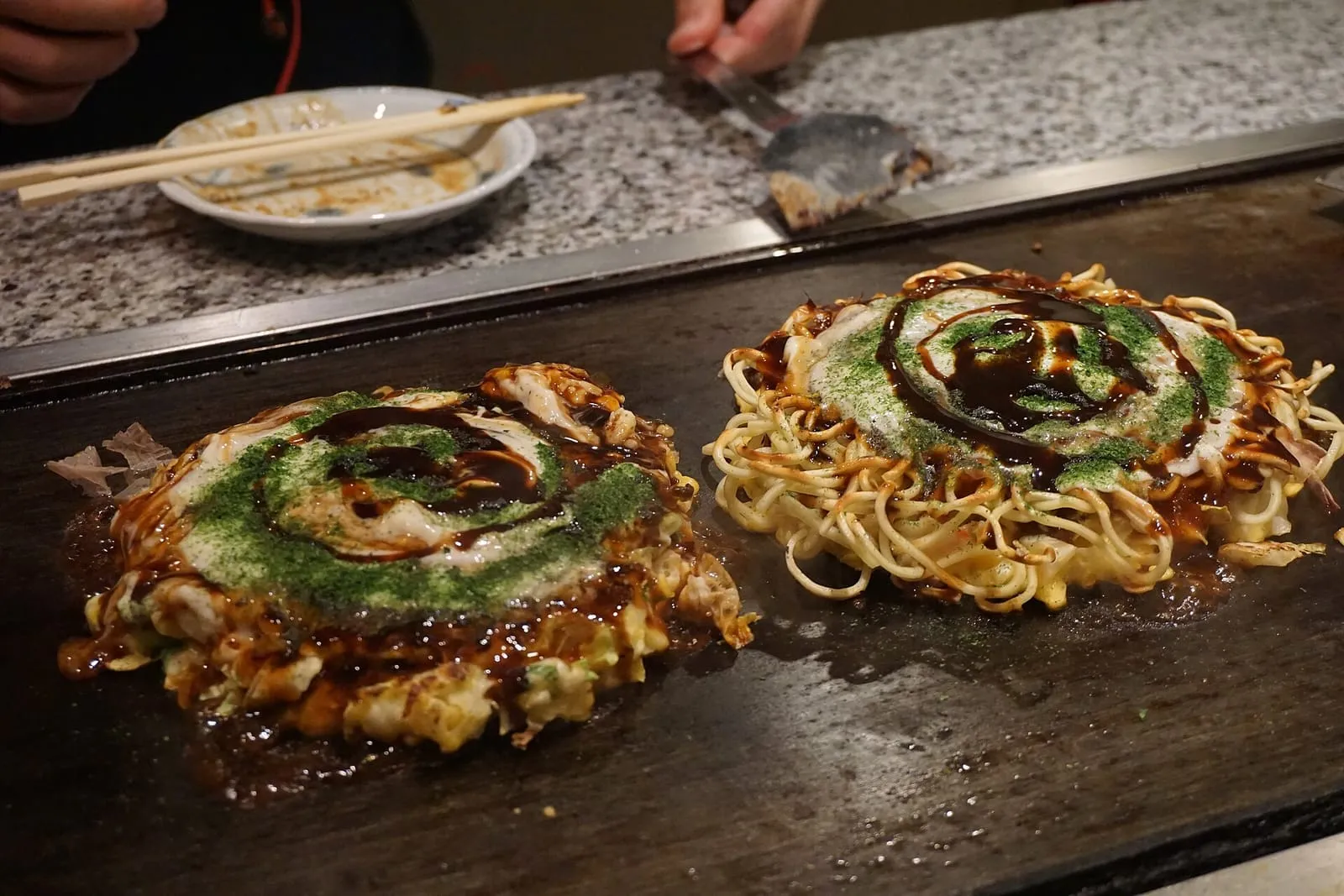
Two okonomiyaki, one with noodles, on a teppan griddle with a spatula and a used plate beside them. Photo: Lianguanlun, Wikimedia Commons, CC BY 4.0.
- Use your kote (or hera): You will be provided with a miniature metal spatula alongside your chopsticks. Use the sharp edge of the spatula to slice the pancake into bite-sized squares, like a pizza.
- Eat directly from the spatula: Traditionally in Osaka, you lift the square of okonomiyaki directly to your mouth using the flat metal spatula. If that feels unwieldy or too hot, transfer the slice to your small side plate (torizara) and use chopsticks.
- Customize your seasoning: Counters provide shaker bottles of extra brown sauce, kewpie mayonnaise, powdered aonori seaweed, katsuobushi bonito flakes, and spicy ichimi chilli pepper.
To combine these food stops with local sights, follow our Dotonbori and Shinsaibashi walk or the Namba and Kuromon Market walk. For a broader overview of the city’s food quarters including kushikatsu and ramen, read where to eat in Osaka. If heading to the capital, see our guide on where to eat in Tokyo.
Common questions
What is the difference between Osaka and Hiroshima okonomiyaki?
In Osaka style (Kansai style), all ingredients—finely shredded cabbage, egg, dashi, grated mountain yam, and flour—are mixed together before cooking on the griddle. In Hiroshima style, ingredients are layered separately over a thin crepe, piled high with cabbage, pork, fried yakisoba noodles, and a fried egg.
Why do bonito flakes move on top of takoyaki and okonomiyaki?
Bonito flakes (katsuobushi) are shaved paper-thin from dried, smoked skipjack tuna. When placed on steaming food, heat and rising moisture cause the delicate flakes to curl and sway in a hypnotic 'dance'.
How hot are fresh takoyaki inside?
Takoyaki are served piping hot straight off the iron griddle. The crispy outer crust seals in a molten, custardy batter centre that can burn your mouth. Pierce the ball with a toothpick to let steam escape before eating.
Who invented takoyaki in Osaka?
Endo Tomekichi, founder of Aizuya in Osaka, invented takoyaki in 1935. He adapted an earlier snack called rajioyaki (which used beef tendon and konjac) by substituting boiled octopus from Akashi and flavouring the batter with dashi.