In this guide
💡 The Short Version: The Basilica of Our Lady of Guadalupe (Basílica de Santa María de Guadalupe) is, in the sanctuary’s own words, one of the most visited sanctuaries in the world, set at the foot of Tepeyac Hill in northern Mexico City. The New Basilica is open every day from 06:00 to 21:00, including Mondays, which makes it an easy Monday pairing with Museo Soumaya. Ride the moving walkways beneath the Tilma inside the New Basilica, see the Old Basilica, and climb Tepeyac Hill to the Capilla del Cerrito. Or book a tour: the 5-hour Mexico City: Basilica of Our Lady of Guadalupe Tourad is dedicated to the shrine, and the Mexico City: Teotihuacan & Basilica of Guadalupe with Lunchad tour adds Tlatelolco and Teotihuacan in 9 hours.
⚠️ Avoid 11–12 December unless you specifically want the Feast Day pilgrimage. The Feast of Our Lady of Guadalupe is on 12 December, when pilgrims fill La Villa and the surrounding streets. On ordinary weekdays the complex is easier to explore in 90 to 120 minutes.
Hours and what is inside the complex
Villa de Guadalupe (La Villa) is a hillside campus of historic and modern churches, chapels, gardens and viewpoints linked by plazas and stairways. The hours below are from the sanctuary’s own schedule page.
| Site inside La Villa | Entry fee | Hours | Time needed |
|---|---|---|---|
| New Basilica and Tilma moving walkways | No admission charge | Daily 06:00–21:00 | 30–40 min |
| Guadalupe Crypt (inside the New Basilica) | No admission charge | Daily 09:00–17:00 (up to 8 people per family) | 10–15 min |
| Old Basilica (Templo Expiatorio a Cristo Rey) | No admission charge | See the sanctuary’s schedule page | 15–20 min |
| Capilla del Cerrito (top of Tepeyac Hill) | No admission charge | Daily 07:00–18:00 | 25–30 min (incl. climb) |
| Capilla del Pocito (Baroque oval chapel) | No admission charge | Falls under the Capuchinas parish; see the sanctuary’s schedule page | 10–15 min |
Practical etiquette tips
- Active place of worship: Masses run through the day in the New Basilica (the schedule lists them from 06:00). Some pilgrims cross the stone plaza on their knees: give them space and never step in front of them for photos.
- Dress code: the sanctuary lists the clothing it does not admit to temples, chapels, museums and crypts: low-cut tops, crop tops, tank tops, shorts above the knee, miniskirts and caps.
- Monday advantage: because the Basilica is open every day, it pairs with a Monday visit to Museo Soumaya or the Centro Histórico walk.
- Guided visits: the sanctuary offers its own guided visits Monday to Saturday at 11:00 and 15:00, lasting 1.5 to 2 hours. They are by reservation (visitasguiadas@inbg.mx), ask for a donation, and have English availability on request.
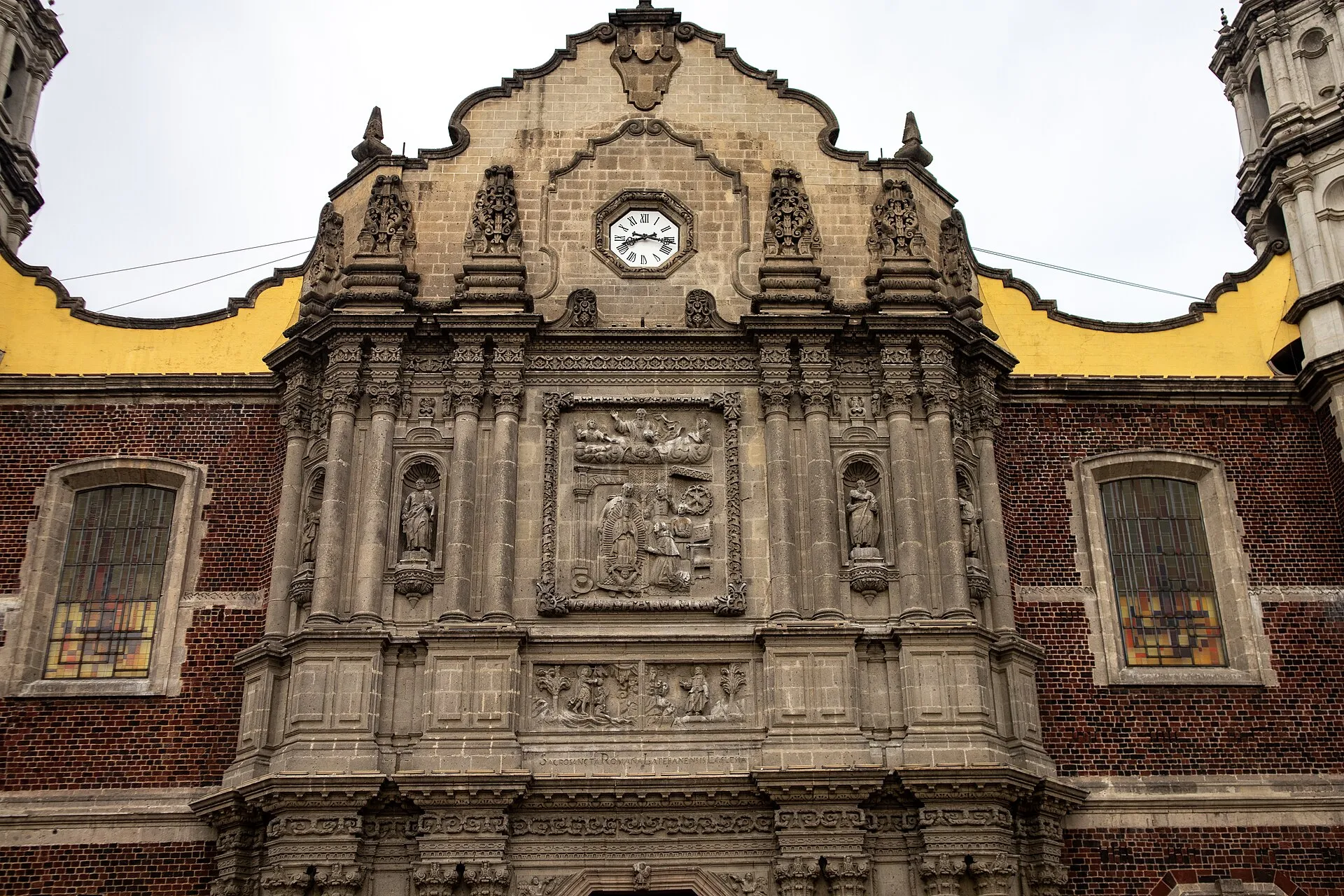 The 1709 Old Basilica beside the main atrium. Photo: ProtoplasmaKid, Wikimedia Commons, CC BY 4.0.
Guided Basilica and Teotihuacán combo tours
La Villa lies north of the Zócalo on the way out towards Teotihuacán, so some travellers pair both northern sites in one organised day.
Mexico City: Basilica of Our Lady of Guadalupe Tour
From MXN 1,089 · 4.4 stars from 27 reviews · 5 hours
The Mexico City: Basilica of Our Lady of Guadalupe Tourad is a 5-hour visit to the Basilica. Its listing describes the shrine as the Catholic world’s most visited site and one of the world’s 20 most-visited places.
Mexico City: Teotihuacan & Basilica of Guadalupe with Lunch
From MXN 1,204 · 4.9 stars from 9 reviews · 9 hours
If you have only 3 days in Mexico City or 4 days, the Mexico City: Teotihuacan & Basilica of Guadalupe with Lunchad tour covers Tlatelolco, the Basilica of Guadalupe and Teotihuacan in one day, according to its listing.
Step-by-step circuit inside the Basilica complex
Allow 1.5 to 2 hours to cover the four core landmarks without rushing.
1. The New Basilica and the Tilma
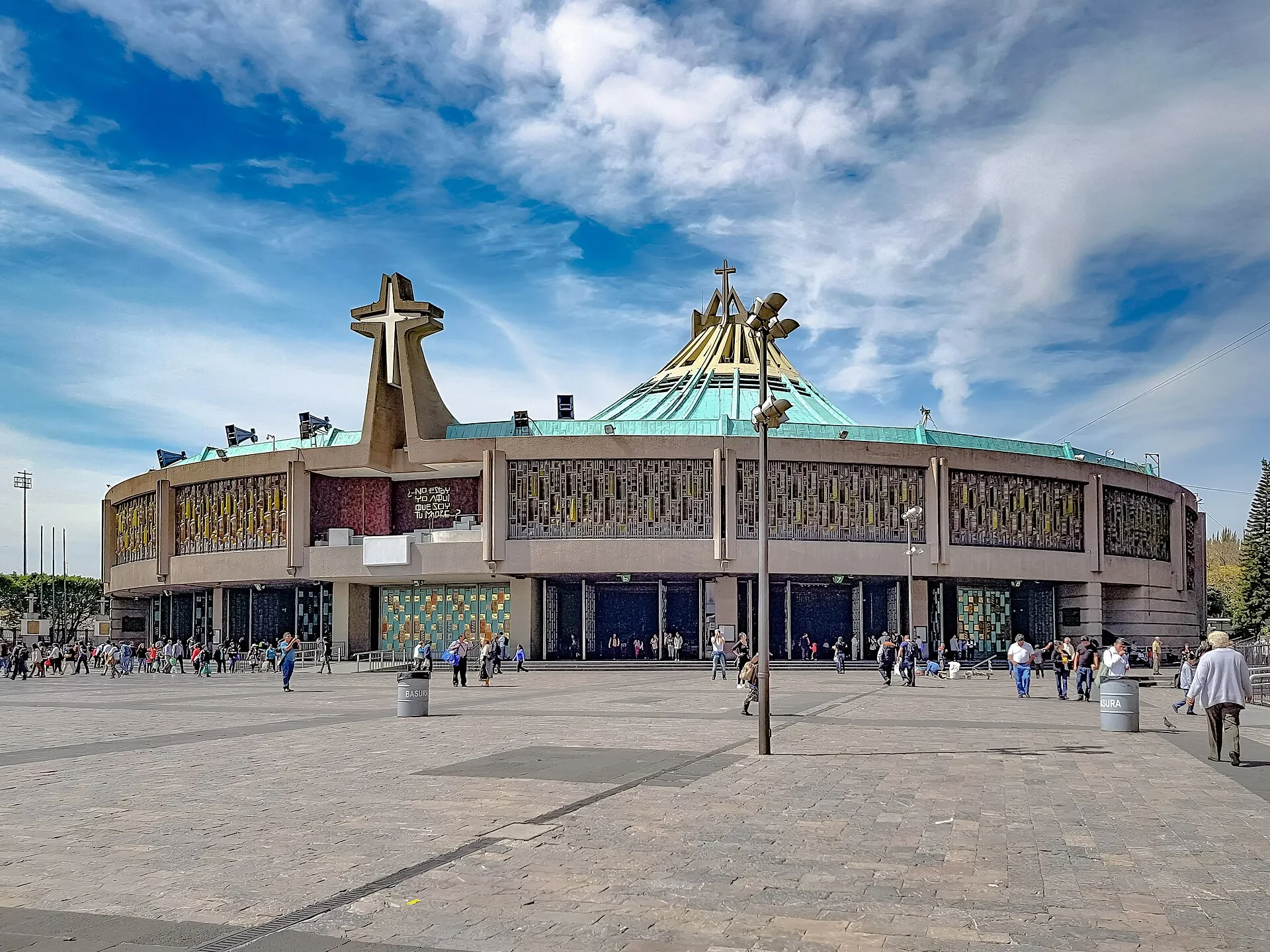
The Basilica of Santa María de Guadalupe has been the main church of the sanctuary since 1976, and the sanctuary says it is where the Tilma of San Juan Diego, bearing the image of the Virgin of Guadalupe, is kept and shown. The building is circular and was designed by architect Pedro Ramírez Vázquez, who also designed the National Museum of Anthropology.
- Viewing the Tilma: the 1531 Tilma is the ayate (agave-fibre) cloak of San Juan Diego. Follow the signs behind the main altar down to the moving walkways, which carry visitors past the image so crowds keep moving. If you want a second look, step off and loop round to ride again.
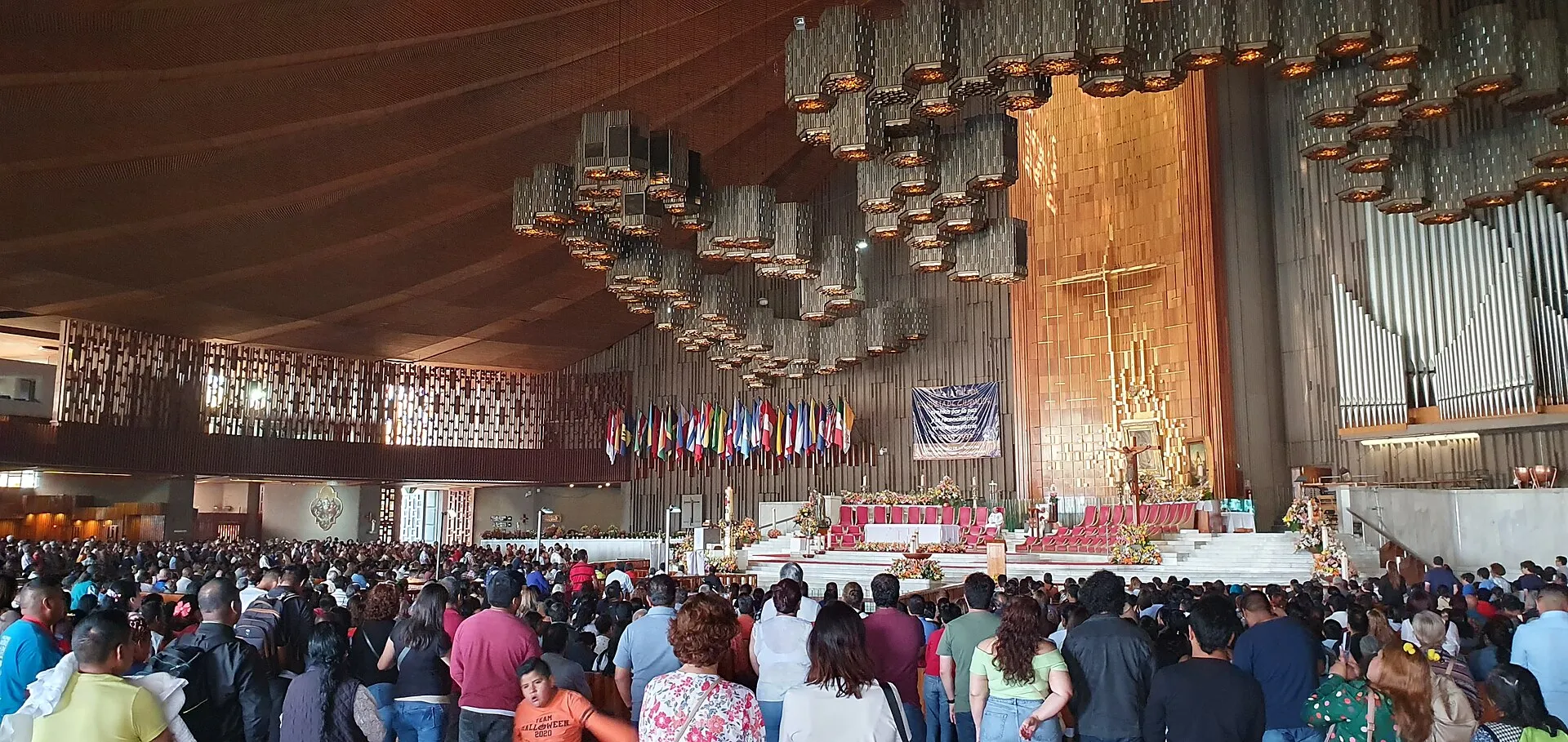 Mass in the New Basilica. Photo: José Luiz, Wikimedia Commons, CC BY-SA 4.0.
2. The Old Basilica (Templo Expiatorio a Cristo Rey)
The Old Basilica (the Antigua Basílica) opened in 1709 and was home to the Virgin of Guadalupe for 267 years, according to the sanctuary. It stands on soft lakebed ground and sank unevenly over time, which is why the New Basilica was built alongside it. Its Baroque facade carries a relief of the apparition above the doorway.
3. Tepeyac Hill and Capilla del Cerrito
Behind the Old Basilica, terraced stone staircases climb Cerro del Tepeyac, the hill where tradition holds the Virgin appeared to Juan Diego in December 1531. Before the Spanish arrival, the hill was associated with the Mexica earth-mother goddess Tonantzin.
- The climb: a short uphill walk past terraced gardens, a waterfall monument to the apparitions, and wide balconies overlooking northern Mexico City.
- Capilla del Cerrito: the chapel stands at the crest and is open daily 07:00 to 18:00, with a community Mass at 12:00. Beside it is the Panteón del Tepeyac cemetery.
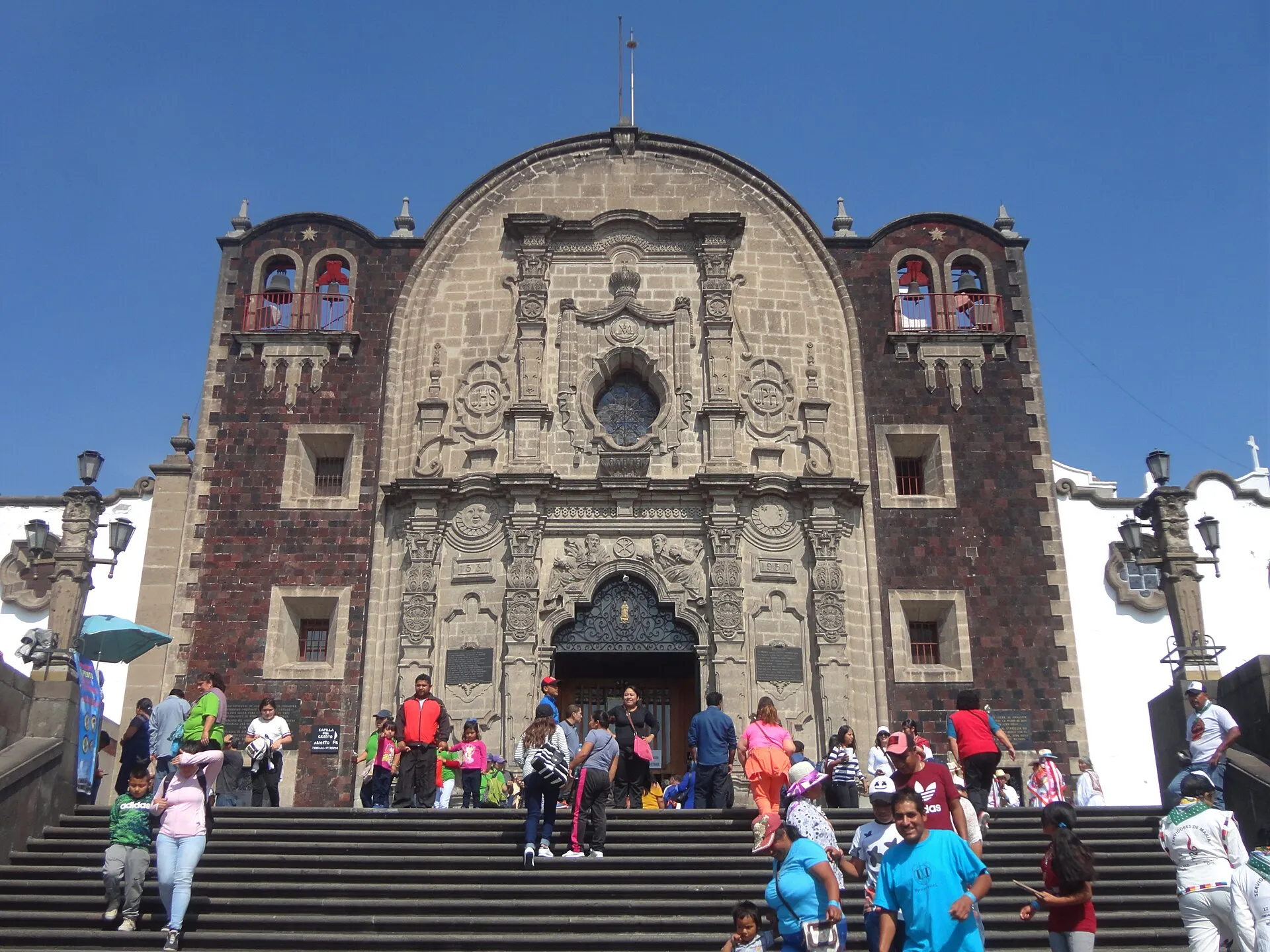 Capilla del Cerrito crowning Tepeyac Hill. Photo: Juan Carlos Fonseca Mata, Wikimedia Commons, CC BY-SA 4.0.
4. Capilla del Pocito (Chapel of the Little Well)
On the eastern flank of the hill as you descend, the Capilla del Pocito (1777–1791) was designed by the architect Francisco Antonio de Guerrero y Torres. It is a circular Baroque chapel with tiled domes, built over a spring associated with the apparitions.
Historical context and pairing with Tlatelolco
According to Catholic tradition, between 9 and 12 December 1531, ten years after the fall of Tenochtitlan, the Virgin Mary appeared four times on Tepeyac Hill to Juan Diego Cuauhtlatoatzin, an Indigenous convert, speaking to him in Nahuatl. Because Tepeyac had previously been sacred to Tonantzin, the dark-skinned Virgin (La Morenita) became a bridge between Indigenous and Spanish cultures, and later the banner carried by Father Miguel Hidalgo at the outbreak of Mexico’s 1810 War of Independence.
- Pairing with Plaza de las Tres Culturas (Tlatelolco): between the Zócalo and the Basilica lies Tlatelolco, where excavated Aztec pyramids, a colonial church and mid-century modernist towers stand side by side, marking both the last stand of Tenochtitlan in 1521 and the memorial to the 1968 student movement. The combined tour above includes Tlatelolco, or you can stop independently at Metro Line 3’s Tlatelolco station on the way north.
- Food near La Villa: for a fuller lunch, head back south to Centro Histórico or Roma (see our where to eat in Mexico City guide).
How to get to the Basilica of Our Lady of Guadalupe
The sanctuary’s own “how to get here” page gives these routes.
- By Metro: with a Tarjeta de Movilidad Integrada (MXN 15 card, MXN 5 per ride; see public transport), ride Metro Line 6 (red) to La Villa-Basílica station, or Metro Line 3 (green) to Deportivo 18 de Marzo; both are a short walk from the Basilica.
- From the Zócalo by Metro: take Line 2 to Hidalgo, change to Line 3 towards Indios Verdes and get off at Deportivo 18 de Marzo, then walk or change to Line 6 for La Villa-Basílica.
- By Uber or DiDi or taxi: the sanctuary gives about 30 minutes from the centre by taxi.
- Safety note: the streets around the Basilica are busy all day, so keep phones and wallets secure around the Metro station and the souvenir stalls (see is Mexico City safe).
The Basílica is also a stop on the Turibus Basílica circuit, and the days after 12 December are covered in Christmas in Mexico City.
Common questions
Does it cost money to enter the Basilica of Our Lady of Guadalupe?
The Basilica's own site lists no admission charge for the sanctuary, and its guided visits ask for a donation instead of a fee. The complex includes the New Basilica where the Tilma hangs, the Old Basilica and the Capilla del Cerrito on Tepeyac Hill.
What are the opening hours of the Basilica of Guadalupe?
The Basilica of Santa María de Guadalupe, the 1976 church that houses the Tilma, is open Monday to Sunday from 06:00 to 21:00, according to the sanctuary's own schedule. Masses are held through the day. The Capilla del Cerrito is open daily 07:00 to 18:00.
How do you see the Tilma (image of the Virgin of Guadalupe) up close?
The Tilma is kept and displayed in the New Basilica, which the sanctuary says has housed it since 1976. Follow the signs behind the main altar to the lower viewing level, where moving walkways pass beneath the image.
How do I get to the Basilica of Guadalupe by Metro?
The sanctuary's own site lists Metro Line 6 (red) to La Villa-Basílica station, and Metro Line 3 (green) to Deportivo 18 de Marzo, both a short walk away. From the Zócalo, ride Line 2 to Hidalgo, change to Line 3 towards Indios Verdes and get off at Deportivo 18 de Marzo, or change to Line 6 for La Villa-Basílica. A taxi from the centre takes about 30 minutes, according to the sanctuary.
Can I combine the Basilica of Guadalupe with Teotihuacán on the same day?
Yes. Both lie north of central Mexico City. The Mexico City: Teotihuacan & Basilica of Guadalupe with Lunch tour on GetYourGuide covers Tlatelolco, the Basilica and Teotihuacan in 9 hours.
What should I wear when visiting the Basilica of Guadalupe?
The sanctuary says it does not allow entry to temples, chapels, museums and crypts in low-cut tops, crop tops, tank tops, shorts above the knee, miniskirts or caps. Dress modestly, keep voices low during Mass and avoid flash near the Tilma.