In this guide
💡 The Short Version: Christmas in Mexico City starts with the posadas, nine nights from 16 to 24 December, and ends with Reyes on 6 January. In between, the city lights the Zócalo: the 2025-26 festival Luces de Invierno ran from 20 December to 4 January with three trees, 14 light sculptures and a monumental nativity scene. The weekdays: 24 December 2026 is a Thursday, 25 December a Friday, 1 January 2027 a Friday and 6 January a Wednesday. Or book a tour: the Magical Christmas Decorations Private Tourad walks the decorated historic centre with a guide.
⚠️ 12 December is the pilgrim peak at the Basílica of Guadalupe. Roads around La Villa are closed and crowds are heavy on 11 and 12 December; see the Basílica of Guadalupe page before you plan that day.
Dates at a glance
| Date | What |
|---|---|
| 11 and 12 December | Pilgrims at the Basílica of Guadalupe; 12 December is the feast day |
| Wed 16 to Thu 24 December 2026 | The nine nights of the posadas |
| Thu 24 December | Nochebuena, Christmas Eve |
| Fri 25 December | Christmas Day |
| 20 December to 4 January | The Zócalo festival dates in 2025-26 |
| Fri 1 January 2027 | New Year’s Day |
| Wed 6 January 2027 | Día de Reyes |
| 2 February | Candelaria, when the rosca’s figure-finder hosts the tamales |
The posadas, 16 to 24 December
A posada is a neighbourhood party on each of the nine nights before Christmas Eve, re-enacting Mary and Joseph’s search for shelter. The city’s tourism site describes them as held in neighbourhoods and cul-de-sacs, with piñatas broken, hot fruit punch (ponche) served and litanies sung. In 2026 they run from Wednesday 16 December to Thursday 24 December.
- Pastorelas: these are shepherd plays staged in theatres, viceregal cloisters and squares in Coyoacán, San Ángel and the Centro Histórico, according to the same page.
- Community posadas: the 2025-26 festival put posadas and pastorelas among the activities at its 15 borough sites.
The Zócalo festival
The city’s 2025-26 Luces de Invierno festival ran in the Zócalo from 20 December to 4 January, with activities at 15 other sites across the boroughs (El Universal, 16 December 2025). The Zócalo had:
- three illuminated trees decorated with nochebuenas, the Mexican name for the poinsettia;
- 14 light sculptures of Christmas motifs and traditional Mexican toys;
- what the city called Mexico’s largest monumental light tunnel, and a monumental nativity scene;
- a stage with 76 music groups, from son and danzón to rock, mariachi and carols;
- 16 days of activities and 120 craft exhibitors, according to the city’s culture secretary.
The city’s tourism page adds that the facades of government buildings in the Zócalo and the streets of the Centro Histórico are lit with large luminous mosaics through December, with free choirs and orchestra concerts and the Artesanos en el Corazón craft stalls in the Zócalo.
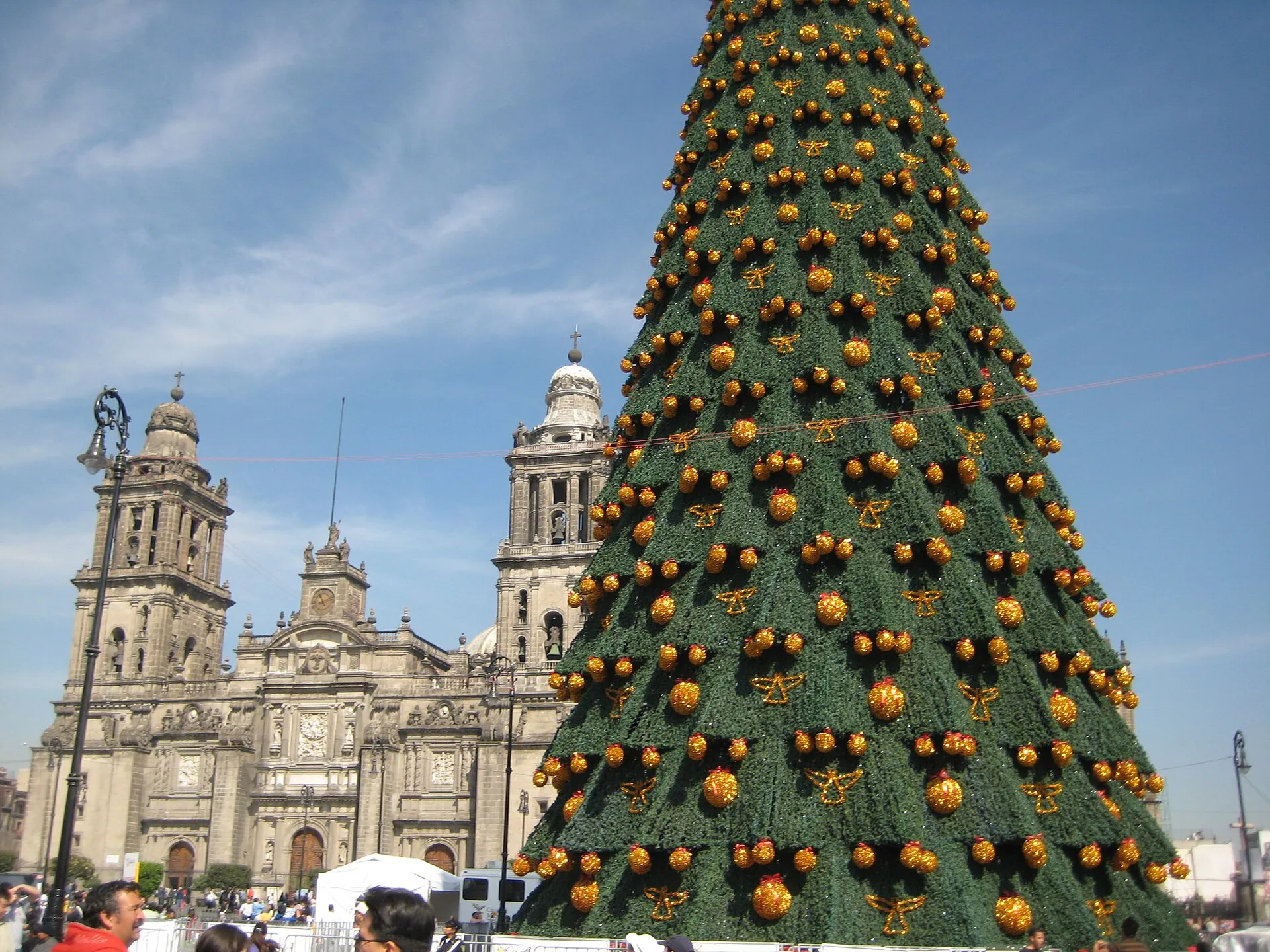 A Christmas tree beside the Metropolitan Cathedral in the Zócalo. Photo: Abraham P V, Wikimedia Commons, CC BY 2.0.
The 2025-26 programme was announced in mid-December 2025, and the 2026-27 one is not out yet. It did not list an ice rink in the Zócalo; it listed snow walks, and the same borough sites hosted posadas, pastorelas and nativity scenes. For a New Year’s Eve event, the city announced an electronic music concert on Paseo de la Reforma in 2025. See 3 days in Mexico City for the days in between.
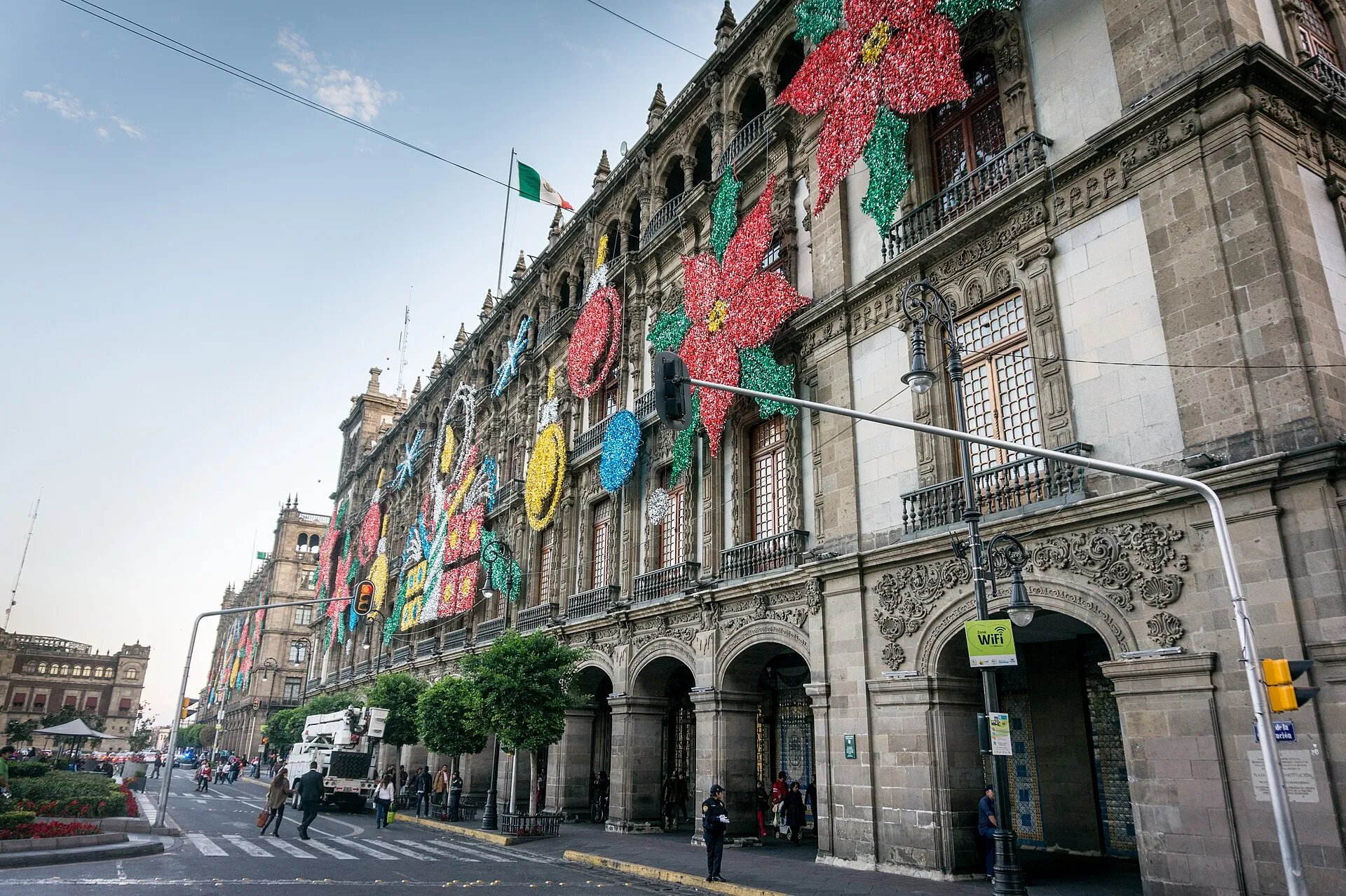 Christmas decorations on a historic building in the Centro Histórico. Photo: L-BBE, Wikimedia Commons, CC BY 3.0.
Día de Reyes, 5 and 6 January
Reyes (Día de Reyes, Epiphany) on 6 January is the day Mexican children get presents from the Three Kings. The city’s tourism page lists three things for visitors:
- The Monumento a la Revolución: its esplanade is the evening gathering where children hand letters to the Three Kings and have their photo taken.
- Toy fairs: they run early in the morning in the boroughs’ markets.
- The giant rosca: a free distribution of a monumental rosca de reyes with hot chocolate, which the page places in the Zócalo. In 2026 it was shared at the Ángel de la Independencia on Monday 5 January, led by the head of government and distributed in the other boroughs at the same time (El Financiero). The venue changes by year.
The rosca de reyes is a ring of sweet bread with candied fruit and a small figure baked inside. Whoever finds it traditionally hosts the party on 2 February, Candelaria, with tamales and atole.
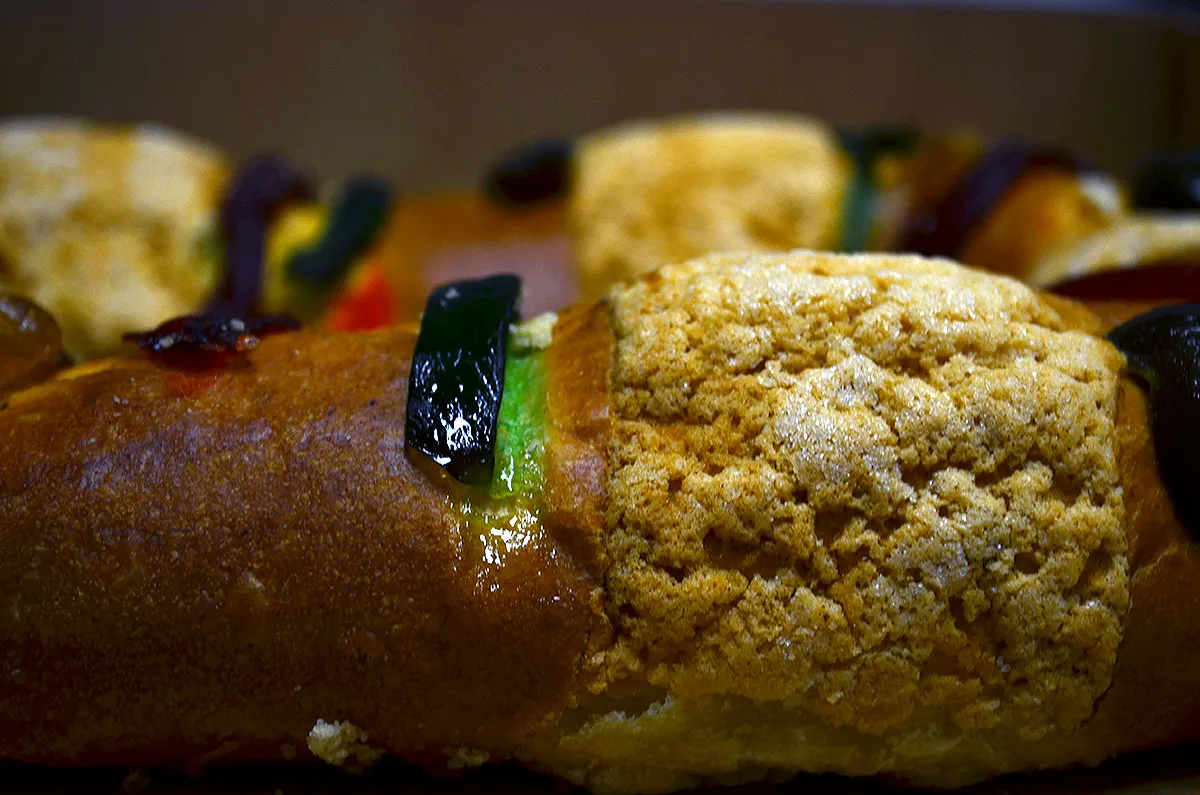 A rosca de reyes. Photo: ProtoplasmaKid, Wikimedia Commons, CC BY-SA 3.0.
Tours
Mexico City: Magical Christmas Decorations Private Tour
From MXN 4,567 · no reviews · 2 hours
The Magical Christmas Decorations Private Tourad is a private walk with a local guide through the historic centre, per its listing, past festive lights, landmarks and holiday traditions.
Mexico City: Night City Tour on a Double-Decker Bus
From MXN 200 · 4 stars from 473 reviews · 45 minutes
The Night City Tour on a Double-Decker Busad is a short night ride; the Turibus Nocturno is the operator’s own evening circuit through the lit Centro and Reforma for MXN 200.
Mexico City: Mexican Folklore Ballet
From MXN 1,548 · 4.6 stars from 144 reviews · 2 hours
The Mexican Folklore Balletad is a two-hour folk dance show of regional dances and costumes; the Palacio de Bellas Artes page has the official ticket.
Where to stay
The Zócalo festival and the Centro Histórico lights are on the Zócalo, where the Gran Hotel Ciudad de Méxicoad stands under its stained-glass ceiling; the Reyes gatherings are at the Monumento a la Revolución and the Ángel, on or near Paseo de la Reforma, where the St. Regisad faces the Diana fountain. Where to stay in Mexico City compares the areas, and best time to visit Mexico City has the December weather.
What to plan around
The Frida Kahlo Museum takes timed tickets online only, so book it early. For the closing dates of museums on 24, 25 and 31 December and 1 January, check each museum’s own page; the Anthropology Museum, Chapultepec Castle and Templo Mayor pages give their usual Monday closures. For the festival that comes before this one, see Día de Muertos in Mexico City.
Common questions
When are the posadas in Mexico City?
The posadas run on the nine nights from 16 to 24 December. In 2026 that is Wednesday 16 December to Thursday 24 December. The city's tourism site describes neighbourhood posadas with piñata-breaking, hot fruit punch (ponche) and sung litanies, and pastorelas, shepherd plays, staged in Coyoacán, San Ángel and the Centro Histórico.
What is on in the Zócalo at Christmas?
In the 2025-26 festival Luces de Invierno, which ran from 20 December to 4 January, the Zócalo had three illuminated trees decorated with nochebuenas (poinsettias), 14 light sculptures, a monumental nativity scene, a light tunnel and a stage with 76 music groups, plus 120 craft exhibitors.
Is there an ice rink in the Zócalo at Christmas?
None was in the announced Zócalo programme for 2025-26, which listed snow walks (paseos nevados) at its sites instead, and none is announced for 2026-27.
When is Día de Reyes in Mexico City?
6 January, a Wednesday in 2027. The city's tourism site describes an evening gathering on the esplanade of the Monumento a la Revolución where children hand their letters to the Three Kings, toy fairs in borough markets in the morning, and a free giant rosca de reyes with hot chocolate. In 2026 the giant rosca was shared at the Ángel de la Independencia on Monday 5 January.
What is a rosca de reyes?
A ring of sweet bread topped with candied fruit, eaten around 6 January. A small figure is baked inside, and the person who finds it traditionally hosts the party on Candelaria, 2 February.