In this guide
💡 The Short Version: Puebla and Cholula lie roughly 130 km south-east of Mexico City (about 2 hours by road), past Popocatépetl and Iztaccíhuatl, in our day trips from Mexico City guide. DIY bus: Estrella Roja and ADO coaches leave the TAPO bus terminal (Metro Line 1 or Line B to San Lázaro). Visit Cholula first for the Great Pyramid of Cholula (INAH: MXN 210 for foreign visitors, open Wednesday to Sunday 09:00–17:00) and the hilltop Santuario de la Virgen de los Remedios, then walk Puebla’s Zócalo, Cathedral, Capilla del Rosario and Calle de los Dulces before sitting down to mole poblano and tacos árabes. Or book a tour: the Mexico City: Puebla, Cholula & Tonantzintla with Lunchad (from MXN 1,051, 4.5 stars from 1,584 reviews, 11 hours) covers all three places with lunch included.
Getting to Puebla and Cholula: TAPO bus vs guided tour
Going on your own or booking a tour comes down to how many stops you want in one day.
| Factor | Independent bus from TAPO | Guided day tour |
|---|---|---|
| Departure point | TAPO bus terminal (Metro San Lázaro, Line 1 / B) | Set by the tour operator; see the listing |
| Transit time | About 2 hours to Puebla CAPU, then a taxi or ride-hail to the centre or Cholula | 11 hours for the whole tour, lunch included |
| Stops | Puebla centre and Cholula, by local taxi | Puebla, Cholula and Tonantzintla |
| Cost | Bus tickets, local taxis, entry and lunch | From MXN 1,051 (lunch included) |
| Suits | A slow lunch and your own return coach | Fitting three places into one day |
How to go independently from TAPO
- Reach TAPO: Ride Metro Line 1 (Pink) or Line B to San Lázaro (MXN 5; see public transport in Mexico City) or take an Uber from Roma Norte, Condesa or Centro.
- Board Estrella Roja or ADO: Buy a ticket at the TAPO counters to Puebla CAPU. Estrella Roja’s site also lists Paseo Destino and Cholula among its Puebla terminals.
- Transfer into Cholula or the centre: From CAPU, take an authorised taxi or ride-hail to the Great Pyramid of Cholula first, or straight to Puebla’s Zócalo.
- Return to Mexico City: Book a coach back that leaves Puebla with enough margin for traffic into the capital.
Morning stop: Great Pyramid of Cholula and Santuario de los Remedios
Begin in Cholula, where on a clear morning Popocatépetl (5,426 metres) is visible to the west.
Beneath what looks like a steep, tree-covered hill lies the Great Pyramid of Cholula (Tlachihualtepetl). INAH describes it as the pyramid with the largest base in Mesoamerica, 450 metres on each side, built by adding layers over many centuries. The INAH archaeological zone is open Wednesday to Sunday, 09:00 to 17:00, with foreign visitors paying MXN 210 and Mexican nationals and residents MXN 105. It has a three-room site museum and an open area of ceremonial patios south and west of the pyramid. Among its murals is Los Bebedores (the Drinkers). INAH lists the 280-metre tunnel through the pyramid as closed to the public until further notice.
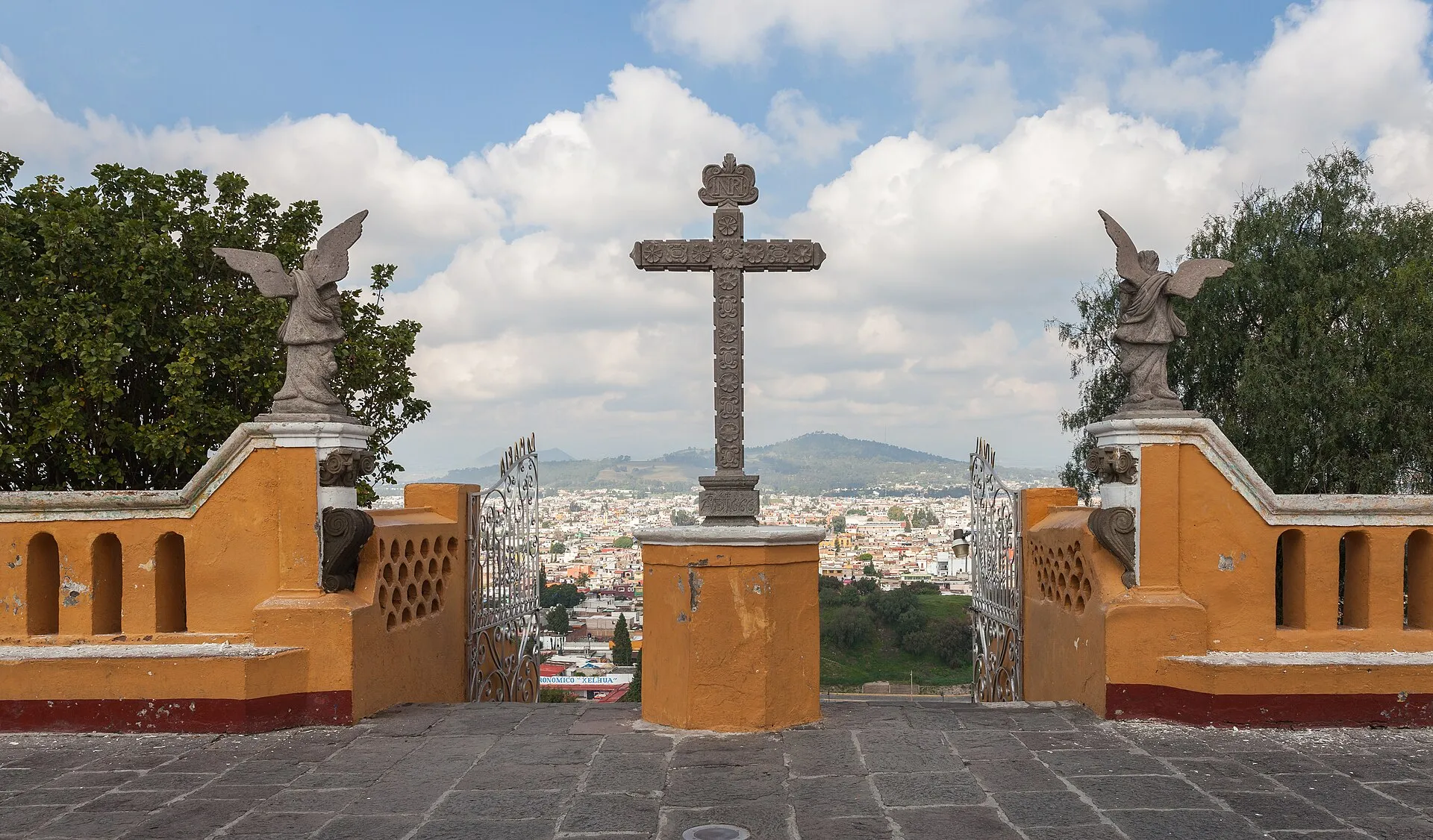
Atrium terrace of Santuario de los Remedios overlooking Cholula. Photo: Diego Delso, Wikimedia Commons, CC BY-SA 3.0.
Walk up the cobbled ramp that wraps around the mound to reach the Santuario de la Virgen de los Remedios, a bright ochre church built by the Spanish directly on the pre-Hispanic summit. The terrace outside gives wide views over Cholula’s domes and churches and across the Puebla valley.
If you have another 30 minutes, or are on a guided tour, visit Santa María Tonantzintla, a church whose interior is covered from floor to dome in polychrome stucco carvings of angels, fruit and flowers.
Afternoon stop: Puebla’s historic centre
Move on to Puebla’s UNESCO-listed Centro Histórico, laid out on a colonial grid of red-brick buildings and hand-painted Talavera ceramic tiles. The main sights are within walking distance of the main square.
Zócalo and Puebla Cathedral
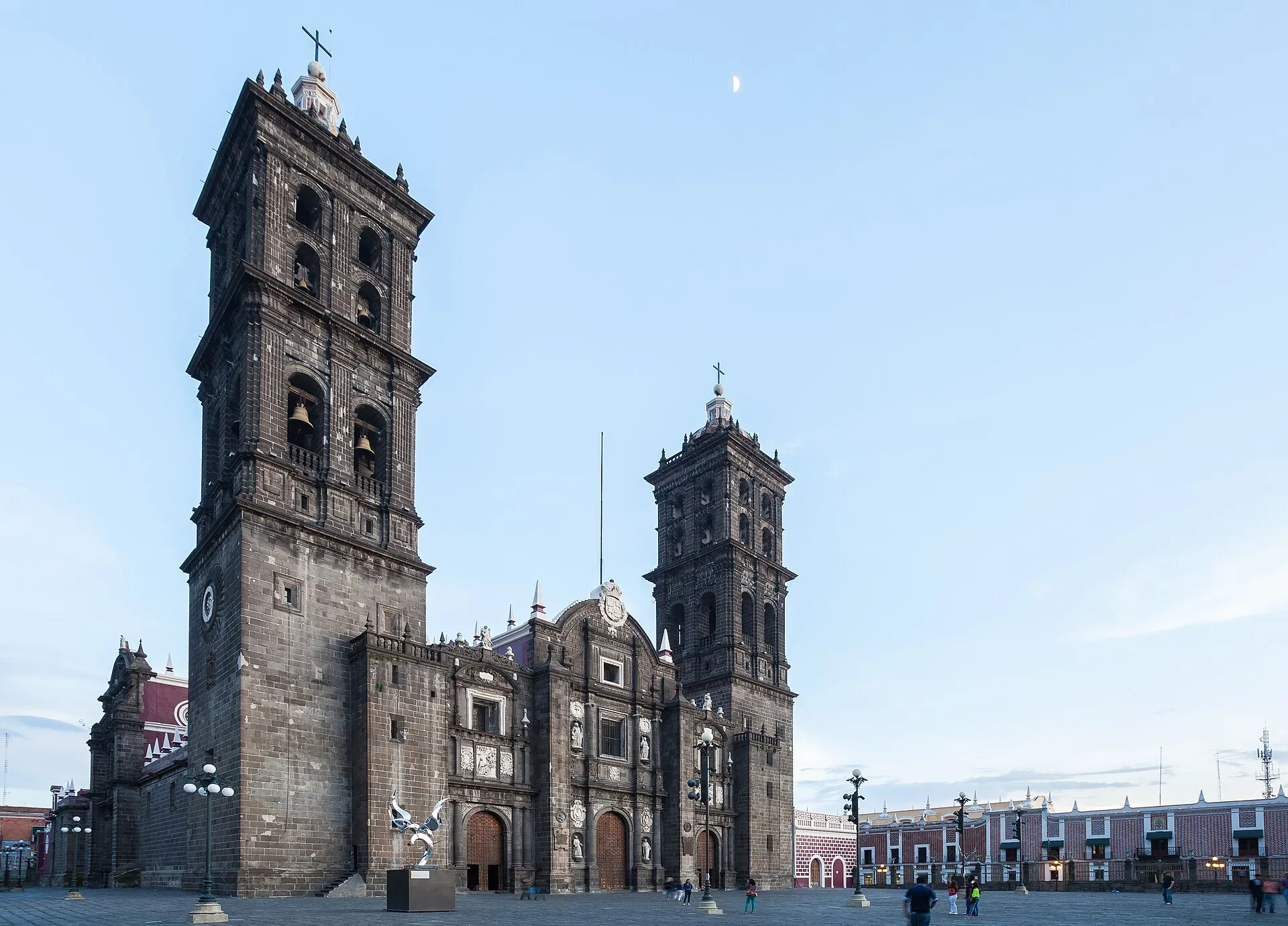
Puebla’s Zócalo is ringed by stone arcades (portales) with cafés and restaurants. The Puebla Cathedral stands on its southern side, built from 1575 and consecrated in 1649. Inside, look for the high altar (ciprés) designed by Manuel Tolsá.
Capilla del Rosario
The Capilla del Rosario is an annexe of the Templo de Santo Domingo at Avenida 5 de Mayo 407. In a printed text of 1690, Fray Diego de Gorozpe called it the eighth wonder of the world. The walls, columns and vaults are covered in gilded carving.
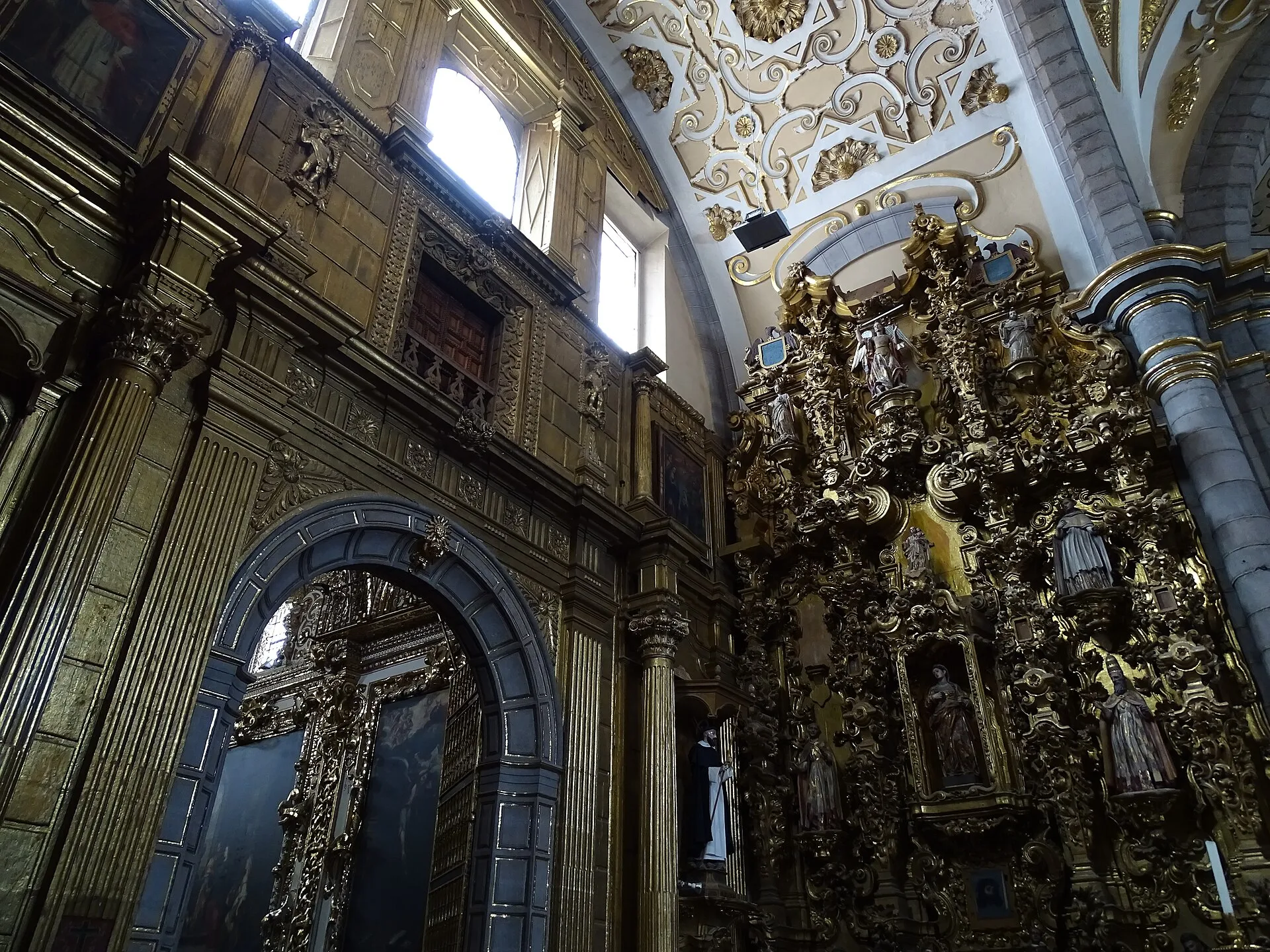
Gilded baroque interior of Capilla del Rosario. Photo: Adam Jones from Kelowna, BC, Canada, Wikimedia Commons, CC BY-SA 2.0.
Biblioteca Palafoxiana, Barrio del Artista and Calle de los Dulces
- Biblioteca Palafoxiana: Founded in 1646 in the Casa de la Cultura beside the Cathedral, it is recognised by UNESCO as the first public library in the Americas and holds more than 45,000 books and manuscripts.
- Calle de los Dulces (Avenida 6 Oriente): A short walk from the Zócalo, this street is lined with shops selling Poblano sweets: camotes (fruit-flavoured sweet-potato rolls), tortitas de Santa Clara (pumpkin-seed cookies) and borrachitos (liquor-filled jelly candies).
- Callejón de los Sapos and Barrio del Artista: Painted colonial townhouses here hold antique dealers and ceramic workshops, with open-air stalls at weekends.
What to eat in Puebla
Plan your main meal (la comida, mid-afternoon) in Puebla rather than grabbing a snack.
- Mole poblano: Puebla’s signature dish combines roasted poblano, mulato, pasilla and ancho chillies with almonds, sesame seeds, raisins, warm spices and dark chocolate, ladled over chicken with rice and tortillas.
- Tacos árabes: Brought to Puebla by Lebanese immigrants in the twentieth century and an ancestor of Mexico City’s tacos al pastor, these are spiced pork shaved from a vertical spit onto thick flour flatbread (pan árabe) with chipotle salsa.
- Cemitas poblanas: Sesame-seeded rolls stuffed with breaded pork or chicken (milanesa), quesillo (Oaxaca cheese), avocado, papalo herb and chipotle.
- Chiles en nogada (seasonal): In season, roughly August and September, look for roasted poblano peppers stuffed with sweet-savoury picadillo, covered in walnut cream sauce and scattered with pomegranate seeds.
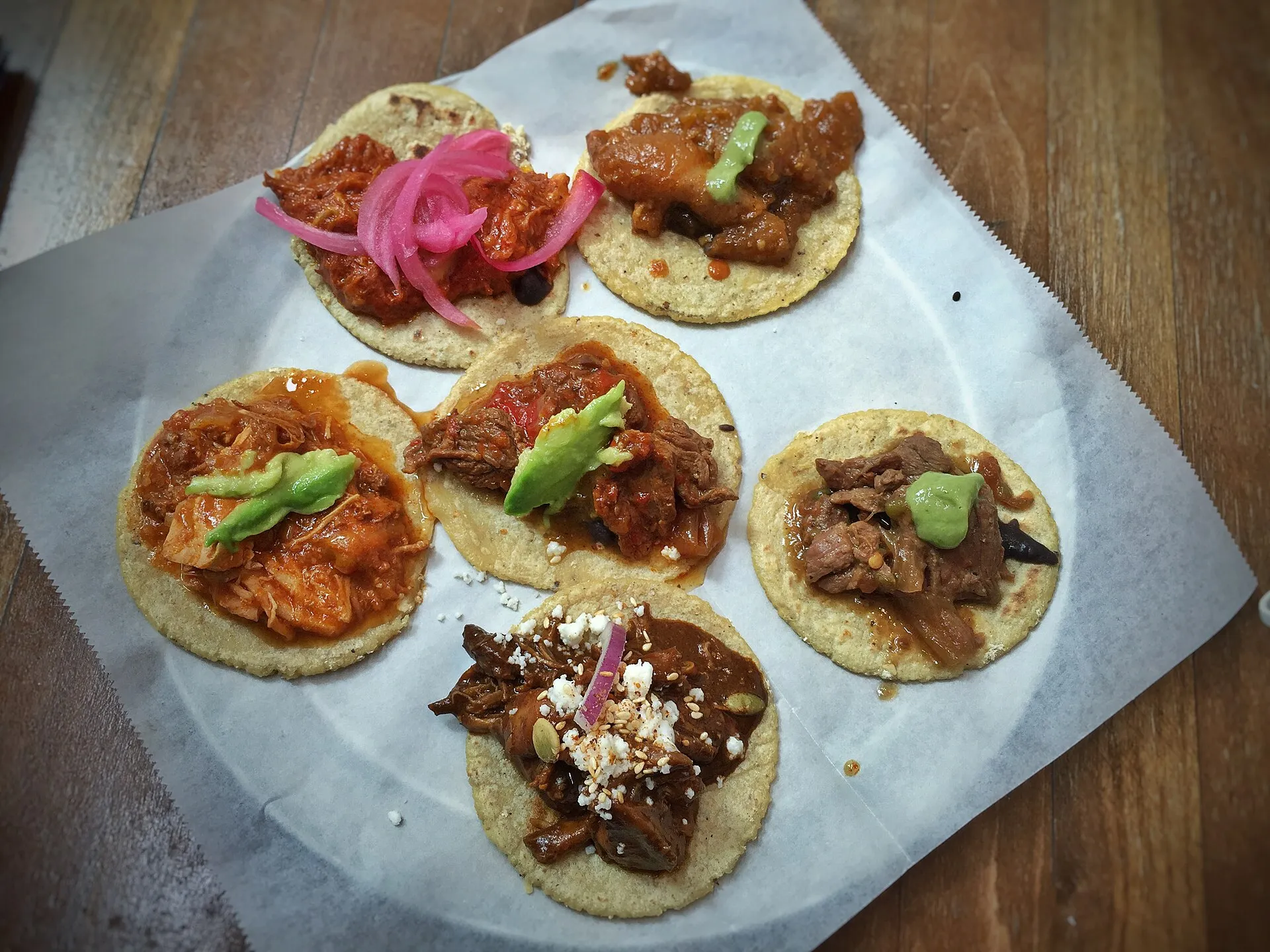
Guisado tacos, including one with mole poblano. Photo: T.Tseng, Wikimedia Commons, CC BY 2.0.
Guided tour option
Mexico City: Puebla, Cholula & Tonantzintla with Lunch
From MXN 1,051 · 4.5 stars from 1,584 reviews · 11 hours
The Mexico City: Puebla, Cholula & Tonantzintla with Lunchad is a full-day tour from Mexico City to the cities of Puebla and Cholula and the village of Tonantzintla, with lunch included. Its listing mentions the colours of Puebla, its local food and its Talavera pottery. It suits the 4 days in Mexico City plan if you would rather not arrange the TAPO bus and local transfers yourself.
Practical tips for Puebla and Cholula
- Check the days: INAH’s Cholula zone is closed on Mondays and Tuesdays, so a Wednesday to Sunday trip lets you see the pyramid zone and the site museum.
- Volcano views: Popocatépetl is usually clearest in the morning; see best time to visit Mexico City for the dry season.
- Footwear: Wear flat shoes with grip for the cobbled climb to the Santuario de los Remedios.
- Carry small pesos: Sweet shops, cemita stalls and local buses work in cash (see money in Mexico City).
Common questions
How long is the bus from Mexico City to Puebla?
Estrella Roja and ADO coaches from Mexico City's TAPO bus terminal (Metro Line 1 or Line B to San Lázaro) take roughly 2 hours to reach Puebla's CAPU terminal, depending on traffic leaving the capital.
Can you visit both Cholula and Puebla in one day trip?
Yes. INAH puts the Cholula archaeological zone about 7 km from the city of Puebla. Start in Cholula in the morning, then spend the afternoon in Puebla's Zócalo, Cathedral, Capilla del Rosario and Calle de los Dulces. The INAH zone is closed on Mondays and Tuesdays, so plan the trip for Wednesday to Sunday.
Are the tunnels inside the Great Pyramid of Cholula open?
INAH's page for the zone lists the tunnel inside the pyramid, about 280 metres long, as closed to the public until further notice. The open area with its ceremonial patios, and the three-room site museum, are the parts you can visit, and the Santuario de la Virgen de los Remedios stands on the summit.
How much does the Great Pyramid of Cholula cost?
INAH lists MXN 210 for foreign visitors and MXN 105 for Mexican nationals and foreign residents. The zone is open Wednesday to Sunday from 09:00 to 17:00.
What dishes is Puebla known for?
Puebla is the home of mole poblano (a sauce of chillies, spices, nuts and chocolate served over chicken), tacos árabes (spit-roasted pork in a thick flour flatbread), cemitas (sesame-roll sandwiches) and, in season, chiles en nogada.