In this guide
The Short Version: Over one million Hindu pilgrims and international spectators gather at Batu Caves for Thaipusam on 22 January 2027, creating one of the most intense and visually captivating religious festivals recognised by Tourism Malaysia. Devotees fulfil vows to Lord Murugan by bearing Paal Kudam (pots of sacred milk) or carrying towering, steel-framed kavadis pierced into the skin and face, accompanied by the thunderous beats of urumi melam drums. The festival begins on the eve with the Silver Chariot procession travelling 15 kilometres from Sri Mahamariamman Temple in Chinatown to the caves. Access is completely free, and KTM Komuter runs 24-hour train services from KL Sentral directly to the temple gates.
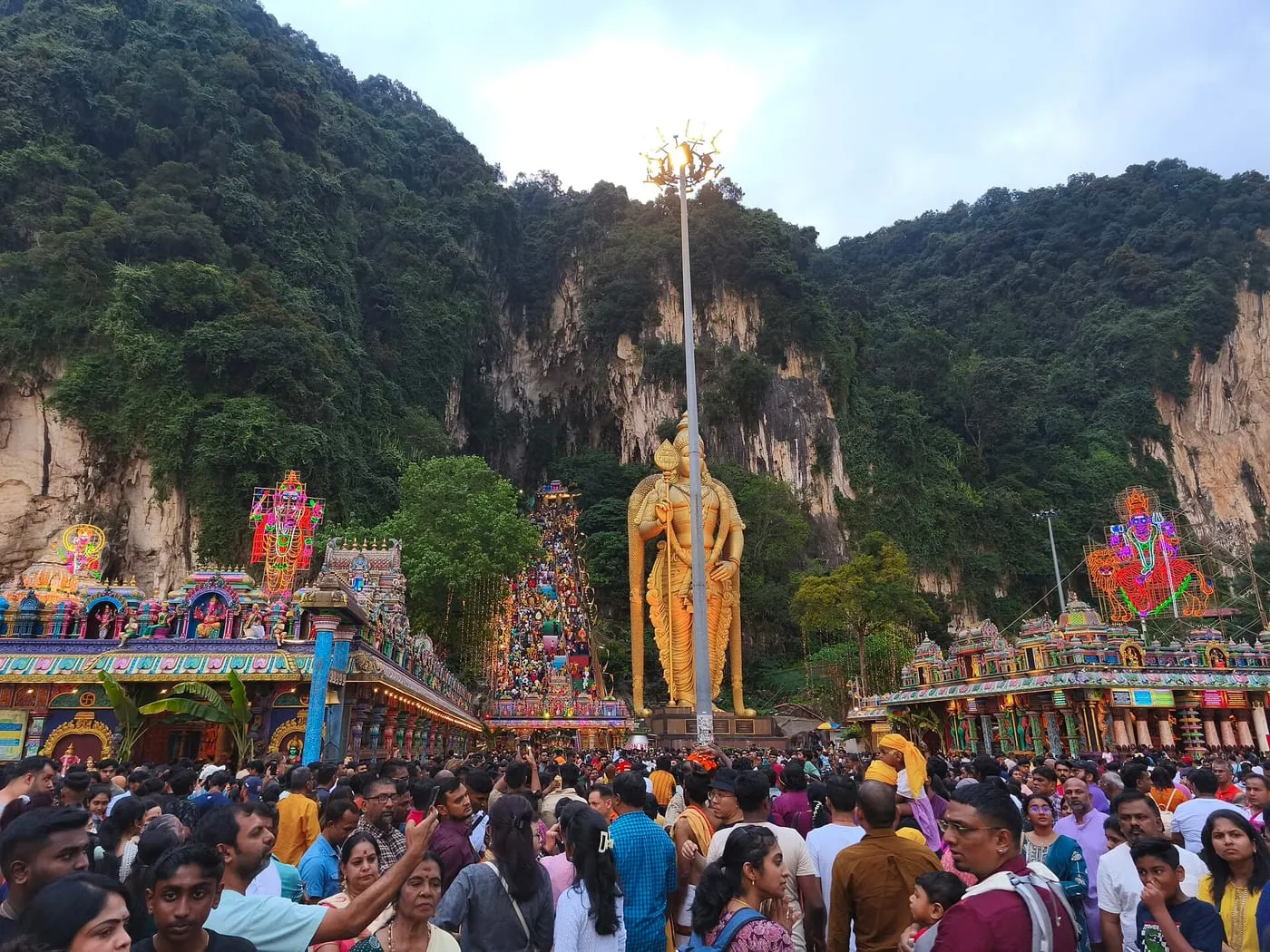
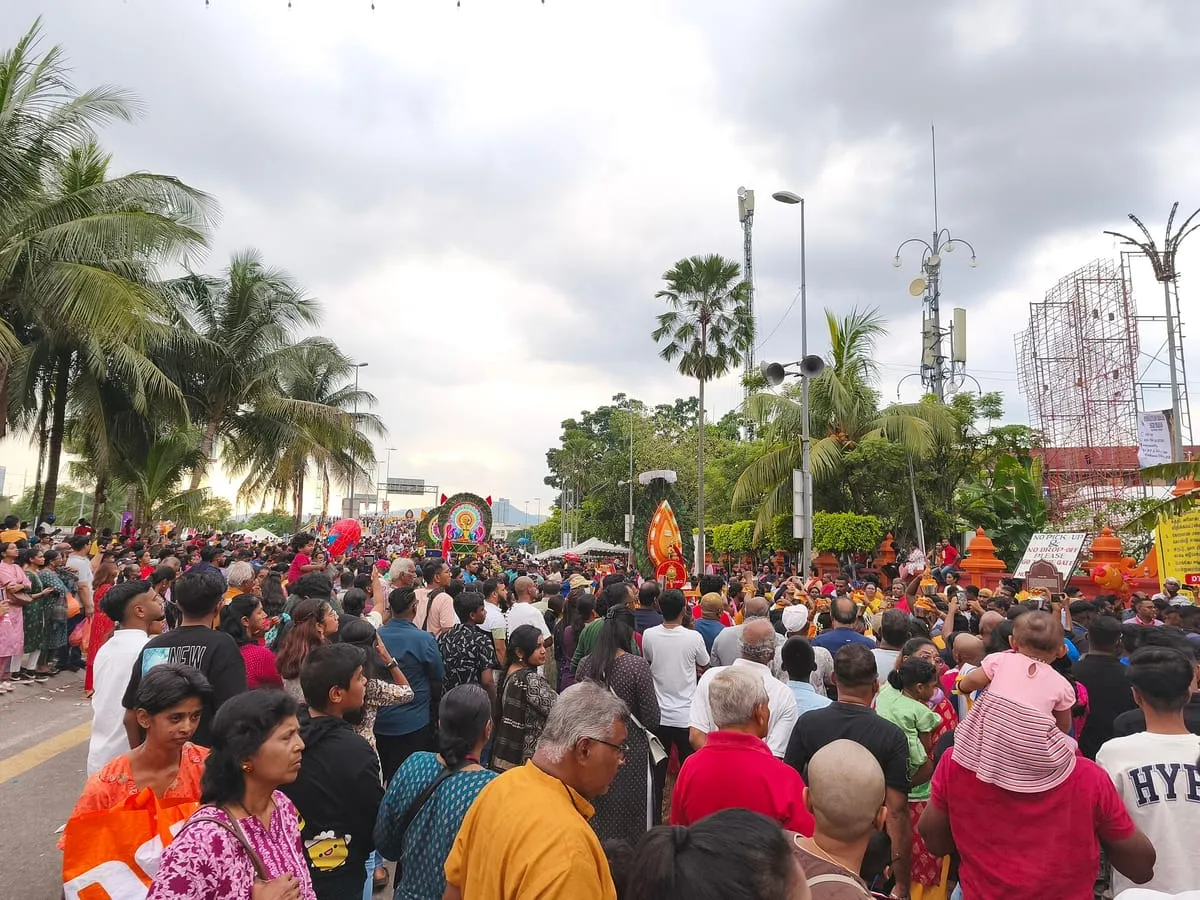
Batu Caves illuminated for Thaipusam. Photo: angys, Wikimedia Commons, CC BY-SA 4.0.
Festival schedule & essentials for 2027
Thaipusam occurs annually during the full moon in the Tamil calendar month of Thai (between mid-January and mid-February). The three-day observance centres around physical discipline, spiritual devotion, and thanksgiving.
| Date / Phase | Time | Location | What happens & visitor advice |
|---|---|---|---|
| Thursday, 21 January 2027 (Eve) | 21:00 departure through midnight | Sri Mahamariamman Temple to Batu Caves | Silver Chariot procession carrying deities moves slowly along a 15km route through the night |
| Friday, 22 January 2027 (Main Festival) | Dawn (05:00) until late midnight | Batu Caves & Sungai Batu riverbank | Peak kavadi processions, river purifications, trance drumming, and ascent of the 272 steps |
| Saturday, 23 January 2027 (Conclusion) | 16:00 until early morning hours | Batu Caves returning to Chinatown | Thanksgiving prayers; Silver Chariot departs Batu Caves on its overnight return journey |
The spiritual significance of Thaipusam
Thaipusam commemorates the mythological victory of Lord Murugan (also revered as Kartikeya or Subramaniam), the Hindu god of war, wisdom, and virtue, over the demon king Soorapadman. According to Hindu scripture, Goddess Parvati presented Murugan with a sacred golden spear—the Vel—with which he vanquished demonic tyranny and restored celestial balance.
For devotees, Thaipusam is not a period of mourning, but a celebration of good prevailing over ignorance and negative habits. Worshippers prepare weeks in advance through a strict spiritual discipline known as vratam:
- Observing a strict vegetarian diet for 21 to 48 days.
- Practising celibacy and sleeping on simple floor mats.
- Abstaining from alcohol, smoking, and profane speech.
- Daily prayer, ritual bathing in cold water, and mental focus on Murugan.
Through this physical purification, devotees believe their minds and bodies are sanctified, allowing them to bear burdens and undergo piercings without pain or physical injury.
The pilgrimage: Paal Kudam, trance and Kavadis
As dawn breaks over Batu Caves on 22 January, hundreds of thousands of worshippers converge on the banks of the Sungai Batu river, located adjacent to the temple complex, to prepare for their ascent.
Paal Kudam (Milk Pot Bearers)
The most widespread act of devotion is carrying the Paal Kudam. Devotees—men, women, and children dressed in bright yellow or saffron robes—carry brass or clay pots filled with fresh cow’s milk balanced carefully on their heads.
The vessel is covered with fresh cloth and crowned with sprigs of aromatic margosa (neem) leaves. Pilgrims carry the milk up the 272 steps into the Cathedral Cave, where temple priests pour it over the statue of Lord Murugan in an elaborate ritual ablution (abishekam).
The Kavadi: Bearing the physical burden
The word kavadi translates literally from Tamil as a “burden” or “sacrifice”. Devotees carry kavadis to express gratitude for prayers answered—such as recovery from a grave illness, the birth of a child, or deliverance from hardship.
Kavadis take various forms:
- Alagar Kavadi: A semicircular wooden canopy decorated with peacock feathers (the peacock is Murugan’s celestial mount) and floral garlands, balanced across the shoulders.
- Vel Kavadi: A colossal steel and aluminium framework soaring up to four metres high and weighing between 20 and 35 kilograms. The framework is anchored directly into the devotee’s torso, waist, and ribs via dozens of sharp curved metal spikes and hooks.
- Piercings: Many kavadi bearers have their cheeks, lips, or tongues pierced with miniature silver or brass spears (vels). The spear through the tongue serves as a symbolic vow of silence, preventing speech and concentrating the mind entirely on devotion.
The state of spiritual trance
Kavadi bearers enter a heightened state of spiritual consciousness known as arul vakku or divine trance. Surrounded by family members, spiritual mentors, and musicians playing traditional urumi melam drums, the bearer is sustained by rhythmic chanting:
“Vel! Vel! Vetrivel! Sakthivel!” (“Hail the spear of victory and power!”)
Under this hypnotic sensory rhythm, devotees exhibit no signs of distress as hooks and skewers are inserted into their skin. Observers frequently note the remarkable absence of bleeding during both the insertion and subsequent removal of the metal pins.
The Silver Chariot procession
The festival officially commences on the evening before the main day (21 January 2027) with the departure of the Silver Chariot from Sri Mahamariamman Temple on Jalan Tun H.S. Lee in Chinatown.
Constructed from carved teak and plated in pure silver, the 21-foot-high chariot carries sacred bronze statues of Lord Murugan and his consorts, Valli and Deivayanai. Drawn by a team of two consecrated white bullocks, the chariot is escorted by thousands of barefoot pilgrims holding oil lamps and chanting devotional hymns.
The chariot winds through the streets of Kuala Lumpur over the course of 12 to 14 hours, traversing Jalan Sultan, Jalan Dang Wangi, and Sentul before arriving at Batu Caves on the morning of Thaipusam. Along the route, residents and business owners smash thousands of fresh coconuts onto the road surface before the wheels—an act symbolising the shattering of individual ego to reveal the pure white flesh of spiritual humility within.
24-hour KTM Komuter festival trains
With over one million people descending upon the site, roads surrounding Batu Caves, including the Middle Ring Road 2 (MRR2) and Jalan Kuching, experience severe traffic gridlock. Driving or booking road taxis to the site on the main festival day is strongly discouraged.
The only dependable way to reach the temple is by rail:
- The Operator: Keretapi Tanah Melayu Berhad (KTMB) operates special 24-hour round-the-clock festival train schedules on the KTM Komuter line between KL Sentral and Batu Caves Station.
- Travel Time: Exactly 30 minutes from KL Sentral, pulling up at the terminal platform situated right outside the temple gates.
- Frequencies: Trains run every 15 to 30 minutes throughout the entire night and day.
- Fare: 2.60 MYR each way. Payment is handled by tapping a Touch ‘n Go card or buying a single-journey token at station ticket windows.
For full advice on ticketing and route maps, see our guide to Public Transport in Kuala Lumpur.
Visitor etiquette, dress code & photography
Thaipusam is a sacred religious pilgrimage, not a commercial tourist performance. While visitors of all backgrounds are warmly welcomed, showing proper respect ensures a harmonious experience for everyone:
1. Mandatory dress code
- Wear clothing that covers your shoulders and extends well below the knee. Loose cotton trousers or ankle-length skirts paired with breathable short-sleeve shirts are recommended.
- Avoid wearing black: In Tamil Hindu tradition, black is associated with grief and inauspiciousness. Devotees appreciate visitors who wear auspicious colours such as yellow, saffron, orange, or clean white.
- Footwear must be removed and stored before stepping into any formal temple prayer hall inside the cave complex.
2. Photography guidelines
- Photography and videography are permitted throughout the open grounds and staircase.
- Maintain a respectful distance: Never push between a kavadi bearer and their drum troop, as bearers operate in an altered psychological state and need a wide turning radius.
- Do not use flash: Avoid aiming harsh camera flashes directly into the eyes of devotees in trance or priests conducting sanctum blessings.
- Be courteous: If capturing close-up portraits of pilgrims resting or having milk poured on their heads, ask for permission with a polite nod or smile.
3. Beware the resident macaques
Hundreds of wild long-tailed macaques inhabit the limestone cliffs. During Thaipusam, the monkeys are over-stimulated by crowds, food offerings, and noise:
- Never carry open food containers, loose bananas, or coconut pieces in your hands.
- Keep plastic carrier bags hidden inside zipped rucksacks, as macaques associate plastic rustling with food.
- Secure sunglasses, cameras, and mobile phones firmly with wrist straps.
Survival tips for first-time spectators
- Optimal timing: Arrive either very early in the morning (05:30 to 08:30) to witness the arrival of the Silver Chariot and beat the blistering midday sun, or visit in the evening (19:30 to 22:30) when illuminated kavadis light up with neon bulbs and battery-powered LED strips.
- Hydration and heat management: Equatorial temperatures exceed 32°C with 85% humidity. Bring a large reusable water bottle, electrolyte sachets, a wide-brimmed sun hat, and packet tissues or wet wipes. Free cold drinking water is distributed at charity stalls (Thanneer Panthal) set up by local community groups along the approach roads.
- Ear protection: The rhythmic urumi melam percussion ensembles produce intense, sustained volume levels. If you are sensitive to loud noise or travelling with children, pack foam earplugs.
- Patience: Moving up the 272 stairs can take 45 to 60 minutes due to the dense crowd flow. Stay patient, keep your footing on the wet concrete steps, and follow the directional barriers set up by volunteer marshals.
To explore Batu Caves outside of festival periods, consult our comprehensive Batu Caves Guide. For advice on building a broader travel schedule around your trip, see our 3 Days in Kuala Lumpur Itinerary and Best Time to Visit Kuala Lumpur.
Common questions
When is Thaipusam at Batu Caves in 2027?
Thaipusam takes place on Friday, 22 January 2027. Associated rituals span three consecutive days, beginning with the Silver Chariot procession departing Chinatown on 21 January and concluding with its return journey on 23 January.
How much does it cost to attend Thaipusam at Batu Caves?
Attendance and entry to Batu Caves during Thaipusam are completely free for all devotees and foreign visitors. KTM Komuter train tickets from KL Sentral cost 2.60 MYR each way.
What should visitors wear to Thaipusam at Batu Caves?
Modest attire covering shoulders and knees is mandatory. Wearing bright festive colours like yellow or saffron is traditional and auspicious. Devotees and visitors are advised to avoid wearing black, as it is considered inauspicious.
How do you travel to Batu Caves during Thaipusam?
Take the KTM Komuter train from KL Sentral directly to Batu Caves station. Keretapi Tanah Melayu operates a continuous 24-hour festival rail timetable throughout the peak days, completely bypassing the massive road traffic jams on the MRR2 highway.