In this guide
The Short Version: Batu Caves is a major Hindu pilgrimage site in peninsular Malaysia, featuring a colossal 42.7-metre (140-foot) golden statue of Lord Murugan standing beside 272 brightly painted rainbow steps leading into a towering limestone cavern. Admission to the main Temple Cave is free, but strict temple etiquette applies: shoulders and knees must be completely covered by your attire. The most straightforward transport is the direct KTM Komuter train from KL Sentral (30 minutes, RM2.60 each way), dropping you right outside the temple gates. Arrive between 07:30 and 08:30 to beat midday tropical heat, avoid large tour coach crowds, and dodge aggressive macaque monkeys that target exposed food and plastic bags on the stairs. Or book a tour: take the hassle out of morning transit with a Batu Caves half-day tourad (from RM 38, 4.5 stars from 4,878 reviews) with door-to-door hotel collection.
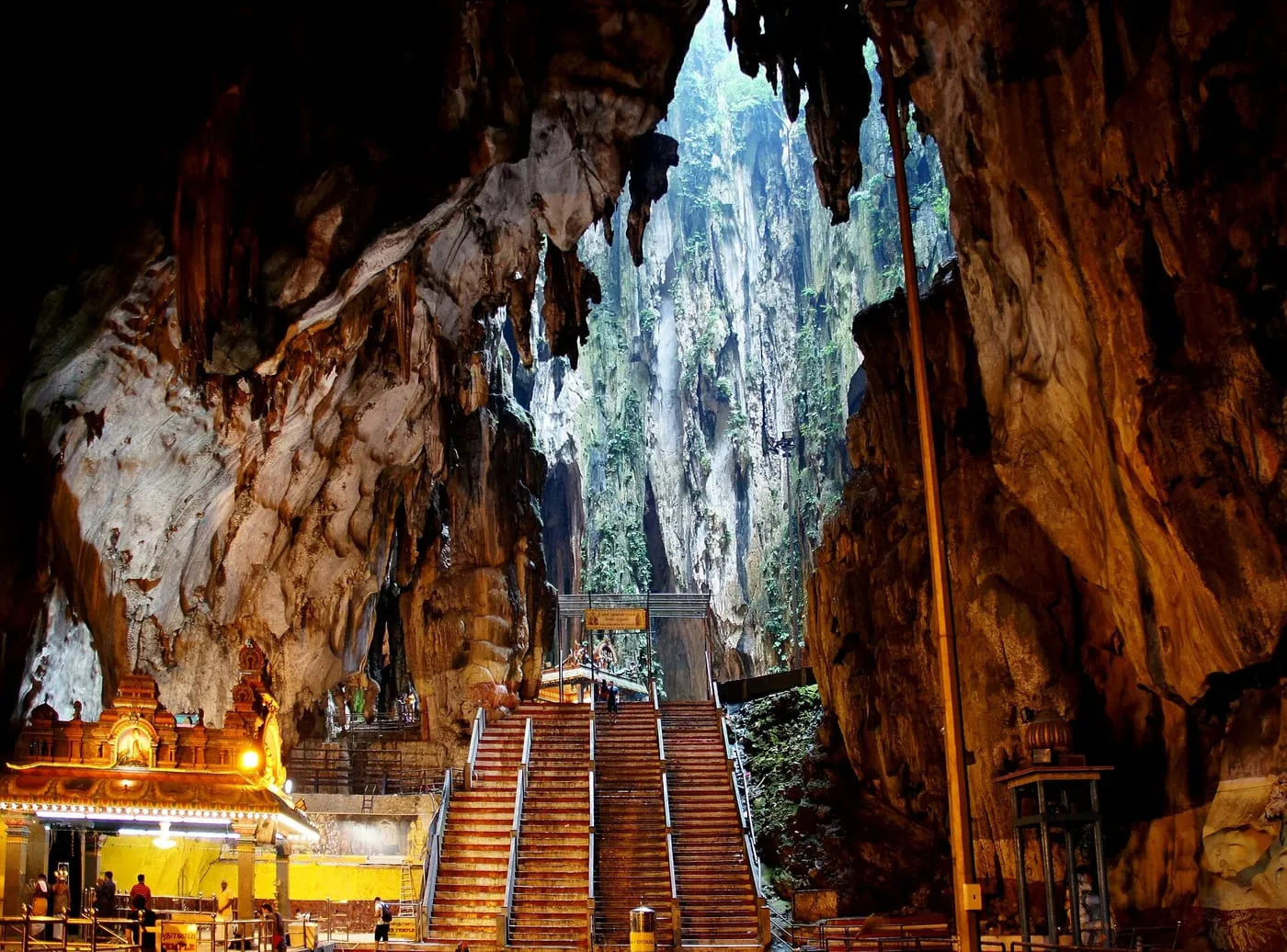
Cathedral Cave interior at Batu Caves. Photo: Bernard Spragg. NZ, Wikimedia Commons, CC0.
Understanding Batu Caves: history and significance
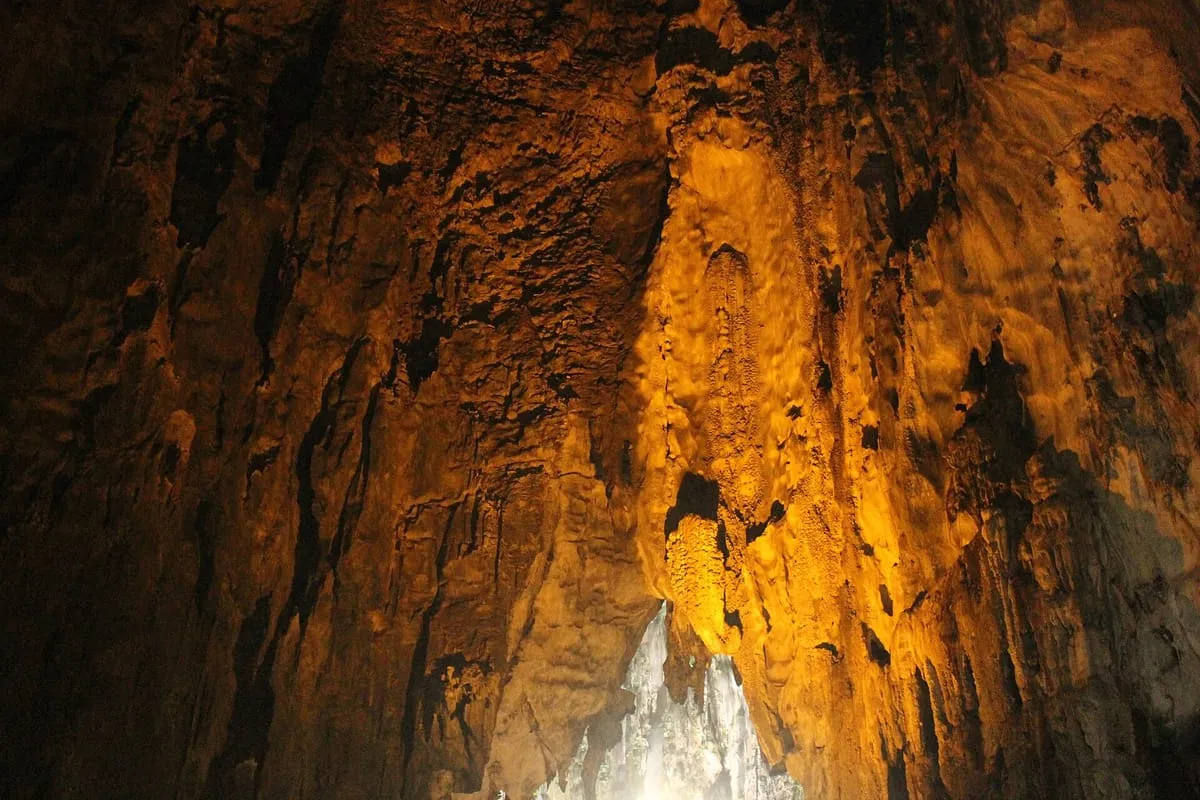
Rising 100 metres above the surrounding suburban plain in Gombak, roughly 13 kilometres north of central Kuala Lumpur, the Batu Caves are formed from ancient karst limestone estimated to be over 400 million years old.
Historically used as shelter by indigenous Orang Asli tribes and later excavated for guano fertiliser by early European settlers, the caves were dedicated as a Hindu temple in 1890 by influential merchant K. Thamboosamy Pillay. He was inspired by the spear-shaped entrance of the main cavern, which bore a striking resemblance to the divine vel (spear) wielded by Lord Murugan, the Hindu god of war and victory.
Today, Batu Caves stands as the focal point of the global Tamil Hindu diaspora and forms the dramatic spiritual climax of the annual Thaipusam festival, during which over a million devotees and pilgrims gather in prayer, accompanied by the hypnotic beat of ceremonial drums.
| Cave or Section | Location | Admission | Key highlights |
|---|---|---|---|
| Temple Cave (Cathedral Cave) | Top of the 272 steps | Free | Vast 100-metre-high cavern, Hindu shrines, natural skylight |
| Lord Murugan Statue | Base of staircase | Free | 42.7-metre golden statue, starting point of the rainbow climb |
| Ramayana Cave | Left of entrance plaza | RM5 | Dioramas depicting the Ramayana epic, 15-metre reclining Kumbhakarna |
| Cave Villa | Base of cliff pond | RM15 | Illuminated footbridges, koi ponds, painted Hindu deity statues |
The main sights in the complex
The limestone hill houses several independent caves, shrines, and cultural exhibitions:
1. The 140-foot Lord Murugan Statue and Rainbow Steps
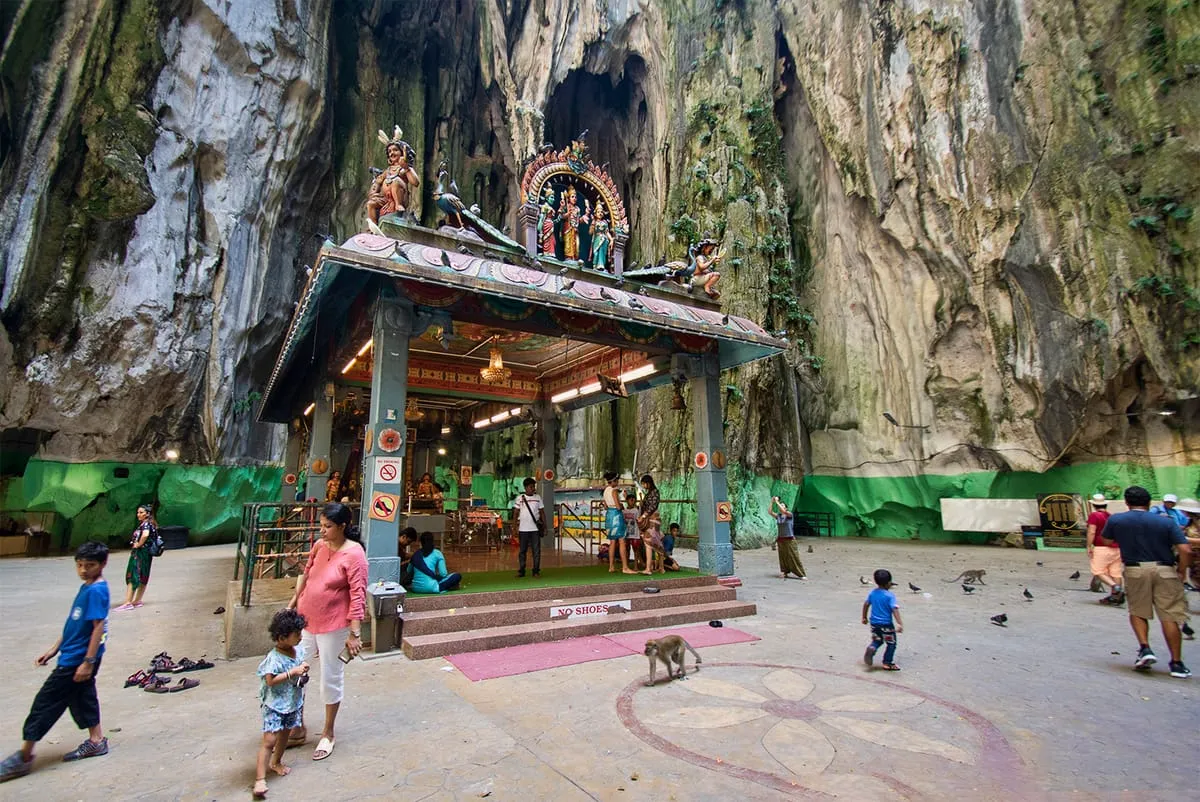
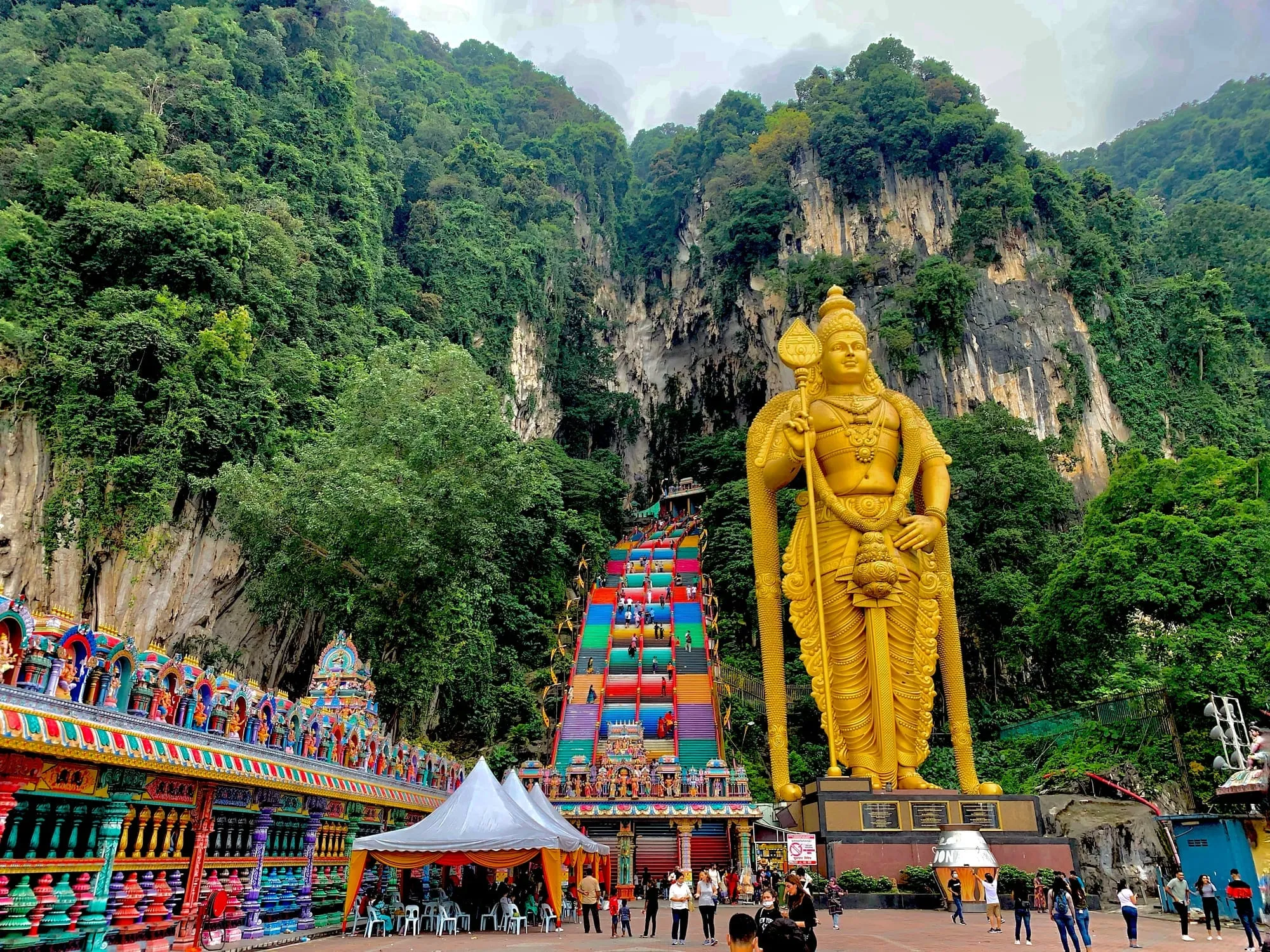
Standing at the base of the limestone cliff is the monumental statue of Lord Murugan. Completed in 2006, it measures 42.7 metres (140 feet) in height, constructed using 1,550 cubic metres of concrete, 250 tonnes of steel bars, and over 300 litres of gold paint imported from Thailand. It remains the tallest statue of a Hindu deity in Malaysia.
Rising behind the statue are the famous 272 concrete steps, painted in 2018 in bright rainbow hues of red, blue, green, and orange. The staircase is split into four parallel lanes, allowing climbing pilgrims, descending visitors, and maintenance workers to move smoothly.
2. Temple Cave (Cathedral Cave)
At the top of the 272 steps lies the main cavern, known as the Temple Cave or Cathedral Cave:
- The Geology: The cavern features a 100-metre-high vaulted ceiling with dramatic stalactites hanging from above and natural sunlight streaming down through a massive ceiling opening into an inner courtyard.
- The Shrines: Several ornate Hindu shrines are embedded into the rock walls, including the Sri Valli Deivanai temple dedicated to Lord Murugan and his consorts. You will witness priests conducting traditional puja ceremonies with burning camphor, incense, and coconut offerings.
- Admission: Free of charge. Visitors remove shoes when stepping onto the tiled sanctum platforms inside the shrines.
3. Ramayana Cave
Located 100 metres to the left of the main entrance, adjacent to the railway station:
- The Statues: Marked by an impressive 15-metre-tall green statue of the monkey god Hanuman and a multi-tiered chariot.
- The Cavern: The interior walls are lined with illuminated, life-sized statues and dioramas depicting scenes from the epic Hindu legend of the Ramayana.
- Admission: RM5 per person, payable at the cave entrance booth.
4. Cave Villa
Situated at the base of the cliff beside the ornamental koi ponds:
- Exhibits: Houses statues of Hindu deities, painted murals illustrating classical Indian scriptures, and a small cultural reptile sanctuary.
- Admission: RM15 for international visitors (RM7.00 for Malaysian citizens).
5. Dark Cave (Conservation area)
Located midway up the 272 steps on the left side, the Dark Cave is a protected 2-kilometre cave network holding one of the world’s rarest trapdoor spider species (Liphistius batuensis) and extensive bat colonies. While scientific educational tours previously ran here, the cave is currently closed to commercial tourist traffic to preserve its delicate underground ecosystem.
Or book a tour
If you prefer round-trip air-conditioned transport with central hotel pickup and a guide to explain the Hindu iconography, reserve the Kuala Lumpur: Suburbs & Batu Caves Half-Day Tourad{rel=“sponsored nofollow noopener”}.
Strict dress code rules
Batu Caves is an active, holy place of worship. The dress regulations are strictly enforced by temple security staff posted at the turnstiles at the base of the staircase:
- What MUST be covered:
- Both men and women must ensure their knees and shoulders are completely covered.
- Long trousers, linen pants, maxi dresses, or long skirts falling below the knee are required.
- T-shirts covering the shoulders are acceptable.
- What is PROHIBITED:
- Short shorts, hot pants, gym running shorts, and mini-skirts.
- Sleeveless singlets, tank tops, vest tops, halter tops, and low-cut blouses.
- Sheer, see-through fabrics or heavily ripped denim.
- Sarong rental & purchase: If you arrive wearing non-compliant clothing, you will be turned away at the turnstile. Fortunately, temple stalls beside the stairs rent or sell colourful batik sarongs for roughly RM5 to RM15.
| Permitted Attire | Prohibited Attire |
|---|---|
| Long trousers / Jeans | Running shorts / Short shorts |
| Long skirts below the knee | Mini-skirts / Tennis skirts |
| Sleeved T-shirts / Blouses | Tank tops / Sleeveless singlets |
| Modest maxi dresses | Low-cut tops / Bare midriffs |
| Shawls / Sarongs covering legs | See-through / Sheer fabrics |
How to get to Batu Caves from Kuala Lumpur
Batu Caves sits right at the terminus of suburban transport lines, making travel from central Kuala Lumpur straightforward.
| Transport mode | Journey duration | Standard fare | Pick-up / Departure point | Key considerations |
|---|---|---|---|---|
| KTM Komuter Train | 30 minutes | RM2.60 each way | KL Sentral (Platforms 3 & 4) | Direct line terminating at Batu Caves; train departs every 30–45 minutes |
| Grab E-hailing Car | 20–35 minutes | RM20–RM30 | Hotel lobby in KL | Convenient door-to-door comfort; fare fixed upfront; avoid 07:30–09:00 rush hour |
| Public Bus (RapidKL 173) | 45–60 minutes | RM2.50 | Lebuh Ampang bus stop | Slowest option with numerous street stops; requires Touch ‘n Go card |
| Organised Half-Day Tour | 3.5–4 hours | From RM38 | Central hotel pick-up | Includes air-conditioned minibus transport, English-speaking guide, and stop at Royal Selangor Pewter |
Taking the KTM Komuter train (Step-by-step)
- Head to KL Sentral concourse; see our Kuala Lumpur public transport guide for connecting rail lines.
- Tap your contactless bank card or physical Touch ‘n Go card at the KTM Komuter turnstiles, or buy a paper ticket for RM2.60.
- Board the train heading towards Batu Caves (Line 1).
- Disembark at the final station: Batu Caves Station. Walk through the station exit gates, and you are immediately inside the temple complex grounds, just 100 metres from the rainbow staircase.
Monkey safety and visitor advice
The cliff faces around Batu Caves are home to hundreds of wild long-tailed macaques:
- Hide all food and plastic bags: Monkeys associate plastic bags and shopping bags with food. If you hold a plastic bag, a monkey will likely leap from the railing to rip it from your hands. Carry everything inside a securely zipped backpack.
- Do NOT feed the monkeys: Feeding the animals disrupts their natural foraging habits and encourages aggressive behaviour towards passing children and tourists.
- Avoid direct eye contact: In primate body language, prolonged direct eye contact and baring teeth (even in a wide smile) can be interpreted as a display of aggression. Walk past them steadily and calmly.
- Keep valuables close: Secure loose sunglasses, hats, earrings, and camera straps. Do not set your phone down on the stone staircase balustrade to pose for photos.
The annual Thaipusam festival
If your visit coincides with the Tamil month of Thai (usually late January or early February), you will witness one of the most astonishing spiritual festivals in Asia:
- The Pilgrimage: The three-day festival begins in the dead of night at the Sri Mahamariamman Temple in Chinatown, where a silver chariot bearing Lord Murugan processes 15 kilometres through the city to Batu Caves.
- Kavadi Attam: Devotees enter states of trance, carrying elaborate, decorated steel frameworks (kavadi) weighing up to 30 kilograms, anchored into their skin and torsos with metal hooks and skewers as acts of devotion, penance, or thanksgiving.
- Spectator Advice: The complex welcomes international visitors during Thaipusam with open hospitality. However, be prepared for immense crowds exceeding 500,000 people, heavy road closures, and tropical heat; travel exclusively via the 24-hour KTM Komuter festival trains.
Practical tips for your visit
- Best time to arrive: Aim to reach Batu Caves between 07:30 and 08:30. The morning temperature is significantly cooler (around 25°C to 27°C compared to 34°C at midday), morning sunlight illuminates the golden statue beautifully, and you will climb the 272 steps before massive tour buses arrive.
- Footwear: Wear comfortable, supportive walking shoes or trainers with good grip. The concrete steps can be slippery when wet after an early morning shower, and you will be climbing over 50 vertical metres.
- Hydration: Carry a reusable water bottle inside your daypack. Keep it stowed away while climbing to prevent inquisitive monkeys from snatching it.
- Vegetarian dining: The ground plaza features numerous South Indian vegetarian restaurants serving hot masala tea (chai), fresh roti canai, crispy thosai, and banana leaf rice sets for roughly RM8 to RM15.
For more planning advice and citywide orientation, read our complete Kuala Lumpur travel guide hub, or explore skyline towers in our Petronas Twin Towers ticket guide and KL Tower Menara Kuala Lumpur guide.
Tours and guided options
The main Cathedral Cave at Batu Caves is completely free to enter, and the KTM Komuter train costs just RM2.60 each way. Guided tours make sense when you want air-conditioned hotel collection, an informative cultural guide explaining Hindu theology, or combined itineraries adding waterfalls or fireflies.
Batu Caves half-day tour with hotel pick-up option
From RM 38 · 4.5 stars from 4,878 reviews · 3.5 hours · central pick-up included
Batu Caves half-day tour with hotel pick-up optionad: Climb 272 steps to the Batu Caves, marvel at the 140-foot-tall Lord Murugan statue, meet playful monkeys, and discover traditional Batik art on this cultural Kuala Lumpur adventure.
Batu Caves in-depth cultural temple tour
From RM 150 · 4.7 stars from 1,696 reviews · 4 hours · guided walk up the 272 stairs
Batu Caves in-depth cultural temple tourad: Join a sightseeing tour from Kuala Lumpur and visit the Batu Caves, a site of great importance to Hindu pilgrims. Climb the 272 steps to the statue of Lord Murugan and see the six-tier Thean Hou Temple.
Batu Caves, Ramayana Cave and Kanching Falls day trip
From RM 77 · 4.4 stars from 1,278 reviews · 5 hours · temple caves plus rainforest waterfall
Batu Caves, Ramayana Cave and Kanching Falls day tripad: Discover Batu Caves, explore the Ramayana Caves, and unwind at Kanching Falls. Experience Kuala Lumpur’s rich culture and lush nature in one day.
Batu Caves and 15 city highlights half-day tour
From RM 103 · 4.3 stars from 74 reviews · 4 hours · temple complex and downtown sights
Batu Caves and 15 city highlights half-day tourad: Discover Kuala Lumpur in 4 hours. Visit Batu Caves, Batik Factory, King’s Palace, Merdeka Square, KL Tower and Petronas Twin Towers, plus more city highlights.
Official ticket or tour: the prices side by side
DIY transit via the suburban rail network compared with guided tour excursions.
| Component | Independent visit | On GetYourGuide |
|---|---|---|
| Cathedral Cave (Temple Cave) entrance | Free | Included on all tours |
| KTM Komuter train round-trip from KL Sentral | RM5.20 return | Transport included |
| Guided half-day temple tour with coach pick-up | N/A | From RM 38 shared group |
| In-depth cultural tour with dedicated temple guide | N/A | From RM 150 small group |
| Batu Caves, Ramayana Cave and Kanching Falls | RM5 (Ramayana) + RM7 (Falls) + Grab | From RM 77 combined tour |
Common questions
Is admission to Batu Caves free?
Yes. Entry to the main Temple Cave (Cathedral Cave) and climbing the 272 rainbow steps is completely free of charge. Only smaller secondary caves on the site charge modest admission fees: Ramayana Cave costs RM5 and Cave Villa costs RM15.
What is the dress code at Batu Caves?
Batu Caves is an active, sacred Hindu pilgrimage shrine. Both men and women must cover their shoulders and knees. Shorts, short skirts, sleeveless tank tops, and low-cut shirts are strictly forbidden on the staircase. Security guards at the base inspect clothing; visitors in non-compliant attire must rent or buy a sarong (roughly RM5 to RM15) before climbing.
How do I get from central Kuala Lumpur to Batu Caves?
The easiest and most affordable route is the direct KTM Komuter train from KL Sentral to Batu Caves station, taking roughly 30 minutes and costing RM2.60 each way. The station exit leads directly into the temple grounds. Alternatively, a Grab car from central hotels in Bukit Bintang or KLCC costs RM20 to RM30.
How fit do I need to be to climb the 272 steps?
The climb involves 272 concrete steps broken into four flights with flat resting platforms between them. While the gradient is steep and the tropical humidity high, visitors of average fitness can complete the ascent in 10 to 15 minutes by pacing themselves and taking brief breathers on the landings.
What should I know about the monkeys at Batu Caves?
Wild long-tailed macaque monkeys inhabit the cliff face and staircase railings. Never carry food, plastic bags, or opened drinks in your hands, as the monkeys associate plastic bags with food and will snatch them aggressively. Keep water bottles, sunglasses, hats, and jewellery zipped securely inside a backpack.