In this guide
The Short Version: Entry to Tran Quoc Pagoda is completely free, with gates open daily from 07:30 to 11:30 and 13:30 to 17:30 (closed for lunch). Perched on Golden Fish Island along the tree-lined Thanh Nien causeway dividing West Lake (Ho Tay) and Truc Bach Lake, Hanoi’s oldest Buddhist temple features an eleven-tiered red brick stupa and a sacred Bodhi tree cutting gifted from India. Arrive by 16:00 to tour the incense-scented courtyards in modest dress before heading outside to catch the sunset shimmering across West Lake. Or book a tour: If you prefer visiting West Lake with a guide and lunch included, join the Hanoi City Highlights Walking Tourad (VND 699,800) or explore the lake shore by vintage army vehicle on the Hanoi Historic Jeep Tourad (VND 1,790,000).
Resting gracefully on Golden Fish Island (Dao Ca Vang) in the southeastern waters of West Lake, Tran Quoc Pagoda (Chua Tran Quoc) is the spiritual cornerstone of Hanoi. With a history spanning more than 1,450 years, it was founded in the 6th century during the reign of King Ly Nam De (541–548 AD) under the name Khai Quoc (“National Founding”).
Originally constructed along the sandy banks of the Red River, gradual water erosion threatened the sanctuary’s foundations, prompting its relocation in 1615 to its present islet on West Lake (Ho Tay). Connected to the mainland by a short causeway, the pagoda forms an idyllic silhouette against Hanoi’s largest body of freshwater.
Visiting hours and practical rules
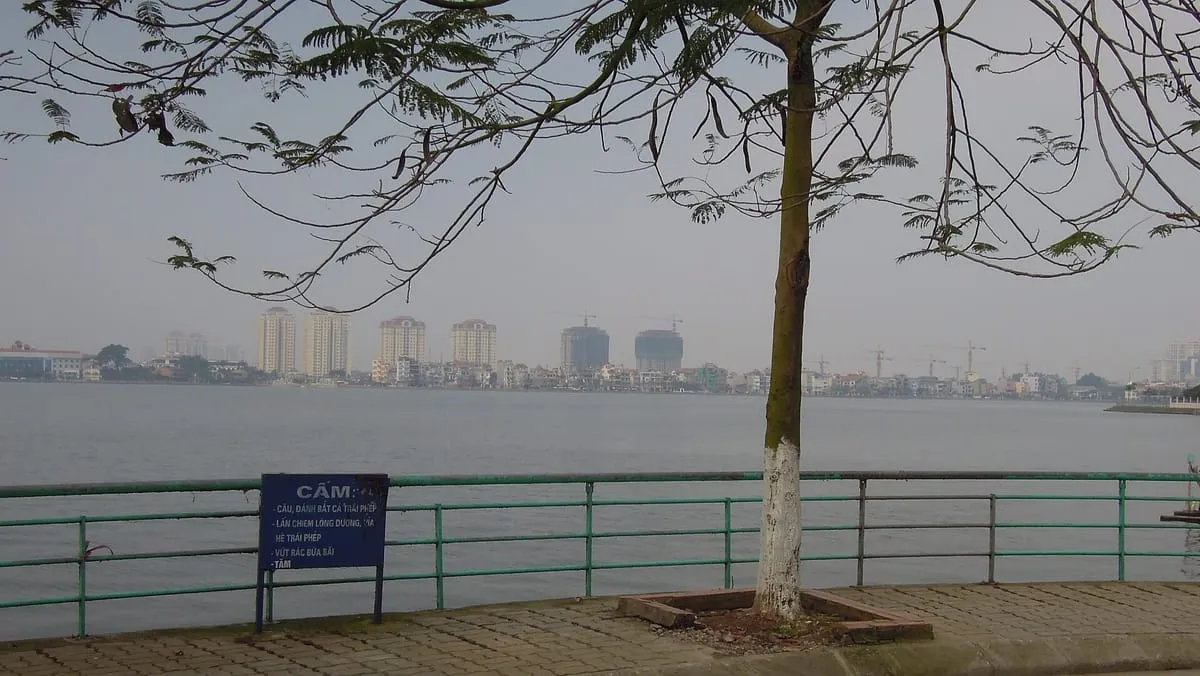
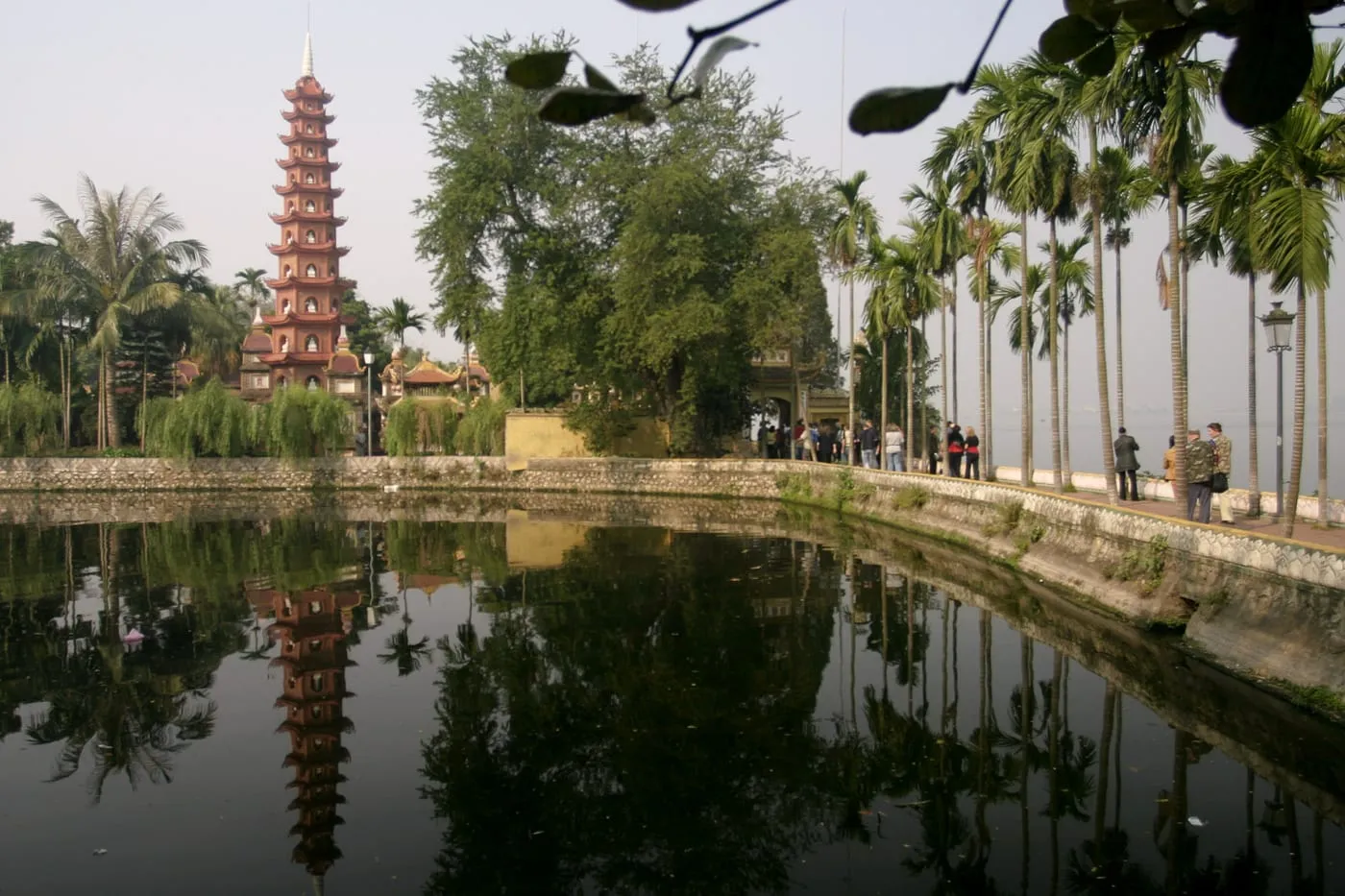
The tree-lined Thanh Nien causeway separating West Lake and Truc Bach Lake. Photo: Greg Willis from Denver, CO, usa, Wikimedia Commons, CC BY-SA 2.0.
Admission to Tran Quoc Pagoda is free, but visitors must respect the midday closure and Buddhist dress regulations confirmed by the Hanoi City Portal and the Vietnam National Authority of Tourism.
| Visiting detail | Practical condition | What to expect |
|---|---|---|
| Admission price | Free | Voluntary donation boxes (cong duc) placed inside prayer halls |
| Morning opening hours | 07:30 to 11:30 | Quietest time for contemplation and local prayers |
| Midday closure | 11:30 to 13:30 | Gates are strictly locked; no visitor access permitted |
| Afternoon opening hours | 13:30 to 17:30 | Busiest period, culminating in late-afternoon sunset views |
| Clothing requirements | Modest attire required | Shoulders and knees covered; no singlets, miniskirts, or gym shorts |
| Shoe etiquette | Shoes removed at shrines | Outdoor paths permit footwear; remove shoes at doorsteps of active altars |
Key temple landmarks and sacred relics
The pagoda complex is laid out on strict Buddhist architectural principles, consisting of three main halls: the front sanctuary (Tien Duong), the incense-burning house (Thieu Huong), and the upper sanctuary (Thuong Dien), joined together in the shape of the Chinese character Cong (工).
1. The eleven-tiered Bao Thap Stupa
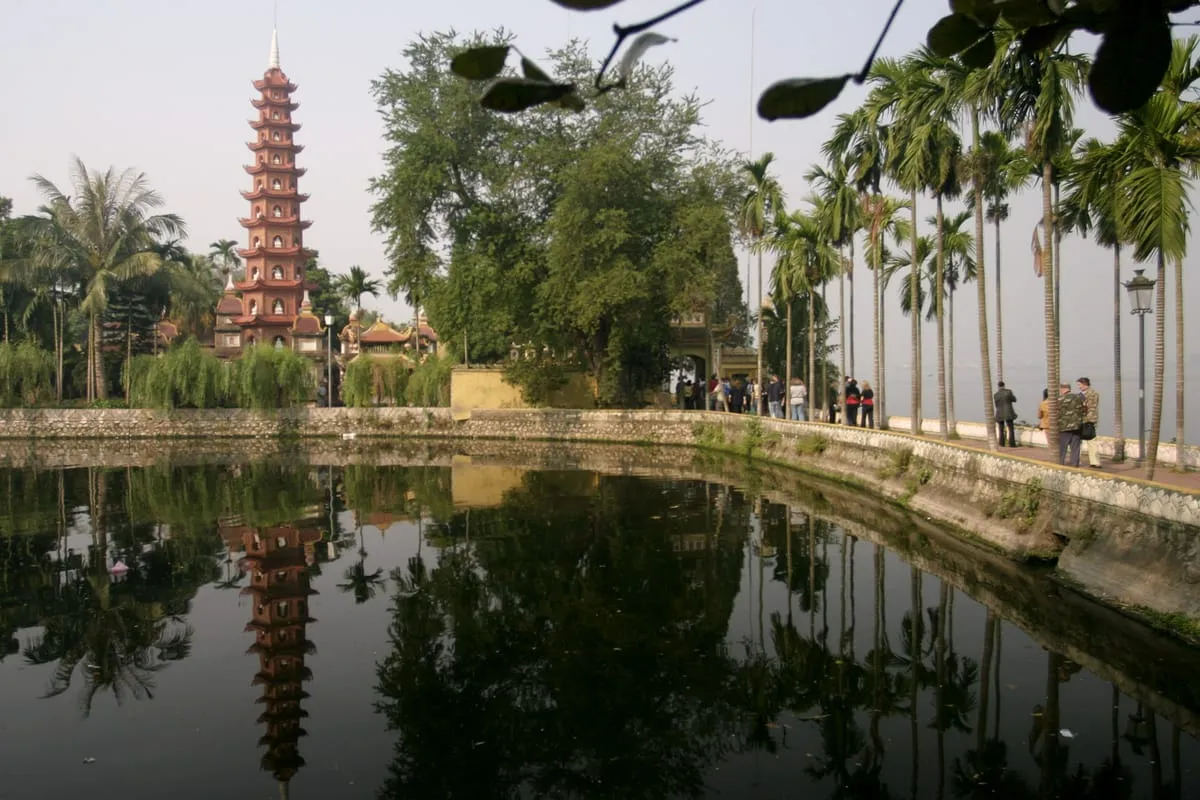
The eleven-tiered Bao Thap stupa at Tran Quoc Pagoda. Photo: Greg Willis from Denver, CO, usa, Wikimedia Commons, CC BY-SA 2.0.
The visual centrepiece of the island is the red hexagonal lotus stupa (Bao Thap), constructed in 1998. Soaring 15 metres above the water, it features eleven stepped tiers that symbolise the stages of Buddhist enlightenment:
- Each tier contains six arched doorways.
- Set inside every doorway is a statuette of Amitabha Buddha carved from polished white gemstone.
- The summit of the stupa is crowned with an ornate, multi-tiered gemstone lotus (Cuu Pham Lien Hoa), representing purity rising untainted from worldly waters.
- Adjacent to the stupa is an ancient garden containing red-brick ancestral stupas dating from the 18th century, housing the cremated ashes of former venerable abbots.
2. The sacred Bodhi tree (Cay Bo De)
In the main courtyard stands a flourishing Bodhi tree (Ficus religiosa) with broad heart-shaped leaves. In 1959, during an official state visit to Hanoi, Indian President Rajendra Prasad presented President Ho Chi Minh with a grafted cutting taken directly from the sacred Mahabodhi tree in Bodh Gaya, India—the exact site where Siddhartha Gautama attained enlightenment.
Pilgrims walk circumambulatory loops around the tree’s raised octagonal stone planter while reciting silent mantras.
3. Sanctuary halls and golden statues
Inside the prayer halls, the air is thick with sandalwood incense. The altars display hand-carved, red-lacquered and gold-leafed statues:
- The Buddha of the Three Times (past, present, and future).
- The Amitabha Trinity and Guan Yin, the Bodhisattva of Compassion.
- A masterpiece wooden statue of Shakyamuni Buddha entering Parinirvana (the reclining Buddha), known for its serene facial expression and naturalistic drapery.
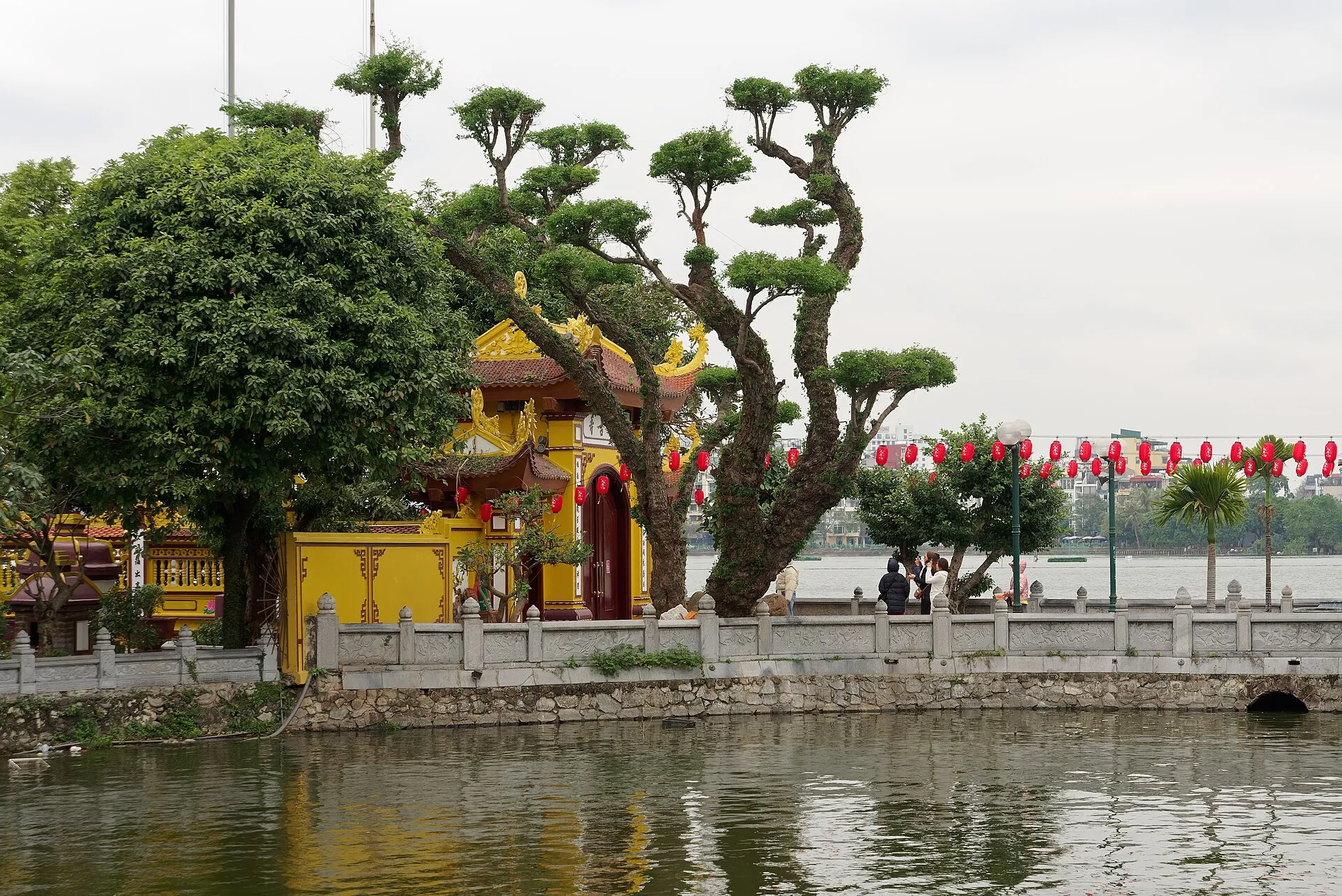
The courtyard garden and incense burners at Tran Quoc Pagoda. Photo: Jakub Hałun, Wikimedia Commons, CC BY 4.0.
Sunset over West Lake and Thanh Nien causeway
West Lake covers over 500 hectares with a shoreline perimeter exceeding 17 kilometres. The southern boundary is formed by Thanh Nien Road, a breezy causeway shaded by willow and flame trees that separates West Lake from the smaller Truc Bach Lake.
Late afternoon is the most time along the causeway:
- Sunset reflections: Between 16:30 and 17:15, the sun descends directly over the broad western expanse of the lake, turning the water copper-orange and silhouetting the tiers of the Bao Thap Stupa.
- Lakeside promenades: Paved walking trails wrap around the edge of the lake, filled with locals jogging, cycling, and sipping fresh sugarcane juice (nuoc mia).
Exploring Truc Bach Lake and Ngu Xa island
Directly across the road from Tran Quoc Pagoda lies Truc Bach Lake, steeped in 20th-century history and known for its culinary enclaves:
The John McCain memorial monument
Along the eastern bank of Truc Bach Lake on Thanh Nien Road stands a concrete relief monument marking the location where US Navy aviator (and future senator) John McCain was shot down on 26 October 1967. After ejecting from his damaged A-4E Skyhawk, he parachuted into Truc Bach Lake, where he was pulled ashore by local residents before being transported to Hoa Lo Prison.
Swan pedalos on Truc Bach
Near the southern end of the lake, local boat kiosks hire out giant swan pedalos for 100,000 VND to 120,000 VND per hour. Paddling onto the calm water offers panoramic views of the lakeside villas and willow trees.
Street food enclave of Ngu Xa
Wander five minutes south of Truc Bach Lake to the small peninsula of Ngu Xa, Hanoi’s spiritual home of pho cuon:
- Pho cuon: Uncut square sheets of fresh steamed rice noodles wrapped around flash-fried marinated beef, crisp lettuce, and fresh cilantro, dipped into a sweet-savoury nuoc cham sauce with pickled green papaya (approx 60,000 to 70,000 VND per plate).
- Banh tom: Crisp, deep-fried freshwater shrimp fritters served with sweet potato slivers and fresh herbs. For more local specialties, read our guide to the best pho and bun cha in Hanoi.
Guided tours of Tran Quoc Pagoda and West Lake
While wandering the island sanctuary independently is straightforward, guided excursions provide context on Buddhist cosmology, royal folklore, and transport between distant lakeside temples:
Hanoi City Highlights Walking Tour – Landmarks & History
From VND 699,800 · 5.0 stars from 206 reviews · 4.5 - 5 hours · Small group
Book the Hanoi City Highlights Walking Tourad to explore Hanoi’s spiritual and cultural foundations with an English-speaking guide. The itinerary covers Tran Quoc Pagoda alongside the Old Quarter guild streets, Train Street, and local street food tastings. Suits first-time visitors seeking rich historical storytelling without navigating traffic alone.
Hanoi: City Sightseeing Motorbike Tour
From VND 860,100 · 4.9 stars from 220 reviews · 3 - 4 hours · Guided pillion ride
Book the Hanoi City Sightseeing Motorbike Tourad to ride pillion with an experienced local driver along the breezy shores of West Lake and Truc Bach. Stops include Tran Quoc Pagoda, the French Quarter boulevards, and the Long Bien railway bridge, concluding with authentic street snacks and egg coffee.
Hanoi: Historic Jeep Tour
From VND 1,790,000 · 4.8 stars from 46 reviews · 4 hours · Open-top military jeep
Book the Hanoi Historic Jeep Tourad for an open-air ride in a restored Vietnam War-era GAZ-69 jeep. The route navigates the quiet leafy avenues around West Lake, passing Tran Quoc Pagoda, the Presidential Palace gardens, and unseen back alleys, accompanied by a knowledgeable historian guide.
Getting there and combining your itinerary
Tran Quoc Pagoda sits approximately 3.5 kilometres northwest of the Old Quarter:
- By Grab: A GrabCar ride from Hoan Kiem Lake takes roughly 10 to 15 minutes, costing between 40,000 VND and 60,000 VND.
- By public bus: Bus route 50 drops passengers directly on Thanh Nien Road outside the pagoda entrance for 8,000 VND.
- Combine with Ba Dinh sights: The pagoda is located just 1.5 kilometres north of the Ho Chi Minh Mausoleum and Ba Dinh Complex and the Imperial Citadel of Thang Long, making it a natural late-afternoon finale after touring political and historical monuments.
- Discover more cost-free sightseeing opportunities in our roundup of free things to do in Hanoi.
Common questions
How much is admission to Tran Quoc Pagoda?
Admission to Tran Quoc Pagoda is completely free for all domestic and international visitors. Voluntary donation boxes are placed near the altars for temple upkeep.
What are the opening hours of Tran Quoc Pagoda?
The pagoda opens daily from 07:30 to 11:30 and reopens from 13:30 to 17:30. The grounds are closed during the two-hour lunch break between 11:30 and 13:30.
What is the dress code for visiting Tran Quoc Pagoda?
Visitors must dress modestly as this is an active Buddhist place of worship. Shoulders and knees must be covered. Sleeveless shirts, short shorts, low-cut tops, and revealing garments are prohibited. Hats must be removed and shoes taken off before entering the inner shrine halls.
How old is Tran Quoc Pagoda?
Tran Quoc Pagoda is Hanoi's oldest Buddhist temple, originally established in the 6th century (between 541 and 548 AD) during the reign of King Ly Nam De. Originally situated along the banks of the Red River, it was moved to its current location on West Lake in 1615 due to riverbank erosion.
What is the best time of day to visit Tran Quoc Pagoda and West Lake?
Late afternoon between 16:00 and 17:30 is ideal. The temple grounds are bathed in soft golden light, and the adjacent Thanh Nien causeway offers unobstructed westward views of the sunset reflecting across West Lake.