In this guide
💡 The Short Version: Split’s main sight, Diocletian’s Palace, is a lived-in neighbourhood with no entry charge. You can walk the Peristyle, step inside the Vestibule, pass through all four Roman gates, rub the toe of Gregory of Nin and stroll the palm-lined Riva for free. Beyond the old town, climb Marjan hill to the Sedlo watchtower (free, with a lift), sit in the clifftop Sustipan Park, and watch picigin players at Bačvice beach. Or book a tour: the Split: Diocletian’s Palace & Old Town Small Group Tourad explains the gates and squares for €15.
⚠️ Free sights have operating hours. The Sedlo watchtower closes at dusk and in severe weather (bura winds), the Peškarija fish market closes at 13:00, and the Roman guard change runs only from mid-May to late September.
| Sight | Free because | What you get |
|---|---|---|
| Diocletian’s Palace streets and gates | Open 24/7 | Walk the whole palace at no charge |
| The Peristyle and the noon guard change | Roman square | The legionary show |
| The Vestibule | Open brick oculus | Klapa singing acoustics |
| Gregory of Nin | Bronze statue at the Golden Gate | The lucky toe |
| Sedlo watchtower, Marjan (148 m) | Public park | A viewing platform with a lift |
| Prva Vidilica belvedere | Marjan viewpoint | City and harbour panorama |
| Sustipan clifftop park | Public park | Pine shade, sea views and a stone gloriette |
| Đardin (Strossmayer Park) | Public park | Fountain and lawns by the North Gate |
| The Riva | Waterfront esplanade | “Split’s living room” |
| Matejuška and the West Coast Walk of Fame | Fishermen’s port | Olympic medal plaques |
| Bačvice beach | Public beach | Watching picigin in the shallows |
Free highlights inside Diocletian’s Palace
The palace was built between 295 and 305 AD as a fortified retirement home for the Roman emperor Diocletian. When Salona, the nearby provincial capital, was destroyed in the 7th century, refugees moved inside the walls and turned temples into churches and imperial chambers into homes. Today the 30,000-square-metre complex is an ordinary city district.
| Free monument | Location inside palace | Historical significance | What to experience |
|---|---|---|---|
| The Peristyle (Peristil) | Central courtyard intersection | Imperial ceremonial court where Diocletian appeared as a living god | Red granite Roman columns, 3,500-year-old Egyptian sphinx, noon guard change |
| The Vestibule (Atrij) | South of Peristyle | Imperial entrance hall to private imperial apartments | Open circular dome (oculus); free daily acoustic performances by klapa vocalists |
| The Golden Gate (Porta Aurea) | North palace wall | Main gate, facing the road to Salona | Double gatehouse; empty statue niches; beside the Gregory of Nin monument |
| The Silver Gate (Porta Argentea) | East palace wall | Eastern Roman gate facing the mountains | Preserved octagonal Roman defensive towers; leads to Stari Pazar market |
| The Iron Gate (Porta Ferrea) | West palace wall | Western gate, towards the People’s Square | 15th-century 24-hour clock face; the early Christian Church of Our Lady of the Bell Tower |
| The Bronze Gate (Porta Aenea) | South seawall facade | Sea-level water gate for imperial supply galleys | Central barrel-vaulted cellars passageway linking Riva to Peristyle for free |
| Let Me Pass Street (Pusti me da prođem) | Beside Temple of Jupiter | Narrowest medieval lane in the city | Single-file alleyway where two people cannot pass without brushing shoulders |
1. The Peristyle and the Egyptian Sphinx
The Peristyle is the central square of the palace, lined with colonnades of rose granite from Aswan in Egypt and white limestone from the island of Brač. A black granite Egyptian sphinx from the reign of Pharaoh Thutmose III (circa 1479–1425 BC), over 3,500 years old, guards the eastern side. You can sit on the perimeter steps for nothing. Between mid-May and late September the Roman guard changes here every day at 12:00, with a trumpet fanfare and an imperial speech.
2. The Imperial Vestibule
South of the Peristyle, through the Protiron portal, is the Vestibule, once the entrance hall to Diocletian’s private apartments. This round brick room was originally capped by a mosaic-lined dome and lined with marble. The dome collapsed centuries ago, leaving an open circular oculus that frames the sky and the cathedral bell tower.
The brick walls make the room resonant. In the tourist season, klapa ensembles (male and female a cappella groups whose multipart singing is on UNESCO’s intangible heritage list) stand in the centre and sing folk ballads. Listening is free; the singers sell CDs.
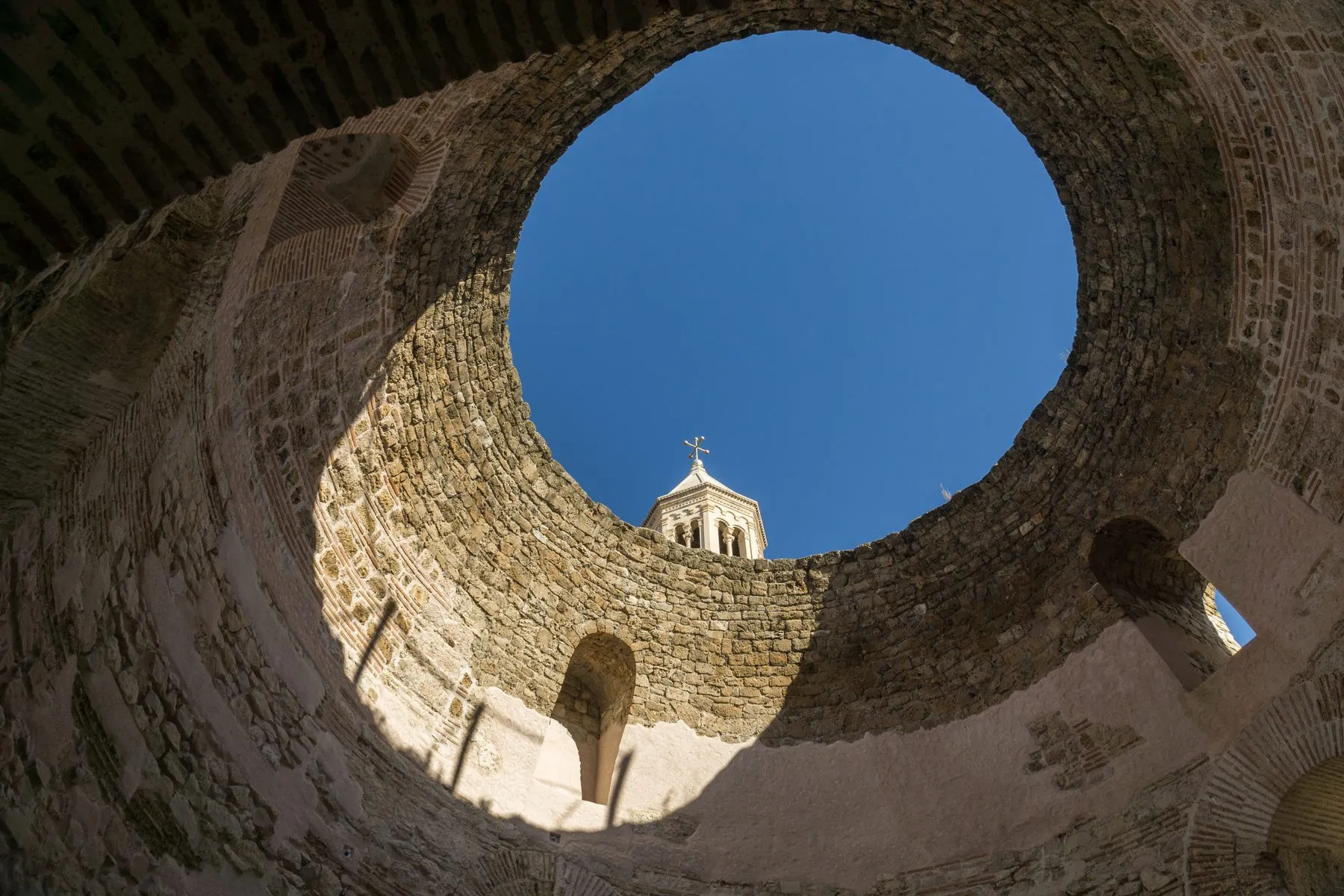 The open brick oculus of the imperial Vestibule. Photo: Sumitsurai, Wikimedia Commons, CC BY-SA 4.0.
3. Gregory of Nin’s Lucky Toe
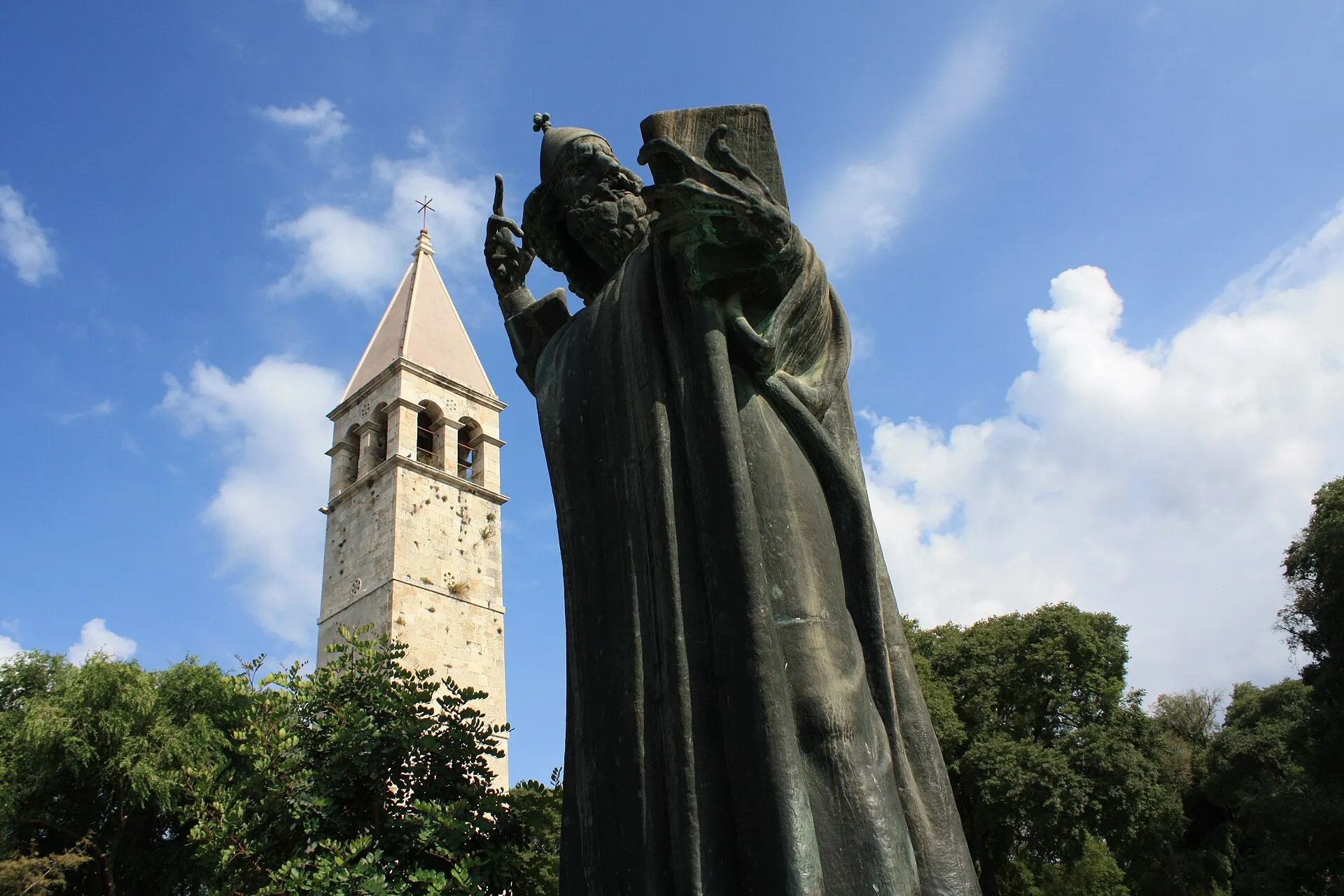
Just outside the northern Golden Gate stands the monumental bronze statue of Bishop Gregory of Nin (Grgur Ninski), made in 1929 by the sculptor Ivan Meštrović. Gregory was a 10th-century bishop who argued for Slavonic rather than Latin in church services. The statue stands 8.5 metres tall. Local tradition says that rubbing the bishop’s polished bronze left big toe brings good luck and a return visit to Split.
4. The Palace Gates and Public Thoroughfares
All four exterior palace gates are free to inspect:
- Golden Gate (north): Carved niches that once held statues of Diocletian, Maximian, Galerius and Constantius Chlorus.
- Silver Gate (east): Walled up for centuries under Venetian rule and reopened in 1952; it opens onto the Stari Pazar market stalls.
- Iron Gate (west): An early Christian belfry and a 15th-century clock with a 24-hour Roman numeral dial.
- Bronze Gate (south): The entrance to the central cellar passage between the Riva and the Peristyle. The side halls of the cellars need a €10 ticket; the central arched hall is free to walk through.
Free parks, gardens and viewpoints
Marjan Forest Park and the Sedlo Watchtower
Marjan Forest Park covers 347 hectares on the peninsula west of the old town. Entry is free at all hours.
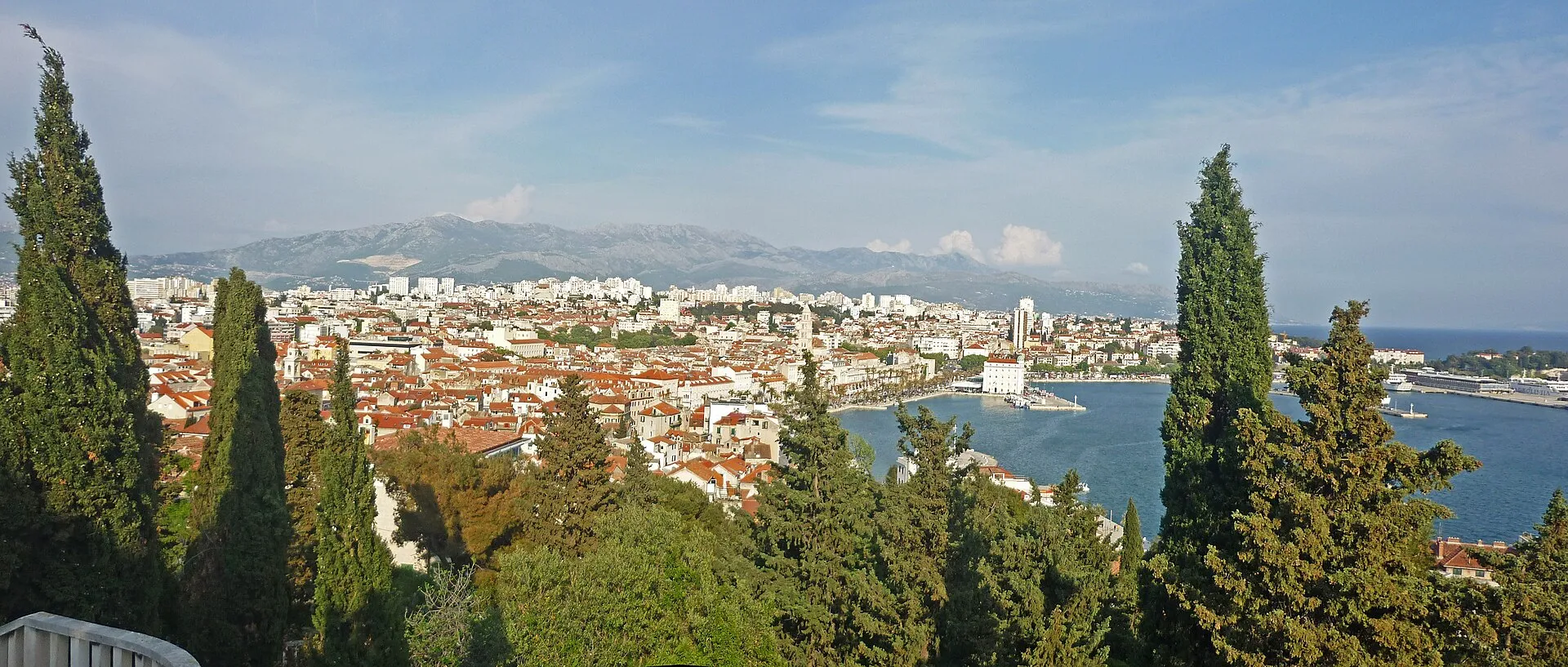
- Prva Vidilica (First Belvedere): A 10-to-15-minute climb up stone stairs from Veli Varoš, next to the Old Jewish Cemetery (founded in 1573). The terrace looks over Diocletian’s Palace, the Riva and the ferry port.
- Sedlo watchtower: At the 148-metre saddle of the peninsula, a rebuilt fire watchtower, free to climb, with a viewing platform and a lift. It opens in daylight and closes at dusk or in stormy weather.
- Telegrin summit (178 m): A further 15 minutes and 314 stone steps up, the highest point of Marjan, marked by a large Croatian flag, with views over Kaštela Bay and the islands.
Sustipan Park
Sustipan is a park on the south-western headland at the entrance to Split harbour. A Benedictine monastery of St Stephen stood here in the Middle Ages (the peninsula’s name comes from it), and in the 19th century the site became the municipal cemetery. The cemetery moved in the 1950s and the grounds became a park under cypresses and Aleppo pines.
At the edge of the cliffs stands a neoclassical stone gloriet pavilion. There are stone benches for watching catamarans enter the harbour and the sunset over the island of Čiovo.
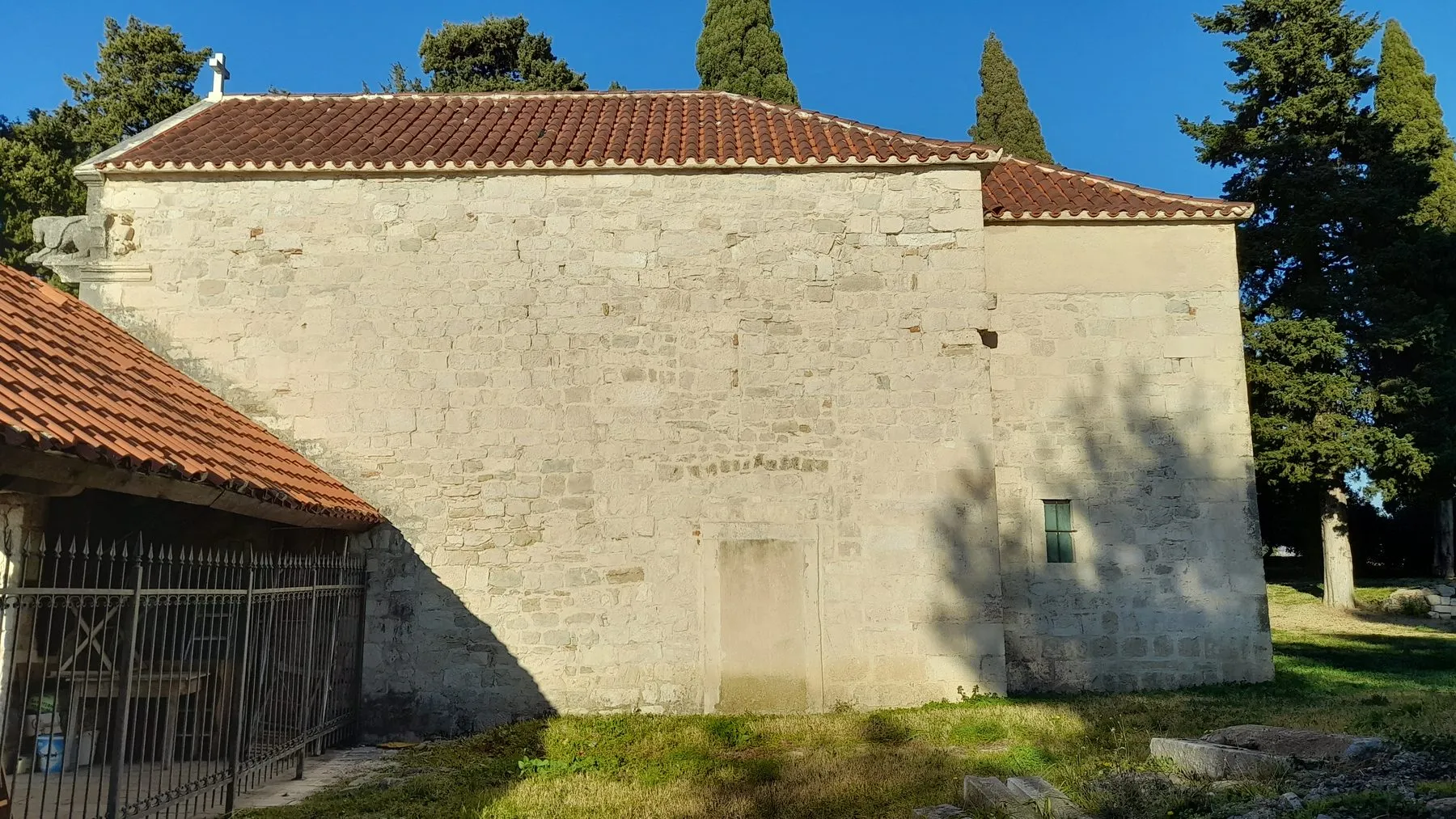 The neoclassical stone gloriet in Sustipan Park above the sea cliffs. Photo: Argo Navis, Wikimedia Commons, CC BY-SA 4.0.
Đardin (Strossmayer Park)
Đardin, officially Josip Juraj Strossmayer Park, lies opposite the Golden Gate and the statue of Gregory of Nin. It was laid out in 1859 within the bastions of the Venetian fortifications, with lawns, shade trees, a central stone fountain with a putto sculpture, and benches where locals sit out the midday heat.
Free markets and coastal strolls
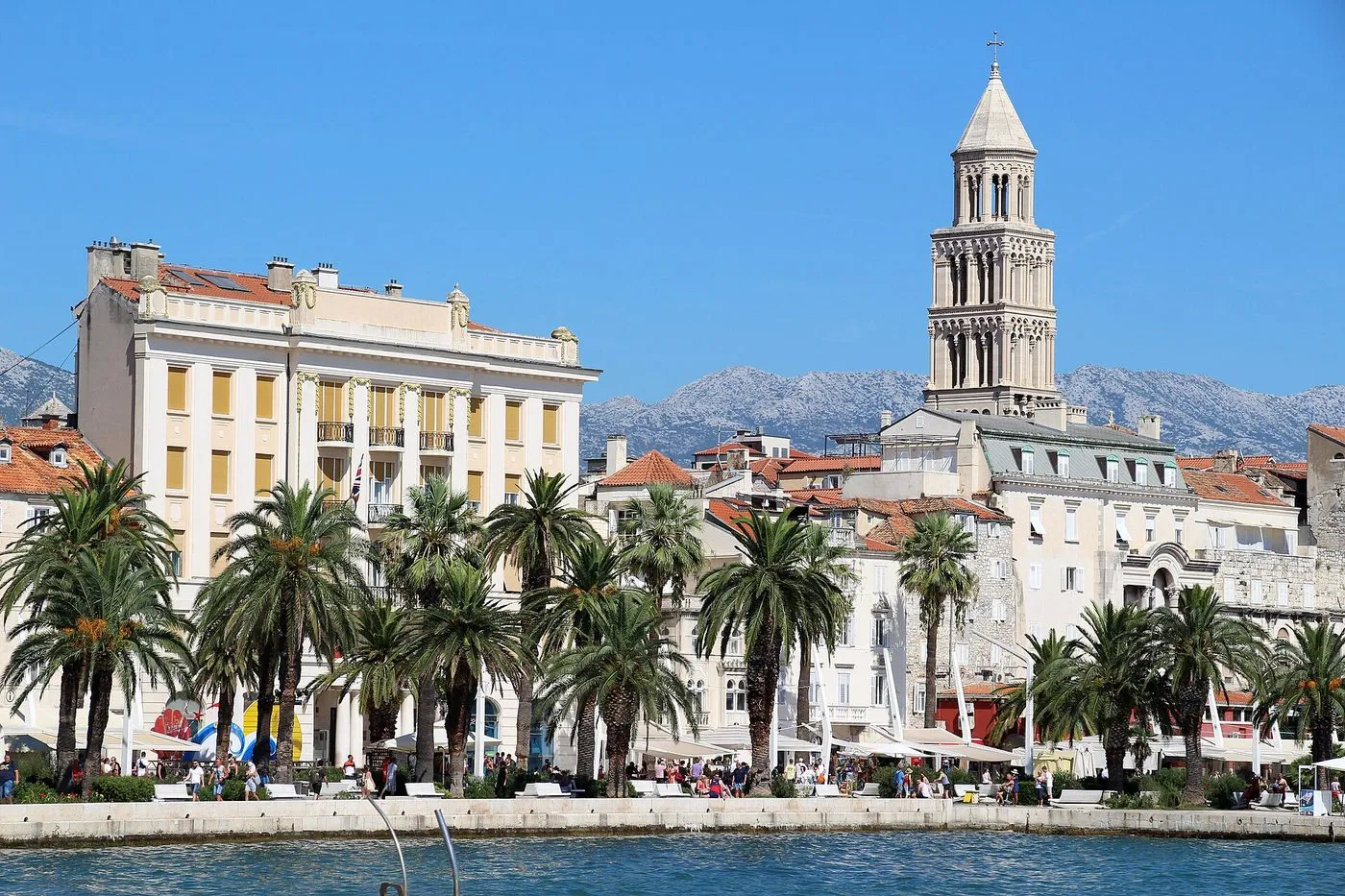
- The Split Riva: The pedestrian esplanade along the southern palace wall is 350 metres long and lined with date palms. Walking it, reading the brass Olympic plaques along the West Coast (Zapadna obala) and sitting on the stone breakwater at Matejuška to watch fishing boats come in all cost nothing.
- Stari Pazar (Green Market): Along the eastern wall outside the Silver Gate, farmers sell figs, mandarins, wild asparagus, lavender bags and olive oil. Walking through is free.
- Peškarija (Fish Market): In an 1890 Secession hall on Obrov street, open daily 06:30 to 13:00. Locals say the neighbouring sulphur springs keep the flies away.
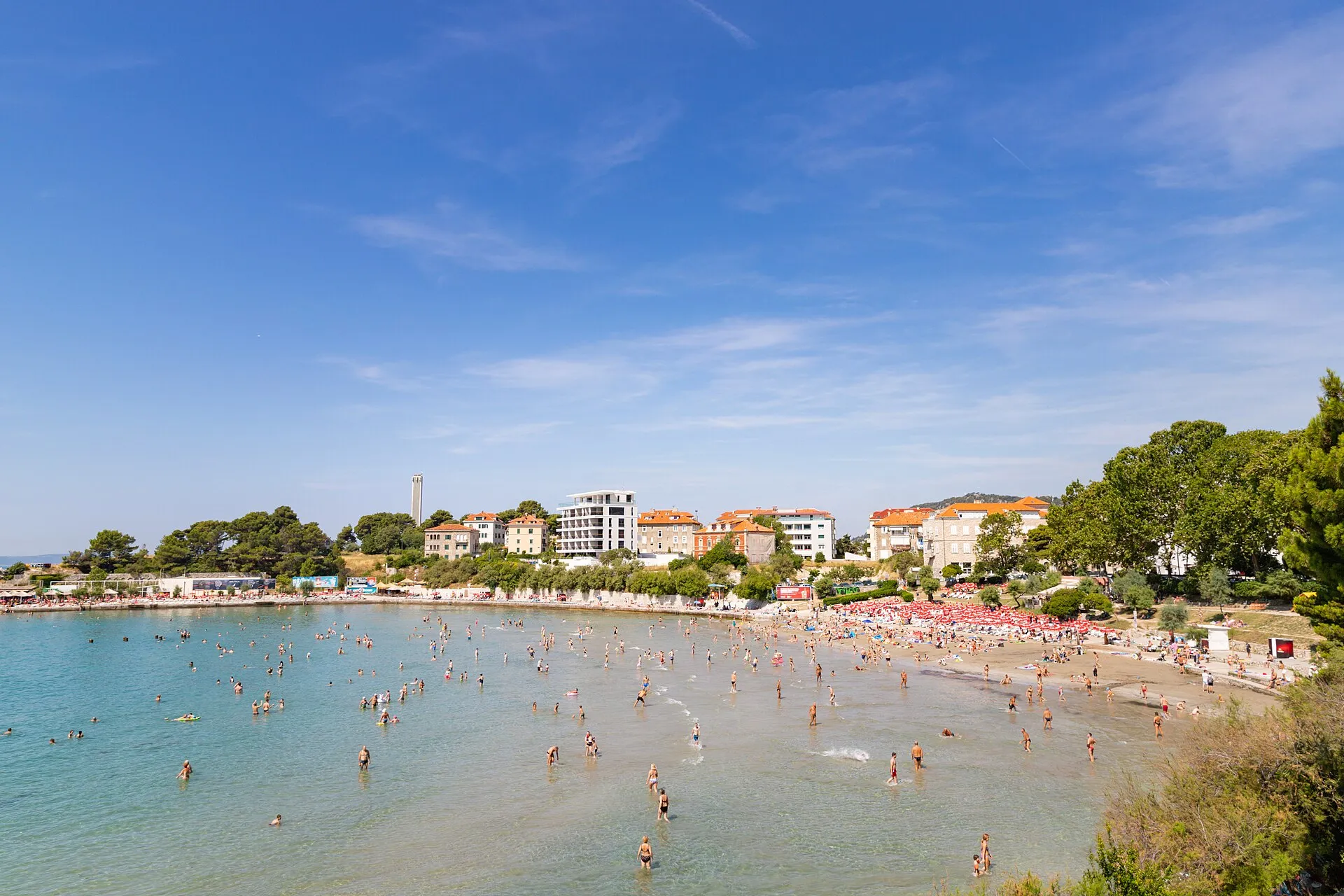
- Picigin at Bačvice: Go to Bačvice beach on any sunny day to watch players dive through ankle-deep water to keep a peeled tennis ball in the air. The beach is free, and the lungomare promenade east to Firule, Trstenik and Žnjan is 4.5 kilometres without traffic.
Tours and guided walks
The monuments are free to visit alone; a small-group tour adds the history of the Roman building work, Diocletian’s abdication and the medieval town.
Split: Diocletian’s Palace & Old Town Small Group Tour
From €15 · 4.9 stars from 1,034 reviews · 1.5 - 5.5 hours · free cancellation
Split: Diocletian’s Palace & Old Town Small Group Tourad: Explore 1,700 years of living history with an accredited guide. Walk through the four gates, the Peristyle and the side courtyards.
Diocletian’s Palace & Split Old Town Guided Tour – Since 2007
From €15 · 4.8 stars from 868 reviews · 1.5 - 5 hours · free cancellation
Diocletian’s Palace & Split Old Town Guided Tour – Since 2007ad: A 150-minute historical walk covering the Palace gates, the morning Fish Market, Pjaca, Marmontova, and the historic fishermen’s quarter of Varoš.
Split: Diocletian Palace, Marjan Hill Viewpoint & Local Eats
From €29 · 4.9 stars from 81 reviews · 1.5 - 2.5 hours · free cancellation
Split: Diocletian Palace, Marjan Hill Viewpoint & Local Eatsad: Combine a guided Roman palace walk with an easy climb up the stone stairs of Marjan to Prva Vidilica, finishing with local food tastings.
DIY free sightseeing vs budget guided tour
| Category | Free self-guided visit | Small-group guided tour |
|---|---|---|
| Cost | Free | From €15 per person |
| Pace | Your own schedule | 1.5 to 5.5 hours, depending on the tour |
| Explanation | Guidebooks and plaques | A licensed guide, with questions |
| Sights | All public gates, Peristyle, Vestibule, parks | The same public sights on a set route |
| Suits | Budget travellers and spontaneous explorers | First-time visitors wanting the history quickly |
What actually costs money in Split
These charge for entry:
- Diocletian’s Palace Cellars: The central corridor between the Riva and the Peristyle is free. The side halls cost €10 for adults (splitculture.hr).
- St Domnius Cathedral and Bell Tower: The cathedral is €5, the treasury €5, the bell tower €7, and a ticket for everything €15 (splitska-nadbiskupija.hr).
- Ivan Meštrović Gallery: €12 for the villa and the Crikvine-Kaštilac (mestrovic.hr).
- Archaeological Museum of Split: €8 for adults (armus.hr).
What to see next
- Diocletian’s Palace Split Guide: The Roman residence, building by building.
- Marjan Forest Park and Viewpoints: Walking trails, the Sedlo watchtower and the chapels.
- Split Riva and Promenade Walk: The route from the Bronze Gate to Matejuška.
- Bačvice Beach and Coastal Walks: The sandy bay, picigin rules and the seaside promenade to Žnjan.
- Money in Split: ATM fees and euro cash tips.
- Getting Around Split: Bus routes, tickets, and ferry connections.
Common questions
Is Diocletian's Palace free to enter?
Yes. The palace is not a museum with an entry gate; it is a residential part of the city centre. You can walk its streets, the Peristyle, the four Roman gates and the central corridor of the Cellars without a ticket. Entry fees apply only to the side halls of the Cellars (€10), the cathedral complex and the municipal galleries.
Where can you find a free viewpoint in Split?
The Sedlo watchtower on Marjan hill (148 metres above sea level) has 360-degree views over Split, the sea and the mountains, and is free. It has a lift. Prva Vidilica, a 10-to-15-minute climb from Veli Varoš, is a lower terrace with a view over the palace and harbour, also free.
Can you hear authentic klapa singing for free in Split?
Yes. Traditional a cappella klapa vocal groups sing in the open-roofed imperial Vestibule during spring, summer and early autumn. The round brick chamber is resonant, and listening is free.
What is the Roman guard changing ceremony?
Every day at noon from mid-May through late September, actors dressed in Roman legionary armour stage an imperial guard change on the Peristyle. An actor portraying Emperor Diocletian emerges on the Protiron balcony to deliver a speech to the crowd.
Why do visitors rub the toe of the Gregory of Nin statue?
Local tradition says that rubbing the bronze big toe of Ivan Meštrović's 8.5-metre statue of Bishop Gregory of Nin (Grgur Ninski), outside the Golden Gate, brings good luck and means you will return to Split.