In this guide
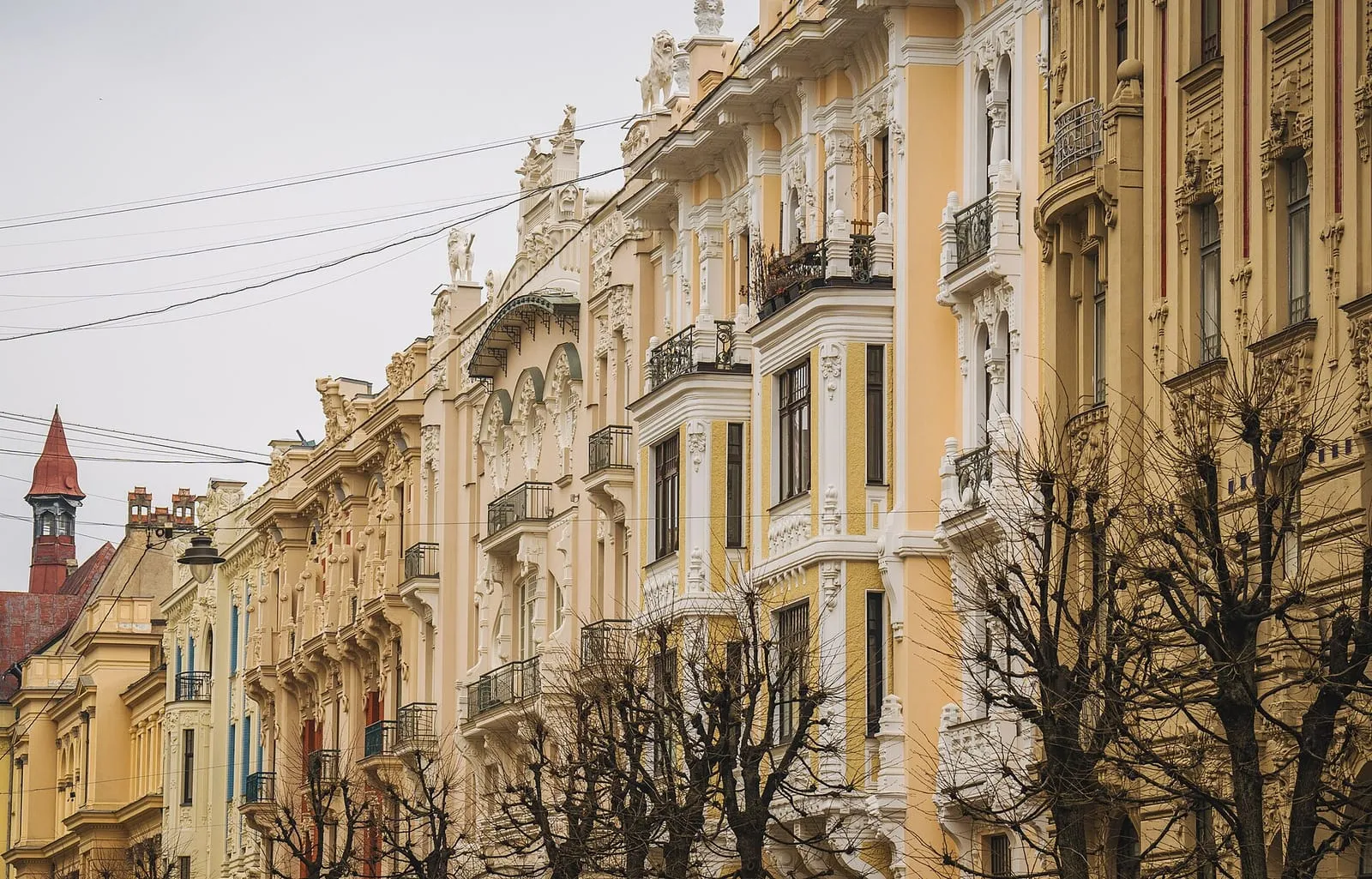
💡 The Short Version: Riga has over 800 Art Nouveau (Jūgendstils) buildings, about one third of its central city. They are concentrated in the Quiet Centre (Klusais centrs) around Alberta iela and Elizabetes iela, where Mikhail Eisenstein’s facades carry screaming masks, winged sphinxes and peacock-blue tiles. The Riga Art Nouveau Museum at Alberta iela 12 preserves architect Konstantīns Pēkšēns’ 1903 apartment and its spiral staircase (open Tuesday to Sunday 10:00 to 18:00, closed Mondays). Walking the streets is free 24/7. Or book a tour: an Art Nouveau walking tour with a local guidead is sold on GetYourGuide.
⚠️ Look up above the second floor. Shopfronts and modern doorways hide most of the detail. The sculpture, wrought-iron balconies, mythological reliefs and glazed ceramics sit between the third floor and the roofline.
Why Riga has so much Art Nouveau
At the turn of the 20th century, Riga was the third-largest industrial manufacturing centre in the Russian Empire and one of its busiest Baltic commercial seaports. Between 1897 and 1913, the municipal population grew from 280,000 to over 500,000 residents.
Following the demolition of the medieval Swedish earthen fortification ramparts between 1857 and 1863, the city council enacted progressive urban zoning regulations. Timber construction was strictly outlawed in the central city, and newly planned boulevards were designated for multi-storey stone and brick rental apartment buildings (īres nami).
Local wealth coincided with the graduation of the first generation of professionally trained Latvian architects from the Riga Polytechnic Institute (now Riga Technical University), alongside established Baltic German and Russian engineers. Rather than copying historical neoclassical or neo-Gothic forms, they embraced the revolutionary European Art Nouveau (Jugendstil) aesthetic.
Riga’s Art Nouveau movement developed across four primary architectural styles:
- Eclectic Decorative Art Nouveau (1901–1905): Characterised by lush facade ornamentation, mythological sculptures, expressive human masks, stylized floral garlands, and exuberant roof pediments, masterminded by Mikhail Eisenstein.
- Perpendicular Art Nouveau (1906–1912): Emphasising verticality, geometric window strips, grooved pilasters, and streamlined masonry relief carvings.
- National Romanticism (1905–1911): A homegrown Latvian movement led by Konstantīns Pēkšēns and Eižens Laube that rejected foreign ornamentation in favour of heavy, rough-hewn native limestone, dark granite, steeply pitched roofs reminiscent of ancient Baltic farmsteads, and geometric woodcarvings inspired by traditional Latvian ethnographic textile patterns.
- Neo-Classical Art Nouveau (1910–1914): A restrained, monumental interpretation incorporating classical Greek and Roman columns with Art Nouveau proportions.
Alberta iela
Laid out in 1901 to mark Riga’s 700th anniversary, Alberta iela was named after Bishop Albert of Buxhoeveden. Within seven years it was built up with ornate residential facades.
Alberta iela 2 and 2a (Mikhail Eisenstein, 1906)
Number 2a has:
- Flanking Sphinxes: Two large sculpted stone sphinxes guard the entrance steps, their paws extended over the pavement.
- The False Sky Openings: Look directly at the rooftop pediment: Eisenstein pierced the upper masonry screen with large open oval windows that reveal the moving blue sky behind them, creating a dramatic optical illusion of lightness.
- Glass-tiled details: Symmetrical winged maidens and screaming gorgon masks flank the windows, complemented by bands of red and white ceramic bricks.
Alberta iela 4 (Mikhail Eisenstein, 1904)
Commissioned by wealthy state councillor Andrei Lebedinsky, Number 4 has:
- The Blue Glazed Facade: The central facade is clad in lustrous peacock-blue glazed tiles that contrast with chalk-white plaster reliefs.
- Sculptural Symbols: The central portal is framed by roaring lion heads (symbolising strength and guardianship), while the top gable features the winged head of Medusa and stylized sunbursts.
- Balcony Ironwork: Elaborate hand-forged wrought-iron balustrades curve along the second and third storeys in fluid whip-lash lines.
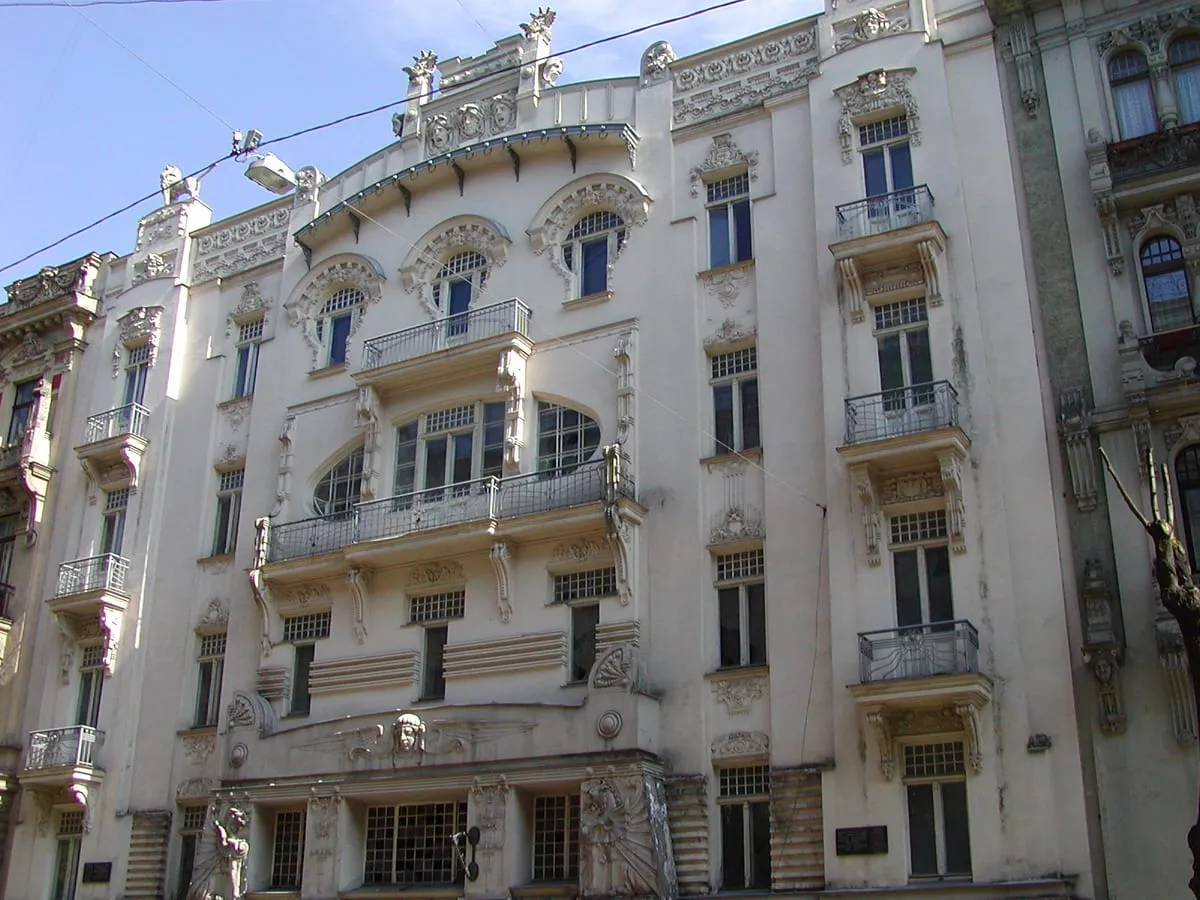
Alberta iela 8 (Mikhail Eisenstein, 1903)
Also designed for Lebedinsky, Number 8 exemplifies Eisenstein’s horror vacui—a creative compulsion to cover every square metre of masonry with symbolic figures. The facade depicts the cycle of human existence, from youth and love through struggle, terror and old age, framed by carved lion masks, oak leaves and soaring female caryatids.
Alberta iela 13 (Mikhail Eisenstein, 1904)
Constructed shortly after the outbreak of the Russo-Japanese War, Number 13 reveals a darker, brooding artistic mood. The facade is dominated by screaming plaster faces contorted in anguish, falling warriors, sculpted scythes and tragic female heads draped in mourning veils. The philosopher Sir Isaiah Berlin was born inside this apartment building in 1909.
Riga Art Nouveau Museum (Alberta iela 12)
Standing at the corner of Alberta iela and Strēlnieku iela, Number 12 is a monumental work designed in 1903 by master architect Konstantīns Pēkšēns with his then-student Eižens Laube. The building seamlessly bridges the transition from decorative Art Nouveau to organic National Romanticism, featuring a distinctive rounded corner turret and stylized pine-tree motifs.
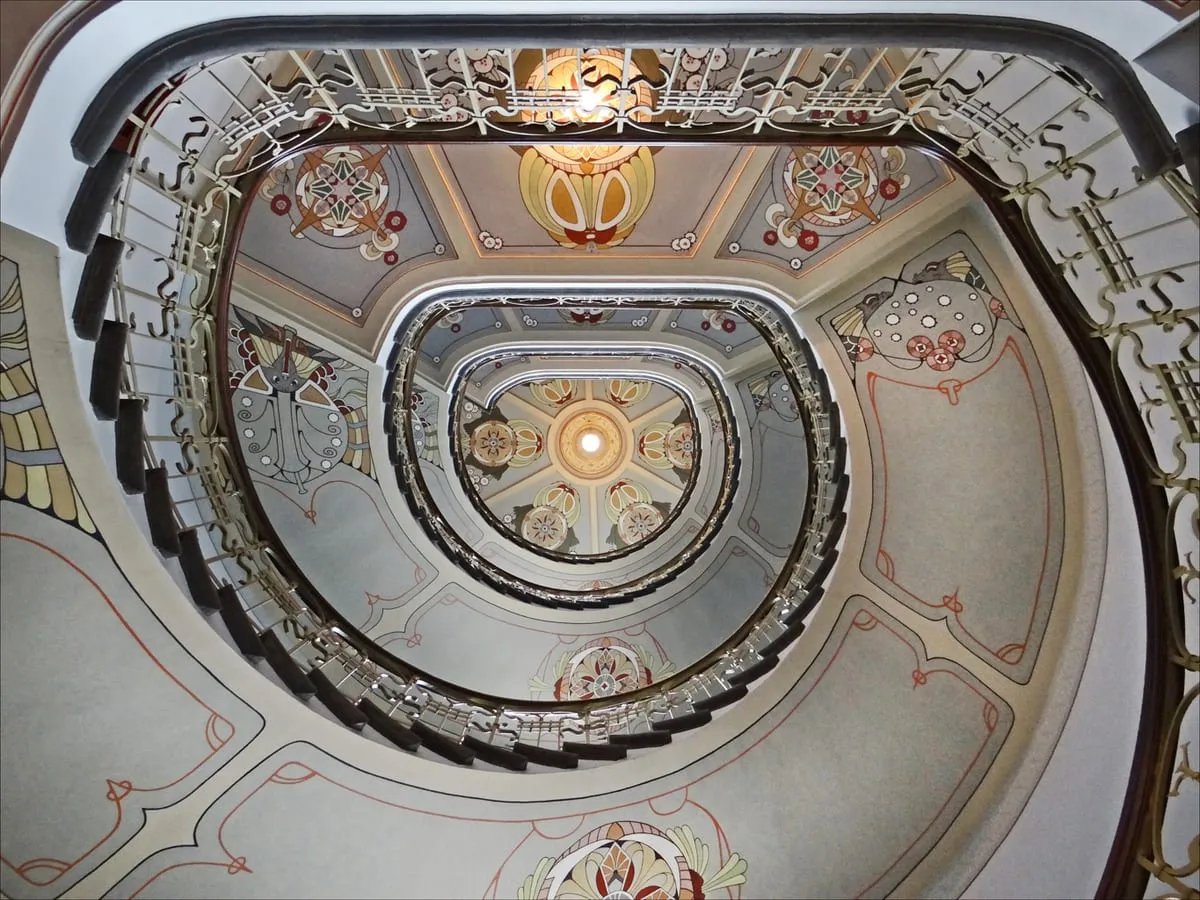
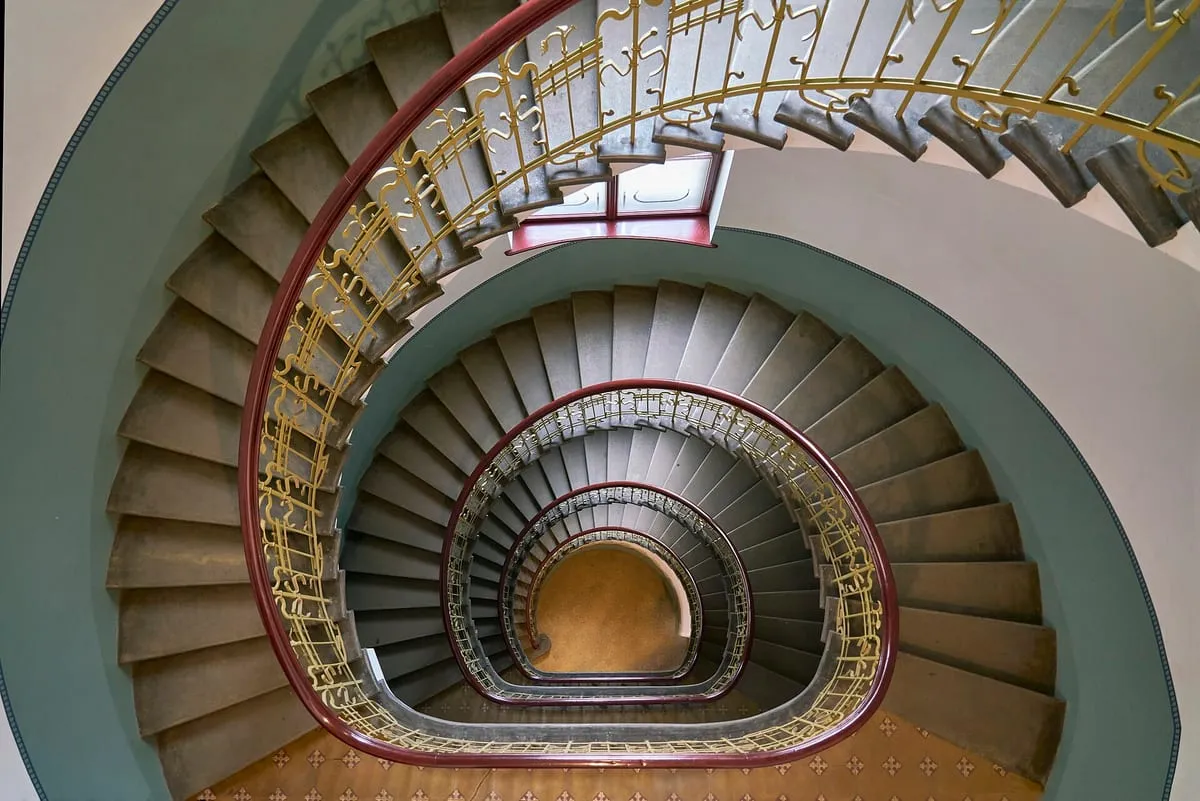
The famous spiral staircase
Stepping through the main residential entrance on Alberta iela brings you into the stairwell. The curved spiral staircase rises through six storeys.
The vaulted stairwell ceiling was painted in 1903 by the Latvian artist Jānis Rozentāls, decorated with trailing stylized irises, water lilies and geometric Baltic vine scrolls. Visitors may enter the vestibule to admire and photograph the staircase from the ground floor, though staff request quiet consideration for the residents living in the upper private apartments.
Museum exhibitions and visiting hours
The ground and first floors house the official Riga Art Nouveau Centre (Rīgas Jūgendstila centrs - jugendstils.riga.lv), situated inside Pēkšēns’ own private residential apartment.
The interior was restored from archival blueprints and estate inventories from 1903:
- The Living Rooms: Featuring authentic period furniture, cast-iron tile stoves, stained-glass transoms, early electric chandeliers, and authentic early-1900s wallpapers manufactured from historic copper printing rollers.
- The Dining Room and Kitchen: Complete with copper cookware, cast-iron wood-burning range, hand-cranked coffee grinders and authentic porcelain dinner services from the Kuznetsov Porcelain Factory in Riga.
- The Digital Attic: Interactive digital screens let visitors browse high-resolution facade drawings, architectural profiles and historical photographs of every Art Nouveau building in Riga.
The museum is open Tuesday to Sunday 10:00 to 18:00 and closed Mondays. Children under 7 enter free all year.
Elizabetes, Strēlnieku and Antonijas iela highlights
While Alberta iela commands international fame, several streets nearby in the Quiet Centre have fine facades of their own:
Elizabetes iela 10b (Mikhail Eisenstein, 1903)
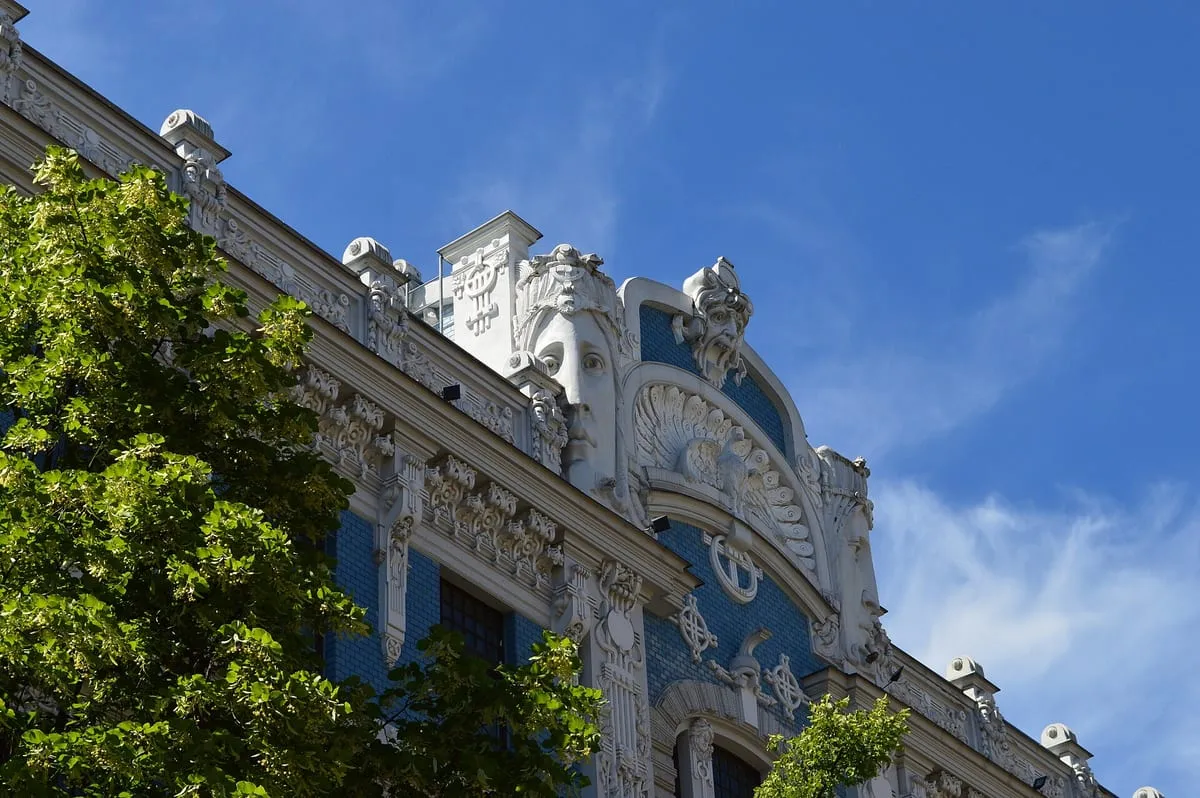
Elizabetes 10b is recognised by its upper facade:
- The fifth floor features an open colonnaded screen framed by colossal female stone faces whose dramatic, windswept hair extends into the window arches.
- A wide band of vivid cobalt-blue ceramic tiles across the top storey acts as an artificial sky, illuminated by gilded sunbursts and flanked by sculpted peacocks representing beauty and vanity.
Elizabetes iela 33 (Mikhail Eisenstein, 1901)
Eisenstein’s earliest apartment commission in Riga, featuring a balanced symmetrical facade adorned with neoclassical garlands, gorgon keystones, and expressive female caryatids supporting the central third-floor bay window.
Strēlnieku iela 4a (Mikhail Eisenstein, 1905)
Constructed as a prestigious private boarding school for boys, Strēlnieku 4a is covered in decorative plasterwork. The exterior is packed with Egyptian lotus motifs, winged Roman helmets, open-mouthed gargoyles and intricate geometric diaper patterns. Today, the building houses the Stockholm School of Economics in Riga.
Antonijas iela and the dining quarter
Antonijas iela is the Quiet Centre’s eating street. It is lined with National Romantic apartment buildings designed by Eižens Laube and Baltic German architects, housing wine bars, chef bistros and shaded sidewalk cafes.
Self-guided walking route and logistics
This walking circuit takes 90 minutes:
- Start at the Esplanāde: From the Freedom Monument, stroll north through the tree-lined gardens of the Esplanāde, pausing to admire the Latvian National Museum of Art.
- Elizabetes iela: Cross Krišjāņa Valdemāra iela into Elizabetes iela. Inspect Eisenstein’s blue masterpiece at Number 10b, then continue past Number 33.
- Turn into Strēlnieku iela: Walk past the Stockholm School of Economics at Strēlnieku 4a.
- Alberta iela: Turn right into Alberta iela. Stroll slowly down the north side to inspect Numbers 2, 2a, 4, 8, 12 and 13.
- Visit the Museum: Step inside the vestibule at Alberta 12 to photograph the spiral staircase, and purchase a ticket for the interior apartment rooms.
- Finish on Antonijas iela: Turn down Antonijas iela to conclude your walk with coffee and pastries at a sidewalk terrace or wine bar. See our where to eat in Riga guide for restaurant recommendations.
Transit connections
- On foot: The Quiet Centre is a 12 to 15-minute walk north from Old Riga (Vecrīga).
- Public transport: Tram 11 runs along Krišjāņa Barona iela, stopping at Dzirnavu iela. Trolleybuses 3, 5, 19 and 25 stop on Krišjāņa Valdemāra iela at Mākslas muzejs, just two blocks south of Alberta iela. See the Riga public transport guide for fare instructions.
What to see next
- Latvian National Museum of Art: Located five minutes away on the edge of the Esplanāde, showcasing national masterworks inside Wilhelm Neumann’s restored historic palace.
- KGB Corner House: Walk ten minutes east along Stabu iela to tour the grim former Soviet secret police headquarters.
- Free things to do in Riga: Discover additional Art Nouveau facades in the central shopping boulevards.
- Riga in one or two days: Combine your architecture exploration with Vecrīga’s medieval sights.
- Where to stay in Riga: Explore boutique hotel options set inside restored Art Nouveau buildings in the Quiet Centre.
Common questions
Why does Riga have so much Art Nouveau architecture?
Between 1897 and 1913, Riga had an industrial boom, and its population passed 500,000. When medieval fortification ramparts were demolished, strict building codes required stone apartment blocks. Because the building surge coincided exactly with the European Art Nouveau movement, roughly one third of all central city buildings—over 800 structures—were built in the style.
Where are the best Art Nouveau streets in Riga?
The highest concentration of masterworks sits in the Quiet Centre (Klusais centrs), particularly along Alberta iela, Elizabetes iela, Strēlnieku iela and Antonijas iela. Notable examples also line Brīvības bulvāris and Tērbatas iela in the wider Centrs neighbourhood.
Who was Mikhail Eisenstein in Riga?
Mikhail Eisenstein (1867–1921) was a Russian civil engineer and architect who designed the ornate Eclectic Art Nouveau facades of Riga, primarily along Alberta and Elizabetes streets. He was the father of acclaimed Soviet film director Sergei Eisenstein.
How long does the Art Nouveau walking tour take?
A self-guided walking circuit through the Quiet Centre covering Alberta iela, Elizabetes iela and Strēlnieku iela takes roughly 90 minutes. Allow an additional 45 to 60 minutes if stepping inside the Art Nouveau Museum.