In this guide
💡 The Short Version: The aurora borealis (norðurljós) can be seen in Reykjavik from late August to mid-April, requiring three concurrent conditions: solar geomagnetic activity, pitch-black skies, and cloud-free atmosphere. Monitor the real-time cloud and solar wind forecasts on the Icelandic Meteorological Office portal. Within city limits, escape urban glare at Grótta lighthouse, the forested hill of Öskjuhlíð by Perlan, or the Sun Voyager waterfront. Or book a tour: maximize your sighting chances with expert guides who track live satellite feeds to evade localized cloud banks by booking GetYourGuide’s Northern Lights Bus Tour with Hot Chocolatead.
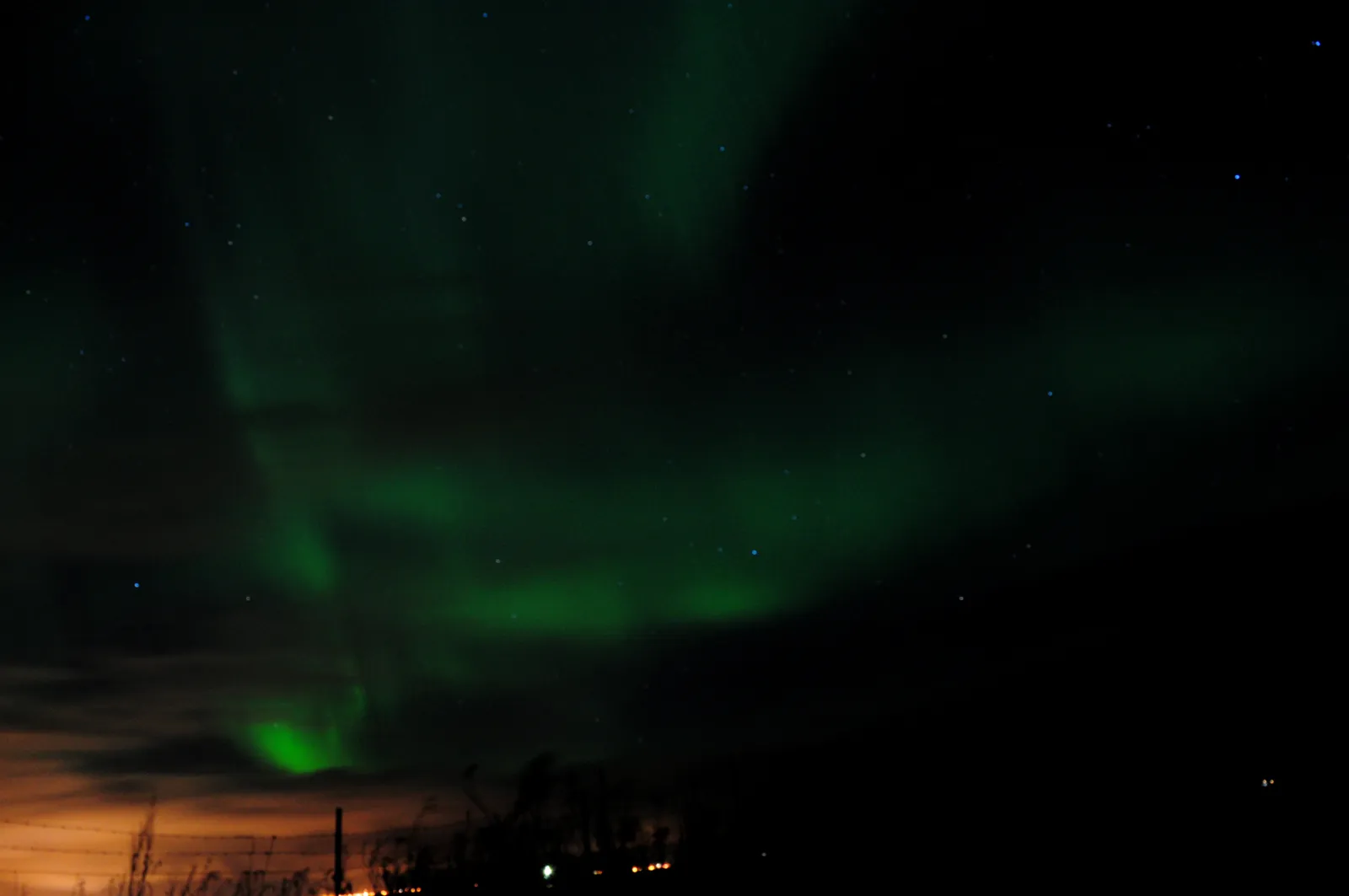
Iceland’s geographic position just below the Arctic Circle (64°08’ N) places Reykjavik directly underneath the Auroral Oval—the permanent ring of geomagnetic activity where charged solar wind particles funnel along Earth’s magnetic field lines, colliding with atmospheric oxygen and nitrogen atoms between 80 and 300 kilometres above ground to emit vivid curtains of green, violet, and crimson luminescence.
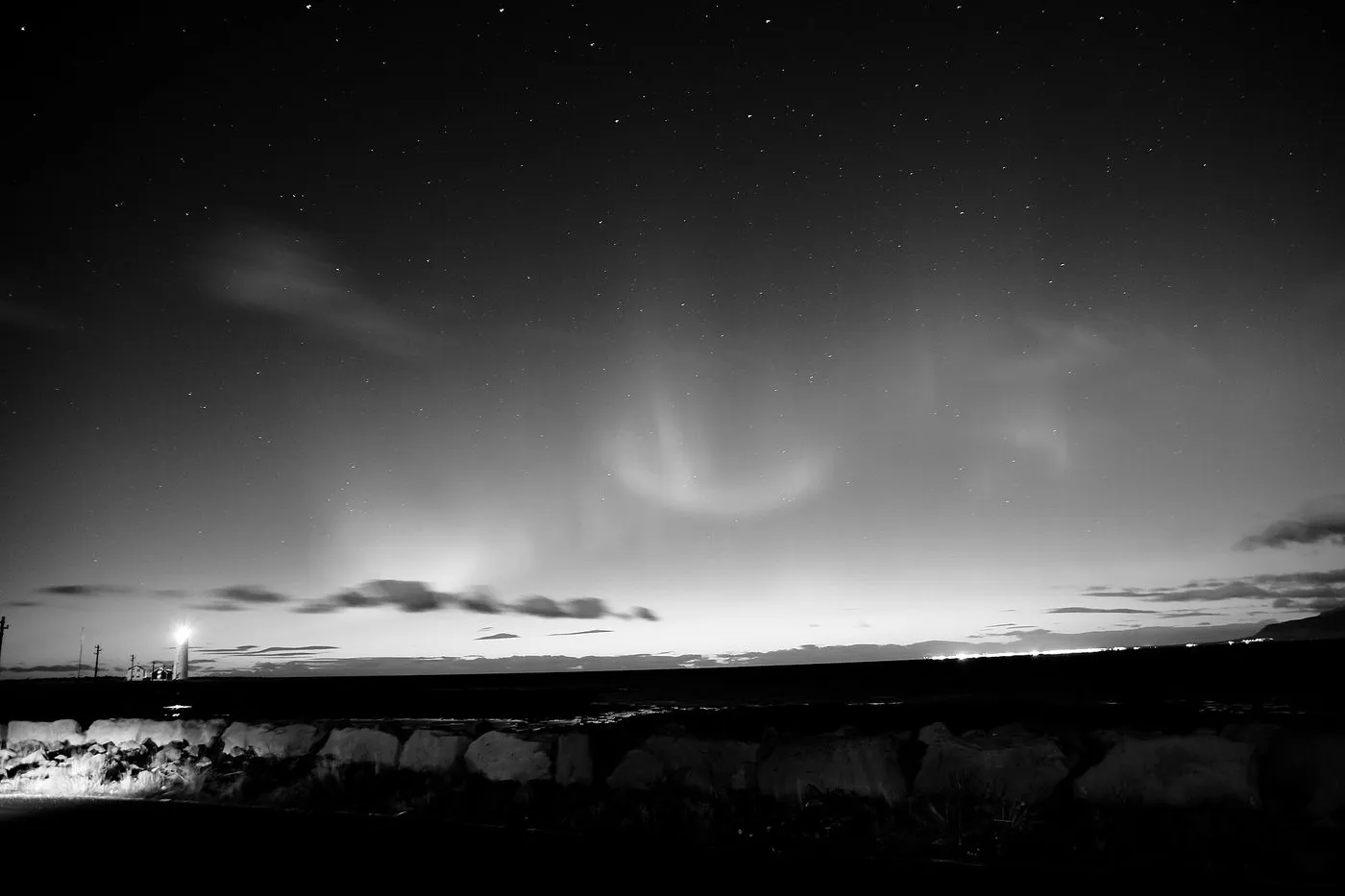 The aurora over Grótta, Seltjarnarnes. Photo: Massimo Margagnoni from Mondo, Italia, Wikimedia Commons, CC BY 2.0.
Aurora viewing season and daylight dynamics
The northern lights occur in the upper ionosphere 365 days a year, but human eyes cannot perceive them against a sunlit sky. For successful viewing, deep astronomical twilight or complete solar darkness is essential:
| Calendar period | Average night darkness | Sighting potential | Seasonal notes & weather considerations |
|---|---|---|---|
| May to mid-August | 0 hours (Midnight Sun) | Zero | Nights are illuminated by perpetual daylight; no auroral viewing possible |
| Late August to September | 6 to 9 hours | Moderate to High | Milder temperatures, autumn equinox solar activity, comfortable viewing |
| October to November | 10 to 14 hours | Very High | Long dark nights, crisp autumn skies, early snowfall on mountain peaks |
| December to January | 18 to 20 hours | Peak Darkness | Shortest days (4 hours daylight); allows early evening aurora watching from 18:00 |
| February to March | 12 to 15 hours | Very High | Spring equinox historically produces elevated solar geomagnetic storms |
| April | 7 to 10 hours | Moderate | Season concludes as twilight brightens past 23:00; final seasonal tours run |
How to decode the Icelandic Met Office forecast
The most common mistake international visitors make is misinterpreting the official Vedur.is aurora forecast map:
1. The cloud cover map: green means CLOUDS, not aurora
The interactive satellite map displays projected cloud coverage across Iceland. On this map:
- Green shading represents cloud layers: Light green denotes low or middle clouds; dark green represents thick overcast.
- Crisp white areas represent CLEAR SKIES: You must position yourself underneath pure white zones. An intense auroral storm occurring above green shaded terrain will remain completely invisible behind cloud cover.
2. The geomagnetic activity scale (Kp-index)
In the upper right-hand corner of the page, an activity gauge rates projected planetary geomagnetic disturbance on a logarithmic scale from 0 to 9:
- 0 to 1 (Quiet): Very faint auroras, visible primarily through long-exposure camera lenses.
- 2 to 3 (Low to Moderate): Standard background activity. Under crisp, dark rural skies away from streetlights, a Kp rating of 2 produces distinct, rippling green arcs clearly visible to the naked eye.
- 4 to 5 (Active to Minor Storm): Dynamic, multi-coloured auroral ribbons with rapid curtain movement, pink-tinted lower edges, and overhead auroral coronas visible directly above Reykjavik.
- 6 to 9 (Major Geomagnetic Storm): Rare intense solar storms visible across entire skies, casting green reflections onto ocean waters and snowbanks.
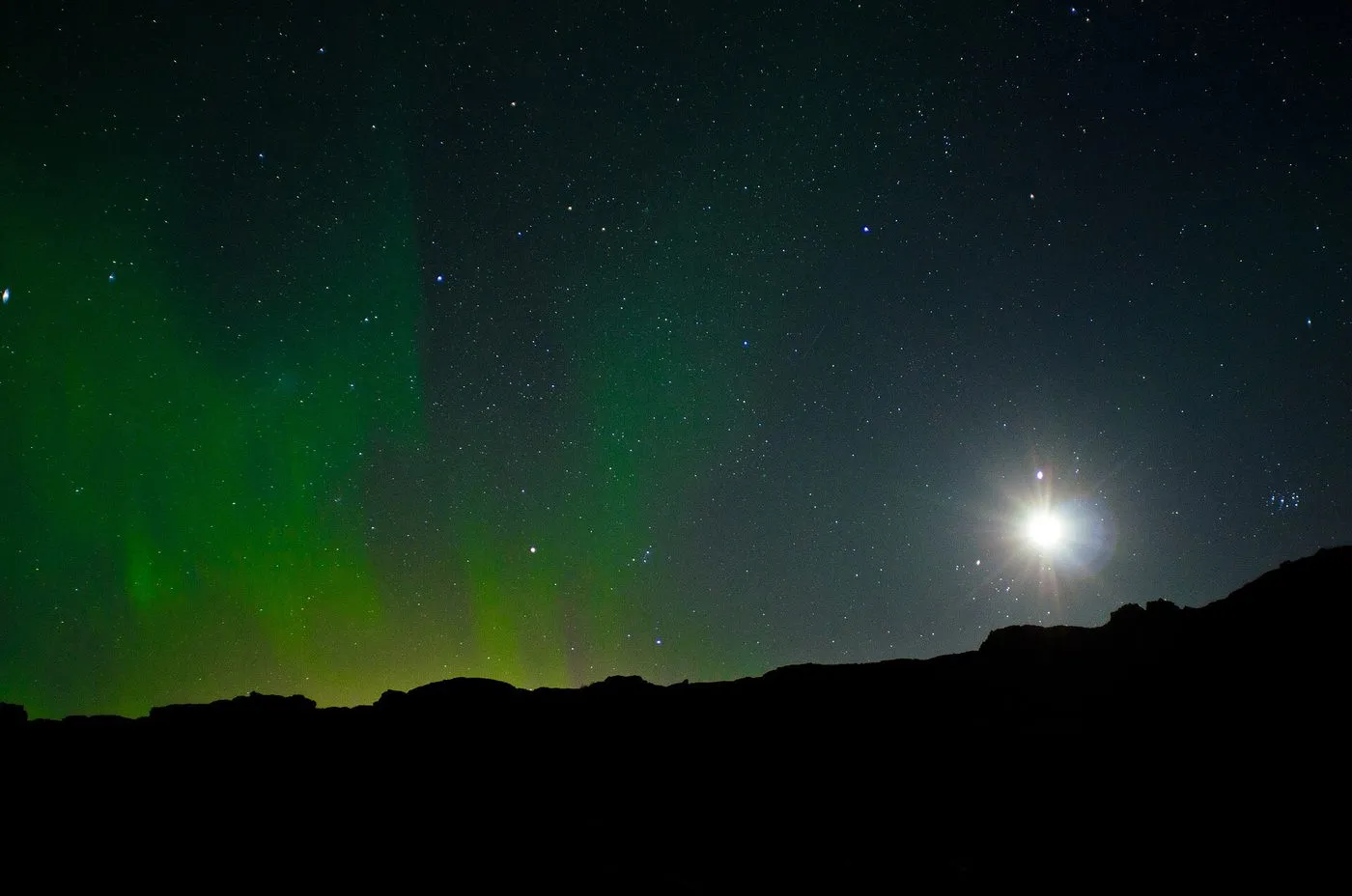 The aurora, the moon and the Pleiades over Þingvellir. Photo: Carl Young, Wikimedia Commons, CC BY-SA 4.0.
Top viewing locations in and around Reykjavik
If you are not joining an organized tour or renting a vehicle, several strategic vantage points within the greater capital area offer darker skies away from dense commercial neon and high-intensity streetlamps:
1. Grótta Lighthouse (Seltjarnarnes Peninsula)
Located at the westernmost tip of the Seltjarnarnes peninsula, roughly 4.5 kilometres from downtown, Grótta has been a protected municipal nature reserve since 1974. With the urban city lights positioned behind you to the east, the vantage point offers an unobstructed 180-degree panorama over the open ocean toward Faxaflói bay and Mount Esja.
- Getting there: Take Strætó bus route 11 to the Lindarbraut terminus, then walk 15 minutes along the paved coastal footpath. By car or taxi, the drive takes under 10 minutes.
- Footbath bonus: Beside the shoreline car park sits Kvika, a small geothermal footbath carved into a boulder by artist Ólöf Nordal, where you can soak your feet in 39°C thermal water while gazing up at the night sky.
2. Öskjuhlíð Woodland and Perlan
The forested hill of Öskjuhlíð, crowning the southern ridge of the city, provides an elevated retreat from streetlights. The walking trails winding through the pine and birch woodlands are dark, while the exterior viewing terrace around the glass dome of Perlan delivers 360-degree views across the entire capital basin.
3. Sæbraut Coastal Promenade and the Sun Voyager
For travellers staying in central hotels without transport, the seaside promenade along Sæbraut offers wide, open vistas over the bay toward Mount Esja. While light pollution from waterfront traffic is present, intense geomagnetic displays (Kp 3+) are clearly visible shimmering above the stainless-steel ribs of the Sun Voyager sculpture and Harpa Concert Hall.
4. Þingvellir National Park (Self-Drive Destination)
For travellers with a hire car, driving 45 minutes east on Route 36 into Þingvellir National Park takes you into complete rural wilderness within the Mid-Atlantic Ridge rift valley. The sheer basalt walls of the Almannagjá gorge and the dark reflective surface of Lake Þingvallavatn provide foregrounds for night photography.
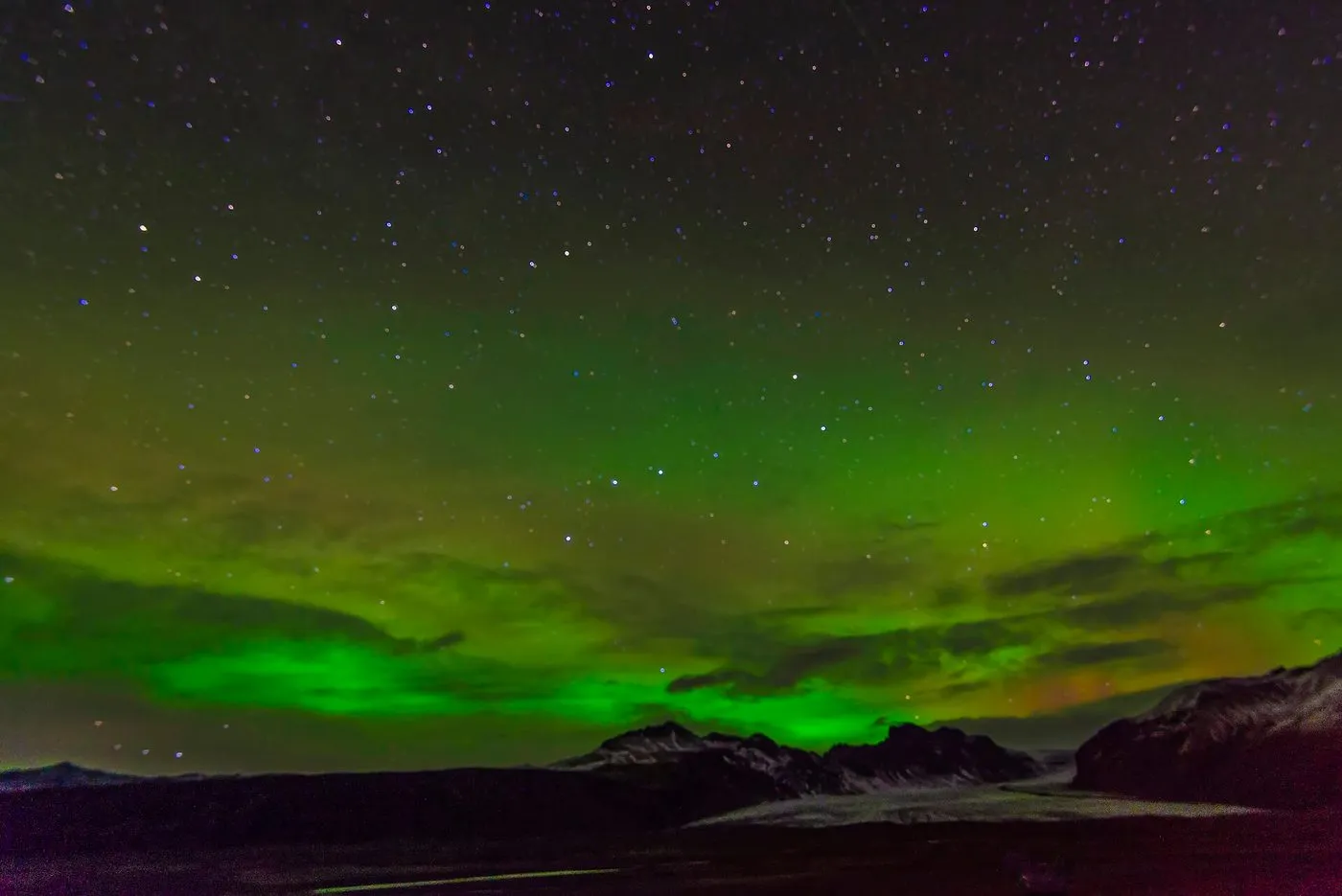 The aurora over the Icelandic coast, November. Photo: Francisco Diez from Toronto, Canada, Wikimedia Commons, CC BY 2.0.
Tour options and bookings
Organized aurora tours eliminate the stress of navigating unlit sub-arctic country roads in sub-zero conditions. Experienced driver-guides monitor satellite weather radar and maintain radio contact with scout vehicles to reposition guests beneath clear sky pockets.
From Reykjavik: Northern Lights Bus Tour with Hot Chocolatead
From 10,400 ISK · 4.2 stars from 15,501 reviews · 4 hours · Evening excursion
A coach tour from central Reykjavik. The heated coach equipped with free Wi-Fi and USB charging ports. Guides drive out of the city to darker countryside and serve hot chocolate on the way.
Reykjavik: Northern Lights Yacht Tourad
From 12,700 ISK · 4.4 stars from 1,391 reviews · 2 hours · Coastal ocean perspectives
A yacht leaves the Old Harbour and sails out into Faxaflói bay, away from the city lights. There are open decks and a heated indoor saloon.
Small-Group Premium Northern Lights Tour from Reykjavikad
From 12,900 ISK · 4.4 stars from 3,255 reviews · 4 hours · Expert photographer guide
Travel in an intimate group of no more than 18 passengers aboard a Mercedes minibus. The smaller group allows access to remote mountain tracks that large coaches cannot reach. The guide assists guests with manual camera settings and takes professional portraits of each guest beneath the dancing lights, delivered via email free of charge.
Sighting guarantee and rescheduling strategies
Because auroras are a natural phenomenon dependent on unpredictable atmospheric conditions, operators cancel scheduled tours if total overcast blanket the region, or reschedule if no displays materialize.
- The Golden Rule: Book for Night One: Schedule your aurora tour for the very first evening of your stay in Reykjavik. If cloud cover prompts a weather cancellation, or if you embark on a tour that sees no aurora, your booking automatically rolls over to subsequent nights without financial penalty.
- Repeat tours: once a coach or boat has left, operators do not refund, but many offer another tour if no aurora appears. Check the terms for your booking.
Photographing the northern lights: smartphone and camera settings
Human night vision relies on rod cells that perceive low-intensity light in shades of grey and pale green. Long-exposure camera sensors capture vivid reds, purples, and deep emerald hues that the naked eye cannot fully resolve:
Smartphone photography tips (iPhone & Android)
- Disable the Flash: Ensure camera flash is permanently disabled.
- Night Mode Long Exposure: Set Night Mode exposure time to maximum (typically 3 to 10 seconds).
- Keep the Phone Immobile: You cannot hold a phone steady in your hands for a 5-second exposure. Clamp the phone into a lightweight tripod or brace it firmly against a rock, bench, or railing.
- Tap to Focus: Tap on a distant star or bright horizon light to lock infinity focus.
Manual camera settings (DSLR / Mirrorless)
- Lens: Ultra-wide angle (14mm to 24mm) with a fast maximum aperture ($f/1.4$ to $f/2.8$).
- Focus: Set manual focus ($M$) and use live digital magnification to focus sharply on a bright star.
- ISO: Set ISO between 1600 and 3200 depending on ambient darkness.
- Shutter Speed: 4 to 8 seconds for fast-moving auroral curtains; 10 to 15 seconds for faint, static green arcs.
- Tripod: A heavy, sturdy tripod is completely indispensable in high sub-arctic winds.
Vital cold-weather safety advice
The Icelandic Association for Search and Rescue (ICE-SAR) outlines essential safety guidelines on Safetravel.is:
- Never stop on highway shoulders: Stopping a vehicle on the narrow gravel shoulder of Route 1 to photograph auroras is extremely dangerous and strictly illegal. Other drivers blinded by the dark cannot see parked cars on the verge. Only pull over in designated tarmac rest areas.
- Thermal Dressing: Standing motionless on frozen ground for hours leaches core body warmth rapidly. Wear thermal wool base layers, an insulated winter parka, windproof overtrousers, a fleece neck warmer, thick wool socks, and insulated winter boots. Pack spare camera batteries inside an interior coat pocket, as extreme cold drains lithium-ion batteries in minutes.
For coordinating an evening aurora hunt with daytime adventures, consult our 3 days in Reykjavik guide and explore our packing for Iceland equipment checklist.
Common questions
What months can you see the northern lights in Reykjavik?
The aurora borealis season in Iceland extends from late August through mid-April. Complete solar darkness is an absolute prerequisite, making sightings impossible during the bright summer months of May, June, and July when the midnight sun illuminates the sky.
Can you see the northern lights from central Reykjavik without joining a tour?
Yes. When solar coronal mass ejections produce high geomagnetic activity (Kp-index 4 or above), bright auroral ribbons can be seen dancing directly above downtown rooftops. However, street lighting diminishes subtle colours; walking to darker coastal spots like Grótta lighthouse or the Öskjuhlíð woodland provides significantly clearer viewing.
What happens if a guided northern lights tour fails to find the lights?
Many operators let you repeat the tour if no aurora appears, and cancel and rebook tours when cloud covers the whole region. The terms differ by operator, so read them on your booking.
How do you correctly read the Icelandic Met Office aurora forecast?
On the official Vedur.is aurora map, white areas indicate completely clear skies, while green areas represent cloud cover (with dark green denoting dense overcast). Many visitors mistakenly assume green signifies the northern lights. Check the Kp-index scale in the top right corner: ratings of 2 or 3 under clear white skies yield excellent sightings.