In this guide
💡 The Short Version: In terms of human crime, Reykjavik is one of the safest urban environments in the world. Iceland has ranked first on the Global Peace Index every consecutive year since 2008, and regular police officers do not carry firearms on daily patrol. However, Iceland’s raw sub-arctic nature presents genuine hazards: sneaker waves at Reynisfjara beach, scalding geothermal pools, sudden violent gales, and icy winter roads. In any emergency across Iceland, dial 112. Before departing on country day trips, always consult Safetravel.is and Umferdin.is.
Understanding personal safety in Iceland requires recalibrating your perceptions. In most European capitals, safety precautions focus on pickpocketing syndicates, bag snatching, and late-night street crime. In Iceland, crime is minor; instead, the elements demand your complete respect. Severe Atlantic storms can arrive within minutes, ocean swells carry tremendous hydrodynamic power, and geothermal ground can collapse beneath incautious footsteps.
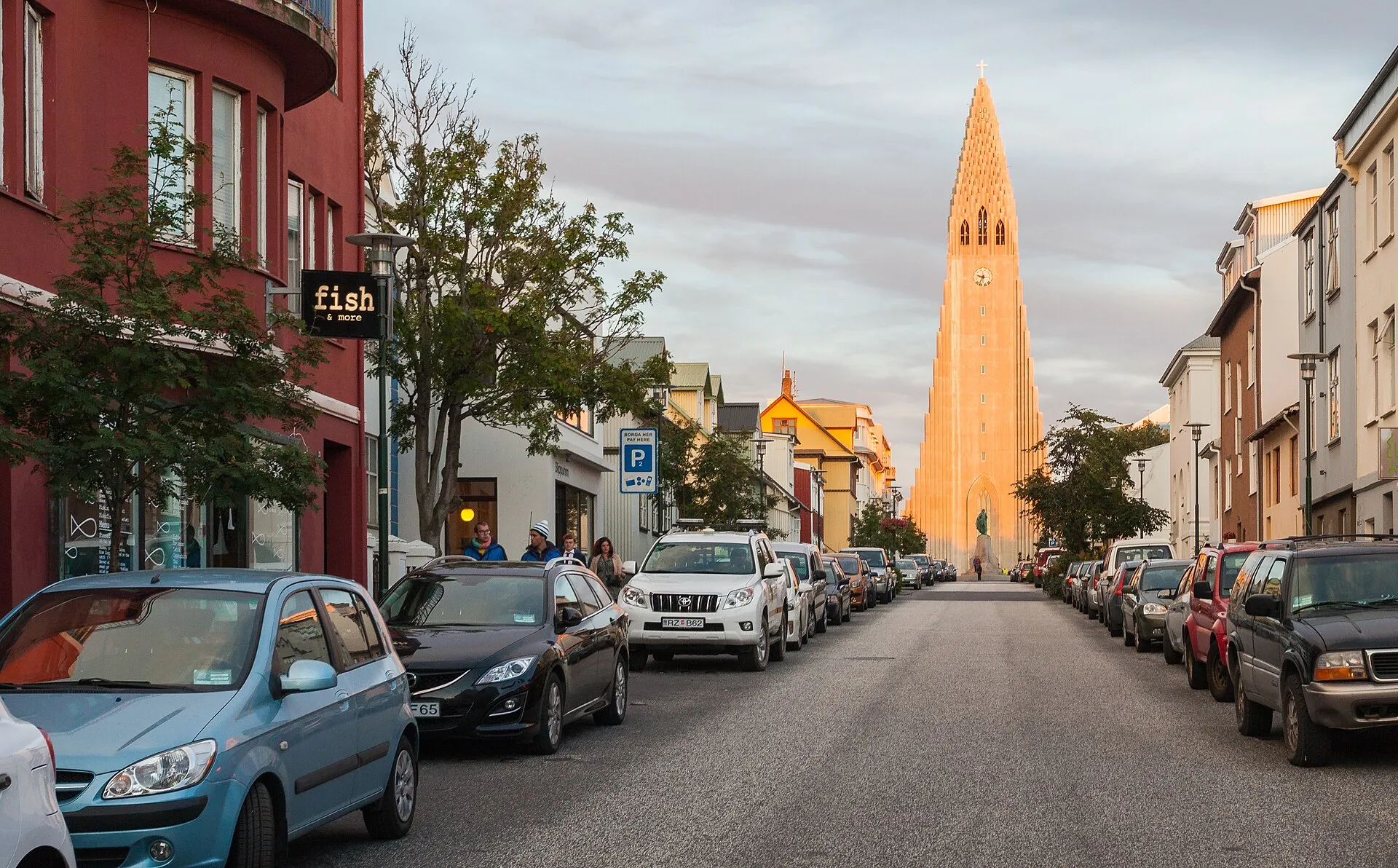
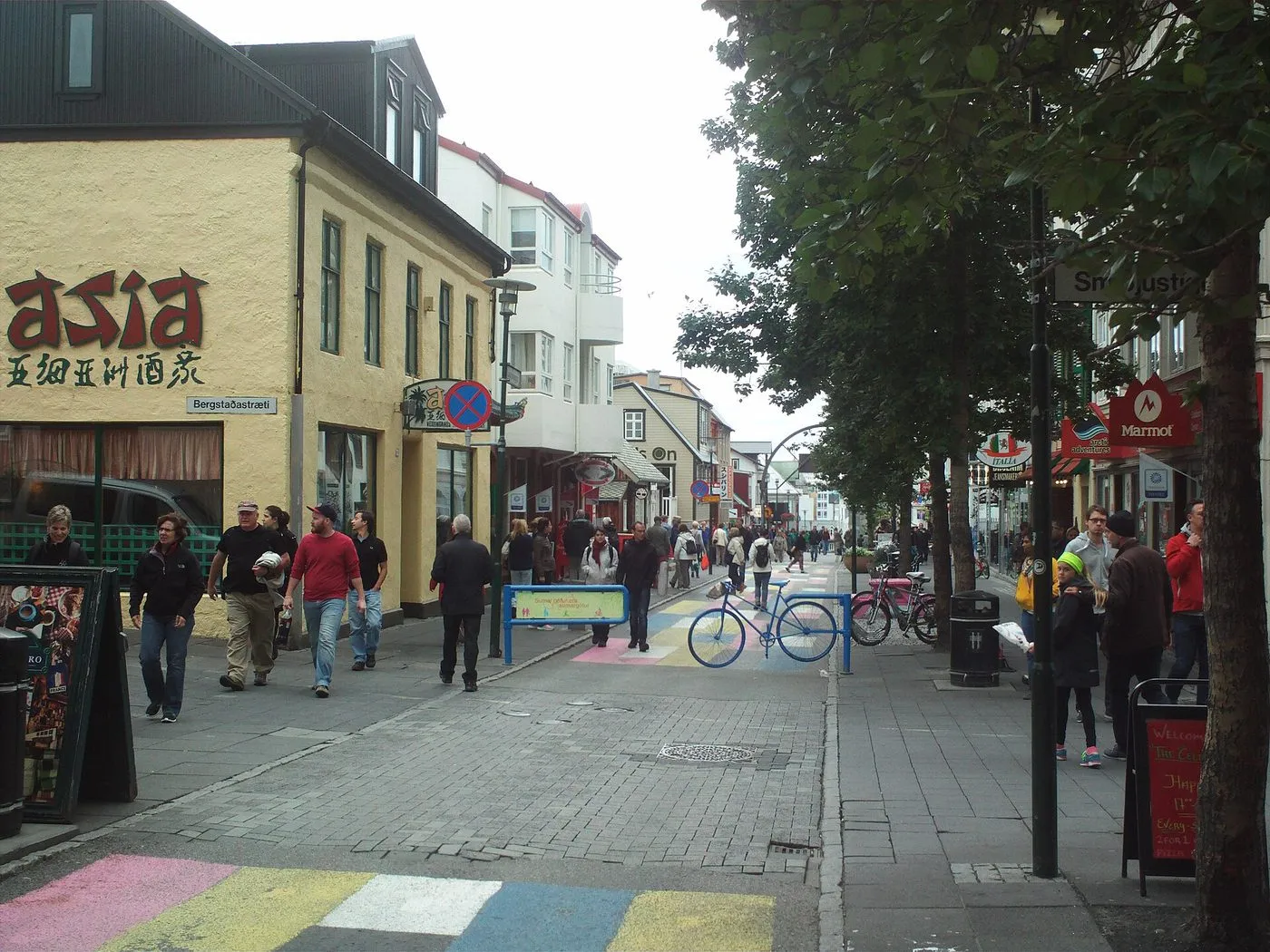 Pedestrians on Laugavegur. Photo: Ypsilon from Finland, Wikimedia Commons, CC0.
Crime statistics and urban safety in Reykjavik
Iceland’s social cohesion, low wealth disparity, universal healthcare, and robust social safety net contribute to remarkably low crime metrics:
Global safety indices
- Global Peace Index: The Institute for Economics and Peace (IEP) has ranked Iceland as the world’s most peaceful nation in every annual report published since 2008.
- Homicide Rate: Iceland averages fewer than two homicides per year nationwide, representing one of the lowest per-capita murder rates globally (approximately 0.3 per 100,000 residents).
- Unarmed Police: General duty officers of the Metropolitan Police (Lögreglan) patrol on foot and by bicycle carrying only batons and pepper spray. Specialist tactical firearms units (Víkingasveitin) are deployed only in rare armed standoff emergencies.
Nightlife and petty theft
While violent crime is exceptionally rare, the UK Foreign Office and US State Department note that opportunistic petty theft and rowdy antisocial behaviour can occur in downtown Reykjavik (Miðborg), primarily along Laugavegur and Bankastræti during early morning weekend hours (between 02:00 and 05:00 on Saturday and Sunday).
Simple common-sense precautions suffice:
- Keep handbags and rucksacks zipped and within sight while dining in crowded bars and food halls.
- Never leave unattended smartphones or wallets resting on bar counters or outdoor café tables.
- Do not leave valuable camera gear or luggage exposed on the passenger seats of parked hire cars.
Critical natural hazards across Iceland
The overwhelming majority of hospitalizations and emergency search-and-rescue operations involving foreign tourists stem from natural and environmental hazards:
| Environmental hazard | Geographic hotspots | Nature of danger | Essential safety protocol |
|---|---|---|---|
| Sneaker Waves (Drápsbylgjur) | Reynisfjara beach, Kirkjufjara, Djúpalónssandur | Massive rogue swells surging far up the beach; lethal undertow | Never turn your back on the sea; obey electronic warning lights; keep $\ge 25$ metres back |
| Geothermal Scalding | Geysir (Haukadalur), Gunnuhver, Seltún | Boiling mineral water ($100^\circ\text{C}+$); thin, fragile earth crusts | Remain strictly on designated wooden boardwalks and behind rope fences |
| Glacial Crevasses & Rockfalls | Sólheimajökull, Falljökull, Svínafellsjökull | Concealed 30-metre ice chasms; collapsing seracs; tumbling moraine rock | Never step onto glacier ice without crampons, helmet, and a certified mountain guide |
| Coastal Gales & Katabatic Winds | Route 1 along Eyjafjöll, Kjalarnes, Snæfellsnes | Sustained wind gusts exceeding 25–35 m/s (50–70 knots) | Hold car doors firmly with both hands; postpone driving if amber/red weather alerts fire |
| Winter Black Ice & Blizzards | Ring Road (Route 1), Hellisheiði, mountain passes | Invisible ice glazing on tarmac; zero-visibility whiteouts | Check umferdin.is before driving; drive on studded winter tyres; reduce speed |
| Volcanic Gases ($SO_2$) | Reykjanes peninsula (Sundhnúkur fissure zone) | Toxic sulfur dioxide fumes causing respiratory distress | Monitor air quality on loftgaedi.is; obey evacuation sirens |
 Corrugated-iron houses in central Reykjavik. Photo: Thomas Quine, Wikimedia Commons, CC BY-SA 2.0.
Reynisfjara beach: understanding sneaker waves
Located on the South Coast near Vík, Reynisfjara is known for its hexagonal basalt columns and jet-black sand, but it is also Iceland’s most lethal tourist site.
The physics of sneaker waves
Unlike typical coastlines where outgoing waves break over shallow offshore sandbars, the underwater seabed off Reynisfjara drops steeply into deep ocean trenches. Long-period swells generated across the southern oceans travel thousands of kilometres unimpeded until they hit the steep shore, suddenly surging upwards without warning.
A sneaker wave can surge 20 to 30 metres further up the dry black sand than the preceding wave sets. Because the water contains suspended black gravel, it acts like a dense liquid slurry that instantly knocks adults off their feet. As the water rushes back down the steep slope, a powerful underwater undertow sweeps the victim into freezing ($4^\circ\text{C}$ to $6^\circ\text{C}$) ocean surf, causing cold-water shock and drowning within minutes.
The electronic safety light system
An automated safety traffic light stands beside the path leading down from the car park:
- Green Light: Moderate conditions. Keep well back from active waves; maintain standard vigilance.
- Yellow Light: Heightened danger. Keep at least 15 to 20 metres back from the waterline; entry to the sea cave at Hálsanefshellir and climbing the basalt columns is strictly prohibited.
- Red Light: Severe life-threatening danger. Beach access is completely closed. Remain strictly on the elevated viewing platform by the restaurant.
- The Golden Rule: Never turn your back on the ocean. Do not pose for photos with the surf breaking directly behind you.
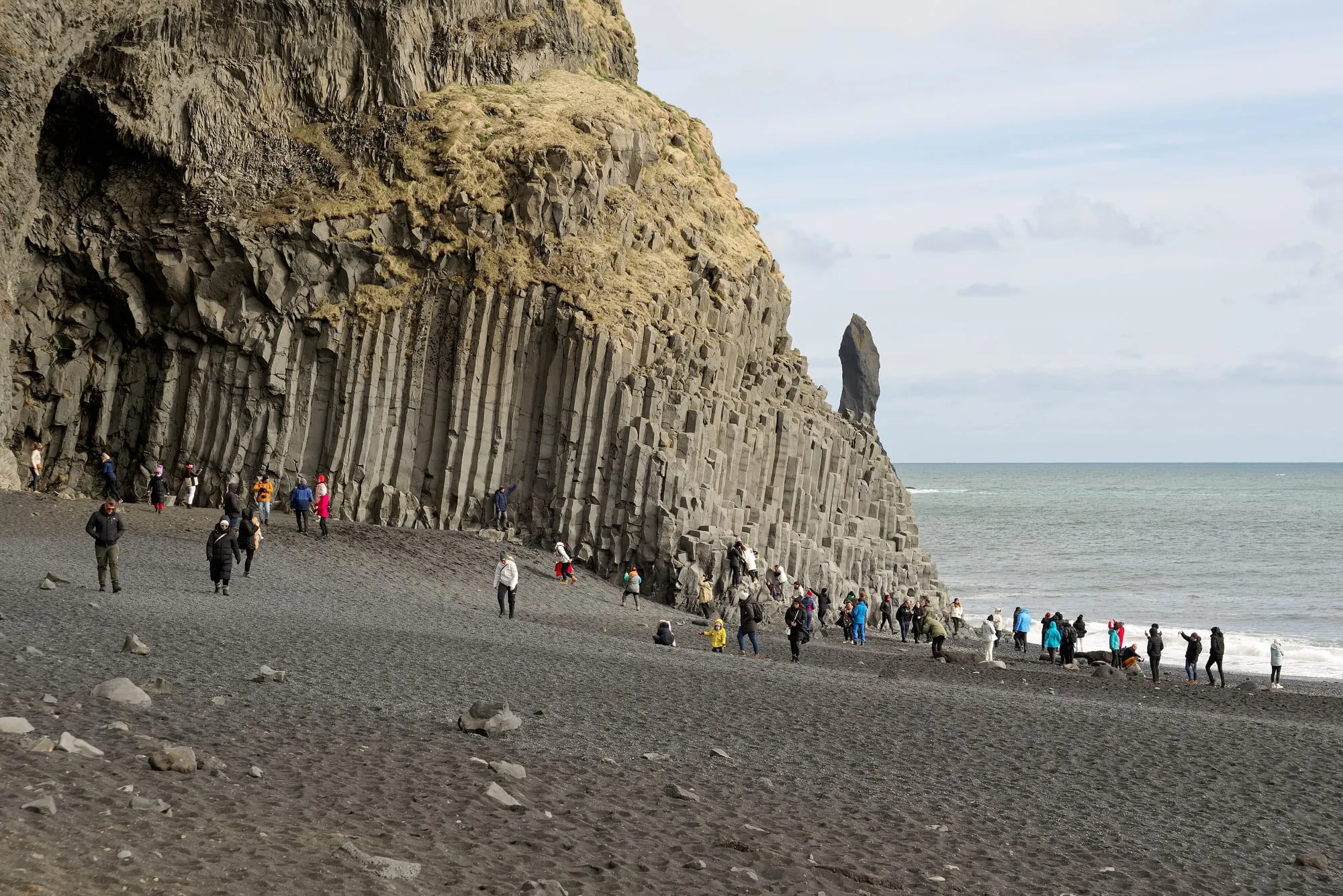 Basalt columns and black sand at Reynisfjara. Photo: Jakub Hałun, Wikimedia Commons, CC BY-SA 4.0.
Volcanic unrest on the Reykjanes peninsula
Between late 2023 and 2025, recurring volcanic fissure eruptions along the Sundhnúkur crater chain near Grindavík created international headlines. Understanding the geological reality will keep your trip safe and worry-free:
Fissure eruptions versus explosive stratovolcanoes
The volcanoes of the Reykjanes peninsula are effusive basaltic fissure systems, not explosive sub-glacial calderas like Eyjafjallajökull in 2010. They produce glowing lava fountains and slow-moving basaltic lava flows that follow predictable topographic depressions; they do not eject high-altitude ash plumes that disrupt European airspace.
Protection of infrastructure
Extensive civil engineering projects have constructed massive earth and rock defensive barriers (varnargarðar) rising up to 10 metres high around the town of Grindavík, the Svartsengi power station, and the Blue Lagoon. These dykes have successfully redirected advancing lava flows away from critical infrastructure.
Volcanic gas monitoring
When an active eruption occurs, prevailing winds can carry sulfur dioxide ($SO_2$) gas across the peninsula. The Environment Agency of Iceland operates real-time monitoring stations accessible to the public at Loftgaedi.is. If elevated gas concentrations are detected in populated areas, local civil protection authorities advise residents and tourists to close windows and stay indoors.
Safe winter driving rules in Iceland
Driving outside Reykjavik between October and April requires vigilance and specialized techniques:
- Check Road Status Every Morning: Never set off on a winter day trip without consulting Umferdin.is, the live portal maintained by the Icelandic Road and Coastal Administration (Vegagerðin). Roads are colour-coded: Green (clear tarmac), Yellow (slippery spots), Blue (packed snow/ice), White (heavy snow cover), and Red/Black with the word Lokað (completely closed). If a road is marked Lokað, do not attempt to bypass barriers; rescue vehicles cannot reach you easily.
- Continuous Headlights: Motorists must keep headlights illuminated 24 hours a day. Automated vehicle sensors frequently fail to activate rear taillights during twilight or misty conditions.
- Beware of Wind Gusts on Car Doors: Iceland’s oceanic wind gusts regularly exceed 30 m/s (60 knots). When parking at open viewpoints (such as Gullfoss, Skógafoss, or Reynisfjara), always park facing into the wind. Grip the door handle firmly with both hands when opening it; gusts can instantly catch the door and bend the hinges backward, causing thousands of pounds of damage that is excluded from all rental insurance policies.
- Single-Lane Bridges (Einbreið brú): Rural highways feature numerous narrow single-lane bridges. The vehicle closest to the bridge has the right of way. Slow down to 50 km/h or less, assess oncoming traffic, and pull over if the opposing vehicle is closer.
- Off-Road Driving is Strictly Illegal: Driving off marked roads, beaches, or designated tracks (utanvegaakstur) is strictly forbidden by national law. Sub-arctic moss takes up to a century to recover from vehicle tyre ruts; violators face substantial police fines and vehicle impoundment.
Emergency services and useful contacts
- Emergency Telephone: 112 (Police, Ambulance, Fire, Coast Guard, Mountain Rescue).
- Non-Emergency Police Line: +354 444 1000 (Central Reykjavik Police Station at Hverfisgata 113).
- 24-Hour Medical Helpline: 1700 (or +354 544 4113 for foreign phones). Operated by certified healthcare professionals to provide non-emergency medical advice or direct you to the nearest urgent care clinic (Læknavaktin at Háaleitisbraut 68).
- The Safetravel Smartphone App: Download the free app from Safetravel.is. The app delivers push notifications regarding approaching blizzards, road closures, and volcanic alerts, and features an integrated SOS check-in button that transmits your exact GPS coordinates directly to emergency dispatchers.
For seasonal packing guidelines and route planning, consult our guides on packing for Iceland, day trips from Reykjavik, and the complete Reykjavik travel guide.
Common questions
Is Reykjavik safe for solo female travellers?
Yes. Iceland consistently ranks as the safest country in the world, holding the number one position on the Global Peace Index every year since 2008. Violent crime is virtually non-existent, street harassment is rare, and solo travellers of all backgrounds navigate downtown streets comfortably at all hours of the day and night.
What is the emergency telephone number in Iceland?
Dial 112 from any mobile phone or landline throughout Iceland. It connects directly to the unified national emergency dispatch centre for police (*lögreglan*), ambulance (*sjúkrabíll*), fire departments, and volunteer search and rescue teams (ICE-SAR).
What is the primary danger for tourists visiting Iceland?
Natural environmental hazards, not human crime. The leading causes of serious injury and death among tourists are sneaker waves at Reynisfjara black sand beach, falling through fragile crusts into boiling geothermal springs, slipping on sheer ice at waterfall viewpoints, and motor accidents caused by gale-force crosswinds and winter black ice.
Are volcanic eruptions on the Reykjanes peninsula dangerous to Reykjavik?
Fissure eruptions along the Sundhnúkur crater chain near Grindavík produce localized basaltic lava flows that do not threaten Reykjavik, which lies roughly 50 kilometres north-east across rugged terrain. International flights at Keflavík Airport operate normally during effusive basaltic eruptions. The primary hazard is drifting sulfur dioxide (SO2) volcanic gas, tracked via loftgaedi.is.