In this guide
💡 The Short Version: Seoul is largely cashless for shopping and dining, but carrying cash won remains essential for transit and markets. Major international cards (Visa and Mastercard) work at hotels, sit-down eateries, convenience stores, and municipal taxis. However, ticket vending machines for transit cards (T-money and the Climate Card) accept cash banknotes only, as do most traditional stalls at Gwangjang Market and Myeongdong. Withdraw cash at machines displaying the ‘Global ATM’ logo at major retail banks (Hana Bank, Shinhan Bank, Woori Bank) rather than domestic-only terminals. Tipping does not exist in South Korea; bills include all statutory charges.
Cash versus card in Seoul
South Korea operates one of the world’s most card-intensive consumer payment economies, regulated under the Bank of Korea. Visitors can pay by card for the vast majority of day-to-day transactions, but transit infrastructure and traditional street food trade remain firmly cash-based.
| Payment method | Acceptance level | Best for | Key condition |
|---|---|---|---|
| Foreign Visa / Mastercard | Universal (95%+) | Hotels, shopping malls, cafes, taxis, chain restaurants | Must be chip-and-PIN or contactless enabled; carry a backup |
| Cash (South Korean won, ₩) | Essential backup | Transit card top-ups, street food markets, temple donations | Banknotes required for automated station ticket kiosks |
| T-money card | Universal transit & micro-payments | Seoul Subway, municipal buses, convenience stores | Must be loaded with physical cash at station machines |
| WOWPASS | Universal retail + T-money | Prepaid foreign currency loading without ATM bank fees | Kiosk exchange rate applies; T-money pocket loaded separately with cash |
| Climate Card | Seoul municipal transit only | Unlimited 1-day to 7-day tourist subway and bus travel | Physical card costs ₩3,000 cash; transit pass loaded with cash only |
- Credit and debit cards: Visa and Mastercard are accepted across departmental retail, franchise bakeries, cafes, and municipal taxis. American Express is accepted at international hotels, luxury department stores, and airport retailers, but independent cafes and smaller restaurants frequently decline it.
- Where cash is strictly required:
- Transit card reloads: Automated ticket machines inside Seoul Metro stations and convenience store registers accept physical cash banknotes only when loading funds onto physical T-money cards or the Climate Card. Neither domestic nor international payment cards are accepted by station reloader units.
- Traditional market stalls: Vendors at food markets like Gwangjang Market or Namdaemun Market conduct business primarily in cash, though select permanent stalls with fixed POS hardware accept cards.
- Subway coin lockers: Storage lockers at subway interchanges require coins (₩500) or ₩1,000 banknotes, though newer touchscreen storage banks in major hubs take T-money and credit cards.
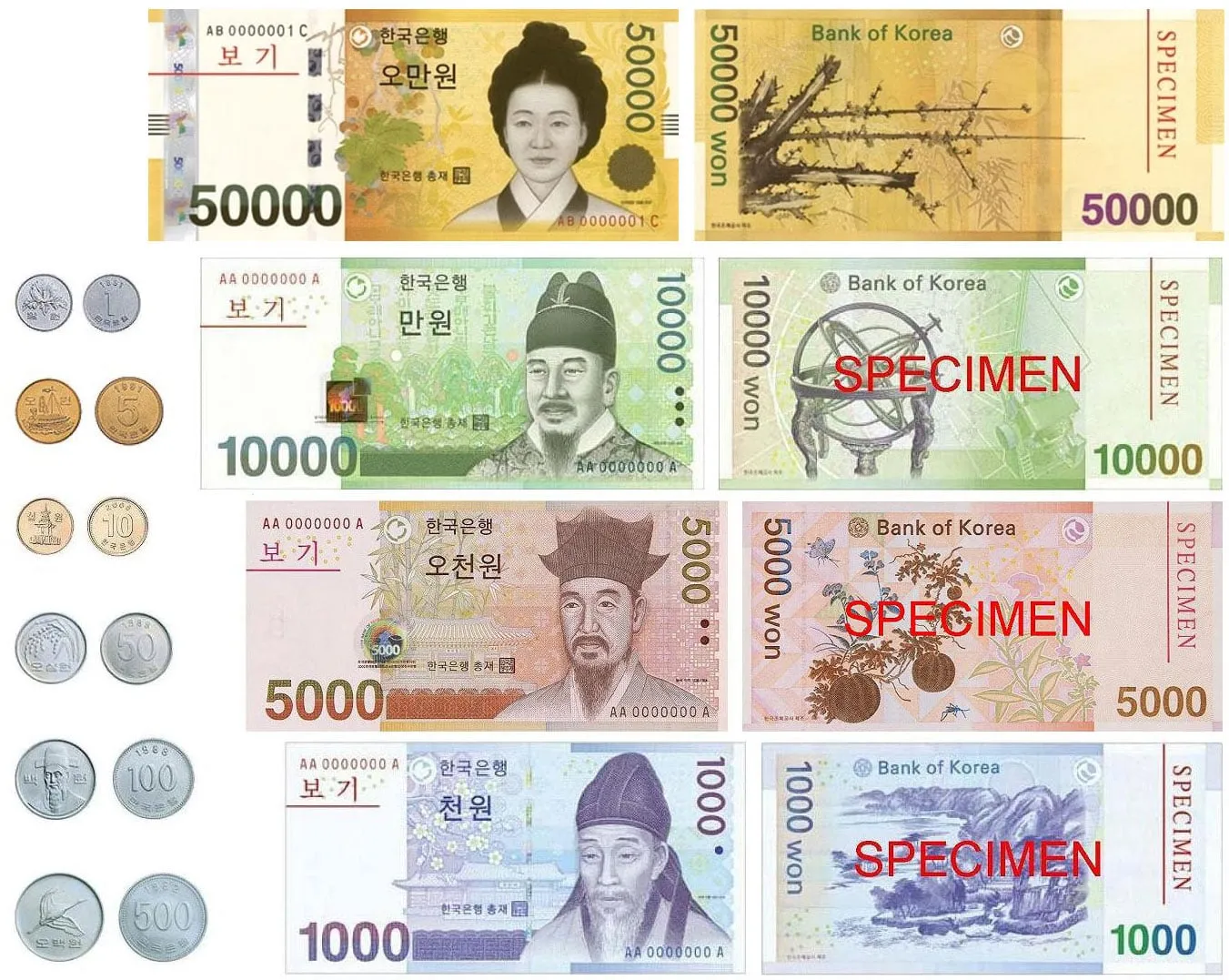
South Korean banknotes and coins. Photo: The Bank of Korea한국은행, Wikimedia Commons, South Korean currency.
Banknotes and coins
South Korean currency is issued by the Bank of Korea in the following denominations:
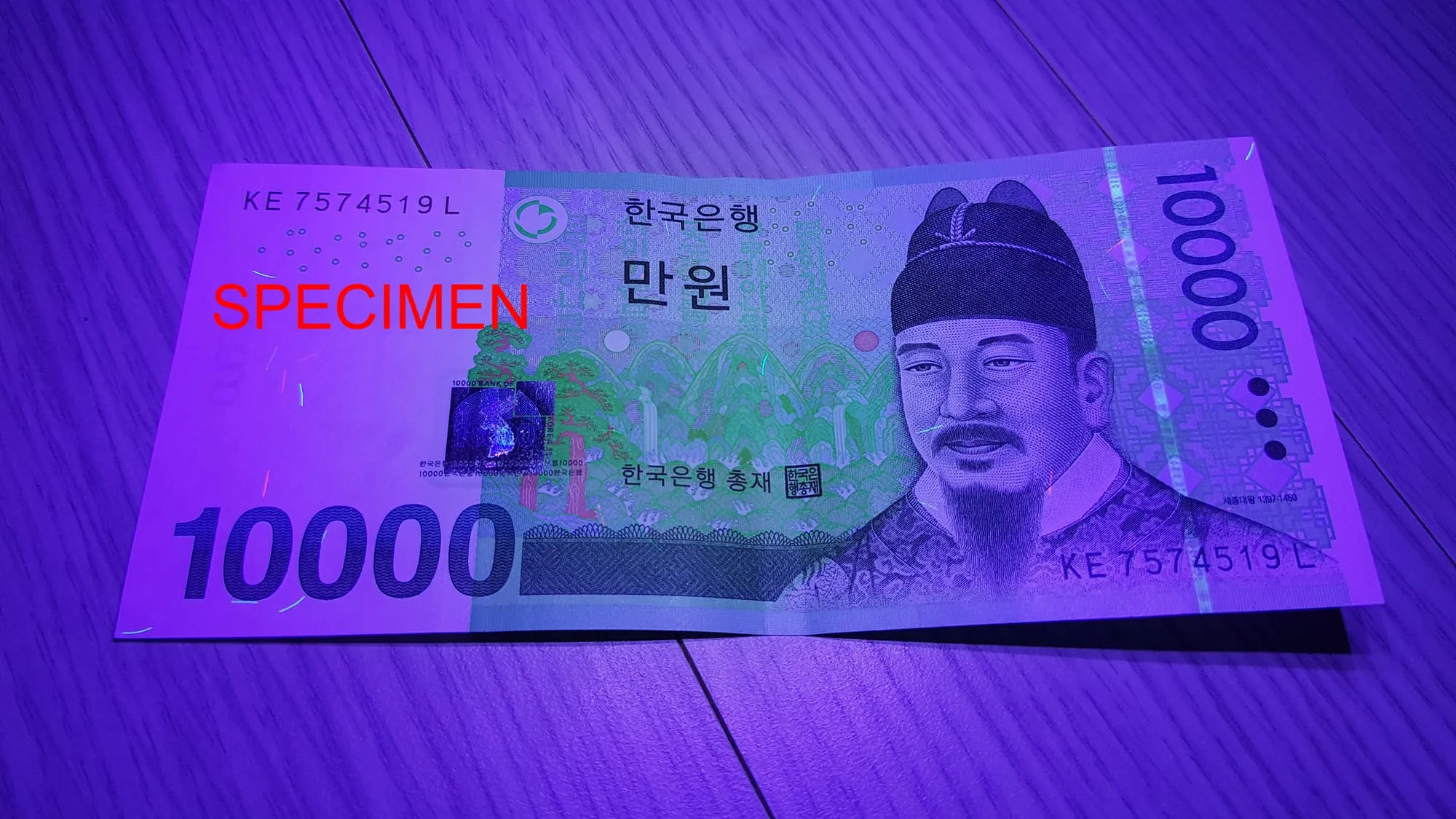
- Banknotes: ₩1,000 (blue, depicting scholar Toegye Yi Hwang), ₩5,000 (orange-red, philosopher Yulgok Yi I), ₩10,000 (green, King Sejong the Great), and ₩50,000 (yellow, artist Shin Saimdang). The ₩50,000 note is the largest general-circulation denomination and is accepted without hesitation across shops, taxis, and ticket machines.
- Coins: ₩10, ₩50, ₩100, and ₩500. Smaller coins (₩10 and ₩50) have negligible purchasing power and are rarely encountered except as supermarket change.
- Cash buffer recommendation: Withdrawing ₩50,000 to ₩100,000 per person upon arrival at Incheon International Airport covers your initial T-money card purchase (₩4,000 to ₩5,000), basic transit rides, luggage storage, and first night market snacks without requiring additional cash runs.
Withdrawing cash from Global ATMs
Standard domestic ATMs in South Korea operate on proprietary local banking networks and reject foreign-issued cards. International travellers must use terminals bearing the Global ATM emblem.
- Bank branch lobbies: Hana Bank, Shinhan Bank, Woori Bank, and KB Kookmin Bank maintain 24-hour automated teller lobbies outside their retail branches. At least one machine in every branch is designated as a Global ATM.
- Convenience store machines: Outlets of CU, GS25, 7-Eleven, and Emart24 house multi-bank ATMs managed by operators like Nice, CashZone, and Lotte ATM. These display an on-screen ‘Foreign Card’ button, though international service fees are higher than high-street bank branches.
- Operating procedure:
- Select ‘English’ and press ‘Foreign Card’ on the opening touchscreen interface.
- Select ‘Checking Account’ (or ‘Credit Card’ if cash advance is intended).
- Enter your 4-digit PIN. If prompted for a 6-digit PIN, enter your standard 4 digits followed by ‘00’.
- Select withdrawal amount in Korean won.
- Withdrawal fees: Korean host banks levy an access charge between ₩3,500 and ₩5,000 per transaction, assessed in addition to any foreign transaction fees charged by your home card issuer.
- Dynamic currency conversion: When the ATM screen asks whether to debit your card in your home currency (GBP, USD, EUR) or local South Korean won, always choose South Korean won (KRW). Opting for home currency allows the machine operator to set an unfavourable conversion margin (often 5% to 8% above interbank rates).
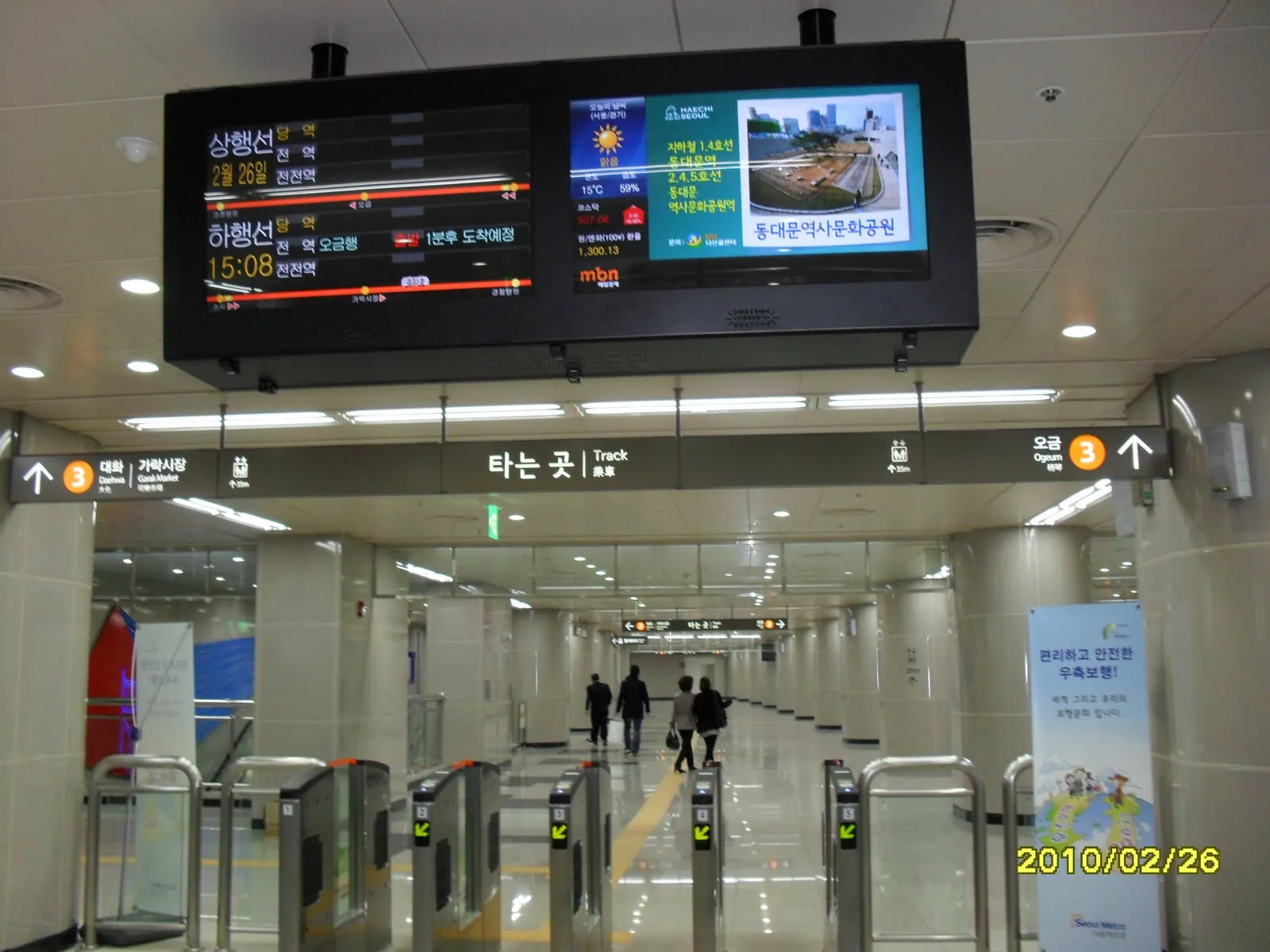
Fare gates and platform signs at a Seoul subway station. Photo: 박경수(ko:사용자:Subwaymaster1994), Wikimedia Commons, GFDL.
The WOWPASS and NAMANE cards
Prepaid travel smartcards designed specifically for inbound tourists provide a streamlined alternative to frequent ATM withdrawals.
WOWPASS card
The WOWPASS is an all-in-one chip card combining a private prepaid debit account with an independent T-money transit chip:
- Kiosk distribution: Automated multilingual kiosks operate across Incheon International Airport (Terminals 1 and 2), Gimpo International Airport, major Seoul Metro interchange stations (Seoul Station, Myeongdong, Hongik University, Gangnam), and prominent tourist hotels.
- Direct currency deposit: Kiosks accept physical banknotes in 16 major currencies (including GBP, EUR, USD, CAD, AUD, and JPY), converting them instantly into Korean won at competitive rates and loading the balance directly onto the card without local bank fees.
- Dual-pocket balance structure: The retail spending balance pays for purchases across any merchant POS terminal in South Korea. The transit function is governed by a separate T-money chip embedded on the card; this transit chip cannot draw directly from the card’s retail balance and must be loaded independently with cash won at standard subway station kiosks.
- App controls: The WOWPASS smartphone app provides instant push notifications for all transactions, displays live balance levels, and permits users to lock the card instantly if mislaid.
NAMANE card
The NAMANE Card operates on a similar dual-pocket architecture (Pay Balance for shopping and dining, Transit Balance for rail and buses). Unlike WOWPASS, users can design a custom photo front on the card via the NAMANE mobile app before printing it at station kiosks, and funds can be transferred directly between the Pay and Transit pockets within the smartphone application.
Tax refunds (VAT)
South Korea imposes a 10% Value Added Tax (VAT) on consumer goods. Foreign visitors spending ₩15,000 or more in a single transaction at certified Tax-Free retail premises are entitled to refund claims under regulations set by the Korea Customs Service.
- Immediate on-site tax refunds: Retailers displaying the ‘Tax Free’ or ‘Immediate Tax Refund’ signage (including Olive Young cosmetics flagships, major sportswear outlets, and department stores) deduct the VAT component directly at the till upon presentation of your physical passport. Immediate refund limits are capped at ₩1,000,000 per single transaction and ₩5,000,000 total per trip.
- Customs refund kiosks at airports: For purchases where immediate VAT deduction was not processed, collect the printed Tax Refund receipt from the cashier. At Incheon Airport, locate the automated Tax Refund kiosks prior to luggage check-in (Terminal 1 near departure check-in rows D and J; Terminal 2 near rows D and E). Scan your passport and receipts at the kiosk. If your total refund value exceeds ₩75,000, customs officers may inspect the unused items in your baggage before stamping approval. Once through security, collect cash won or card credit at designated refund desks behind departure gates.
Tipping culture
There is no tipping culture in South Korea. Attempting to tip taxi drivers, restaurant servers, hotel porters, or bartenders is considered unusual and often causes awkwardness or confusion.
- Bills are final: The price listed on restaurant menus, salon tariff boards, and taxi meters represents the full, final legal charge, inclusive of 10% VAT and all operational service costs.
- Returning extra cash: If you leave cash banknotes on a restaurant table or tell a taxi driver to keep the change, staff will routinely pursue you down the street to return the forgotten money under the assumption it was left behind by mistake.
- Luxury hospitality: Upmarket international hotels and fine-dining establishments in Gangnam or Jongno incorporate a formal 10% service charge directly into published menu prices or the final itemised folio. No further gratuity is expected or required.
Common questions
Can you pay by card in Seoul?
Yes. Major international credit and debit cards including Visa and Mastercard are accepted across department stores, hotels, sit-down restaurants, cafes, and taxis. However, physical transit card top-ups (T-money and Climate Card) and traditional street food stalls require cash won.
Do ATMs in Seoul accept foreign cards?
Yes, provided you use machines marked 'Global ATM'. These operate in 24-hour lobbies at major commercial banks including Woori Bank, Hana Bank, Shinhan Bank, and KB Kookmin Bank, as well as select convenience store branches.
Do you tip in Seoul?
No. Tipping is not practised anywhere in South Korea. Taxis, restaurants, bars, and hotels charge the exact total on the bill, which includes all statutory taxes and service fees. Leaving extra cash can cause confusion.
What is a WOWPASS card?
WOWPASS is an all-in-one prepaid foreign visitor debit card with an embedded T-money transit chip. You deposit foreign cash banknotes (GBP, EUR, USD, JPY) directly into automated kiosks at transport hubs to load a local Korean won spending balance.