In this guide
💡 The Short Version: City-centre high-speed rail beats short-haul flights across Europe on almost every leg under four hours. You step off in the historic centre with no airport transfers, no liquid rules and no cabin-bag fees. Eight classic pairings and trios work seamlessly without a car: Rome–Florence–Venice (1h 36m + 2h 13m), Paris–Brussels–Bruges–Amsterdam (1h 22m + 56m + 1h 50m), Vienna–Bratislava–Budapest–Prague (56m + 2h 24m + 4h), Barcelona–Madrid–Seville–Granada (2h 30m + 2h 37m + 2h 40m), Lisbon–Porto (2h 39m), Munich–Salzburg–Vienna (1h 43m + 2h 25m), Kraków–Warsaw (2h 15m) and Stockholm–Copenhagen (5h 30m). Book dynamic-fare high-speed trains 60–90 days ahead to lock in €9–€29 base fares, and check Monday museum closures before picking which day to ride.
Short-haul European flights look quick on a booking screen until you add 45 minutes to the airport, 90 minutes before departure, baggage fees and another 45 minutes into the next city centre. A 70-minute flight between Rome and Florence or Barcelona and Madrid eats four hours door to door — longer than the high-speed train that drops you 10 minutes’ walk from the Duomo or Retiro Park.
Below are eight proven multi-city rail itineraries built around our European city hubs, with exact journey times, operators, central stations, realistic advance fares and the museum-closure timing that makes each route run smoothly. Before locking in your travel dates, cross-check our 2026–2027 advance booking calendar so you do not miss timed slots at the Colosseum, Alhambra or Anne Frank House.
Quick reference: 8 European rail corridors compared
| Rail Itinerary | Recommended Days | Fastest Leg Times | Key Operators | Typical Advance Fare / Leg |
|---|---|---|---|---|
| 1. Rome – Florence – Venice | 7–10 days | 1h 36m / 2h 13m (3h 51m direct) | Trenitalia Frecciarossa, Italo | From €23.90 |
| 2. Paris – Brussels – Bruges – Amsterdam | 7–10 days | 1h 22m / 56m / 1h 50m | Eurostar, SNCB | From €29 (Eurostar) |
| 3. Vienna – Bratislava – Budapest – Prague | 8–11 days | 56m / 2h 24m / 4h 00m | ÖBB Railjet, RegioJet, ČD | €9–€19.90 |
| 4. Barcelona – Madrid – Seville – Granada | 9–12 days | 2h 30m / 2h 37m / 2h 40m | Renfe AVE/Avlo/Avant, Iryo, Ouigo | €9–€25 |
| 5. Lisbon – Porto | 5–7 days | 2h 39m | CP Alfa Pendular, Intercidades | €64.50 return (standard); promos lower |
| 6. Munich – Salzburg – Vienna | 6–8 days | 1h 43m–1h 55m / 2h 25m | ÖBB Railjet, DB/BRB RE5, WESTbahn | €34 Bayern-Ticket; €19.90+ Sparschiene |
| 7. Kraków – Warsaw | 5–6 days | 2h 15m | PKP Intercity Pendolino (EIP) | Dynamic at intercity.pl |
| 8. Stockholm – Copenhagen | 6–7 days | 5h 30m–5h 45m | SJ High-Speed + Öresundståg | From SEK 250–350 |
1. Rome – Florence – Venice (7 to 10 days)
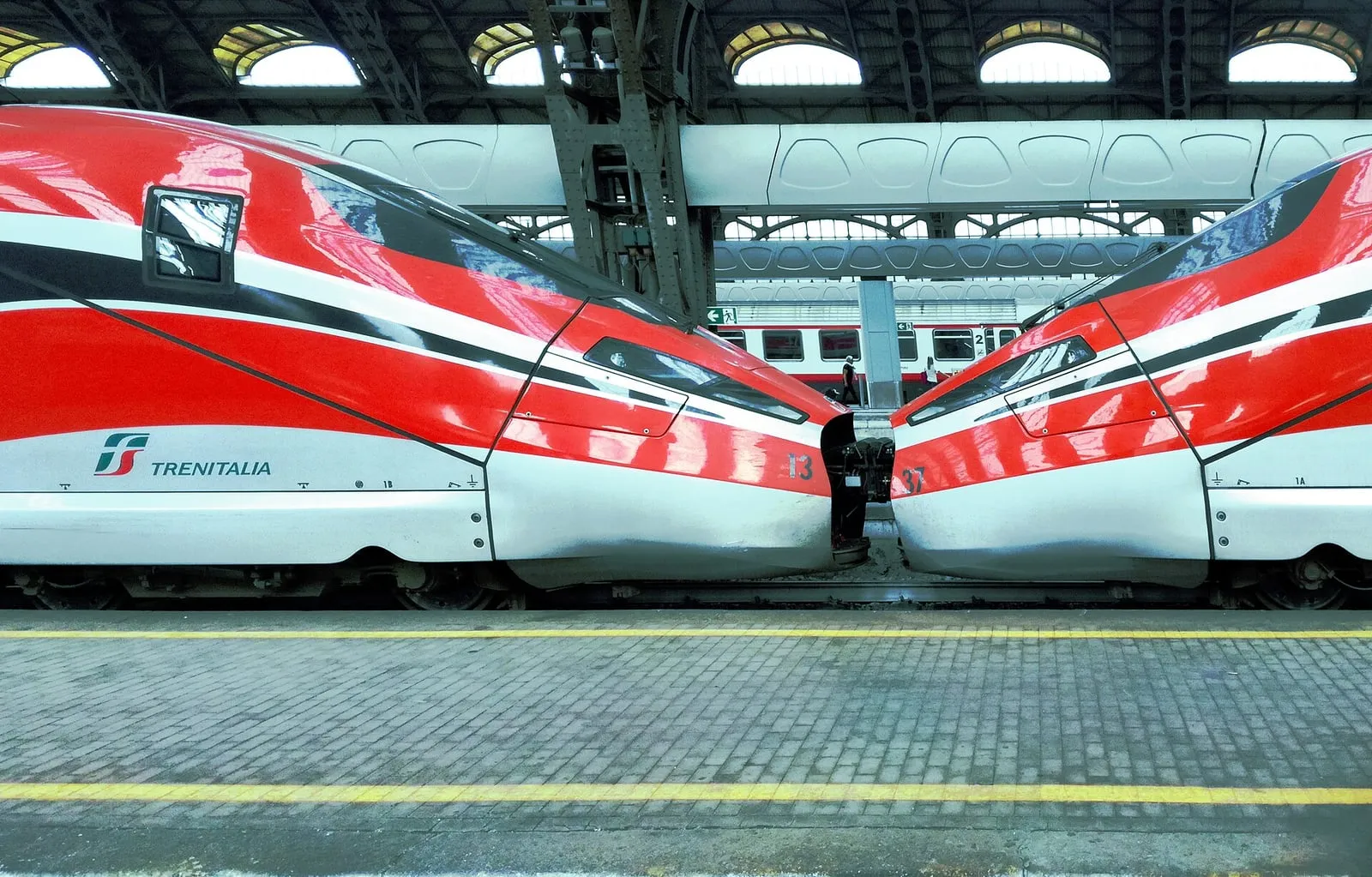
Italy’s high-speed spine is Europe’s cleanest first-time rail trip. Two rival operators — state-owned Trenitalia (Frecciarossa) and private Italo — run frequent city-centre services along dedicated 300 km/h tracks with no station X-ray security checks.
- Rome to Florence: 1 hour 36 minutes on most non-stop Frecciarossa trains from Roma Termini to Firenze Santa Maria Novella, running roughly every half hour in the morning, with advance fares from €23.90 each way at trenitalia.com. See Rome vs Florence and our Florence day trip from Rome.
- Florence to Venice: 2 hours 13 minutes direct from Firenze Santa Maria Novella to Venezia Santa Lucia — the station that opens directly onto the Grand Canal. Do not alight at Venezia Mestre unless your hotel is on the mainland. See Venice vs Florence.
- Rome to Venice direct (if skipping Florence): 3 hours 51 minutes to 3 hours 56 minutes on direct Frecciarossa trains passing through Florence and Bologna. See Rome vs Venice.
Smart pacing & closure rule: Spend 3–4 nights in Rome (3 days in Rome), 2–3 nights in Florence (3 days in Florence) and 2–3 nights in Venice (3 days in Venice). Move from Rome to Florence on a Monday: the Vatican Museums are open on Monday mornings while Florence’s Uffizi, Accademia, Palazzo Pitti and Bargello are all shut.
2. Paris – Brussels – Bruges – Amsterdam (7 to 10 days)
Former Thalys trains now run under the Eurostar brand, linking Paris, Brussels and Amsterdam on a single seamless continental high-speed corridor — with no passport control or airport-style security (unlike London Eurostar services).
- Paris to Brussels: 1 hour 22 minutes to 1 hour 30 minutes direct from Paris Gare du Nord to Brussels-Midi (Bruxelles-Midi/Zuid) on Eurostar, with Standard advance fares starting from €29 one way when booked 2–4 months ahead.
- Brussels to Bruges: 56 to 59 minutes on frequent SNCB InterCity trains from Brussels-Midi (three an hour, continuing toward Ostend/Knokke). Get off at Brugge, not Brugge-Sint-Pieters. Flat-fare domestic tickets need no advance reservation. See getting to Bruges and Bruges vs Brussels.
- Brussels to Amsterdam: 1 hour 50 minutes to 1 hour 58 minutes direct from Brussels-Midi to Amsterdam Centraal on Eurostar (from €29 advance), or slightly slower EuroCity Direct services for budget flexibility.
Smart pacing: Pair 3–4 nights in Paris (3-day Paris itinerary), 1–2 nights in Brussels (3 days in Brussels) or Bruges (2 or 3 days in Bruges), and 3 nights in Amsterdam (3 days in Amsterdam). Book the Anne Frank House exactly six weeks ahead on Tuesday at 10:00 Dutch time before locking in your Amsterdam hotel nights.
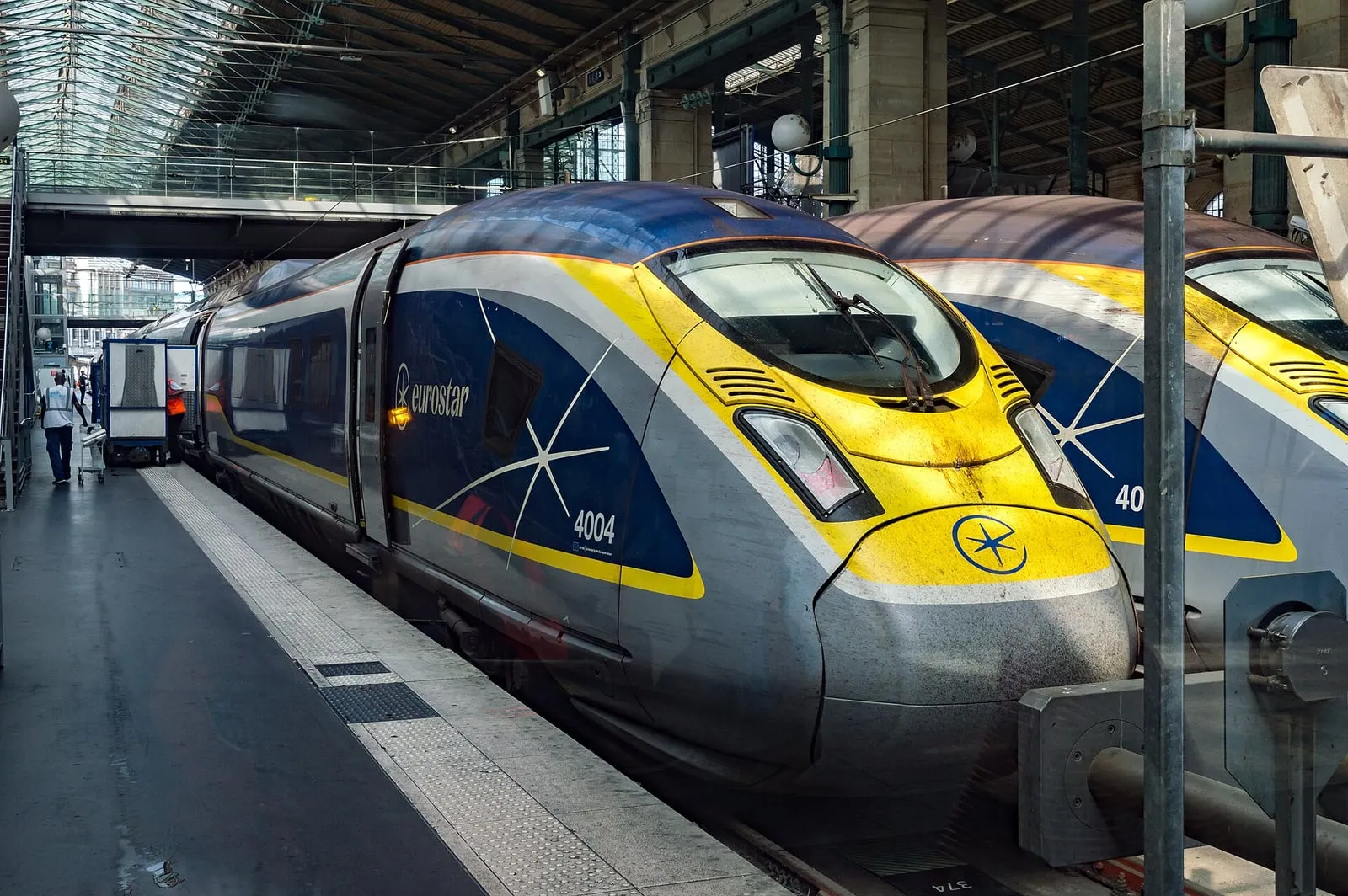
Eurostar at Paris Gare du Nord. Photo: RAIL P (RAIL.PHOTOGRAPHY), Wikimedia Commons, CC0 1.0.
3. Vienna – Bratislava – Budapest – Prague (8 to 11 days)
Central Europe’s imperial capitals sit on one of Europe’s best-value rail networks, where competition between ÖBB/ČD Railjet and bright-yellow private operator RegioJet keeps advance fares low even on international routes.
- Vienna to Bratislava: 56 minutes on the hourly ÖBB REX 8 from Wien Hauptbahnhof (departing at :14) to Bratislava hlavná stanica. Alternatively, RegioJet buses take 1h 30m for €4.90–€5.90, or the Twin City Liner river boat takes 1h 15m for €34–€39 plus fuel surcharge. See Vienna to Bratislava and Bratislava vs Vienna.
- Vienna to Budapest: 2 hours 24 minutes to 2 hours 31 minutes on RegioJet (four trains daily from Wien Hbf to Budapest-Kelenföld, €9 to €39.90 one way, seat reservation included), or 2 hours 39 minutes to 2 hours 58 minutes on the hourly ÖBB Railjet / EuroCity to Budapest-Keleti. See Vienna to Budapest.
- Vienna to Prague: 3 hours 56 minutes to 4 hours 20 minutes direct from Wien Hauptbahnhof to Praha hlavní nádraží on ÖBB/ČD Railjet/ComfortJet (every two hours, Sparschiene from €14.90) or RegioJet (up to four times daily, refundable up to 15 minutes before departure). Walk-up ÖBB fares climb to €60–€88, so book early.
Station & border tips: Carry your passport or EU national ID card — Austria maintains border controls on its Slovak and Hungarian borders until at least 15 March 2027. Note that Prague, Vienna and Budapest use three different currencies (CZK, EUR, HUF): see cards, cash and tipping. Plan 3 nights in Vienna (3 days in Vienna), a day trip or 1 night in Bratislava (3 days in Bratislava), 3 nights in Budapest (3 days in Budapest) and 3 nights in Prague (3 days in Prague). Compare the northern and southern anchors in Prague vs Budapest.
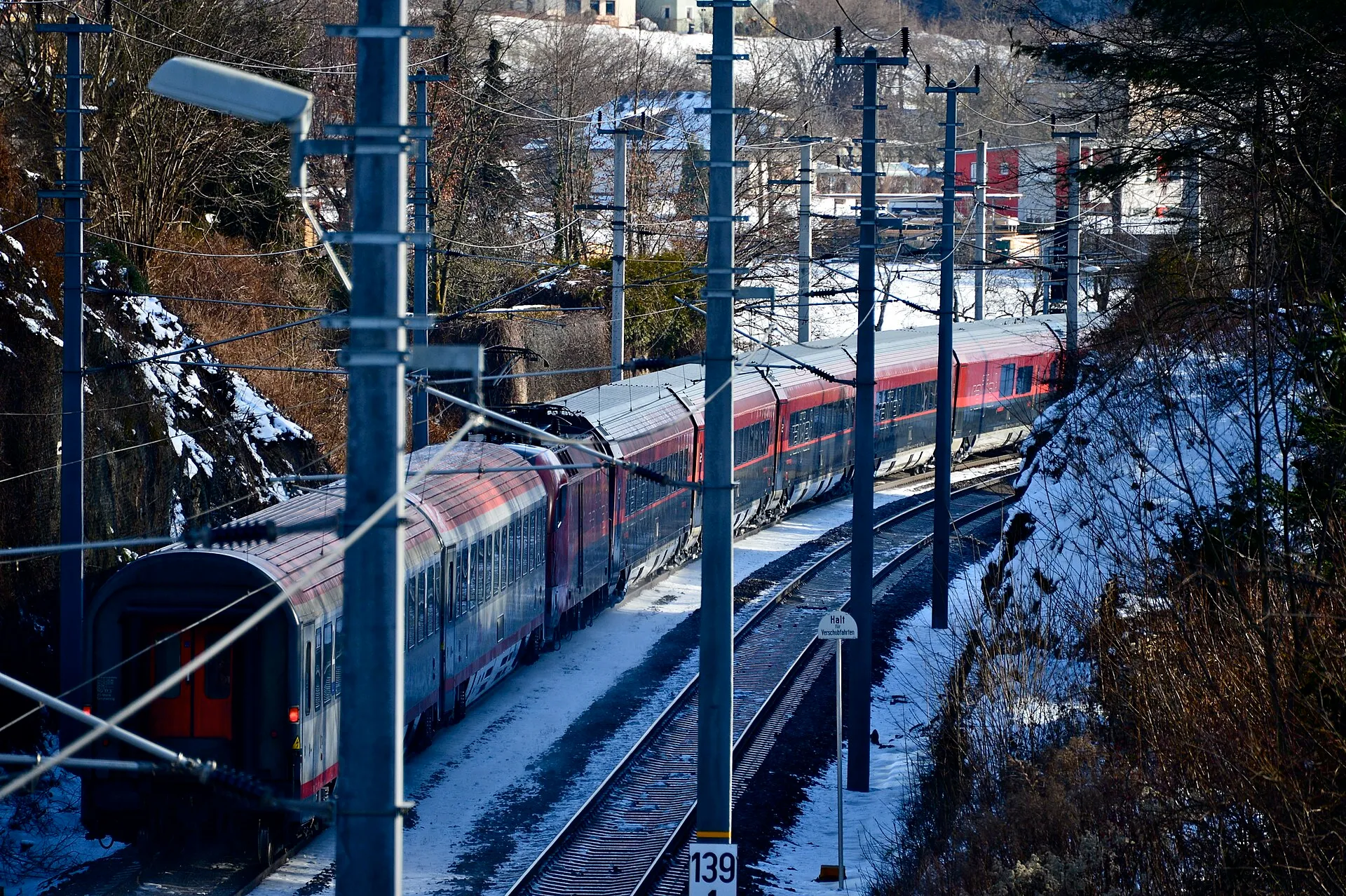
An ÖBB Railjet train in Carinthia, Austria. Photo: Johann Jaritz, Wikimedia Commons, CC BY-SA 4.0.
4. Barcelona – Madrid – Seville – Granada (9 to 12 days)
Spain has Europe’s largest high-speed rail network and fierce four-way competition (Renfe AVE, low-cost Avlo, Italian-backed Iryo and French low-cost Ouigo) on its main corridors.
- Barcelona to Madrid: 2 hours 30 minutes on the fastest non-stop trains between Barcelona-Sants and Madrid Puerta de Atocha (some low-cost services use Chamartín). Ouigo sells advance fares from €19 each way; Iryo and Avlo also undercut legacy AVE prices. See Barcelona vs Madrid.
- Madrid to Seville: 2 hours 37 minutes to 2 hours 50 minutes from Madrid Atocha to Seville Santa Justa across AVE (from €20 advance), Iryo (from €18), Ouigo (from €9) and Avlo (from €7). Check luggage allowances on Avlo and Ouigo — base fares include only a small bag, with cabin trolleys charged extra.
- Seville to Granada: 2 hours 38 minutes to 2 hours 52 minutes on four direct Renfe Avant trains daily in each direction between Seville Santa Justa and Granada. See Seville day trip from Granada and Granada and the Alhambra from Seville.
Station & booking tips: Arrive at Spanish high-speed stations 20 to 30 minutes before departure for mandatory X-ray luggage screening before the platform gates. Book your Alhambra ticket (€22.27) before booking the Seville–Granada train so your arrival aligns with your fixed 30-minute Nasrid Palaces slot. Allocate 3 nights in Barcelona (3-day Barcelona itinerary), 2–3 nights in Madrid, 2–3 nights in Seville and 2 nights in Granada (3 days in Granada).
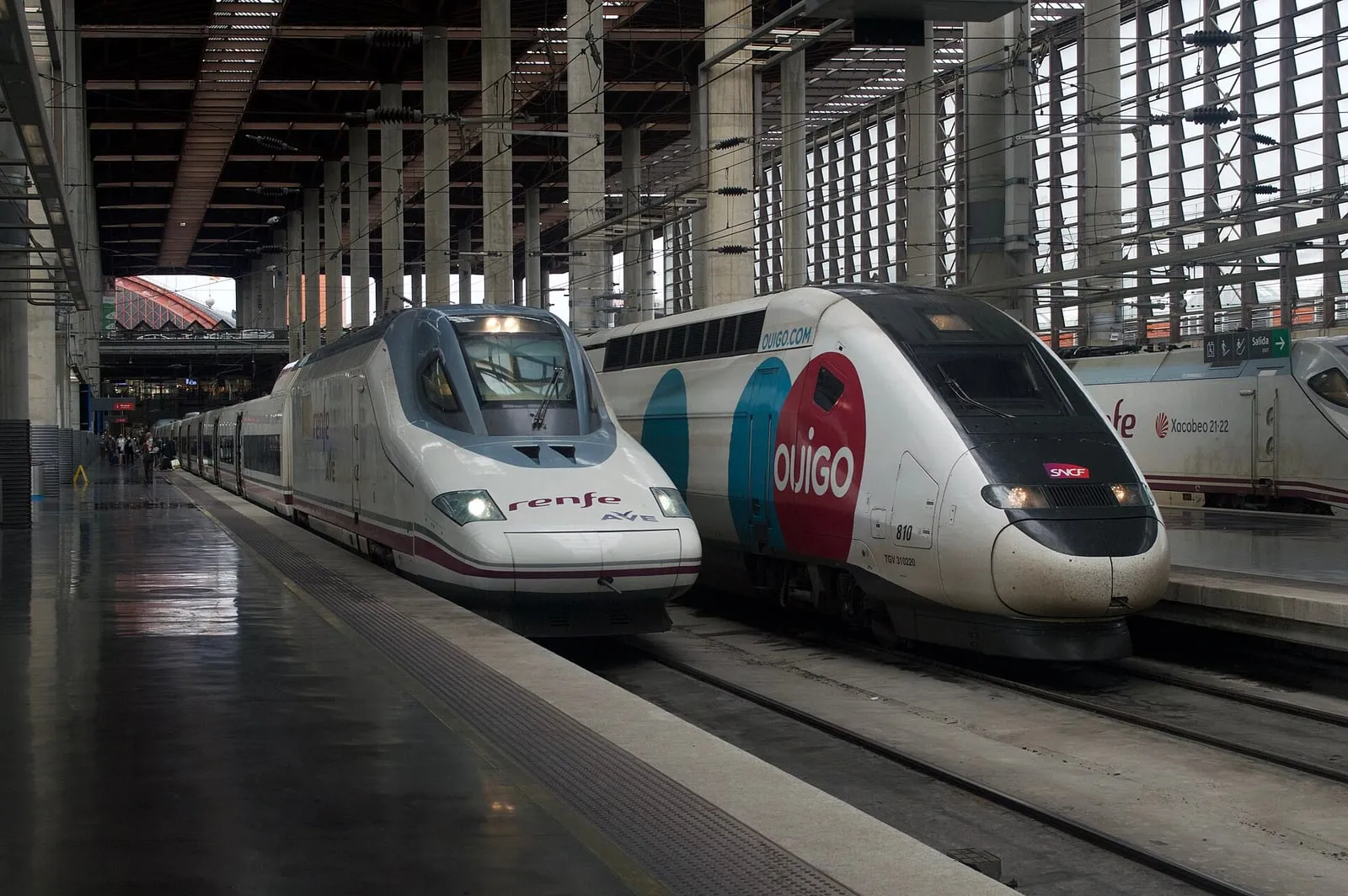
High-speed AVE trains at Madrid Atocha. Photo: Phil Richards, Wikimedia Commons, CC BY-SA 2.0.
5. Lisbon – Porto (5 to 7 days)
Portugal’s north-south Atlantic spine is a single straightforward rail link operated by Comboios de Portugal (CP).
- Lisbon to Porto: 2 hours 39 minutes on the fastest tilting Alfa Pendular from Lisboa Oriente (or ~2h 48m from Santa Apolónia) to Porto Campanhã. Standard return fare is €64.50 (cheaper Promo tickets open weeks ahead at cp.pt); slower Intercidades trains take ~3h 15m for less.
- Station transfer tip: Your CP long-distance ticket includes a free 4-minute urban train connection from Porto Campanhã straight into historic Porto São Bento in the city centre — do not buy a separate metro ticket or pay for a taxi unnecessarily.
Smart pacing: As our Porto from Lisbon day trip guide notes, five hours on trains makes a same-day return rushed; split 3–4 nights in Lisbon (3 days in Lisbon, including a 40-minute suburban train to Sintra) and 2–3 nights in Porto (Porto in 2 days). Compare both cities in Lisbon vs Porto.
6. Munich – Salzburg – Vienna (6 to 8 days)
This Alpine-to-Danube trio pairs Bavaria’s beer halls and castles with Mozart’s baroque old town and Vienna’s Habsburg palaces.
- Munich to Salzburg: 1 hour 43 minutes to 1 hour 58 minutes on direct ÖBB Railjet / ICE / EuroCity trains (or 1 hour 49 minutes on WESTbahn) from München Hauptbahnhof to Salzburg Hauptbahnhof. Budget alternative: the hourly regional RE5 takes 1 hour 55 minutes to 2 hours 8 minutes and is fully covered by the €34 Bayern-Ticket (which covers regional trains across Bavaria and into Salzburg, valid for up to five people on a sliding scale). See Salzburg from Munich.
- Salzburg to Vienna: 2 hours 25 minutes on the hourly ÖBB Railjet Xpress (departing :28) into Wien Hauptbahnhof (€67.70 walk-up; far cheaper on Sparschiene advance tickets), or 2 hours 30 minutes on WESTbahn into Wien Westbahnhof (note the different Vienna arrival station). See Salzburg from Vienna.
Smart pacing: Spend 3 nights in Munich (3 days in Munich), 1–2 nights in Salzburg (3 days in Salzburg — remember overnight guests get free local transit on the Guest Mobility Ticket) and 3 nights in Vienna.
7. Kraków – Warsaw (5 to 6 days)
Poland’s two contrasting cities — medieval royal capital vs rebuilt 20th-century metropolis — sit just over two hours apart on Poland’s flagship tilting train.
- Kraków to Warsaw: 2 hours 15 minutes on PKP Intercity’s Pendolino (EIP) between Kraków Główny and Warszawa Centralna. Book 30 days ahead at intercity.pl for Super Promo tiers; seat reservations are compulsory on EIP services.
Smart pacing: Spend 3 nights in Kraków (3 days in Kraków, allowing a full day for Auschwitz-Birkenau or Wieliczka Salt Mine) and 2–3 nights in Warsaw (3 days in Warsaw). Read Kraków vs Warsaw to decide how to split your nights.
8. Stockholm – Copenhagen (6 to 7 days)
Scandinavia’s two grandest waterfront capitals are linked across the Øresund Bridge, trading Sweden’s archipelago for Denmark’s royal palaces and harbour swims.
- Stockholm to Copenhagen: 5 hours 30 minutes to 5 hours 45 minutes between Stockholm Central and København H on SJ high-speed trains (direct X2000 when rostered, or a smooth timed transfer onto an Öresundståg regional train at Malmö Central). Advance non-flexible tickets at sj.se open roughly 90 days ahead from SEK 250 to SEK 350 (rising to SEK 500–950+ close to departure).
Smart pacing: Spend 3 nights in Stockholm (3 days in Stockholm) and 3 nights in Copenhagen (3 days in Copenhagen). Compare costs, daylight hours and airport links across the region in Scandinavian city breaks compared.
Practical checklist for multi-city rail trips
- Book direct with the national or private operator (Trenitalia, Italo, Eurostar, ÖBB, ČD, RegioJet, Renfe, Iryo, Ouigo, CP, PKP Intercity, SJ) to avoid reseller booking fees and get instant delay alerts.
- Use travel days to dodge closed museums. Ride between Rome and Florence on a Monday, or leave Paris on a Tuesday morning (when the Louvre is shut).
- Check whether a city pass makes sense for short stops. On a 2-night stop in a multi-city itinerary, a 72-hour pass is wasted — check exact break-even thresholds in European city passes compared and official tickets vs guided tours.
- Keep mobile tickets and live timetables working across borders without daily roaming fees using eSIMs for Europe.
Common questions
When is taking the train faster than flying between European cities?
On almost any city-centre rail journey under four hours. Once you add airport transfers (30–60 minutes each end), security screening and boarding cut-offs, a 2.5- to 4-hour train such as Rome to Venice (3h 51m), Barcelona to Madrid (2h 30m) or Vienna to Prague (4h) beats flying door to door with zero baggage fees.
How far in advance should I book European high-speed trains?
Book 60 to 120 days ahead for dynamic-pricing operators such as Eurostar (from €29), Trenitalia Frecciarossa (Rome–Florence from €23.90), Renfe/Ouigo/Iryo (Barcelona–Madrid from €19, Madrid–Seville from €9–€20), ÖBB Sparschiene (Vienna–Prague from €14.90) and SJ (Stockholm–Copenhagen from SEK 250). Regional flat-fare tickets such as Bavaria's €34 Bayern-Ticket and Brussels–Bruges SNCB tickets do not require advance booking.
Do I need to go through security checks for European trains?
Only on a few corridors. Spanish high-speed trains (AVE, Avlo, Iryo, Ouigo) run a quick X-ray bag scan before platform access, so arrive 20–30 minutes early at Madrid Atocha or Barcelona-Sants. Eurostar to or from London requires passport control and security, whereas continental Eurostar trains between Paris, Brussels and Amsterdam have no passport control — just board before doors close. Italy, Austria, Germany, Poland and Sweden have open platforms with no bag X-ray.
Are there border checks on Schengen trains in 2026–2027?
Yes on selected internal borders. Austria operates temporary border controls on its Slovak and Hungarian borders (until at least 15 March 2027) and Germany checks trains arriving from Austria at Salzburg/Freilassing, so always carry your passport or national ID card on cross-border trains.
Is a Eurail or Interrail pass cheaper than point-to-point tickets on these routes?
Rarely for a two- or three-city trip booked ahead. Point-to-point advance fares on routes like Barcelona–Madrid (€19), Rome–Florence (€23.90), Vienna–Budapest (€9–€39.90) and Paris–Brussels (€29) usually cost less than a rail pass plus mandatory high-speed seat reservation fees. A pass starts to pay off only on last-minute, flexible multi-country itineraries.