In this guide
💡 The Short Version: Pay by contactless card or phone, and keep a little cash for markets, small bars, tips and some taxis. If a card terminal or cash machine offers to charge you in your own currency, decline and pay in the local one, so your bank does the conversion: the offer is called dynamic currency conversion. A cash machine shows its fee before it pays out: read it, and use a machine at a bank branch where you can. Budapest, Edinburgh, Istanbul, Krakow, Marrakech and Prague are outside the euro, and the Marrakech dirham cannot easily be exchanged outside Morocco. Tipping is small and optional almost everywhere: service is already in the price in France and Portugal, Budapest restaurants often print 15%, and Istanbul restaurants may no longer add one. In Italy read the menu for the coperto, and in Portugal the couvert. Entry rules and phone data are in the other planning guides.
Cards and cash
Cards and phones are the default in every city. What differs is how much cash is still used and where a card will not do.
- Across the euro area, cash was used for 52% of shop payments in 2024 and was the most-used method, especially for small amounts (European Central Bank). Keep notes and coins for small purchases.
- Netherlands. Cards paid for 83% of shop payments in 2025 and cash for 17% (De Nederlandsche Bank), although 96% of shops still accepted cash (Dutch Payments Association). Some venues take cards only: the Amsterdam restaurant guide says which.
- Germany. Cash was still the most-used way to pay in 2025, at 45% of payments, and shops took cards for 86% of in-person purchases (Bundesbank). See the Berlin restaurant guide.
- Spain. Visa and Mastercard are the most widely accepted cards, American Express and Diners far less, and some shops set a minimum of €5 to €10 for a card payment (Madrid tourist office). Spain’s national tourist board puts the minimum at around €10 (spain.info).
- Greece. Major cards are widely accepted, but some places do not take American Express or Diners (Athens tourist board).
- Budapest, Prague and Krakow. Cards work almost everywhere, but markets and small shops in Budapest are better with cash (Budapest Info). Czechia’s tourist board says contactless and Apple Pay and Google Pay are widely accepted (VisitCzechia), and a Krakow guide says almost anything can be paid for by contactless card (Visit Krakow).
- Istanbul. Most services take credit cards, but some taxis do not accept foreign ones (Smartraveller). Istanbul public transport takes no cash.
- Marrakech. Visa and Mastercard are accepted by most hotels and some restaurants, shops and petrol stations (Moroccan National Tourist Office). Taxis, the souks, small cafés and porters take cash: see Marrakech.
- Transport. A contactless bank card does not open the gates on the Paris metro. Boats in Venice sell tickets by card or phone only, and Dublin Bus takes coins only, with no change. Edinburgh, Lisbon, Madrid and Rome take a contactless card.
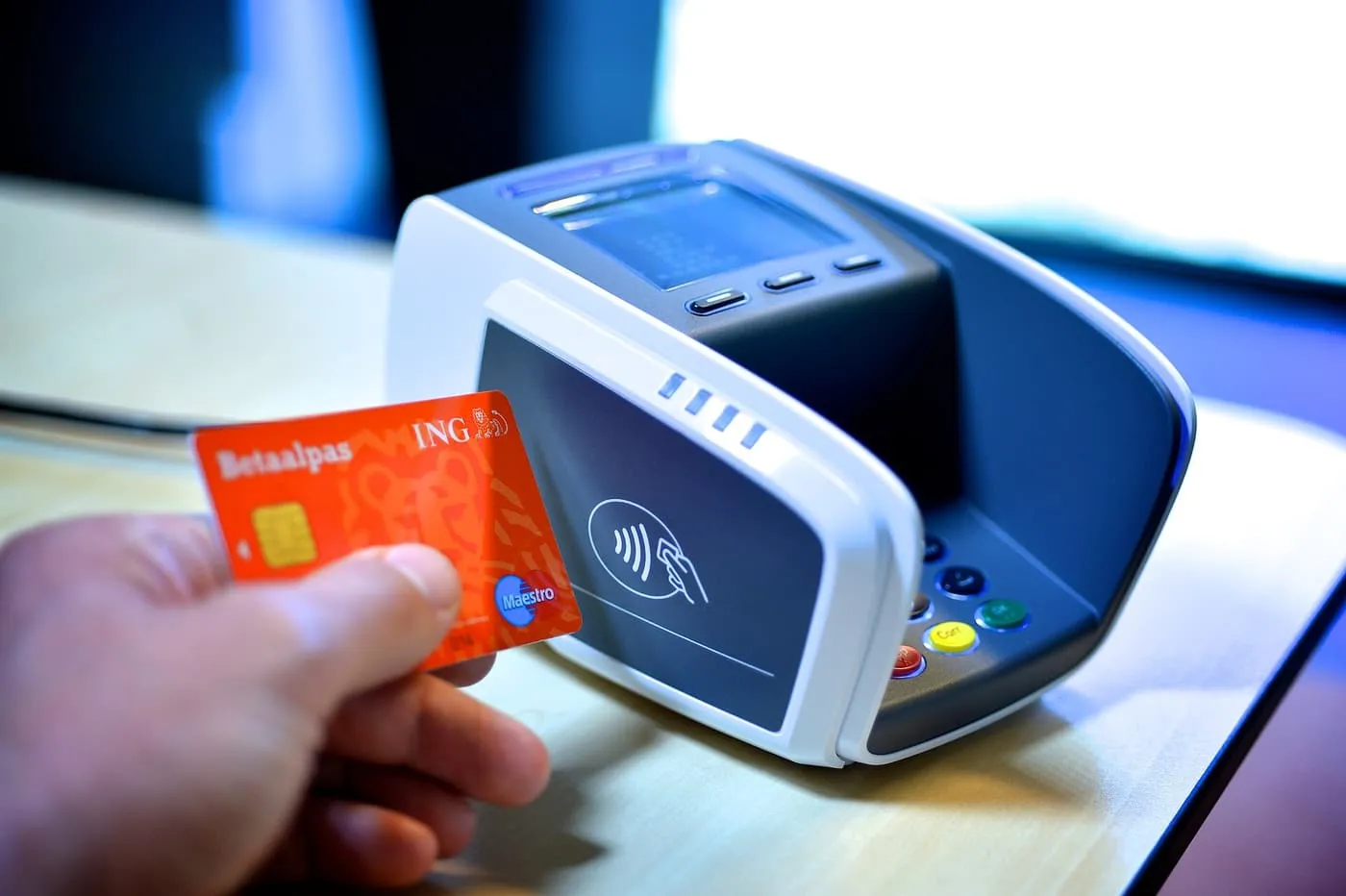
A Dutch debit card held to a contactless terminal. Photo: ING Nederland, Wikimedia Commons, CC BY-SA 2.0.
Pay in the local currency
A terminal or cash machine abroad may show two totals, one in the local currency and one in yours, and ask you to pick. Pick the local currency every time. The other option is dynamic currency conversion: the shop or machine’s operator does the conversion, at a rate with a mark-up built in, instead of your bank.
In the EU, a terminal or machine that offers conversion must show the total charge as a percentage mark-up over the European Central Bank’s rate before you agree, and must tell you that you can pay in the local currency and have your own bank convert it (Regulation (EU) 2021/1230, Article 4). Madrid’s tourist office gives the same advice: pay in euros, and the conversion is done by your bank or card provider (Madrid tourist office). The choice appears in Edinburgh, Istanbul and Marrakech too, so make it there as well.
Cash machines
Two charges apply to a withdrawal: the machine owner’s fee, and your own bank’s foreign fee.
- The machine’s fee is shown before the cash comes out. An independent operator, one that is not your bank, must tell you any withdrawal charge before you withdraw and again on the receipt (Directive (EU) 2015/2366, Article 3(o)). If the figure is high, cancel.
- Bank-owned machines sit at branches, which is where Spain’s tourist board says cash is usually withdrawn (spain.info). Standalone machines are where the fees are: Athens’s tourist board says its machines charge about €2 to €3 a withdrawal, and a Krakow guide calls the Euronet network the one real problem with Polish money (Visit Krakow).
- Your bank’s fee is not shown on the machine. Ask your bank what it charges for foreign withdrawals (Madrid tourist office).
- Istanbul. Smartraveller advises ATMs in banks, shops and shopping centres, not on the street at night (Smartraveller).
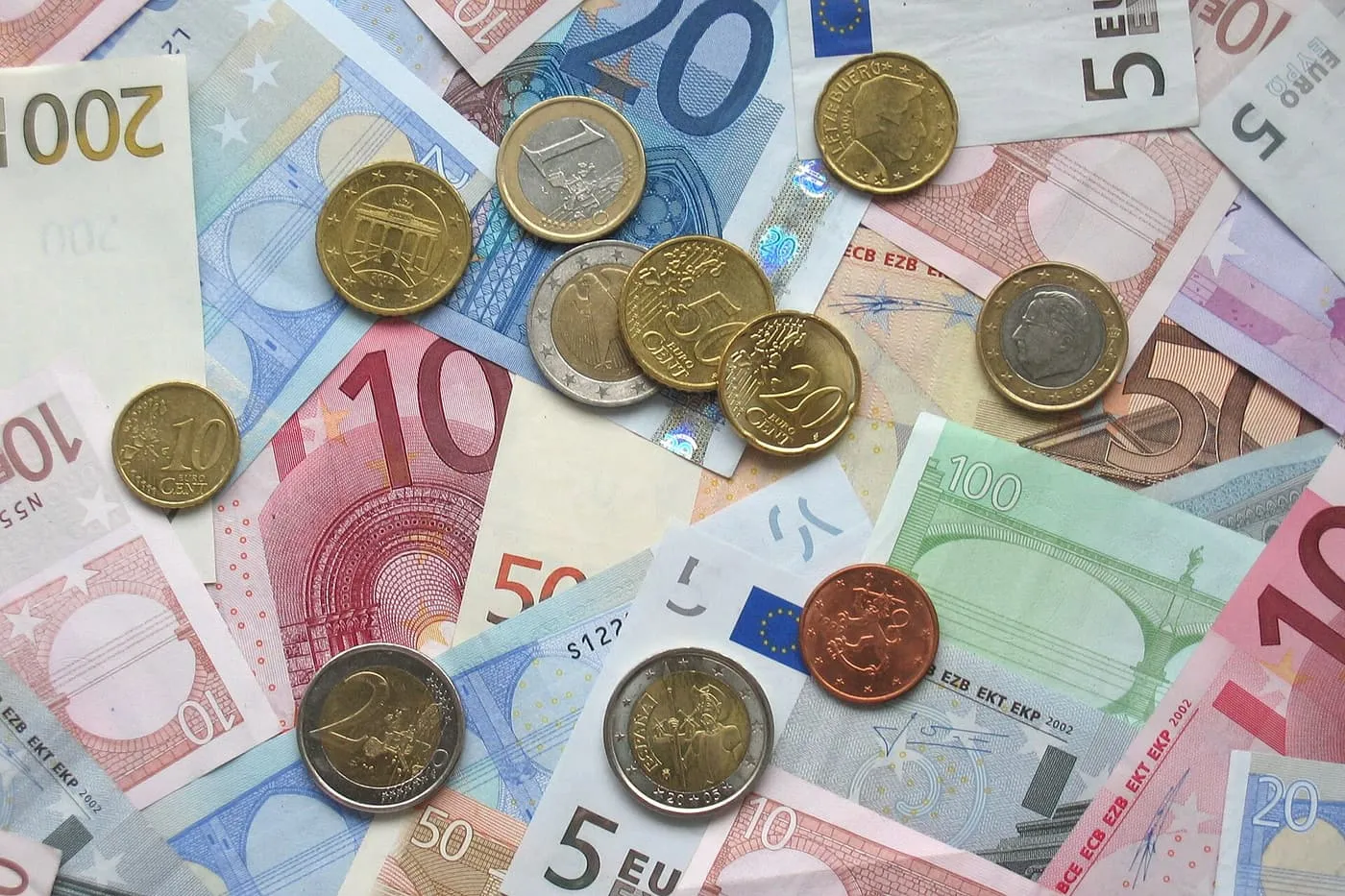
Euro coins scattered on euro banknotes. Photo: Avij, Wikimedia Commons.
Cities outside the euro
- Budapest: forint (HUF). Budapest Info advises changing money at a bank or an official exchange bureau, after checking the Hungarian National Bank’s rate.
- Prague: koruna (CZK).
- Krakow: złoty (PLN). Visit Krakow warns against the exchange booths near the train station and in the Old Town (Visit Krakow).
- Edinburgh: pound sterling (GBP). A day trip from Dublin to Northern Ireland also moves to sterling: Tourism Ireland says pound sterling is its currency (Ireland.com). See the Belfast day trip.
- Istanbul: lira (TRY).
- Marrakech: dirham (MAD). The dirham is a closed currency that cannot easily be exchanged outside Morocco, so take cash from a cash machine on arrival (UK government). Australian dollars cannot be exchanged in Morocco at all (Smartraveller).
Tipping and service charges
A service charge is a line the restaurant adds to the bill; a tip is what you choose to leave. Read the bill for the first before you add the second.
| Where | What to leave |
|---|---|
| France (Paris) | Service is in the price. Paris je t’aime says 5% to 10% extra is the guide for good service (Paris je t’aime); France’s national tourist board says 2% to 3% or the small change (France.fr) |
| Portugal (Lisbon) | Service is included, and 5% to 10% extra is customary. Taxis: round up or 5% to 10% (Visit Portugal) |
| Spain (Madrid, Barcelona, Seville) | Not obligatory. The national tourist board gives 5% to 10% as usual in bars and restaurants (spain.info); Madrid’s tourist office says tipping is not customary (Madrid tourist office) |
| Italy (Rome, Florence, Venice) | Not compulsory, with no fixed rule; about 10% when you are happy with the service (Italia.it) |
| Germany (Berlin) | Round up, or 5% to 10% at a table. Say the total you want to pay, tip included, rather than leaving money on the table, and tip in cash if you can (Berlin.de) |
| Austria (Vienna) | About 10% in restaurants and coffee houses, 5% on a very large bill. It can be added when you pay by card (Vienna Tourist Board) |
| Netherlands (Amsterdam) | No rule. A modest 5% to 10% of the bill is customary (I amsterdam) |
| Greece (Athens) | No service charge is added at bars and restaurants, so tip: 5% to 15% is the norm (Athens tourist board) |
| Ireland (Dublin) | 10% is the minimum and 12.5% the accepted norm, in cash if you can; some restaurants add a service charge of 12.5% (The Irish Times) |
| UK (Edinburgh) | There is no big tipping culture, but 10% in restaurants and taxis for good service is the rule of thumb (VisitScotland) |
| Hungary (Budapest) | Several restaurants print a service charge of 15% on the bill, so check before tipping on top: see the Budapest restaurant guide |
| Czechia (Prague) | Tips up to 10% are customary (VisitCzechia), and some restaurants add a service charge: see the Prague restaurant guide |
| Poland (Krakow) | About 10% in bars, cafés and restaurants when service is good. A tip added to a card payment may not go through, so hand cash to the server (Visit Krakow) |
| Turkey (Istanbul) | Since 30 January 2026 restaurants, cafés and pastry shops cannot charge a service, cover or table fee under the Trade Ministry’s price-label regulation; a tip stays voluntary (Bloomberg HT) |
| Morocco (Marrakech) | A tip of 10 to 20 MAD for a riad porter is usual, and tour operators suggest 20 to 50 MAD a person for a day with a group guide: see Marrakech and the medina tours |
A card terminal may suggest a much higher percentage and has a button for no tip, as the Berlin restaurant guide notes.
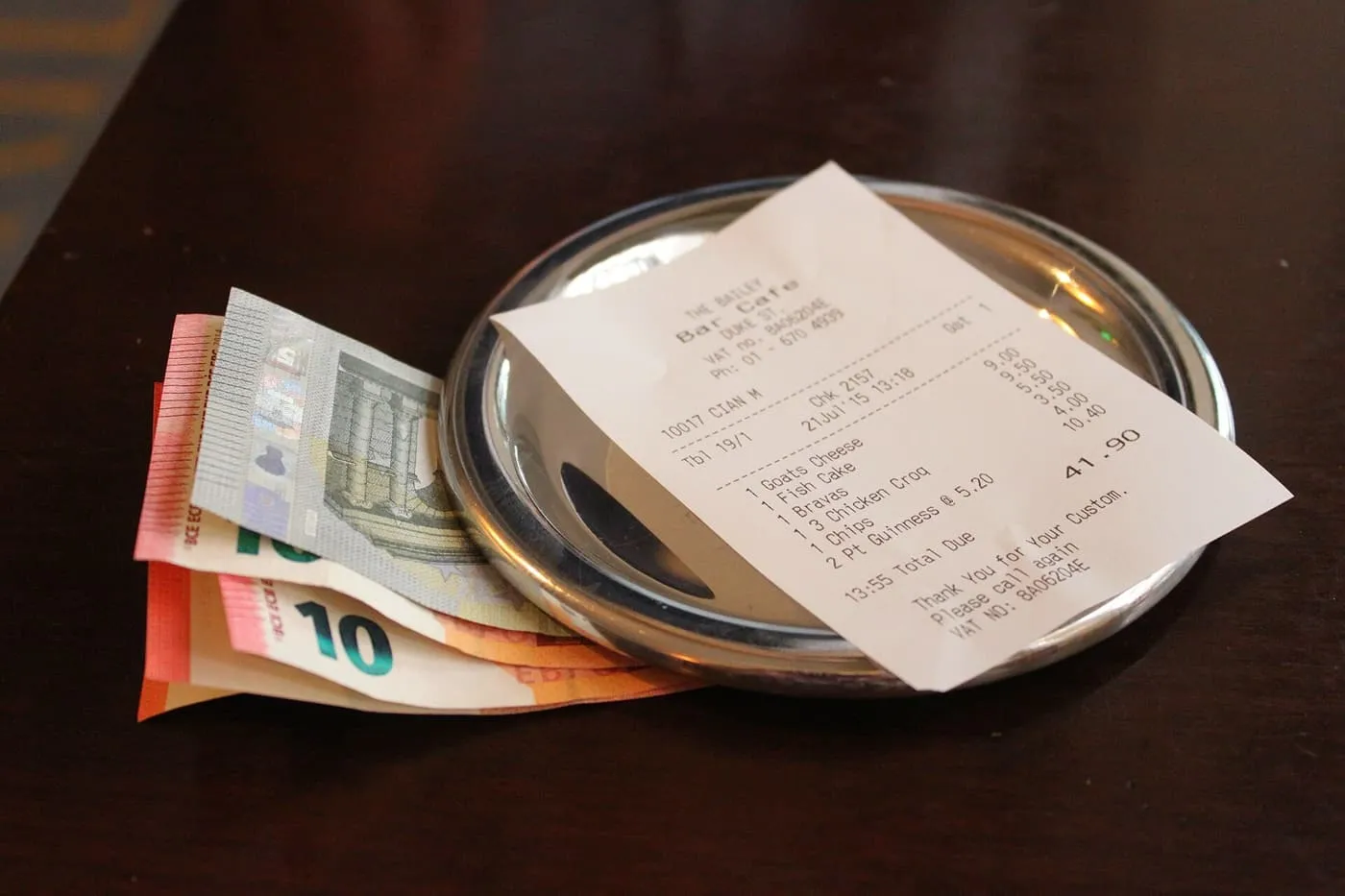
A bar bill and euro notes on a tray. Photo: Benreis, Wikimedia Commons, CC BY 3.0.
Cover charges: the coperto and the couvert
- Italy: the coperto. A per-person charge for the table and bread. No national law bans it, but it must be on the price list, under article 18 of a 1940 royal decree (Unione Nazionale Consumatori). Rome and the rest of Lazio are the exception: regional law no. 21 of 2006 forbids a cover charge, while allowing a separate service line if the menu shows it (same source). In Venice and Florence, read the menu before you sit.
- Portugal: the couvert. The bread, butter and olives put on the table before the meal. The price list must say that no dish, food or drink, the couvert included, can be charged if you did not ask for it or did not touch it, so tell the waiter to take it away if you do not want it (DECO PROteste). Eat it and you pay for it.
- Spain. Some restaurants charge €2 or €3 for bread or a small tapa. They must tell you, and you can refuse it (Madrid tourist office).
- Turkey. The kuver cover charge has been banned since 30 January 2026, as above.
Cards, cash and tipping in each city
The table gives each city’s currency and a line on cards, cash and tipping; the city name links to its guides.
The other planning guides cover EES and ETIAS, the Schengen 90/180-day rule, eSIMs for Europe and where to go each month.
| City | Currency | Cards | Cash | Tipping |
|---|---|---|---|---|
| Amsterdam | Euro (EUR) | Cards and phones: 83% of Dutch shop payments in 2025 | Taken at 96% of shops; some venues are card-only | Not required; 5–10% of the bill is customary |
| Athens | Euro (EUR) | Major cards widely accepted; metro takes Visa and Mastercard only | ATMs charge about €2–3 a withdrawal | 5–15%; no service charge is added at bars and restaurants |
| Barcelona | Euro (EUR) | Visa and Mastercard widely used; some shops set a minimum | Accepted almost everywhere; euros only | Not obligatory; 5–10% is usual in restaurants |
| Berlin | Euro (EUR) | Widely taken, but not at every market stall | Carry some for markets and to tip at a table | Round up, or 5–10% at a table |
| Budapest | Hungarian forint (HUF) | Accepted almost everywhere; tap a card at the metro gates | Carry some forint for markets and small shops | A 15% service charge is often added; check the bill |
| Dublin | Euro (EUR) | Visa and Mastercard widely accepted; Amex in some places | Dublin Bus drivers take coins only and give no change | 10–12.5% in restaurants unless a service charge is added |
| Edinburgh | Pound sterling (GBP) | Contactless works on buses and trams, with daily capping | Bus cash fares are exact change only | About 10% in restaurants and taxis for good service |
| Florence | Euro (EUR) | Visa, Mastercard and Amex; tap a card on buses and trams | Euro-area average: cash is 52% of shop payments | Optional, about 10%; check the menu for coperto |
| Istanbul | Turkish lira (TRY) | Most services take cards; some taxis refuse foreign cards | No cash on buses, trams, metro or ferries | Voluntary: restaurants cannot add service or cover charges |
| Kraków | Polish złoty (PLN) | Contactless debit or credit card works almost everywhere | Euronet cash machines are best avoided | About 10% for good service; cash is easier than card |
| Lisbon | Euro (EUR) | Major cards widely used; tap in at Metro gates | Historic trams take cash; modern trams do not | Service is included; 5–10% extra is customary |
| Madrid | Euro (EUR) | Nearly all shops; contactless at Metro gates for single tickets | Useful under the €5–10 minimum some shops set for cards | Optional, not customary; a little extra for good service |
| Marrakech | Moroccan dirham (MAD) | Most hotels; some restaurants, shops and petrol stations | Needed for taxis, souks, small cafés and porters | 10–20 MAD for a riad porter; 20–50 MAD a day for a guide |
| Paris | Euro (EUR) | Widely used, but a bank card does not open metro gates | Virtually all ATMs take Visa and Mastercard | Service is in the price; small change or 5–10% is optional |
| Porto | Euro (EUR) | Cards and MB Way widely used; the historic trams take only these | Buses take cash for the €2.50 single; the trams take none | Service is included; 5–10% extra is customary |
| Prague | Czech koruna (CZK) | Widely accepted, including contactless; trams sell tickets by card | The metro has no card terminal | Customary up to 10%; some restaurants add a service charge |
| Rome | Euro (EUR) | Visa, Mastercard and Amex; tap a card on buses and metro | Most ticket offices take cash or card; Trevi entry is card-only | Optional, about 10%; a cover charge is banned in Lazio |
| Seville | Euro (EUR) | Major cards widely used; some shops want about €10 minimum | Taken almost everywhere, usually in euros only | Not obligatory; 5–10% is usual in bars and restaurants |
| Venice | Euro (EUR) | Cards widely accepted; boats sell tickets by card or phone | Not accepted on board water buses | Optional, about 10%; the coperto is printed on the menu |
| Vienna | Euro (EUR) | Tap a card on public transport (pilot from 28 May 2026) | Taxis take both cash and cards | About 10% in restaurants and coffee houses; 5% on big bills |
Common questions
Should I pay in the local currency or in my own?
In the local currency. When a card terminal or cash machine offers to charge you in your own currency, that is dynamic currency conversion: the shop or machine's operator does the conversion and adds a mark-up. Choosing the local currency leaves the conversion to your own bank. In the EU the terminal must show the mark-up as a percentage over the European Central Bank's rate and tell you that you can pay in the local currency.
Do I need cash in European cities?
A little. Cards and phones are accepted in most shops, restaurants and on most transport, but cash was used for 52% of shop payments across the euro area in 2024 and is the usual way to pay small amounts. Markets, small shops, some taxis and tips are where it is still needed, and Marrakech runs on it. Istanbul transport takes no cash at all.
Which cash machines should I use?
One at a bank branch where you can. Every cash machine shows its own fee before it pays out, and an independent operator must tell you any withdrawal charge before you withdraw. Athens's tourist board says its machines charge about €2 to €3 a withdrawal, and a Krakow guide says to avoid the Euronet network. Your own bank's foreign fee is not shown on the machine, so look it up before you go.
How much should I tip in a European restaurant?
It depends on the country and is small almost everywhere. Service is already in the price in France and Portugal. Italy, Spain, Germany, Austria and the Netherlands run from rounding up to about 10%. Greece and Ireland expect more, 5% to 15% and 10% to 12.5%. Check the bill first: Budapest restaurants often add 15%, and Istanbul restaurants may no longer add any charge.
What is the coperto in Italy?
A per-person charge for the table and bread, printed on the menu. No national law bans it, but it must be on the price list. Rome and the rest of Lazio are the exception: a 2006 regional law forbids a cover charge there, although a separate service line is allowed if the menu shows it. In Florence and Venice, read the menu before you sit.
What is the couvert in Portugal?
The bread, butter, olives and spreads a restaurant puts on the table before the meal. It must be on the price list, and DECO PROteste says it cannot be charged if you did not ask for it and did not touch it. Tell the waiter to take it away, or expect to pay for what you eat.
Which of the cities do not use the euro?
Budapest uses the forint, Edinburgh the pound sterling, Istanbul the lira, Krakow the złoty, Marrakech the dirham and Prague the koruna. The dirham is a closed currency that cannot easily be exchanged outside Morocco, so take cash from a machine on arrival.