In this guide
The Short Version: Osaka’s transport network revolves around the Osaka Metro Midosuji Line (the red subway spine running north-south through Shin-Osaka, Umeda, Shinsaibashi, and Namba) and the circular JR Osaka Loop Line. You do not need paper tickets: tap an ICOCA IC card or your existing mobile Suica or Pasmo from Tokyo at the ticket gates for seamless access across all subway, JR, and private railway lines. If you plan four or more subway rides in a day, buy the Enjoy Eco Card (820 yen weekdays, 620 yen weekends). For visitors combining sightseeing with unlimited subway travel, check if the Osaka Amazing Pass saves money against individual attraction admissions.
Transit options and passes compared
| Ticket / Card | Price in Yen | Valid Network | Best for |
|---|---|---|---|
| ICOCA Card | 2,000 yen (includes 500 yen deposit + 1,500 yen fare) | All subways, JR lines, private trains, buses, lockers | Multi-day visits mixing all operators |
| Mobile Suica / Pasmo | Pay-as-you-go balance | Same national IC network | Anyone with Apple Wallet or compatible mobile app |
| Enjoy Eco Card (Weekday) | 820 yen (children 310 yen) | Osaka Metro and Osaka City Bus | Four or more subway rides on Monday to Friday |
| Enjoy Eco Card (Weekend) | 620 yen (children 310 yen) | Osaka Metro and Osaka City Bus | Three or more subway rides on Saturday or Sunday |
| Osaka Amazing Pass (1-Day) | 3,500 yen | Osaka Metro, city buses, some private railways + about 40 sightseeing admissions | Packing 3+ major sights and subway trips into 1 day |
| Single Subway Ticket | 190 to 390 yen by distance | One continuous subway ride | One-off journeys without an IC card |
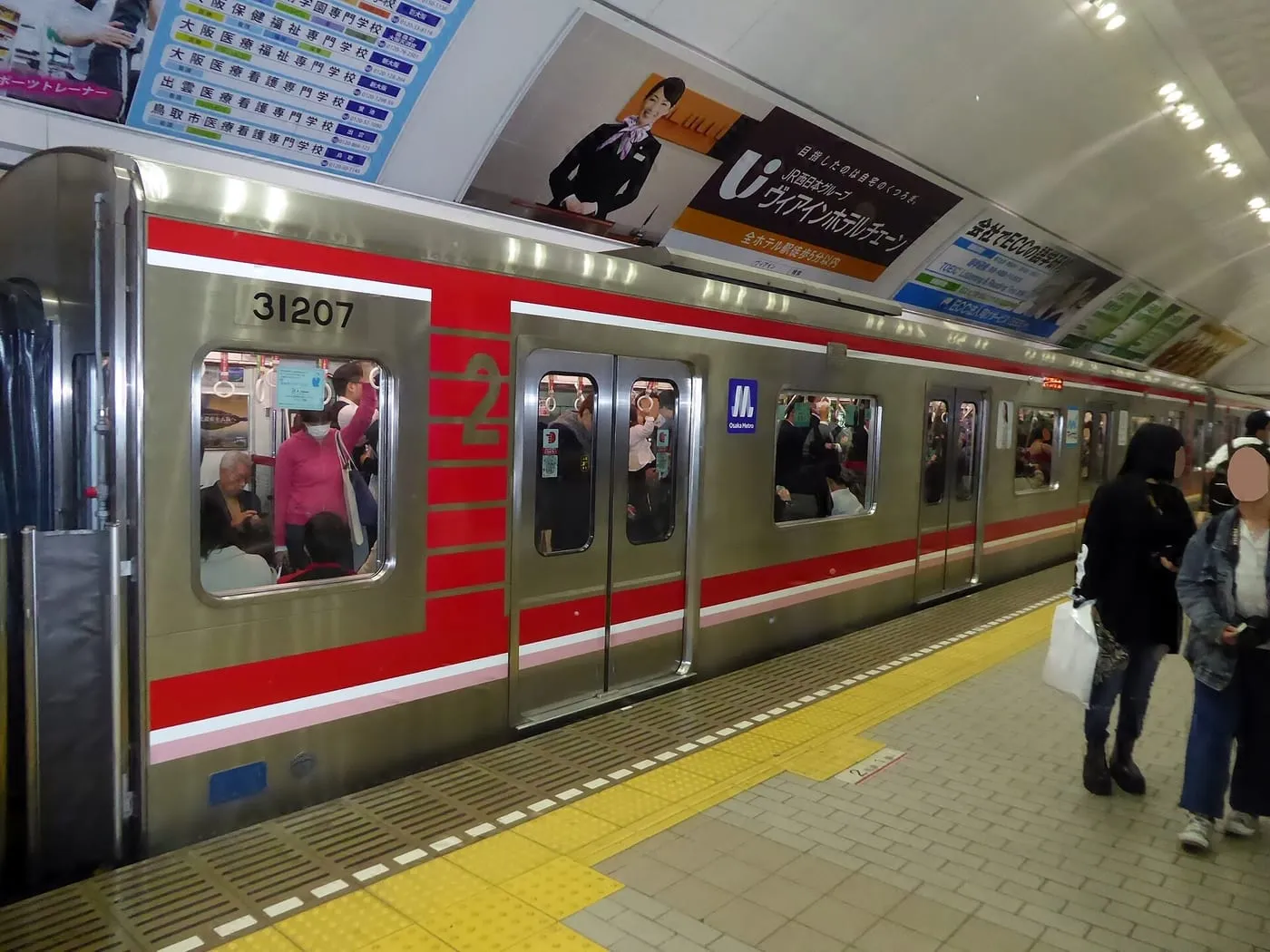
1. Osaka Metro: the primary tourist network
The Osaka Metro consists of eight subway lines and one automated people mover (the New Tram in the Bay Area). Stations are marked with letter codes and numbers (for example, M16 for Umeda on the Midosuji line).
Key subway lines:
- Midosuji Line (Red / M): The central trunk line of Osaka. It connects Shin-Osaka (Shinkansen terminal), Umeda (Osaka Station), Shinsaibashi, Namba, and Tennoji. Almost every visitor rides this line daily.
- Chuo Line (Green / C): Runs east-west, linking Osaka Castle (Tanimachi 4-chome) to Osaka Bay (Osakako for the Kaiyukan Aquarium and Tempozan Ferris Wheel).
- Tanimachi Line (Purple / T): Runs parallel to the Midosuji Line through Higashi-Umeda, Tenmabashi (for cherry blossom cruises), and Shitennoji Temple.
- Sennichimae Line (Pink / S): Connects Namba and Nipponbashi (Kuromon Market) to Tsuruhashi (Koreatown and yakiniku district).
- Sakaisuji Line (Brown / K): Connects Kitahama to Nipponbashi and Dobutsuen-mae (Shinsekai). It offers through-running onto the Hankyu railway to Kyoto.
Fares are calculated by five distance zones: Zone 1 (up to 3 km) costs 190 yen, Zone 2 (up to 7 km) is 240 yen, Zone 3 is 290 yen, Zone 4 is 340 yen, and Zone 5 is 390 yen.
2. JR West and the Osaka Loop Line
JR lines in Osaka are vital for specific tourist destinations and regional connections:
- Osaka Loop Line (Osaka Kanjo-sen): A circular railway encircling downtown Osaka. It stops at Osaka Station (Umeda), Morinomiya (Osaka Castle Park), Shin-Imamiya (Shinsekai), and Tennoji.
- JR Yumesaki Line (JR Sakurajima Line): Branches off the Loop Line at Nishikujo Station directly to Universal-City Station for Universal Studios Japan.
- JR Yamatoji Line: Runs from JR Namba and Tennoji to Nara in 35 to 40 minutes (day trips from Osaka).
- JR Kyoto Line & Kobe Line: Fast Special Rapid (Shin-Kaisoku) trains departing Osaka Station for Kyoto (29 minutes, 580 yen) and Kobe Sannomiya (22 minutes, 410 yen).
If you hold a nationwide Japan Rail Pass or JR West Kansai Area Pass, it covers all JR lines and the Loop Line, but it is not accepted on the Osaka Metro.
3. The private railways: connecting the region
Private railways in Kansai connect central Osaka directly with surrounding cities without requiring transfers:
- Hankyu Railway: Departs from Osaka-Umeda Station. The Kyoto Line runs to central Kyoto (Kyoto-Kawaramachi), the Kobe Line runs to Kobe-Sannomiya, and the Takarazuka Line serves northern suburbs.
- Hanshin Electric Railway: Departs from Osaka-Umeda and Osaka-Namba, running west to Kobe-Sannomiya and Koshien Stadium.
- Keihan Electric Railway: Runs along the Yodogawa river from Yodoyabashi and Kyobashi in Osaka directly to eastern Kyoto (Gion-Shijo, Fushimi Inari, Kiyomizu-gojo).
- Kintetsu Railway: Departs from Osaka-Namba and Osaka-Uehommachi, providing the fastest rail route to Nara (Kintetsu-Nara Station in 35 minutes, 680 yen) and services to Nagoya and Mount Yoshino.
4. How to pay: ICOCA and IC cards
Or order an IC card online
Order an ICOCA IC Cardad{rel=“sponsored nofollow noopener”} online with preloaded travel credit to pick up on arrival at Kansai Airport and start tapping transit gates immediately.
Payment for public transport in Osaka is straightforward:
- ICOCA Card: Kansai’s regional IC card, issued by JR West. Purchase one at any JR West ticket machine for 2,000 yen (500 yen refundable deposit plus 1,500 yen usable balance). Tap your card on the blue sensor at the ticket gates when entering and exiting.
- Mobile IC Cards: If you already added a digital Suica or Pasmo card to Apple Wallet or Google Wallet during a previous visit or while in Tokyo, it works identically on all Osaka gates. Top up using your linked credit card.
- Contactless Bank Cards: Osaka Metro has installed open-loop contactless readers (Visa, Mastercard, JCB, American Express) at selected station gates. However, coverage across private rail operators remains incomplete, making an IC card the smoother choice.
For advice on local currencies, cash machines, and card fees, read our comprehensive overview of money in Osaka and compare with Tokyo public transport. Set up an eSIM for Japan before you fly, and see is the Japan Rail Pass worth it? if you are adding long rail trips.
Common questions
What is the best way to pay for transport in Osaka?
An IC card like ICOCA or mobile Suica and Pasmo. Tapping an IC card covers every Osaka Metro line, the JR Osaka Loop Line, and all private railways (Hankyu, Hanshin, Keihan, Kintetsu). It deducts the exact fare at the gate.
Can I use my Tokyo Suica or Pasmo card in Osaka?
Yes. Japan's major IC cards (Suica, Pasmo, ICOCA, TOICA, manaca, Kitaca, nimoca, SUGOCA, Hayakaken) are mutually compatible nationwide. You can tap your physical or Apple Wallet Suica or Pasmo on all Osaka trains, subways, and city buses.
Is the Osaka Metro 1-day pass worth buying?
The Enjoy Eco Card costs 820 yen on weekdays and 620 yen on weekends and public holidays. With single subway rides costing 190 to 390 yen, the weekend pass pays for itself in three rides. However, it covers only the Osaka Metro and city buses, not JR or private railway lines.
How late do trains run in Osaka?
Trains generally operate from around 5:00 until midnight. Last departures from major hubs like Umeda and Namba leave between 23:30 and 00:15 depending on the destination.