In this guide
The Short Version: Crowning the wooded crest of Robson Heights overlooking central Kuala Lumpur, Thean Hou Temple is a multi-tiered Chinese temple complex. Admission is completely free, with the site opening daily from 08:00 to 20:00. Dedicated primarily to Mazu (goddess of the sea), the six-tiered structure seamlessly blends elements of Buddhism, Taoism, and Confucianism beneath thousands of glowing red lanterns, curved yellow-tiled roof ridges, and carved stone dragon pillars. The ideal time to visit is late afternoon at 17:30: you catch the golden hour sun illuminating the upper observation balconies, enjoy panoramic skyline views towards Merdeka 118 and the Petronas Towers, and watch the illuminated red lanterns come alive at twilight. Reach the temple via a quick Grab ride from KL Sentral (RM10 to RM15), as the uphill climb on foot is steep, winding, and exposed to midday heat. Or book a tour: combine the hilltop temple with central landmarks on the Kuala Lumpur grand full-day guided tourad (from RM 96, 4.6 stars from 1,209 reviews).
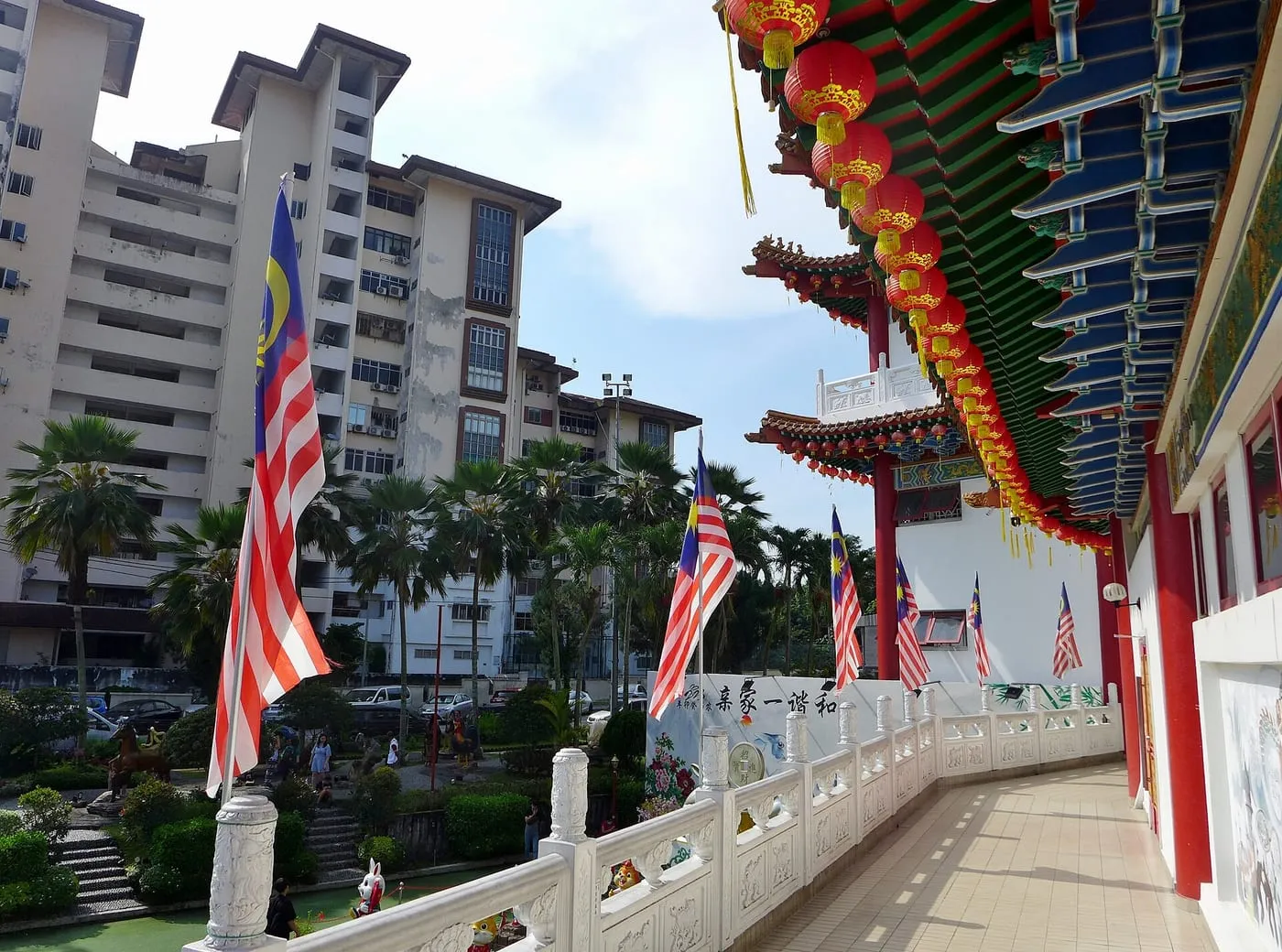
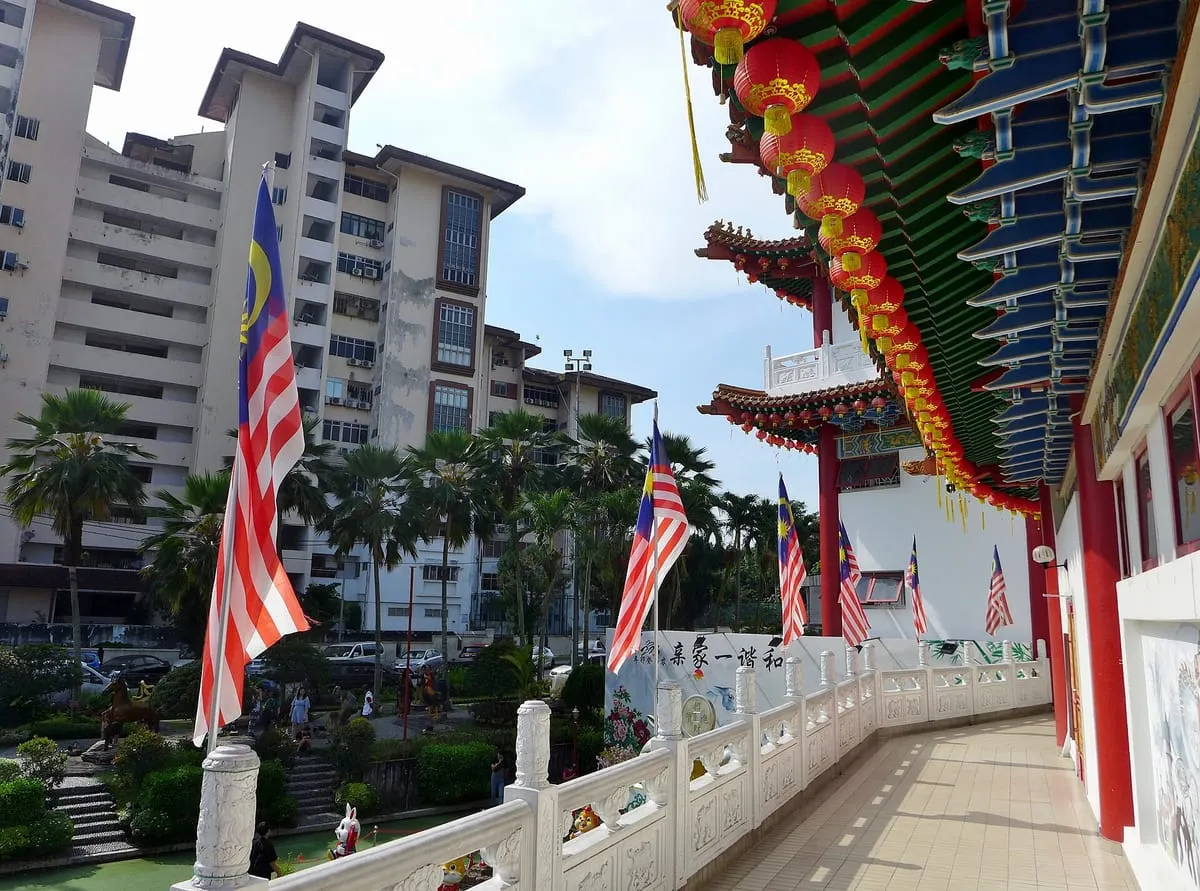
Lanterns hanging at Thean Hou Temple. Photo: Bahnfrend, Wikimedia Commons, CC BY-SA 4.0.
History and architectural layout on Robson Heights
Constructed between 1981 and 1987 by the Selangor and Federal Territory Hainan Association, Thean Hou Temple officially opened in September 1989. Founded by descendants of Hainanese seafaring migrants who credited the sea goddess Mazu with their safe passage across the South China Sea, the sanctuary serves as both a active community gathering centre and an active religious pilgrimage site.
The complex spans six distinct vertical levels built into the terraced hill:
Level 1 & 2: Heritage basement and marriage registry
- Level 1: Houses a basement souvenir gallery, religious book stalls, and a casual vegetarian cafeteria serving traditional Chinese steamed buns, mock-meat noodle soups, and herbal teas.
- Level 2: Home to the busy civil marriage registration hall. On auspicious calendar dates (such as Valentine’s Day, 9th September, or 11th November), hundreds of Malaysian Chinese couples dressed in formal gowns and suits gather here simultaneously to exchange vows and take wedding photos beneath the lanterns.
Level 3: Administration and reading library
Level 3 contains administrative offices, a traditional Chinese calligraphy classroom, and a quiet Buddhist research library.
Level 4: The Main Prayer Hall & Altars
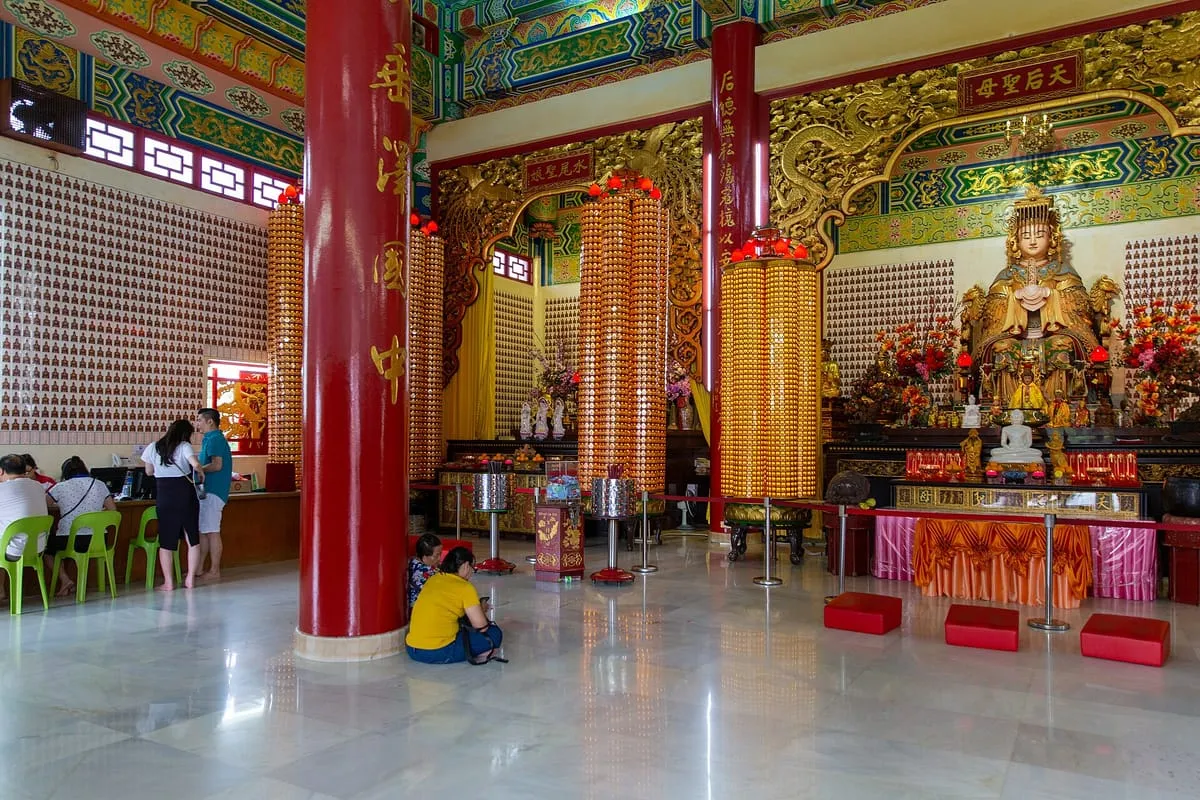
The focal point of worship sits on the fourth level. The cavernous prayer hall features traditional tiered eaves, intricate red-and-gold lacquered roof trusses, and three central gilded deity shrines:
- Tian Hou (Mazu) in the centre: The protector of fishermen, sailors, and travellers across the sea.
- Guan Yin on the left: The Bodhisattva of Compassion, to whom worshippers pray for peace, healing, and fertility.
- Shui Wei Sheng Niang on the right: The Hainanese goddess of the waterfront and inland waterways.
Flanking the prayer hall are a giant brass temple bell and a massive ceremonial drum, traditionally sounded during morning rituals and festival inaugurations.
Level 5 & 6: Upper balconies and panoramic rooftops
Octagonal external spiral staircases lead from the prayer hall up to the open-air tiered balconies and pagoda pavilions. These upper terraces offer the most sought-after photographic perspectives: looking down through the lattice of hundreds of hanging red paper lanterns towards the distant silhouettes of Merdeka 118, the Petronas Twin Towers, and the KL Tower.
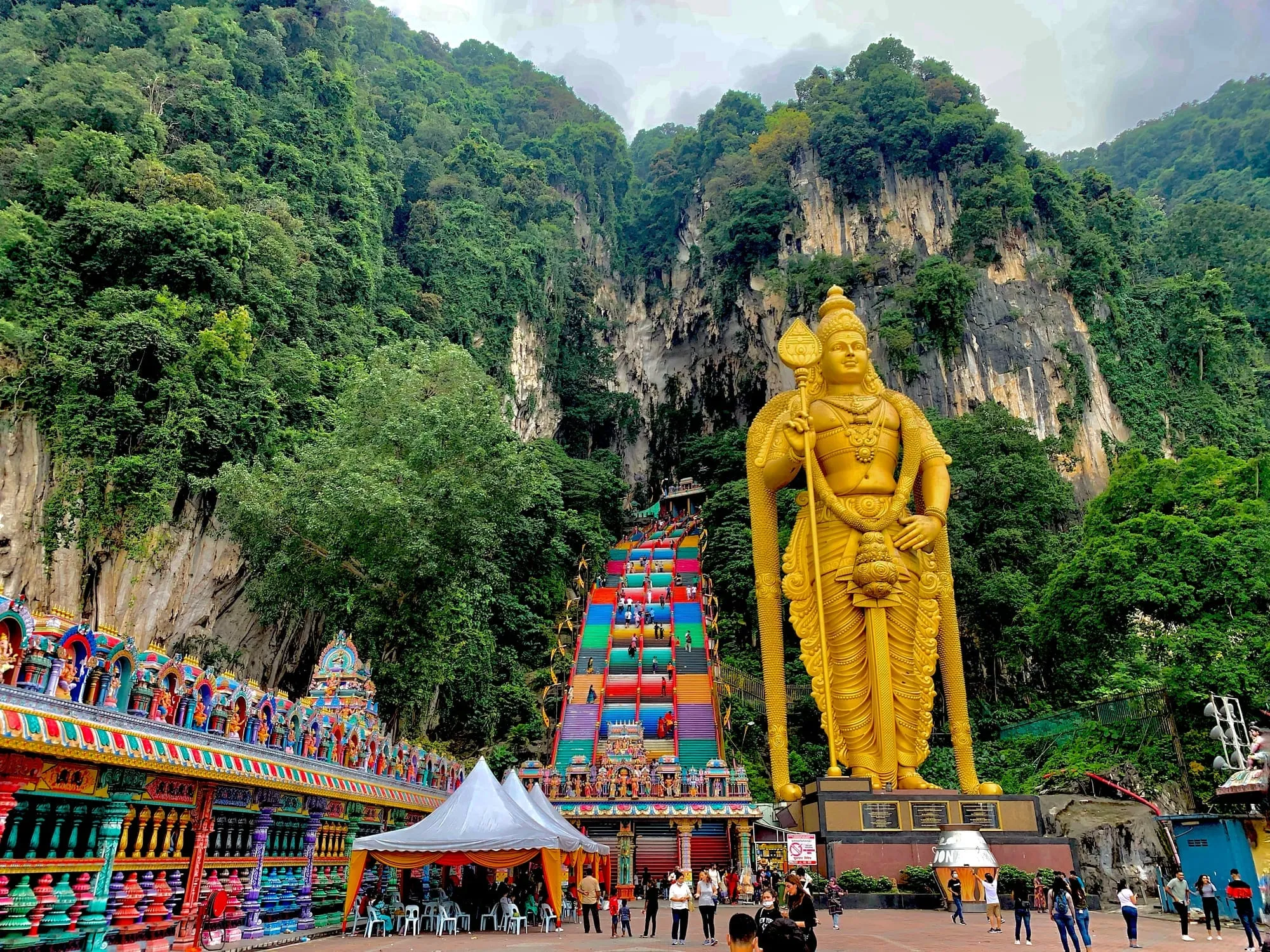
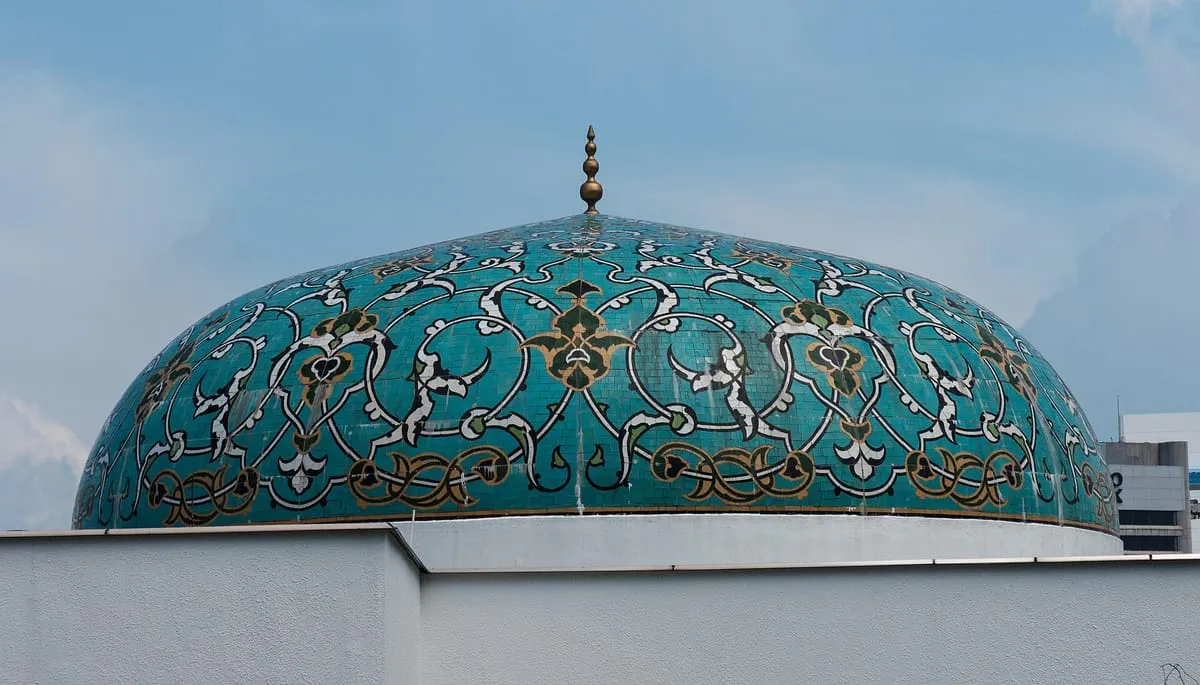
For other remarkable religious landmarks in the capital, pair this Taoist-Buddhist sanctuary with the sacred Hindu caverns at Batu Caves or the modernist domes of the National Mosque and Islamic Arts Museum.
Cultural rituals: Kau Chim fortune sticks and gardens
Beyond its eye-catching pagodas, Thean Hou Temple offers interactive spiritual traditions and landscaped grounds open to curious international visitors:
The Kau Chim (fortune stick) tradition
Inside the prayer hall, you will observe worshippers performing Kau Chim (bamboo stick divination):
- Kneel respectfully in front of the altar of Guan Yin or Mazu and silently formulate your question or life situation.
- Hold the large cylindrical bamboo tube containing numbered flat wooden sticks and gently tilt and shake it at an angle until a single bamboo stick gradually works its way free and clatters onto the carpet.
- Note the number engraved on the fallen stick.
- Confirm the reading by casting two crescent-shaped wooden blocks (jiaobei) onto the floor. If one lands flat-side up and the other curved-side up, the reading is validated.
- Take the number to the timber drawer cabinet located at the back of the hall to retrieve your printed oracle paper slip, which provides poetic verses and practical interpretations in English, Malay, and Mandarin.
The wishing well of Guan Yin
Beside the lower prayer courtyard sits an ornate fountain pavilion featuring a statue of Guan Yin standing atop a dragon. When visitors step onto a kneeling pad and drop a coin into the collection basin, an automated mechanism dispenses a stream of blessed water from the goddess’s vase into an open stone lotus cup.
Chinese Medicinal Herb Garden & 12 Zodiac Statues
- Medicinal Herb Garden: Located on the hillside behind the main temple building, this tranquil gravel path winds past dozens of cultivated indigenous and traditional Chinese medicinal plants, each labelled with its botanical name and traditional therapeutic uses in herbal teas and compresses.
- Chinese Zodiac Garden: Across the entrance courtyard, twelve life-sized carved stone statues represent the animals of the lunar zodiac (Rat, Ox, Tiger, Rabbit, Dragon, Snake, Horse, Goat, Monkey, Rooster, Dog, and Pig). Each statue is accompanied by an informational plaque detailing birth years and personality traits.
Visiting times, festivals and photography advice
| Visiting Factor | Recommendation | Details & Practical Advice |
|---|---|---|
| Golden Hour & Twilight | 17:30 to 19:30 | Captures soft sunlight on glazed roof tiles, followed by the illumination of the lanterns |
| Admission & Tickets | Completely Free | No gate entry ticket required; small donations can be placed in collection boxes |
| Dress Regulations | Modest attire | Covered shoulders and knee-length shorts/skirts preferred; remove shoes on prayer hall rugs |
| Chinese New Year Window | January / February | Thousands of extra lanterns strung overhead, nightly lion dances, and festive night fairs |
| Wesak Day & Mid-Autumn | May & September | Wesak Day floral float parades and Mid-Autumn lantern walks with families and children |
Golden hour and night photography
Because the temple faces eastwards towards the Kuala Lumpur city centre, arriving in the late afternoon (around 17:30) allows the low golden sun to cast warm light across the red columns and dragon carvings.
As the sun dips below the horizon around 19:15, automated timers switch on the internal lightbulbs inside hundreds of hanging red paper lanterns. The visual contrast between the glowing red lanterns and the illuminated modern city skyscrapers in the background creates one of the most memorable photographic vistas in Malaysia.
How to get to Thean Hou Temple
The temple is located at 65, Persiaran Endah, off Lorong Bellamy on Robson Heights.
By Grab (strongly recommended)
Taking a Grab car is by far the most practical way to reach the summit:
- From KL Sentral or Brickfields: 8 to 10 minutes drive, costing roughly RM10 to RM15.
- From Bukit Bintang or Chinatown: 12 to 18 minutes drive, costing roughly RM14 to RM20.
- Pick-up upon return: When you are ready to depart, use the Grab app to book your return car directly from the main vehicle roundabout at the temple entrance. Because Thean Hou Temple is a popular tourist destination, Grab drivers are consistently available within 5 to 8 minutes.
Why walking from the train station is inadvisable
The closest railway stations are Bank Rakyat–Bangsar LRT (Kelana Jaya Line) and Mid Valley KTM Komuter, both roughly 1.8 to 2.2 kilometres away. While it appears walkable on a map, the route requires ascending a steep 150-metre vertical elevation along narrow residential roads (Jalan Robson) with sharp blind curves, missing sidewalks, and heavy tropical humidity. Taking an affordable Grab car preserves your energy for exploring the temple’s multiple flights of stairs.
For more details on navigating regional trains and buses, read our citywide guide to public transport in Kuala Lumpur.
What to explore after visiting
Because of its strategic location adjacent to Brickfields, you can easily combine your temple visit with cultural dining and exploring:
- Brickfields Little India: Located just a 5-minute Grab ride down the hill, Brickfields offers banana leaf curry restaurants, fresh mango lassi, aromatic jasmine flower garlands, and colourful sari boutiques.
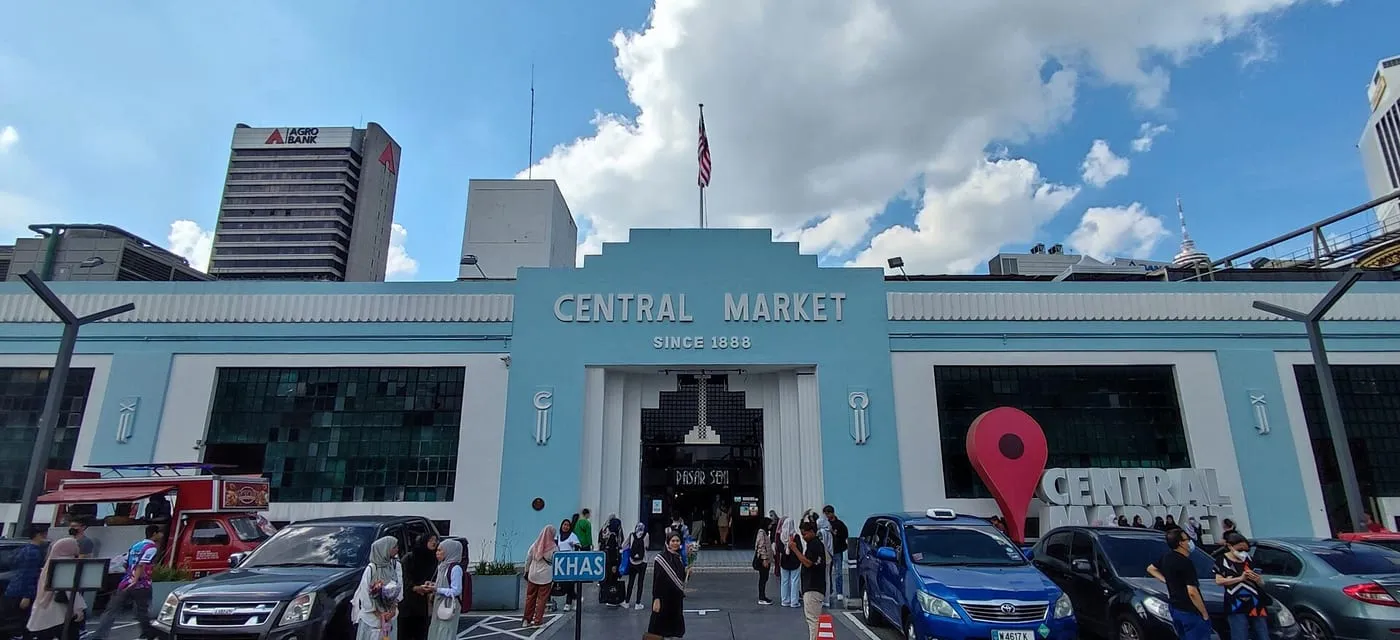
- Central Market and Chinatown: Head 10 minutes north across the river to explore pre-war Chinese shophouses, street food stalls along Petaling Street, and artisan crafts at Pasar Seni.
Plan the rest of your urban adventures with our curated guide to free things to do in Kuala Lumpur and explore top neighbourhood recommendations in where to stay in Kuala Lumpur.
Tours and guided options
Thean Hou Temple is free to enter, but sits atop Robson Heights with no direct rail station nearby. City highlights tours solve the suburban taxi journey and pair the temple with Merdeka Square and the National Mosque.
Kuala Lumpur grand full-day tour with Thean Hou Temple
From RM 96 · 4.6 stars from 1,209 reviews · 10 hours · 25 landmarks with lunch stop
Kuala Lumpur grand full-day tour with Thean Hou Templead: Explore 25 top Kuala Lumpur sights in one day! Experience diverse cultures, prominent landmarks, and local stories—perfect for first-time visitors seeking the city’s highlights.
Half-day city highlights tour with local guide
From RM 40 · 4.5 stars from 1,043 reviews · 3.5 hours · includes Thean Hou Temple stop
Half-day city highlights tour with local guidead: Uncover the beauty and charm of the old and new on a half-day tour of Kuala Lumpur. Contrast the skyscrapers and upscale shopping malls with colonial buildings.
Private city highlights tour with flexible stops
From RM 211 · 4.6 stars from 883 reviews · 8 hours · tailored itinerary with driver
Private city highlights tour with flexible stopsad: Discover Kuala Lumpur’s top attractions on a private full-day city tour. Visit the Petronas Twin Towers, Kuala Lumpur Tower, Batu Caves, and more.
Common questions
How much is admission to Thean Hou Temple in Kuala Lumpur?
Admission is completely free for all visitors. Voluntary cash donations can be dropped into the red collection boxes to support temple maintenance, and visitors may purchase incense sticks or red prayer candles for roughly RM3 to RM10 at the counter.
What are the opening hours of Thean Hou Temple?
The temple grounds open daily from 08:00 to 20:00. During major Chinese festive celebrations such as Chinese New Year, the Mid-Autumn Festival, and Wesak Day, opening hours often extend until 22:00 or later to accommodate evening pilgrims and lantern viewers.
What is the best time of day to visit Thean Hou Temple?
Arriving around 17:30 to 18:00 during golden hour offers the most rewarding experience. You can photograph the tiered pagodas in warm sunlight, watch the dusk skyline light up across Kuala Lumpur, and see the thousands of red paper lanterns switch on automatically at nightfall.
Can you walk to Thean Hou Temple from the nearest train station?
Walking is not recommended because the temple sits atop the steep, winding slopes of Robson Heights with minimal pedestrian pavements and no shade under the tropical sun. Booking a Grab ride from KL Sentral or Bangsar LRT takes 8 to 10 minutes and costs between RM10 and RM15.