In this guide
The Short Version: Located 45 km west of central Hanoi in Son Tay, Duong Lam is a 1,200-year-old agricultural village that preserves the heritage of the northern Red River Delta. Famous for its weathered laterite stone walls (da ong), ancient banyan trees, and sunlit courtyards lined with ceramic soy sauce fermentation jars (tuong ban), Duong Lam offers a tranquil escape from urban traffic. Highlights include walking through the 1684 Mong Phu Communal Gate and Hall, renting a bicycle for 30,000 VND to 50,000 VND to cycle through rice fields to the dynastic shrines of King Phung Hung and King Ngo Quyen, and enjoying a home-cooked family lunch in a 300-year-old courtyard. Entry is just 20,000 VND. Compare all regional escapes in our master day trips from Hanoi guide. A village tour with lunch and a workshop can be booked below instead of arranging the transport yourself.
In 2006, Duong Lam became the first rural settlement in Vietnam to be designated as a National Historical and Cultural Relic, sharing the same heritage protection status as Hoi An and the Hanoi Old Quarter. Unlike an open-air museum, Duong Lam remains a living agricultural community where roughly 1,400 families tend vegetable gardens, dry rice sheaves along paved lanes, and welcome visitors into ancestral timber courtyards.
How to get to Duong Lam from Hanoi
Located 45 km west of the capital, the village is easily accessible by private vehicle, public bus, or organised tour.
| Transport option | Cost (one way) | Travel time | Practical advice |
|---|---|---|---|
| Private car with driver | 1,100,000–1,500,000 VND (round-trip) | 1 hour 15 min | Complete departure flexibility; the driver waits at the village gate while you explore by bicycle. |
| Grab taxi / car | 450,000–550,000 VND | 1 hour 15 min | Simple outward booking from Hanoi Old Quarter; book your return driver in advance as rural Grab availability can be sparse. |
| Public Bus 71 | 20,000 VND | 1.5–2 hours | Departs My Dinh Bus Station every 15–20 minutes to Son Tay bus station; transfer to a 5-minute taxi (40,000 VND) to the village. |
| Organised small-group day tour | 650,000–1,100,000 VND | Full day | Includes round-trip transport, bicycle hire, admission ticket, local family lunch, and an English-speaking guide. |
Book a tour instead
Book the From Hanoi: Duong Lam Ancient Village Day Tourad{rel=“sponsored nofollow noopener”} to cover round-trip hotel transfers, village bicycle hire, entrance tickets, and a home-cooked family lunch.
Architectural heritage: the laterite stone houses
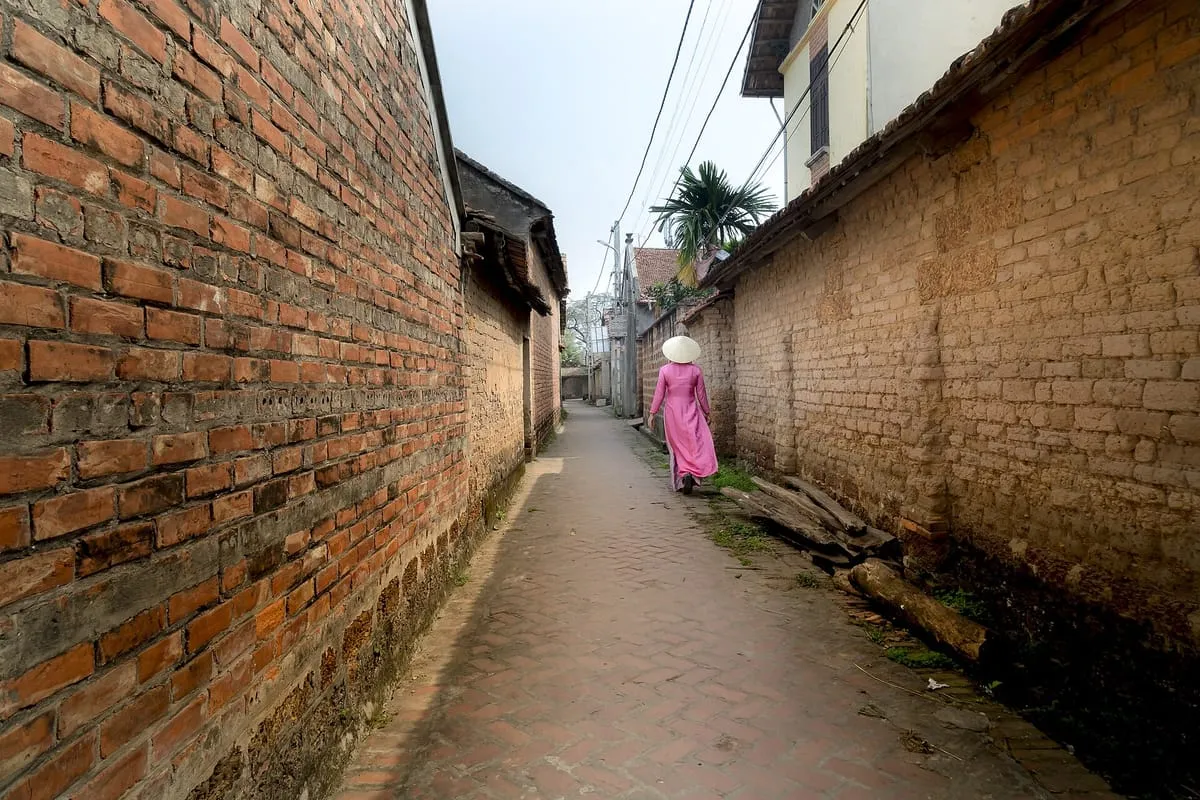
The visual hallmark of Duong Lam is laterite (da ong), an iron- and aluminium-rich porous red-brown clay excavated from the surrounding earth. When first dug up, laterite is soft enough to slice with a spade; upon exposure to air and sun, it cures into rock-hard building blocks resembling honeycomb.
The village features nearly 1,000 traditional residences, including over 30 historic timber houses dating back 200 to 400 years:
- Ong The’s House (Built 1774): A classic northern five-compartment home built with ironwood beams and wooden pegs (no metal nails). The central bay holds the family ancestral altar adorned with carved gilding and red lacquer.
- Ong Huyen’s House: Surrounded by a courtyard filled with dozens of brown terracotta jars filled with fermenting soybean paste (tuong ban). The family demonstrates the traditional fermentation method using roasted sticky rice and rainwater.
- Village Wells (Gieng Co): Deep cylindrical community wells lined with rough laterite blocks, traditionally situated beside communal lotus ponds.
What to see: a walking and cycling itinerary
Upon arriving at the village ticket booth (entry 20,000 VND), rent a single-speed bicycle with a front basket for 30,000 to 50,000 VND for the day. Cycling is the ideal way to navigate the peaceful brick alleys and country lanes.
1. Mong Phu Village Gate and Ancient Banyan Tree
The primary eastern entryway to Duong Lam. Built in 1833, the arched brick gate features a swooping tiled roof flanked by a massive 300-year-old banyan tree and a quiet lotus pond. Farmers returning from the rice paddies with conical hats (non la) and baskets on shoulder poles pass beneath this gate daily.
2. Mong Phu Communal House (Dinh Mong Phu)
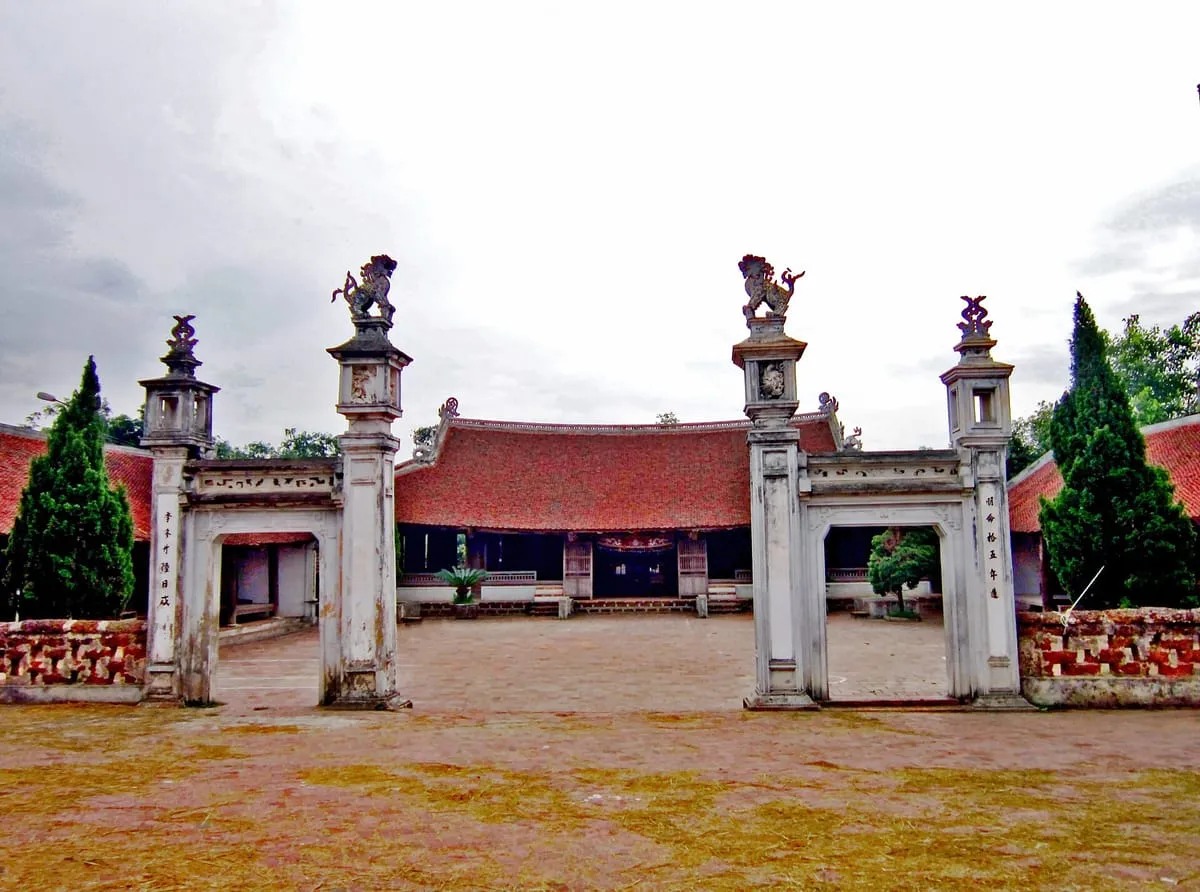
Located at the heart of the village on high ground, this communal hall was constructed in 1684 during the reign of King Le Hy Tong:
- Architecture: Features classic Vietnamese communal design with low overhanging eaves, carved dragon and phoenix roof finials, and an open wooden timber floor elevated on stilts.
- Significance: For centuries, it has served as the administrative and ceremonial focal point where village elders gather to discuss communal matters and hold seasonal harvest rituals.
3. Courtyards of Tuong Ban (Soy Sauce Jars)
As you stroll down the brick alleys, stop into the courtyards of local sauce makers. Tuong Ban is a traditional northern Vietnamese fermented condiment made from soybeans, roasted sticky rice, salt, and filtered rainwater.
- Rows of large clay jars bask in the sun for two to six months, stirred daily until the paste turns rich chestnut-brown with a savory, umami fragrance.
- You can purchase bottles of fresh artisanal sauce (30,000 to 50,000 VND) to take home.
4. Shrines of King Phung Hung and King Ngo Quyen
Cycle 1.5 km west through open rice fields and lotus lakes to the hamlet of Cam Lam:
- Temple of King Phung Hung: An atmospheric shrine complex surrounded by old banyan trees, dedicated to the 8th-century chieftain known as Bo Cai Dai Vuong (The Great Father and Mother King).
- Tomb and Temple of King Ngo Quyen: Perched on a gentle knoll overlooking the valley, this quiet memorial honours the military strategist who ended a thousand years of Chinese domination in 938 AD. A grove of 18 ancient duoi trees (streblus asper), where soldiers once tethered their war elephants, stands beside the tomb.
5. Mia Pagoda (Chua Mia)
Located in neighboring Dong Sang hamlet:
- Founded in the 17th century by Lady Nguyen Thi Ngoc Huyen (the Mia Queen).
- Houses 287 historic Buddhist statues crafted from jackfruit wood, clay, and bronze, including the revered statue of the Bodhisattva Quan Am holding a child in her arms.
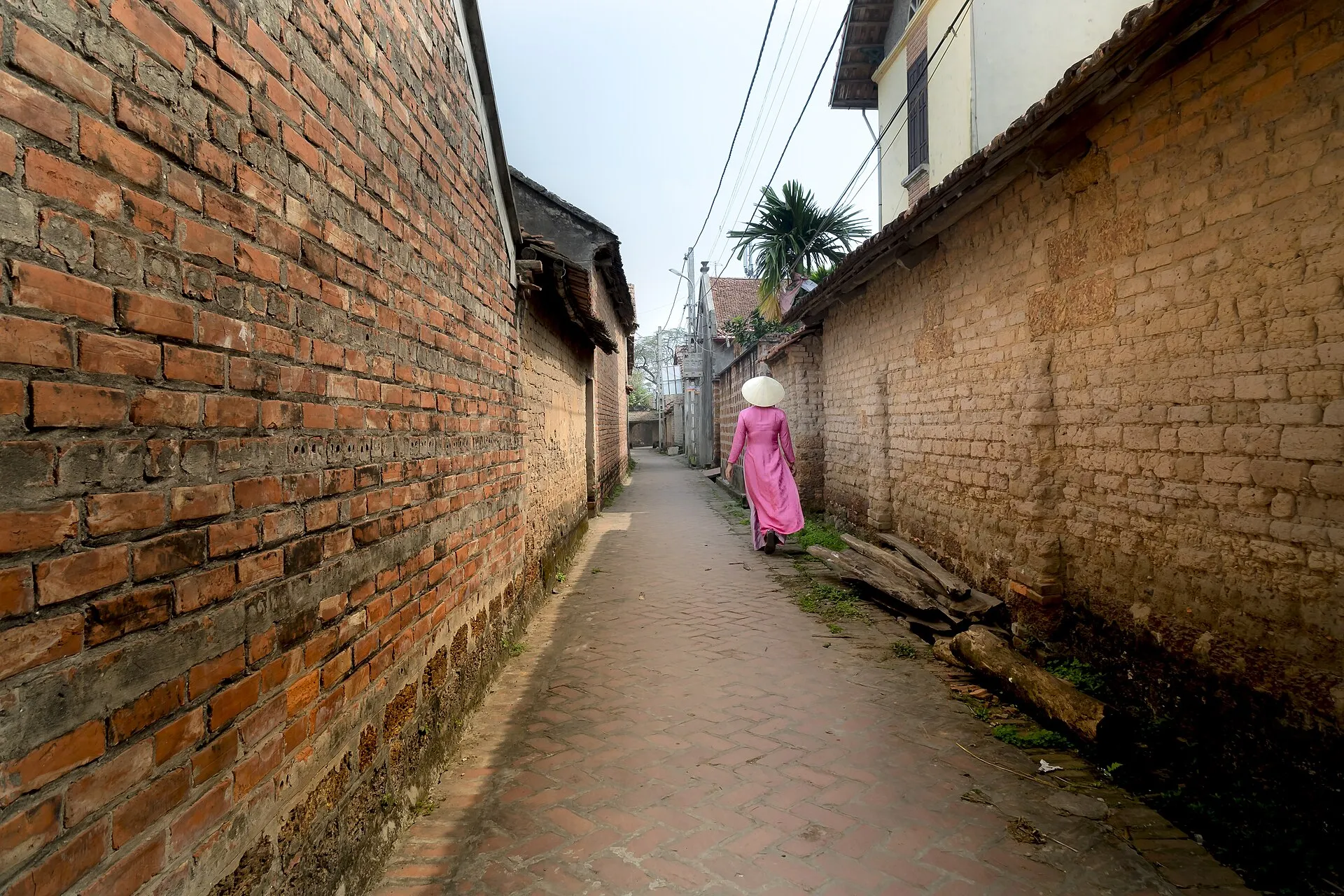
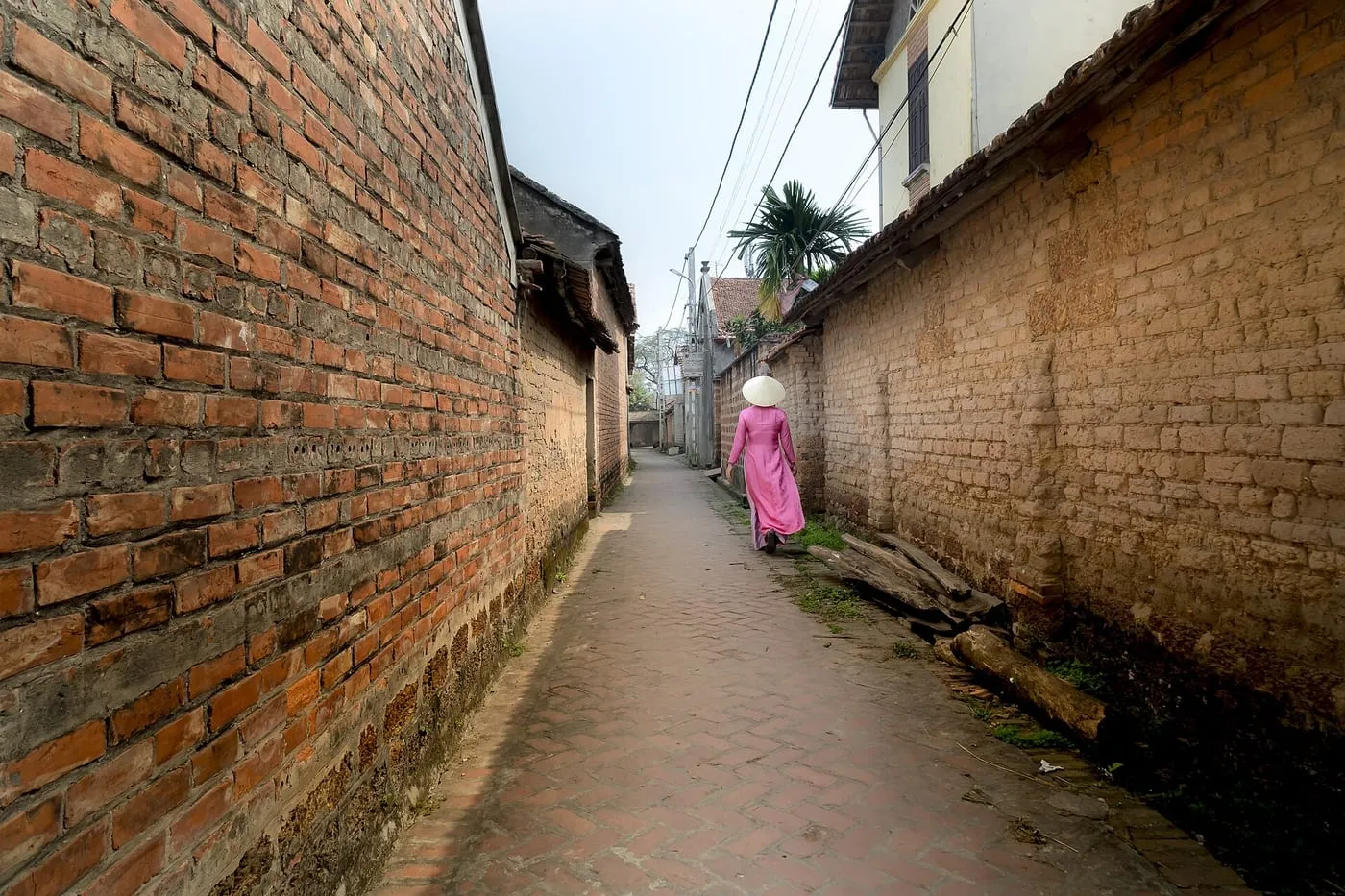
Traditional courtyard and laterite brick walls in Duong Lam ancient village. Photo: Quangpraha, Wikimedia Commons, CC0.
Dining: home-cooked village banquets
Enjoying a traditional northern Vietnamese home-cooked meal is a memorable part of visiting Duong Lam. Several ancestral families open their courtyards to visitors for lunch (pre-booking upon morning arrival is recommended).
A standard family set lunch (120,000 to 180,000 VND per person) features fresh home-grown specialties:
- Ga Mia (Mia Cane Chicken): A rare heritage poultry breed native to Son Tay, known for tender, sweet meat and yellow skin, steamed with lime leaves.
- Thit Quay Don (Crispy Rolled Pork): Pork belly seasoned with crushed guava leaves, garlic, and fish sauce, rolled tightly and roasted over charcoal coals until the crackling is light and crispy.
- Rau Muong Xao Toi: Fresh morning glory stir-fried with crushed garlic and served with local tuong ban dipping sauce.
- Che Lam: A traditional sweet snack made from roasted glutinous rice flour, ginger juice, roasted peanuts, and sugarcane molasses, served alongside hot green tea.
Guided excursions to Duong Lam Ancient Village
Booking an organised day tour pairs round-trip transfers with countryside cycling and authentic family dining inside a 300-year-old home:
From Hanoi: Duong Lam Ancient Village & Countryside Day Trip
From VND 2,250,000 · 5.0 stars from 1 review · 8 hours · Full-day heritage immersion
Book the Duong Lam Ancient Village Day Tripad for an all-inclusive heritage experience. Includes hotel pickup, bicycle riding through laterite stone alleys, private home visits, lunch cooked with village ingredients, and visits to the ancient royal temples.
Hanoi: Ancient Village, Old Citadel or Incense Village & Hat
From VND 350,000 · 4.9 stars from 9 reviews · 5 - 7 hours · Rural culture tour
Book the Ancient Village & Countryside Tourad for an economical introduction to northern Vietnam’s traditional rural settlements, historic communal houses, and craft legacies.
Hanoi: Red River Delta Village Tour with Lunch & Bike Ride
From VND 3,500,000 · 5.0 stars from 1 review · 10 hours · Private cycling adventure
Book the Red River Delta Village Tourad to cycle along rural canals and green rice paddies, stopping at Duong Lam’s ancient laterite homes and Son Tay medieval citadel.
Suggested 1-day itinerary
| Time | Activity | Location |
|---|---|---|
| 08:00–09:15 | Road transit via Highway 32 | Hanoi Old Quarter to Duong Lam |
| 09:15–10:00 | Enter Mong Phu Gate, rent bicycle, visit Mong Phu Communal House | Village centre |
| 10:00–11:30 | Visit Ong The and Ong Huyen ancestral houses and soy sauce courtyards | Mong Phu hamlet |
| 11:30–12:30 | Traditional courtyard family banquet lunch | Ancestral family home |
| 12:45–14:15 | Cycle through rice paddies to King Phung Hung & Ngo Quyen shrines | Cam Lam hamlet |
| 14:15–15:00 | Explore ancient Buddhist statues at Mia Pagoda | Dong Sang hamlet |
| 15:15–16:30 | Return bicycle, enjoy tea and che lam, return transit to Hanoi | Return to Old Quarter |
After returning to the capital, cap your day with an evening bowl of steaming noodles at one of the best pho spots in Hanoi or discover other excursions in our master day trips from Hanoi guide.
Common questions
How far is Duong Lam from Hanoi and how long is the journey?
Duong Lam Ancient Village is located roughly 45 km west of central Hanoi in Son Tay town. A private taxi or Grab car takes about 1 hour and 15 minutes via Highway 32, costing roughly 450,000 to 550,000 VND each way. Public Bus 70 or 71 from My Dinh Bus Station takes 1.5 to 2 hours (20,000 to 25,000 VND).
How much does admission to Duong Lam Ancient Village cost?
Visitor admission tickets cost 20,000 VND per adult and 10,000 VND per child, purchased at the ticket booth adjacent to the Mong Phu communal gate. Bicycle rentals right at the village gate cost between 30,000 and 50,000 VND for the day.
Why is Duong Lam known as the 'Land of Two Kings'?
The village is the birthplace of two of Vietnam's national heroes: King Phung Hung (761–802 AD), who led a successful uprising against Tang Chinese rule, and King Ngo Quyen (898–944 AD), who defeated the Southern Han fleet at the battle of Bach Dang River in 938 AD to secure Vietnam's independence.
What is special about the houses in Duong Lam?
The homes, boundary walls, and wells are constructed from laterite stone (*da ong*), a porous orange-brown iron-rich clay rock quarried from local soil. The stone naturally hardens upon exposure to air, providing excellent insulation that keeps homes cool in scorching summers and warm during chilly winters.
Can you eat lunch inside the ancient houses?
Yes. Several multi-generational families host traditional home-cooked northern banquets inside their courtyards (such as Ong The's House or Ong Huyen's House). Meals cost roughly 120,000 to 200,000 VND per person and feature free-range chicken, stir-fried water spinach with garlic, local soy sauce, and sweet peanut candy.