In this guide
💡 The Short Version: Located at Pažického 3 on a wooded hill north of the castle, Slavín is completely free to enter and open 24 hours a day. The site is a military cemetery for 6,845 Red Army soldiers with a 39.5-metre granite obelisk topped by an 11-metre victory statue. The terrace has panoramic views across the Old Town and Bratislava Castle. Or book a tour: a Cold War history and architecture walking tourad from €35 or an Old Town walk through coronation historyad from €26 is sold on GetYourGuide.
⚠️ Slavín is an active military cemetery. 6,845 soldiers are buried beneath the lawns and plazas. The terrace is a popular sunset viewpoint, but keep your voice low, do not play music and do not step on the grave markers.
History and design of the monument
The monument complex was constructed between 1957 and 1960 on what was originally a field cemetery overlooking the city. It officially opened on 3 April 1960 to commemorate the 15th anniversary of the liberation of Bratislava by the Soviet Red Army during the Bratislava-Brno Offensive in April 1945. In 1961, the Czechoslovak government designated Slavín a National Cultural Monument.
Slovak architect Ján Svetlík designed the complex in a socialist realist style:
- The Staircase: A broad stone staircase rises through cypress-lined terraces from Pažického street to the ceremonial courtyard.
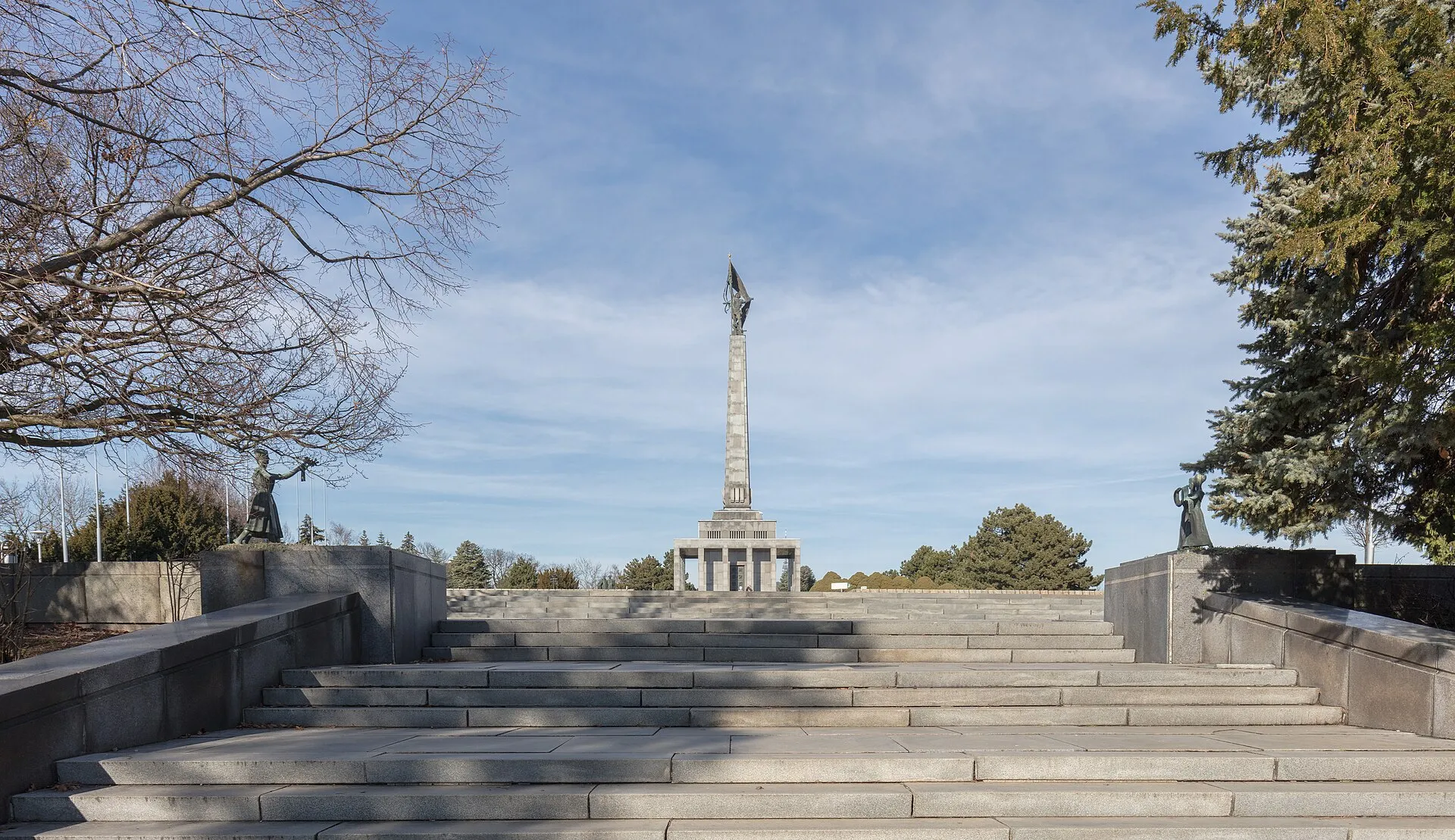
- The Central Pylon: The central obelisk stands 39.5 metres high and is faced with polished dark granite blocks. At its summit, an 11-metre bronze statue sculpted by Alexander Trizuljak depicts a Soviet soldier trampling a bent swastika beneath his boot while unfurling a banner of victory.
- The Ceremonial Hall: At the base of the pylon is an enclosed memorial hall. Its bronze entrance doors, by sculptor Rudolf Pribiš, carry bas-relief panels of wartime bombardment, grief and liberation. Inscriptions etched along the exterior marble plinth record the liberation dates of Slovak cities, from Košice (19 January 1945) and Banská Bystrica (25 March 1945) to Bratislava (4 April 1945).
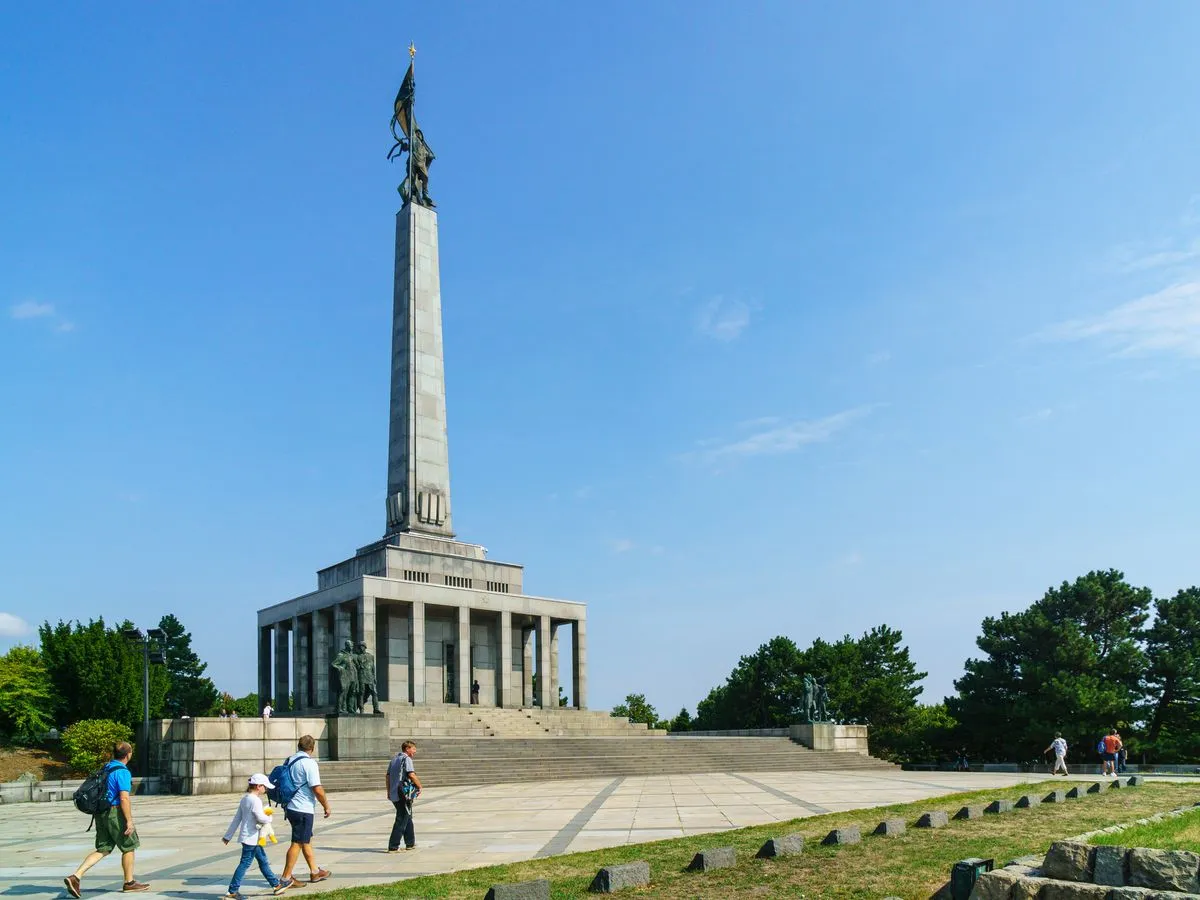
The 39-metre granite obelisk and soldier statue at Slavín. Photo: Radler59, Wikimedia Commons, CC BY-SA 4.0.
The military cemetery
Slavín is a war grave maintained by the City of Bratislava and the Slovak Ministry of Defence under international bilateral treaties:
- Mass Graves: The western section of the terrace features six large collective mass graves containing 6,567 soldiers. Each is a green lawn bordered by granite kerbstones.
- Individual Graves: Flanking the ceremonial hall are 278 individual grave plots, primarily holding identified Soviet officers, tank commanders and pilots killed in heavy fighting along the Little Carpathians foothills. Each individual grave carries a rectangular bronze tablet bearing the soldier’s name, military rank and birth and death dates in Cyrillic script.
- Sculptures: Bronze sculptures by post-war Slovak artists surround the grave terraces, including Tibor Bártfay’s group Above the Father’s Grave and Ján Kulich’s Tomb of the Unknown Soldier.
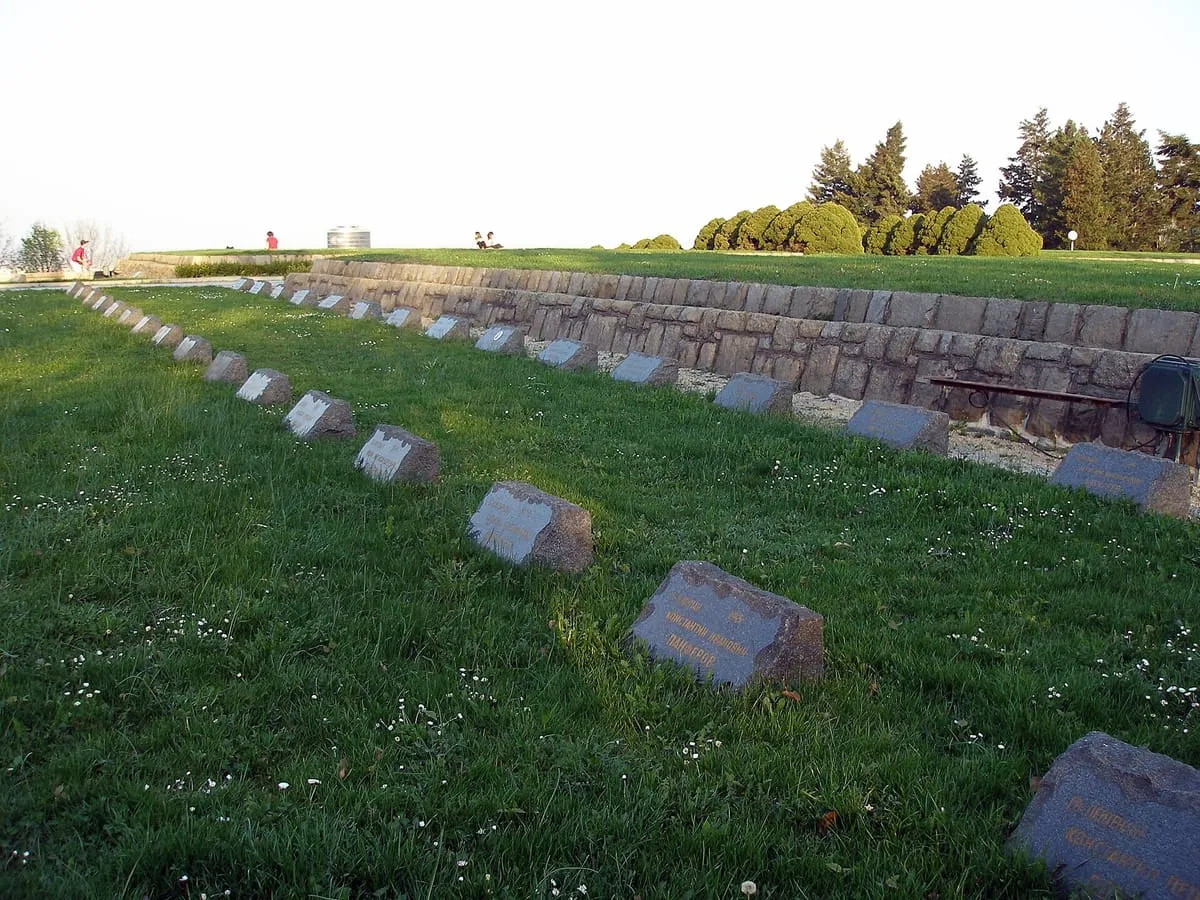
The military cemetery and manicured grave lawns. Photo: Stimoroll, Wikimedia Commons, Public domain.
Historical memory and local sentiment
Slavín means two things to Bratislava residents, as the Bratislava Tourist Board describes:
- The 1945 graves: A memorial to the Ukrainian, Russian, Belarusian and other Soviet soldiers who died breaking the German defensive lines across the Danube valley in the final weeks of World War II.
- The Cold War era and 1968: A reminder of the four decades of Communist rule that followed the 1948 Czechoslovak coup d’état, and of the August 1968 Warsaw Pact invasion of Czechoslovakia, which ended the Prague Spring and removed Slovak reform leader Alexander Dubček.
After Russia’s invasion of Ukraine in 2022, protesters painted the memorial’s lower steps and parts of the pylon yellow and blue, which sparked a national debate about historical conservation and contemporary politics.
Tours featuring Slavín and Cold War history
Slavín is easy to visit independently. A specialist historical tour adds Bratislava’s wartime history, the 1948–1989 Iron Curtain border regime and socialist urban planning.
Cold War history and architecture walking tour
From €35 · 4.8 stars from 5 reviews · 2 hours · socialist architecture
A walk through socialist Czechoslovak architecture and the family stories behind the Iron Curtain. Bratislava Behind the Iron Curtain: History & Architecturead
Coronations, curious statues and local secrets
From €26 · 3.7 stars from 3 reviews · 3 hours · coronations and statues
A walk with a local guide through Bratislava’s coronation history, street statues and local stories. Bratislava Unveiled: Coronations, Curious Statues and Local Secretsad
The panorama over Bratislava
Because Slavín sits at an elevation of 250 metres above sea level (roughly 100 metres higher than the Danube water level), the south-facing marble balustrade looks across the whole city basin:
- Bratislava Castle: The white rectangle of the four-towered castle stands against the Danube.
- The Old Town: The green copper spire of Michael’s Gate and the 85-metre neo-Gothic bell tower of St Martin’s Cathedral rise above the dense red-tile rooftops.
- Danube Bridges and Petržalka: On clear days, the cables of Most SNP and the saucer of the UFO Tower are clearly visible across the water, backed by the geometric expanse of Petržalka and the wind turbines of eastern Austria.
- Kamzík TV Tower: Turning around to face north reveals the rolling green ridge of the Little Carpathians (Malé Karpaty), crowned by the 196-metre Kamzík television tower set among dense beech forests.
Sunset is a popular time to visit. After dusk the castle and cathedral towers are floodlit, and the lights of barges move along the river.
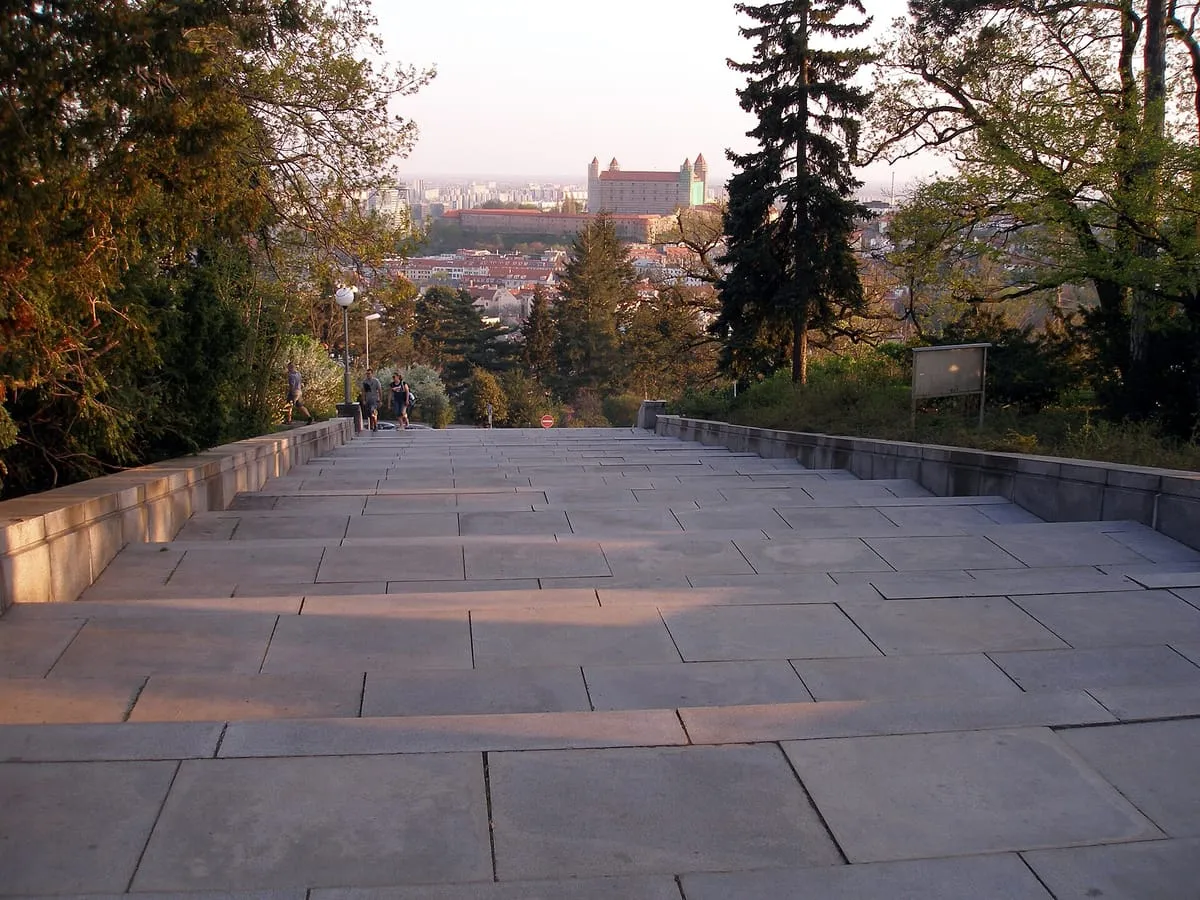
The view towards Bratislava Castle and the Old Town from Slavín. Photo: Stimoroll, Wikimedia Commons, Public domain.
How to get there: walking routes and transit
Slavín is in a diplomatic quarter of Staré Mesto, among pre-war villas, ambassadorial residences and embassies. There are three ways to reach it:
1. By trolleybus (least effort)
- Line 44: Catch trolleybus 44 from the central transit platform on Hodžovo námestie (located directly outside Grassalkovich Palace, the Presidential Residence).
- Alight at “Búdková”: The journey uphill takes approximately 8 minutes.
- Walk through the embassy quarter: From the Búdková turnaround loop, walk east along Búdková cesta for 200 metres, turn right into Stará vinárska, and follow Pažického street. The walk takes 8 to 10 minutes (about 700 metres) along quiet residential pavements.
- Fares: Standard DPB city transit tickets apply: tap a contactless payment card for €1.09 (30-minute validity) or buy a €1.20 paper ticket at the kiosk. Full ticketing rules are explained in public transport in Bratislava.
2. Walking uphill from Hodžovo námestie (scenic climb)
If you enjoy a brisk uphill walk, you can walk directly from the Presidential Palace in approximately 20 to 25 minutes:
- From Hodžovo námestie, follow Štefánikova street north for 200 metres.
- Turn left into Križkova, crossing Hlboká cesta via the historic pedestrian footbridge.
- Climb the paved zigzag footpaths and stone steps up Mišíkova street.
- Emerge at the base of the monumental Slavín staircase. Note that this route involves roughly 90 metres of continuous vertical elevation gain over cobblestones and stairs.
3. Walking through Horský Park (nature stroll)
For a longer afternoon walk, combine Slavín with Horský Park, a forest park established in 1868:
- From the Búdková trolleybus terminus, cross into the shaded ravine of Horský Park along wooden boardwalks and dirt forest paths.
- Stop at the historic Horáreň Horský Park (Forester’s Lodge), an 1870s wooden cottage that operates a community cafe serving traditional Slovak herbal teas, hot spiced wine and fresh poppy-seed pastries (bratislavské rožky).
- From Horáreň, a gentle 15-minute uphill trail brings you directly to the western edge of the Slavín memorial terrace.
Practical visitor tips
- Admission & Hours: Entry is free, with no tickets, turnstiles or gates. The site is accessible 24 hours a day.
- Facilities: There are no public toilets, ticket booths or commercial kiosks within the memorial grounds. Restrooms and cafes are located either down at Horáreň Horský Park or back in the Old Town.
- Accessibility: The main formal approach from Pažického features more than eighty stone steps and is not wheelchair accessible. However, visitors with reduced mobility or pushchairs can access the upper memorial terrace step-free by approaching from the rear gate along Na Slavíne street, which provides level paved access directly onto the viewing platform.
- Safety: The surrounding streets are residential and close to several embassies. General safety guidance is in is Bratislava safe?.
What to see next
- Bratislava Castle: the castle on the neighbouring hill to the south.
- Free Things to Do in Bratislava: more viewpoints, historic streets and parks.
- UFO Tower Bratislava: the paid deck on Most SNP, to compare with the free hill panorama.
- 3 Days in Bratislava: a day-by-day itinerary.
- Bratislava City Hub: all Bratislava city guides.
Common questions
What is the Slavín memorial in Bratislava?
Slavín is a military cemetery and war memorial on a hill above central Bratislava. It holds the mass and individual graves of 6,845 Soviet soldiers who died in April 1945 during the liberation of Bratislava and western Slovakia from Nazi occupation.
How much does it cost to visit Slavín?
Admission is free. The memorial grounds, the terraced cemetery lawns and the viewpoint platforms are open to the public 24 hours a day, 365 days a year.
How tall is the Slavín monument?
The central granite obelisk stands 39.5 metres high. It is capped by an 11-metre bronze sculpture of a Soviet soldier crushing a broken swastika underfoot while holding aloft a victory banner, designed by sculptor Alexander Trizuljak.
How do I get to Slavín by public transport?
Board trolleybus 44 from Hodžovo námestie (in front of the Presidential Palace) to the 'Búdková' stop. From there, walk 8 to 10 minutes through the embassy quarter along Stará vinárska and Pažického streets to the main memorial steps.
What can you see from the Slavín viewpoint?
Slavín has a free panorama looking south across the red-tiled roofs of the Old Town, the white towers of Bratislava Castle, the Danube River and the Kamzík television tower on the forested ridge to the north.