In this guide
💡 The Short Version: Located on Primaciálne námestie 2 directly behind the Old Town Hall, Primate’s Palace (Primaciálny palác) is a neoclassical palace and the working seat of the Mayor of Bratislava. Admission to the state rooms and the tapestry gallery costs €5 for adults. The palace is open Tuesday to Sunday from 10:00 to 17:00 and closed on Mondays. The main rooms are the Hall of Mirrors, where the 1805 Peace of Pressburg was signed after Napoleon’s victory at Austerlitz, and a series of 17th-century English Mortlake tapestries. Or book a tour: an Old Town walk through coronation historyad from €26 or a guided Old Town walk with castle entryad from €63 is sold on GetYourGuide; neither includes palace entry.
⚠️ Closed on Mondays, and subject to official civic closures. The public museum galleries are closed every Monday. Primate’s Palace is the working town hall, so the Hall of Mirrors sometimes closes to visitors for council meetings, receptions or award ceremonies. Check the notices at the entrance before buying a ticket.
Ticket prices and opening rules
Tickets are sold at the reception desk on the first floor (piano nobile), up the ceremonial staircase from the inner courtyard. Prices are set in euros (€) by the City of Bratislava and the Bratislava Tourist Board:
| Ticket Type | Official Price | Requirements and Inclusions |
|---|---|---|
| Standard Adult Admission | €5.00 | Full access to state apartments, Hall of Mirrors and tapestries |
| Bratislava CARD | Free | Free single admission to the state rooms |
Bratislava CARD holders enter the state apartments free; the city pass is covered in public transport in Bratislava.
Opening hours and visiting times
- Operating Days: Tuesday to Sunday, 10:00 to 17:00.
- Last Admission: 16:30 (30 minutes before closing).
- Weekly Closure: Closed every Monday year-round.
- Annual Public Holiday Closures: Closed on 1 January, Easter Sunday, 1 November, 24 December and 25 December.
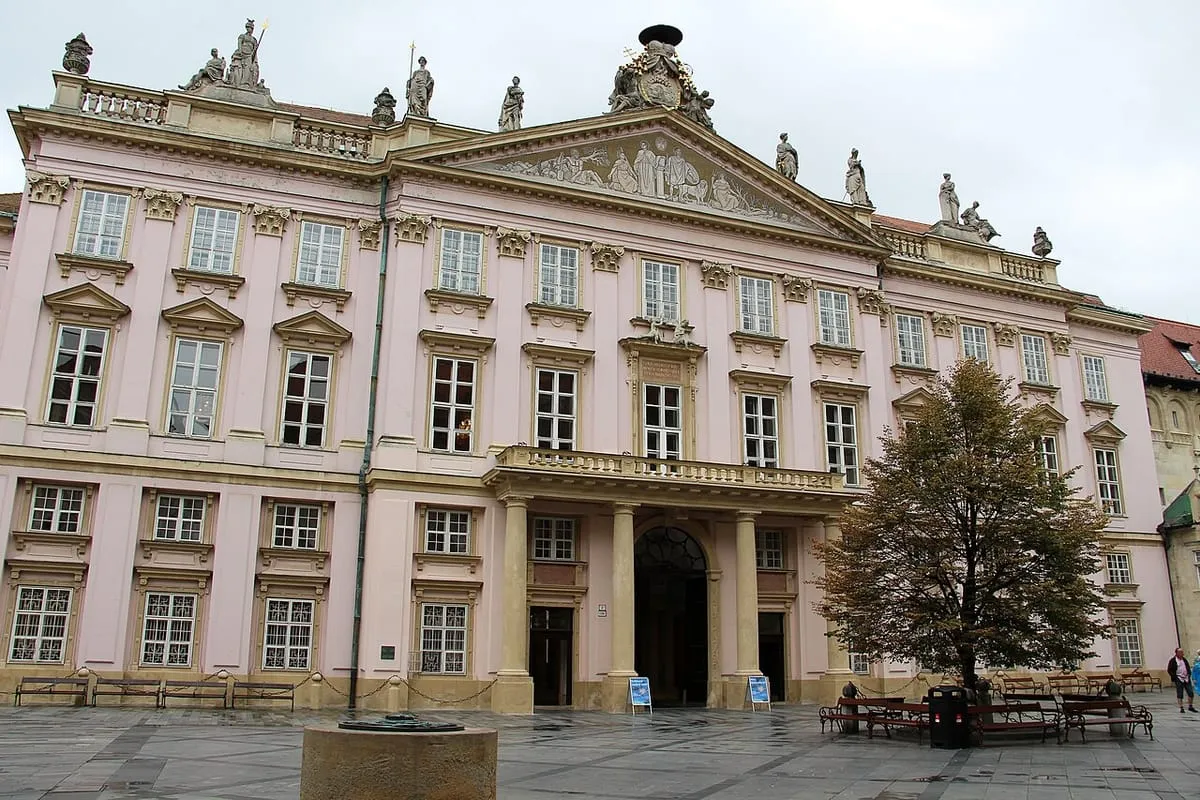
The grand neoclassical ceremonial interior of Primate’s Palace. Photo: Fred Romero from Paris, France, Wikimedia Commons, CC BY 2.0.
Guided tours featuring Primate’s Palace
Primate’s Palace is a stop on guided historical walks of Bratislava, where guides cover the 1805 treaty and the history of the Hungarian archbishopric.
Coronations, curious statues and local secrets
From €26 · 3.7 stars from 3 reviews · 3 hours · coronations and statues
A walk with a local guide through Bratislava’s coronation history, street statues and local stories. Bratislava Unveiled: Coronations, Curious Statues and Local Secretsad
Guided walking tour with castle entry ticket
From €63 · 4.6 stars from 54 reviews · 2 to 3 hours · castle entry included
A guided walk through the historic centre that ends with entry to Bratislava Castle. Bratislava: Guided Walking Tour with Castle Entry Ticketad
Cold War history and architecture walking tour
From €35 · 4.8 stars from 5 reviews · 2 hours · socialist architecture
A walk through socialist Czechoslovak architecture and the family stories behind the Iron Curtain. Bratislava Behind the Iron Curtain: History & Architecturead
Official box office vs third-party tours side by side
| Option | Official Price | Third-Party Tour Option | What to Know |
|---|---|---|---|
| State rooms and tapestry visit | €5.00 adult | Independent walk-in | Buy tickets directly at the 1st-floor desk; an audio guide comes with admission |
| Guided historical walking tour | Palace ticket not included | Guided tour from €26.00 | Licensed guide explains the 1805 Peace of Pressburg and tapestries |
| Inner courtyard and St George fountain | Free daily | Self-guided walk | Courtyard open to all pedestrians during daylight hours |
History and neoclassical architecture
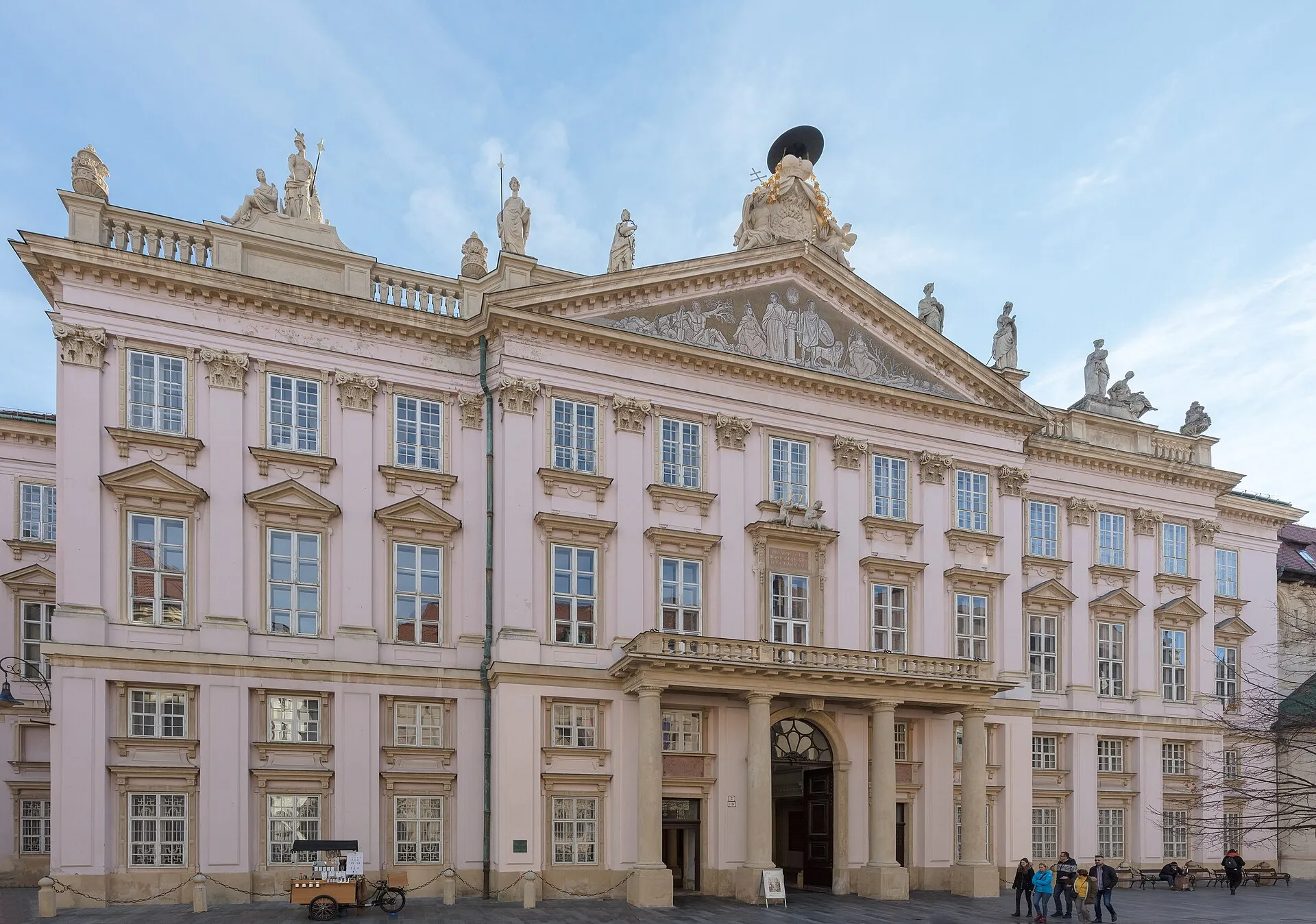
Primate’s Palace was constructed between 1778 and 1781 for the Archbishop of Esztergom, Cardinal József Batthyány, who served as the Primate of Hungary (hence the palace’s name). Designed by Viennese court architect Melchior Hefele in a French neoclassical style, the building replaced an older medieval episcopal residence:
- The Facade: The pale pink and white facade faces Primaciálne námestie. It is topped by a triangular pediment filled with allegorical sculptures of Cardinal Batthyány’s virtues and his episcopal coat of arms.
- The Cardinal’s Hat: At the apex of the pediment is a cast-iron replica of a cardinal’s galero (broad-brimmed clerical hat) weighing 150 kilograms, above a gilded cross.
- The Rooftop Statues: Arranged along the roofline balustrade are classical sandstone statues representing Peace, Wisdom, Temperance and Justice, sculpted by Johann Messerschmidt and Philipp Prokop.
The inner courtyard and St George Fountain
Entering through the grand central carriage portal brings you into the inner courtyard (nádvorie), which is free and open to the public daily:
- St George and the Dragon: The centrepiece is a 17th-century sandstone fountain showing Saint George on horseback spearing a three-headed dragon. According to legend, water poured from the dragon’s nostrils only on Saint George’s Day (24 April).
- Arcaded Loggias: Open-air arcades frame the courtyard and lead to the ceremonial staircase and the municipal offices.
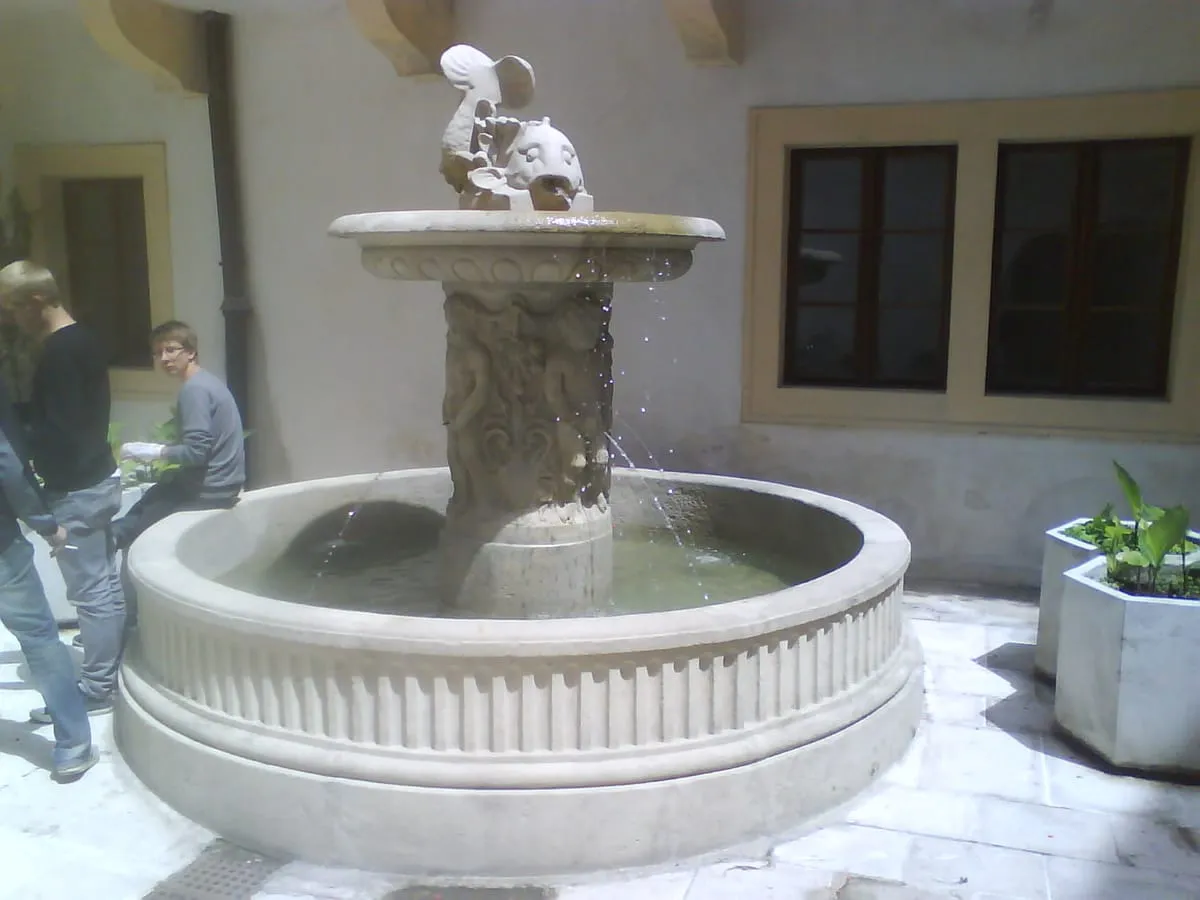
The inner courtyard fountain of St George slaying the dragon at Primate’s Palace. Photo: Brutalhovno, Wikimedia Commons, CC BY-SA 3.0.
The Hall of Mirrors (Zrkadlová sieň)
On the second floor is the Hall of Mirrors (Zrkadlová sieň):
- The room: High vaulted ceilings, pastel stucco mouldings, gold-leaf gilding, crystal chandeliers from Murano and tall arched wall mirrors facing tall French windows.
- The Peace of Pressburg (1805): After his victory over the combined armies of Austria and Russia at the Battle of Austerlitz (the Battle of the Three Emperors), Napoleon Bonaparte dictated peace terms to the Habsburg monarchy. On 26 December 1805, French Foreign Minister Charles-Maurice de Talleyrand and Austrian Prince Johann von Liechtenstein signed the Treaty of Pressburg in this hall. Austria ceded Tyrol and Vorarlberg to Bavaria and Venetia to the Kingdom of Italy, and recognised Napoleon’s Confederation of the Rhine, which led to the dissolution of the Holy Roman Empire several months later.
- Abolition of Serfdom (1848): In April 1848, the Hungarian Diet assembled in the Hall of Mirrors to confirm the revolutionary April Laws, signed into law by Austrian Emperor Ferdinand I, which formally abolished serfdom throughout the Kingdom of Hungary.
- Modern Civic Use: Today, the Hall of Mirrors serves as the venue for classical chamber music concerts, diplomatic treaty signings and the official monthly public sessions of the Bratislava City Council.
The English Mortlake Tapestries
The palace holds six 17th-century English wool and silk tapestries (Bratislavské gobelíny):
- Origin: The tapestries were woven in the 1630s at the Royal Mortlake Tapestry Works near London, based on designs attributed to royal court painter Francis Cleyn during the reign of King Charles I.
- The Myth of Hero and Leander: The series depicts the tragic ancient Greek mythological love story of Hero, a priestess of Aphrodite in Sestos on the Hellespont, and Leander, a young man of Abydos who swam the strait every night guided by a torch in Hero’s tower, before drowning in a storm.
- The 1903 Discovery: The tapestries disappeared from English inventories and came into the possession of the archbishops of Esztergom. When the City of Bratislava bought the palace in 1903 and began renovations, workers removing decayed 18th-century panelling and false chimney walling found them rolled up inside the wall cavities, where they had been hidden from Napoleonic troops in 1809. Sheltered from daylight and smoke for nearly a century, their indigo, crimson and gold dyes survive in good condition.
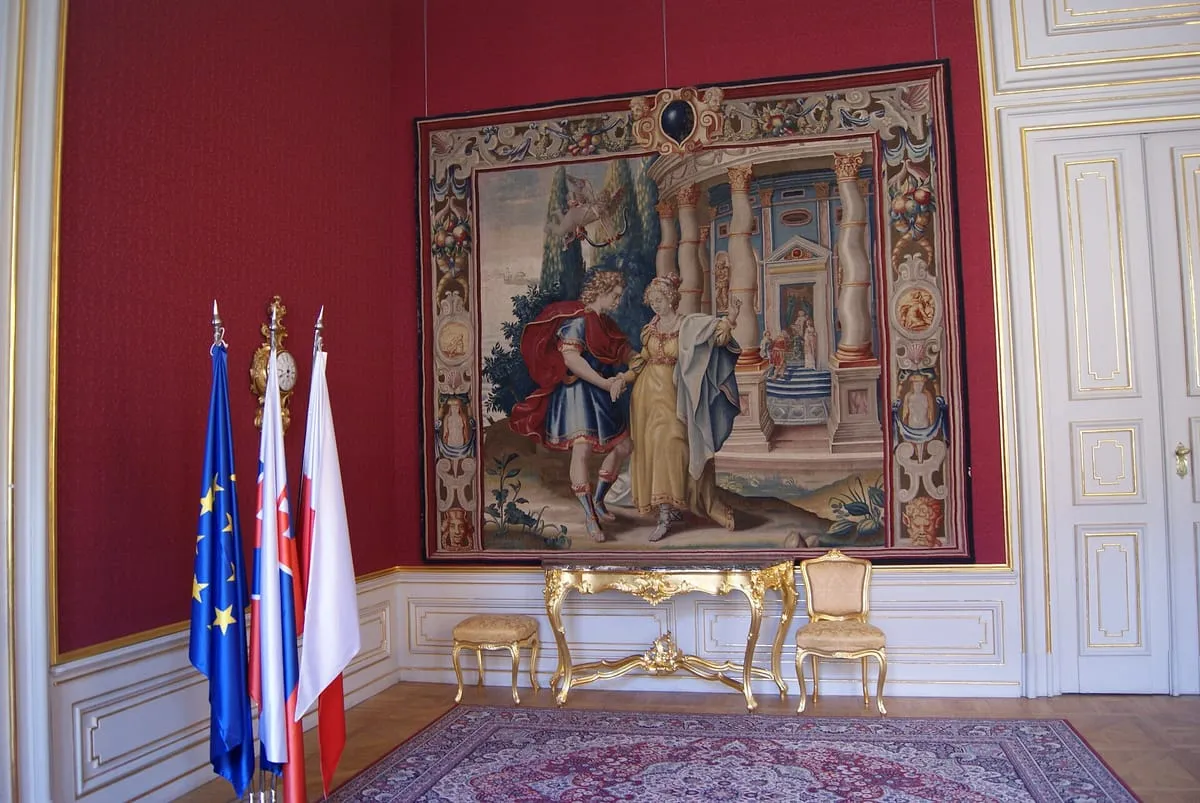
One of the rare 17th-century English Mortlake tapestries in Primate’s Palace. Photo: Smuconlaw, Wikimedia Commons, CC BY-SA 4.0.
Practical visiting tips
- Audio Guides: A free multi-lingual handheld audio wand is included with every paid admission ticket. The commentary covers each tapestry and salon.
- Concerts: The Hall of Mirrors hosts regular evening classical chamber concerts and string quartet recitals throughout the year. Concert schedules and tickets are displayed on posters at the courtyard entrance.
- Accessibility: A wheelchair lift provides barrier-free step-free access to the first-floor reception and state rooms. Visitors with mobility requirements should ring the buzzer beside the main courtyard entrance for staff assistance.
- Location: Primate’s Palace sits on Primaciálne námestie, directly adjacent to the Old Town Hall. You can walk through the arched courtyard of the Old Town Hall straight into Primatial Square in less than 60 seconds.
What to see next
- Old Town Hall and Main Square: the city museum, reached through the town hall courtyard.
- Michael’s Gate and Tower: the 51-metre baroque tower at the northern entrance to the Old Town.
- St Martin’s Cathedral: the Gothic cathedral where Hungarian monarchs were crowned.
- Bratislava Christmas Market: in December, craft stalls and children’s carousels fill Primatial Square.
- Bratislava City Hub: the full list of Bratislava city guides.
Common questions
How much are tickets to Primate's Palace?
Standard adult admission to the state rooms and tapestry gallery is €5, and Bratislava CARD holders enter free.
What are the opening hours of Primate's Palace?
The public state rooms are open Tuesday to Sunday from 10:00 to 17:00, with last entry at 16:30. The palace is closed every Monday. Because the palace serves as the active seat of the Mayor of Bratislava and the city council, rooms occasionally close for municipal sessions.
What happened in the Hall of Mirrors at Primate's Palace?
On 26 December 1805, representatives of Napoleon Bonaparte and Austrian Emperor Francis I signed the Treaty of Pressburg (Peace of Pressburg) in the Hall of Mirrors after Napoleon's victory at the Battle of Austerlitz.
What are the English tapestries in Primate's Palace?
A cycle of six 17th-century royal tapestries woven at the Mortlake Tapestry Works near London in the 1630s. Depicting the Greek tragic myth of Hero and Leander, they were discovered hidden behind palace walls during 1903 renovations.
Where is Primate's Palace located?
On Primaciálne námestie (Primatial Square) in the historic Old Town, situated directly behind the Old Town Hall and just two minutes on foot from Main Square.