In this guide
💡 The Short Version: Bratislava is close to Austria and to the wine hills of western Slovakia, and every trip below needs no car. Devín Castle is the quickest half-day trip (21 minutes on city bus 29 from Most SNP, closed Mondays), with clifftop ruins above the meeting of the Danube and Morava. Vienna is the cross-border option (56 to 65 minutes by direct hourly train, or 70 to 80 minutes on coaches from €7.90). For contemporary sculpture on the water, go south to Danubiana Art Museum (34 minutes on bus 90). For wine and a Renaissance fortress with cellars, take the Small Carpathians wine route through Svätý Jur, Pezinok and Modra to Červený Kameň Castle. For baroque churches and medieval town walls, take a train of 37 to 52 minutes to Trnava. Or book a tour: the Devín Castle and Iron Curtain half-day tourad from €134 and the 6.5-hour Small Carpathian wine tourad from €228 each replace the bus timetables above with one booking.
Bratislava is in the south-west corner of Slovakia, on the Austrian and Hungarian borders, so each trip below is within about an hour of the centre.
The day trips compared
The five excursions by journey time, transport, entry fee and closing days.
| Destination | Travel time & transit mode | Transport fare | Admission fee | Weekly closure & seasonal rules |
|---|---|---|---|---|
| Devín Castle | 21 min on city bus 29 from Most SNP | €1.09 contactless tap (€1.20 paper) | €8.00 summer / €6.00 winter (MMB) | Closed Mondays year-round; cave exhibitions closed November to March |
| Vienna | 56–65 min by REX train from Central Station | Bratislo/Wien-Ticket at the station (return rail plus Vienna day transit); coaches from €7.90 one way | Per museum | Most Viennese state museums open daily; Austrian shops closed Sundays |
| Danubiana Art Museum | 34 min on city bus 90 from Nové SND | €1.09 contactless tap (€1.20 paper) | €12.00 adult / €6.00 student (Danubiana) | Closed Mondays, grounds included |
| Small Carpathians Wine Route | 20–50 min on regional train/bus from Nivy | Regional bus or train ticket | Červený Kameň €7 to €8 | Family cellars require advance notice on weekdays; English castle tours at 11:30 and 15:30 |
| Trnava | 37–52 min by direct train from Hlavná stanica | ZSSK rail ticket, sold at the station and in the app | Town tower €4.00; Basilicas free | Town tower closed Mondays; church museums open Tue–Sun |
Devín Castle: Clifftop fortress and the Iron Curtain
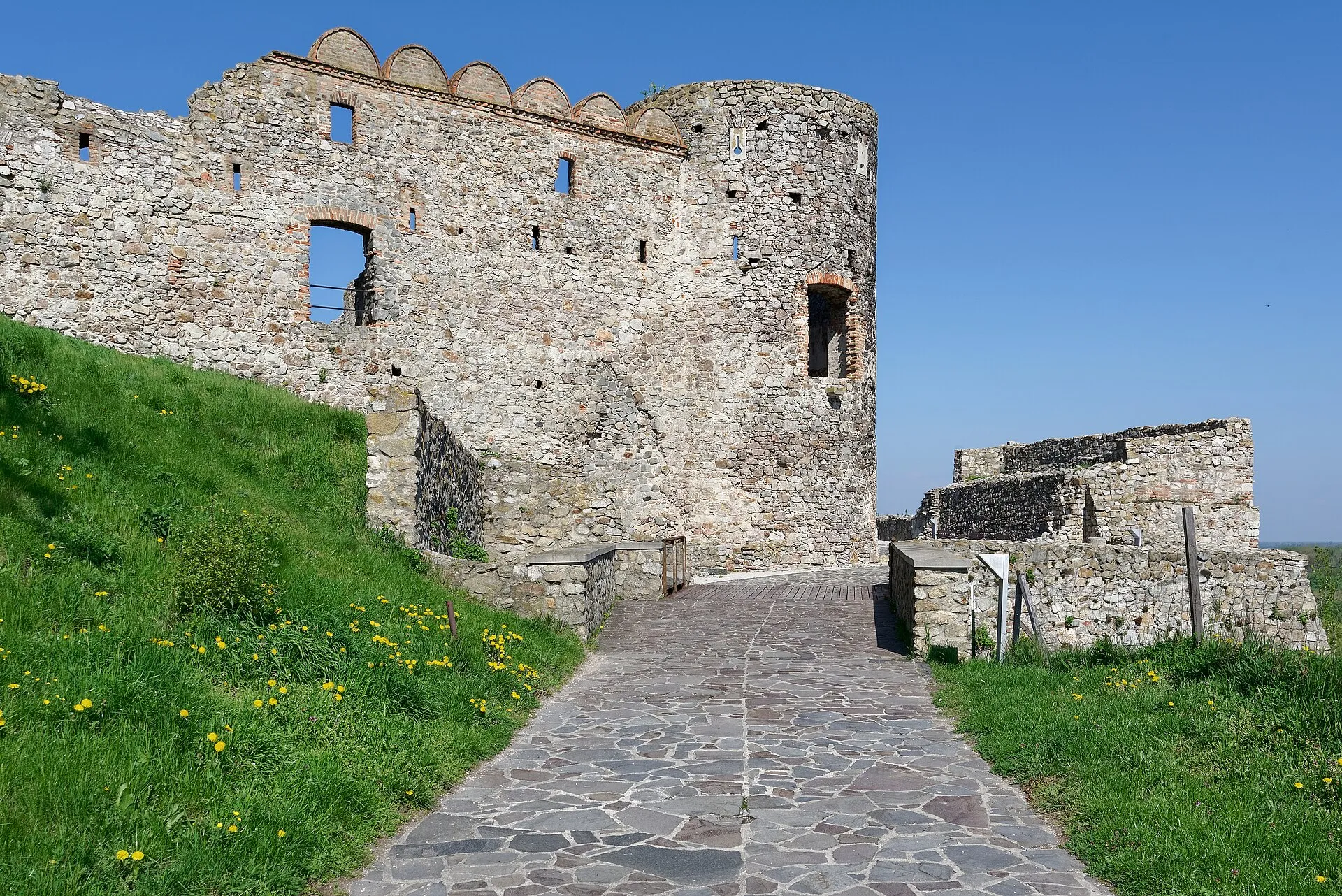
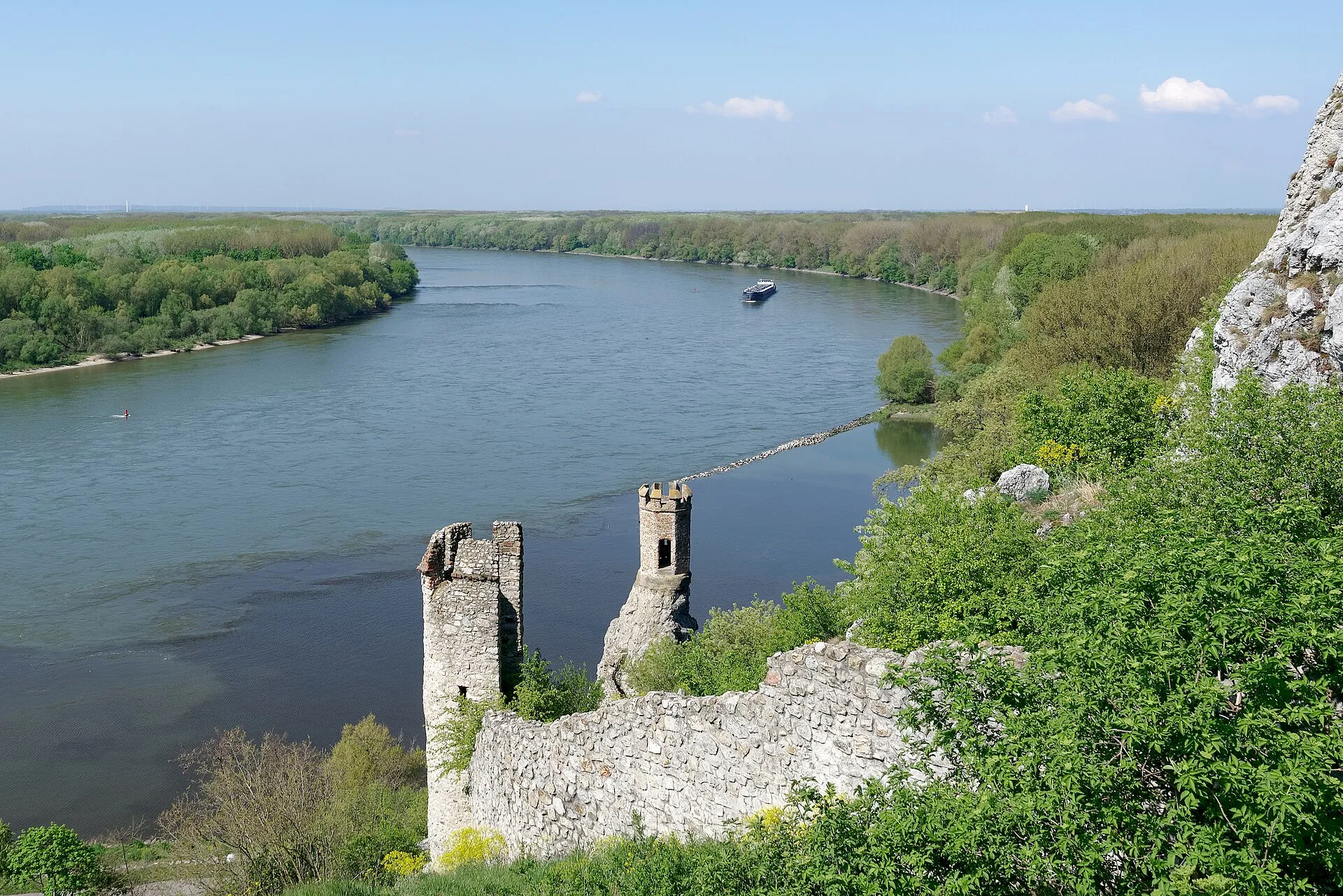
Devín Castle (Hrad Devín) stands on a 212-metre limestone crag above the confluence of the Danube and Morava rivers.
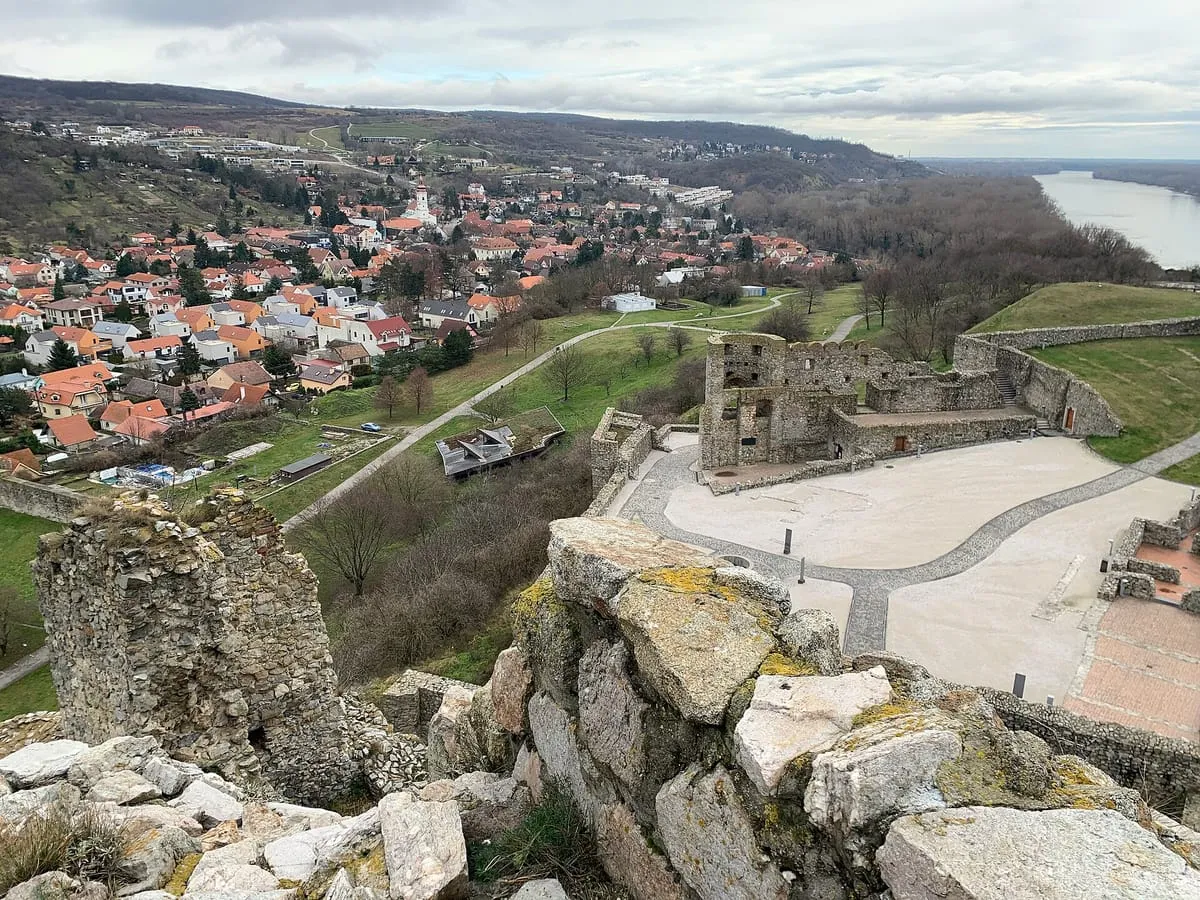 Restored ramparts and archaeological foundations on the upper ridge of Devín Castle. Photo: Punteador, Wikimedia Commons, CC BY-SA 4.0.
Settled since the Neolithic era and fortified by the Celts and Romans, Devín became an important ninth-century stronghold of the Great Moravian Empire. It was expanded into a royal castle in the Middle Ages, until Napoleon’s retreating French forces blew up its main bastions with gunpowder in 1809. The ruins are managed by the Bratislava City Museum.
- Getting there: Municipal bus line 29 departs from the terminal beneath the northern approach of Most SNP every 20 minutes on weekdays and every 30 minutes at weekends. The journey takes 21 minutes, terminating directly at the Hrad Devín village car park. Pay with a contactless tap on board (€1.09 per journey) or use a Zone 100+101 transit pass. Between April and October, river boats also run from Bratislava’s central passenger port to Devín, taking 90 minutes upstream and 30 minutes downstream.
- Hours & Admission: Open Tuesday to Sunday from 10:00 to 18:00 from April to October, until 19:00 in June to August (adult ticket €8.00, concession €4.00). From November to March it closes at 16:00 (17:00 in March), the adult ticket is €6.00 and the cave exhibitions are closed. Closed on Mondays year-round.
- Highlights: Climb the metal stairways to the upper castle terrace for views over Austria’s Marchfeld plain and the slender stone Maiden Tower (Panenská veža) on its needle of rock. At the foot of the castle rock on the Morava riverbank is the Gate of Freedom Memorial (Pamätník Brána slobody), to the more than 400 people killed trying to cross the Czechoslovak-Austrian border during the Cold War. In Devín village, try the local blackcurrant wine (ríbezľové víno), made there for over a century.
Vienna: Imperial palaces and museums
Vienna is 60 kilometres from Bratislava across the flat Danube plain.
- Getting there:
- By train: Regional Express (REX) trains leave every hour from Bratislava Hlavná stanica for Wien Hauptbahnhof, taking 56 to 65 minutes. Buy the Bratislo/Wien-Ticket at the station ticket window; it covers the return rail journey plus a day pass for Vienna’s U-Bahn, trams and buses.
- By coach: Slovak Lines and RegioJet run express coaches up to three times an hour from the underground bus platforms at Nivy station. Fares start from €7.90 one way, and the coaches reach Wien Hauptbahnhof or Erdberg in 70 to 80 minutes.
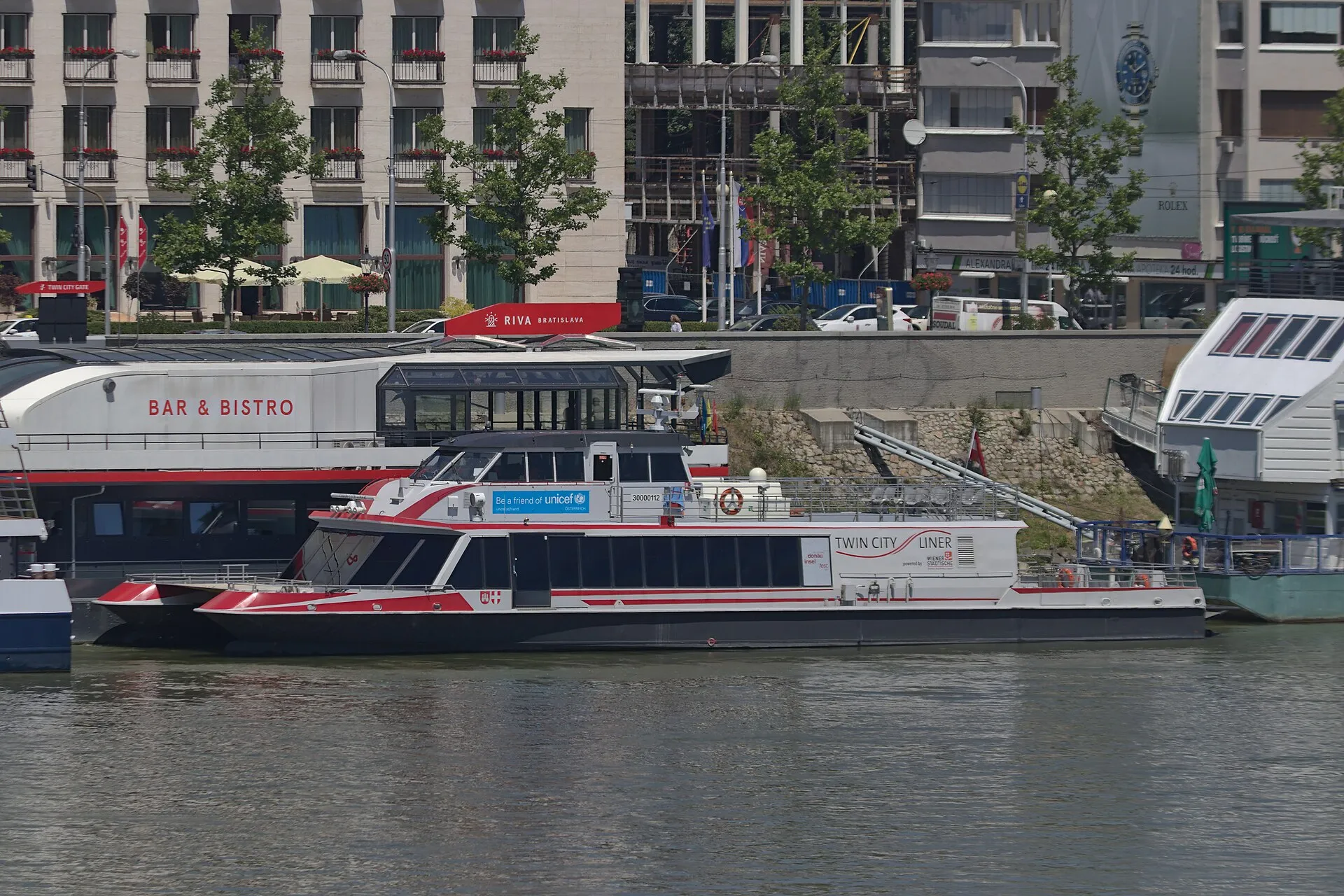
- By boat: The Twin City Liner catamaran runs between Bratislava passenger port and Vienna Schwedenplatz (in the city centre) from late March to early November, taking 75 minutes.
- Sights for a single day: Stay in Vienna’s Innere Stadt (District 1). Walk up Kärntner Straße to St Stephen’s Cathedral (Stephansdom), through the courtyards of the Hofburg Palace and along the Ringstraße, then spend the afternoon in the Kunsthistorisches Museum or the Albertina. Finish with a Melange coffee and Sachertorte in a coffee house before an evening train back. The Vienna Day Trip from Bratislava guide has hour-by-hour routing.
Danubiana Meulensteen Art Museum: Modern art on the water
The Danubiana Meulensteen Art Museum is twenty kilometres south of Bratislava, on an artificial peninsula in the reservoir of the Gabčíkovo waterworks.
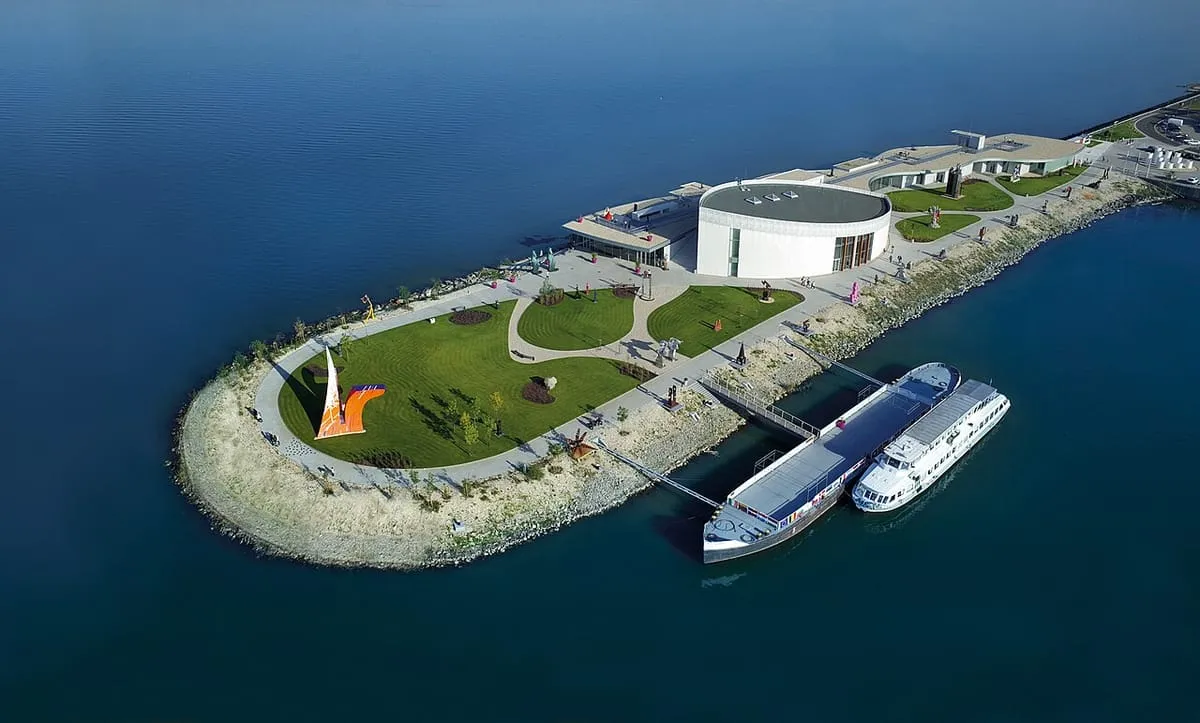 The ship-shaped Danubiana Meulensteen Art Museum on its peninsula in the Danube. Photo: Veropol, Wikimedia Commons, CC BY-SA 4.0.
Founded in 2000 by Dutch art collector Gerard Meulensteen and Slovak gallerist Vincent Polakovič, the building is shaped like the prow of a Roman galley cutting through the Danube.
- Getting there: Municipal bus 90 runs from the Nové SND stop (behind the new Slovak National Theatre and the Eurovea mall) to the Danubiana terminus in 34 minutes, hourly through the week. Standard city tickets apply (€1.09 contactless tap each way). On weekends from May to early October, passenger boats also run from Bratislava passenger port to the museum’s private jetty.
- Hours & Admission: Open Tuesday to Sunday from 10:00 to 18:00 (closed Mondays). Adult admission is €12.00; students and seniors €6.00; children under 6 enter free; the family ticket (2 adults and 2 students) costs €25.00.
- Highlights: Alternating temporary exhibitions of international and Slovak painters, sculptors and photographers, and an outdoor sculpture park on the peninsula’s lawns, where bronzes, steel forms and glass installations stand against the river and passing barges. You can climb to the walkable green roof terrace for 360-degree views across the Danube floodplains into Hungary and Austria.
Small Carpathians wine route and Červený Kameň Castle
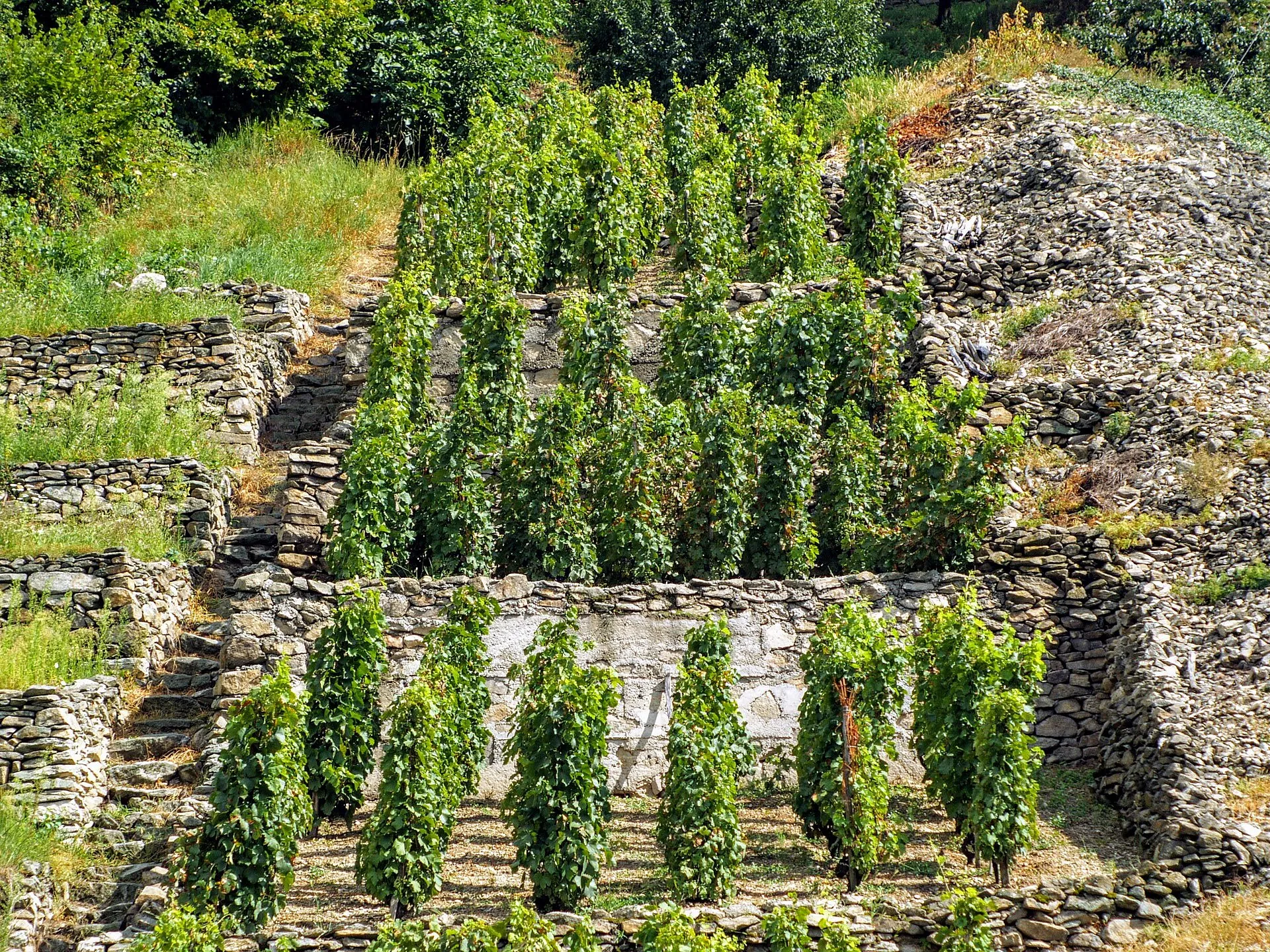
Stretching along the southeastern slopes of the Small Carpathian mountain range (Malé Karpaty) immediately northeast of Bratislava, this wine corridor has produced wine since Roman times.
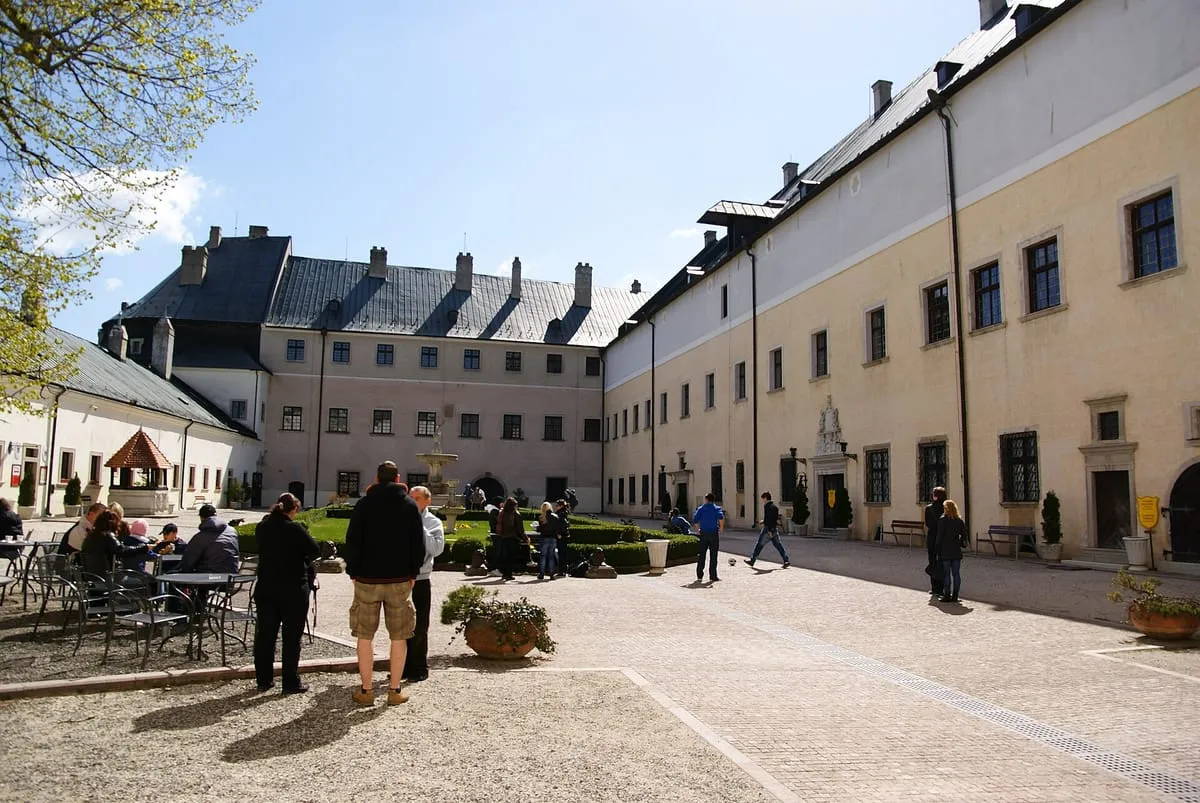 The fortified Renaissance courtyard of Červený Kameň Castle in the Small Carpathians. Photo: Bjalek Michal, Wikimedia Commons, CC BY-SA 3.0.
The wine route links several historic towns:
- Svätý Jur (14 km from Bratislava): An ancient royal free town with Gothic town walls and sixteenth-century vintner houses. Take a regional train from Bratislava Hlavná stanica (14 minutes) to explore local family wine cellars (viechy) serving Frankovka Modrá and Veltlínske zelené.
- Pezinok (21 km): The centre of regional wine production, with the Small Carpathian Museum (Malokarpatské múzeum), which holds historical wooden wine presses, in a Renaissance vintner’s manor. Regional trains reach Pezinok in 20 minutes from Central Station.
- Modra (28 km): Known for hand-made glazed majolica pottery (Modranská majolika) with blue, yellow and green folk patterns. The town square is lined with wine-tasting rooms, bakeries and pottery workshops. Regional Slovak Lines buses link Nivy bus station to Modra in 45 to 50 minutes.
- Červený Kameň Castle (Častá): In the wooded hills above the village of Častá (5 km from Modra), Červený Kameň (Red Stone Castle) is a Renaissance-Baroque fortress palace. The German Fugger mining dynasty built it in the sixteenth century and the Hungarian Pálffy family later expanded it. It has residential halls with antique furnishings, weapons collections and vaulted storage cellars up to 70 metres long. The castle is visited on a guided tour. The Slovak National Museum charges adults €8 for the long tour and €7 for the short tour in a foreign language, with English tours at 11:30 and 15:30 daily (snm.sk). Slovak Lines regional buses run from Nivy bus terminal to Častá, rázcestie Červený Kameň, followed by a 15-minute uphill forest walk.
Trnava: The “Slovak Rome” and medieval town walls
Trnava is 47 kilometres northeast of Bratislava in the Danubian Lowland. King Béla IV of Hungary granted it a royal charter in 1238.
When the Ottoman Empire took Buda and the archiepiscopal see of Esztergom in 1543, the Archbishop of Esztergom fled north to Trnava, and the town became the religious and intellectual centre of the Kingdom of Hungary for nearly three centuries. Its baroque churches and Jesuit colleges earned it the name “Little Rome” or the “Slovak Rome” (Slovenský Rím).
- Getting there: Regional Express (REX) and domestic passenger trains depart Bratislava Hlavná stanica for Trnava at least once an hour along the main rail corridor toward Žilina. The rail journey takes 37 minutes on the quickest train and up to 52 on slower ones, according to the ZSSK timetable. Slovak Rail (ZSSK) tickets are sold at the station and in the ZSSK app.
- Highlights: From Trnava railway station, a five-minute walk brings you to the brick-and-stone medieval town walls, with surviving barbicans and defensive towers. In Trojičné námestie (Trinity Square), climb the 143 steps of the sixteenth-century Renaissance Town Tower (Mestská veža, admission €4.00) for views over the church towers and surrounding plains. Other landmarks are the Gothic two-towered Basilica of Saint Nicholas (Dóm svätého Mikuláša) and the Saint John the Baptist Cathedral (Katedrála svätého Jána Krstiteľa), which has a 20-metre-high carved wooden early Baroque high altar completed in 1640. The Trnava Day Trip from Bratislava guide has a full walking itinerary.
Tours and organised excursions
Two guided excursions leave from central Bratislava.
From Bratislava: Devin Castle & Iron Curtain Half-Day Tour
From €134 · 5 stars from 2 reviews · 3 hours · Devín Castle and an Iron Curtain site
A guided tour to Devín Castle, the confluence of the Danube and the Morava, and a former Iron Curtain site. From Bratislava: Devin Castle & Iron Curtain Half-Day Tourad
Bratislava: 6.5-hour Carpathian Wine Tour and Tasting
From €228 · 4.1 stars from 7 reviews · 6 to 6.5 hours · transport included
A tour of the Small Carpathian wine region outside the city, with transport included. Bratislava: 6.5-hour Carpathian Wine Tour and Tastingad
Independent and guided costs compared
Independent costs against the two guided tours above.
| Excursion | Independent cost per adult | Guided tour cost per adult | Independent transit duration |
|---|---|---|---|
| Devín Castle | €10.18 (€2.18 bus return + €8 summer entry) | From €134.00 (3-hour guided tour) | 21 minutes on city bus 29 |
| Vienna | €15.80 return by coach (€7.90 each way) | No tour listed | 56 to 65 minutes on direct rail; 70 to 80 on coach |
| Danubiana Art Museum | €14.18 (€2.18 bus return + €12 entry) | No tour listed | 34 minutes on city bus 90 |
| Small Carpathians & Castle | €7 to €8 castle tour plus regional bus or train fares | From €228.00 (6.5-hour guided wine tour) | 45 to 60 minutes on regional bus |
| Trnava | €10.40 (€6.40 train return + €4 tower) | No tour listed | 37 to 52 minutes on direct rail |
Practical advice for day trips from Bratislava
- Monday closures: Devín Castle and Danubiana Art Museum are closed on Mondays, while Červený Kameň Castle runs English tours at 11:30 and 15:30 every day. On a Monday, go to Vienna or walk Trnava’s churches and town walls.
- Slovak rail tickets: Buy Slovak Rail (ZSSK) tickets in the ZSSK app (Ideme vlakom) or at the ticket counters in Bratislava Hlavná stanica. Domestic fares cost the same whether you buy weeks ahead or five minutes before departure.
- Regional bus payment: Slovak Lines buses for the Small Carpathians leave from the underground terminal at Nivy. Buy tickets at the customer service counters or the ticket kiosks, or tap your contactless card at the driver’s console when boarding.
- Carry your passport: For Vienna, carry your passport or EU national identity card. There are normally no border controls inside the Schengen zone, but spot checks happen on cross-border trains and coaches.
What to see next
- Devín Castle Day Trip: bus 29 schedules, trails and history.
- Vienna Day Trip from Bratislava: train, bus and catamaran compared.
- Danubiana Art Museum Guide: the sculpture park and bus 90.
- Small Carpathians Wine Route: Svätý Jur, Pezinok and Modra.
- Trnava Day Trip from Bratislava: church walks and the medieval town walls.
- 3 Days in Bratislava: fitting day trips into a long weekend.
Common questions
What is the quickest half-day trip from Bratislava?
Devín Castle. It is 12 kilometres west of the city centre, 21 minutes on city bus 29 from beneath Most SNP. A bus ticket costs €1.09 with a contactless card tap, and castle admission is €8 in summer or €6 in winter.
Can you do a day trip from Bratislava to Vienna?
Yes. Vienna is 60 kilometres away. Direct Regional Express (REX) trains link Bratislava Hlavná stanica to Wien Hauptbahnhof in 56 to 65 minutes (the return rail ticket comes with a Vienna transit pass). Slovak Lines and RegioJet run express buses from Nivy station from €7.90, taking 70 to 80 minutes.
Do you need a rental car for day trips around Bratislava?
No. Devín Castle is reached by city bus 29, Danubiana Art Museum by city bus 90, Trnava and Svätý Jur by regional train, the wine towns by regional bus, and Vienna by rail or express coach.
Does the Bratislava Card cover regional day trips?
It gives free admission to Devín Castle and Červený Kameň Castle. Bought with the transport option, it also covers regional transit zones in the Bratislava region.