In this guide
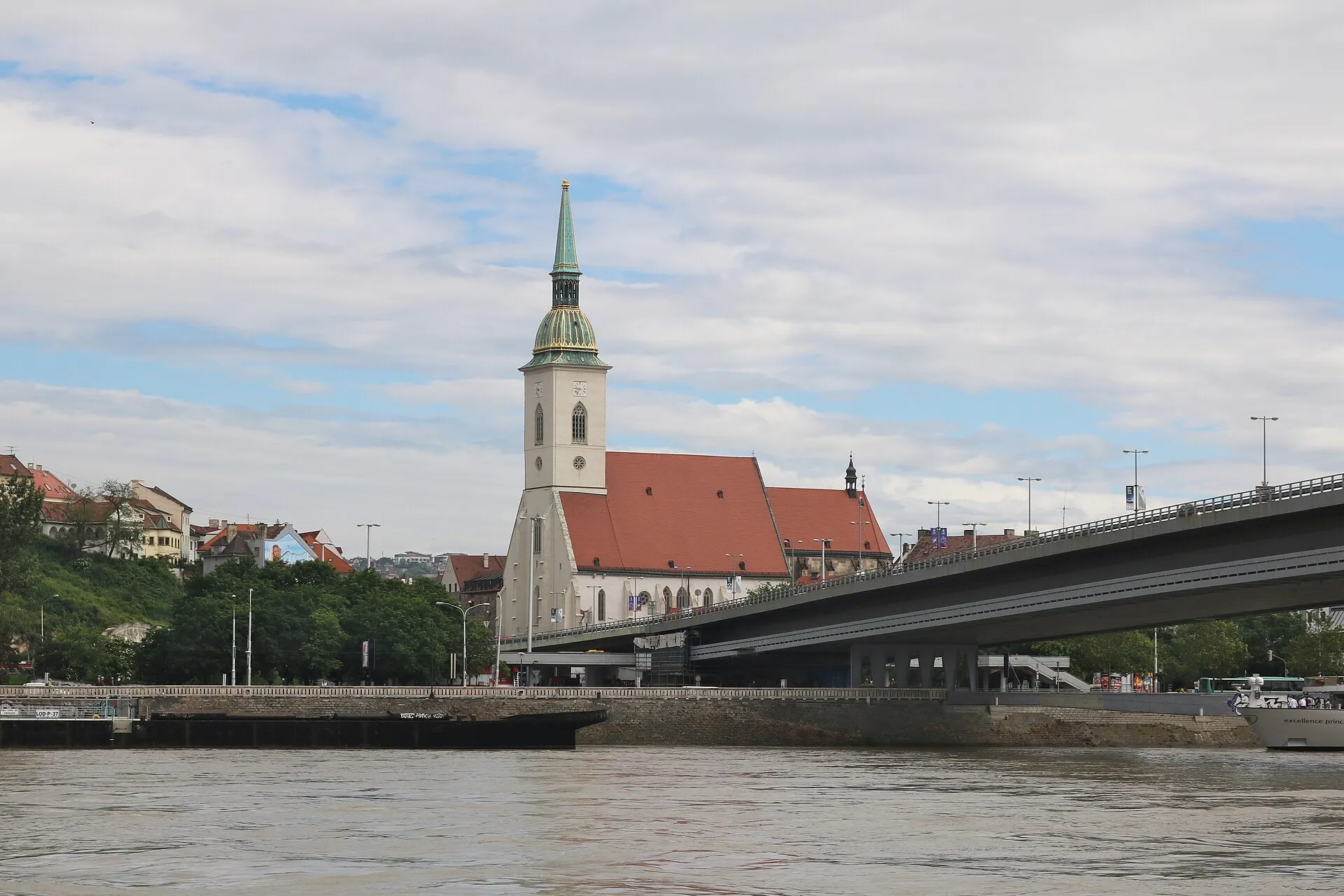
💡 The Short Version: Standing at Rudnayovo námestie 1 at the base of the castle hill, St Martin’s Cathedral (Katedrála svätého Martina) is a Gothic hall church and the coronation cathedral of the Kingdom of Hungary from 1563 to 1830. The main nave is free to visit Monday to Friday from 09:00 to 11:30 and 13:00 to 18:00 (Saturday afternoons from 13:45; Sundays 13:30 to 16:30). A €5 ticket (€2.50 student) grants entry to the treasury, the crypt and the choir gallery. The 85-metre spire is capped by a 300-kilogram gilded royal crown. Or book a tour: an Old Town and castle walking tourad from €2.10 or a guided Old Town walk with wine tastingad from €55 is sold on GetYourGuide.
⚠️ The cathedral closes to tourists between 11:30 and 13:00 daily. Visiting is also suspended during Mass, including the daily morning Mass, Sunday morning services and Saturday weddings. Plan your visit for early morning (09:00 to 11:00) or mid-afternoon (14:00 to 17:00).
Opening hours and visiting schedule
St Martin’s is an active Roman Catholic parish and cathedral seat administered by the Parish of St Martin. Visiting hours are scheduled around liturgical worship:
| Day of the Week | Morning Tourist Visiting | Afternoon Tourist Visiting | Liturgical Services (No Touring) |
|---|---|---|---|
| Monday to Friday | 09:00 to 11:30 | 13:00 to 18:00 (17:30 in winter) | 07:00 Mass, 12:00 Mass |
| Saturday | 09:00 to 11:30 | 13:45 to 18:00 | Morning weddings & evening vigil |
| Sunday | Closed to tourists | 13:30 to 16:30 | 07:30, 09:00, 10:30 & 12:00 Masses |
Silence must be maintained inside the nave. Mobile phones must be switched to silent, shoulders and knees should be covered, and photography without flash is permitted in the free nave areas.
Ticket prices for the paid areas
The Gothic nave, the main altar and the Donner statue of St Martin are free to see. The vaults and treasury need a ticket from the sacristy desk inside the cathedral:
| Section | Price | Details and Inclusions |
|---|---|---|
| Main Gothic Nave & Aisles | Free | The nave and aisles outside Mass |
| Paid Area (Treasury, Crypt & Choir) | €5.00 | Adult ticket to parish treasury, crypt and upper gallery |
| Students | €2.50 | Student ID required |
| Schoolchildren (under 15 years) | Free | When accompanied by an adult |
| Guided Group Supplement | €5.00 | Per person in group; guide headsets provided |
Payments for the paid area can be made in cash in euros (€) or via contactless card at the parish desk.
The Gothic rib-vaulted nave inside St Martin’s Cathedral. Photo: Lure, Wikimedia Commons, CC BY-SA 3.0.
Guided tours featuring St Martin’s Cathedral
Guided walking tours of the historic centre pass the cathedral and cover its coronation history.
Old Town and castle walking tour
From €2.10 · 4.7 stars from 929 reviews · 165 minutes · Old Town and castle
A guided walking tour of Bratislava’s Old Town and castle area. Bratislava: Old Town and Castle Walking Tourad
Old Town walking tour with Slovak wine tasting
From €55 · 5 stars from 18 reviews · 2.5 hours · wine tasting, groups of up to 8
A walk from the castle to the Old Town with a licensed local guide, in a group of up to eight, ending with Slovak wine at a historic winery. Bratislava: Old Town Walking Tour with Slovak Wine Tastingad
Old Town & Blue Church walking tour
From €25 · 5 stars from 3 reviews · 1.5 hours · Blue Church
A walking tour of the Old Town that includes the Blue Church, led by a local guide. Bratislava: Old Town & Blue Church Walking Tourad
Free entry vs guided tour: comparison table
| Option | Cost | What to Expect |
|---|---|---|
| Independent nave visit | Free | Step inside during opening windows to see the Gothic vaulting and the Donner statue |
| Paid treasury and crypt ticket | €5.00 per adult | Liturgical gold, episcopal vestments and Pálffy family tombs |
| Guided historical walk | From €2.10 | Royal coronations, Maria Theresa and the city walls |
| Small-group walk with wine | From €55.00 | Ecclesiastical history, then Slovak wine tasting |
The coronation church of the Kingdom of Hungary
The Ottoman army under Sultan Suleiman the Magnificent defeated the Hungarian royal army at the Battle of Mohács in 1526 and captured Buda in 1541, and the Kingdom of Hungary was partitioned. Pressburg (modern Bratislava), protected by its castle and close to Vienna, became the temporary administrative capital and coronation city:
- Coronation Span (1563–1830): For nearly three centuries, St Martin’s hosted the coronations of the Hungarian monarchy.
- Nineteen Royal Coronations: Eleven kings and eight royal consorts were crowned here. The first monarch was Maximilian II, crowned King of Hungary on 8 September 1563. The best known is Archduchess Maria Theresa, crowned Queen of Hungary on 25 June 1741, a ceremony that secured Hungarian noble support for her reign during the War of the Austrian Succession. The final coronation was that of Ferdinand V in 1830.
- The Procession Route: After the ceremony in the sanctuary, the new monarch walked in imperial robes through the Old Town to the Franciscan Church to dub new knights of the Golden Spur, then to the banks of the Danube to ride a white stallion up the Coronation Hill (Korunovačný vŕšok) and slash a sword to the four cardinal directions, swearing to defend the realm. Brass crown markers embedded in the cobblestones trace the procession from the cathedral to Main Square.
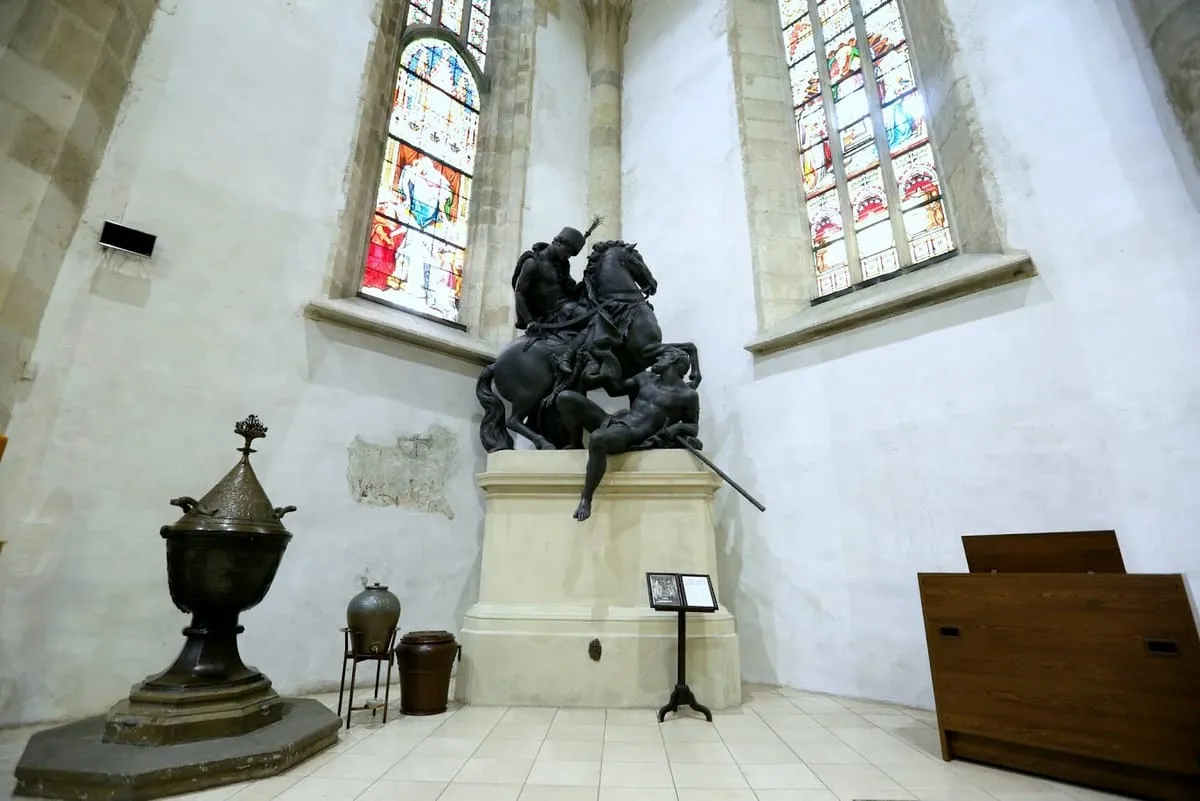
Georg Rafael Donner’s lead sculpture of St Martin and the Beggar inside the cathedral. Photo: Thaler Tamas, Wikimedia Commons, CC BY-SA 4.0.
Architecture and interior treasures
St Martin’s is a hall church (Hallenkirche) built mainly between 1311 and 1452, replacing an earlier Romanesque church:
1. The Gothic Hall Nave
The interior has three parallel aisles of equal height, with eight pairs of octagonal stone pillars carrying Gothic star and reticulated vaults. The stained-glass windows in the presbytery, installed during extensive 19th-century neo-Gothic restorations, depict scenes from the lives of Saint Martin, Saint Stephen and Hungarian saints.
2. Georg Rafael Donner’s St Martin and the Beggar
In the south-western corner of the right aisle stands the equestrian group St Martin and the Beggar, cast in 1734 by the Austrian court sculptor Georg Rafael Donner:
- Material and Composition: Cast from an alloy of lead and tin, the sculpture shows Saint Martin of Tours as a young Hungarian hussar officer in Hungarian military dress on horseback. He uses his cavalry sabre to cut his woollen cloak in two to clothe a beggar at his horse’s hooves.
- Original High Altar: The sculpture was the centrepiece of the baroque high altar commissioned by Archbishop Imre Esterházy. During 19th-century Gothic restorations the baroque altar was dismantled; the flanking lead angels went to the Hungarian National Gallery in Budapest, and the equestrian group stayed in the cathedral.
3. The Chapel of St John the Merciful
Commissioned by Archbishop Esterházy in 1732 and designed by Georg Rafael Donner, this baroque burial chapel adjoins the northern side of the presbytery. Clad in red Salzburg and Austrian marbles with gilded stuccoes, it holds the silver reliquary chest containing the preserved bodily remains of Saint John the Merciful, the 7th-century Patriarch of Alexandria.
4. The Underground Crypts
Accessible with the €5 paid ticket, a stone stairway descends into the subterranean catacombs excavated beneath the chapel. The vaults contain four separate burial crypts, notably including the resting places of the noble Pálffy family (hereditary captains of Bratislava Castle), several archbishops of Esztergom including Cardinal Péter Pázmány (founder of Trnava University), and prominent church canons.
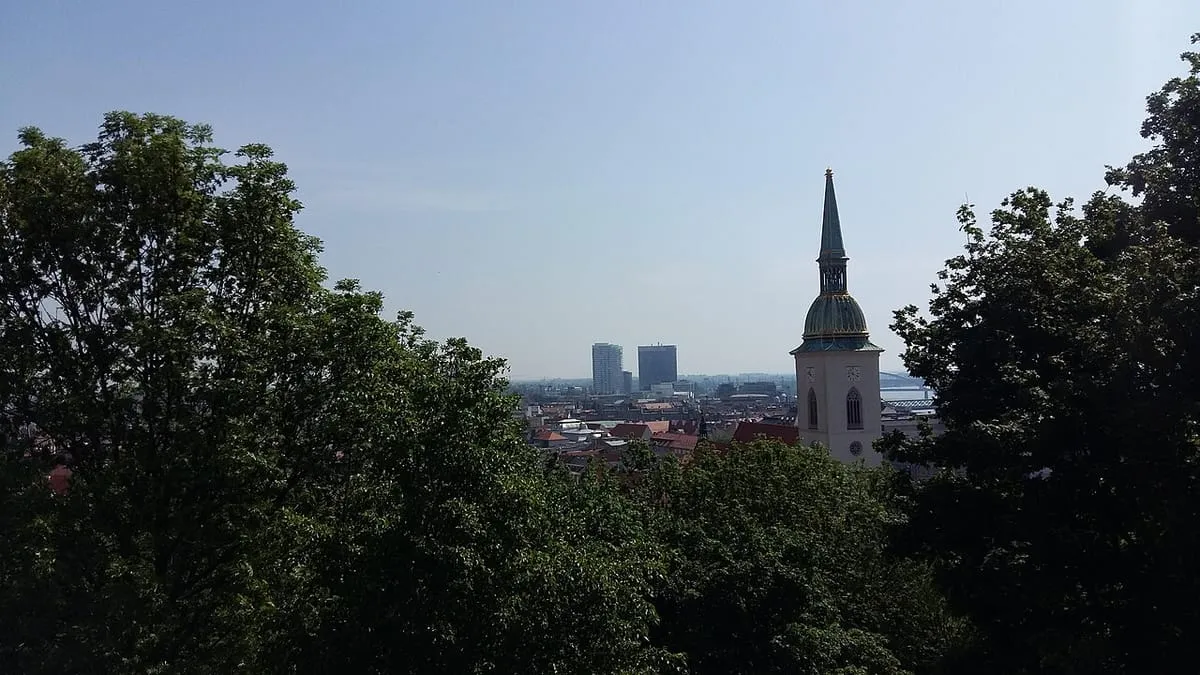
The Gothic spire of St Martin’s Cathedral from the castle hill. Photo: Radosław Botev & Sylwia Botev, Wikimedia Commons, CC BY 3.0 pl.
The 85-metre tower and the Golden Crown
The tower was part of the city’s defences:
- Built into the City Walls: The western edge of the cathedral abutted the city moat, so the 85-metre tower was built into the fortifications as a bastion and watchtower. The cathedral has no western portal; entry was only through reinforced northern and southern side doorways.
- The 300-kg Golden Crown: The neo-Gothic pyramid spire is capped not by a Christian cross, but by a gilded wooden cushion measuring 2 by 2 metres, upon which rests a handcrafted, 164-centimetre-tall gilded copper replica of the sacred Crown of St Stephen weighing 300 kilograms. Originally hoisted into position in 1846 to mark the cathedral’s royal heritage, the crown was lowered and regilded with eight kilograms of pure gold leaf during restoration in 2010.
Practical visiting advice
- Dress Code: St Martin’s is an active Catholic church, so dress modestly. Men remove hats on entering, and low-cut tops, sleeveless shirts and very short skirts or shorts should be covered.
- Timing Your Arrival: Enter between 09:00 and 10:00 for the light through the eastern presbytery windows.
- Pedestrian Access: The cathedral is located at Rudnayovo námestie 1, at the corner of Židovská and Panská streets. Directly adjacent to the cathedral’s west wall runs Staromestská street and the pedestrian overpass leading up to Bratislava Castle.
What to see next
- Bratislava Castle: the pedestrian steps lead from the cathedral up to the castle.
- Old Town Hall and Main Square: follow the brass coronation crowns through the Old Town streets.
- Michael’s Gate and Tower: the northern medieval gatehouse.
- UFO Tower Bratislava: the pedestrian walkway beside the cathedral leads across the bridge to the south bank.
- Bratislava City Hub: all Bratislava city guides.
Common questions
Is St Martin's Cathedral in Bratislava free to enter?
Yes. The central Gothic nave, the side aisles and the Chapel of St Anne are free to enter outside service hours. The paid treasury, crypt and choir gallery area costs €5 for adults and €2.50 for students.
What are the visiting hours for tourists at St Martin's Cathedral?
The cathedral is open for tourist visits Monday to Friday from 09:00 to 11:30 and from 13:00 to 18:00 (closing at 17:30 in winter). On Saturdays the afternoon opening is at 13:45. On Sundays, visiting is from 13:30 to 16:30. The interior closes to sightseeing during Catholic Mass, weddings and rehearsals.
Why is St Martin's Cathedral called the coronation church?
Between 1563 and 1830, when the Ottoman Turks occupied Hungary's capital of Buda, Bratislava became the royal capital of Hungary. Nineteen Habsburg monarchs (eleven kings, including Maximilian II and Maria Theresa, and eight queens consort) were officially crowned in this cathedral.
What is on top of the cathedral tower?
Instead of a traditional cross, the 85-metre cathedral spire is crowned by a 300-kilogram gilded replica of the sacred Crown of St Stephen, resting upon a 2x2-metre gilded pillow.
Where is the statue of St Martin cutting his cloak?
In the right-hand corner of the southern side aisle. It is a baroque lead sculpture cast in 1734 by the Austrian sculptor Georg Rafael Donner.