In this guide
- Journey time: 33 minutes on direct LTG Link trains from Vilnius Central Station, followed by a 25-minute lakefront walk to the castle footbridge.
- Tickets & admission: €14 adult (€7 students and seniors) from April to September; €12 adult (€6) from October to March, from trakaimuziejus.lt.
- Opening hours: Daily 10:00 to 19:00 May to September; Tuesday to Sunday 10:00 to 18:00 in March, April, October and November; Wednesday to Sunday 10:00 to 18:00 December to February (trakaimuziejus.lt).
- Or book a tour: Vilnius: Trakai Tour with Audio Guide and Minibus Transfersad (from €30, 4.3 stars from 1,561 reviews) is a 4-hour audio-guided trip with minibus transfers from Vilnius, so you do not need to work out the train or bus.
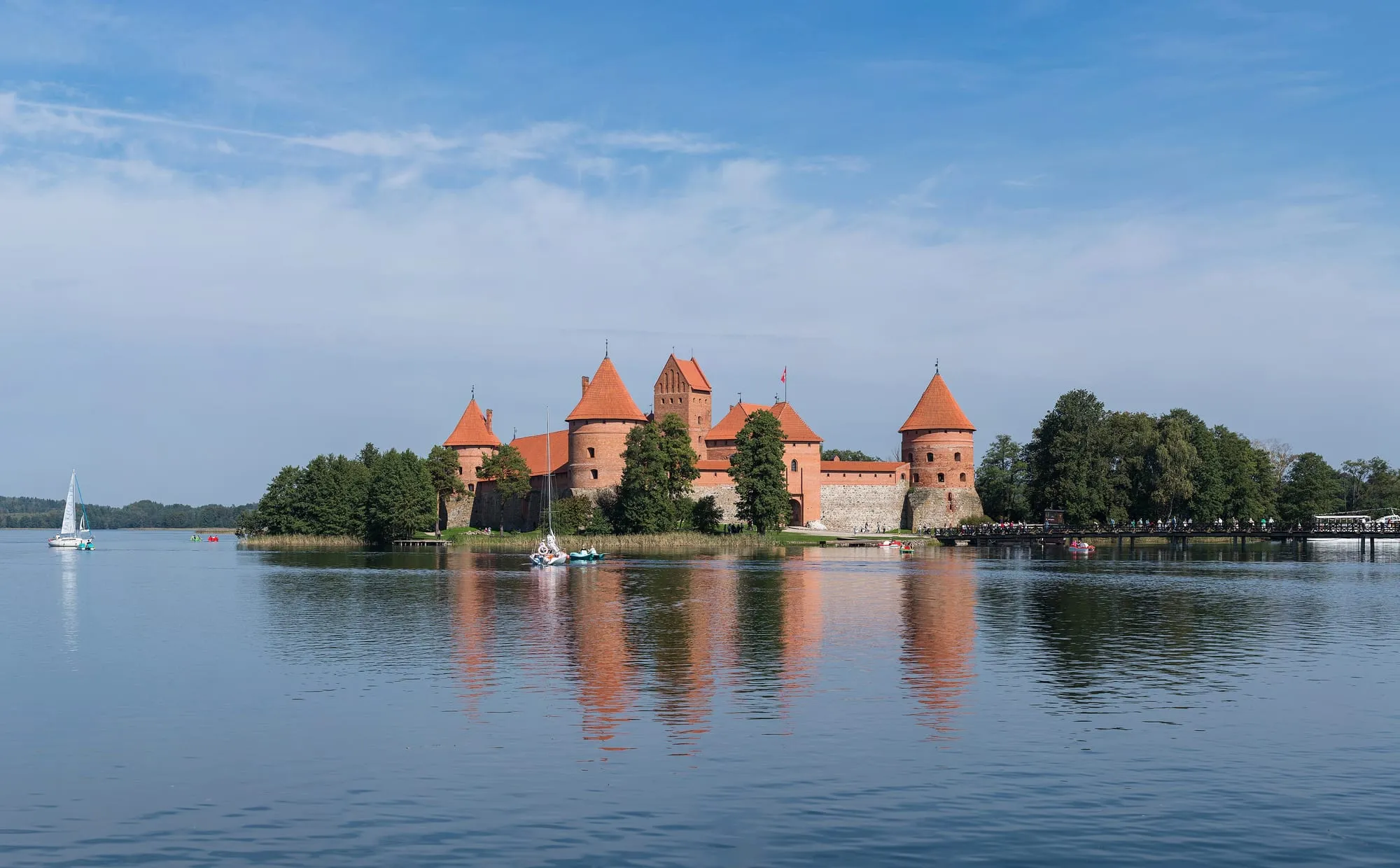
Trakai Island Castle (Trakų salos pilis) stands on an islet in Lake Galvė, roughly 28 kilometres west of Vilnius. Built in the late fourteenth and early fifteenth centuries by Grand Duke Kęstutis and completed by his son Vytautas the Great, it served as a stronghold against the Teutonic Order and later as a residence of the Grand Duchy of Lithuania.
Its red-brick bastions, moat and defensive galleries rise straight out of the lake. Trakai is also home to the Karaites, a Turkic-speaking ethno-religious group brought here from Crimea over six centuries ago, whose wooden cottages and cooking remain part of the town’s identity.
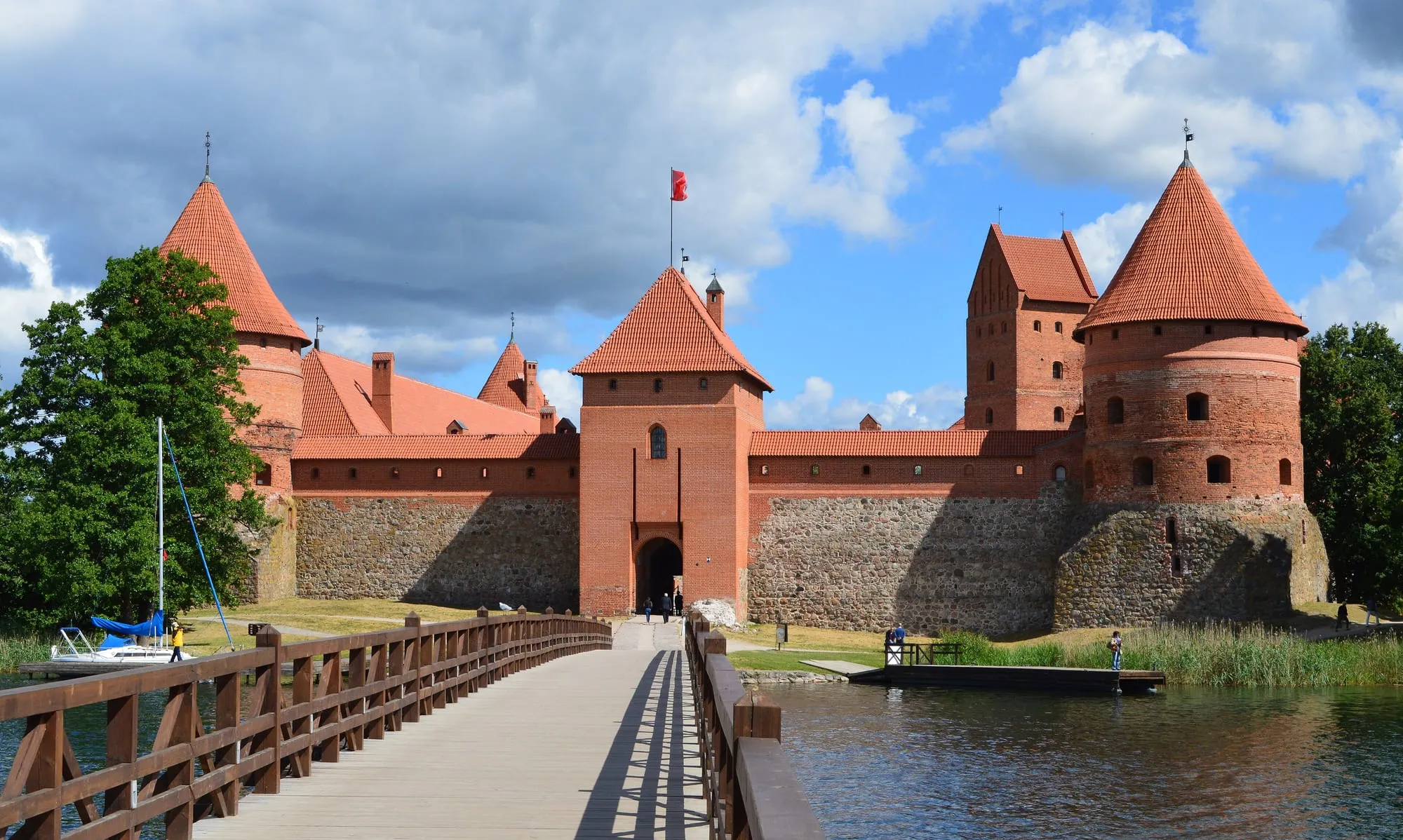
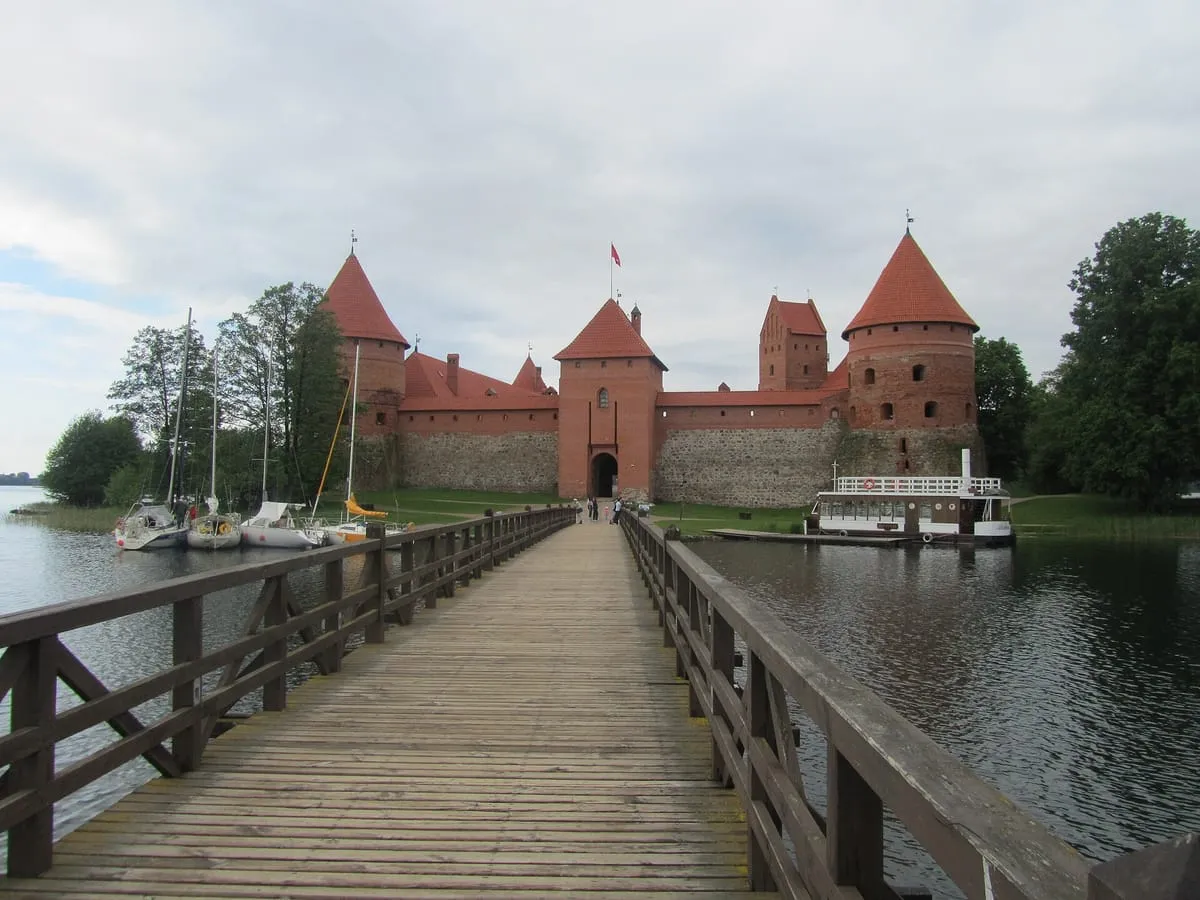 The wooden footbridge across Lake Galvė to Trakai Island Castle. Photo: Reza1615, Wikimedia Commons, CC BY-SA 3.0.
How to get to Trakai from Vilnius
You can go independently by train or bus, or take a tour.
By train (LTG Link)
- Departure: Vilnius Central Railway Station (Vilniaus geležinkelio stotis, Geležinkelio g. 16), 10 minutes’ walk from the Old Town or reached by public transport.
- Journey time: 33 minutes on direct LTG Link commuter trains.
- Frequency: Trains run roughly every 60 to 90 minutes, from early morning to mid-evening.
- Buy tickets at the station desks, the ticket machines, or on the LTG Link website and app.
- Walking from Trakai station: The station is on the southern edge of town. Follow Vytauto street north along the lake shore towards the castle. The walk is 2.2 kilometres, 25 to 30 minutes, past town parks, the Peninsula Castle ruins and the Karaimų street promenade. Local minibuses also link the station with the castle stop.
By suburban bus
Suburban buses depart from Vilnius Central Bus Station (Vilniaus autobusų stotis, Sodų g. 22), located directly across the square from the railway station:
- Frequency: Minibuses and coaches run every 20 to 30 minutes towards Trakai.
- Journey time: 35 to 45 minutes depending on traffic along the Savanorių avenue artery.
- Bus stop: The bus station in Trakai is slightly north of the railway station, which saves about 5 minutes of the walk to the castle.
| Transport Option | Journey Time | Practical Details |
|---|---|---|
| Train | 33 minutes | From Vilnius Central Station, about every 60 to 90 minutes |
| Bus | 35 to 45 minutes | From Vilnius bus station, every 20 to 30 minutes |
| Minibus tour with audio guide | 4 hours in total | Round trip from Vilnius, from €30 |
Tickets, entry fees and opening hours
The castle is run by the Trakai History Museum (Trakų istorijos muziejus). A ticket covers the gatehouse, the inner courtyard, the ducal palace and the permanent exhibitions in the brick vaults.
Admission prices
- April to September:
- Adults: €14.00
- Students and seniors: €7.00
- October to March:
- Adults: €12.00
- Students and seniors: €6.00
- Combined ticket: From April to September, a joint ticket for Trakai Island Castle and the Peninsula Castle is €17 for adults and €9.50 for students and seniors.
- Family ticket: From April to September €20 for 1 adult and up to 3 children, €30 for 2 adults and up to 3 children; from October to March €16 and €25 (trakaimuziejus.lt).
Opening hours
- May to September: Daily 10:00 to 19:00.
- March, April, October and November: Tuesday to Sunday 10:00 to 18:00 (closed Mondays).
- December to February: Wednesday to Sunday 10:00 to 18:00 (closed Mondays and Tuesdays).
- Last admission: 30 minutes before closing (trakaimuziejus.lt).
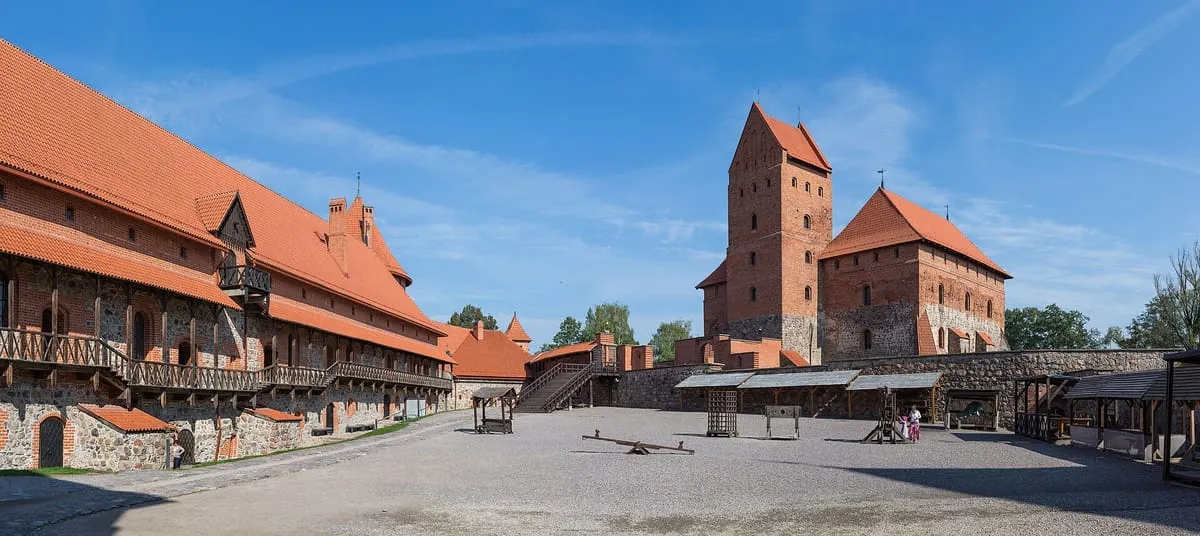 The inner brick courtyard and residential galleries of Trakai Castle. Photo: Diliff, Wikimedia Commons, CC BY-SA 3.0.
Exploring the castle interior
Access to the island fortress begins across a 300-metre twin wooden footbridge spanning Lake Galvė from the mainland. The fortress is divided into two primary zones: the outer defensive bailey (priešpilis) and the raised central palace (donžonas).
The outer bailey and casemates
The outer courtyard is defended by semi-circular brick bastions and high curtains. Historically, this area housed the garrison, horse stables, armouries, and food storehouses. Today, the perimeter casemates display medieval archaeological finds uncovered during the twentieth-century restoration, including fourteenth-century crossbow bolts, siege cannonballs, ornamental ceramics, and glass fragments from ducal feasts.
The ducal palace and Great Hall
A wooden drawbridge crosses a defensive moat that separates the outer yard from the inner stronghold. Inside, the palace rises four storeys around a small courtyard bordered by covered timber balconies:
- The Great Hall (Didžioji menė): The vaulted reception chamber on the upper floor has Gothic ribbed vaulting, restored stained glass and portraits of Grand Duke Vytautas and Lithuanian rulers.
- Treasury and coin collections: Displays showcase medieval silver bars (lietuviški ilgieji), royal seals, and mintings from the Grand Duchy’s mint in Vilnius.
- Religious art and craft exhibitions: Rooms in the southern wing hold collections of eighteenth- and nineteenth-century sacred art, liturgical silver, and porcelain imported by noble families of the Polish-Lithuanian Commonwealth.
Karaite heritage and Kibinai
The Karaites (karaimai) are the other reason to visit Trakai. In 1397–1398, Grand Duke Vytautas brought several hundred Karaite families from the Crimean peninsula to Lithuania. They served as his personal bodyguard and as defenders of the palace.
The Karaites are a Turkic ethnic group who practice Karaite Judaism, following only the Hebrew Bible (Tanakh) while rejecting rabbinic Talmudic traditions. Over six centuries, they maintained their distinctive dialect, customs, and community along Karaimų street.
Karaite wooden architecture
As you walk north along Karaimų street toward the castle bridge, notice the distinctive single-storey wooden houses painted in muted yellows, greens, and ochres:
- The three windows: Tradition holds that every traditional Karaite home was built with three windows facing the street: “one for God, one for Duke Vytautas, and one for the master of the house.”
- The Kenesa: At Karaimų g. 30 stands the wooden Karaite prayer house (Kenesa), rebuilt in the early twentieth century, featuring an octagonal cupola and geometric interior carvings.
- Karaite Ethnographic Museum: Located at Karaimų g. 22, this compact museum displays traditional clothing, ceremonial tableware, family photographs, and weapons documenting the 600-year history of the community in Lithuania.
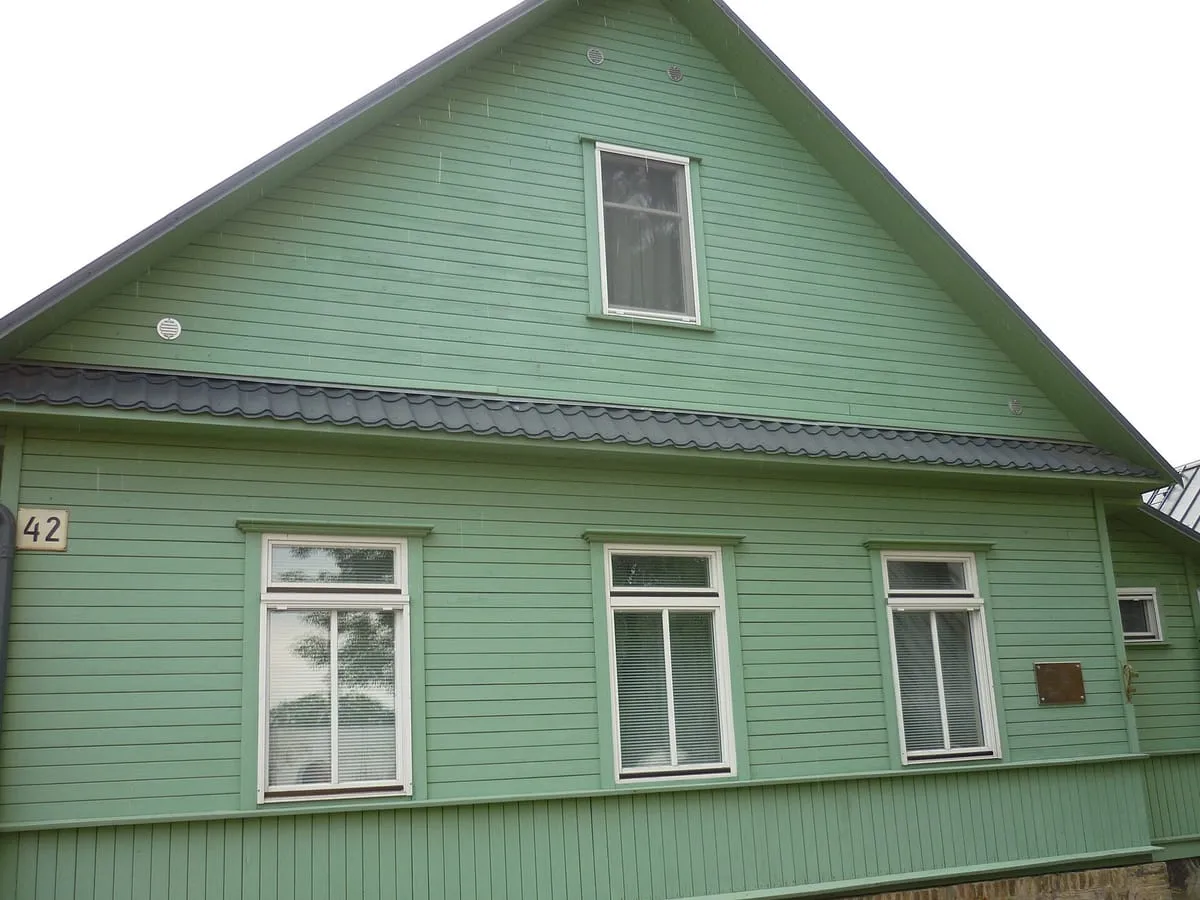 Traditional three-window Karaim wooden houses along Karaimų street. Photo: WiseWoman, Wikimedia Commons, CC BY-SA 4.0.
Where to eat kibinai
Kibinas (plural kibinai) is the dish of Trakai: a hand-crimped pastry traditionally filled with chopped mutton or lamb with onions and black pepper. Pork, poultry, curd cheese and spinach fillings are common today. It is eaten warm with a cup of clear vegetable or meat broth (sultinys).
Where to eat kibinai:
- Kybynlar (Karaimų g. 29): A Karaite restaurant with a lakeside terrace, serving mutton kibinai, Karaite soups and herbal teas.
- Senoji Kibininė (Karaimų g. 65): A tavern serving freshly baked kibinai with crisp, buttery crusts.
- Bona Pizzeria & Lounge (Karaimų g. 53a): Modern seating with a view of the castle across the lake.
Guided tours and organized excursions
Tours skip the train timetables and run from Vilnius to Trakai.
| Tour Option | Price | Duration | Highlights |
|---|---|---|---|
| Minibus tour with audio guide | From €30 | 4 hours | Audio guide and minibus transfers |
| Trakai Castle and Paneriai Memorial | From €110 | 5 to 6 hours | Trakai with the Paneriai memorial park |
| Private half-day tour | From €280 for up to 2 | 4 hours | Guided half-day tour to Trakai |
Vilnius: Trakai Tour with Audio Guide and Minibus Transfers
From €30 · 4.3 stars from 1,561 reviews · 4 hours · audio guide and minibus transfers
Vilnius: Trakai Tour with Audio Guide and Minibus Transfersad: an audio-guided trip to the lakeside town that covers Trakai’s history as a capital of the Grand Duchy of Lithuania and the Insular Castle, with minibus transfers from Vilnius.
From Vilnius: Trakai Castle and Paneriai Memorial Tour
From €110 · 4.7 stars from 129 reviews · 5 to 6 hours · Trakai Castle and Paneriai Memorial
From Vilnius: Trakai Castle and Paneriai Memorial Tourad: a day trip combining Trakai Castle with the Paneriai Memorial Park, where more than 100,000 people were murdered in the Ponary massacre.
Vilnius: Half-Day Sightseeing Tour to Trakai
From €280 for a group of up to 2 · 4.3 stars from 141 reviews · 4 hours · half-day trip to Trakai
Vilnius: Half-Day Sightseeing Tour to Trakaiad: a guided half-day tour to Trakai, covering its development as a capital of the Grand Duchy of Lithuania, the castle and the Gothic old town.
Seasonal tips for visiting Trakai
- Summer (June to August): Pedal boats, kayaks and small sailing dinghies can be hired along the Lake Galvė promenade. Arrive before 11:00 to beat coach tour groups.
- Winter (December to February): The castle is closed Mondays and Tuesdays. In a long cold spell Lake Galvė freezes; check the ice is open to walkers before stepping on it.
- Autumn (September to October): The woods around the lake turn golden-orange.
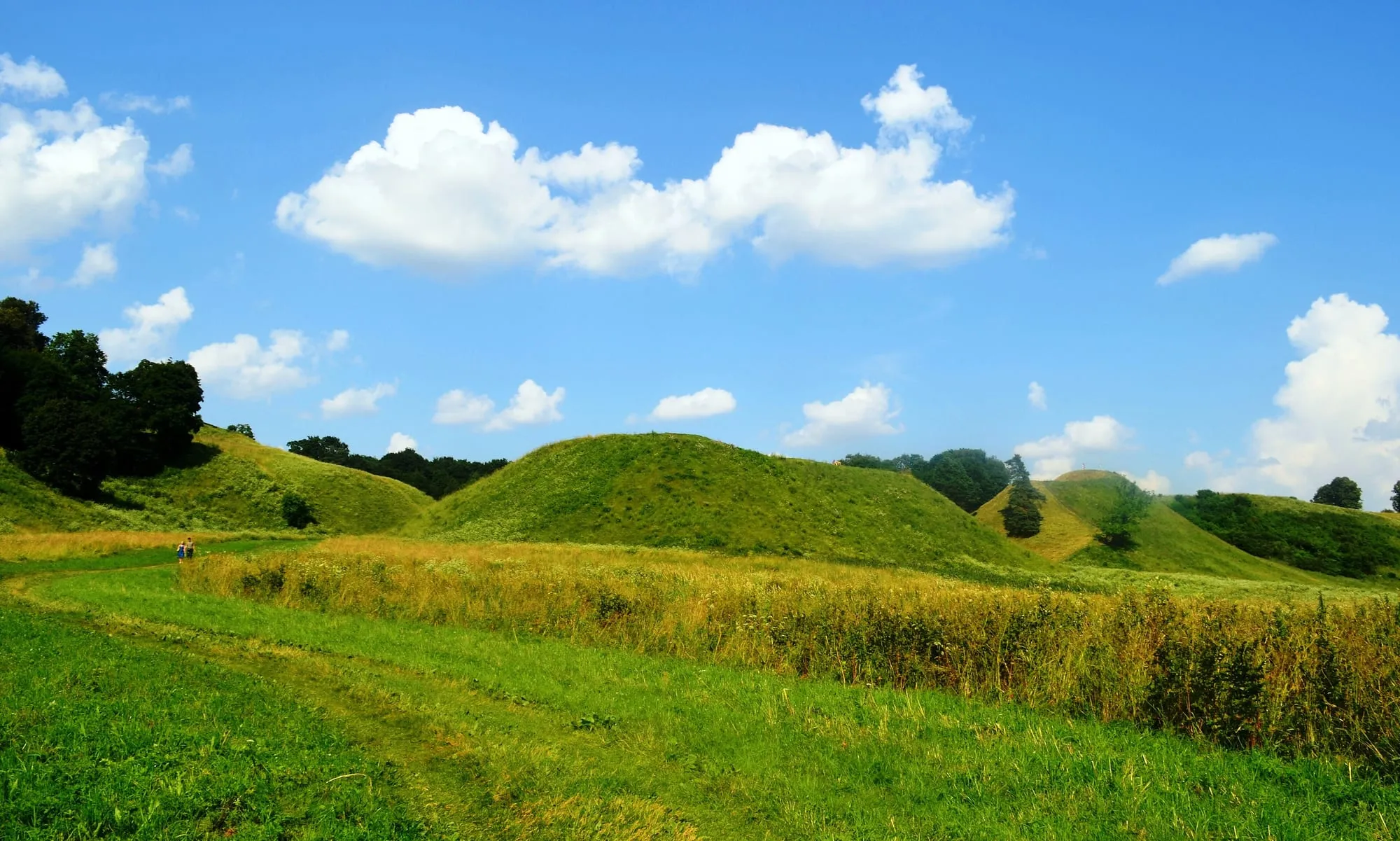
- With other sights: Pair Trakai with a morning at the Palace of the Grand Dukes in Vilnius, to see the city residence of the court that built the lake fortress. More excursions are in day trips from Vilnius, including Kaunas and the prehistoric mounds of Kernavė.
Common questions
How do you travel from Vilnius to Trakai Island Castle?
Take a direct LTG Link train from Vilnius Central Station (33 minutes) or a bus from the Vilnius bus station (35 to 45 minutes). From Trakai station it is a 25-minute walk along Lake Galvė to the footbridge leading to the castle.
How much are tickets to Trakai Island Castle?
Adult admission to Trakai Island Castle costs €14 from April to September and €12 from October to March. Students and seniors pay €7 in summer and €6 in winter.
What are the opening hours of Trakai Island Castle?
From May to September the castle opens daily from 10:00 to 19:00. In March, April, October and November it opens Tuesday to Sunday 10:00 to 18:00, and from December to February Wednesday to Sunday 10:00 to 18:00. Last entry is 30 minutes before closing (trakaimuziejus.lt).
What is the traditional food in Trakai?
The Karaite kibinas (plural kibinai), a savoury crescent pastry filled with hand-cut mutton, pork or cottage cheese, usually served with clear broth at Karaite taverns along Karaimų street.
Can you walk around Trakai Castle without paying admission?
Yes. The wooden bridge and the lake shore are free, and so is the view of the fortress from the shore. Admission is only needed for the inner courtyard, the palace museum and the defensive galleries.
How long should you spend on a Trakai day trip?
Plan for 4 to 5 hours in total: 1.5 hours return travel by train, 1.5 to 2 hours exploring the castle museum and ramparts, and an hour enjoying kibinai by the lakeshore.