In this guide
- Distance & travel: 35 km northwest of Vilnius; 55 to 65 minutes on suburban buses from Vilnius Central Bus Station or 40 minutes by taxi/rideshare.
- Entry & admission: The hillfort mounds and valley trails are free to walk year-round. The Archaeological Museum costs €6.00 adult / €3.00 concession and is free on the last Sunday of the month (kernave.lt).
- UNESCO significance: Five pagan and early medieval earthen hillforts (piliakalniai) overlooking the Pajauta Valley along the Neris River.
- Or book a tour: Vilnius, Trakai and Kernave Private Full-Day Tourad (from €200 for a group of up to 2, 4.8 stars from 65 reviews) links Kernavė, Trakai and Vilnius Old Town in one private day, so there is no public transport to connect them.
Kernavė lies above the Pajauta Valley on the Neris River and covers nearly 195 hectares. UNESCO listed the Kernavė Archaeological Site in 2004 for continuous human settlement from the Epipaleolithic era (9th millennium BC) to the late fourteenth century.
In the thirteenth century Kernavė was the first documented capital of pagan Lithuania, under Grand Duke Traidenis. It was a trade hub and ducal residence protected by five earthen hillforts (piliakalniai). Teutonic crusaders burned the wooden settlements in 1390, and river sediment later buried the medieval valley intact, preserving wooden foundations, craft workshops and pagan graves.
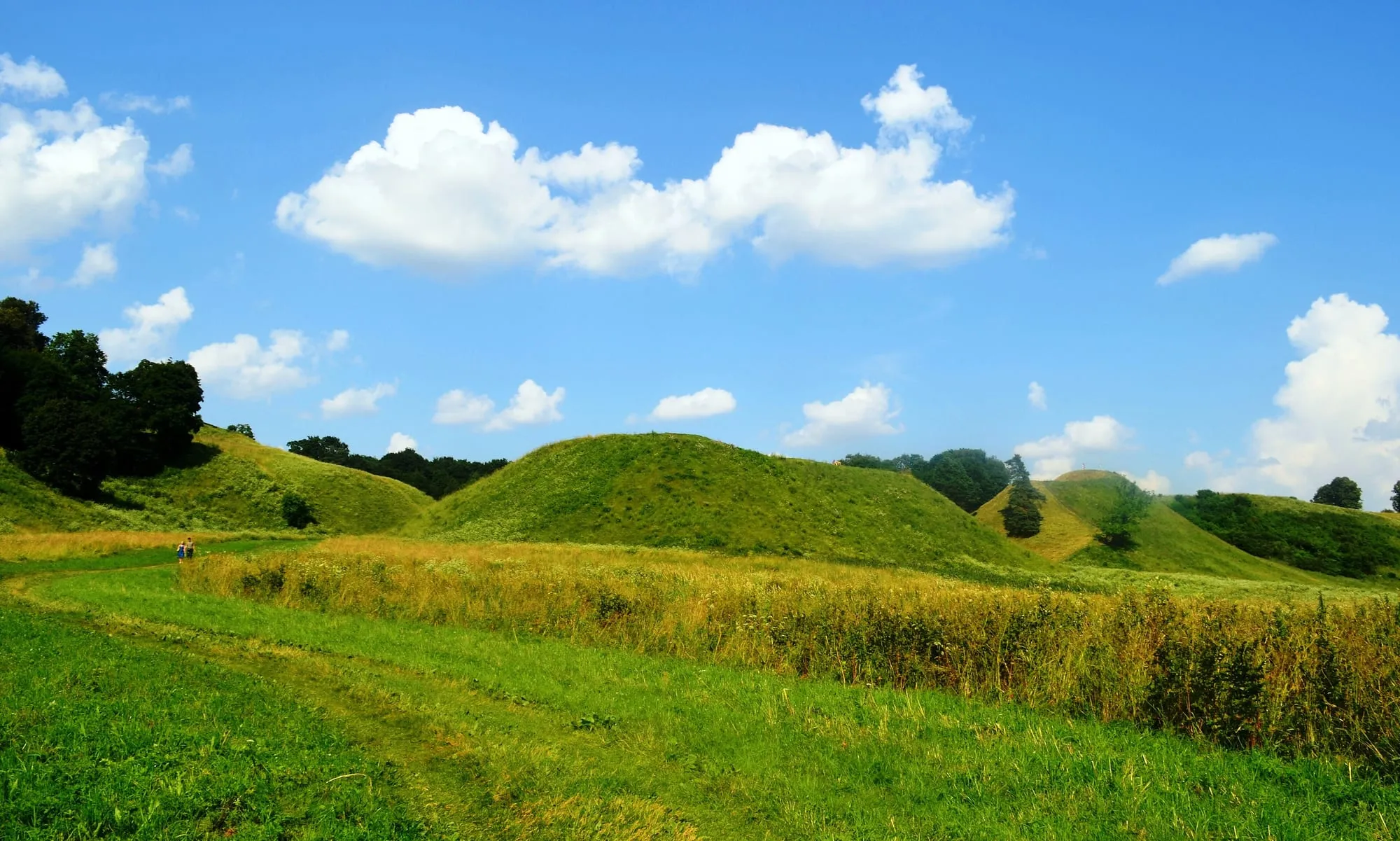
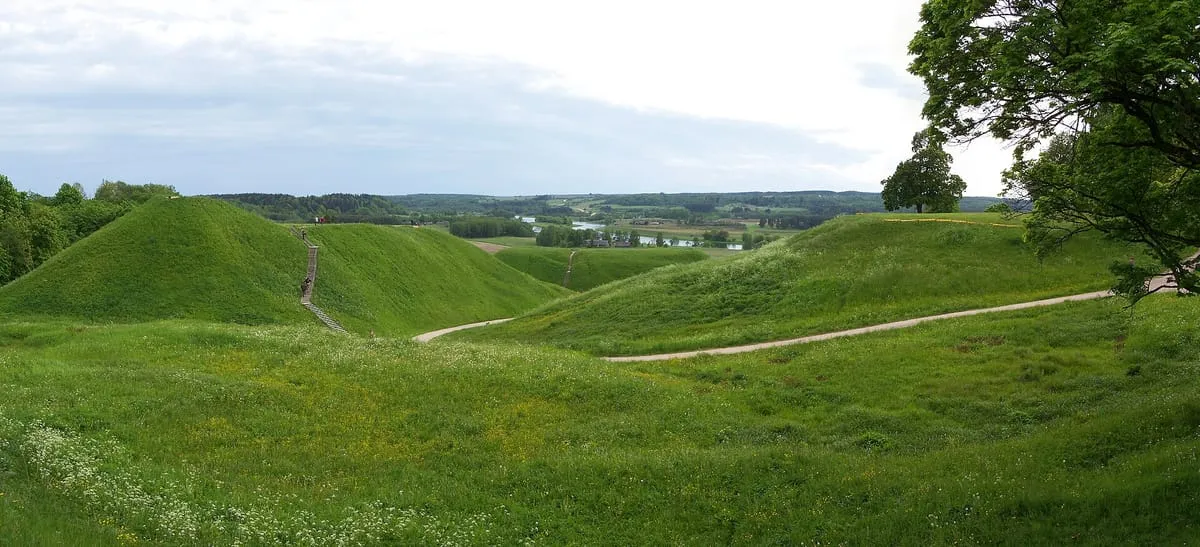 The prehistoric hill forts overlooking the Pajauta Valley. Photo: Lestat (Jan Mehlich), Wikimedia Commons, CC BY-SA 3.0.
How to get to Kernavė from Vilnius
Kernavė works as a half-day trip from Vilnius by public bus, car or guided tour.
By suburban bus from Vilnius
- Departs: Vilnius Central Bus Station (Vilniaus autobusų stotis, Sodų g. 22), typically from platform 10 or 11.
- Carrier: Regional suburban buses operated by Širvintų autobusų parkas or Vilniaus autobusų parkas.
- Journey time: 55 to 65 minutes.
- Frequency: Buses run roughly 5 to 7 times daily on weekdays and Saturdays (starting around 07:30, with departures around 11:00, 14:00, and 17:30). Note that Sunday departures are less frequent (2 to 3 runs daily).
- Tickets: Purchase tickets at the bus station ticket counter or directly from the driver upon boarding.
- Alighting in Kernavė: Buses drop passengers at the central bus shelter in Kernavė village (Vilniaus g.), directly opposite the neo-Gothic church and a 3-minute walk from the museum entrance and hillforts.
- Return tips: Always check the return schedule posted at the Kernavė bus stop upon arrival to plan your walk accordingly.
By car or rideshare
- Driving from central Vilnius via highway A2 or route 171 takes roughly 40 minutes (35 kilometres).
- Free vehicle parking is available adjacent to the museum building on Vilniaus street.
| Transport Option | Journey Time | Typical Cost | Practical Details |
|---|---|---|---|
| Suburban Bus | 55-65 min | Pay at the counter or driver | 5-7 runs daily from bus station plat. 10 |
| Bolt / Taxi | 40 min | App or metered fare | Direct car journey; pre-arrange return |
| Private Full-Day Tour (Tour 62486) | 8 hours | from €200 for a group of up to 2 | Door-to-door transit; combines Trakai |
Exploring the five hillfort mounds
Five steep-sided earthen mounds rise between the upper plateau and the Pajauta floodplain. Wooden steps, boardwalks and gravel paths connect all five summits and protect the turf.
- Aukuro Kalnas (Altar Hill): The oldest fortified mound, occupied continuously from the first millennium BC. Archaeological evidence indicates that a pagan sanctuary and eternal fire altar stood here before Grand Duke Traidenis built his residential wooden manor on the crest in the thirteenth century.
- Mindaugo Sostas (Mindaugas’ Throne): A lookout over river traffic on the Neris.
- Lizdeikos Kalnas (Lizdeika’s Hill): Named in folk legend after Lizdeika, the supreme pagan high priest (Krivių krivaitis) who interpreted Duke Gediminas’ dream of the Iron Wolf. It served as a forward defensive rampart protecting the residential compounds.
- Pilies Kalnas (Castle Hill): Positioned directly at the western edge of the valley, this fortified bastion protected the lower artisans’ settlement from invaders ascending the Pajauta plain.
- Kriveikiškio Piliakalnis (Kriveikiškis Hillfort): Located slightly isolated to the east across the Kernavėlė stream, this auxiliary outpost served as an early warning lookout along the forest fringes.
From the top of Mindaugas’ Throne or Altar Hill you see the loops of the Neris, pine woodland and the Pajauta Valley, where medieval blacksmiths, bone carvers and jewellers once lived.
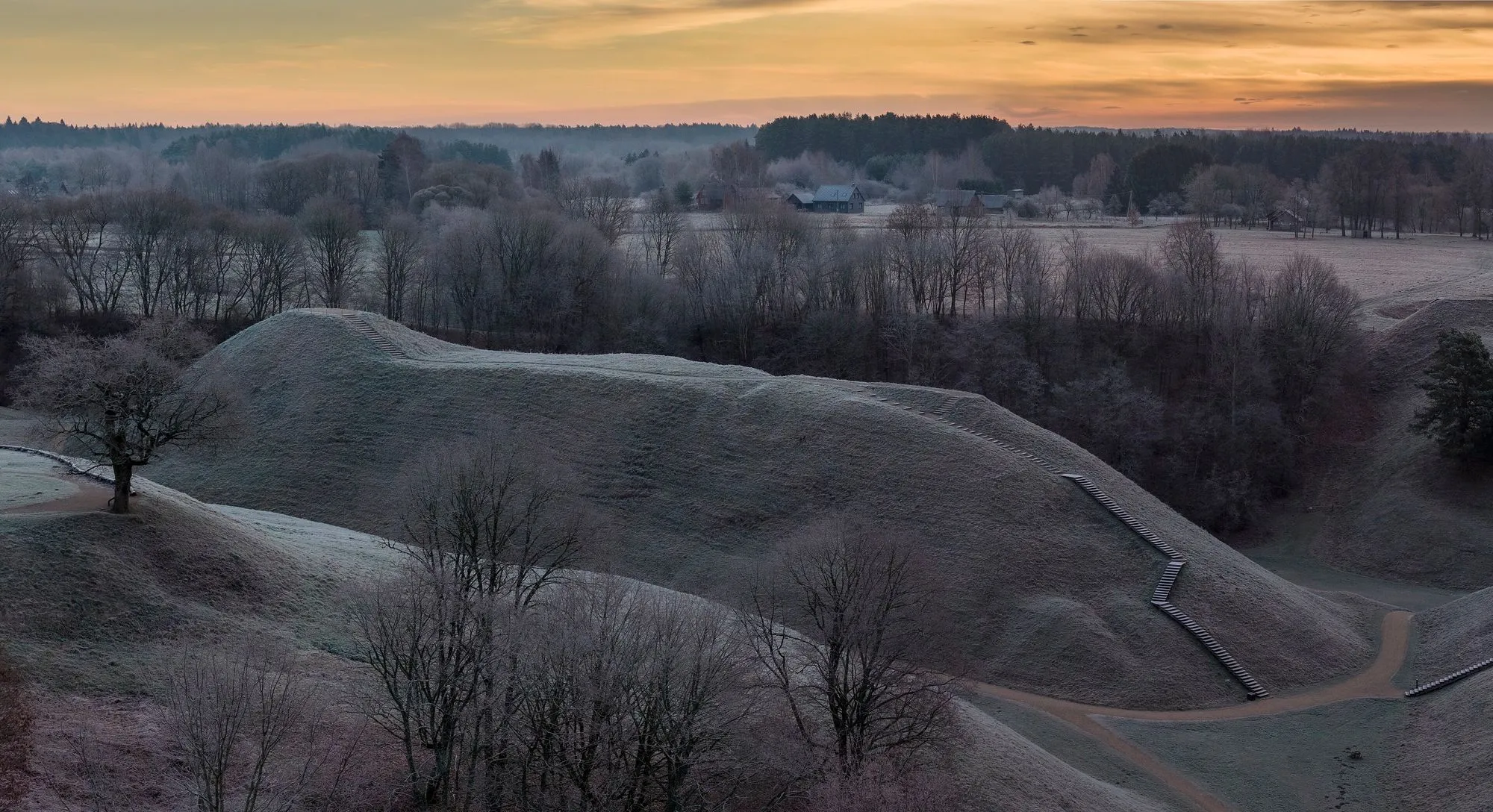 A Kernavė hillfort in winter. Photo: Gytis Grižas, Wikimedia Commons, CC BY-SA 4.0.
Kernavė Archaeological Museum & Open-Air Homestead
The hills are free to walk. The indoor museum and the reconstructed settlement explain what the excavations found.
Kernavė Archaeological Site Museum (Kernavės archeologinės vietovės muziejus)
The museum is at Kerniaus g. 4a. It displays artefacts excavated by Lithuanian archaeologists over five decades:
- Pagan jewellery and silver: Bronze and silver torcs, spiral bracelets and amber amulets worn by Lithuanian nobles before Christianisation.
- Weaponry: Fourteenth-century crossbow bolts, battleaxes, iron stirrups and chainmail fragments from the Teutonic sieges.
- Everyday life: Leather footwear, bone dice, wooden bowls and trade seals from Kievan Rus, Novgorod and Central Europe, which show Kernavė’s reach as a trading town.
- Admission: €6.00 adult, €3.00 students and seniors, €12.00 family ticket (1-2 adults and up to 3 children). Free on the last Sunday of each month (kernave.lt).
- Opening hours (kernave.lt):
- April to October: Tuesday to Sunday 10:00 to 18:00.
- November to March: Tuesday to Sunday 10:00 to 16:00.
- Closed Mondays and on some public holidays.
The reconstructed medieval homestead
Outdoors between the museum and the hillforts, the open-air museum recreates a thirteenth-to-fourteenth-century Kernavė artisan quarter from the excavations:
- Three timber log homesteads inside a palisade.
- Workstations for iron smelting, bone carving and tar distillation.
- It is included in your museum ticket and open only from April to October (kernave.lt).
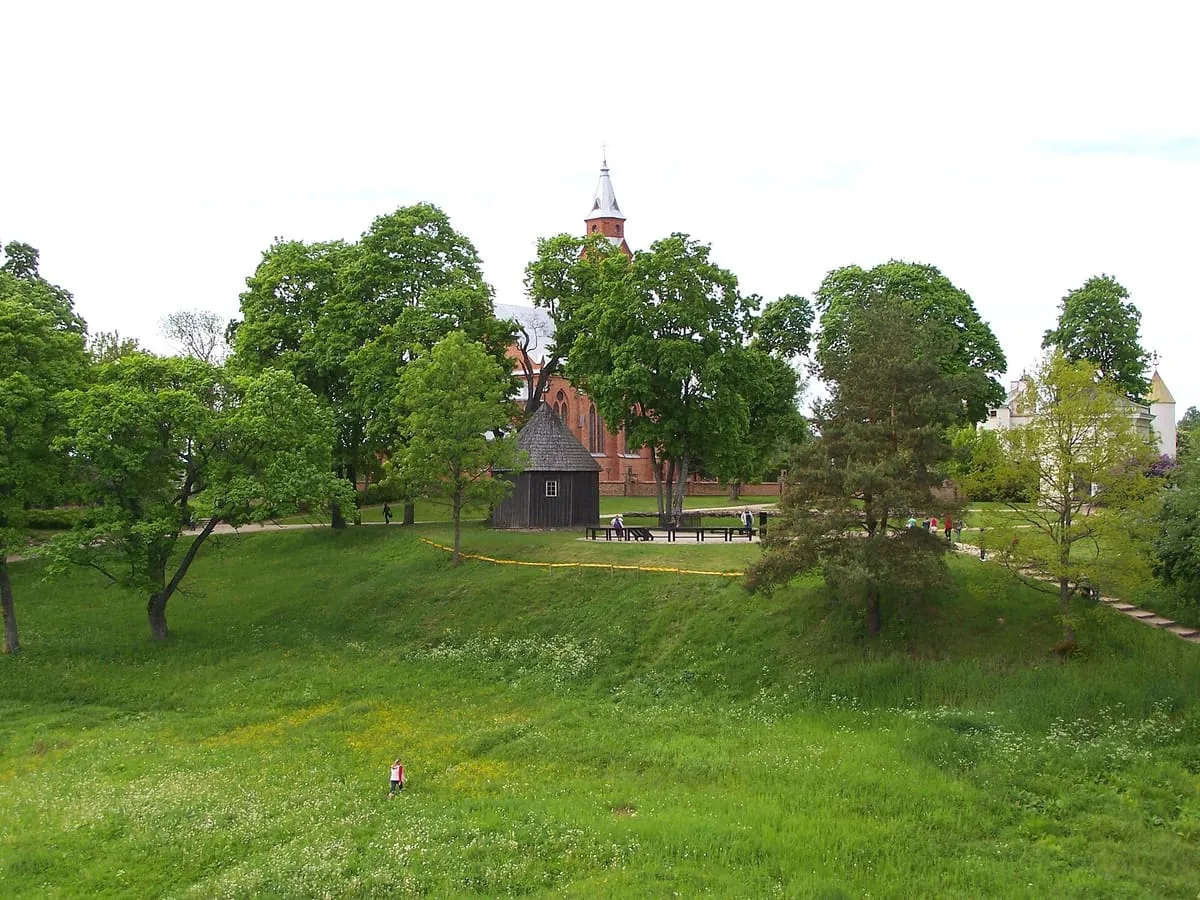 The Church and historic wooden chapel in Kernavė. Photo: Lestat (Jan Mehlich), Wikimedia Commons, CC BY-SA 3.0.
Kernavė village and church ensemble
Beside the archaeological entrance on the upper village square stands the historic ecclesiastical ensemble:
- Church of the Assumption of the Blessed Virgin Mary: A neo-Gothic red-brick church consecrated in 1920, with stained-glass windows and an open churchyard.
- Stone Chapel of the Romer Family: A classicist stone mausoleum with the tombs of the Romer family, who owned the Kernavė manor in the nineteenth century.
Festivals
Kernavė hosts an international living-history festival, the Days of Live Archaeology, where re-enactors, bronze-casters, potters and medieval warriors from across Europe recreate prehistoric and medieval crafts, music and tournaments. Dates are published on kernave.lt.
Guided excursions from Vilnius
A tour avoids the rural bus timetables and combines Kernavė with other sights.
| Tour Option | Price | Duration | Route & Key Sights |
|---|---|---|---|
| Vilnius, Trakai & Kernavė Tour (GYG 62486) | from €200 for a group of up to 2 | 8 hours | Kernavė hillforts and Trakai Castle |
| Paneriai, Trakai & Kernavė Tour (GYG 139334) | from €190 | 7 hours | Paneriai forest memorial, Trakai and the Kernavė mounds |
Vilnius, Trakai and Kernave Private Full-Day Tour
From €200 for a group of up to 2 · 4.8 stars from 65 reviews · 8 hours · private; Kernavė, Trakai and Old Town
Vilnius, Trakai and Kernave Private Full-Day Tourad: a private day through three towns central to Lithuania’s history: Kernavė and its UNESCO-listed hill forts, Trakai and its island castle, then Vilnius Old Town.
From Vilnius: Hill of Crosses, Pakruojis Manor & Kernavė …
From €300 for a group of up to 2 · 4.8 stars from 8 reviews · 8 hours · Hill of Crosses, Pakruojis Manor, Kernavė
From Vilnius: Hill of Crosses, Pakruojis Manor & Kernavė …ad: a day trip to the Hill of Crosses, Pakruojis Manor and Kernavė.
From Vilnius/Kaunas: Anykščiai, Labanoras & Kernavė Tour
From €179 · 5.0 stars from 1 review · 11 hours · Kernavė, Treetop Path, observatory
From Vilnius/Kaunas: Anykščiai, Labanoras & Kernavė Tourad: a day trip from Vilnius or Kaunas to Kernavė, the Treetop Path and the Molėtai Astronomical Observatory.
Practical advice for your visit
- What to bring: Water and snacks, as places to eat in Kernavė village are limited outside peak summer weekends. Kernavės Bajorynė near the highway and Asociacija Šeimyniškių Karčema serve cepelinai and roast game.
- Timing: Allow 2.5 to 3 hours to walk the hillfort loop, see the museum and the reconstructed homestead.
- Combining with other sights: Pair Kernavė with an afternoon at Trakai Island Castle, or go back to Vilnius for Gediminas Tower. For the other excursions, see day trips from Vilnius or the Vilnius city hub.
Common questions
How far is Kernavė from Vilnius?
Kernavė is approximately 35 kilometres northwest of Vilnius along the right bank of the Neris River, taking roughly 40 minutes by car or 1 hour by direct suburban bus.
How do you get from Vilnius to Kernavė by bus?
Suburban buses operated by Širvintų autobusų parkas depart from Vilnius Central Bus Station (usually platform 10 or 11) roughly 5 to 7 times daily on weekdays and Saturdays. The trip takes around 60 minutes. Sunday services are limited, so verify return timetables before departing.
Is there an entry fee to visit the Kernavė hillforts?
No. The outdoor archaeological reserve—including the five ancient hillfort mounds, walking trails, wooden staircases, and panoramic viewpoints over the Pajauta Valley—is open free of charge year-round during daylight. A ticket is needed only for the indoor museum, which includes the open-air medieval homestead.
How much are tickets to the Kernavė Archaeological Museum?
The museum costs €6.00 for adults and €3.00 for students and seniors, with a €12.00 family ticket (1-2 adults and up to 3 children). It is free on the last Sunday of each month (kernave.lt). The hillfort mounds and valley trails are free to walk all year.
Why is Kernavė a UNESCO World Heritage Site?
Inscribed in 2004, Kernavė preserves a 10,000-year sequence of human settlement spanning from the late Paleolithic era through the Middle Ages. Its complex of five defensive earthen hillforts was the first medieval capital of pagan Lithuania before Teutonic raids forced the relocation of the ducal seat to Trakai and Vilnius.
What should you wear when visiting Kernavė?
Wear sturdy, comfortable walking shoes. Exploring the reserve involves climbing several hundred wooden steps connecting the hillfort crests and traversing uneven grassy trails across the Pajauta river valley.