In this guide
💡 The Short Version: Founded by the Jesuits and King Stephen Báthory in 1579, Vilnius University is one of the oldest universities in Eastern and Central Europe (govilnius.lt). The historic ensemble of 13 interconnected courtyards and the St John’s Church Bell Tower are ticketed, with booths at the entrances. The bell tower has a glazed lift up to the 45-metre platform, but it is open from late April to late October and closed in winter. St John’s Church itself is open year-round with free entry. Or book a tour: Vilnius: Old Town Walking Tour with Local Storiesad (from €25, 4.9 stars from 20 reviews) is a guided Old Town walk with a local, covering history, architecture and local legends.
⚠️ Seasonal bell tower closure in winter. If visiting in winter, climb Gediminas Tower or the Cathedral Bell Tower instead.
Ticket prices and opening hours
Vilnius University (Vilniaus universitetas) is an active academic institution with more than 20,000 students. The historic central campus occupies an entire city block bordered by Universiteto, Šv. Jono, Pilies, and Skapo streets.
| What | Tickets | Opening hours |
|---|---|---|
| Historic Courtyards & Ensemble | Ticket booth at the entrance | Monday to Saturday 09:00 to 18:00 (closed Sunday) |
| St John’s Church (Šv. Jonų bažnyčia) | Free | Mon–Sat 09:00 to 19:00; Sun 09:00 to 15:00 |
| St John’s Bell Tower (Varpinė) | Ticket booth at the entrance | Daily 10:00 to 19:00 (late April to late October only) |
| University Library historic halls | Pre-booked guided tours via library site | By booking |
Tickets for the courtyards and bell tower are sold at the attended ticket booths at the two main public entrances:
- Universiteto g. 5: The main gate of the Faculty of Philology, entering directly into Sarbievijus Courtyard.
- Šv. Jono g. 12: The southern gate opening directly into the Grand Courtyard next to St John’s Church and the bell tower.
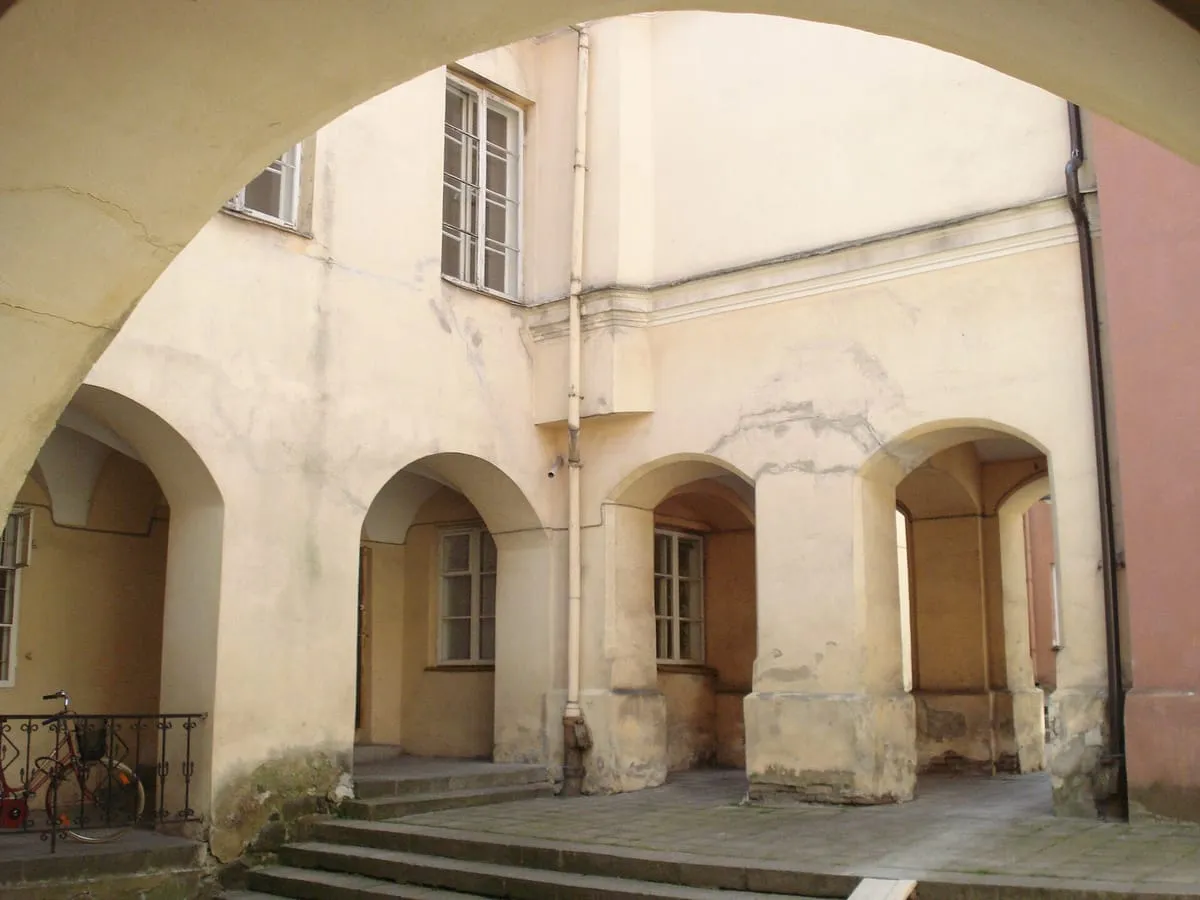
The Grand Courtyard of Vilnius University. Photo: Alma Pater, Wikimedia Commons, Public domain.
St John’s Bell Tower: views and the Foucault pendulum
The Bell Tower of the Church of St John the Baptist and St John the Apostle and Evangelist (Šv. Jonų bažnyčios varpinė) is 68 metres high.
Built between 1610 and 1737, it has a square Renaissance stone base and slender late baroque octagonal tiers, designed by the Silesian architect Johann Christoph Glaubitz after the city fire of 1737.
- The glazed lift: A glass-sided lift runs through the timber belfry to the 45-metre observation balcony, so you do not need to climb.
- The staircase: The wooden and metal staircase has 193 steps and passes bell-hanging beams, clock gears and panels about the university’s scholars.
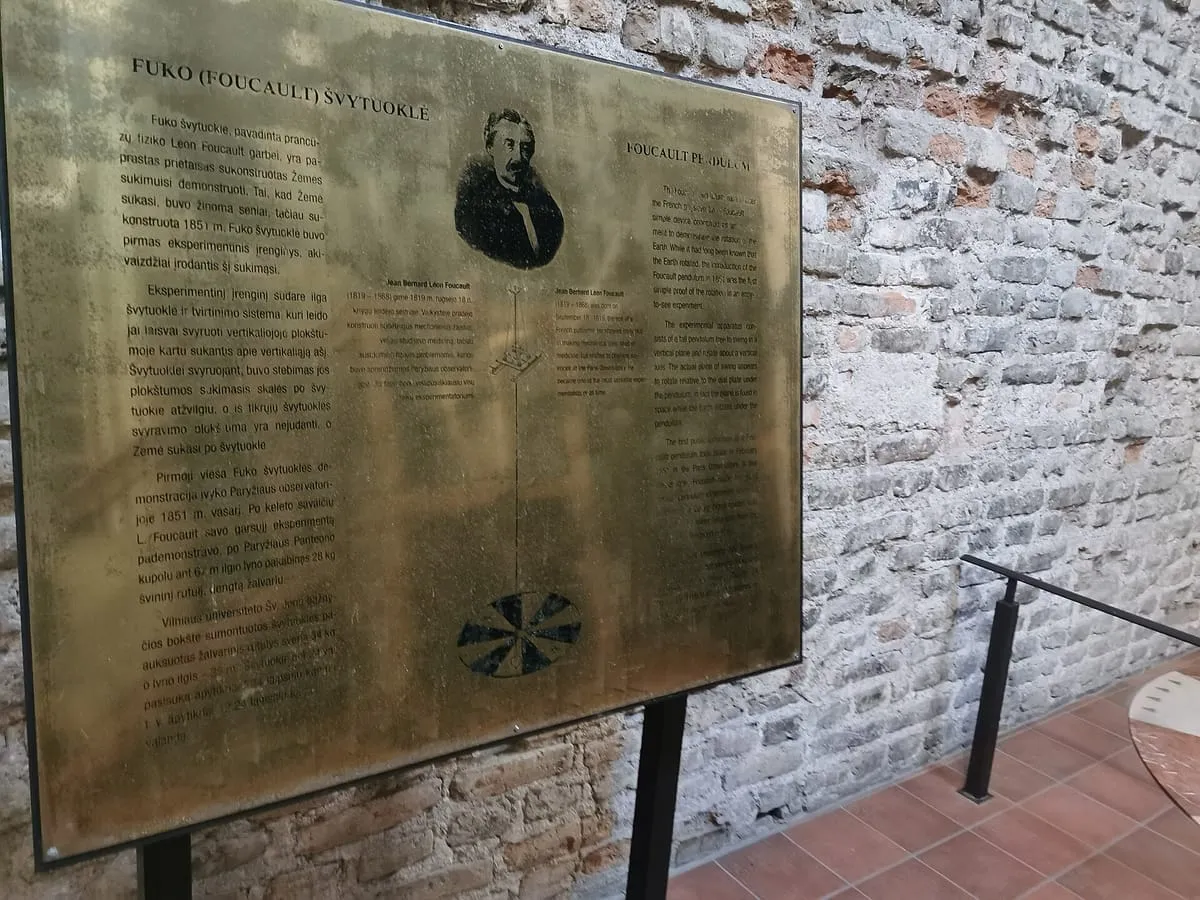
- The Foucault pendulum: In the second-floor stairwell, a brass sphere swings on a long steel cable from the tower ceiling, showing the Earth’s rotation against a circular floor compass.
- The observation platform: The open gallery at 45 metres looks across the rooftops of Pilies and Didžioji streets, to the red spires of St Anne’s Church, down onto the baroque gable of St John’s Church, and up towards the Hill of Three Crosses.
St John’s Church Bell Tower at Vilnius University. Photo: Stela, Wikimedia Commons, CC BY-SA 4.0.
St John’s Church interior
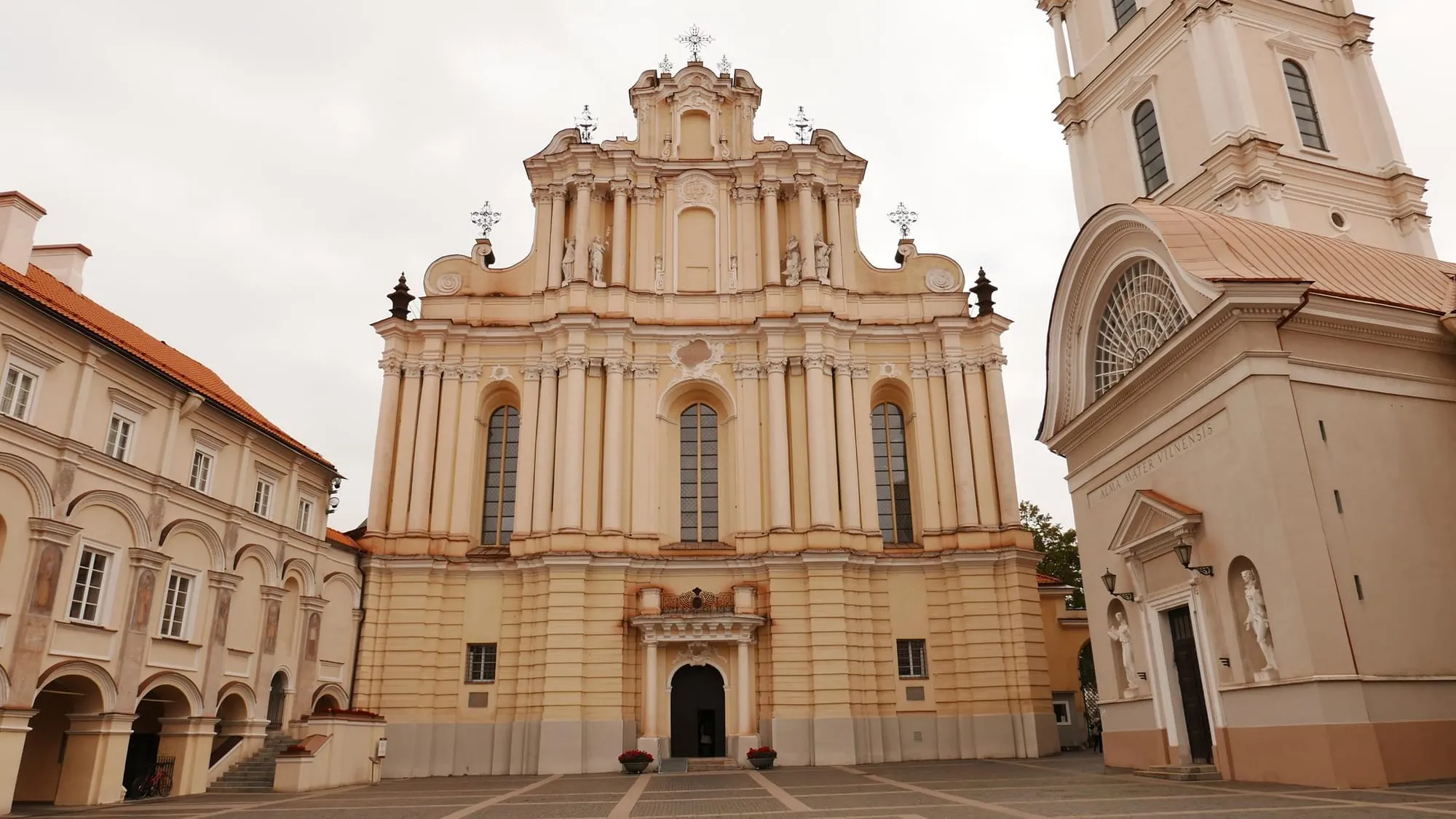
Constructed between 1387 and 1426 in early Gothic style and handed over to the Jesuit order in 1571, St John’s Church was transformed between 1738 and 1749 by Glaubitz into the showpiece of the “Vilnius Baroque” school.
Step through the southern portals from the Grand Courtyard to observe:
- The main altar: Glaubitz created ten interconnected tiered altars on different depth planes, framing eighteen stucco statues of saints and doctors of the church.
- Memorials: Marble busts along the nave commemorate university figures, including the poet Adam Mickiewicz (Adomas Mickevičius), the historian Simonas Daukantas and the composer Stanisław Moniuszko, who was organist here between 1840 and 1858.
- The organ: This late baroque organ has 3,600 pipes and was restored in 2000. Recitals take place on selected Saturday afternoons and during the university’s academic festivals.
Courtyards to see
The ensemble grew over four centuries and mixes Gothic, Renaissance, Baroque and Classicist styles across its thirteen interconnected courtyards. Five to look for:
- The Grand Courtyard (Didysis kiemas): The ceremonial heart of the university. Renaissance arcades with Latin inscriptions frame the north and west sides, and the late baroque facade of St John’s Church and its detached bell tower the east. Fresco plaques beneath the cornices commemorate the founders, Grand Duke Stephen Báthory and Bishop Walerian Protasewicz.
- Astronomical Observatory Courtyard (Observatorijos kiemas): The neoclassical Observatory building was established in 1753 by the astronomer and mathematician Martynas Počobutas. Its white baroque pediment has 18th-century stucco of the twelve signs of the zodiac, lunar crescents and planetary spheres.
- Sarbievijus Courtyard (Sarbievijaus kiemas): Named after Maciej Kazimierz Sarbiewski (Sarbievijus), a 17th-century professor of poetics nicknamed “the Sarmatian Horace” for his Latin odes. It has stepped buttresses and leads to the student bookshop Littera.
- The Faculty of Philology and “The Seasons” fresco: In the Lithuanian Studies Centre on the second floor, Petras Repšys’s 1985 fresco The Seasons (Metų laikai) covers the vaulted lobby walls and ceilings. It draws on Baltic pagan mythology, folklore, funeral rites and agricultural festivals.
- Simonas Daukantas Courtyard (Simono Daukanto kiemas): Named after the author of the first history of Lithuania written in Lithuanian, who studied here between 1816 and 1822. An oak planted by university graduates shades the courtyard.
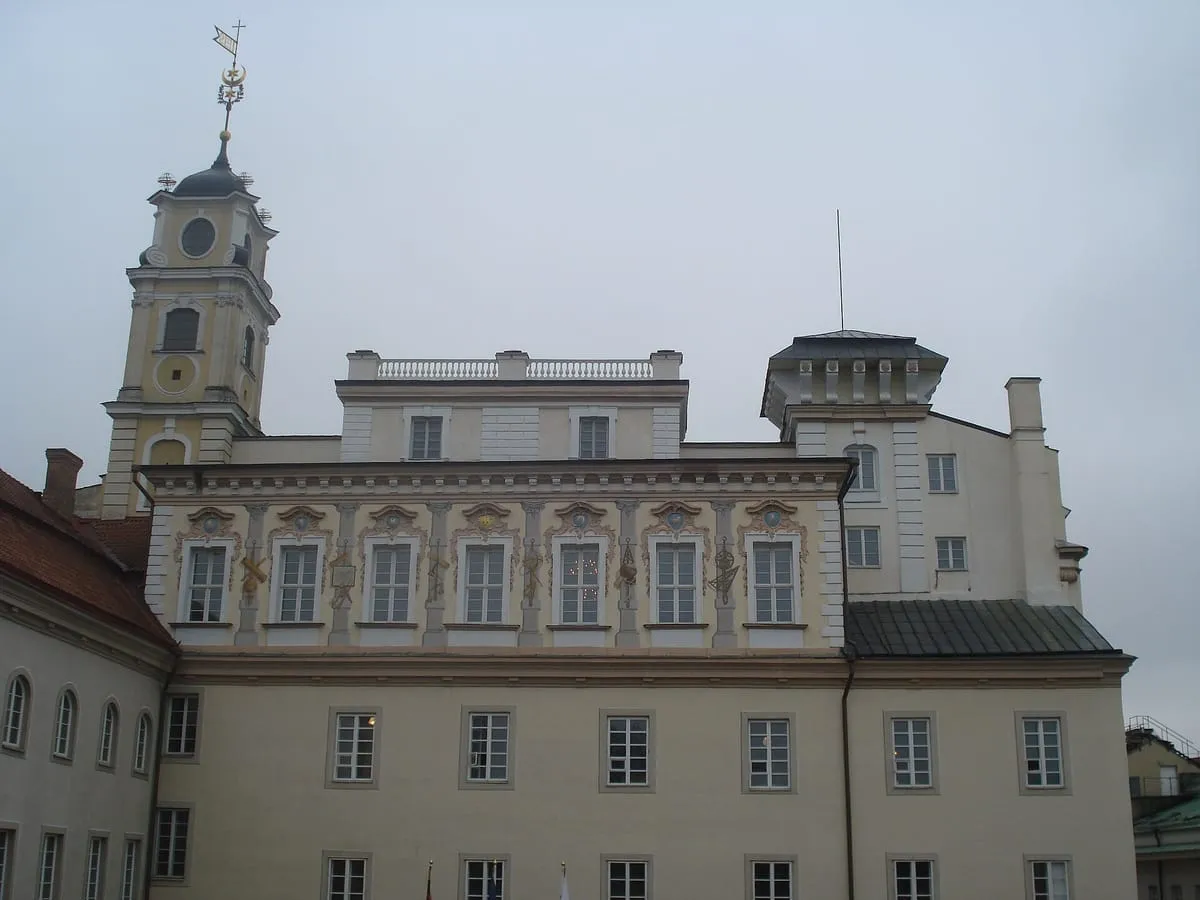
The Astronomical Observatory courtyard at Vilnius University. Photo: Alma Pater, Wikimedia Commons, CC BY-SA 3.0.
Tours and guided walks
Vilnius: Old Town Walking Tour with Local Stories
From €25 · 4.9 stars from 20 reviews · 2.5 hours · Old Town with a local guide
Vilnius: Old Town Walking Tour with Local Storiesad: a local guide takes you through the Old Town for its history, architecture and local legends.
Vilnius: Old Town Walking Tour with Local Guide & Chocolate
From €21 · 4.9 stars from 26 reviews · 2.5 hours · local guide and chocolate tasting
Vilnius: Old Town Walking Tour with Local Guide & Chocolatead: a walk through the Old Town led by a local, covering the city’s history, everyday life and hidden corners, with chocolate as part of the tour.
Vilnius: Guided Baroque City Tour
From €30 · 5.0 stars from 5 reviews · 2 hours · St Theresa’s, Dominican Church and the cathedral
Vilnius: Guided Baroque City Tourad: a guided tour of Baroque Vilnius, visiting the Church of St Theresa, the Dominican Church and the cathedral.
Official ticket or tour
| What you want | Official | On GetYourGuide |
|---|---|---|
| Historic courtyards and bell tower | Pay at the entrance booths | A guided Old Town walk from €21 |
| St John’s Church nave | Free | Included on walking tours that stop at the church |
Practical visiting tips
- Working university: There are lectures and exams on campus. Keep quiet in the corridors of the Philology and History faculties, and do not enter lecture rooms with closed doors.
- Accessibility: The Grand Courtyard, St John’s Church and the Bell Tower are wheelchair accessible. A ramp leads from Šv. Jono Street into the church, and the bell tower lift takes manual wheelchairs. Some of the smaller cobbled courtyards, such as Sarbievijus, have uneven surfaces and thresholds.
- Bookshop Littera: The small university bookshop in Sarbievijus Courtyard has a vaulted ceiling with 1978 Renaissance-style tempera frescoes by Antanas Kmieliauskas, showing professors, doctors and students.
- Getting there: The university is in the pedestrian Old Town. The nearest stops are Vokiečių and Bernardinų sodas, both 5 minutes’ walk away.
What to see next
- Vilnius Cathedral and Bell Tower: 200 metres north on Cathedral Square.
- Palace of the Grand Dukes: the royal state apartments next to the cathedral.
- St Anne’s Church and Bernardine: 5 minutes’ walk east down Šv. Mykolo Street, a Gothic brick church.
- Republic of Užupis Guide: over the Vilnia River, the artists’ quarter.
- Vilnius City Hub: the city overview.
Common questions
Do you need a ticket for Vilnius University and St John's Bell Tower?
The courtyards and the St John's Church Bell Tower are ticketed, and you pay at the booths at the Universiteto g. 5 and Šv. Jono g. 12 entrances. St John's Church itself is free. The bell tower has a lift to the 45-metre observation platform.
When is the St John's Bell Tower open?
The bell tower opens seasonally from late April to late October, operating daily from 10:00 to 19:00. It is closed from November to April.
What are the opening hours for Vilnius University courtyards?
The historical courtyards are open Monday to Saturday from 09:00 to 18:00 (closed to tourists on Sundays). St John's Church is open Monday to Saturday 09:00 to 19:00 and Sunday 09:00 to 15:00.
Can you take a lift up St John's Bell Tower?
Yes. Visitors can either climb the 193 wooden and steel steps or ride the modern glazed passenger lift directly to the 45-metre observation level.
What is the Foucault pendulum inside the bell tower?
Suspended on the second floor of the bell tower, the working Foucault pendulum demonstrates the rotation of the Earth on its axis, swinging over a graduated brass dial throughout the day.
Where are the famous university frescoes located?
The monumental 1985 fresco 'The Seasons' (Metų laikai) by artist Petras Repšys is located inside the Lithuanian Studies Centre on the second floor of the Faculty of Philology, accessible via Sarbievijus Courtyard.