In this guide
- Location: 12 km north of Šiauliai; ~220 km northwest of Vilnius near the northern border with Latvia.
- Independent journey: 2 hours 15 minutes on LTG Link train to Šiauliai, local bus to Domantai stop, and a 20-minute (2 km) flat walk to the hill.
- Entry & hours: Completely free admission; open 24 hours daily. Modern visitor centre open daily 09:00 to 18:00 (17:00 in winter).
- History: A symbol of peaceful resistance to Tsarist Russian and Soviet rule. Pope John Paul II held Mass here in 1993.
- Or book a tour: The Hill of Crosses: Full-Day Tour from Vilniusad (from €440 for a group of up to 2, 4.8 stars from 83 reviews) is a full-day tour from Vilnius that explains the symbolism of the crosses, so you do not need to arrange the transport yourself.
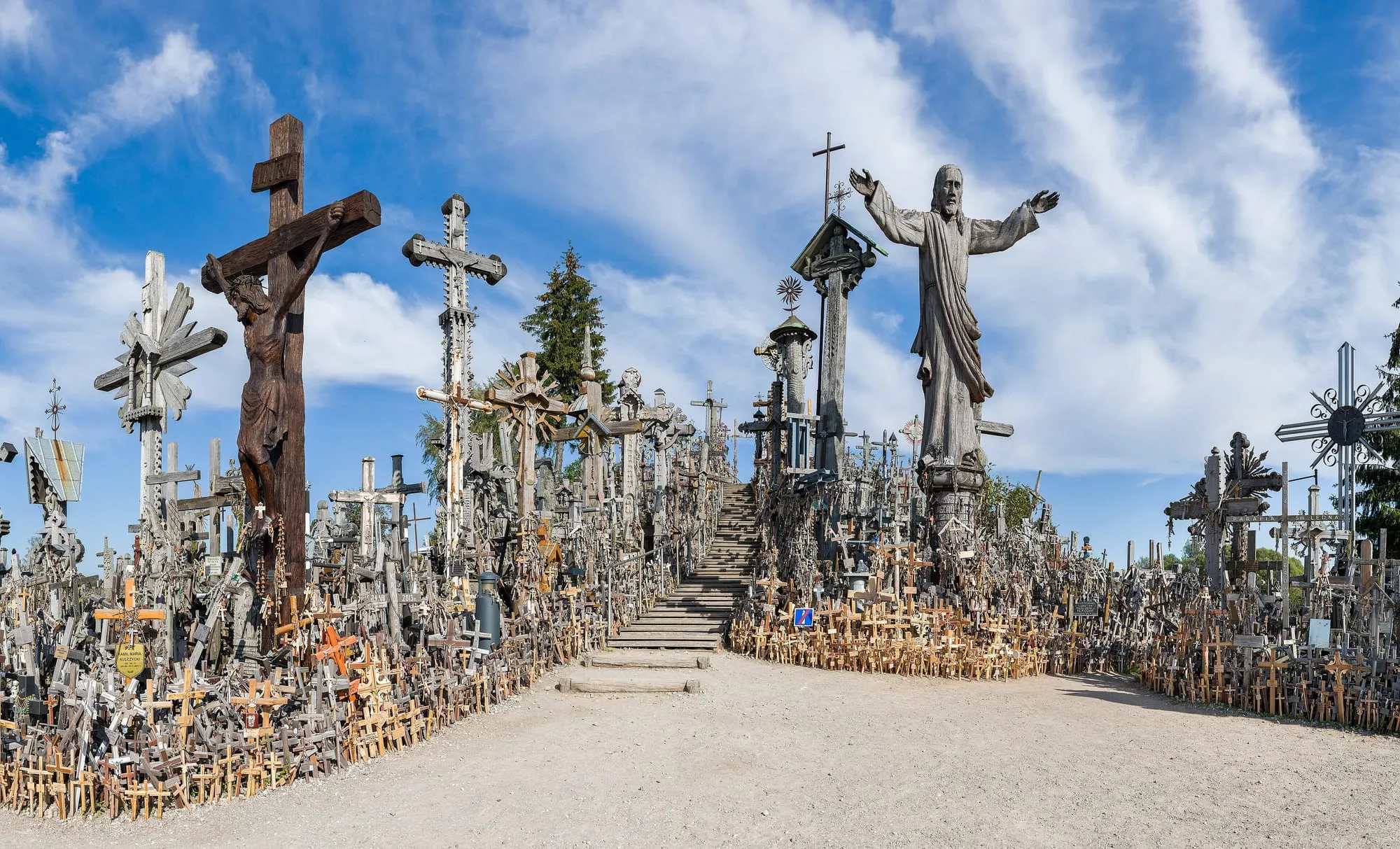
The Hill of Crosses is a low double-humped mound on the flat farmland of northern Lithuania, covered in more than 100,000 crosses. They range from four-metre carved oak crucifixes to rosary beads, metal crosses, carved figures of the Sorrowful Christ (Rūpintojėlis) and stone tablets left by pilgrims from around the world.
Under Russian imperial and Soviet rule the hill became a symbol of Lithuanian identity and peaceful resistance, as well as a pilgrimage site.
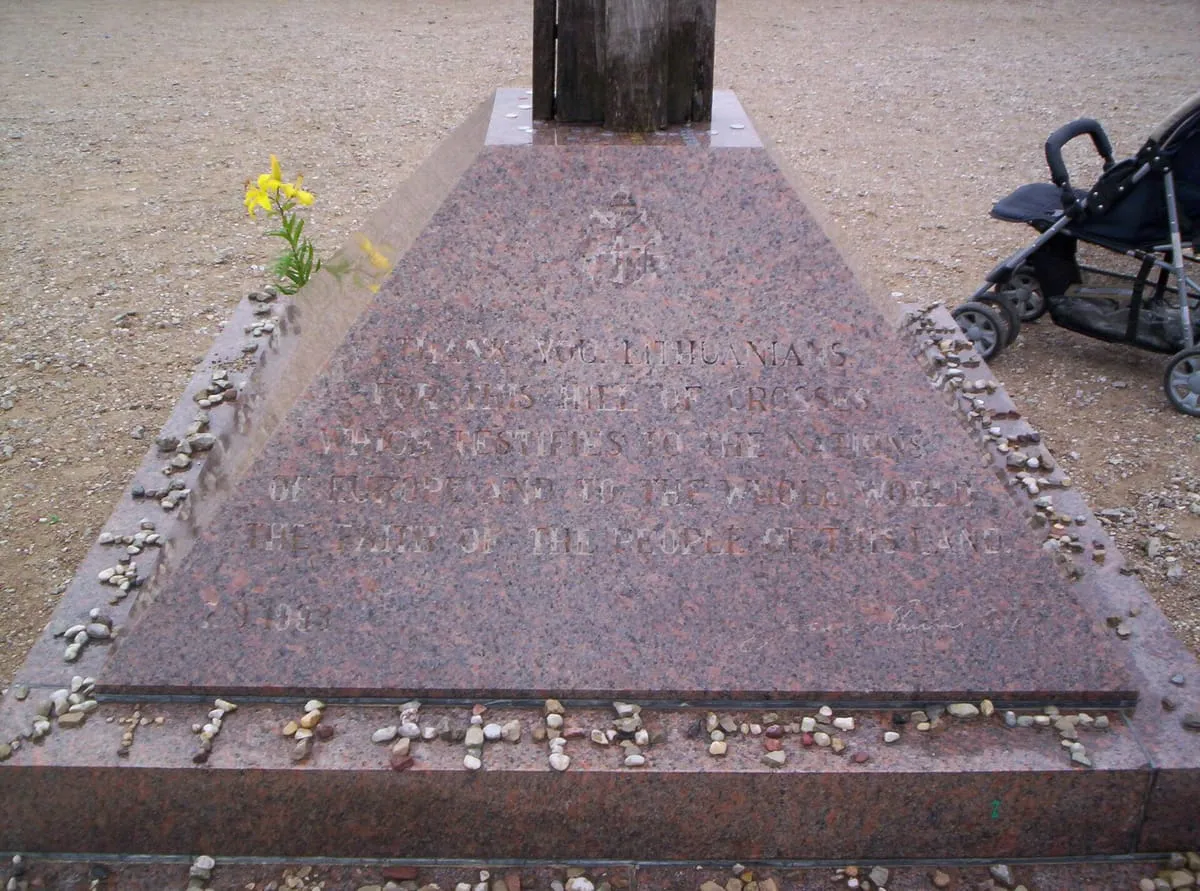 Stone with Pope John Paul II’s words. Photo: Shinsaku, Wikimedia Commons, CC BY 3.0.
How to get to the Hill of Crosses from Vilnius
An independent day trip needs an early start and a check of the return timetable.
Step 1: Train from Vilnius to Šiauliai
- Departure: Vilnius Central Railway Station (Vilniaus geležinkelio stotis).
- Carrier: LTG Link intercity trains on the Vilnius–Klaipėda line.
- Duration: 2 hours 10 minutes to 2 hours 25 minutes.
- Frequency: Trains leave Vilnius roughly 4 to 6 times daily, with morning departures between 06:45 and 09:30.
Step 2: From Šiauliai to the Hill of Crosses
Arriving at Šiauliai railway station (Dubijos g. 44), exit and walk 10 minutes (800 metres) east along Tilžės street to Šiauliai Central Bus Station (Šiaulių autobusų stotis, Tilžės g. 109, located inside the Saulės Miestas shopping centre).
From the bus station there are two ways to reach the hill:
-
Local bus to Domantai stop (cheaper):
- Head to platform 11 or 12 and board any local bus heading towards Joniškis, Naujoji Akmenė, or Rygą. Confirm with the driver by asking: “Kryžių kalnas?”
- Purchase a ticket from the driver.
- The journey takes roughly 15 minutes. Alight at the Domantai stop along highway A12.
- From the bus stop, follow the signposted paved country lane (Jurgaičių g.) eastward across the fields. The flat walk to the hill is 2.0 kilometres and takes approximately 20 to 25 minutes.
- Return journey: Check the return timetable posted on the shelter at Domantai bus stop or photograph the schedule at Šiauliai bus station before leaving. Buses run roughly every 45 to 90 minutes until early evening.
-
Taxi or rideshare from Šiauliai station (faster):
- Taxis wait outside both Šiauliai railway and bus stations, and the Bolt app works in Šiauliai.
| Leg / Mode | Duration | Cost | Details |
|---|---|---|---|
| Walk: Domantai stop to the Hill | 20 min (2 km) | Free | Paved rural lane |
| Full-Day Tour (GYG 75332) | Full day (8-9 hr) | from €440 for a group of up to 2 | Door-to-door van |
History: From Tsarist rebellions to Soviet defiance
The mound itself—historically known as Jurgaičiai or Domantai hillfort—was fortified in the fourteenth century with a wooden castle burned down by Livonian crusaders in 1348.
The tradition of planting crosses began in the nineteenth century. Following the November Uprising of 1831 and the January Uprising of 1863 against the Tsarist Russian Empire, the Russian authorities executed hundreds of Lithuanian rebels, banished families to Siberia, and refused to hand over victims’ bodies for burial. Grieving families began climbing this ancient pagan mound to plant wooden crosses in memory of their missing sons, fathers, and brothers.
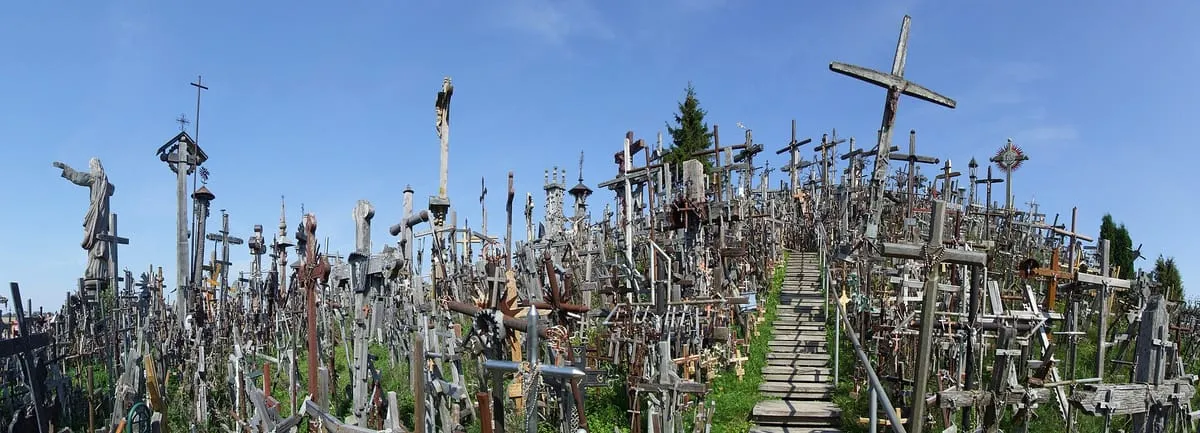 Intricately carved wooden crosses and rosaries covering the slopes. Photo: Pudelek (Marcin Szala), Wikimedia Commons, CC BY-SA 3.0.
The Soviet bulldozers and midnight planting
After World War II the Soviet authorities treated the hill as an affront to their atheist state policy:
- Operation “Destruction” (1961): In April 1961, Soviet military bulldozers flattened the site in a single night. Over 5,000 wooden crosses were gathered into piles and burned on site; iron crosses were carted off as scrap metal, and stone monuments were pulverized into road ballast.
- Repeated assaults (1973 and 1975): The authorities bulldozed the hill repeatedly and even flooded surrounding drainage canals, declaring the area an infectious quarantine zone guarded by armed KGB officers.
- The secret resistance: Despite round-the-clock KGB patrols and the threat of long prison sentences, local residents, Catholic priests, and students crawled through marshes at night to replant crosses. By dawn, new crosses stood on the bare earth again.
The Papal Visit of 1993
On 7 September 1993, just weeks after the final Soviet military units departed Lithuania, Pope John Paul II visited the Hill of Crosses. The Polish-born pontiff climbed the wooden stairs, prayed before the sea of crucifixes, and held an open-air Mass attended by over 100,000 pilgrims.
He presented a stone-based crucifix inscribed with the words: “Thank you, Lithuanians, for this Hill of Crosses which testifies to the nations of Europe and to the whole world the faith of the people of this land.” In 2000, a Franciscan monastery was consecrated 300 metres behind the hill, where Franciscan friars live in prayer and welcome retreat guests.
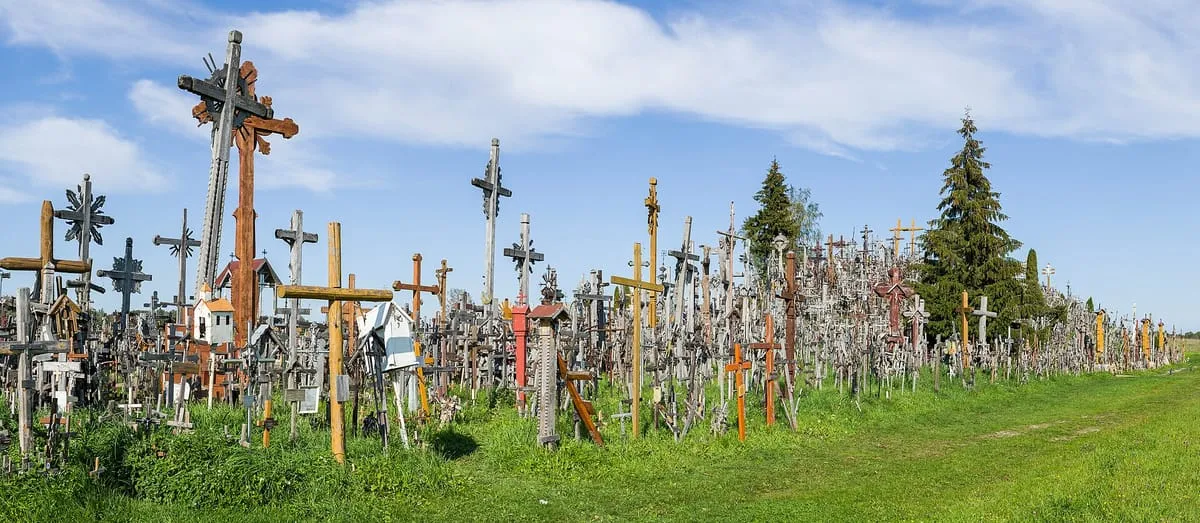 Dense clusters of devotional crosses surrounding the central paths. Photo: Diliff, Wikimedia Commons, CC BY-SA 3.0.
What to see and practical visitor tips
- The paths: Narrow wooden boardwalks and stepped paths run up and over the two crests of the hill. In wind, the hanging metal rosaries click against each other.
- Leaving your own cross: Visitors of any faith, or none, may leave a cross. Bring your own or buy a wooden one at the visitor centre. Many people write a prayer, a name or a date on the horizontal beam. Place it wherever there is space, for example tucked into the arms of a larger sculpture.
- Visitor centre: The visitor centre (Kryžių kalno informacijos centras) has toilets, luggage storage, a souvenir shop and exhibitions on the Soviet demolitions and the papal visit.
- Weather: The hill is exposed farmland and the wind can be sharp in autumn and winter. Bring windproof layers and sturdy shoes for the gravel and wooden steps.
Guided tours and day trips
The round trip from Vilnius is roughly 440 km, and a tour removes the train and bus connections.
| Tour Option | Price | Duration | Highlights |
|---|---|---|---|
| Full-Day Tour from Vilnius (GYG 75332) | from €440 for a group of up to 2 | 1 day | Private full-day trip |
| Hill of Crosses & Šiauliai Tour (GYG 130011) | from €230 for a group of up to 2 | 8 hours | Hill of Crosses and Šiauliai in one day |
The Hill of Crosses: Full-Day Tour from Vilnius
From €440 for a group of up to 2 · 4.8 stars from 83 reviews · 1 day · private Hill of Crosses trip
The Hill of Crosses: Full-Day Tour from Vilniusad: a full-day trip to the Hill of Crosses, covering the symbolism of the crosses and the craft of making them.
From Vilnius: Hill of Crosses, Pakruojis Manor & Kernavė …
From €300 for a group of up to 2 · 4.8 stars from 8 reviews · 8 hours · Hill of Crosses, Pakruojis Manor, Kernavė
From Vilnius: Hill of Crosses, Pakruojis Manor & Kernavė …ad: a day trip to the Hill of Crosses, Pakruojis Manor and Kernavė.
Hill of Crosses and Siauliai Tour
From €230 for a group of up to 2 · 4.1 stars from 22 reviews · 8 hours · Hill of Crosses and Šiauliai
Hill of Crosses and Siauliai Tourad: a one-day tour to the Hill of Crosses and the city of Šiauliai.
Continuing on to Riga
The hill lies near Lithuania’s northern border, on the way from Vilnius to Riga, Latvia, so some travellers break the journey there. If your Baltic trip continues north, ask the transfer operator whether it stops at the hill.
For the other excursions from the capital, see day trips from Vilnius, plan your stay with the 3-day Vilnius itinerary, or return to the Vilnius city guide.
Common questions
How far is the Hill of Crosses from Vilnius?
The Hill of Crosses (*Kryžių kalnas*) is approximately 220 kilometres northwest of Vilnius and 12 kilometres north of the regional city of Šiauliai.
How do you reach the Hill of Crosses by public transport from Vilnius?
Take an early morning LTG Link express train from Vilnius Central Station to Šiauliai (roughly 2 hours 15 minutes). From Šiauliai bus station, board a local bus bound for Joniškis, get off at the Domantai stop, and walk 2 kilometres down the country lane to the site.
Is there an entrance fee to visit the Hill of Crosses?
No. The Hill of Crosses is completely free to enter and remains open 24 hours a day, 365 days a year. The modern visitor centre on site charges a nominal parking fee for vehicles and sells wooden devotional crosses.
How many crosses are on the Hill of Crosses?
There are currently well over 100,000 crosses, ranging from tiny wooden rosaries and folk crucifixes to monumental 4-metre carved oak shrines, iron monuments, and statues of the Virgin Mary.
What is the history behind the Hill of Crosses?
Crosses first appeared in the 1830s after the Tsarist Russian suppression of the November 1831 Uprising, when relatives planted crosses for fallen rebels whose bodies were never returned. During Soviet occupation, the regime repeatedly bulldozed and burned the hill, and locals replanted crosses at night despite KGB surveillance.
Is it better to take a guided tour from Vilnius or go independently?
Going independently takes roughly 6 to 7 hours of return transit by train, local bus and on foot. A full-day van tour collects you from your Vilnius hotel and removes the connections.