In this guide
💡 The Short Version: Semana Santa 2027 runs from Palm Sunday, 21 March, to Easter Sunday, 28 March. The Madrugá is the night of 25 to 26 March. Holy Thursday and Good Friday are public holidays, and the Real Alcázar and the Torre del Oro are closed on Good Friday. About 60 brotherhoods go out, and every one passes through the Carrera Oficial to the Cathedral. Watching is free on the street; chairs on the route are rented. Rooms in the centre sell out months ahead and prices rise sharply, so book as soon as your dates are fixed. Or book a walk: the Small-Group City Highlights Walking Tourad is from €22.50 for 2 hours.
⚠️ Closed. On Good Friday, 26 March, the Real Alcázar, the Torre del Oro and the Archivo General de Indias are closed, and the Archivo is closed on Holy Thursday too. The Cathedral and the Giralda change their hours daily. Holy Thursday and Good Friday are public holidays.
Semana Santa is a religious festival. The processions are acts of worship by the brotherhoods that carry them, and Visita Sevilla’s guide says you do not have to be a believer to watch.
The week in dates
About 60 brotherhoods (hermandades) go out, with more than a hundred processional floats (pasos). The names below are the brotherhoods Visita Sevilla’s 2027 guide lists for each day.
| Day | Date | Brotherhoods |
|---|---|---|
| Friday of Sorrows | 19 March | Parish brotherhoods in outer districts: Heliópolis, Pino Montano, Bellavista, Palmete and others. They do not go to the Cathedral |
| Saturday of Passion | 20 March | The same: outer districts, no Cathedral |
| Palm Sunday | 21 March | La Borriquita, Jesús Despojado, La Paz, La Cena, La Hiniesta, San Roque, La Estrella, La Amargura, El Amor |
| Holy Monday | 22 March | Polígono San Pablo, El Rocío, Santa Genoveva, Santa Marta, San Gonzalo, La Vera Cruz, Las Penas, Las Aguas, El Museo |
| Holy Tuesday | 23 March | El Cerro, Los Javieres, San Esteban, Los Estudiantes, San Benito, La Candelaria, La Bofetá, Santa Cruz |
| Holy Wednesday | 24 March | Carmen Doloroso, La Sed, San Bernardo, El Buen Fin, La Lanzada, El Baratillo, Cristo de Burgos, Las Siete Palabras, Los Panaderos |
| Holy Thursday | 25 March | Los Negritos, La Exaltación, Las Cigarreras, Montesión, La Quinta Angustia, El Valle, Pasión |
| The Madrugá | Night of 25 to 26 March | El Silencio, El Gran Poder, La Macarena, El Calvario, La Esperanza de Triana, Los Gitanos |
| Good Friday | 26 March | La Carretería, La Soledad (San Buenaventura), El Cachorro, La O, San Isidoro, Montserrat, La Sagrada Mortaja |
| Holy Saturday | 27 March | El Sol, Los Servitas, La Trinidad, El Santo Entierro, La Soledad (San Lorenzo) |
| Easter Sunday | 28 March | La Resurrección |
The brotherhoods’ own timetables and routes are in the programme the city publishes each spring (El Llamador); Visita Sevilla links it from its Holy Week page.
How it works
Each brotherhood leaves its own church, often in another district, and walks to the Cathedral and back. The part of the route all of them share is the Carrera Oficial: from the Plaza de la Campana along Calle Sierpes, the Plaza de San Francisco and the Avenida de la Constitución to the Cathedral, which they enter by the San Miguel door and leave by the Palos door on the Plaza Virgen de los Reyes. The visit to the Cathedral is the brotherhood’s estación de penitencia. In 2027 the Council of Brotherhoods has announced a new route inside the Cathedral, the same every day: in by San Miguel, round the foot of the church, down the San Pedro nave and out by Palos (Europa Press, 29 September 2026).
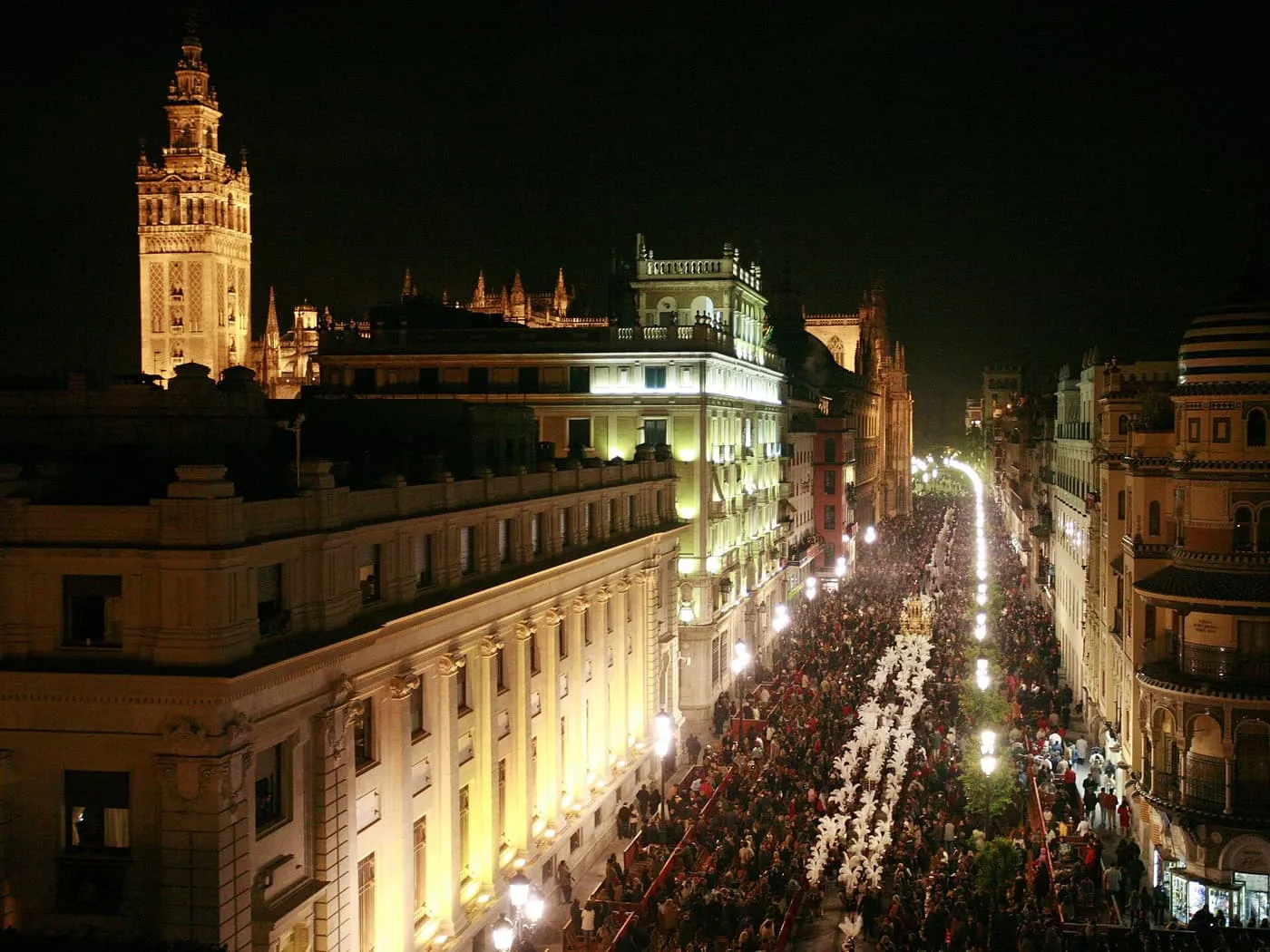
A Holy Week procession filling a street in the centre, with the Giralda at upper left. Photo: Sevilla Congress & Convention Bureau, Wikimedia Commons, CC BY-SA 2.0.
A procession can last more than ten hours from leaving its church to returning. The nazarenos in pointed hoods walk in front of and between the floats; those in capes may hand sweets or wax to children, and those in the long-tailed robes of the stricter brotherhoods walk in silence. Christ’s floats are followed by bands of cornets and drums and the Virgin’s by music bands, and some brotherhoods go out with no music at all. From a balcony you may hear a saeta, a flamenco prayer sung to a float as it passes.
Where to watch
Watching is free on the street. Visita Sevilla advises arriving early at the busiest spots and picking the processions you want each day, because they leave from different churches at similar times.
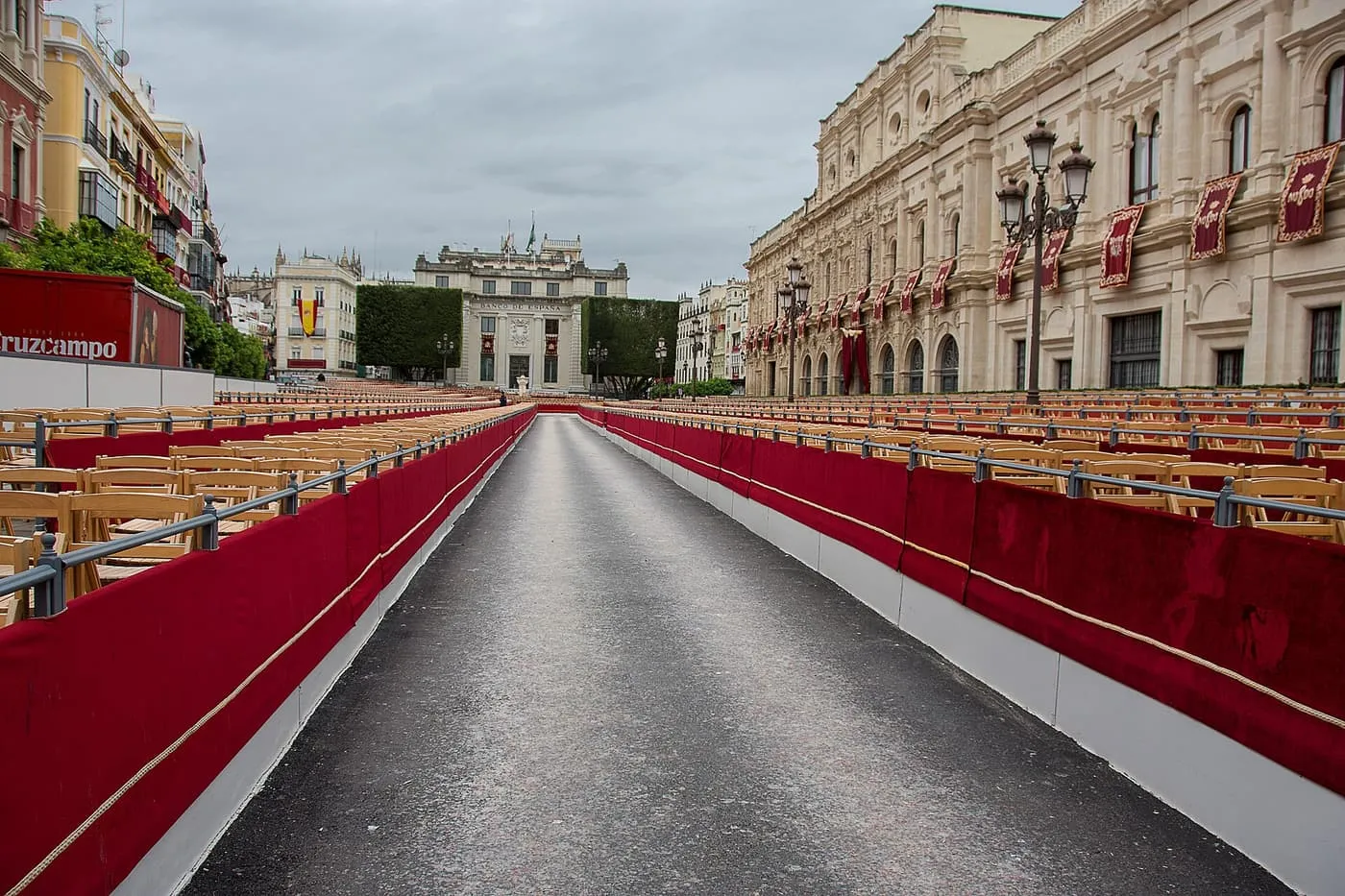
Seats along the Carrera Oficial. Photo: Anual, Wikimedia Commons, CC BY-SA 4.0.
- Chairs on the Carrera Oficial. Visita Sevilla says chairs are rented by season ticket for the whole week or for individual days, with prices that depend on the place and the day. The Council of Brotherhoods’ season tickets for chairs and boxes cost €90.50 to €1,016.77 in 2026, payable by 31 January, with the cheapest on the Plaza Virgen de los Reyes (Diario de Sevilla).
- Balconies. The Colegio de Administradores de Fincas put the average rent for a balcony in the centre at €6,000 for the week in 2026, and up to €9,000 for the Madrugá (Diario de Sevilla).
- The Madrugá. It runs from midnight on Holy Thursday until the morning of Good Friday. The Esperanza de Triana sets out from the Capilla de los Marineros on Calle Pureza in Triana. In 2026 the council treated two areas as the busiest: the centre, and the Triana streets Betis, Pureza, San Jacinto and the Altozano.
- Bars. In 2026 the council required bars on the Carrera Oficial and its main access streets to take their terraces in from 17:00, and bars serving alcohol to close from 03:00 to 06:00 on the Madrugá unless they had an extension, and stopped street stalls in those two areas from selling drinks in glass, cans or plastic bottles above 500 ml, and ice, while a brotherhood passed. The council issues the rules again each year.
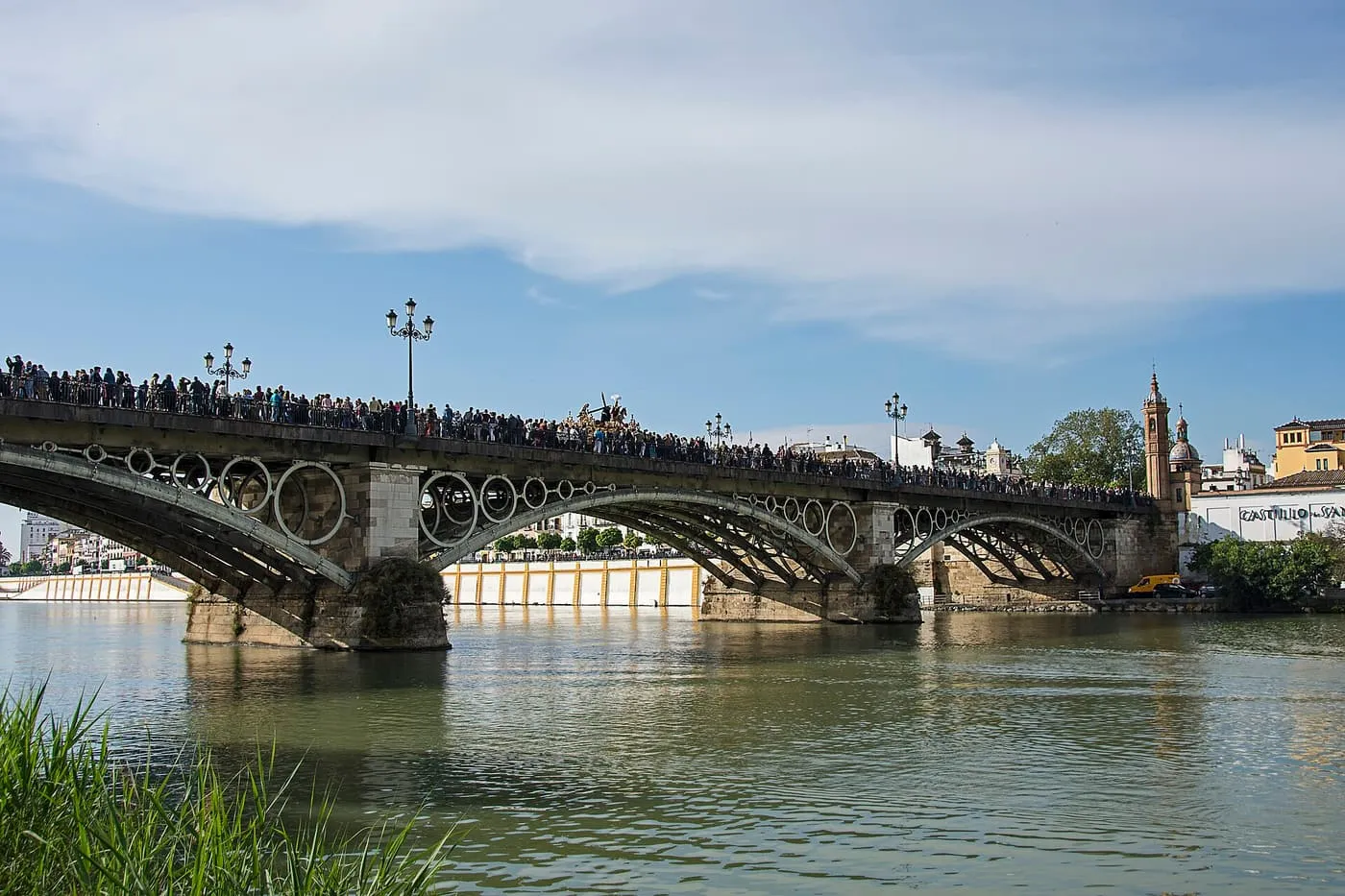
Crowds on the Puente de Isabel II, the Triana bridge, in Holy Week. Photo: Anual, Wikimedia Commons, CC BY-SA 4.0.
Sights, shops and the Cathedral
| Sight | Semana Santa 2027 |
|---|---|
| Real Alcázar | Closed on Good Friday, 26 March: see Real Alcázar tickets |
| Torre del Oro | Closed on Good Friday |
| Archivo General de Indias | Closed on Holy Thursday and Good Friday |
| Cathedral and Giralda | Hours change every day. In 2025 the Cathedral was closed to visitors on Palm Sunday and Holy Tuesday, open 11:00 to 17:00 on Monday and Wednesday, 10:30 to 14:30 on Holy Thursday and Good Friday, 10:30 to 17:00 on Holy Saturday and 14:30 to 19:00 on Easter Sunday. The Cabildo publishes the timetable shortly before: see Cathedral and Giralda tickets |
| Shops and markets | Holy Thursday and Good Friday are public holidays. The Triana market’s shops are closed on holidays; the bars and restaurants inside open from 10:00 to 17:00 |
Visita Sevilla warns that many monuments change their hours during the week, and publishes special timetables for Tussam buses and the metro. The clocks go forward one hour on Easter Sunday morning. Other sights keep their usual hours: Seville museums lists their closed days.
What to eat
Lent has its own kitchen, and Visita Sevilla names its dishes: potaje de vigilia (chickpeas with salt cod), spinach with chickpeas, cod with tomato, pavías of cod, stewed lentils and, for dessert, torrijas (bread soaked and fried), pestiños and rice pudding. Bars serve them through Lent and Holy Week, and the best-known places are in Seville tapas and where to eat in Seville.
The weather and the light
March in Seville averages a high of 21.9°C and a low of 9.2°C, with 36 mm of rain on 4.3 days (AEMET, airport station, 1981 to 2010). The sun sets at about 19:39 on Holy Thursday and, after the clocks go forward, at about 20:42 on Easter Sunday. The orange trees flower in March and April, and Visita Sevilla lists the smell of orange blossom with incense and wax as part of the week.
Where to stay
Rooms in the centre sell out months ahead for Holy Thursday and Good Friday and prices rise sharply. Hotels set their own terms for the week. Hotel Adriano, for example, takes a stay that includes Holy Thursday or Good Friday only for at least four nights, charges the whole stay at booking and refunds it in full only if you cancel more than 31 days before arrival, and refunds nothing on its non-refundable rate. Where to stay in Seville compares the areas, and hotels near Seville Cathedral lists the closest. The links below go to the hotel on Hotels.com.
Hotel Adriano
Calle Adriano 12 · Hotels.comad
An 18th-century town house with courtyards, facing the church of El Baratillo. The hotel says its guests can watch that brotherhood leave and return from the roof terrace or their window, that Calle Adriano is on the route of several brotherhoods, and that it is a few metres from the Carrera Oficial.
Hotel Simón
Calle García de Vinuesa 19 · Hotels.comad
The hotel calls itself one of the oldest in Seville, in an 18th-century building 50 m from the Cathedral. A courtyard has a fountain, and breakfast is served in a dining room decorated with Seville tiles.
Casa Alfarería 59
Calle Alfarería 59, Triana · Hotels.comad
A bed and breakfast in Triana with white walls, plants and bright furniture, 400 m from the Triana bridge by the hotel’s count. Breakfast is included, and some rooms have a sitting area.
Next
The Feria de Abril 2027 follows three weeks later, on 12 to 18 April. The best time to visit Seville gives the weather and the crowds by month, Seville in one or two days fits the sights round the closed days, and Christmas in Seville covers the other festive season. What to book before you go to Seville has the hours for every sight, and Seville airport to the city and Seville public transport cover the way in.
Common questions
When is Semana Santa in Seville in 2027?
From Palm Sunday, 21 March, to Easter Sunday, 28 March 2027. The Friday of Sorrows (19 March) and the Saturday of Passion (20 March) come just before, with parish brotherhoods that stay in their own districts. Easter Sunday always falls between 22 March and 25 April, so 2027 is at the early end.
When is the Madrugá in 2027?
From midnight on Holy Thursday, the night of 25 to 26 March, until the morning of Good Friday. Six brotherhoods go out: El Silencio, El Gran Poder, La Macarena, El Calvario, La Esperanza de Triana and Los Gitanos.
Is Good Friday a public holiday in Seville in 2027?
Yes. Holy Thursday (25 March) and Good Friday (26 March) are public holidays across Andalusia in 2027, set by the Junta de Andalucía's decree 84/2026.
Which sights are closed during Semana Santa?
The Real Alcázar and the Torre del Oro are closed on Good Friday, 26 March, and the Archivo General de Indias on Holy Thursday and Good Friday. The Cathedral changes its hours every day of the week, and the Cabildo publishes the timetable shortly before.
Do you have to pay to watch the processions in Seville?
No. The processions are on the street and free to watch. Chairs along the Carrera Oficial, the shared route to the Cathedral, are rented by season ticket for the whole week or by the day. The Council of Brotherhoods' season tickets cost €90.50 to €1,016.77 in 2026.
Do the clocks change during Semana Santa 2027?
Yes, on Easter Sunday, 28 March 2027, when Spain's clocks go forward one hour. Holy Week 2027 runs on winter time up to the night of Holy Saturday.