In this guide
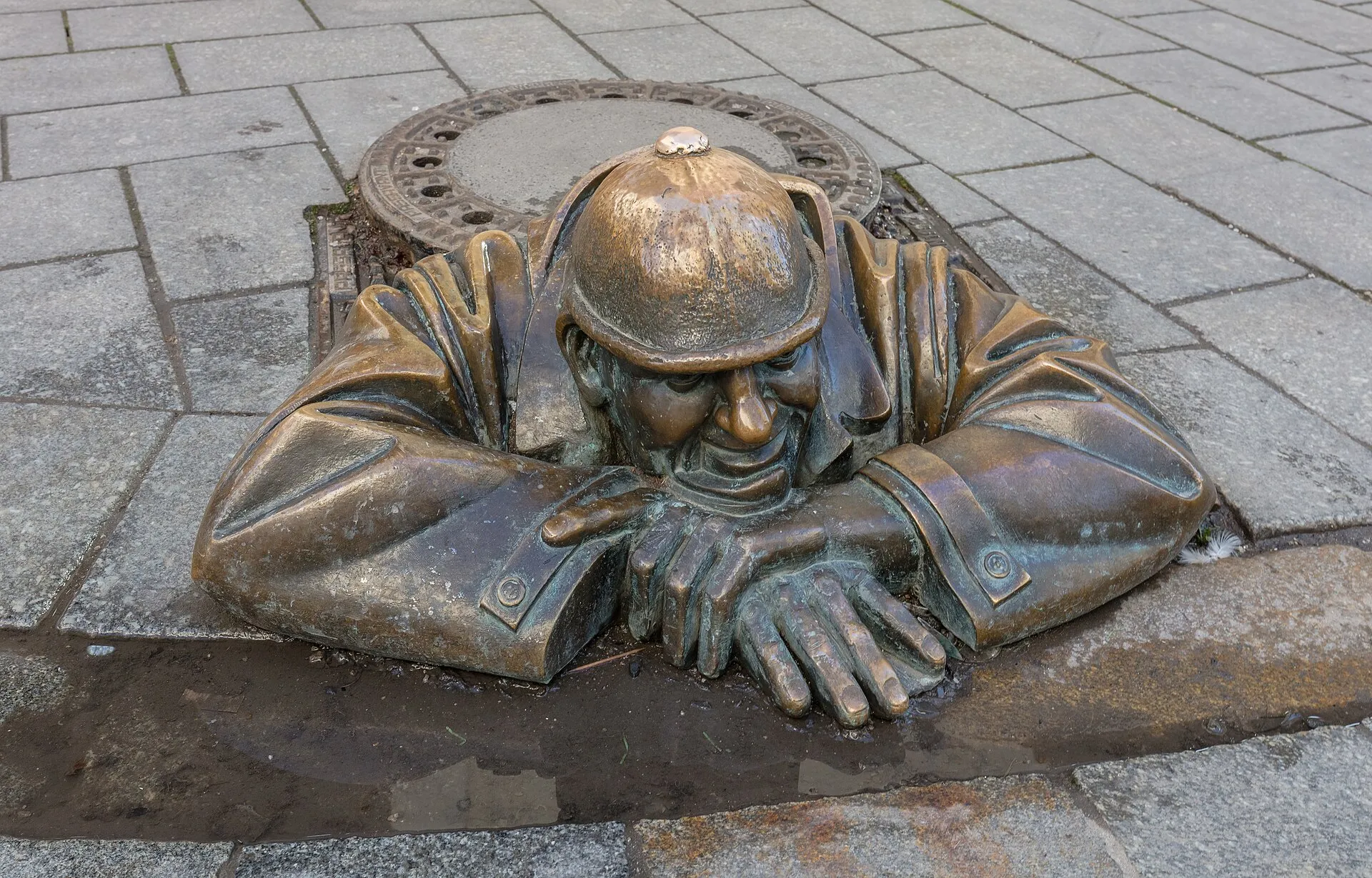
💡 The Short Version: Bratislava’s bronze street statues are in the pedestrianised Old Town, minutes apart on foot. The route links Čumil (Man at Work) at the junction of Panská, Laurinská and Rybárska brána, the top-hat-tipping Schöne Náci on Rybárska brána, the Napoleonic Soldier leaning over a bench on Main Square, and the Hans Christian Andersen Monument on Hviezdoslav Square. The statues stand in public streets and are free to see at any hour. Or book a tour: an Old Town walk through coronation history and the statuesad from €26 or a guided Old Town and castle walkad from €2.10 is sold on GetYourGuide.
⚠️ Watch your step around Čumil. The bronze worker sticks out of the paving at ground level, and people looking at their cameras trip over his head. Watch the paving under your feet, especially in busy afternoon crowds.
Overview of the statues walk
In the summer of 1997 the City of Bratislava completed the pedestrianisation of the historic core. To mark the removal of motor traffic, the city commissioned Slovak sculptors to install life-sized figurative bronzes that sit in the street without granite pedestals.
| Statue | Location | Sculptor & Year | What to Look For |
|---|---|---|---|
| Schöne Náci | Rybárska brána near Main Square | Juraj Meliš (1997) | Silver finish, grey top hat, smiling greeting |
| Napoleonic Soldier | Main Square (Hlavné námestie) | Juraj Meliš (1997) | Bare feet, bicorne hat, resting on park bench |
| Čumil (Man at Work) | Junction of Panská, Laurinská & Rybárska brána | Viktor Hulík (1997) | Grinning drainage worker, bronze manhole rim |
| Hans Christian Andersen | Hviezdoslavovo námestie | Tibor Bártfay (2006) | Fairytale figures, snail on hat, Ugly Duckling |
| Pavol Országh Hviezdoslav | Central Hviezdoslav Square | Vojtech Ihriský (1937) | Seated poet overlooking fountains |
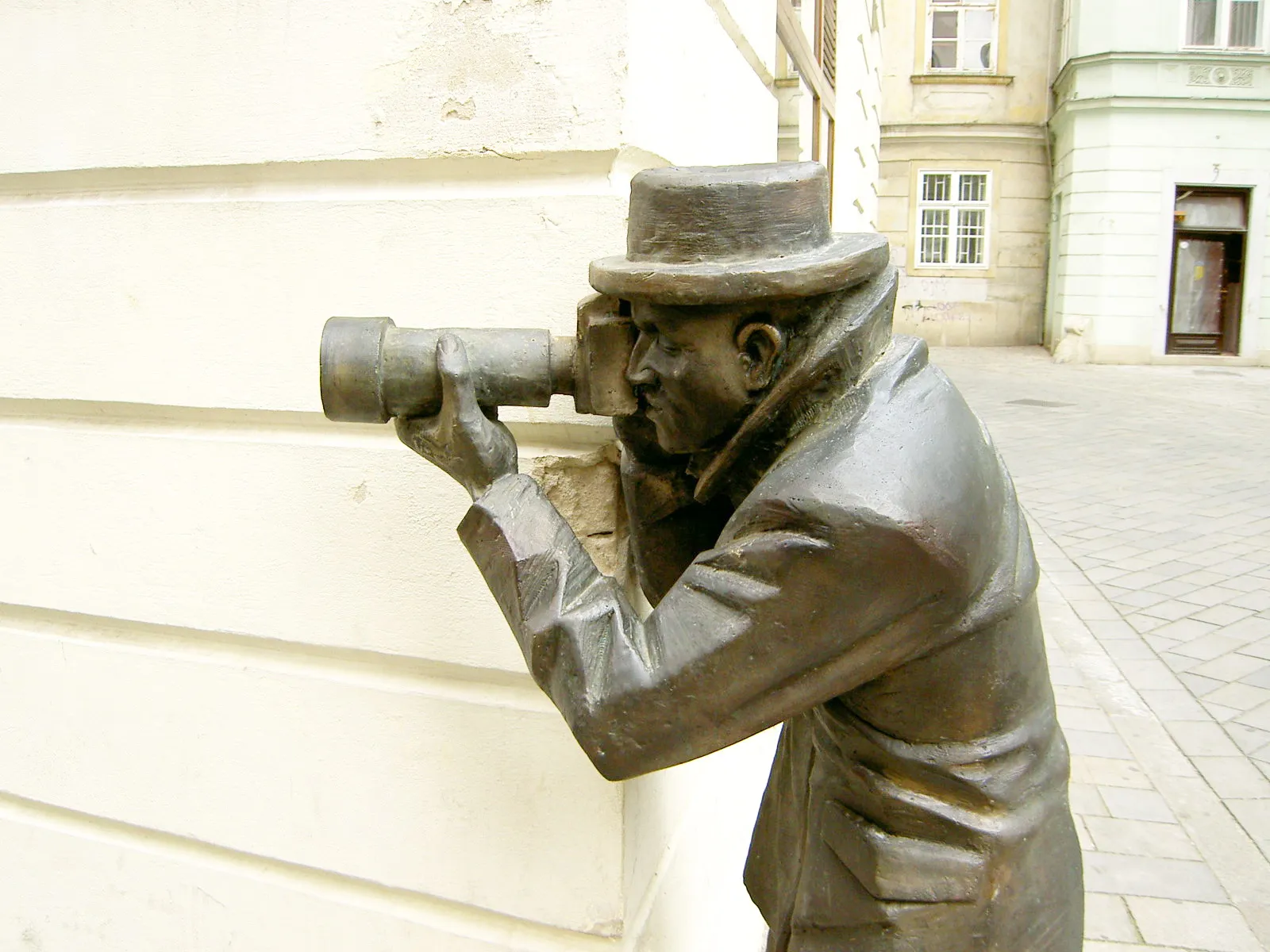
Paparazzo statue. Photo: photo by Benmil222, Wikimedia Commons, CC BY-SA 3.0.
Step-by-step walking route
The walk forms a 1.5-kilometre loop that starts at Main Square and finishes along the shaded promenade of Hviezdoslav Square.
Stop 1: Schöne Náci (Rybárska brána)
Begin on Rybárska brána (Fishermen’s Gate street), just three steps from the entrance to Main Square. On the pavement stands Schöne Náci (the “Beautiful Ignác”), a statue of a real Bratislava resident:
- The story of Ignác Lamár: Born in 1897 in the nearby village of Petržalka, Ignác Lamár was the grandson of a local puppeteer and the son of a cobbler. After family tragedies and unrequited love in his youth, he resolved to bring joy to the streets of Pressburg.
- The street gentleman: For over forty years, through the last decades of Austria-Hungary, the First Czechoslovak Republic, World War II and the Communist years, Ignác strolled the promenade every day. Dressed in a velvet tailcoat, polished shoes, grey top hat and white gloves, he bowed to every passing woman, tipping his hat and murmuring in Slovak, German or Hungarian: “Ruku bozkávam” / “Küss die Hand” / “Kezét csókolom” (“I kiss your hand”). Local cafe owners fed him free coffee and sweet walnut pastries (bratislavské rožky).
- The statue: Juraj Meliš cast Schöne Náci in silver-patinated bronze, smiling and lifting his top hat to people entering Main Square. Lamár died in 1967 aged seventy and was first buried in Lehnice; in September 2007 his remains were reburied in Bratislava’s historic Ondrejský cemetery.
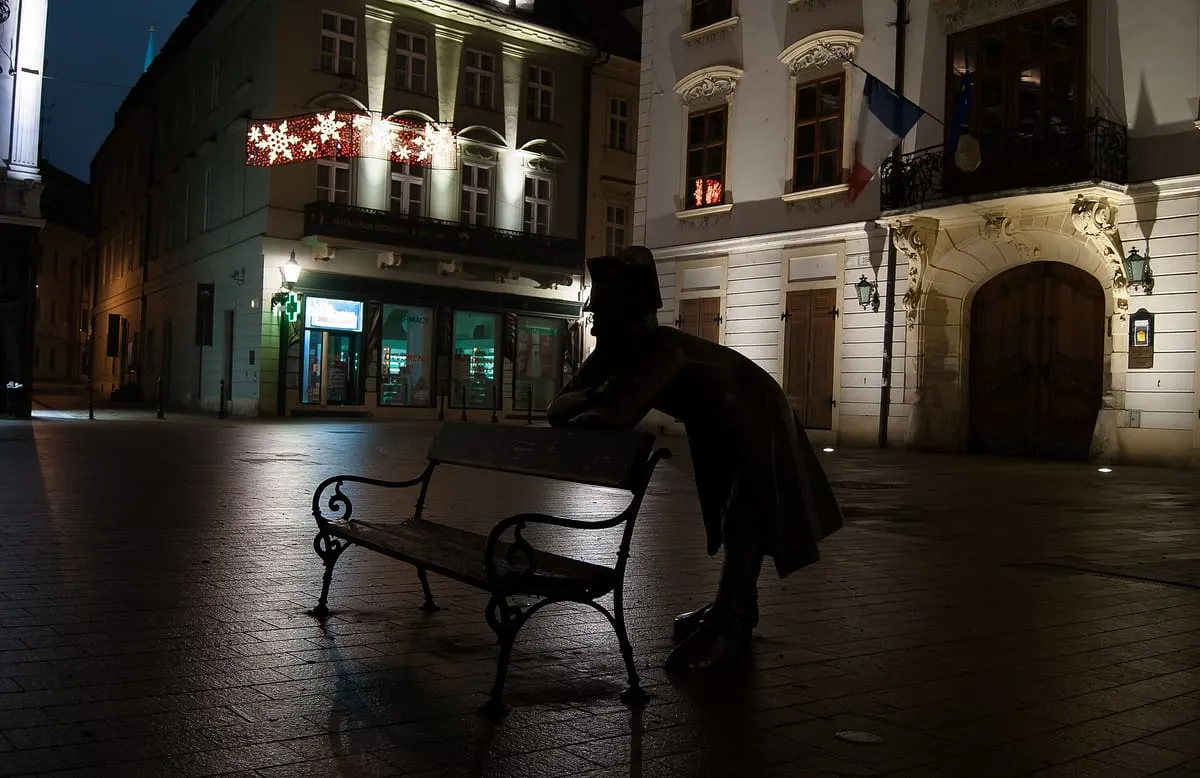
The bronze Napoleonic soldier leaning over a bench on Main Square. Photo: Guillaume Speurt, Wikimedia Commons, CC BY-SA 2.0.
Stop 2: The Napoleonic Soldier (Main Square)
Walk twenty paces into Main Square (Hlavné námestie). On the western perimeter of the square, directly in front of the French Embassy, examine the wooden park benches facing Roland Fountain:
- The soldier at rest: Juraj Meliš’s bronze soldier wears the long-skirted uniform, epaulettes and bicorne hat of Napoleon’s Grande Armée. He leans with his elbows over the back of the bench, his hat pulled down over his eyes.
- The 1809 siege: The statue commemorates the summer of 1809, in the War of the Fifth Coalition, when Napoleon’s forces besieged Pressburg from the southern bank of the Danube and fired over 13,000 cannonballs into the Old Town.
- The legend of Hubert: The soldier is barefoot. Local legend identifies him as a French cavalryman named Johann Evangelist Hubert, wounded in the siege and nursed in a Pressburg hospital by a Slovak nurse named Pauline. He married her and stayed. Combining French sparkling-wine know-how with Small Carpathian grapes, he founded Hubert J.E. in 1825, still a Slovak sparkling wine brand. Visitors sit on the bench beside the soldier to pose for photographs.
Stop 3: Čumil, the Man at Work (Panská, Laurinská & Rybárska brána)
From Main Square, follow Rybárska brána south for 60 metres to its four-way junction with Panská and Laurinská streets:
- The manhole: Viktor Hulík designed Čumil (Slovak for “The Rubberneck” or “The Watcher”) in 1997. A bronze sewer worker emerges from an open manhole, resting his chin on his folded forearms as he watches the street.
- Two theories: Locals debate his motive: an honest municipal labourer taking a smoke break, or a cheeky voyeur looking up the skirts of women in summer dresses. Hulík said he simply wanted to show a cheerful tradesman taking life easy.
- Good luck: According to local tradition promoted by the Bratislava Tourist Board, rubbing the brass button on Čumil’s cap brings good luck, and touching his nose makes a secret wish come true within a year, provided you tell nobody what you wished for. His nose and cap button are worn gold by tourists’ hands.
- The “Man at Work” sign: In his early years, when vehicles were still occasionally allowed into the street, delivery trucks twice hit the bronze worker and nearly decapitated him. The city put up a traffic warning sign above the manhole, showing a running stick figure and the English words “MAN AT WORK”.
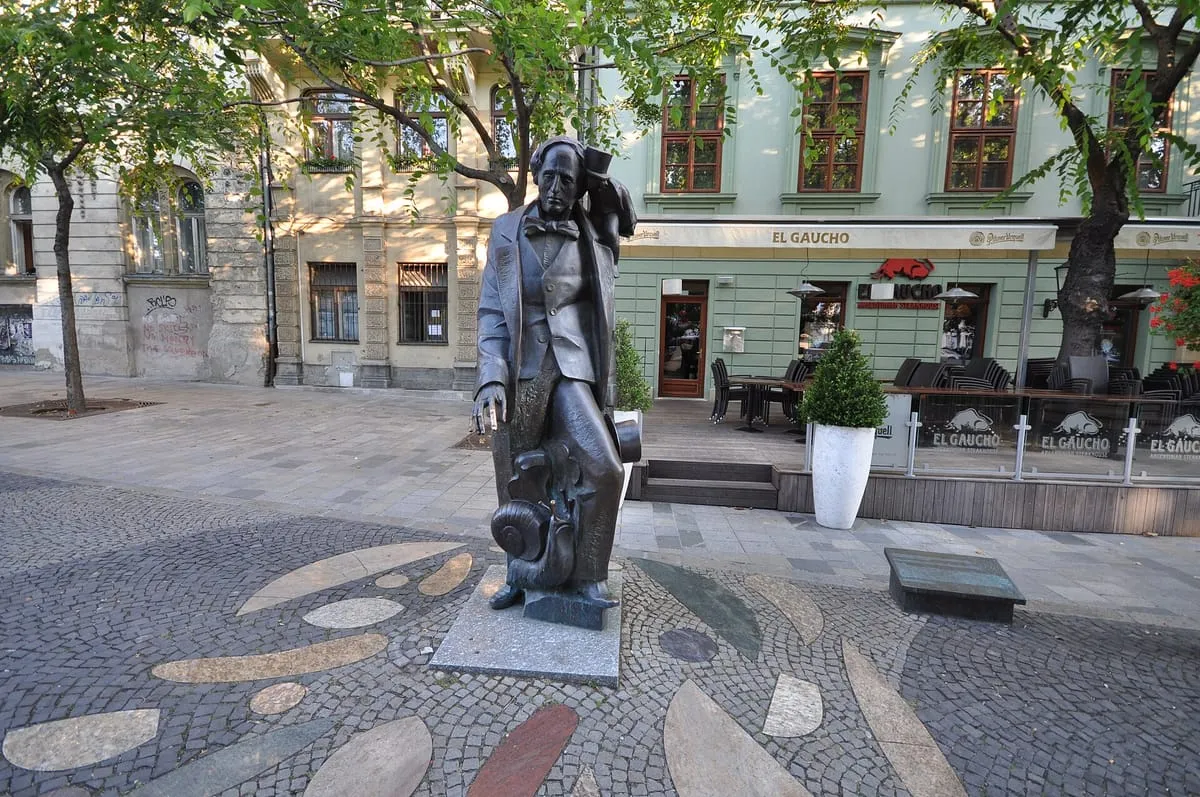
The Hans Christian Andersen monument on Hviezdoslav Square. Photo: Jorge Láscar from Australia, Wikimedia Commons, CC BY 2.0.
Stop 4: Hans Christian Andersen Monument (Hviezdoslav Square)
Continue walking south down Rybárska brána for another 50 metres, entering the eastern end of Hviezdoslavovo námestie beside the historic Slovak National Theatre. Turn right onto the tree-shaded pedestrian promenade to locate the monument to Danish fairytale writer Hans Christian Andersen:
- Andersen’s visit to Pressburg (1841): In June 1841 Andersen stayed at the Hotel Zum Grünen Baum (now the Radisson Blu Carlton) while travelling down the Danube to Constantinople. Townspeople asked him whether he would write a fairytale about Pressburg. He replied: “You ask me for a fairytale? Why? Your city is itself a fairytale; you need only look around you.”
- The sculpture: Unveiled in 2006, the bicentenary of Andersen’s birth, Tibor Bártfay’s bronze shows the Danish author in a frock coat, leaning on a tree trunk. The wild swan from The Wild Swans perches on his shoulder, a snail sits on his top hat, and The Ugly Duckling waddles behind his boots.
Stop 5: Pavol Országh Hviezdoslav Monument & Ganymede’s Fountain
The walk ends at the centre of Hviezdoslav Square:
- Pavol Országh Hviezdoslav: At the midpoint of the boulevard a bronze statue shows the poet Pavol Országh Hviezdoslav (1849–1921), seated with an open manuscript.
- Ganymede’s Fountain: In front of the neo-Renaissance facade of the Slovak National Theatre, Ganymede’s Fountain (Ganymedova fontána) was sculpted in 1888 by Viktor Tilgner. The bronze shows the Greek youth Ganymede carried up to Mount Olympus by Zeus in the guise of an eagle, flanked by cherubs wrestling river crayfish and carp.
Guided walking tours featuring the statues
A guided walk adds the stories behind the statues, the city’s coronation history and its Cold War past.
Coronations, curious statues and local secrets
From €26 · 3.7 stars from 3 reviews · 3 hours · coronations and statues
A walk with a local guide through Bratislava’s coronation history, street statues and local stories. Bratislava Unveiled: Coronations, Curious Statues and Local Secretsad
Old Town and castle walking tour
From €2.10 · 4.7 stars from 929 reviews · 165 minutes · Old Town and castle
A guided walking tour of Bratislava’s Old Town and castle area. Bratislava: Old Town and Castle Walking Tourad
Old Town walking tour with Slovak wine tasting
From €55 · 5 stars from 18 reviews · 2.5 hours · wine tasting, groups of up to 8
A walk from the castle to the Old Town with a licensed local guide, in a group of up to eight, ending with Slovak wine at a historic winery. Bratislava: Old Town Walking Tour with Slovak Wine Tastingad
Where is the Paparazzi statue?
The city used to have another bronze: The Paparazzi (Paparazzo), a life-sized photographer in a trench coat, hiding round a street corner with a long telephoto lens aimed at passers-by.
- Original location: From 1997 until 2012 the Paparazzi stood at the corner of Radničná and Laurinská streets, outside a restaurant named Paparazzi.
- The ownership dispute: Unlike Čumil and Schöne Náci, which the city commissioned, the Paparazzi was privately owned by the restaurant proprietor. When the restaurant closed in 2012 the owners removed the statue, and there were public protests.
- Where to see it now: The sculpture was bought and moved across the Danube to the restaurant level of the UFO Tower on Most SNP, where it greets diners leaving the lift.
Practical advice for walking the route
- Surface and access: The route is level pedestrianised cobblestones and flagstones, with no steps or steep slopes, so it works for wheelchairs and pushchairs.
- Timing: Go before 09:30 to photograph Čumil and the Napoleonic soldier without tour groups. In summer between 11:00 and 15:00 there is usually a queue for Čumil.
- Refreshments: The route passes many cafes. Try coffee and poppy-seed pastries (bratislavské rožky) at Konditorei Kormuth on Sedlárska street, which has neo-Renaissance frescoes, or draft craft beer at Meštiansky pivovar on Dunajská street, covered in our guide to Bratislava craft beer and wine.
What to see next
- Old Town Hall and Main Square: climb the clock tower overlooking the Napoleonic soldier and Roland Fountain.
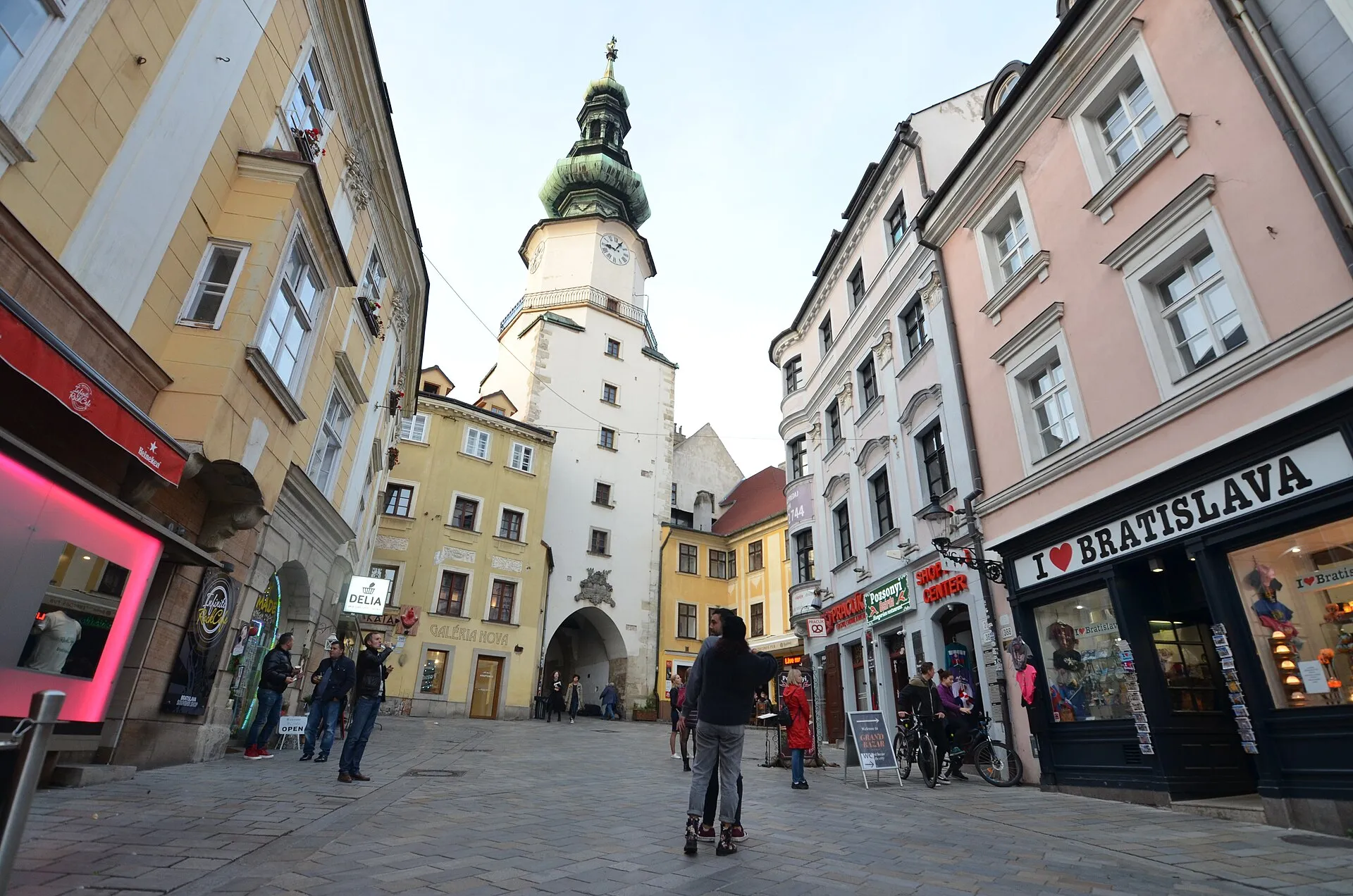
- Michael’s Gate and Tower: the medieval gatehouse at the north end of the Old Town.
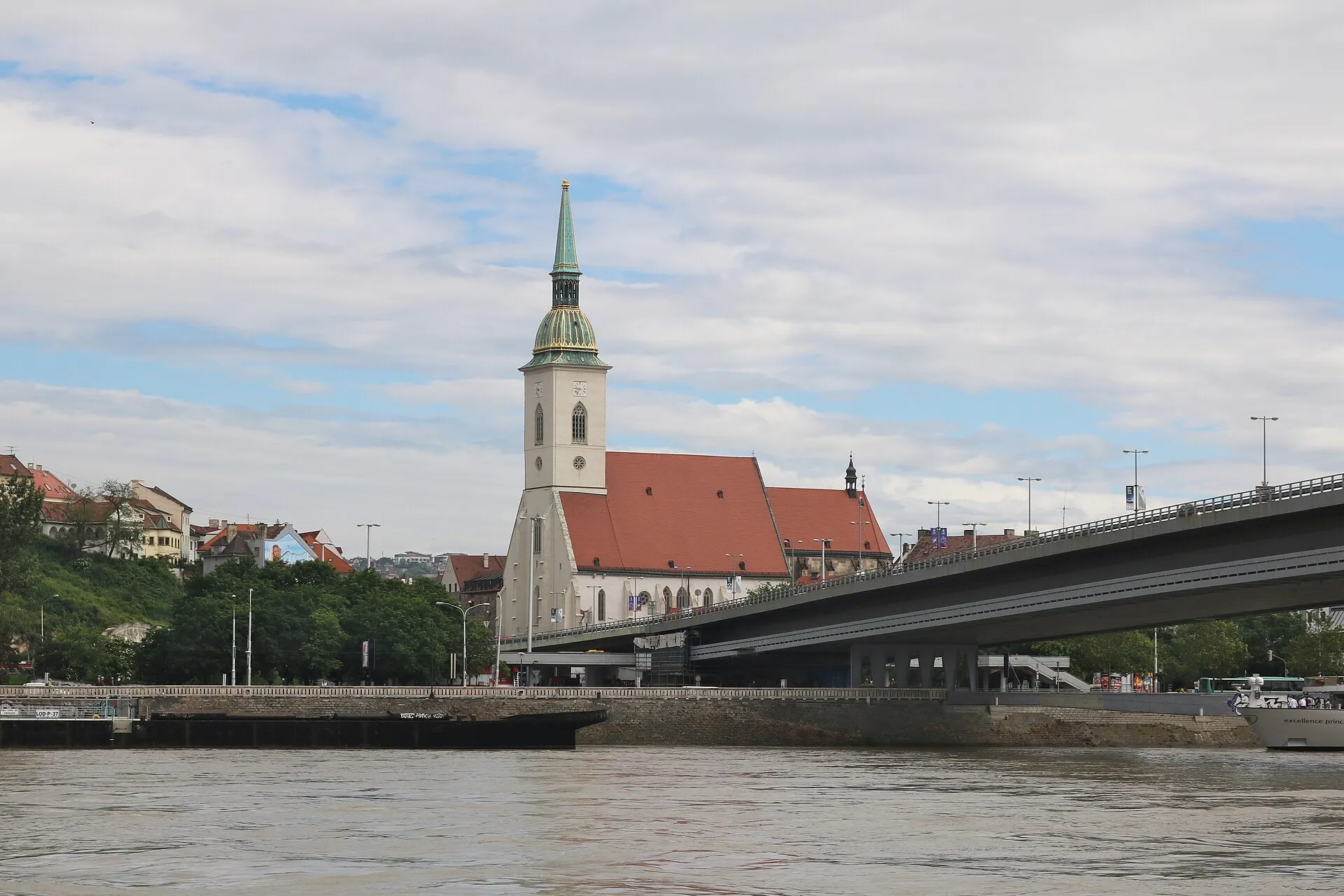
- St Martin’s Cathedral: follow Panská street west to the coronation cathedral.
- Free Things to Do in Bratislava: more free walks and sights.
- Bratislava City Hub: all Bratislava guides.
Common questions
Where is the Čumil (Man at Work) statue in Bratislava?
Čumil is at the pedestrian junction of Panská, Laurinská and Rybárska brána streets in the Old Town. The bronze shows a smiling maintenance worker peering out of an open sewer manhole.
Who was the real-life person behind the Schöne Náci statue?
Schöne Náci ('Beautiful Ignác') was the local street character Ignác Lamár (1897–1967). Dressed in a velvet tailcoat, top hat and white gloves, he strolled Bratislava's cafe terraces tipping his hat to women with the greeting 'I kiss your hand' ('Ruku bozkávam').
Why was the Napoleonic soldier statue built on Main Square?
Sculpted by Juraj Meliš, the bronze French soldier leaning over a bench on Main Square commemorates the 1809 Napoleonic siege. According to local lore, he represents a French infantryman named Hubert who fell in love with a local nurse and stayed to establish the Hubert sparkling wine brand.
How long does the street statues walk take?
The walking loop covers roughly 1.5 kilometres through the pedestrianised Old Town and takes approximately 45 to 60 minutes at a leisurely pace, including photo stops.
Why does Bratislava have so many quirky bronze statues?
In 1997, after the historic centre was pedestrianised, the city commissioned Slovak sculptors to install life-sized bronze figures in the streets, set at pavement level without pedestals.