In this guide
💡 The Short Version: Singapore uses the Singapore dollar (S$ / SGD). Contactless bank cards, Apple Pay, and Google Pay are accepted virtually everywhere, including MRT trains and buses. However, traditional hawker centres and wet markets require cash: carry small S$2, S$5, and S$10 banknotes because stallholders cannot change S$50 or S$100 bills for a S$4 dish. On restaurant menus, ++ adds 19.9 per cent: a 10 per cent service charge plus 9 per cent GST compounded on the total (S$100 becomes S$119.90). Tipping is not customary. Or book a tour: For a first orientation with the transport handled, book the Big Bus open-top hop-on hop-off tourad from S$67.
⚠️ Foreign digital banking apps cannot scan local PayNow or SGQR codes. While you will see Singaporeans paying at hawker stalls using smartphones, they are using PayNow linked to local bank accounts. Unless you hold a Singapore bank account or supported Southeast Asian e-wallet, foreign banking apps will fail. Always carry cash for hawker meals.
Singapore currency and banknotes
The official legal tender is the Singapore dollar (S$ or SGD), issued and regulated by the Monetary Authority of Singapore (MAS).
Banknotes circulate in the Portrait Series featuring Encik Yusof bin Ishak, Singapore’s first President:
- Polymer Banknotes: S$2 (purple), S$5 (green), and S$10 (red) are durable waterproof polymer notes.
- Paper Banknotes: S$50 (blue, the most common high-denomination note) and S$100 (orange). Larger S$1,000 and S$10,000 notes have been permanently discontinued from issuance to mitigate money laundering risks, though existing notes remain legal tender.
- Coins: Circulate in denominations of 5 cents, 10 cents, 20 cents, 50 cents, and the bi-metallic S$1 coin.
Under the 1967 Currency Interchangeability Agreement between Singapore and Brunei Darussalam, Brunei dollars (BND) are legally accepted at a fixed 1:1 parity alongside Singapore dollars in retail stores and banks across Singapore.
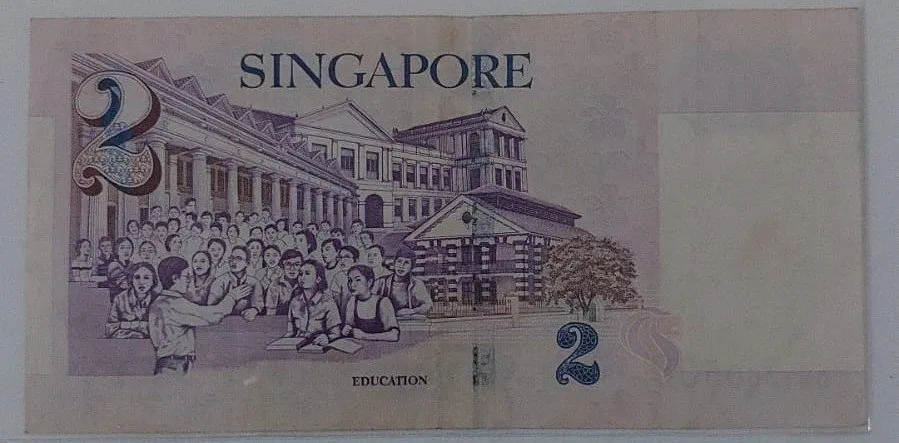
The back of a Singapore two-dollar note. Photo: Camelista27, CC0.
Cashless payments vs hawker cash
Singapore is one of the world’s most cash-light economies. You can spend an entire week using only your smartphone or contactless card for shopping, MRT rides, supermarket runs, and sit-down dining.
| Payment venue | Contactless cards (Visa/Mastercard) | Mobile wallets (Apple/Google Pay) | Cash needed? |
|---|---|---|---|
| MRT & Public Buses | Accepted directly at all fare gates | Accepted directly at all fare gates | No (cards are faster and cheaper) |
| Taxis (ComfortDelGro, Strides) | Accepted (10% admin surcharge on meter) | Accepted in app or terminal | Cash avoids the 10% card fee on taxi meters |
| Restaurants & Cafes | Accepted (minimum spends rarely apply) | Accepted | No |
| Supermarkets & Convenience Stores | Accepted | Accepted | No |
| Hawker Centres (Maxwell, Chinatown Complex) | Generally not accepted (some take NETS) | Foreign wallets not supported on SGQR | Yes — cash is essential |
| Wet Markets & Small Bakeries | Generally not accepted | Only local PayNow supported | Yes — cash is essential |
The hawker cash rule
When dining at historic hawker centres—such as Maxwell Food Centre, Chinatown Complex, Old Airport Road, or Tekka Centre—almost all heritage stallholders operate on cash.
- Always carry a roll of S$2, S$5, and S$10 notes.
- Avoid presenting a S$50 or S$100 note for a S$4.50 plate of chicken rice or a S$1.80 cup of kopi; hawkers start early in the morning with limited float change and may decline the transaction.
The ++ calculation on restaurant bills
When scanning menus outside mid-range and upscale restaurants, hotel cafes, and cocktail lounges, you will notice prices marked with double plus signs (for example, S$38++ or S$85++):
- First plus (+): Represents a 10 per cent service charge levied by the establishment.
- Second plus (+): Represents the statutory 9 per cent Goods and Services Tax (GST).
Compounding tax calculation
Under Inland Revenue Authority of Singapore (IRAS) tax guidelines, GST is calculated not on the base price alone, but on the subtotal after the 10 per cent service charge is added:
$$\text{Final Total} = \text{Base Price} \times 1.10 \times 1.09 = \text{Base Price} \times 1.199$$
This results in an effective surcharge of 19.9 per cent added to your printed menu bill:
| Menu listed price | 10% Service charge | 9% GST (on price + service charge) | Total amount payable |
|---|---|---|---|
| S$10.00++ | S$1.00 | S$0.99 | S$11.99 |
| S$25.00++ | S$2.50 | S$2.48 | S$29.98 |
| S$50.00++ | S$5.00 | S$4.95 | S$59.95 |
| S$100.00++ | S$10.00 | S$9.90 | S$119.90 |
| S$200.00++ | S$20.00 | S$19.80 | S$239.80 |
What does “nett” mean?
When a price displays the word “nett” (for example, S$15 nett), all statutory taxes and service charges are already built into the figure. Hawker centres, fast-food outlets, and food courts are legally required to quote nett prices.
Tipping customs and etiquette
Tipping is not part of Singapore culture and is actively discouraged in several sectors:
- Restaurants and Bars: Because a mandatory 10 per cent service charge is already added to the final tab, you are not expected to leave an additional tip. If service was exceptional, leaving a small cash gratuity or rounding up the bill is appreciated but entirely voluntary.
- Hawker Centres and Fast Casual: Never tip. Hawkers will usually hand back any extra coins left on the counter.
- Taxis and Private Hire: Fares are strictly metered. Passengers commonly round up the fare to the nearest dollar on cash payments for convenience, but tipping is not expected.
- Changi Airport: Tipping airport staff, porters, or immigration personnel is strictly forbidden by Changi Airport Group regulations.
ATMs and bank networks
Singapore possesses a dense network of automated teller machines (ATMs) operated by Singapore’s “Big Three” domestic banks: DBS / POSB, OCBC, and UOB.
- ATM Availability: ATMs are found inside every MRT subway interchange, shopping mall basement, and convenience store. DBS and POSB share an integrated ATM network.
- International Networks: Local ATMs accept overseas cards bearing Visa, Plus, Mastercard, Cirrus, and UnionPay logos.
- Avoid Dynamic Currency Conversion (DCC): When withdrawing cash from an ATM or tapping your card at a restaurant terminal, the machine may ask whether you wish to be billed in your home currency (e.g., GBP, USD, EUR) or in local currency (SGD). Always choose SGD. Choosing your home currency triggers DCC, which applies an extortionate conversion rate markup typically 5 to 8 per cent above mid-market exchange rates.
- Multi-currency Travel Cards: Using digital travel cards (such as Wise or Revolut) provides interbank exchange rates with zero transaction markups.
Best places for currency exchange
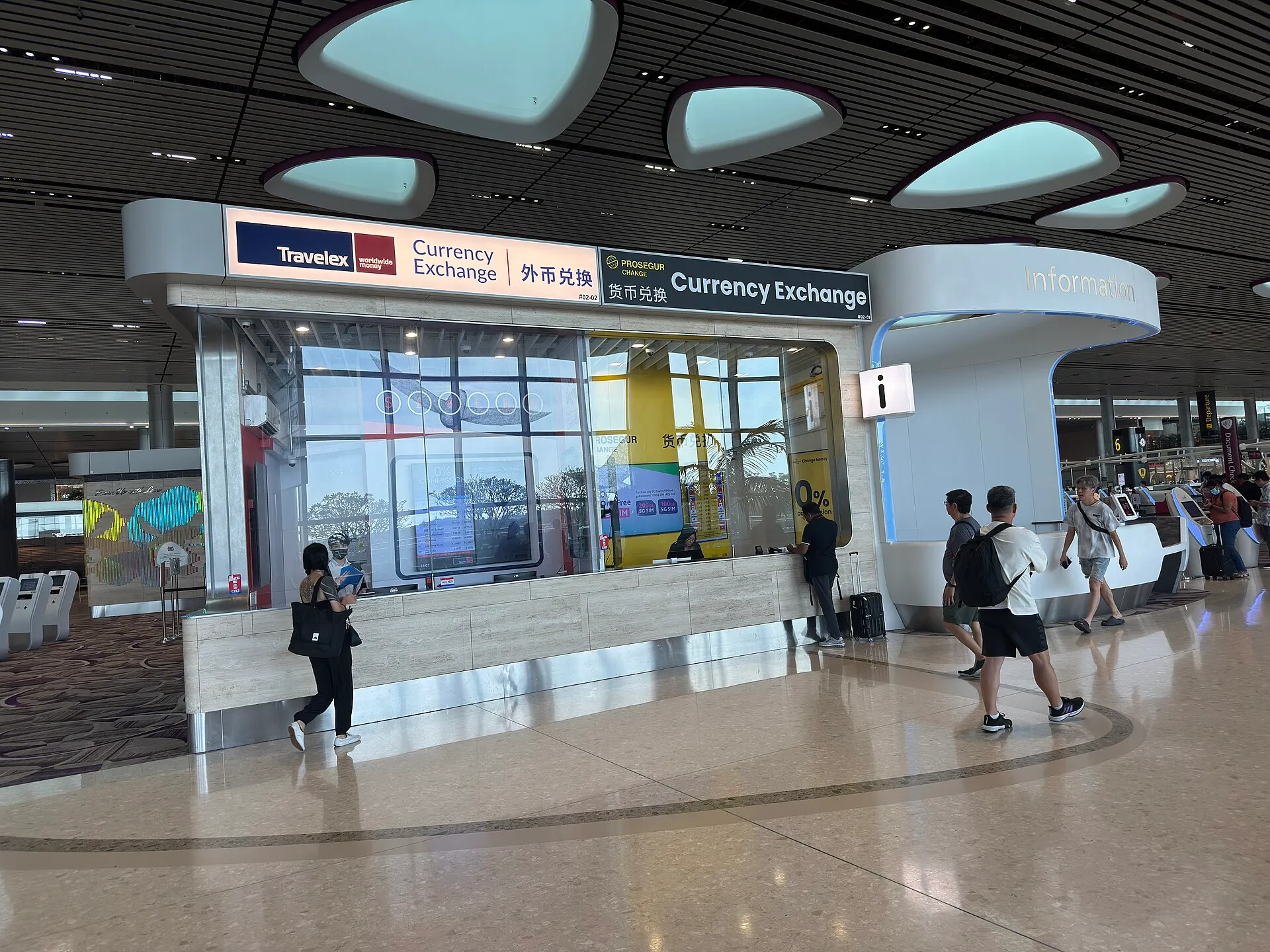
If you carry physical foreign banknotes (such as British pounds, US dollars, euros, or Australian dollars), avoid exchanging large sums at airport arrival counters, where retail buy/sell spreads can reach 8 to 10 per cent.
Head instead to competitive independent licensed money changers located in the city centre:
- The Arcade at Raffles Place (11 Collyer Quay): The historic centre of Singapore currency exchange, located directly outside Raffles Place MRT. Dozens of competing booths offer razor-thin margins.
- People’s Park Complex (Chinatown): Flanked by established money changers offering excellent rates for regional Asian and Western currencies.
- Mustafa Centre (Little India): The 24-hour foreign exchange counters inside Mustafa Centre provide transparent, highly competitive rates around the clock.
Coin rounding rules
Singapore ceased minting 1-cent copper coins in 2002. Consequently, businesses operating cash registers are permitted by IRAS to round cash totals to the nearest 5 cents:
- Totals ending in 1 or 2 cents round down to 0 cents (e.g., S$4.52 becomes S$4.50).
- Totals ending in 3 or 4 cents round up to 5 cents (e.g., S$4.53 becomes S$4.55).
- Totals ending in 6 or 7 cents round down to 5 cents.
- Totals ending in 8 or 9 cents round up to 10 cents.
Rounding applies exclusively to physical cash settlements; electronic card and phone transactions are always settled to the exact cent.
Reclaiming retail GST
Tourists aged 16 and over can claim back the 9 per cent GST on personal retail purchases exceeding S$100 from participating merchants via the electronic Tourist Refund Scheme (eTRS) at Changi Airport. Keep receipts and show your original passport at store checkouts; read our detailed GST refund guide for the complete airport kiosk procedure.
Further planning guides
For transit payments and fare bands, read our comprehensive Singapore public transport guide. Check where to eat in Singapore for hawker recommendations, and consult our where to stay in Singapore guide for accommodation planning.
Common questions
What does ++ mean on a restaurant menu in Singapore?
The notation ++ signifies that the printed price is subject to a 10 per cent service charge and 9 per cent Goods and Services Tax (GST). Crucially, GST is calculated on the subtotal *after* adding the service charge, meaning a S$100 dish actually costs S$119.90 (a 19.9 per cent total markup).
Do you tip in Singapore?
No. Tipping is not customary in Singapore culture and is never expected. Full-service restaurants and upscale hotels already levy a mandatory 10 per cent service charge on the bill. At hawker centres, food courts, taxis, and fast-casual eateries, no service charge is added and tipping is not practised.
Can I use credit and debit cards everywhere in Singapore?
Contactless Visa and Mastercard credit cards, along with Apple Pay and Google Pay, are accepted at almost all retail shops, supermarkets, restaurants, taxis, and public transit fare gates. However, traditional open-air hawker centres, neighbourhood bakeries, and wet markets predominantly require cash.
Can foreign tourists use PayNow or SGQR codes?
Generally no. Singapore's universal SGQR and PayNow payment codes link directly to Singapore-registered local bank accounts (DBS, OCBC, UOB) and selected regional Asian digital wallets. Travellers from Europe, North America, or Australasia cannot scan standard PayNow QR codes with foreign banking apps and must pay with cash at hawker stalls.
What is the best place to exchange foreign currency in Singapore?
The most competitive foreign exchange rates with narrow spreads are offered by licensed private money changers at The Arcade (Raffles Place), People's Park Complex (Chinatown), and Mustafa Centre (Little India). Avoid exchanging large sums at airport arrival bank counters.