In this guide
💡 The Short Version: Deepavali is an official public holiday in Singapore, falling on Sunday 8 November 2026 (Monday 9 November observed) and Thursday 28 October 2027. For nearly two months from mid-September through mid-November, Little India is illuminated by massive overhead arches of peacocks, lotus blossoms, and diyas (clay oil lamps) spanning Serangoon Road. Browse the Deepavali Festival Village on Campbell Lane for traditional sweets (mithai), floral garlands, and intricate henna body art. Mind the legal alcohol ban: Little India is a strict Liquor Control Zone; outdoor public drinking is forbidden all weekend, on public holidays, and on the eve of public holidays. Dress respectfully at temples: cover your shoulders and knees, and remove shoes outside. Or book a tour: travellers wanting an entertaining guided walk through the festival markets can join the Singapore Chinatown, Little India and Arab Street walking tourad from S$113.
Deepavali (also known as Diwali), the ancient Hindu “Festival of Lights,” commemorates the spiritual triumph of light over darkness, good over evil, and knowledge over ignorance. In Singapore, home to a thriving Tamil and South Asian diaspora, Deepavali is one of the nation’s most exuberant and colourful annual cultural festivals.
For roughly seven weeks leading up to the holiday, the historic enclave of Little India transforms into an open-air wonderland of kaleidoscopic lights, buzzing festive night bazaars, gold jewellery displays, and the aroma of roasted cardamom, cloves, and fresh jasmine garlands.
The festival dates and public holidays
Deepavali dates are calculated according to the Hindu lunisolar calendar, coinciding with the darkest new moon night (Amavasya) of the Hindu month of Kartika.
| Festival Edition | Deepavali Day | Gazetted Public Holiday Status | Associated Weekend Dynamics |
|---|---|---|---|
| Deepavali 2026 | Sunday 8 November 2026 | Monday 9 November 2026 observed | Three-day holiday weekend; high festive crowds |
| Deepavali 2027 | Thursday 28 October 2027 | Thursday 28 October 2027 | Mid-week public holiday; heavy eve festivities on Wednesday |
Official dates are published annually by the Singapore Ministry of Manpower (MOM). Because Monday 9 November 2026 is a substitute public holiday, Little India experiences intense pedestrian congestion throughout the Saturday, Sunday, and Monday periods.
What to see and do in Little India during Deepavali
The festival animates the entire neighbourhood with public displays and sacred rituals:
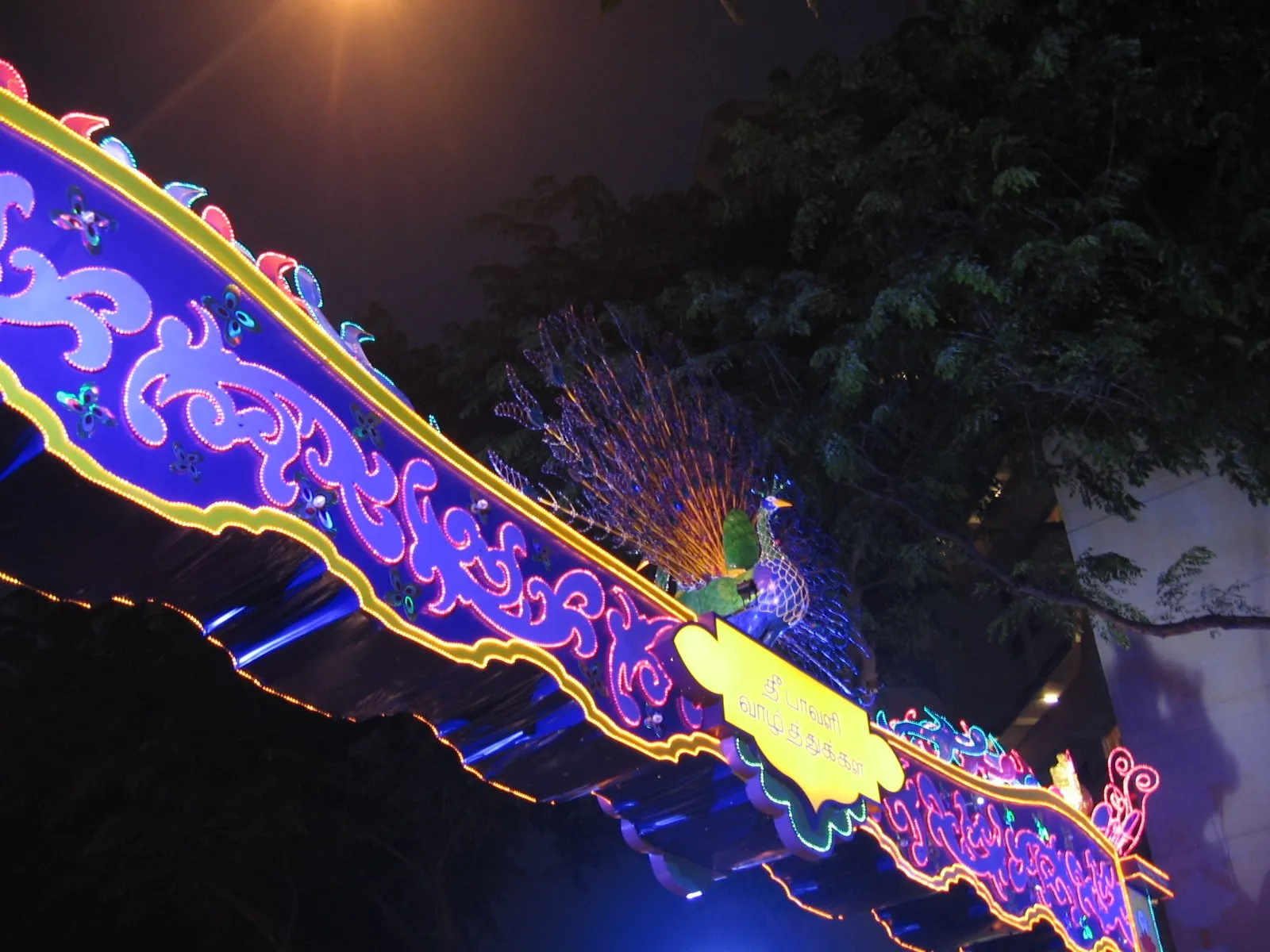
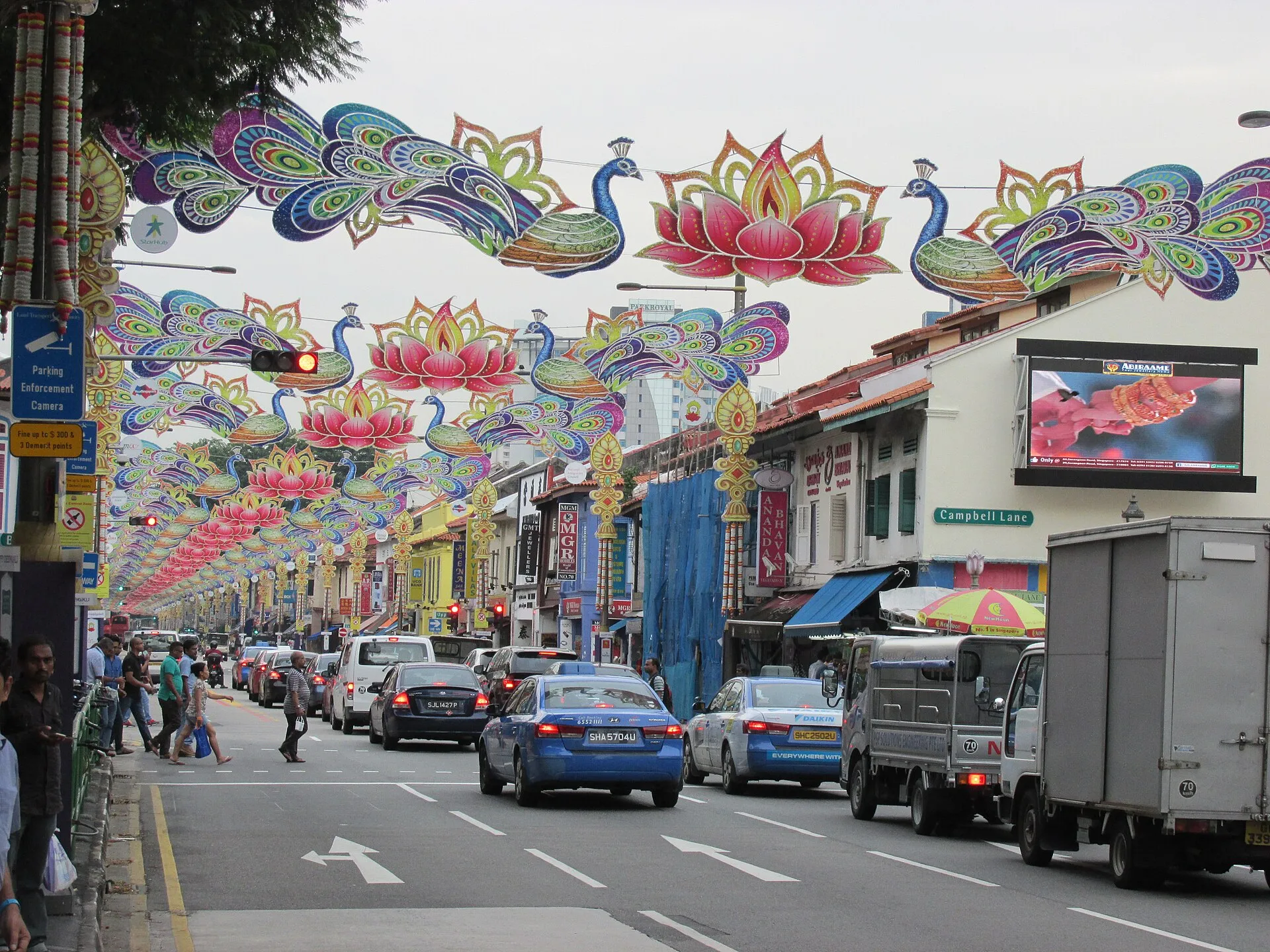
A Deepavali light display in Little India. Photo: User:Sengkang, Wikimedia Commons, Copyrighted free use.
1. The Serangoon Road Street Light-Up
Organised by the Little India Shopkeepers and Heritage Association (LISHA), the street lighting spans roughly two kilometres along Serangoon Road and Race Course Road.
- Lighting Themes: Elaborate multi-tiered light arches feature Hindu motifs: majestic peacocks (symbolising divine grace and beauty), blooming lotus blossoms, sacred elephants, and illuminated clay oil lamps (diyas).
- Viewing Hours: The street illuminations switch on nightly at 19:00 and stay lit until midnight (extending until 02:00 on Friday and Saturday evenings, and all night on the eve of Deepavali).
- Best Photo Spots: The pedestrian overhead bridge linking Tekka Centre to the eastern side of Serangoon Road provides an elevated vantage point to photograph the endless corridor of light arches above evening traffic.
2. The Deepavali Festival Village (Campbell Lane & Hastings Road)
Throughout the month leading up to the holiday, Campbell Lane (in front of the Indian Heritage Centre) and Hastings Road become a pedestrian holiday market:
- Festive Mithai (Indian Sweets): Sample freshly prepared holiday delicacies, including saffron-infused jalebi, melt-in-the-mouth gulab jamun, diamond-shaped cashew kaju katli, and rich ghee-laden laddu. Legendary sweetmakers include Moghul Sweet Shop inside Little India Arcade and Komala Vilas Sweets.
- Mehndi (Henna Body Art): Skilled henna artists set up roadside stations, applying intricate floral and peacock patterns onto the hands and arms of visitors (typically S$10 to S$30 depending on complexity).
- Festive Attire & Bangles: Stalls overflow with embroidered silk saris, sparkling lehengas, gold-trimmed kurtas, and rainbow towers of glass bangles.
- Floral Garlands: Watch master florists thread fresh strands of yellow marigolds, red roses, and white jasmine blossoms used for home shrines and temple offerings.
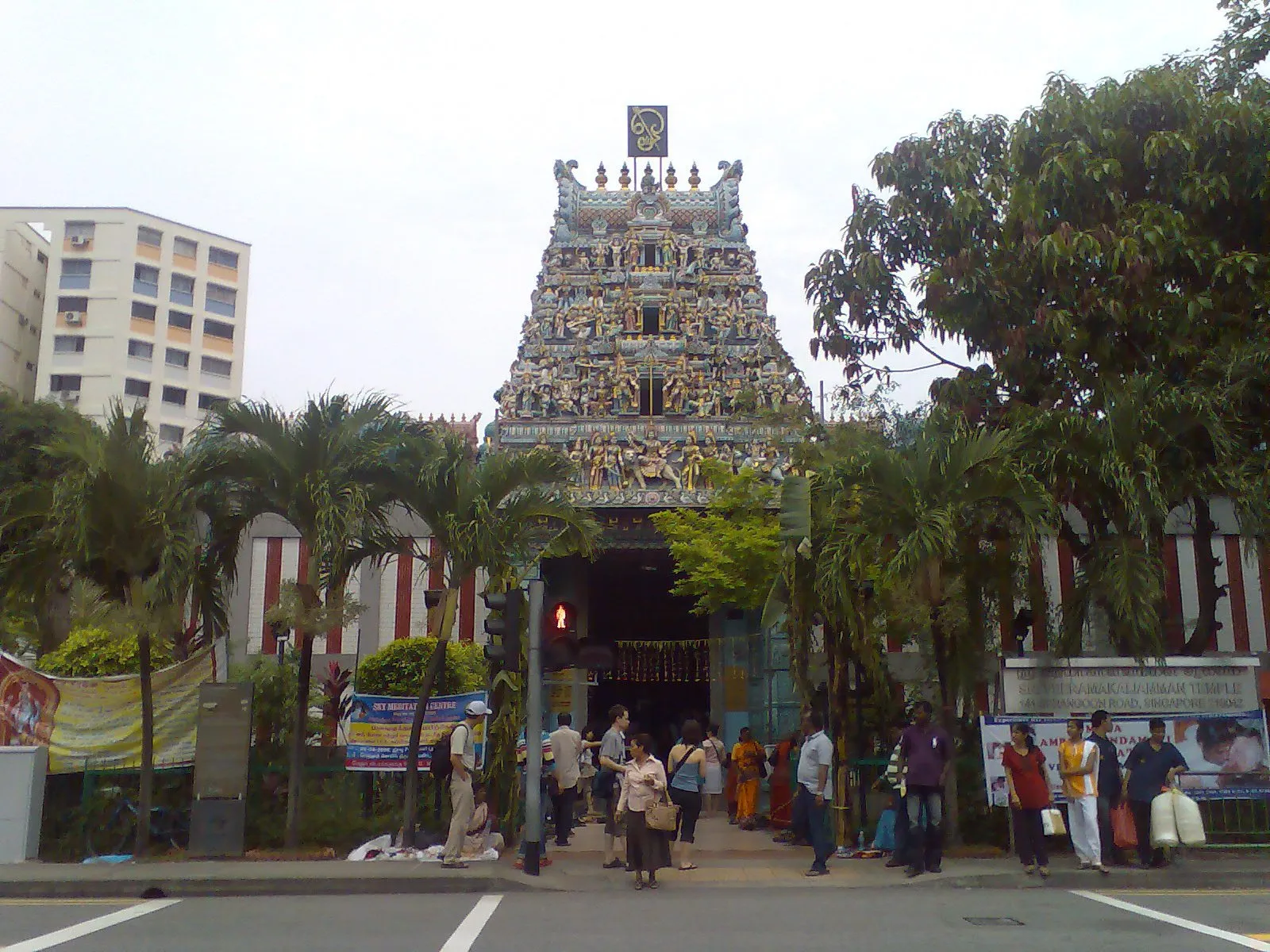
The gopuram of Sri Veeramakaliamman Temple in Little India. Photo: Thaejas Kocherlakota, Wikimedia Commons, CC BY-SA 3.0.
3. Temple Celebrations: Sri Veeramakaliamman and Sri Srinivasa Perumal
The temples of Little India form the spiritual core of Deepavali:
- Sri Veeramakaliamman Temple (141 Serangoon Road): Built in 1881 by early migrant labourers and dedicated to the fierce mother goddess Kali. On the eve and morning of Deepavali, thousands of devotees dressed in new traditional clothing queue to make floral offerings, burn camphor, and receive sacred ash (vibhuti) blessings from temple priests.
- Sri Srinivasa Perumal Temple (397 Serangoon Road): A sprawling National Monument dedicated to Lord Krishna (an avatar of Vishnu). Its magnificent 20-metre-tall gopuram depicts the nine incarnations of Vishnu.
- The Thimithi Firewalking Ceremony: Held roughly one to two weeks prior to Deepavali at Sri Mariamman Temple in Chinatown. In this dramatic annual ritual, thousands of male Hindu devotees walk barefoot across a three-metre pit of glowing red-hot charcoal embers to honour the goddess Drowpathai Amman, fulfilling spiritual vows of endurance and purity.
Independent festive walks vs guided cultural tours
Wandering independently through Little India allows you to browse spice shops and sample sweets at your own pace. However, joining an accredited cultural guide helps you decipher temple rituals, introduces you to generational food stalls, and navigates busy festival alleys.
| Feature | Self-Guided Festival Stroll | Guided Cultural Tour (GYG) |
|---|---|---|
| Cost | Free | From S$69 to S$113 per person |
| Pace | Browse shops and sweets at your own tempo | Structured 3- to 4-hour guided group itinerary |
| Food & Tastings | Purchase street snacks independently | Curated tastings included (roti prata, teh tarik, mithai) |
| Cultural Explanations | Self-guided reading of plaques | Expert commentary detailing Hindu epics, deities, and traditions |
| Route Coverage | Focused primarily on Serangoon Road | Connects Chinatown, Little India, and Kampong Glam |
Recommended cultural walking tours
Singapore: Chinatown, Little India, Arab Street Walking Tour
From S$90 · 4.9 stars from 466 reviews · 4 hours · Cultural walk
Discover how Singapore’s different cultural communities interact and celebrate. An expert local guide leads you through the buzzing festival streets of Little India, explaining the significance of Deepavali rituals alongside visits to Chinatown and Kampong Glam, with MRT transit and food tastings included. Book on GetYourGuidead.
Singapore: Guided Street Food Tour at Night with 9 tastings
From S$109 · 4.6 stars from 545 reviews · 3.5 hours · 9 tastings
A 3.5-hour guided evening food walk with nine tastings. Book on GetYourGuidead.
Singapore: Chinatown, Little India & Kampong Glam Walk
From S$100 · 4.8 stars from 200 reviews · 3 hours · Small group
A fast-paced cultural exploration taking in the architectural landmarks, incense-filled temples, and merchant bazaars across Singapore’s three historic quarters. Book on GetYourGuidead.
Important legal regulations: Liquor Control Zone
Travellers visiting Little India must be aware that the neighbourhood is a legally designated Liquor Control Zone under Singapore’s Liquor Control (Supply and Consumption) Act.
- Public Alcohol Ban: Consuming alcohol in any outdoor public space—including pavements, alleys, open plazas, parks, and residential void decks—is strictly illegal all weekend (from 22:30 on Friday continuously until 07:00 on Monday), as well as all day on public holidays and public holiday eves.
- For Deepavali 2026: The public drinking ban applies continuously from Friday evening 6 November through Tuesday morning 10 November.
- For Deepavali 2027: The ban applies from Wednesday 27 October (Eve) through Thursday 28 October (Public Holiday).
- Where you can drink: Licensed indoor restaurants, bars, and beer halls are permitted to serve alcoholic beverages for on-site consumption during their approved licensing hours.
- Penalties: Police conduct active foot patrols. Breaching public drinking laws in a Liquor Control Zone carries enhanced penalties of up to 1.5 times the standard fine, reaching up to S$1,500 for a first offence.
Practical tips for a smooth visit
- Best time to visit: Arrive in the late afternoon around 16:30 to explore the Indian Heritage Centre (5 Campbell Lane; S$10 adult; note it is closed Mondays). Browse the street bazaars as twilight arrives, and enjoy the full spectacle of the street light-up once darkness falls at 19:15.
- Temple Etiquette: Remove your shoes and socks before ascending temple steps, placing them on the open racks outside. Wear respectful clothing covering shoulders and knees; free sarongs and shawls are provided at temple entrances. Photography is permitted in outer temple courtyards, but do not photograph innermost sanctums during prayer ceremonies.
- Where to Eat: Feast on authentic South Indian vegetarian meals served on banana leaves at Komala Vilas (76 Serangoon Road, operating since 1947), or sample mutton biryani and fresh tandoori naan at Tekka Centre food hall.
- Getting There & Away: Little India is served by two primary MRT stations: Little India MRT (NE7/DT12) at the southern end, and Farrer Park MRT (NE8) at the northern end. To avoid heavy turnstile crowds at Little India station after the lights switch on, consider walking five minutes north to Farrer Park MRT for your return train.
More Singapore guides
Continue planning your Singapore journey:
- Little India neighbourhood guide: 24-hour shopping at Mustafa Centre and temple details.
- Little India to Kampong Glam walk: self-guided walking trail connecting both cultural enclaves.
- Best time to visit Singapore: monthly weather patterns, rainfall, and festive calendars.
- Singapore rules and fines: complete guide to local laws and customs.
- Public transport in Singapore: mastering the MRT network and SimplyGo contactless fares.
- What to book before you go to Singapore: essential ticket planning and reservation timeline.
Common questions
When is Deepavali celebrated in Singapore?
Deepavali is an official gazetted public holiday in Singapore. In 2026, it falls on Sunday 8 November (with Monday 9 November observed as a substitute public holiday). In 2027, Deepavali falls on Thursday 28 October.
When are the Deepavali street lights switched on in Little India?
The annual Little India Deepavali Street Light-Up operates for approximately seven weeks, typically launching in mid-September and glowing nightly through mid-November. The illuminated light arches span two kilometres along Serangoon Road and Race Course Road, illuminating nightly from 19:00 to midnight (extended to 02:00 on Fridays and Saturdays).
Can you drink alcohol in public in Little India during Deepavali?
No. Little India is a legally gazetted Liquor Control Zone. Consuming alcohol in public outdoor places—including pavements, roads, walkways, and void decks—is strictly prohibited throughout the entire weekend, on public holidays, and on the eve of public holidays. Drinking is permitted only inside licensed indoor bars, restaurants, and coffee shops.
What should you wear when visiting Hindu temples during Deepavali?
Dress modestly with shoulders and knees covered. Avoid sleeveless tops, tank tops, shorts, or tight clothing. All footwear must be removed outside the temple entrance and placed on designated storage racks.
Are shops and restaurants in Little India open during Deepavali?
Yes. Unlike Chinese New Year when many Chinese businesses close, Deepavali is the busiest commercial period of the year for Little India. Retail emporiums like Mustafa Centre, traditional sweet shops, textile stores, and restaurants operate full normal hours.