One of 3 self-guided walks in Singapore. See every walk.
In this guide
💡 The Short Version: This 1.6-kilometre self-guided walk links Singapore’s South Asian cultural hub with the historic Malay-Arab royal district. The route runs from Sri Veeramakaliamman Temple down Serangoon Road, past the modern Indian Heritage Centre (S$10 foreign adult; closed Mondays) and the neoclassical minarets of Abdul Gafoor Mosque, across the Rochor Canal to Sultan Mosque (closed to visitors on Fridays) and the colourful murals of Haji Lane. Plan your day carefully: do not walk on a Monday if you want the heritage museum, and do not walk on a Friday if you want to step inside Sultan Mosque. Or book a tour: travellers wanting an entertaining guided perspective across all three ethnic quarters can join the Singapore Chinatown, Little India and Arab Street walking tourad from S$113.
Connecting two of Singapore’s most distinctive historic quarters, the walk from Little India to Kampong Glam bridges the sensory worlds of South Asian commerce and Malay-Muslim royal heritage. Within less than two kilometres, you pass from aromatic garland stalls, spice mills, and Dravidian temple towers into quiet residential alleys, historic minarets, textile shophouses, and independent fashion lanes.
Because the route is flat and compact, it serves as one of Singapore’s most rewarding half-day walking explorations, easily paired with lunch at a traditional hawker centre or heritage cafe.
Interactive route map and itinerary
Map of the walk numbered stops in walking order
Open the route in Google Maps — follow turn-by-turn walking directions directly on your smartphone.
Opening hours by day of the week
To experience all indoor landmarks open, consult this opening schedule before choosing your walking day:
| Day of Week | Indian Heritage Centre (Stop 2) | Sultan Mosque Visiting Hours (Stop 4) | Recommendation |
|---|---|---|---|
| Monday | Closed | Open (10:00–12:00, 14:00–16:00) | Walkable, but you can only view museum exterior |
| Tuesday to Thursday | Open (10:00–18:00) | Open (10:00–12:00, 14:00–16:00) | Ideal days: full access to both sites |
| Friday | Open (10:00–18:00) | Closed to tourists all day | Good for museum, but mosque can only be seen outside |
| Saturday & Sunday | Open (10:00–18:00) | Open (10:00–12:00, 14:00–16:00) | Ideal days: lively atmosphere, full access |
| Stop Number & Landmark | Hours & Admission | Key Sights |
|---|---|---|
| 1. Sri Veeramakaliamman Temple | 05:30–12:00 & 17:00–21:00; Free | Historic 1881 South Indian Dravidian gopuram dedicated to goddess Kali |
| 2. Indian Heritage Centre | Tue–Sun 10:00–18:00; S$10 adult | Modern translucent facade, five permanent diaspora exhibition galleries |
| 3. Abdul Gafoor Mosque | Exterior view anytime; Free | Victorian and Saracenic revival architecture; 25-ray prophetic sundial |
| 4. Sultan Mosque | Sat–Thu 10:00–12:00 & 14:00–16:00; Free | Massive golden onion domes lined with glass soy sauce bottles |
| 5. Haji Lane | Open 24 hours (shops 11:00–20:00) | Street art murals, indie fashion labels, artisanal coffee houses |
Guided walking tour vs independent exploration
Walking independently allows you to take tea breaks at traditional kopitiams and explore quirky side alleys at your own pace. However, joining an accredited local guide provides essential historical context on Singapore’s 1822 Jackson Plan (which designated ethnic reserves for Chinese, Indian, and Malay communities), religious symbolism, and colonial architecture.
| Feature | Self-Guided Walk | Guided Cultural Tour (GYG) |
|---|---|---|
| Total Cost | Free (plus S$10 museum ticket if entering) | S$69 to S$113 per person |
| Flexibility | Pause whenever you like; linger in boutiques | Scheduled 3- to 4-hour group itinerary |
| Food Tastings | Purchase snacks independently at hawker stalls | Guided tastings included (teh tarik, roti prata, sweets) |
| Historical Depth | Self-directed reading of museum panels | Engaging expert commentary detailing folklore and architecture |
| Route Coverage | Covers Little India to Kampong Glam (1.6 km) | Expands across Chinatown, Little India, and Kampong Glam |
Recommended guided cultural tours
Singapore: Chinatown, Little India, Arab Street Walking Tour
From S$90 · 4.9 stars from 466 reviews · 4 hours · Cultural walk
This top-rated small-group cultural tour explores the contrasting heritage enclaves of Chinatown, Little India, and Kampong Glam. Led by an expert local storyteller, you learn the origins of Singapore’s ethnic quarters, uncover hidden street art murals, sample traditional delicacies, and ride the MRT between districts like a resident. Book on GetYourGuidead.
Singapore: Chinatown, Little India & Kampong Glam Walk
From S$100 · 4.8 stars from 200 reviews · 3 hours · Small group
A fast-paced, immersive walking experience taking in the architectural landmarks, incense-filled temples, spice shops, and textile boutiques of Singapore’s three principal historic quarters. Book on GetYourGuidead.
Singapore: Chinatown Historic Walking Tour with Lunch
From S$69 · 5.0 stars from 155 reviews · 3.5 hours · Small group with lunch
Focusing deeply on the historic core of Chinatown, this guided walking tour visits the Buddha Tooth Relic Temple, Sri Mariamman Temple, traditional medicinal herbal dispensaries, and tea merchants. The tour concludes with an authentic lunch featuring Michelin-recognized soya sauce chicken. Book on GetYourGuidead.
Detailed stop-by-stop walking route
Stop 1: Sri Veeramakaliamman Temple
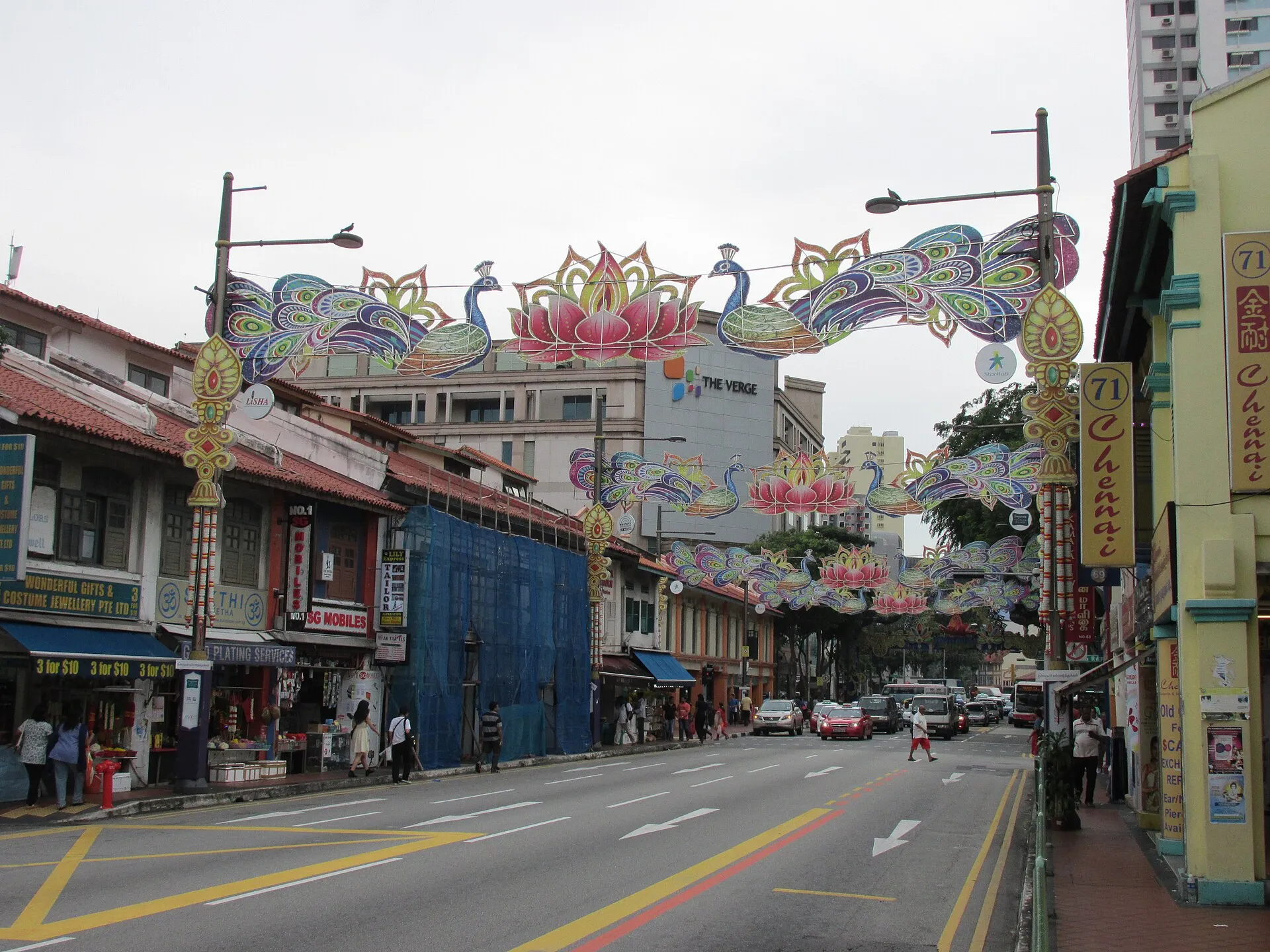
Start at Sri Veeramakaliamman Temple at 141 Serangoon Road, easily reached by walking five minutes north from Little India MRT station (NE7/DT12, Exit E).
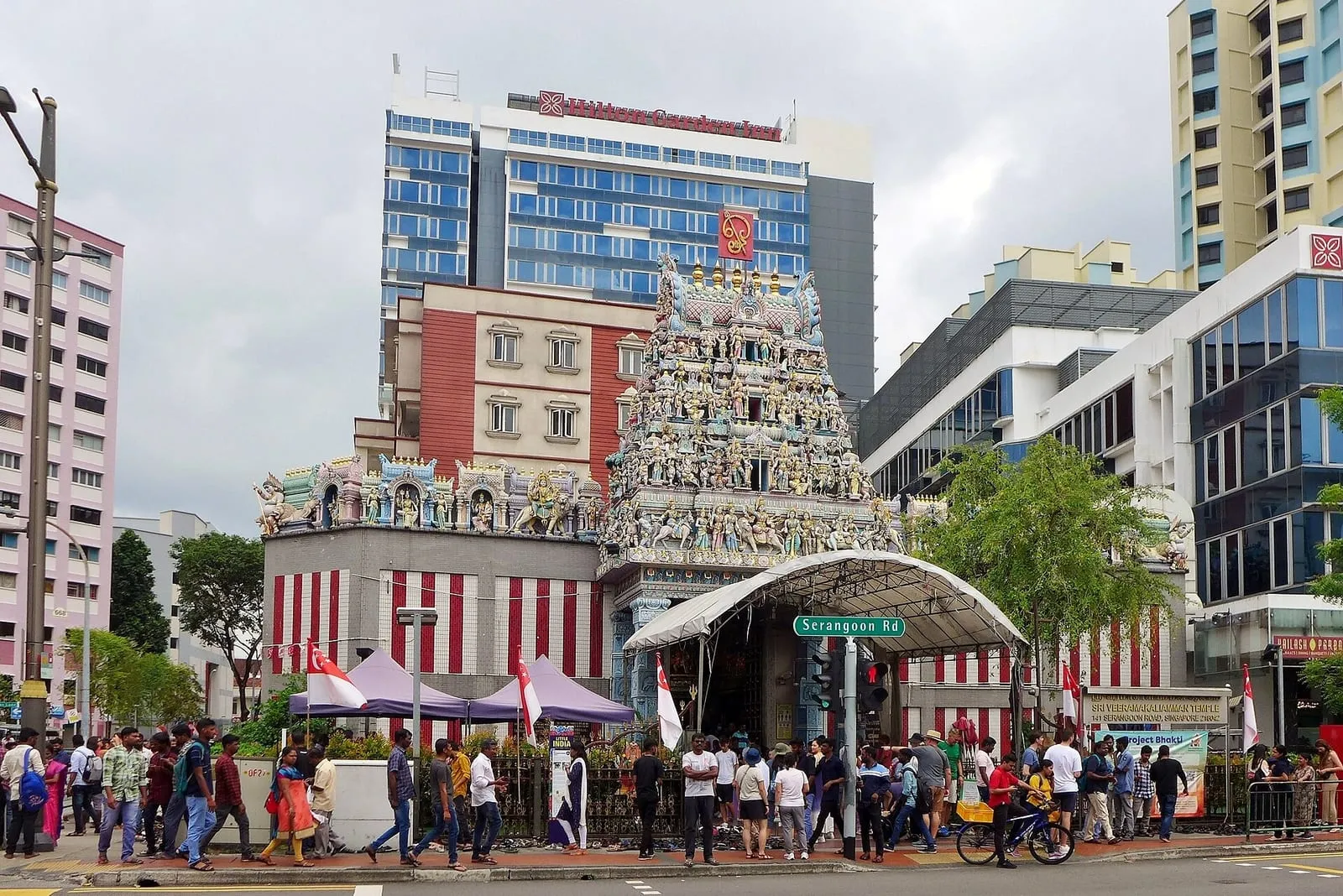
Sri Veeramakaliamman Temple on Serangoon Road. Photo: Bahnfrend, Wikimedia Commons, CC BY-SA 4.0.
Constructed in 1881 by early migrant labourers from Bengal and Tamil Nadu, this temple is dedicated to the Hindu goddess Kali (the fierce, maternal embodiment of Shakti who destroys evil to protect the innocent).
- Historical Significance: During the Japanese air raids of the Second World War in February 1942, hundreds of local residents sheltered inside the temple’s prayer hall; miraculously, neither the temple nor anyone inside was harmed.
- The Gopuram: The South Indian Dravidian tower rises in stepped tiers crowded with brightly painted polychrome sculptures of Kali, Brahma, Vishnu, and celestial warriors.
- Inner Hall: Inside, Kali is depicted wearing a garland of skulls and trampling the demon of ignorance. Ceiling bells chime as worshippers ring them upon entering to announce their presence to the divine.
- Visiting Etiquette: Remove shoes outside and place them on the designated racks. Shoulders and knees must be covered; shawls are provided at the entrance. Photography is permitted in the outer courtyard.
Stop 2: Indian Heritage Centre
From the temple, walk south down Serangoon Road for 250 metres, turn left into Campbell Lane, and arrive at the Indian Heritage Centre at 5 Campbell Lane.
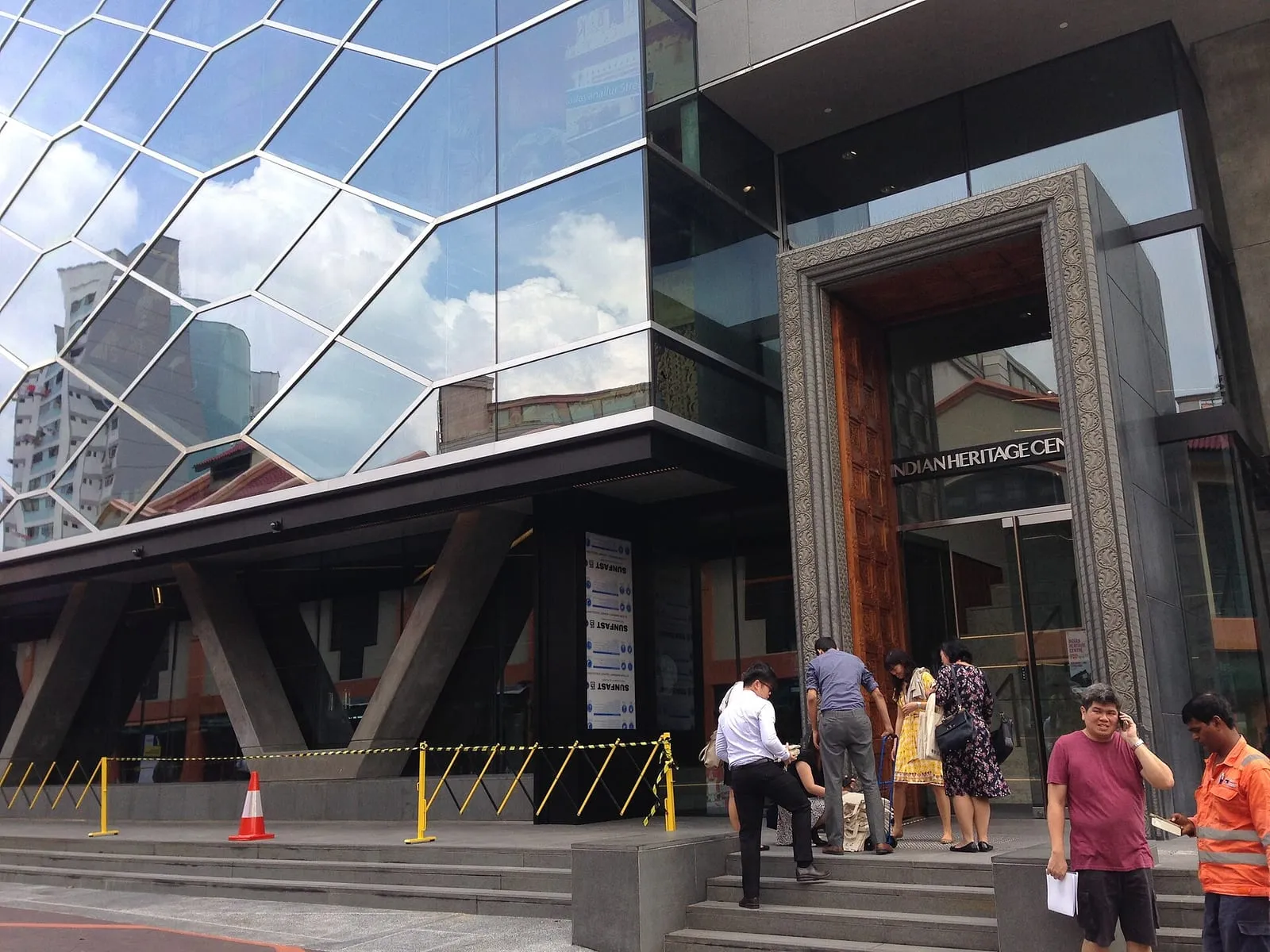
The Indian Heritage Centre on Campbell Lane. Photo: Smuconlaw, Wikimedia Commons, CC BY-SA 4.0.
Opened in 2015, this striking contemporary museum features a shimmering glass curtain facade inspired by traditional Indian baoli (stepwells).
- Galleries: Five permanent galleries trace the history of Indian and South Asian communities in Southeast Asia from early pre-colonial maritime trade routes through colonial plantation migrations, the anti-colonial struggle, and modern contributions to Singaporean nation-building.
- Admission: S$10 for foreign adults, S$8 for seniors and students; free for Singapore citizens and permanent residents.
- Opening Hours: Tuesday to Sunday from 10:00 to 18:00 (closed Mondays). Allow roughly 45 to 60 minutes to view the artefacts, wood carvings, and multimedia exhibits.
Stop 3: Abdul Gafoor Mosque
Leave Campbell Lane, cross Clive Street into Dunlop Street, and walk east for 200 metres to reach Abdul Gafoor Mosque at 41 Dunlop Street.
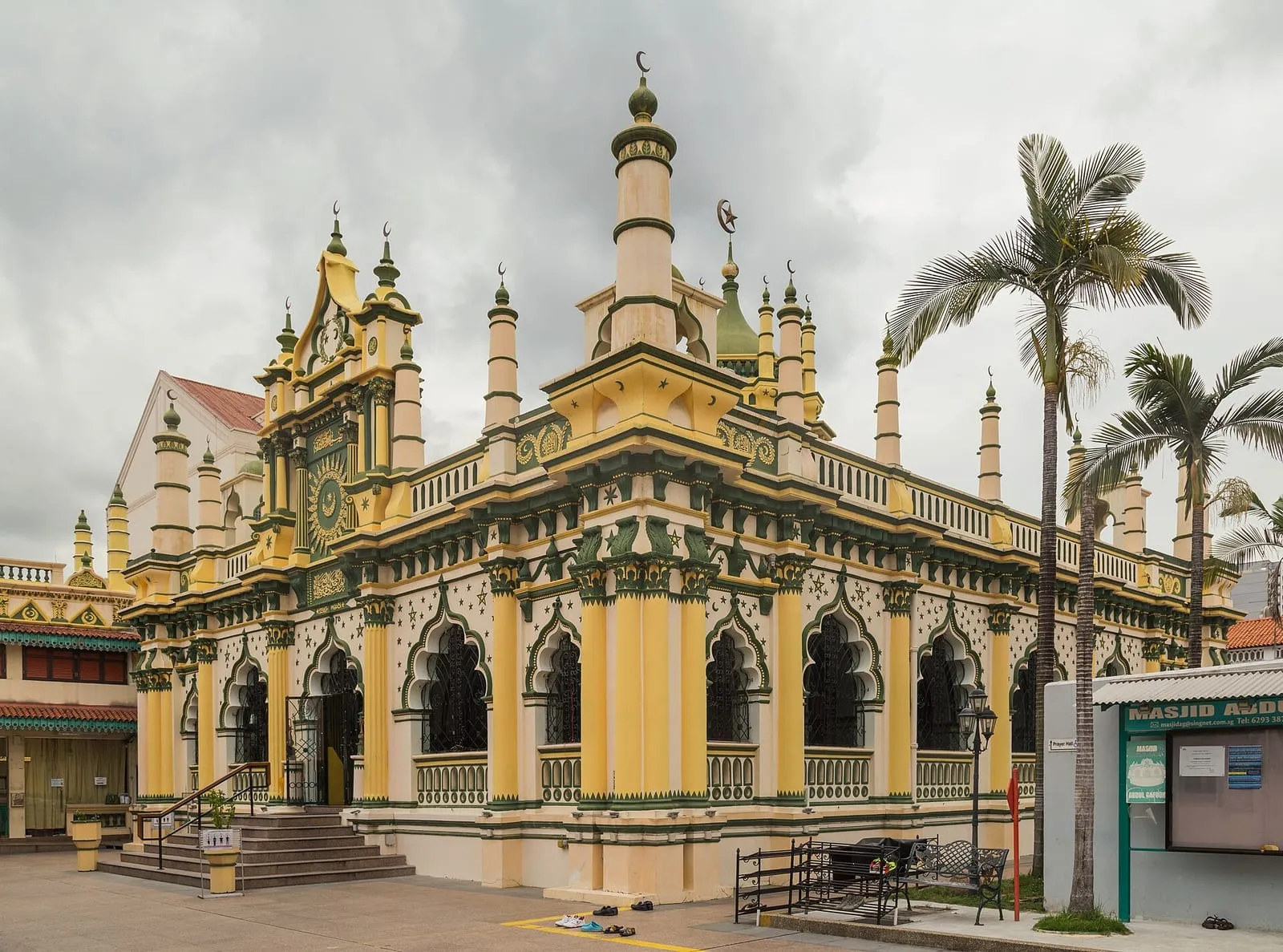
Abdul Gafoor Mosque on Dunlop Street. Photo: Marcin Konsek, Wikimedia Commons, CC BY-SA 4.0.
Gazetted as a National Monument in 1979, this 1910 mosque originally served Indian Muslim merchants and horse trainers working at the nearby Serangoon racecourse.
- Eclectic Architecture: The structure blends Victorian neoclassical pilasters and Moorish Saracenic arches with South Indian decorative flourishes.
- Unique Minarets & Sundial: The roofline is crowned with 25 miniature Corinthian minarets. Above the main entrance arch hangs a unique sundial featuring 25 radial rays decorated with Arabic calligraphy bearing the names of 25 Islamic prophets mentioned in the Quran.
- Visiting: Non-Muslim visitors can admire the intricate yellow-and-green exterior from the courtyard. If entering the perimeter, remove footwear and observe appropriate modest dress.
Stop 4: Sultan Mosque (Masjid Sultan)
From Dunlop Street, cross Jalan Besar, walk east along Ophir Road or Arab Street, cross the Rochor River pedestrian bridge, and enter Kampong Glam along Muscat Street to face Sultan Mosque.
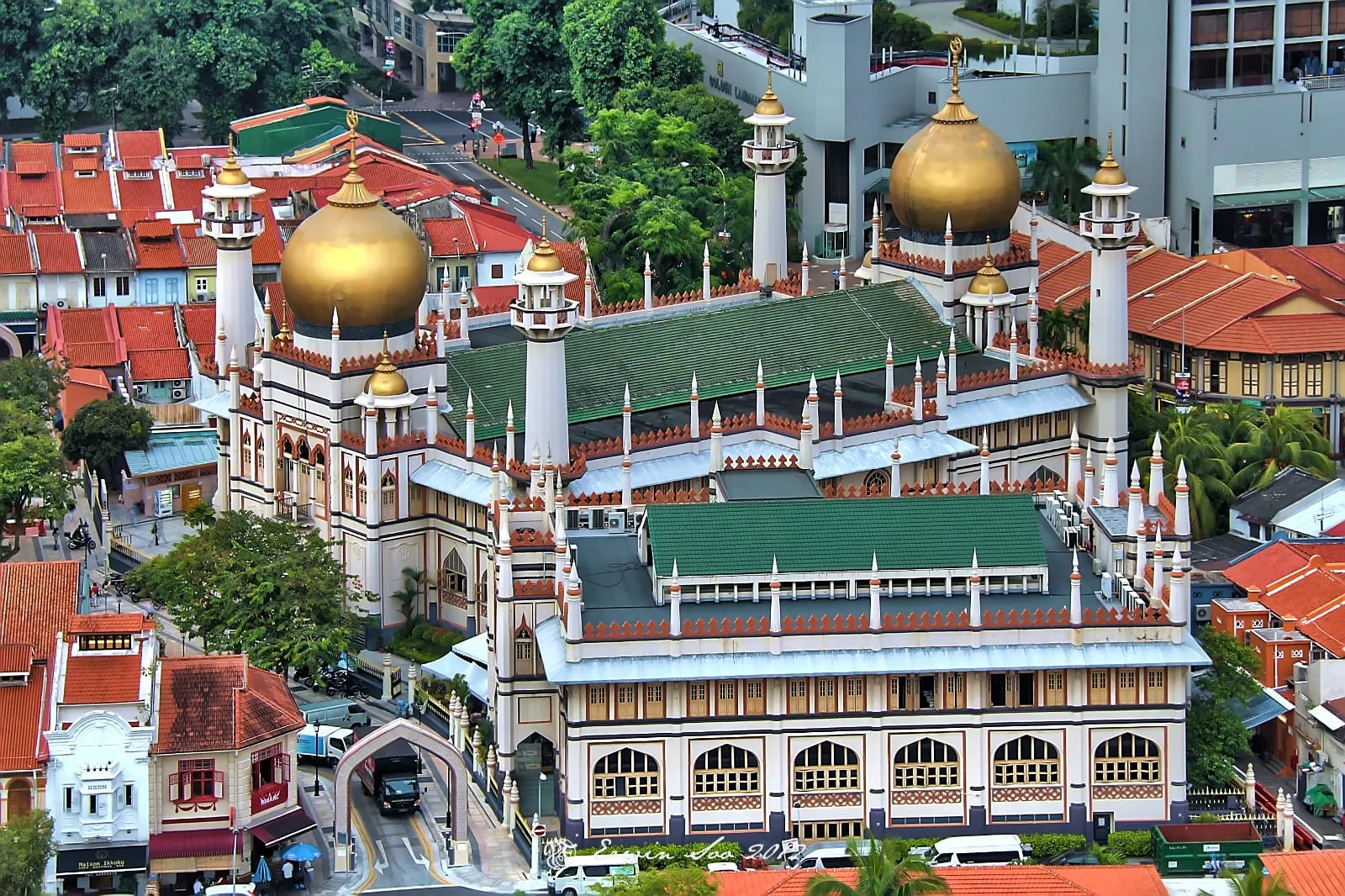
Sultan Mosque in Kampong Glam. Photo: Erwin Soo, Wikimedia Commons, CC BY 2.0.
Sultan Mosque is the spiritual heart of Singapore’s Muslim community. Commissioned in 1824 for Sultan Hussein Shah of Johor and rebuilt between 1924 and 1928 by Denis Santry of Swan & Maclaren, the mosque exemplifies the Indo-Saracenic revival style.
- The Glass Bottle Ring: Examine the base of the massive golden onion domes closely. Beneath the gold leaf lies a dark decorative band formed from thousands of glass soy sauce and drink bottles collected and donated by impoverished Muslim devotees, ensuring that poorer community members could contribute tangibly to the building’s construction alongside wealthy royal patrons.
- Visiting Hours: Walk-in tourist visits run Saturday to Thursday from 10:00 to 12:00 and 14:00 to 16:00 (strictly closed to non-Muslim visitors on Fridays). Enter via Gate 5 facing Bussorah Street.
- Dress Code: Men must wear shirts with sleeves and long trousers; women must wear long sleeves and skirts or trousers reaching to the ankle. Full-length green robes and headscarves are provided free of charge at the reception counter.
Stop 5: Haji Lane and Arab Street
From Sultan Mosque, walk two minutes down Bussorah Street and turn right onto Haji Lane.
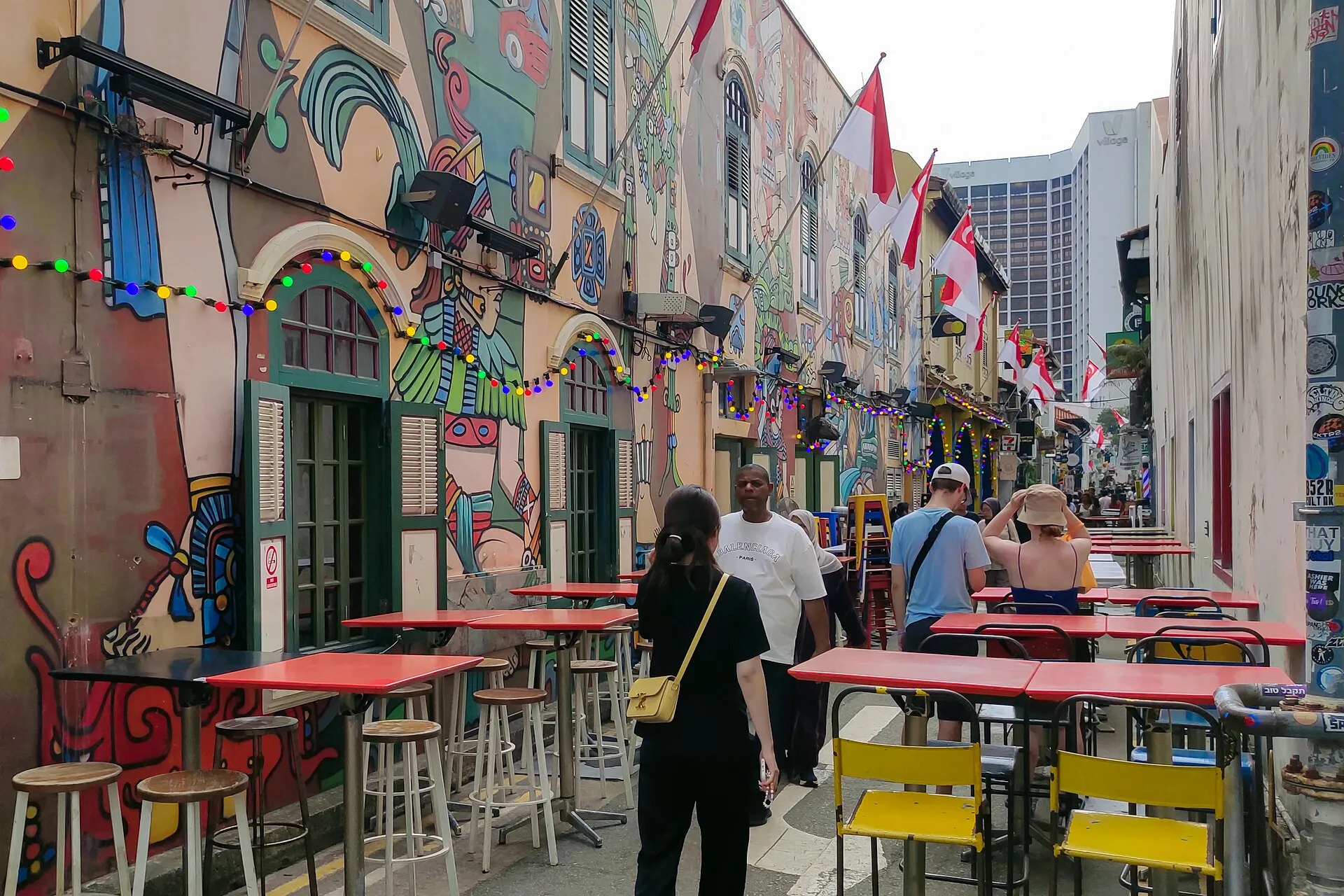
Originally an enclave of narrow shophouses providing lodging for Muslim pilgrims boarding steamships for the Hajj to Mecca, Haji Lane is today Singapore’s epicenter of creative indie culture.
- Street Murals: The walls along Haji Lane, Beach Road, and Ophir Road feature large-scale street art murals, including Aztec and futuristic portraits by international and local muralists.
- Boutiques & Perfumeries: Browse independent fashion boutiques, vintage vinyl stores, and handmade leather workshops. Nearby on Arab Street, visit historic perfume house Jamal Kazura Aromatics (operating since 1933), which blends alcohol-free attar perfume oils tailored to personal preference.
- Cafes & Dining: Enjoy iced artisanal coffees, Turkish apple tea, or mezze platters along the lane’s outdoor patios.
Where to eat along the route
Both Little India and Kampong Glam rank among Singapore’s premier culinary destinations:
- Tekka Centre (Little India): At the corner of Bukit Timah and Serangoon roads, sample crispy roti prata with fish curry at Prata Saga Sambal Berlada, or aromatic mutton biryani at Allauddin’s Briyani.
- Komala Vilas (76 Serangoon Road): Operating since 1947, this revered South Indian vegetarian institution serves unlimited thali meals on banana leaves, accompanied by sambar, rasam, and crisp dosas.
- Singapore Zam Zam (188 Arab Street): Situated directly opposite Sultan Mosque since 1908, Zam Zam is legendary for its pan-fried murtabak—crispy folded dough stuffed with minced mutton, chicken, or beef, fried onions, and egg, served with thick chicken curry gravy.
Important local regulations: Liquor Control Zone
Be aware that Little India is a legally designated Liquor Control Zone under Singapore’s Liquor Control (Supply and Consumption) Act.
- Public drinking ban: Consuming alcohol in any public outdoor place (including pavements, parks, and five-foot-ways) is strictly prohibited from 22:30 on Friday until 07:00 on Monday continuously, as well as all day on public holidays and public holiday eves.
- Licensed venues: You can still purchase and consume alcoholic drinks inside licensed bars, restaurants, and coffee shops during permitted trading hours.
More Singapore guides
Continue discovering Singapore’s historic neighbourhoods and walking trails:
- Chinatown to Marina Bay walk: explore the southern heritage trail from Buddha Tooth Relic Temple to the Merlion.
- Marina Bay evening walk: evening bayfront stroll taking in the Helix Bridge and Spectra water show.
- Little India neighbourhood guide: shopping at Mustafa Centre, spice stalls, and festivals.
- Kampong Glam neighbourhood guide: Malay Heritage Centre, textile traders, and nightlife.
- Best hawker centres in Singapore: Tekka Centre, Maxwell, and Amoy Street compared.
- What to book before you go to Singapore: comprehensive ticketing and itinerary planning checklist.
Common questions
How long is the Little India to Kampong Glam walk?
The walking distance is approximately 1.6 kilometres, taking 25 to 30 minutes of continuous walking. With stops to explore temple courtyards, view museum exhibits at the Indian Heritage Centre, visit Sultan Mosque, and browse indie boutiques along Haji Lane, plan for 2.5 to 3.5 hours.
Which days are best to do this walk?
Tuesday to Thursday, Saturday, or Sunday. The Indian Heritage Centre is closed on Mondays, while Sultan Mosque is strictly closed to non-Muslim visitors on Fridays for congregational prayers. Avoid Mondays if you wish to tour the museum, and avoid Fridays if you want to enter the mosque.
What are the visiting hours for Sultan Mosque?
Non-Muslim visitors can tour Sultan Mosque Saturday to Thursday from 10:00 to 12:00 and 14:00 to 16:00. The mosque is closed to tourists on Friday. Visitors enter through Gate 5 facing Bussorah Street.
What is the dress code for religious sites on this route?
At Hindu temples, remove footwear outside, keep shoulders covered, and wear skirts or trousers reaching below the knee. At Sultan Mosque, men must wear sleeved shirts and long trousers, while women must cover shoulders, arms, and legs down to the ankles; complimentary modest robes are loaned at the entrance counter.