In this guide
💡 The Short Version: Leave chewing gum, e-cigarettes, and vapes at home: vapes are completely illegal and confiscated at customs with fines of up to S$2,000 for possession. Always bin your rubbish: on-the-spot littering fines start at S$300. Do not eat, snack, or drink water on MRT trains or public buses (fines up to S$500), and never bring unsealed durian aboard public transit. Public outdoor drinking is banned between 22:30 and 07:00 nationwide, and all weekend in Little India and Geylang. Smoking is restricted to yellow painted boxes; Orchard Road, parks, and beaches are strictly smoke-free. Or book a tour: If you want an expert-led cultural walking tour that explains local civic laws and heritage quarters safely, book a Singapore cultural quarters walking tourad.
⚠️ Customs officers actively screen for electronic vaporisers at entry points. Do not assume a disposable vape in your carry-on bag will go unnoticed. Singapore Customs and Health Sciences Authority (HSA) officers use high-resolution x-ray scanners at Changi Airport and land checkpoints. Arriving travellers caught with vapes face luggage search, interrogation, confiscation, and immediate spot fines.
Singapore’s civil legal architecture
Singapore’s international reputation as a “Fine City” reflects its deliberate use of statutory penalties, strict policing, and urban enforcement to maintain social cohesion, public hygiene, and civil order.
The legal system operates under British common law, supplemented by strict domestic statutes enforced by specialised statutory boards, including the National Environment Agency (NEA), the Land Transport Authority (LTA), the Health Sciences Authority (HSA), and the Singapore Police Force (SPF).
Ignorance of local legislation is never accepted as a valid legal defence in Singaporean courts. Understanding these rules ensures a smooth and trouble-free visit.
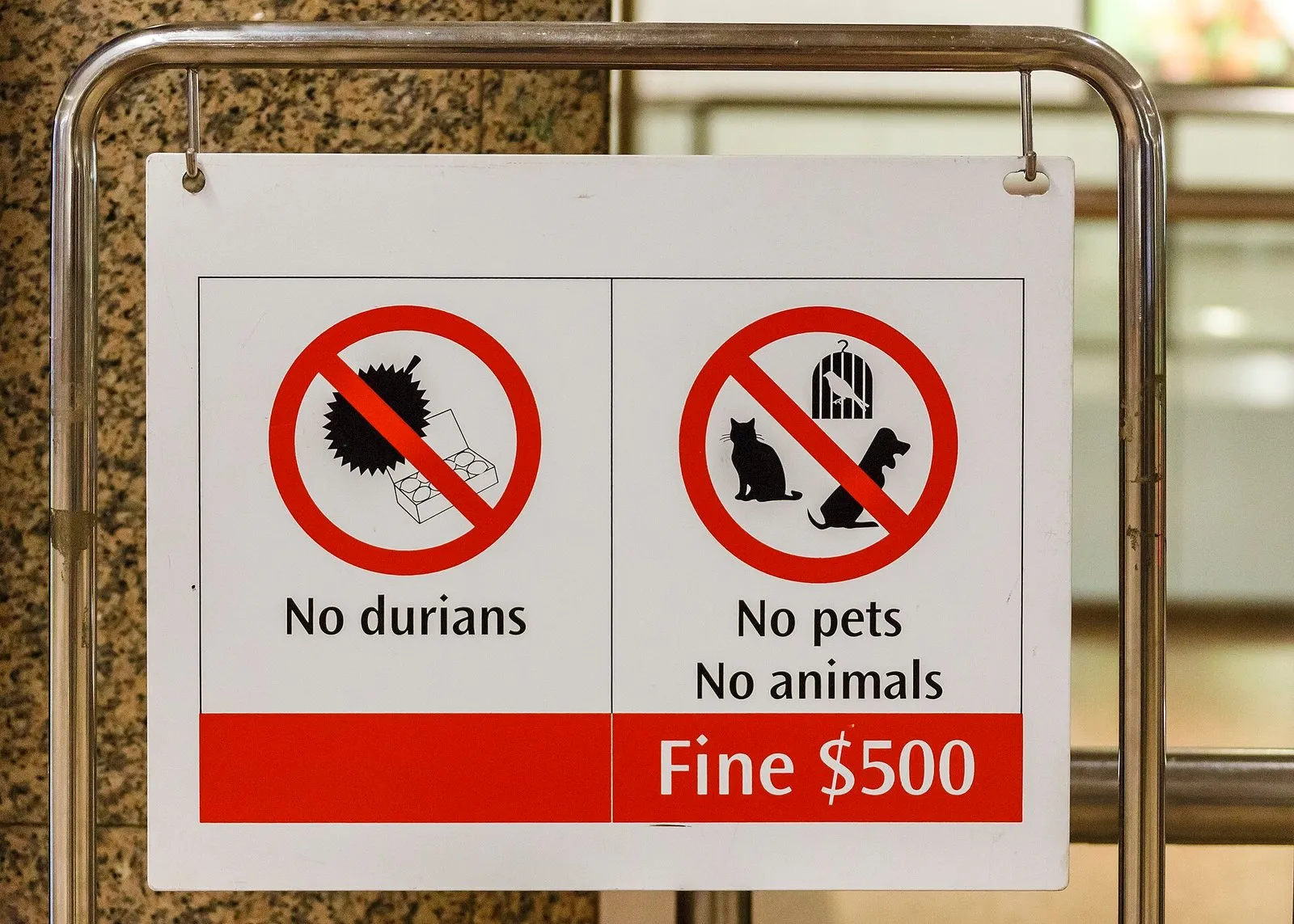
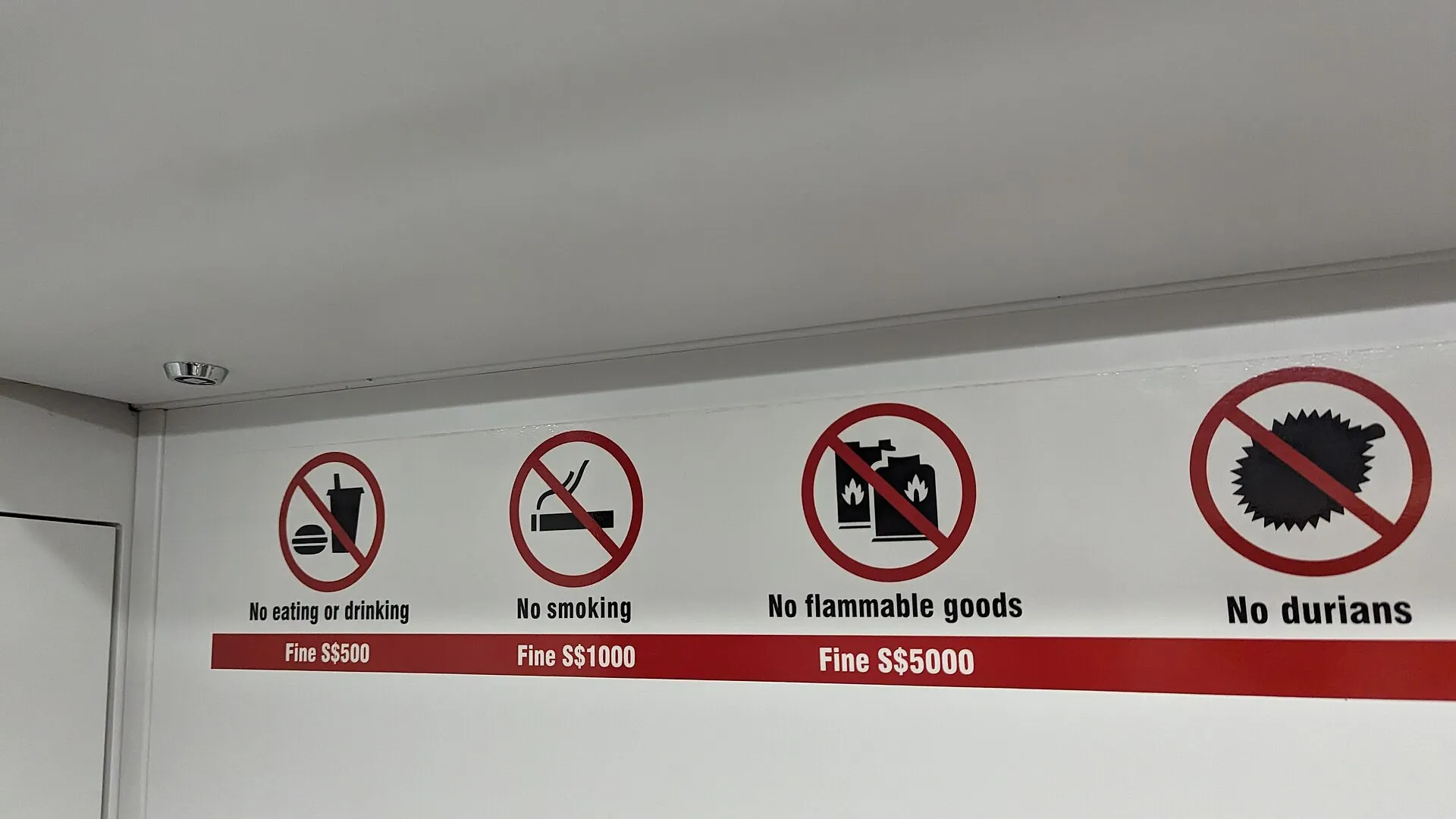
A sign banning durians and pets, with a S$500 fine. Photo: CEphoto, Uwe Aranas, Wikimedia Commons, CC BY-SA 3.0.
Summary of rules and statutory penalties
| Category | Prohibited activity | Governing statute & enforcement | Statutory penalty |
|---|---|---|---|
| Vaping & E-Cigarettes | Possession, purchase, or personal use of any vaporiser device or pod | Tobacco (Control of Advertisements and Sale) Act; HSA | Fine of up to S$2,000; devices confiscated |
| Vape Importation | Bringing e-cigarettes or e-liquids across border checkpoints | Customs Act & HSA regulations | Fine up to S$10,000, 6 months prison, or deportation |
| Chewing Gum Import | Importing chewing gum for distribution or commercial sale | Control of Manufacture Act; Singapore Customs | Commercial seizure; fines for unauthorised commercial import |
| Littering | Discarding any litter, food wrappers, or cigarette butts in public | Environmental Public Health Act; NEA | S$300 on-the-spot fine; court fines up to S$10,000 plus Corrective Work Order |
| Public Transit Dining | Eating, snacking, or sipping beverages inside MRT stations or buses | Rapid Transit Systems Regulations & LTA Bus Bylaws | Composition fine of up to S$500 |
| Durian on Transit | Bringing unsealed or smelly fresh durian onto trains or buses | LTA Conditions of Carriage | Confiscation or denial of boarding |
| Public Drinking | Drinking alcohol outdoors in public spaces between 22:30 and 07:00 | Liquor Control (Supply and Consumption) Act; SPF | Fine up to S$1,000 for first offence; S$2,000 or 3 months jail for repeat |
| Smoking Violations | Smoking outside designated yellow smoking boxes (parks, Orchard Road, beaches) | Smoking (Prohibition in Certain Places) Act; NEA | S$200 composition fine; court fines up to S$1,000 |
| Jaywalking | Crossing within 50 metres of an overhead bridge, pedestrian crossing, or traffic light | Road Traffic (Pedestrian Crossing) Rules; SPF | S$50 composition fine; court fines up to S$1,000 |
| Illicit Narcotics | Possession, consumption, or trafficking of controlled drugs | Misuse of Drugs Act; Central Narcotics Bureau | Long prison terms, mandatory caning, and death penalty for trafficking |
Vaping and e-cigarettes: Total prohibition
Singapore maintains one of the world’s most aggressive zero-tolerance policies against electronic cigarettes and vaporisers:
- Scope of Ban: The ban covers all battery-operated e-cigarettes, vape pods, vape juice cartridges, heated tobacco units (such as IQOS), and electronic shisha devices.
- Personal Use is Illegal: There is no exemption for personal use by tourists. Even if a vape was legally purchased in your home country or in transit, possessing it inside Singapore territory is a crime.
- Border Scans: Luggage at Changi Airport and land checkpoints (Woodlands and Tuas) is subject to random and targeted x-ray screening. If detected, HSA officers issue summonses and impose composition fines of up to S$2,000.
- Public Reporting: Plainclothes enforcement officers patrol tourist quarters (including Clarke Quay, Orchard Road, and Marina Bay) and issue immediate fines to anyone caught vaping in public.
The chewing gum regulations explained
The ban on chewing gum was introduced in 1992 by Prime Minister Goh Chok Tong after vandals repeatedly stuck spent gum over the sensitive optical sensors of newly installed MRT sliding platform doors, causing train delays and maintenance costs.
- Importation vs Possession: The law strictly prohibits the commercial importation and sale of gum. It is not an offence to chew gum in Singapore; rather, it is illegal to import it for sale or distribution.
- Medicinal Exemption: Since 2004, pharmacists and dentists have been permitted to sell therapeutic dental and nicotine gum under the Health Sciences Authority, requiring identity registration.
- Advice for Visitors: While customs officers do not typically prosecute tourists carrying a half-chewed pack in their pocket, bringing multiple cartons or boxes will be flagged as an illegal commercial importation. Always wrap spent gum in paper and place it directly into a rubbish bin.
Public cleanliness: Littering, spitting, and tray return
Singapore takes civic cleanliness seriously, maintaining an army of uniformed and plainclothes NEA environmental officers:
- Littering: Dropping even a tiny item—such as a bus ticket, sweet wrapper, or cigarette butt—triggers an on-the-spot S$300 composition fine. Repeat offenders are sentenced by courts to Corrective Work Orders (CWO), requiring them to sweep public streets while wearing bright orange luminous vests, often covered by local media.
- Spitting: Spitting saliva or expelling phlegm on public streets, footpaths, or markets is an offence carrying fines of up to S$1,000.
- Hawker Tray Return Law: Clearing your table after eating at hawker centres, food courts, and coffee shops is a statutory requirement under the Environmental Public Health Act. Diners must return used trays, crockery, cutlery, and table litter to tray return stations. Failing to do so carries a written warning on the first instance and a S$300 fine for subsequent offences.
Transit bylaws: Food, drink, and durians
Public transport in Singapore is among the cleanest and most efficient in the world because bylaws are rigorously maintained:
- No Food or Drinks: The Rapid Transit Systems Regulations strictly forbid consuming any food, chewing gum, snacks, or beverages once past the fare gates of any MRT station, inside train carriages, or aboard public buses. This prohibition includes taking a sip of plain water from a personal thermos flask. Station staff will instruct you to put drinks away, and roving transit enforcement officers issue composition fines of up to S$500.
- Durians on Transit: Fresh durian fruit is famous for its powerful fragrance, which penetrates air-conditioning filtration systems. Carrying fresh durian onto MRT trains and LRT carriages is completely prohibited. On SBS Transit and SMRT public buses, durians are permitted only if they are packed inside vacuum-sealed, airtight containers.
Liquor control and nighttime drinking restrictions
Following civil disorder in Little India in 2013, Parliament enacted the Liquor Control (Supply and Consumption) Act:
- Island-wide Public Curfew: Consuming alcohol in public outdoor places—such as park benches, pavements, canal walkways, beaches, and housing estate common areas—is strictly prohibited between 22:30 and 07:00 every night.
- Liquor Control Zones (Little India & Geylang): In these two designated cultural zones, public drinking is illegal from 07:00 Saturday to 07:00 Monday continuously, as well as from 19:00 on the eve of public holidays to 07:00 on the morning after.
- Permitted Drinking: You can legally consume alcohol at any hour within licensed premises (hotel rooms, bars, pubs, restaurants, and outdoor licensed dining areas). Takeaway retail sales of bottled beer and wine from convenience stores and supermarkets cease at 22:30 sharp nationwide.
Smoking zones and age limits
- Minimum Legal Age: You must be at least 21 years old to purchase, possess, or consume tobacco products in Singapore.
- Prohibited Smoking Areas: Smoking is illegal in all air-conditioned buildings, within five metres of bus shelters and building entrances, in all parks, nature reserves, gardens (including Gardens by the Bay), public beaches, and along the entire 2.2-kilometre pedestrian corridor of Orchard Road.
- Designated Smoking Areas: Look for clearly marked yellow-painted boxes on pavements outside commercial buildings where smoking is permitted. Cigarette butts must be extinguished and disposed of in built-in ashtrays; flicking a butt onto the pavement incurs a S$300 littering fine.
Jaywalking and road crossing safety
Singapore’s traffic laws penalise crossing roads within 50 metres of a designated pedestrian crossing facility:
- If you cross a road within 50 metres of an overhead pedestrian footbridge, a signalised pedestrian crossing, or a zebra crossing, you commit a jaywalking offence.
- The on-the-spot composition fine is S$50, rising to S$1,000 or three months imprisonment upon conviction in court for repeat violations. Always wait for the green pedestrian signal.
Severe legal penalties: Vandalism, drugs, and public order
- Vandalism Act: Applying graffiti, painting, drawing, carving, or sticking unpermitted posters on public or private property carries mandatory court sentences, heavy fines, and mandatory judicial corporal punishment (caning).
- Misuse of Drugs Act: Singapore enforces some of the world’s strictest drug laws. Possession or consumption of even small quantities of cannabis, cocaine, heroin, or ecstasy leads to lengthy imprisonment. Trafficking quantities above statutory limits (such as 500 grams of cannabis or 15 grams of pure diamorphine) triggers the mandatory death penalty. Singapore authorities carry out random drug screening at immigration checkpoints.
- Public Assembly and National Flags: The Public Order Act prohibits outdoor public demonstrations, political gatherings, or protests without explicit police permits. Under the Foreign National Emblems (Control of Display) Act, displaying foreign flags or national emblems in public spaces without an exemption is illegal.
Practical travel links
For cultural etiquette and religious site dress rules, see our Singapore etiquette guide. To understand why Singapore is one of the safest cities on earth, read is Singapore safe?. Check public transport in Singapore for MRT routes and contactless payment details, and complete your mandatory electronic Singapore arrival card before flying.
Common questions
Is chewing gum completely illegal in Singapore?
Under the Regulation of Imports and Exports (Chewing Gum) Regulations, the commercial importation and sale of chewing gum has been prohibited since 1992, except for approved therapeutic or dental gum prescribed by a doctor or dentist. Bringing multiple unopened packets for resale is a customs offence; however, carrying a single opened personal pack for personal chewing is not actively prosecuted, provided you dispose of it responsibly in a litter bin.
Are electronic cigarettes and vapes banned in Singapore?
Yes. Vapes and electronic vaporisers are strictly illegal in Singapore. Under the Tobacco (Control of Advertisements and Sale) Act, possessing, using, or purchasing an e-cigarette carries a statutory fine of up to S$2,000. Importing vapes through Changi Airport or land checkpoints is a criminal offence punishable by fines of up to S$10,000 and six months imprisonment.
What is the penalty for littering in Singapore?
Under the Environmental Public Health Act, first-time littering offenders face an on-the-spot composition fine of S$300 from National Environment Agency (NEA) officers. Repeat offenders summoned to court face fines of up to S$2,000 for a first court conviction, S$4,000 for a second, and S$10,000 for subsequent convictions, typically combined with mandatory Corrective Work Orders (CWO) cleaning public spaces.
Can you drink plain water on the MRT or public buses?
No. Under the Rapid Transit Systems Regulations and Land Transport Authority bus bylaws, consuming any food or beverages—including sipping plain water from your own water bottle—is strictly prohibited once you pass through MRT fare gates or board a public bus. Violations carry composition fines of up to S$500.
What are the public drinking hours in Singapore?
Under the Liquor Control Act, drinking alcohol in any public outdoor place (such as parks, beaches, sidewalks, or building common areas) is illegal across the entire country between 22:30 and 07:00 daily. In designated Liquor Control Zones (Little India and Geylang), public drinking is prohibited all weekend from 07:00 Saturday to 07:00 Monday continuously.