In this guide
💡 The Short Version: The Plaza de España is free, with no ticket. A charge of €3 to €4 for visitors from outside Seville was announced in February 2024 and, as reported on 8 June 2026, has been shelved; it has not been introduced. A canal 515 metres long runs round the plaza and you can take a boat on it. The plaza stands inside the Parque de María Luisa, which can close in a rain or wind alert. Or book a tour: the small-group walking tourad ends at the plaza and is from €22.50.
Entry and the proposed charge
There is no ticket office and no gate fee: the plaza is open ground inside the Parque de María Luisa. In February 2024 the mayor announced a charge of €3 to €4 for visitors who do not live in Seville. El Correo de Andalucía reported on 8 June 2026 that he had put it aside before the May 2027 council elections, and Diario de Sevilla’s headline of 7 October 2026 says he clings to the plan. The charge would exempt people registered in the city or born in the province. The council owns the open space between the benches and the balustrade, and the state owns the building and gallery.
The canal and the boats
The plaza has a canal 515 metres long along its perimeter, which you can travel on board a boat, and four bridges across it that represent the ancient kingdoms of Spain.
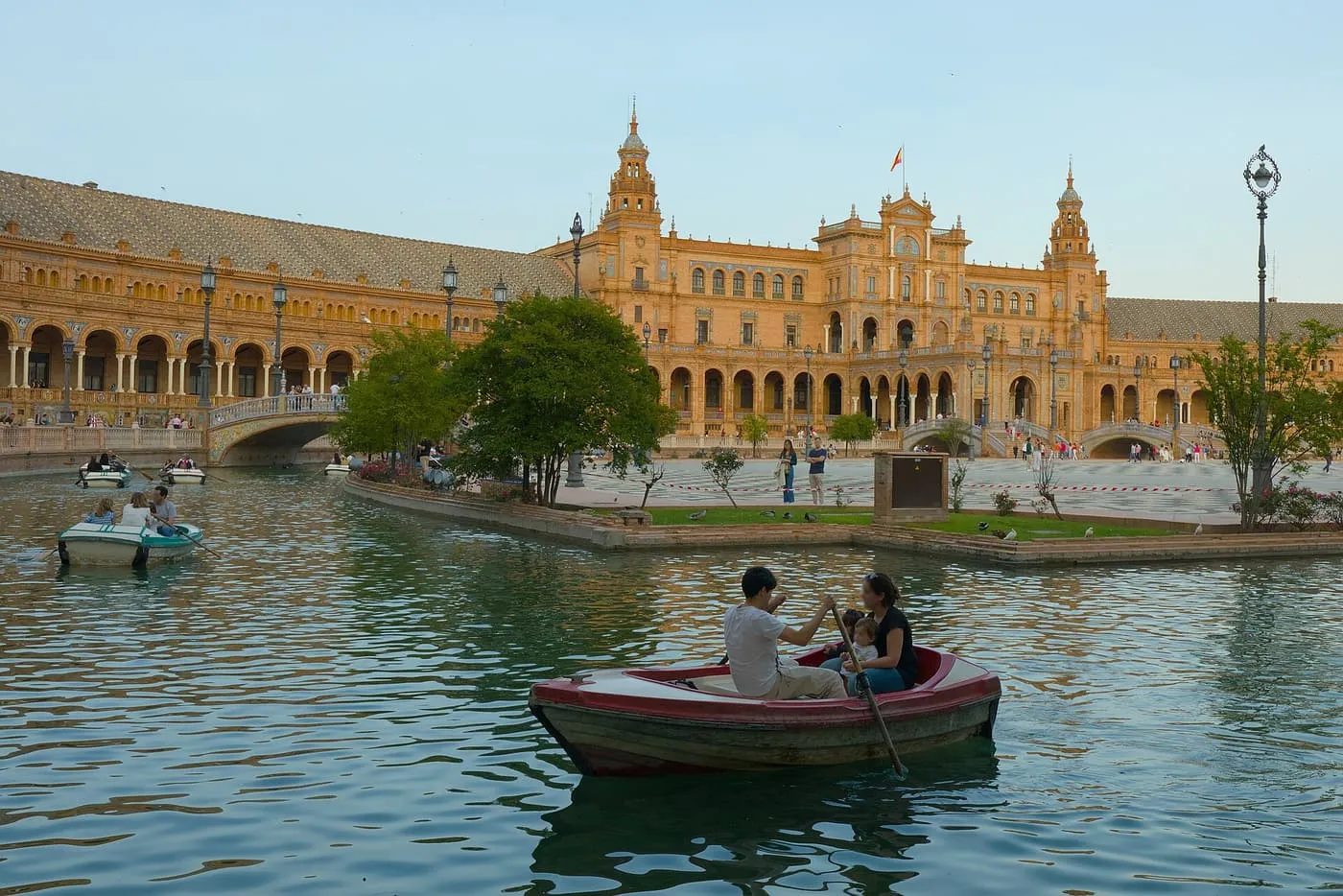
The canal and the central building of the Plaza de España. Photo: Benjamin Smith, Wikimedia Commons, CC BY-SA 4.0.
Tours worth paying for
The plaza costs nothing, so a tour pays only if it adds the guide or the ride. Three of GetYourGuide’s Seville tours include the plaza and the park; prices are its lowest “from” prices, per person.
Small-group walking tour
From €22.50 · 2 hours · up to 10 people · 1,814 reviews
City Highlights Walking Tour for Up to 10 Guestsad is in English and starts at the Mercury fountain in the Plaza de San Francisco, then the Cathedral, the Giralda, the Alcázar, the Torre del Oro and the university, and finishes in the Plaza de España after the Parque de María Luisa. Free cancellation up to 24 hours ahead.
Private electric tuk-tuk tour
From €23.70 · 1 to 2 hours · private group · 1,457 reviews
Private City Tour by 100% Electric Eco Tuk Tukad is in Spanish or English, starts at the Arjona car park and runs from Triana across the Puente de Isabel II to the Plaza de España, the Parque de María Luisa, the Plaza de América, the Torre del Oro and the Maestranza. It does not include entry to monuments. Free cancellation up to 24 hours ahead.
Electric bike tour
From €48 · 2.5 hours · up to 10 people · 216 reviews
Small-Group Electric Bike Tourad by Elecmove is in English, French or Spanish and goes through the centre to the Plaza de España, the Parque de María Luisa and Triana, with a 15-minute safety briefing first. Free cancellation up to 24 hours ahead.
What to see
The plaza was designed by the Sevillian architect Aníbal González for the Ibero-American Exposition of 1929 and covers 50,000 square metres. It holds:
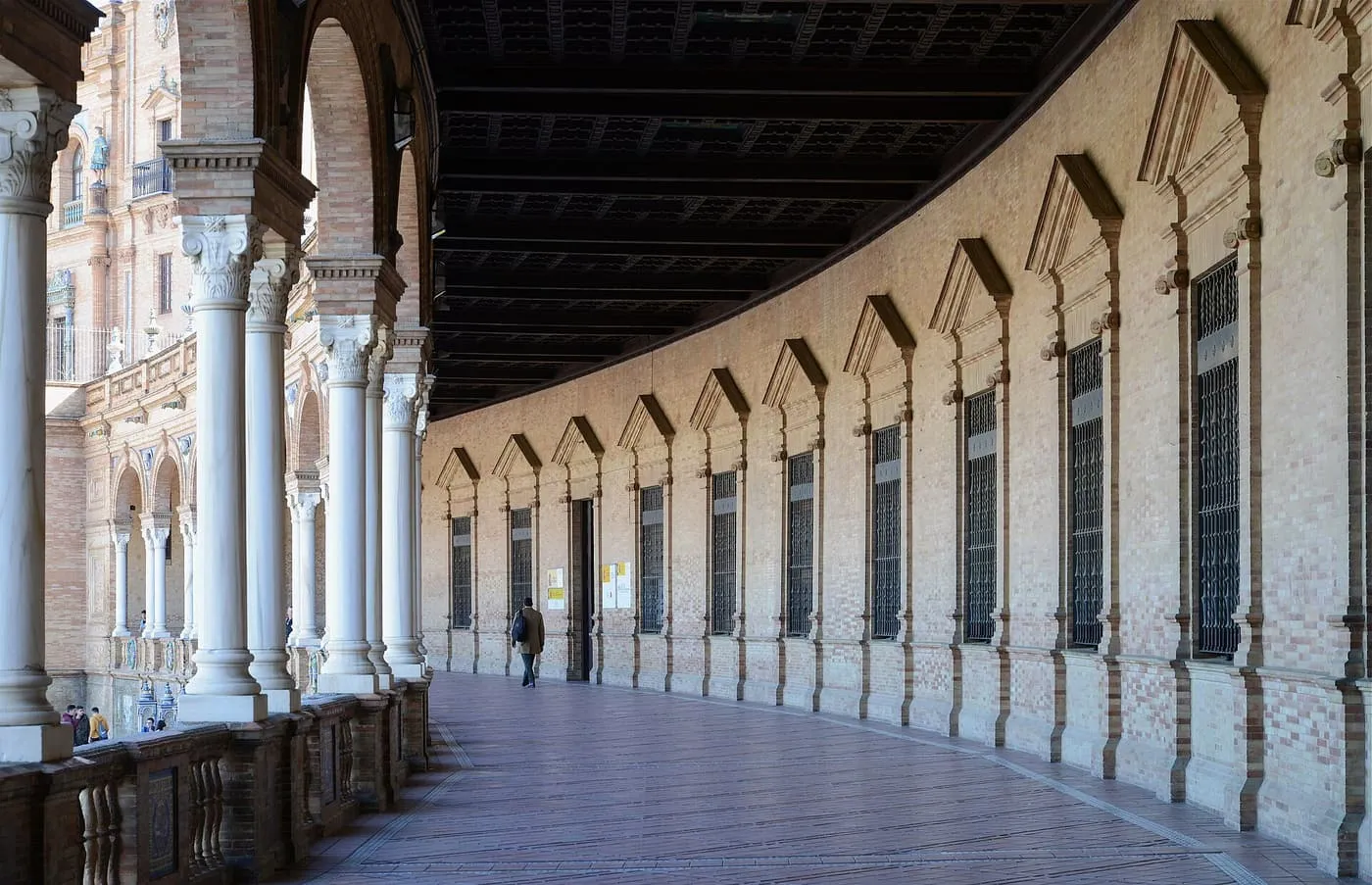
The arcaded gallery. Photo: Alvesgaspar, Wikimedia Commons, CC BY-SA 4.0.
- The arcaded gallery. It separates the open space from the building and has a coffered ceiling. The walls carry medallions with the faces of illustrious Spaniards.
- The provincial benches. Benches of tiles represent the provinces of Spain, and visitors are photographed in front of their own. Many of the tiles of the plaza were made in the historic ceramic factories of Triana; the Triana ceramics centre is in one of them.
- The canal and its four bridges, which represent the ancient kingdoms of Spain.
- The two towers at the ends of the plaza, which can be seen from all over the city.
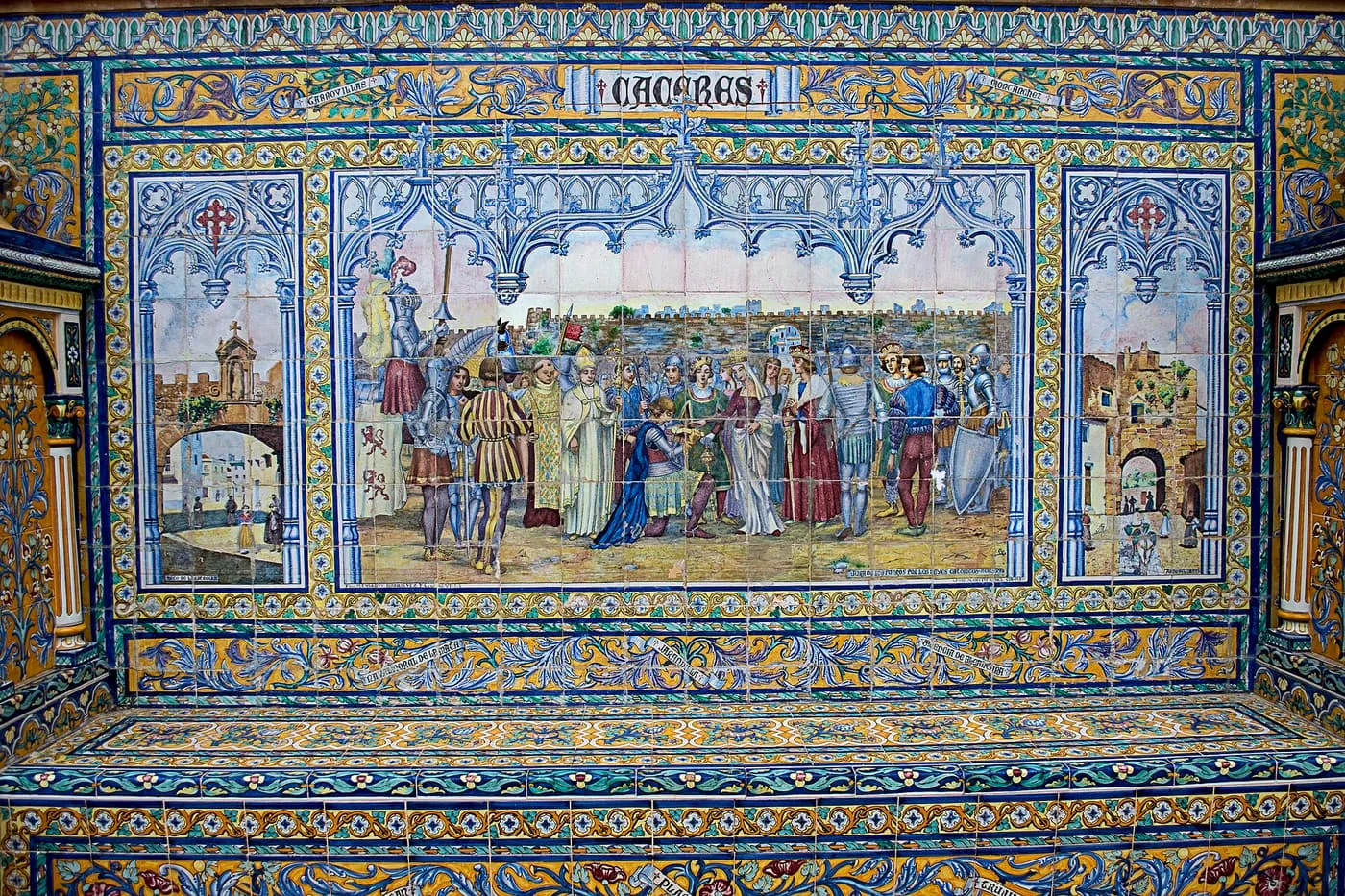
The Cáceres bench, one of the provincial benches. Photo: Anual, Wikimedia Commons, CC BY-SA 4.0.
The plaza has been a film set for Lawrence of Arabia and for Star Wars: Episode II.
What to skip: nothing; it is a short stop. Give the time you save to the park.
The Parque de María Luisa and its museums
The plaza sits inside the Parque de María Luisa, a city park. The Junta de Andalucía says the park closes at times because of the state weather agency’s rain and wind alerts, and the hours of the museums in it change with it.
- Museo de Artes y Costumbres Populares, Plaza de América 3: €1.50, free for accredited EU citizens. From 16 September to 15 June it is open Tuesday to Saturday 9:00 to 21:00 and Sunday and holidays 9:00 to 15:00, and closed on Mondays. Its first floor is closed.
- Museo Arqueológico de Sevilla: closed for refurbishment.
Practical information
- Entry: free, with no ticket.
- Weather: in a rain or wind alert, check that the park is open before you go.
- Tickets elsewhere: the Real Alcázar ticket does not cover the plaza or the park.
Free things to do in Seville lists the other open-air stops, and Seville museums has the park’s museums. What to book before you go to Seville has the hours of every ticketed sight, and Seville in one or two days puts the plaza on a route. To stay near it, see where to stay in Seville. The Metrocentro tram stops at San Bernardo for the park: see Seville public transport. The city walks and the tuk-tuk tours that finish here are on Seville walking tours.
Common questions
Is the Plaza de España in Seville free?
Yes, there is no ticket. The mayor announced a charge of €3 to €4 for visitors from outside the city in February 2024; El Correo de Andalucía reported on 8 June 2026 that he had shelved it before the May 2027 elections, and it has not been introduced.
Can you take a boat on the Plaza de España canal?
Yes. The plaza has a canal 515 metres long running along its perimeter, which you can travel on board a boat.
What are the tiled benches at the Plaza de España?
Benches of tiles representing the provinces of Spain run along the plaza's wall, and many Spanish visitors are photographed in front of their own province's bench.
When was the Plaza de España built?
For the Ibero-American Exposition of 1929, to a design by the Sevillian architect Aníbal González. It covers 50,000 square metres.
Can the Parque de María Luisa close?
Yes. It can close when the state weather agency issues a rain or wind alert, and the hours of the museums inside it change with it.