One of 2 self-guided walks in Lisbon. See every walk.
In this guide
💡 The Short Version: Start at the Praça do Comércio and finish at the São Pedro de Alcântara viewpoint: 2.3 km, about 35 minutes of walking, and 4 to 5 hours with the tickets. Walk it Tuesday to Saturday: on Mondays the São Roque museum is shut and the church opens only at 13:00, and on Sundays the Carmo Museum is shut. Neither lift is running: Carris lists the Santa Justa Lift as temporarily closed and the Glória funicular as out of service, so the climb to the Carmo and to Bairro Alto is on foot. Or book a tour: Lisboa Autêntica’s History, Stories and Lifestyle walking tourad (from £21, 3 hours) covers Bairro Alto, São Roque, the lift and Baixa with a guide.
The route
Map of the walk numbered stops in walking order
Open the whole route in Google Maps - all the stops in walking order, set to walking directions, which is the version to put on your phone.
The Baixa is the grid of straight streets that was laid out after the 1755 earthquake, and the walk runs north across it from the river, then climbs west to Chiado and Bairro Alto. Prices are the adult rate in euros from each operator.
| Stop | Entry (adult) | Open |
|---|---|---|
| 1. Praça do Comércio | Free | Always |
| 2. The Rua Augusta Arch and Rua Augusta | Street free; viewing platform ticketed | Platform every day 10:00 to 19:00, last entry 18:30 |
| 3. The Santa Justa Lift | Closed | Temporarily closed; the foot of the lift is on the street |
| 4. Rossio | Free | Always |
| 5. The Carmo Convent | €7 | Monday to Saturday 10:00 to 19:00 until 31 October, 10:00 to 18:00 from 1 November |
| 6. Chiado and A Brasileira | Free | Always |
| 7. São Roque | Museum €8 | Church and museum Tuesday to Sunday 10:00 to 18:00; church Monday from 13:00 |
| 8. Miradouro de São Pedro de Alcântara | Free | Always |
Walk it with a guide
A guide adds the stories and finds the route for you. Prices are GetYourGuide’s lowest “from” prices, per person.
- Lisbon: History, Stories and Lifestyle Walking Tourad, by Lisboa Autêntica: from £21, 4.8 stars from 12,103 reviews, 3 hours, with five possible meeting points. It covers Bairro Alto, the São Pedro de Alcântara garden, the São Roque church, the Santa Justa Lift and Baixa, then rides the tram up to Portas do Sol for Alfama.
- Best of Lisbon Walking Tour: Rossio, Chiado & Alfamaad, by Inside Lisbon Tours: from £19, 4.9 stars from 3,366 reviews, 3 hours. It starts at the statue of Pedro IV in Rossio and includes a custard tart tasting.
- Lisbon: Walking Tour, Fun Facts, History and Free Tastingsad, by Tours Of My Life: from £6, 4.9 stars from 385 reviews, 3 hours. It starts in Praça Luís de Camões, goes through Bairro Alto, Chiado and Baixa with a food tasting, and finishes in Alfama at Largo das Portas do Sol.
Lisbon food tours compares the food walks that cover the same streets.
1. Praça do Comércio
Free · always open · Terreiro do Paço metro station, on the Blue line, is beneath the square
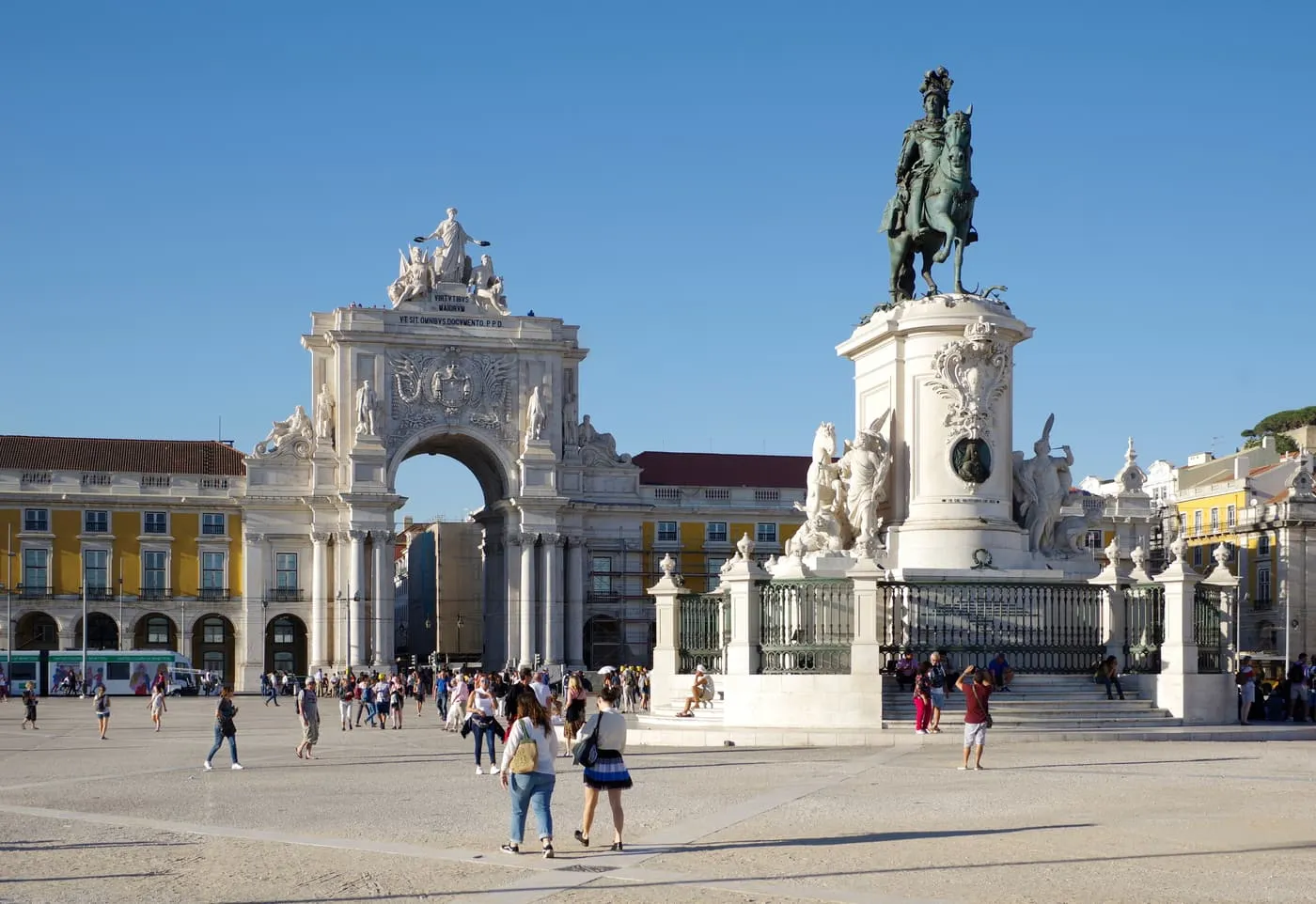
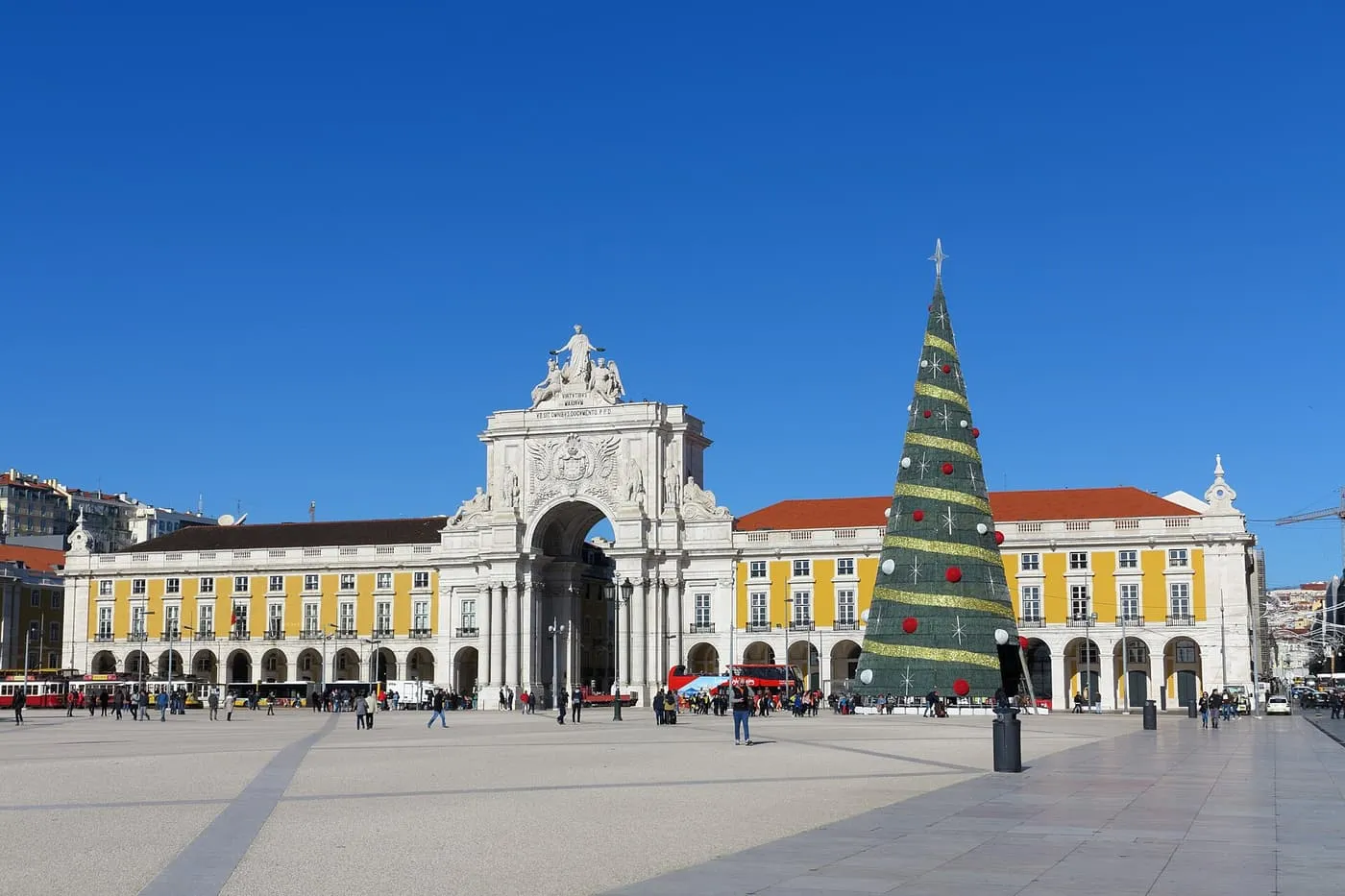
The Praça do Comércio and the Rua Augusta Arch. Photo: Berthold Werner, Wikimedia Commons, CC BY-SA 4.0.
The square is 175 m each way, open to the Tagus on its south side. The Ribeira Palace, the residence of the kings of Portugal, stood here until the 1755 earthquake destroyed it, and the Marquis of Pombal had the square remodelled as part of the rebuilding of the Baixa. The arcaded buildings round it have housed ministries since the 19th century, and the Supreme Court is among them. The square was classified as a National Monument in June 1910.
Walk to the arch in the middle of the north side: 70 m.
2. The Rua Augusta Arch and Rua Augusta
Street free · viewing platform ticketed, sold through Blueticket and Ticketline · every day 10:00 to 19:00, last entry 18:30
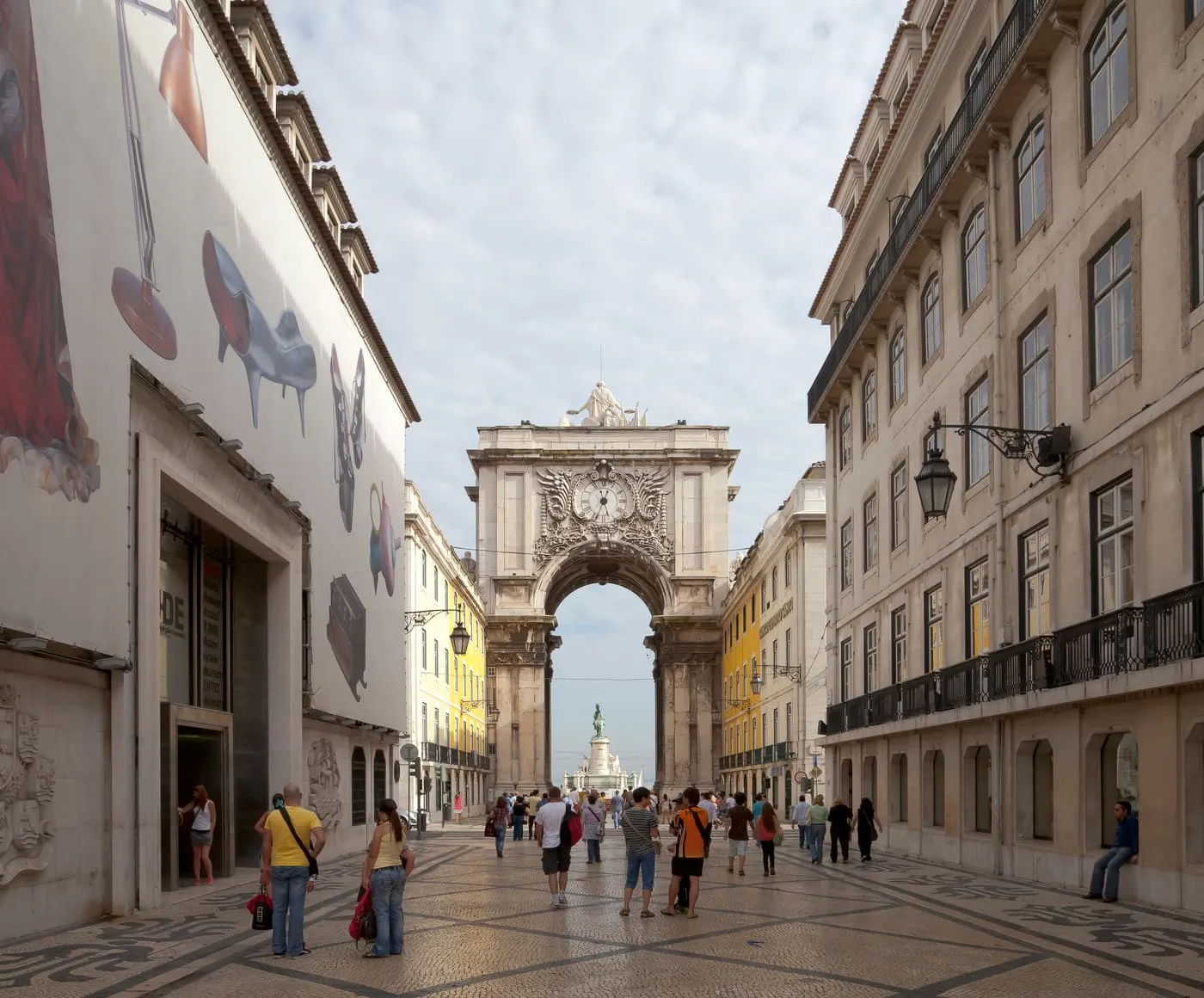
Rua Augusta and the arch. Photo: Diego Delso, Wikimedia Commons, CC BY-SA 3.0.
The arch was built to commemorate the rebuilding of the city after 1755. It has six columns, and at the top Célestin Anatole Calmels’s group shows Glory crowning Genius and Valour. Four statues by Victor Bastos stand over the columns: Nuno Álvares Pereira and the Marquis of Pombal on one side, Vasco da Gama and Viriatus on the other, and the two reclining figures are the rivers Tagus and Douro.
- The viewing platform has been open since 9 August 2013 and gives a 360-degree view of the Baixa and the river; an exhibition in the Clock Room explains the arch’s history. Visit Lisboa’s page for the arch lists the hours and the ticket sellers.
- Rua Augusta is the pedestrian street running north through the grid from the arch to Rossio.
Walk up Rua Augusta and turn left along Rua de Santa Justa to the foot of the lift: 560 m.
3. The Santa Justa Lift
Temporarily closed, on Carris’s own list · seen from the street · foot of the lift on Rua de Santa Justa
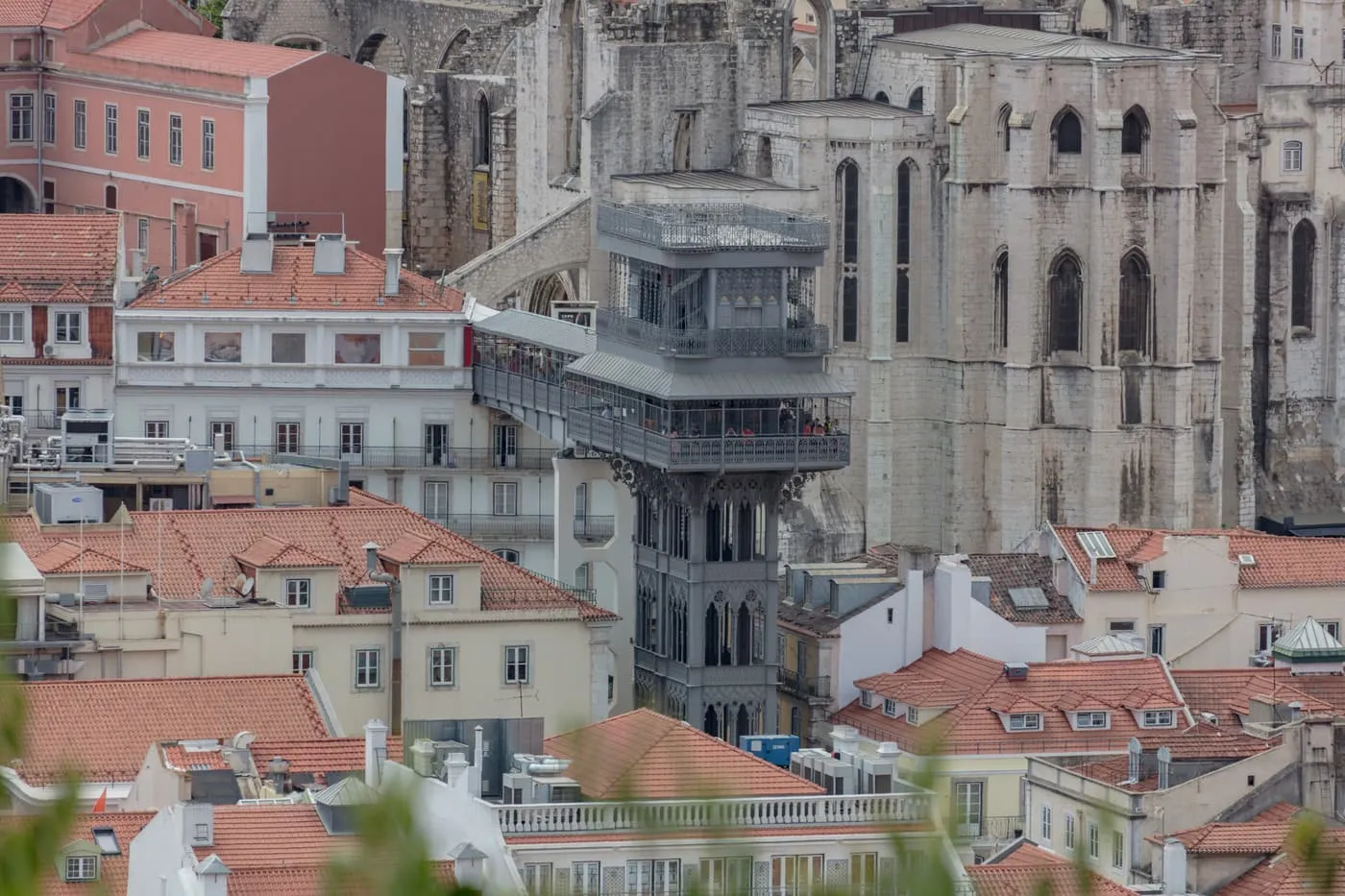
The Santa Justa Lift beside the Carmo Convent. Photo: Diego Delso, Wikimedia Commons, CC BY-SA 4.0.
The lift was inaugurated on 10 July 1902. It was steam-powered at first and fitted with electric motors in November 1907. Raoul Mesnier du Ponsard designed it as a vertical lift 45 m high with an observation platform, decorated in iron in a Neo-Gothic style, and it links Rua de Santa Justa and the lower streets of the Baixa with Largo do Carmo.
- It is out of service. Carris lists the Santa Justa Lift as temporarily closed, and its status page for the historic equipment says there is no fixed date for reopening any of them except the Graça funicular, which reopened on 30 April 2026. The Glória, Bica and Lavra funiculars are out of service too, all since the accident of 3 September 2025.
- To reach the Carmo, walk on to Rossio and climb the Calçada do Carmo, as the route does.
Rossio is 275 m on.
4. Rossio
Free · always open
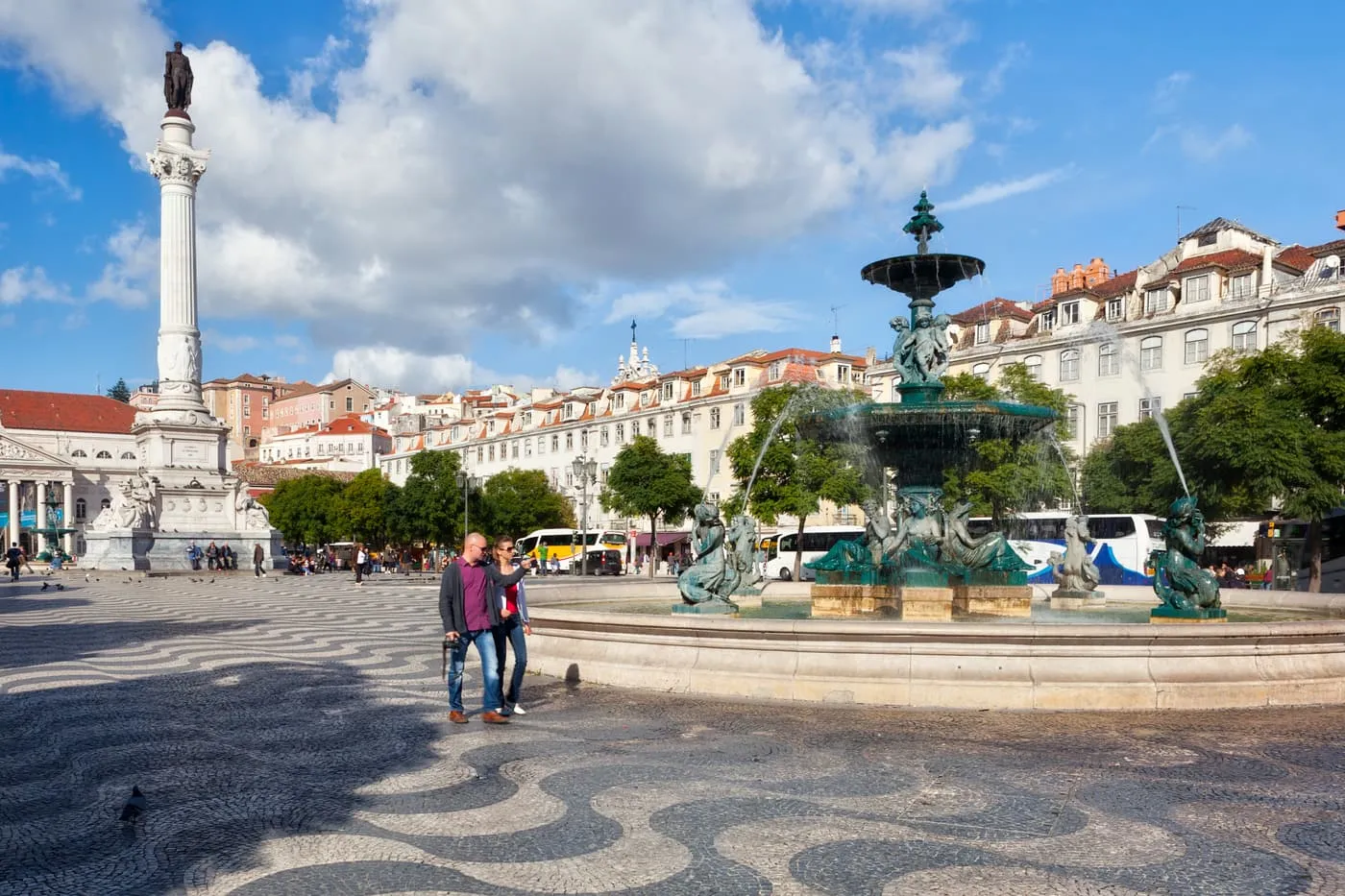
Rossio, with the column of Pedro IV. Photo: Anton Zelenov, Wikimedia Commons, CC BY-SA 3.0.
Rossio, officially Praça de D. Pedro IV, is one of the city’s main squares since the Middle Ages, and its name means common land. The Inquisition sat in a palace on its north side, and the first public burning took place here in 1540. The National Theatre D. Maria II now stands on that site, built in the 1840s in a neoclassical style, with a statue of the playwright Gil Vicente over the pediment. In the 19th century the square was paved in the Portuguese mosaic that still covers it and given bronze fountains imported from France; the column of Pedro IV went up in 1874, and the neo-Manueline front of Rossio station followed in 1886 to 1887. Café Nicola, on the square, dates from the 18th century.
The Calçada do Carmo climbs from the south-west corner of the square to Largo do Carmo: 320 m.
5. The Carmo Convent
€7 · €5 for students, over-65s and with the Lisboa Card · Monday to Saturday 10:00 to 19:00 until 31 October, last entry 18:40; 10:00 to 18:00 from 1 November to April, last entry 17:40 · closed Sundays, 1 January, 1 May and 25 December
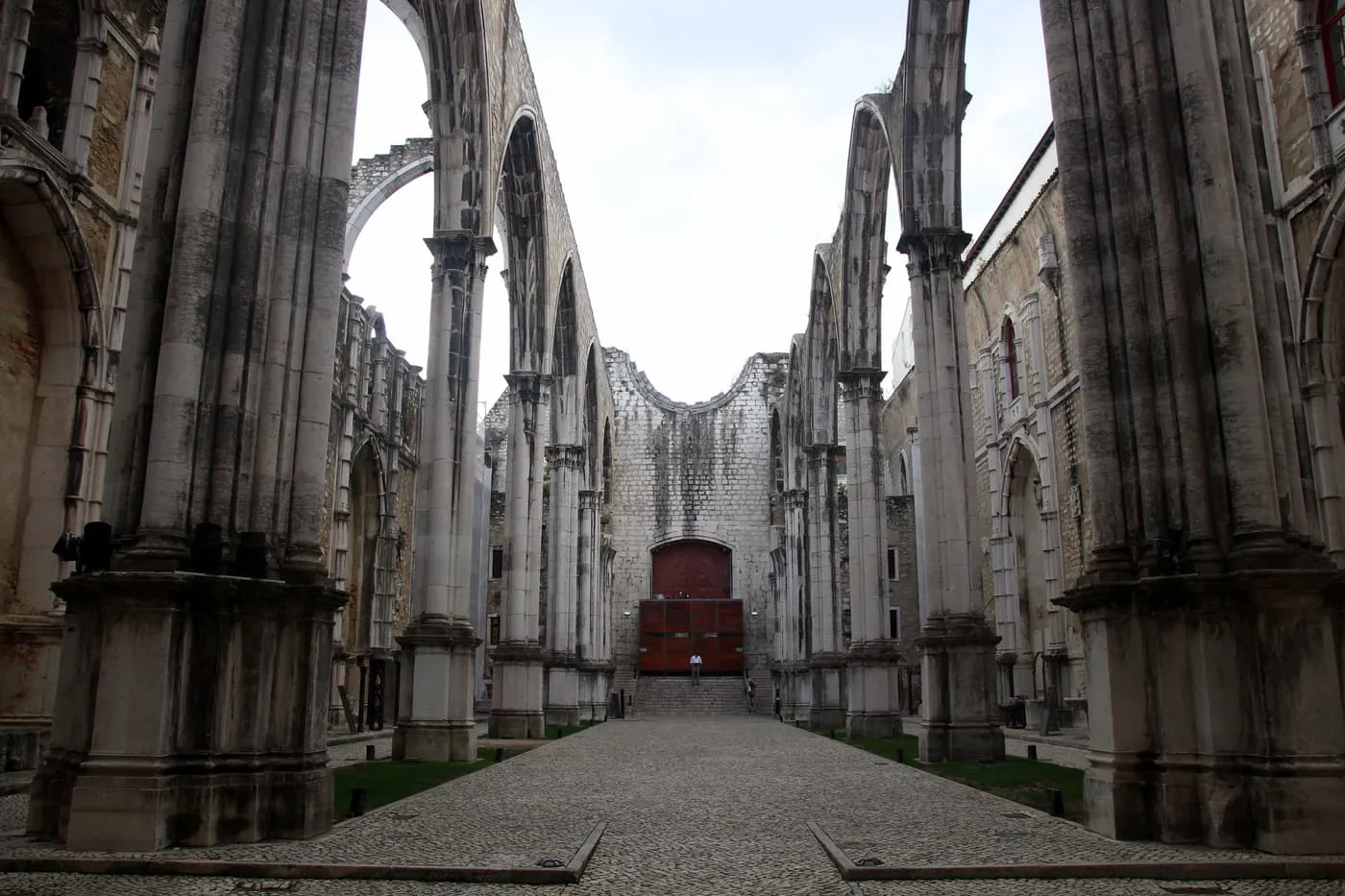
The roofless nave of the Carmo Convent church. Photo: Bex Walton, Wikimedia Commons, CC BY 2.0.
The Constable Nuno Álvares Pereira founded the convent in 1389, and its Gothic church is the main trace of the 1755 earthquake still visible in the old city: the arches stand, the roof does not. The Carmo Archaeological Museum has been in the ruins since 1864, when the Association of Portuguese Archaeologists founded it. It began as a museum of salvaged stone and now holds Roman inscriptions, pre-Columbian ceramics and mummies, and an Egyptian sarcophagus and mummy.
- Children up to 14 go free with an adult. Hours are longer, 10:00 to 19:00, in Easter week and from 26 December to 6 January.
- Conservation and restoration work is under way, the museum says.
Travessa do Carmo and Rua Garrett lead down to A Brasileira: 320 m.
6. Chiado and A Brasileira
Free · Rua Garrett 120 · the Pessoa statue beside the terrace
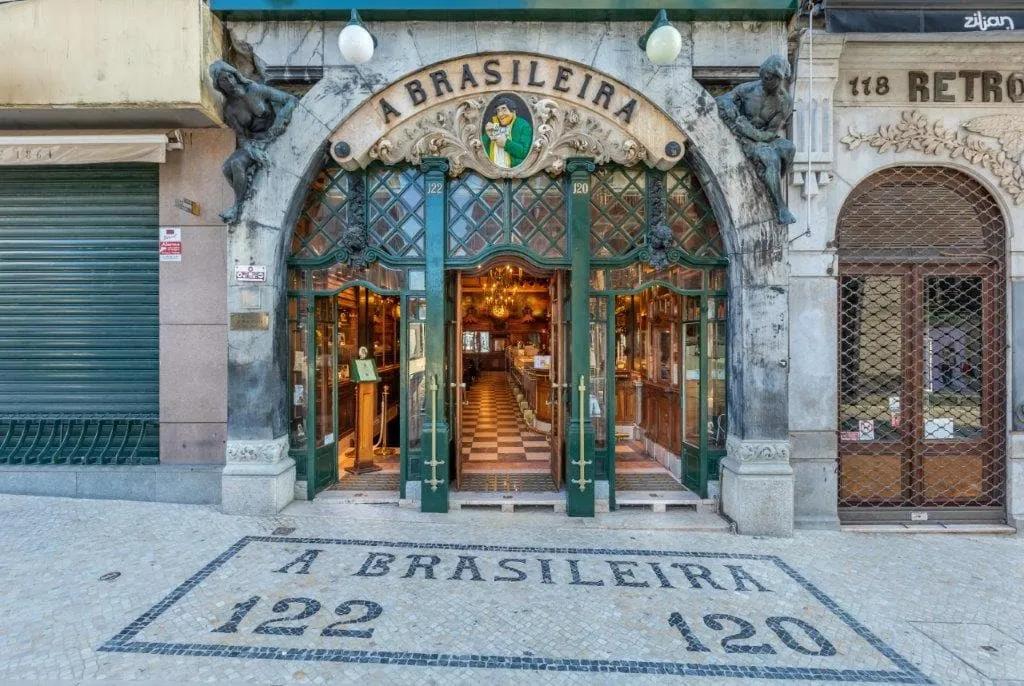
The entrance of A Brasileira. Photo: VDT2021, Wikimedia Commons, CC BY-SA 4.0.
Chiado is the district of Rua Garrett’s shops, theatres and museums; the name is most often traced to a 16th-century poet nicknamed “o Chiado”, the squeak. It was badly hit by a fire in 1988 and rebuilt under Álvaro Siza Vieira. A Brasileira opened on 19 November 1905, when Adriano Telles took over a shirt shop at No. 122 to sell Brazilian coffee from Minas Gerais, and it was the first shop to sell the bica, a small strong coffee. It was redone in 1908 and again in 1922, in Art Deco, with a green and gold entrance, mirrored walls and a long oak bar. In the 1920s Lisbon’s artists and writers met in it, and a bronze of Fernando Pessoa sits at a table beside the terrace.
Castro is on the same street, at No. 38, and Rua Nova da Trindade climbs from Largo do Chiado to São Roque: 450 m.
7. São Roque
Museum €8, €12 with a guided tour · Tuesday to Sunday 10:00 to 18:00 · church Tuesday to Sunday 10:00 to 18:00, Monday 13:00 to 18:00 from October to March (to 19:00 from April to September) · closed 1 January, Easter Sunday, 1 May and 25 December
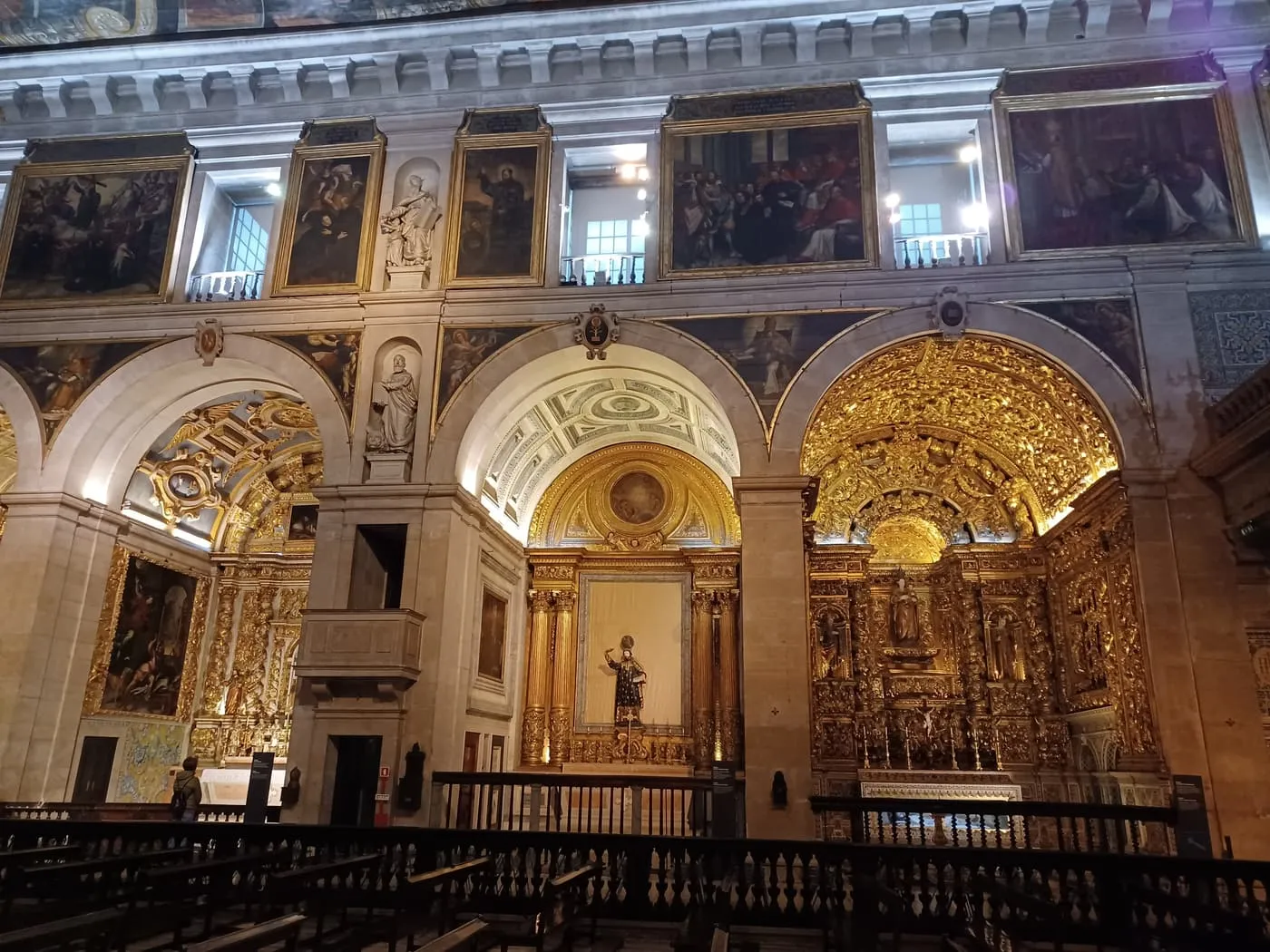
The side chapels of São Roque. Photo: Simon Burchell, Wikimedia Commons, CC BY-SA 4.0.
The church was inaugurated in 1573 as one of the three oldest Jesuit churches in Portugal. It has one wide nave and eight side chapels, and the painted wooden ceiling of 1587 to 1589 is the only mannerist painted ceiling that survives in Lisbon. The Jesuits were expelled in 1768, and the church and the professed house beside it went to the Santa Casa da Misericórdia, which still runs them. The museum in the old professed house was opened in 1905, and it keeps the treasure of the Chapel of St John the Baptist, a set of 18th-century Italian goldsmith’s work, vestments and books, now classified as a National Treasure.
- Mass is celebrated Tuesday to Sunday at 12:30, and visits to the church are limited by the ceremonies.
- Discounts: half price for over-65s, students and the Lisboa Card; free for children up to 12. Residents of Portugal go free on Sundays and holidays until 14:00.
- Combined ticket with the Casa Ásia, €12.
The garden is 250 m on, uphill.
8. Miradouro de São Pedro de Alcântara
Free · always open · Rua de São Pedro de Alcântara
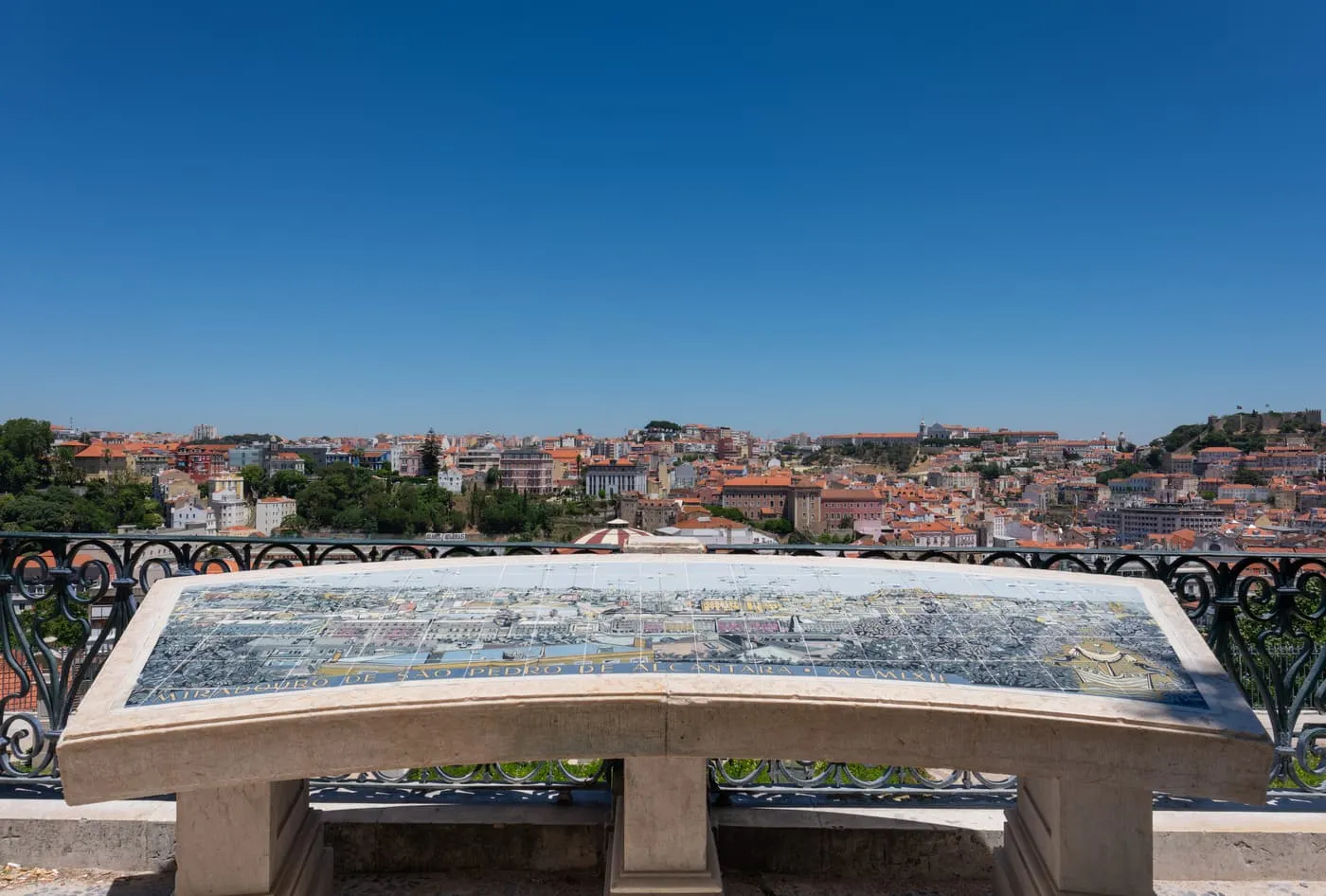
The tile map at the São Pedro de Alcântara viewpoint. Photo: Jules Verne Times Two, Wikimedia Commons, CC BY-SA 4.0.
The garden was laid out in two terraces in 1864 and has a small pond and a viewpoint. A tile map on the balustrade names what you see: the castle walls among the trees, the Sé, the Graça church and São Vicente de Fora with its twin towers, out to the Penha de França church. The view is better at sunset and at night, when the castle and the Sé are lit. A monument of 1904 honours Eduardo Coelho, the founder of the newspaper Diário de Notícias.
- The Glória funicular has connected Praça dos Restauradores with Bairro Alto since 24 October 1885, and it leaves you near the viewpoint. Carris lists it as out of service, with no reopening date for the existing funicular: a new Glória is forecast for 2029, a date Carris calls a forecast and not a commitment.
- Down: the Calçada da Glória, the steep street beside the track, goes to Restauradores in 480 m, and the Blue metro line.
Where to eat
Castro
Rua Garrett 38 · every day 8:30 to 22:00
A shop that sells only pastéis de nata, with clear panels onto the kitchen; Condé Nast Traveller says it opened in early 2022. It is on Rua Garrett, a short walk from A Brasileira.
Manteigaria
Rua do Loreto 2 · 8:00 to midnight · 420 m from the Carmo
A tart bar in a former butter cooperative building from 1900, in Largo do Camões, where you watch the tarts baked behind glass and eat them warm at a standing counter. Metro (2026) and Lovely Lisbonner rank it first among the custard tarts they tried.
Cervejaria Trindade
Rua Nova da Trindade 20 C · Sunday to Thursday 12:00 to midnight · Friday, Saturday and the eve of holidays 12:00 to 01:00 · 180 m from São Roque
A historic brewery building of tiled halls, reopened in 2022 under chef Alexandre Silva (2foodtrippers), with a seafood platter. It books through its site. Where to eat in Lisbon has more places to sit down.
The best day to go
| Day | What changes on the route |
|---|---|
| Monday | The São Roque museum is closed and the church opens at 13:00. The Carmo Museum, the arch platform and everything else are open |
| Tuesday to Saturday | All open |
| Sunday | The Carmo Museum is closed. São Roque, the arch platform and everything else are open |
The timing that works, Tuesday to Saturday: be at the arch when its platform opens at 10:00, at the Carmo by 11:30 so as to have time before lunch on Rua Garrett, and at São Roque after lunch. Take the viewpoint last, for the afternoon light on the castle; the Carmo Museum closes at 19:00 until 31 October and at 18:00 after that.
What closes:
- 1 January, 1 May and 25 December: the Carmo Museum and São Roque are closed.
- Easter Sunday: São Roque is closed.
- 1 November: the Carmo Museum’s closing time drops from 19:00 to 18:00 until April.
- Until Carris announces otherwise: the Santa Justa Lift and the Glória funicular are out of service.
What does not close: the squares, the streets, A Brasileira’s pavement and the viewpoint. A Sunday still makes a good walk: everything but the Carmo Museum is open, and the Carmo’s roofless nave can be seen from the street.
Getting there and back
- To the start: Terreiro do Paço metro station, on the Blue line, is under the Praça do Comércio. Lisbon public transport has the fares.
- From the end: Restauradores metro (Blue line) is 480 m downhill by the Calçada da Glória; Baixa-Chiado, on the Blue and Green lines, is about 1 km.
- In reverse: the route works from São Pedro de Alcântara downhill, but you reach the Carmo Museum later in the afternoon, when its last entry is 18:40, and 17:40 after 31 October.
What to do with the rest of the day
- Alfama: the Alfama walk ends at the Casa dos Bicos, 520 m east of the Praça do Comércio, and goes from the Sé up to the castle and the Pantheon.
- Trams and funiculars: Tram 28 and Lisbon’s funiculars lists what runs and what is shut.
- The whole trip: Lisbon in one day and 3 days in Lisbon build the days round the bookings, and what to book before you go to Lisbon has the rest of the tickets.
Common questions
How long is the Baixa and Chiado walk?
2.3 km from the Praça do Comércio to the São Pedro de Alcântara viewpoint, measured along the streets: about 35 minutes of walking, mostly flat to Rossio and then uphill, and 4 to 5 hours with the Carmo Museum, the Rua Augusta Arch platform and São Roque.
Is the Santa Justa Lift open?
No. Carris lists the Santa Justa Lift as temporarily closed and gives no reopening date. This walk reaches the Carmo Convent from Rossio instead, by the Calçada do Carmo.
Is the Glória funicular running?
No. Carris lists the Glória funicular as out of service, and the Glória, Bica and Lavra funiculars have been suspended since the accident of 3 September 2025. Carris's forecast for a new Glória is 2029, which it calls a forecast and not a commitment. Walk up the Calçada da Glória, the street beside the track, from Restauradores.
Is the Baixa and Chiado walk free?
The squares, the streets, A Brasileira's pavement and the viewpoint cost nothing. The Carmo Museum is €7, São Roque's museum €8, and the viewing platform on the Rua Augusta Arch is sold through Blueticket.
Which day is best for the Baixa and Chiado walk?
Tuesday to Saturday, when everything is open. On Mondays the São Roque museum is closed and the church opens only at 13:00. On Sundays the Carmo Museum is closed.
How do I get from São Pedro de Alcântara back down?
On foot down the Calçada da Glória to Restauradores, 480 m, where the Blue metro line stops. Baixa-Chiado metro is about 1 km away.