In this guide
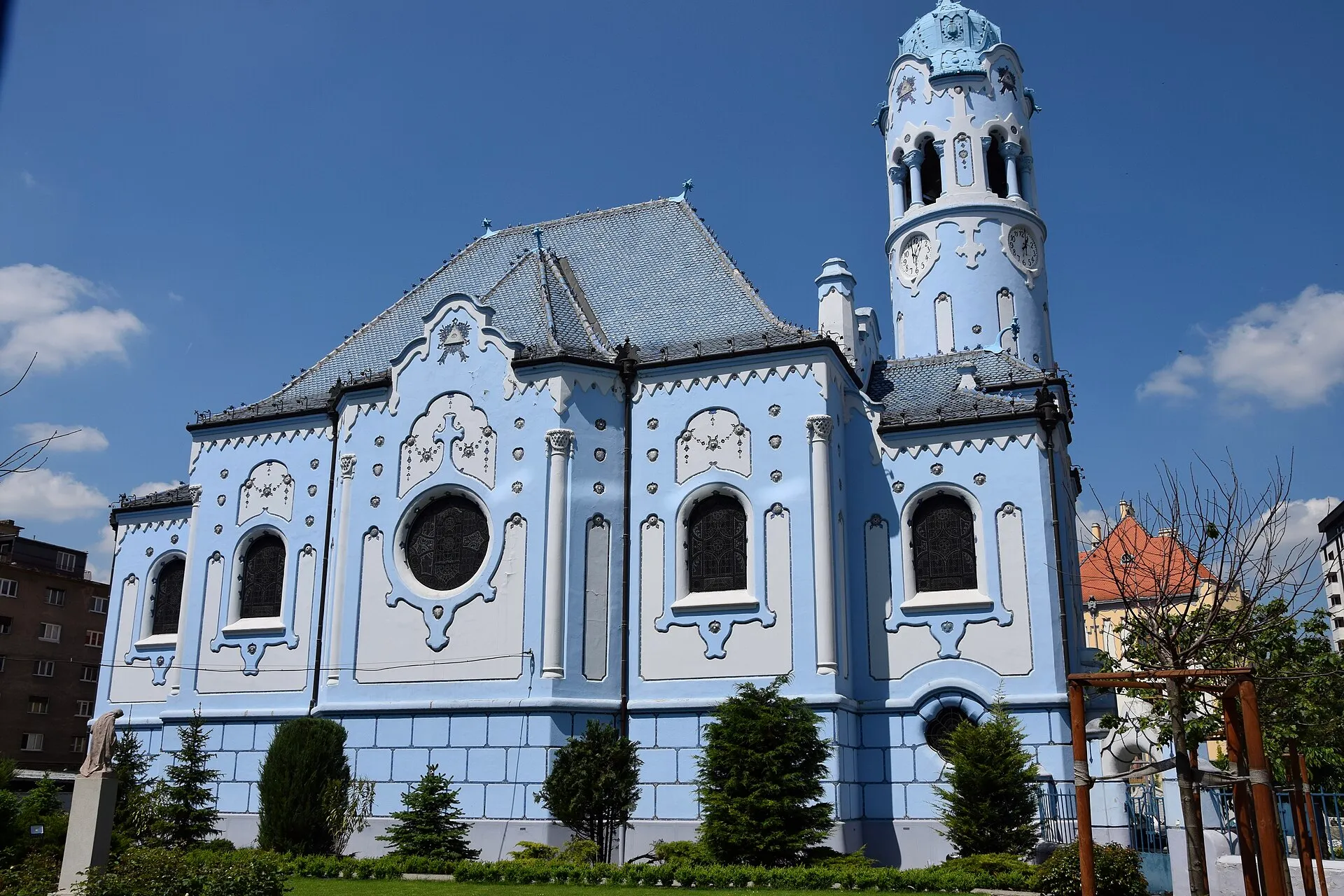
💡 The Short Version: The Church of St Elizabeth (Kostol svätej Alžbety), known as the Blue Church (Modrý kostolík), stands at Bezručova 2. Hungarian Secessionist architect Ödön Lechner designed it and it was completed in 1913, with pastel-blue plasterwork, glazed blue roof tiles and a mosaic portal. Admission is free. The church is open inside for limited hours: Monday to Saturday from 07:00 to 07:30 and 17:30 to 19:00, and on Sunday from 07:30 to 12:00 and 17:30 to 19:00. Or book a tour: an Old Town & Blue Church walking tourad from €25 or a guided Old Town walk with wine tastingad from €55 is sold on GetYourGuide.
⚠️ From Monday to Saturday the interior is open for only 30 minutes in the morning and 90 minutes in the evening. Outside the hours in the Short Version the interior is closed to visitors. In daylight the outer wooden doors are often open, and you can see and photograph the blue nave through the glass and iron vestibule screen.
Visiting hours and liturgical schedule
The Blue Church is an active parish church administered by the Parish of Saint Elizabeth. It is a place of worship rather than a museum, so visiting times are fitted around Mass:
| Day of the Week | Morning Visiting Window | Evening Visiting Window | Liturgical Mass Schedule |
|---|---|---|---|
| Monday to Friday | 07:00 to 07:30 | 17:30 to 19:00 | 07:00 Mass & 18:00 Mass |
| Saturday | 07:00 to 07:30 | 17:30 to 19:00 | 07:00 Mass & 18:00 Vigil Mass |
| Sunday | 07:30 to 12:00 | 17:30 to 19:00 | 08:00, 09:30, 11:00 & 18:00 Masses |
Viewing through the vestibule screen
If you reach Bezručova street outside the posted hours, at midday for example, you can still see inside. The parish opens the double outer wooden doors during the day, and a floor-to-ceiling iron grille with glass panels lets you look from the shallow portico down the central aisle to the blue benches, the ceiling medallions and the high altar.
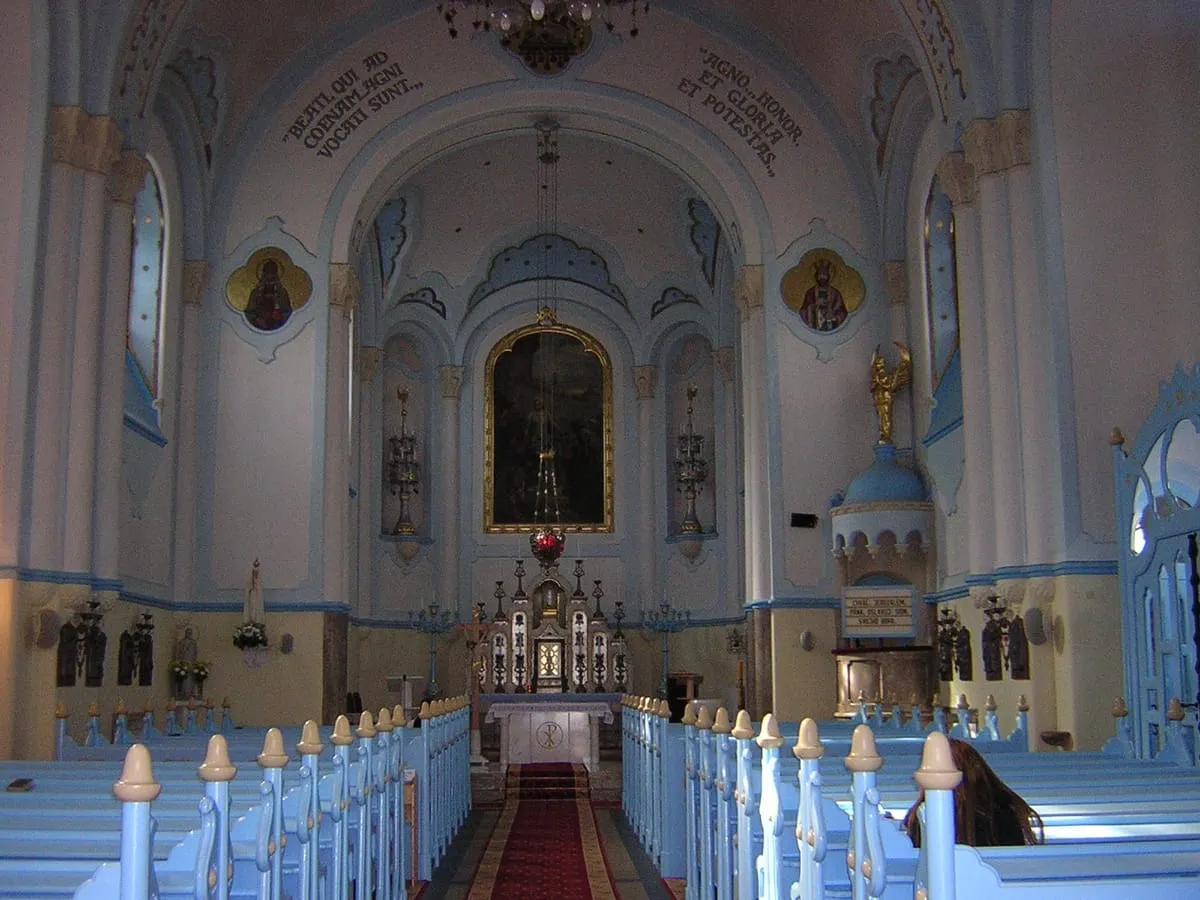
The light blue interior and altar of the Church of St Elizabeth. Photo: RoyFocker, Wikimedia Commons, Public domain.
Guided walking tours featuring the Blue Church
The Blue Church stands just outside the medieval centre and features on architectural walking tours of Bratislava’s Secessionist buildings.
Old Town & Blue Church walking tour
From €25 · 5 stars from 3 reviews · 1.5 hours · Blue Church
A walking tour of the Old Town that includes the Blue Church, led by a local guide. Bratislava: Old Town & Blue Church Walking Tourad
Old Town walking tour with Slovak wine tasting
From €55 · 5 stars from 18 reviews · 2.5 hours · wine tasting, groups of up to 8
A walk from the castle to the Old Town with a licensed local guide, in a group of up to eight, ending with Slovak wine at a historic winery. Bratislava: Old Town Walking Tour with Slovak Wine Tastingad
Old Town and castle walking tour
From €2.10 · 4.7 stars from 929 reviews · 165 minutes · Old Town and castle
A guided walking tour of Bratislava’s Old Town and castle area. Bratislava: Old Town and Castle Walking Tourad
Independent visit vs guided tour comparison
| Option | Ticket Cost | Meeting Point | What you get |
|---|---|---|---|
| Independent visit | Free | Bezručova 2 | The interior at 17:30–19:00 |
| Old Town & Blue Church walking tour | From €25.00 | Michael’s Gate | A guide on Ödön Lechner and Secessionism |
| Small-group walk with wine | From €55.00 | Old Town Hall | Old Town sightseeing and a wine tasting in a group of up to eight |
Architecture: Ödön Lechner
The Hungarian Ministry of Education commissioned the Church of St Elizabeth in 1908 as a school chapel for the adjacent Royal Catholic Gymnasium (now Gamča, the Grösslingová Grammar School). Ödön Lechner (1845–1914) designed it in the Hungarian Secession style (Magyar szecesszió):
- The Hungarian Gaudí: Lechner set out to build a Hungarian national style by mixing Art Nouveau curves, folk-art floral motifs and Eastern details.
- Cylindrical tower: Instead of a square steeple, the church has a 36.8-metre cylindrical bell tower with a dome and a double cross. A clock with gilded Roman numerals is set into the curved masonry near the top.
- Zsolnay ceramic tiles: The blue glazed ceramic tiles came from the Zsolnay porcelain factory in Pécs, Hungary. Majolica ribbons, palmette motifs and blue-glazed roof shingles cover the surface.
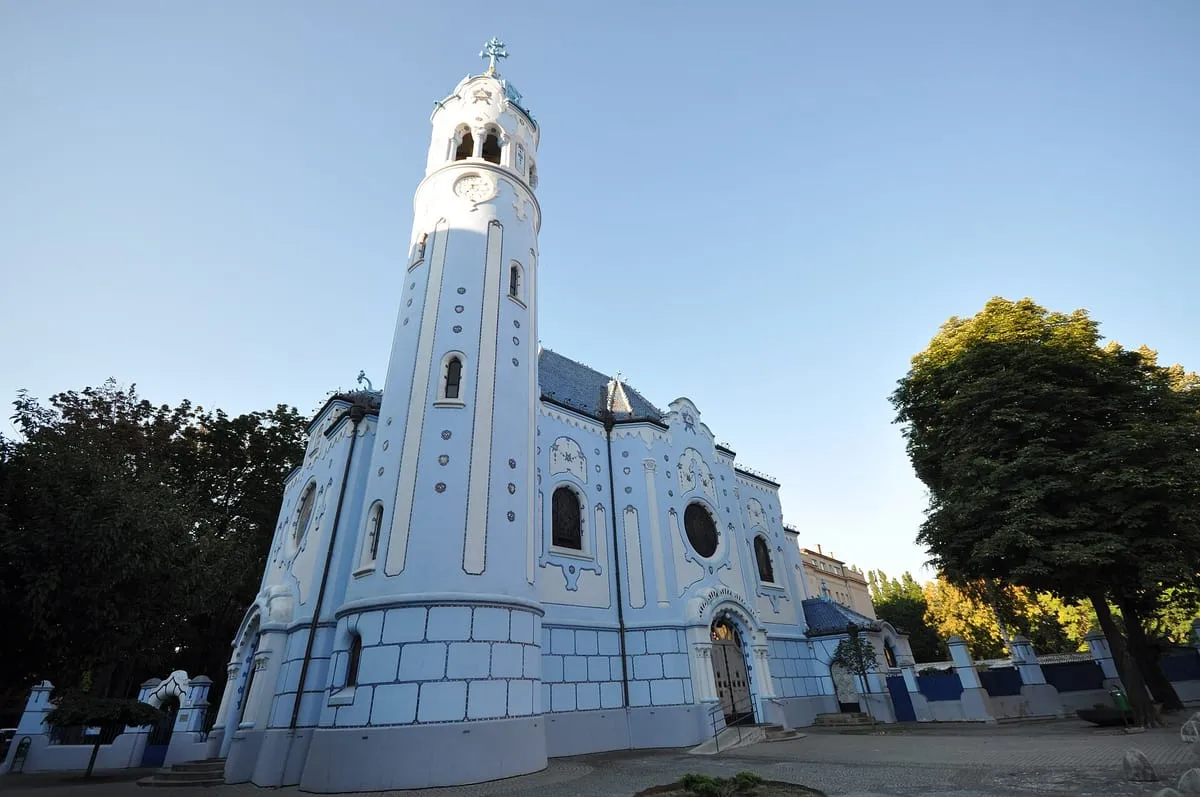
The cylindrical Art Nouveau bell tower of the Blue Church. Photo: Jorge Láscar from Australia, Wikimedia Commons, CC BY 2.0.
Who was Saint Elizabeth of Hungary?
The church is dedicated to Saint Elizabeth of Hungary (Svätá Alžbeta Uhorská, 1207–1231):
- Born in Pressburg: According to tradition, Elizabeth was born in 1207 inside Bratislava Castle, the daughter of Hungarian King Andrew II.
- Life of charity: Betrothed young to Louis IV, Landgrave of Thuringia, Elizabeth moved to Wartburg Castle in Germany. She fed the hungry, tended the sick and built hospitals. After her husband died on crusade she renounced her royal titles and lived in poverty until her death at twenty-four.
- The miracle of the roses: In the legend, Elizabeth was secretly carrying bread under her mantle to the poor when her suspicious brother-in-law demanded to see what she hid. When she opened her cloak, the bread had turned to red roses.
Above the main arched entrance an oval mosaic of Italian glass tesserae shows this scene: Saint Elizabeth before the castle battlements with roses spilling from her mantle.
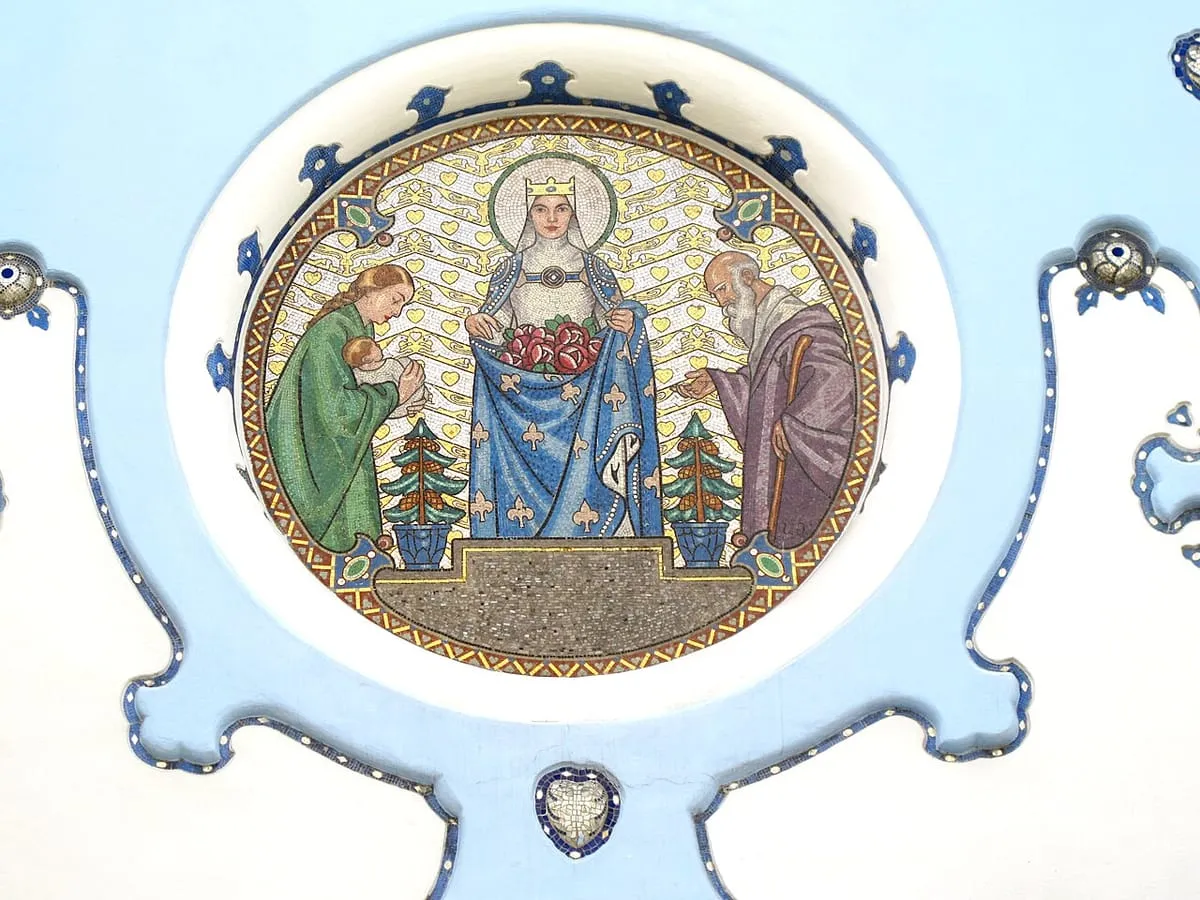
The ceramic mosaic of St Elizabeth above the church entrance. Photo: Acediscovery, Wikimedia Commons, CC BY 4.0.
Inside the Blue Church
The interior is small and bright:
- Single nave: One oval nave with no side aisles, under a wide barrel vault on slim pillars.
- Colours: Walls are painted pale blue, cream and white, with gold leaf accents and floral friezes.
- The altarpiece: The high altar holds an oil painting by the Hungarian painter Gyula Túry of Saint Elizabeth giving bread and clothing to the poor on the steps of Wartburg Castle.
- Pews: The original Art Nouveau pews are painted light blue, with curved end panels carved with floral petals.
- Empress Elisabeth memorial: Above the side altar a marble relief commemorates Empress Elisabeth of Austria (“Sisi”), who was assassinated in Geneva in 1898.
The adjacent Gamča Grammar School and Rectory
Two more buildings stand beside the church:
- The rectory: Directly behind the church, the parish rectory was also designed by Lechner. It repeats the church’s rounded corner towers, wavy rooflines and blue stucco.
- Gamča Gymnasium (Grösslingová 18): Completed in 1908 on the opposite side of the block, this was the first of Lechner’s buildings on the site. Its yellow-and-blue facade, majolica tiling and undulating gables match the church.
How to get there from the Old Town
The Blue Church is situated in a quiet residential neighbourhood east of the historic centre:
- On foot from Main Square: Walk east along Laurinská street, cross Štúrova boulevard, and continue along Grösslingová street for two blocks before turning right into Bezručova. The walk takes approximately 10 to 12 minutes (about 900 metres) over flat, easy pavements.
- On foot from the Danube Embankment: If you are visiting the Slovak National Gallery or walking along the river, head north from Vajanského nábrežie along Dostojevského rad and turn left into Bezručova (a 7-minute walk).
- Public Transport: Ride tram 1, 3 or 4 to the “Šafárikovo námestie” transit stop. From the tram platform, it is a 4-minute walk (350 metres) north along Sienkiewiczova street to the church gate. Transport ticketing rules are explained in our guide to public transport in Bratislava.
Practical visitor tips
- Photographing the outside: The front facade and cylindrical tower face south-west and get direct sun from midday to late afternoon. Early evening light falls warm on the blue roof tiles.
- Mass etiquette: During Mass you can sit quietly in the back pews. Walking the aisles, flash photography and video are not allowed during services.
- Coffee nearby: Bezručova and Grösslingová streets have independent coffee shops, including Mad Drop Coffee and Brew Bar Cafe, handy before the 17:30 opening.
What to see next
- Michael’s Gate and Tower: return to the northern threshold of the medieval Old Town.
- Old Town Hall and Main Square: explore the central market square and city museum.
- Slovak National Gallery: walk down to the Danube to view modern and classical Slovak art.
- Free Things to Do in Bratislava: more free sights, viewpoints and walks.
- Bratislava City Hub: return to the full index of Bratislava travel articles.
Common questions
What is the Blue Church in Bratislava called officially?
Its formal religious name is the Church of Saint Elizabeth of Hungary (Kostol svätej Alžbety Uhorskej), but it is known as Modrý kostolík (The Little Blue Church).
How much does it cost to visit the Blue Church?
Entry is free. It is an active Roman Catholic parish church and sells no tickets.
When can you go inside the Blue Church?
The parish opens the interior for tourist visits Monday to Saturday from 07:00 to 07:30 and from 17:30 to 19:00. On Sundays, it opens from 07:30 to 12:00 and from 17:30 to 19:00. Outside these hours the outer timber doors are often open, and you can see the nave through a glass-and-iron vestibule grille.
Who was the architect of the Blue Church?
Ödön Lechner, a Hungarian Secessionist architect sometimes called the 'Hungarian Gaudí', designed it. It was built between 1909 and 1913.
Where is the Blue Church located?
At Bezručova 2 in the eastern sector of Staré Mesto, roughly 10 to 15 minutes on foot from Michael's Gate and Main Square.