In this guide
💡 The Short Version: Sultan Mosque welcomes walk-in visitors Saturday to Thursday from 10:00 to 12:00 and 14:00 to 16:00, and is strictly closed to tourists on Fridays. Enter through Gate 5 facing Bussorah Street dressed with shoulders and legs covered (or borrow free robes at the counter). Explore the street art and indie boutiques along Haji Lane, shop for silks and perfumes on Arab Street, and eat crispy murtabak across from the mosque at Singapore Zam Zam. Or book a tour: If you want an expert-led cultural walk connecting Kampong Glam, Little India, and Chinatown with food tastings, book a guided cultural quarters walking tourad.
⚠️ Sultan Mosque enforces strict visiting hours and Friday closure. Outside the 10:00–12:00 and 14:00–16:00 windows, security staff restrict entry to worshippers only. On Fridays, the entire compound is closed to tourists all day for congregational prayers. If your schedule only permits a Friday visit, focus on Haji Lane, Arab Street shophouses, and outdoor photography along Bussorah Street.
History and royal heritage of Kampong Glam
Kampong Glam is Singapore’s historic Malay, Arab, and Bugis enclave. In the 1822 Jackson Plan (Raffles’ urban town plan), Sir Stamford Raffles allocated this coastal district to Sultan Hussein Shah of Johor and his royal retinue, along with early Bugis traders, Javanese merchants, and Hadhrami Arab traders from Yemen.
The name derives from the Malay word kampong (village) and the gelam tree (Melaleuca cajuputi, or paperbark tree). The fibrous bark of the gelam tree was traditionally used by local boatbuilders for caulking timber perahu vessels, while its fragrant leaves were distilled into healing cajeput oil.
At the heart of the district sits the Istana Kampong Glam (Sultan’s Palace), constructed in the 1840s by Sultan Ali Iskandar Shah. Today, the palace grounds house the Malay Heritage Centre, a neoclassical building featuring Malay timber elements, sweeping gardens, and exhibits chronicling maritime trade across the Malay Archipelago.
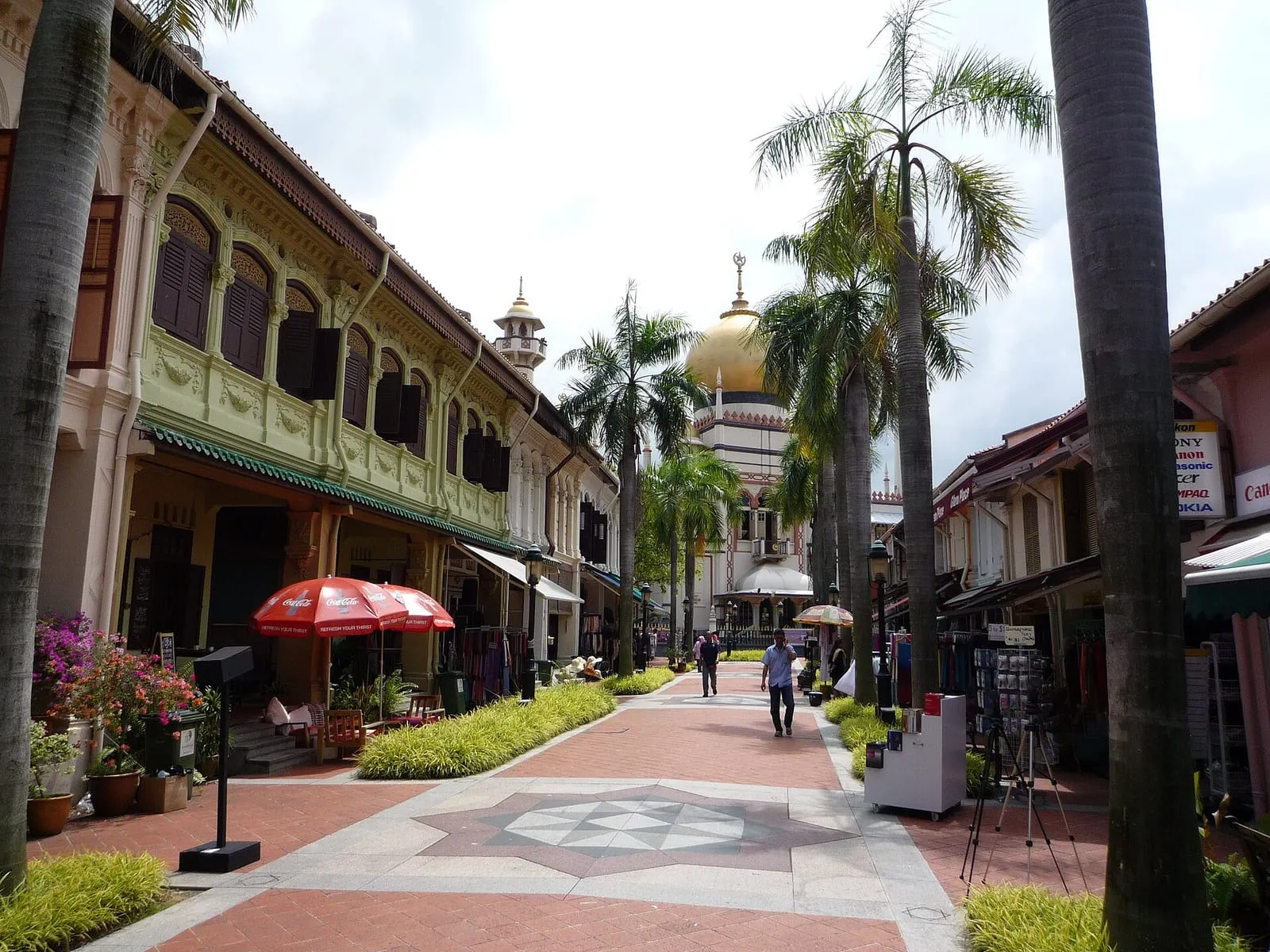
Bussorah Street facing Sultan Mosque. Photo: Jean-Michel Gobet, Wikimedia Commons, CC BY-SA 3.0.
Sultan Mosque (Masjid Sultan)
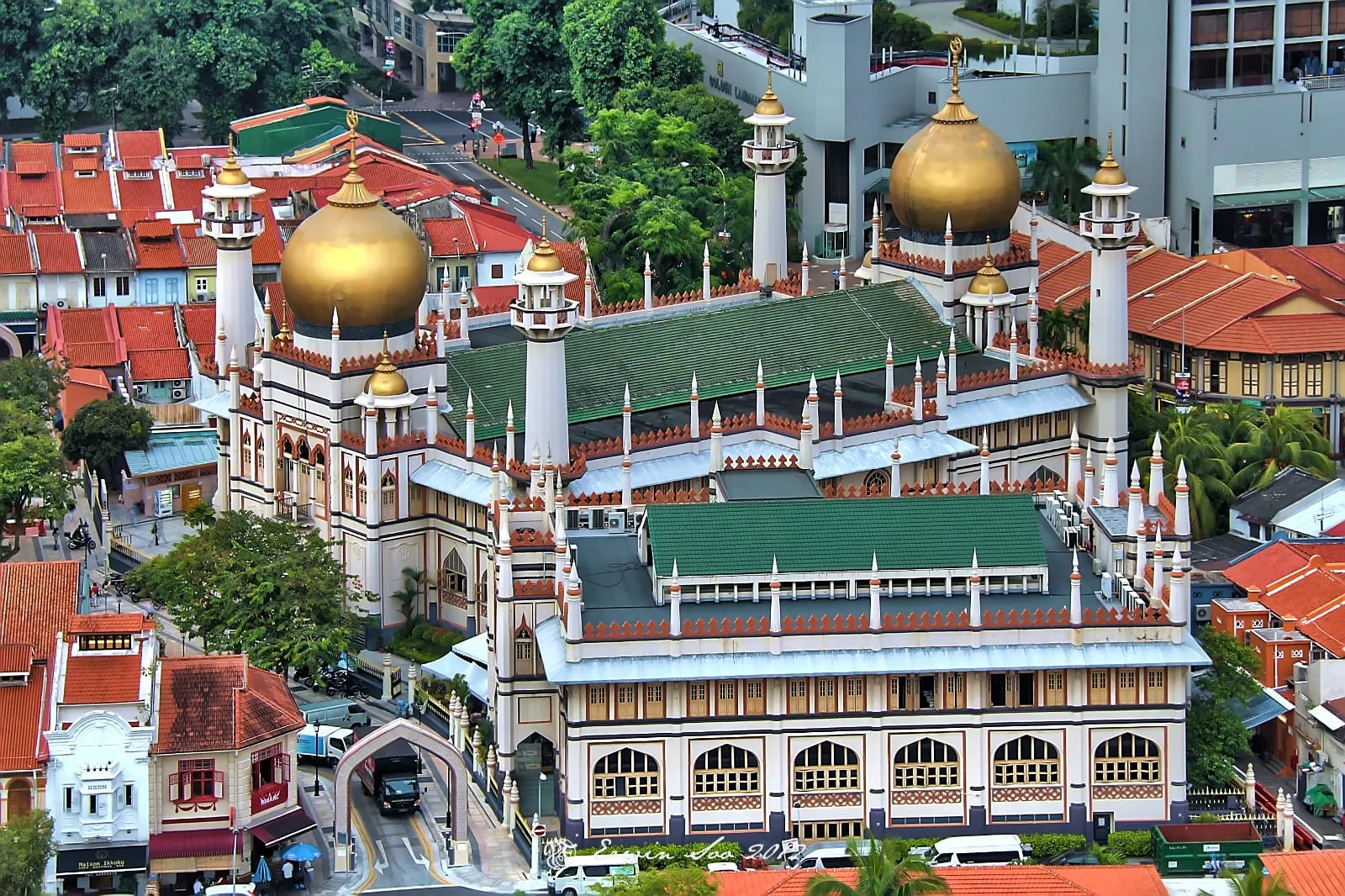
Gazetted as a National Monument in 1975, Sultan Mosque is the focal spiritual landmark for Singapore’s Muslim community.
Originally built in 1824 with a grant from the British East India Company, the current monumental structure was designed in 1928 by Irish architect Denis Santry of Swan & Maclaren in the Indo-Saracenic revival style, incorporating Mughal minarets, balustrades, and soaring golden domes.
The glass bottle dome base
Look closely at the black decorative band immediately beneath each massive golden onion dome. This ring is constructed from thousands of repurposed glass soy sauce bottles collected and donated by impoverished Muslim residents during the 1928 construction. The architect integrated the discarded bottles so that every member of the community—regardless of financial means—could contribute directly to the construction of the sacred landmark.
Visiting hours and etiquette
| Day of week | Visitor visiting hours | Tourist access rules |
|---|---|---|
| Saturday to Thursday | 10:00 to 12:00 and 14:00 to 16:00 | Walk-in visits allowed; enter exclusively through Gate 5 on Muscat Street |
| Friday | Closed to all tourists | Strictly reserved for worshippers attending weekly Juma’ah prayers |
- Dress requirements: Shoulders and upper arms must be covered. Men must wear trousers extending past the knee. Women must wear long-sleeved garments and ankle-length skirts or trousers with no low-cut necklines. Modest hooded robes and wrap-around skirts are loaned free of charge at the reception counter.
- Footwear: All shoes, sandals, and footwear must be removed and placed on the wooden storage shelves outside the entrance.
- Interior etiquette: Non-Muslim visitors can view the vast column-free Main Prayer Hall (which accommodates up to 5,000 worshippers) from the designated visitor boundary line. Entering the carpeted prayer area itself is reserved for active prayer. Photography is permitted without flash; silence your mobile phone upon entry.
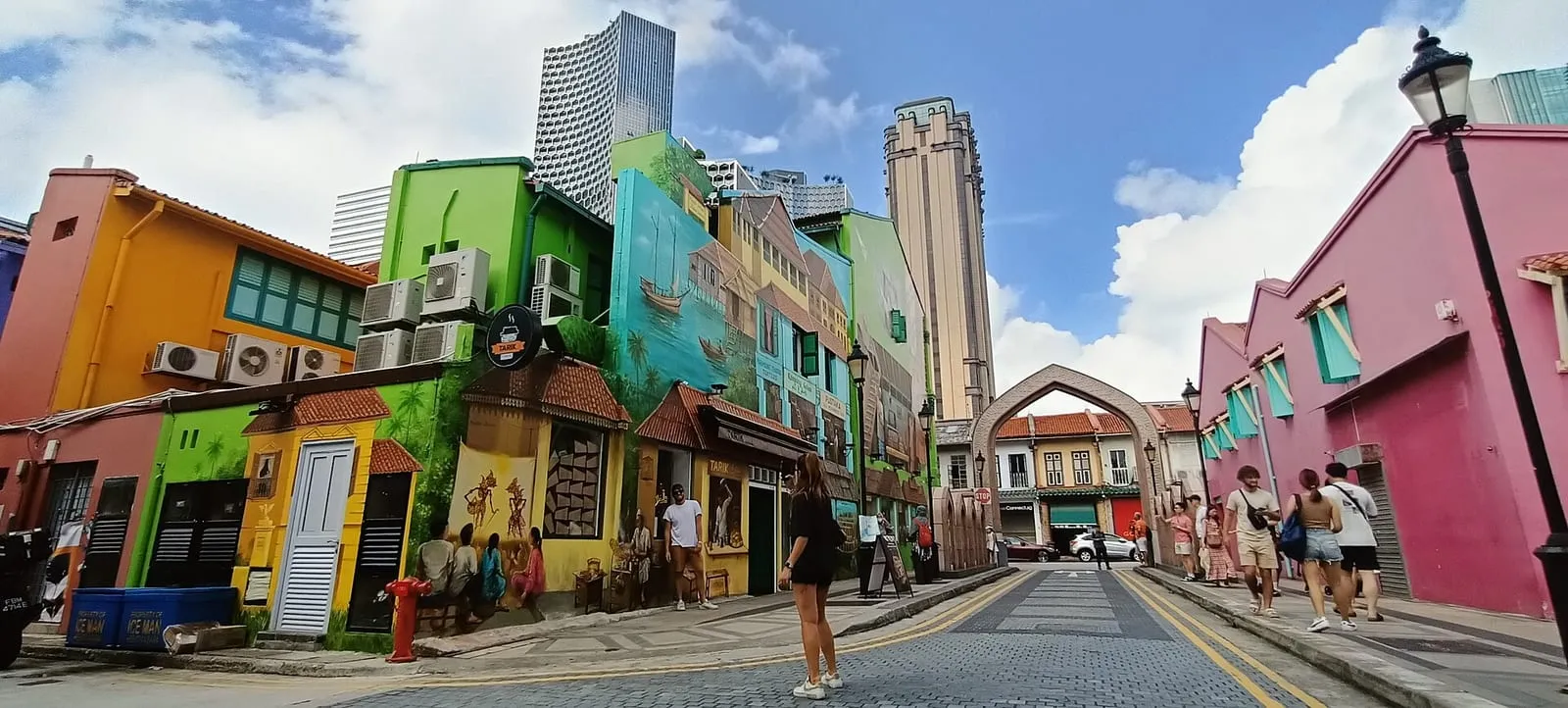
Murals on shophouses at the Arab Street end of Kampong Glam. Photo: Terrence, Wikimedia Commons, CC BY-SA 3.0.
Street-by-street guide
Kampong Glam blends centuries-old mercantile traditions with creative commerce:
- Bussorah Street: The palm-fringed pedestrian boulevard leading directly to Sultan Mosque. Formerly known as Kampong Kaji (Pilgrim Village) because Muslim pilgrims gathered here before embarking on steamships for the Hajj to Mecca. Today it features alfresco Turkish kebab cafes, Middle Eastern tea parlours, and non-alcoholic perfume (attar) boutiques.
- Arab Street: Singapore’s premier destination for textiles, rugs, and craft materials. Flanked by multi-generational family merchants stocking bolts of hand-printed Indonesian batik, luxurious Japanese silk, fine lace, and Afghan kilims. Visit Jamal Kazura Aromatics (established in 1933) to sample custom alcohol-free perfume oils distilled from frankincense, amber, and sandalwood.
- Haji Lane: Once a row of modest lodgings for Hadhrami Arab sailors and pilgrims, this narrow shophouse alleyway has evolved into one of Southeast Asia’s trendiest indie fashion corridors. It is packed with independent designer boutiques, vintage sunglasses shops, Japanese denim ateliers, and cocktail bars covered in floor-to-ceiling graffiti murals.
- Kandahar Street & Baghdad Street: Peaceful conservation streets lined with heritage bakeries, artisanal coffee roasters, and traditional Peranakan shophouse facades adorned with painted floral ceramic tiles.
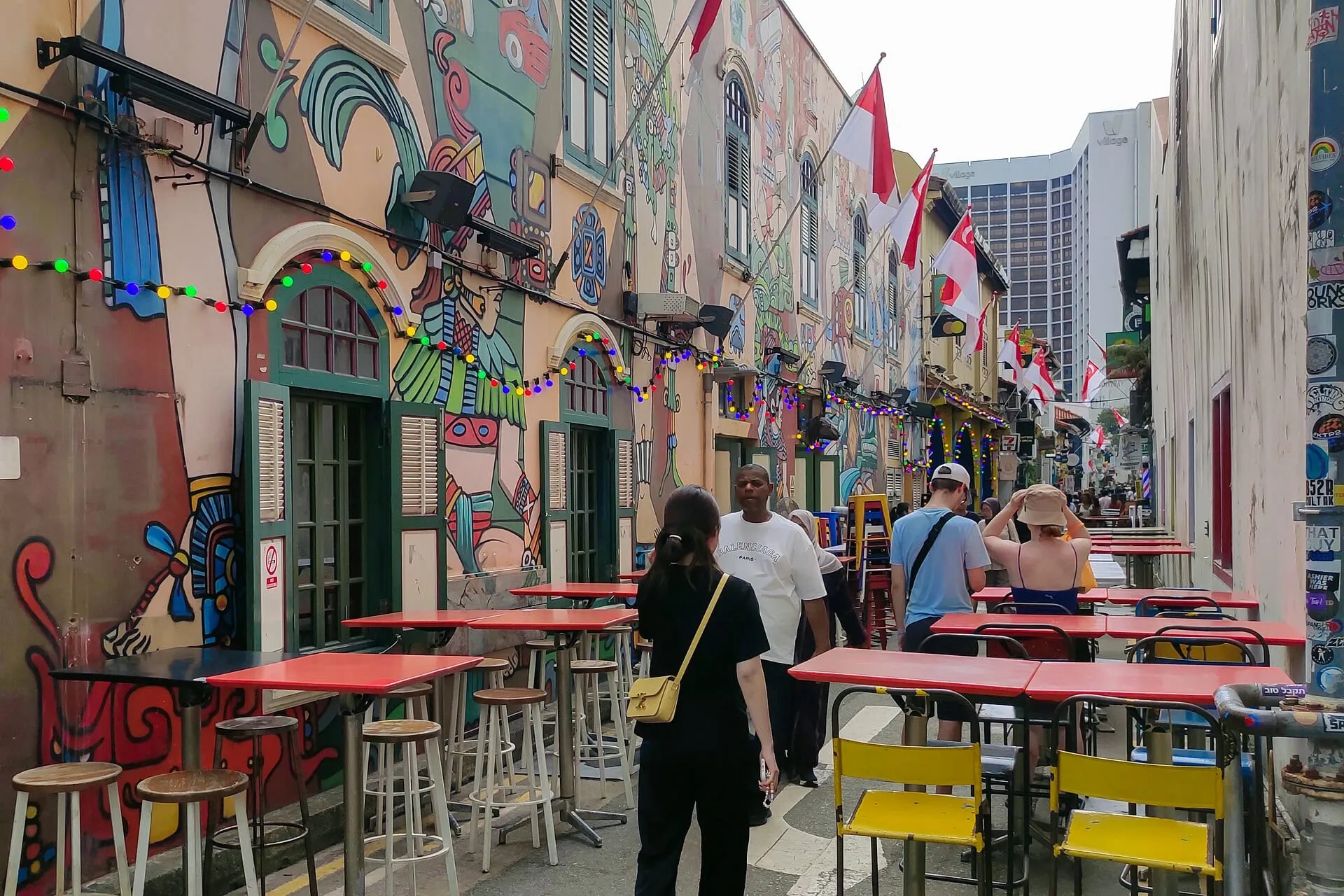
Street art murals and cafes along Haji Lane. Photo: Moheen Reeyad, Wikimedia Commons, CC BY-SA 4.0.
Kampong Glam tours and experiences
Booking an organised walking tour provides historical insight into the Bugis maritime spice traders, Arab merchant dynasties, and royal treaties that shaped colonial Singapore.
1. Chinatown, Little India and Arab Street Walking Tour
From S$90 · 4.9 stars from 466 reviews · 4 hours
This four-hour guided walkad links Kampong Glam with neighbouring Little India and Chinatown.
2. Chinatown, Little India and Kampong Glam Walk
From S$100 · 4.8 stars from 200 reviews · 3 hours
This three-hour walkad covers Chinatown, Little India and Kampong Glam on foot.
Self-guided exploration vs guided tours
| Aspect | Independent walking | Guided cultural tour |
|---|---|---|
| Cost | Completely free (pay only for food and shopping) | S$69 to S$100 per person |
| Mosque visit support | Must plan around strict 10:00–12:00 and 14:00–16:00 slots | Guide times entry perfectly and assists with loan robes |
| Historical storytelling | Self-guided interpretation from plaque boards | Live commentary on royal lineage, trade treaties, and street art |
| Culinary guidance | Independent ordering at crowded counters | Curated food samples with dietary explanations |
| Timing flexibility | Spend as long as you like browsing indie fashion boutiques | Moves at structured tour group pace |
Where to eat in Kampong Glam
Kampong Glam offers a rich culinary landscape spanning centuries-old heritage eateries and modern third-wave coffee bars:
- Singapore Zam Zam (188 North Bridge Road): Operating opposite Sultan Mosque since 1908, Zam Zam is legendary for its murtabak—crisp, buttery pan-fried folded flatbread stuffed with spiced minced mutton, chicken, beef, or deer, served with a bowl of rich curry gravy and sliced cucumbers with tomato sauce.
- Hjh Maimunah Restaurant (11 Jalan Pisang): Awarded a Michelin Bib Gourmand, this traditional eatery serves authentic kampung-style nasi padang. Select your dishes from steaming display trays: tender beef rendang, sambal goreng (spiced tofu and long beans), and smoky tahu telur (fried egg-tofu tower drizzled with dark sweet peanut sauce).
- Rich & Good Cake Shop (24 Kandahar Street): A beloved local confectionery queueing daily for nostalgic Swiss rolls rolled with fresh kaya (pandan coconut jam), durian, and mango creams.
- Teh Tarik Stalls on Baghdad Street: Order an iced or hot teh tarik (pulled milk tea) and watch the master tea maker pour the steaming beverage between two metal cups from arm’s length to aerate the brew and generate a thick, frothy head.
How to get there and practical connections
- MRT Access: Take the MRT to Bugis station (interchange for the East West Line EW12 and Downtown Line DT14). Take Exit B or Exit E, walk along Victoria Street, and turn into Arab Street (6 minutes). Alternatively, take the Downtown Line to Jalan Besar station (DT22) and walk south down Ophir Road (8 minutes).
- Walking Connections: Follow our self-guided Little India to Kampong Glam walk to connect the two quarters along Rochor Canal in under 20 minutes.
- Continuing Itinerary: Kampong Glam forms an integral part of day two in our 3 days in Singapore itinerary and 5 days in Singapore guide. For nearby boutique hotel options in Bugis, see our where to stay in Singapore guide.
Common questions
Is Sultan Mosque open to non-Muslim visitors on Fridays?
No. Sultan Mosque is strictly closed to non-Muslim tourists and casual visitors on Fridays due to weekly Juma'ah congregational prayers. Walk-in visitor sessions run Saturday to Thursday from 10:00 to 12:00 and from 14:00 to 16:00.
What is the dress code to enter Sultan Mosque?
Men must wear sleeved shirts and long trousers covering the knees. Women must wear loose long-sleeved tops with no exposed cleavage and ankle-length trousers or skirts. Footwear must be removed before entering the compound. Complimentary modest robes are provided at the visitor counter.
Where is the visitor entrance for Sultan Mosque?
Tourists must enter exclusively through Gate 5 on Muscat Street, which faces directly down the palm-lined pedestrian mall of Bussorah Street.
Which MRT station is closest to Kampong Glam?
Bugis MRT station (interchange for the East West Line EW12 and Downtown Line DT14) is a 6-minute walk away (Exit B). Jalan Besar MRT station (Downtown Line DT22) is an 8-minute walk from the northern end of Arab Street.
What are the best food spots in Kampong Glam?
Kampong Glam is famous for traditional Malay and Indian-Muslim cuisine. Essential stops include Singapore Zam Zam (established in 1908, famed for crispy mutton and chicken murtabak), Hjh Maimunah on Jalan Pisang (Michelin Bib Gourmand traditional nasi padang), and traditional tea stalls pulling frothy teh tarik.