In this guide
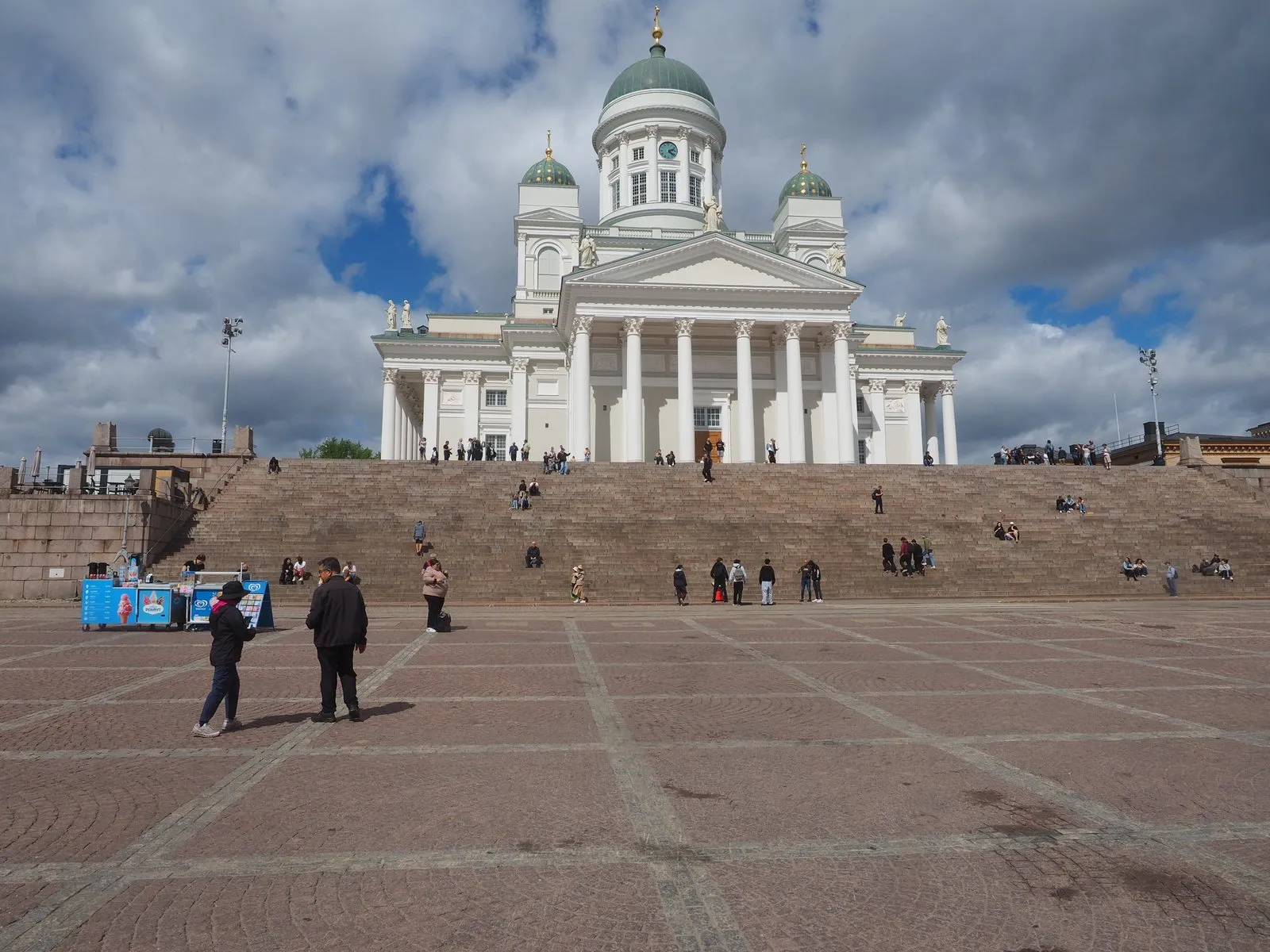
💡 The Short Version: Senate Square (Senaatintori) and Helsinki Cathedral form a neoclassical ensemble. Laid out by Carl Ludvig Engel in the early 19th century after Helsinki became the capital of the Grand Duchy of Finland, the square is framed by the white Lutheran cathedral, the Government Palace, the University of Helsinki main building and the National Library. Senate Square is open at all hours and free. The cathedral interior is open daily (a summer contribution may apply). Climb the 47 granite steps, visit the crypt on Kirkkokatu and look for the twelve zinc Apostles on the roof. Or book a tour: a 2-hour walking tour with Helsinki Cathedral and the marketad from €40 visits Senate Square, Helsinki Cathedral, Market Square and Uspenski Cathedral.
⚠️ Sunday mornings are closed to visitors. The cathedral is closed during the Sunday service (10:00 to 11:30) and during diocesan ceremonies, state occasions and weddings. Visitors are admitted from 12:00 on Sundays.
Engel’s plan for the square
A fire razed wooden Helsinki in 1808, and Tsar Alexander I moved the capital of the Grand Duchy from Turku to Helsinki in 1812. Town planner Johan Albrecht Ehrenström drew up a new grid city and appointed the Berlin-trained architect Carl Ludvig Engel to design the civic buildings.
Engel used restrained Neoclassical and Empire proportions inspired by Saint Petersburg and classical antiquity. Each side of Senate Square stands for one pillar of society:
- The Church: the cathedral on the northern bedrock terrace.
- The State: the Government Palace on the east.
- The Academy: the University of Helsinki on the west.
- Commerce: 18th-century merchant houses along the south.
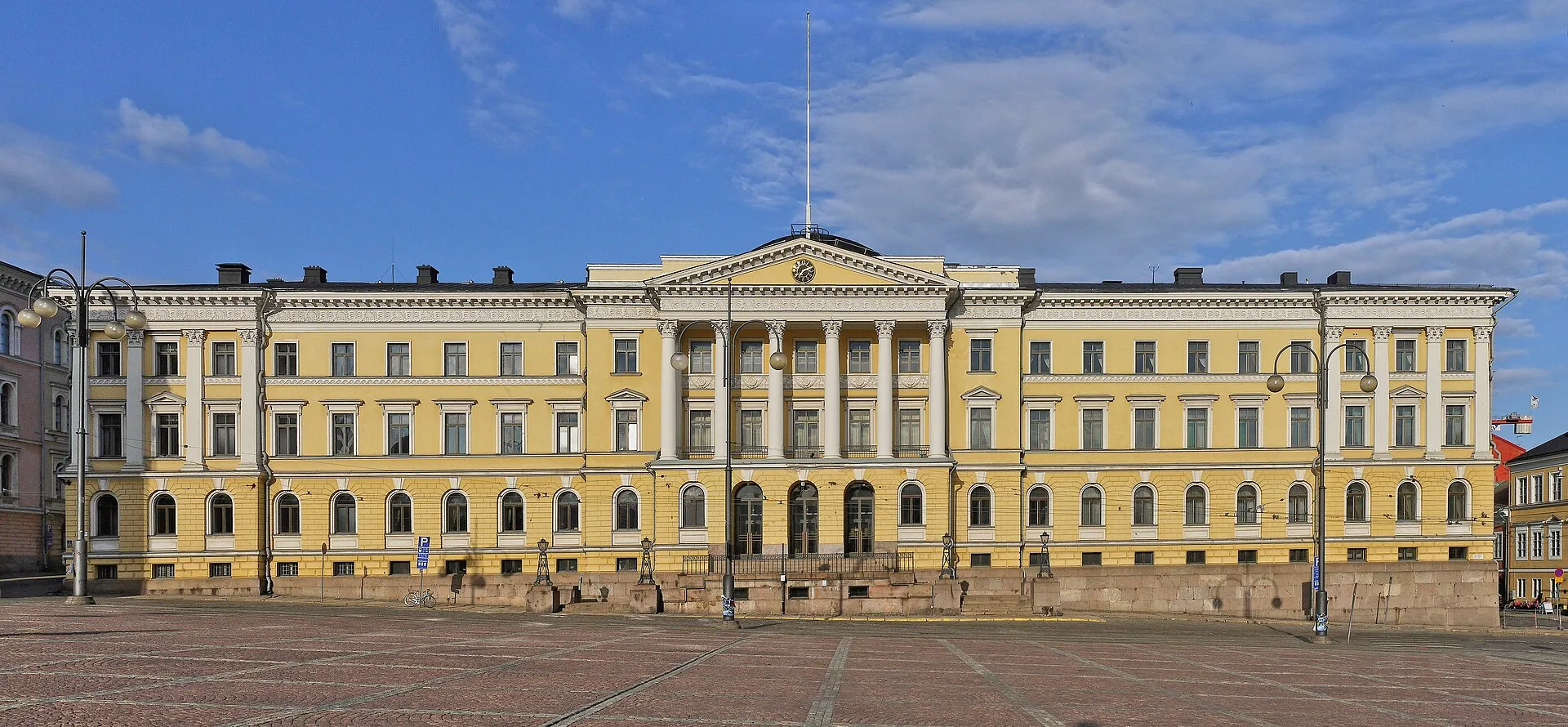
The Government Palace (Valtioneuvoston linna), Senate Square. Photo: Óðinn, Wikimedia Commons, CC BY-SA 2.5 ca.
The monuments around Senate Square
1. The Government Palace (Valtioneuvoston linna)
This yellow building on the eastern side was completed in 1822 as the seat of the Imperial Senate of Finland. It now houses the Prime Minister’s Office, the Chancellor of Justice and parts of the Ministry of Finance. In 1904 the Finnish nationalist Eugen Schauman shot the Russian Governor-General Nikolai Bobrikov on the second-floor staircase.
2. The University of Helsinki Main Building (Yliopiston päärakennus)
Engel’s university building, finished in 1832, mirrors the Government Palace across the square, with Ionic columns and plaster reliefs. It was restored after bomb damage in 1944.
3. The National Library of Finland (Kansalliskirjasto)
Just northwest of the square at Unioninkatu 36, Engel’s library has a Corinthian colonnade outside and a central rotunda of 28 marble-painted columns under a painted skylight dome. Admission is free, and visitors can walk through the reading halls.
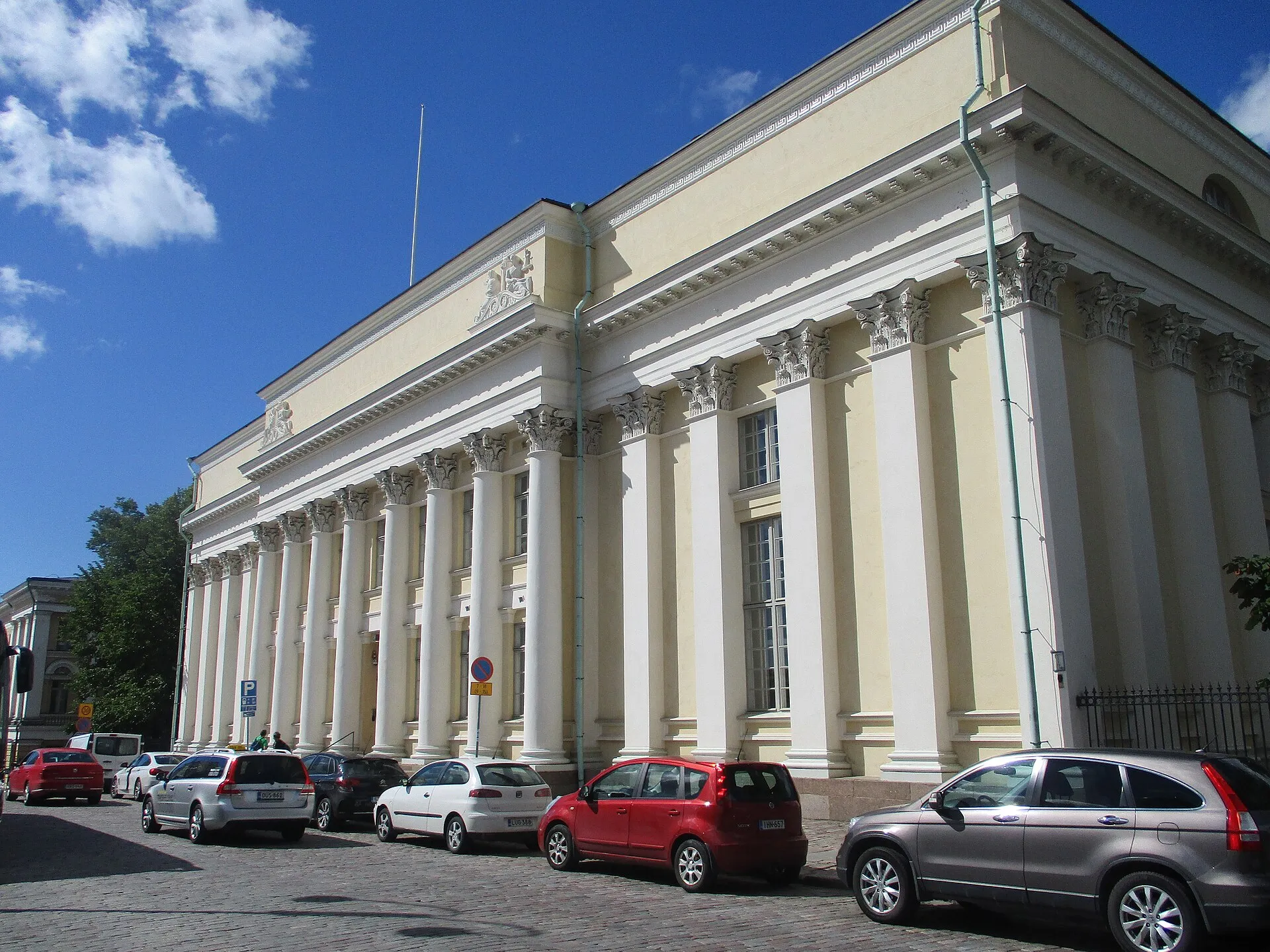
The classical colonnade and entrance of the National Library of Finland (Kansalliskirjasto) adjacent to the square. Photo: Mikkoau, Wikimedia Commons, CC BY-SA 4.0.
4. The Monument to Emperor Alexander II
This bronze in the centre of the square honours Emperor Alexander II of Russia (1818–1881). Johannes Takanen and Walter Runeberg sculpted it and it was unveiled in 1894. It commemorates the Tsar reconvening the Diet of Finland in 1863, which restored constitutional government and raised Finnish to official status alongside Swedish.
The Tsar wears a Finnish guards officer’s uniform. Four bronze allegories surround the pedestal: Lex (Law), Lux (Light and Science), Pax (Peace) and Labor (Work). Under later tsars, Finns laid flowers here as a silent protest against Russian rule.
Inside Helsinki Cathedral
Originally named St Nicholas Church (Nikolainkirkko) in honour of both Saint Nicholas, patron saint of mariners, and Emperor Nicholas I of Russia, the cathedral took 22 years to build (1830 to 1852). When Finland gained independence in 1917, the name was changed to the Great Church (Suurkirkko), and upon the founding of the Diocese of Helsinki in 1959, it became the Cathedral of Helsinki (Helsingin tuomiokirkko).
The exterior: columns, domes and the Twelve Apostles
The cathedral is an equilateral Greek cross. Four pedimented porticos with giant Corinthian columns face the four compass points. A green copper dome sits at the centre, ringed by four smaller domes that Ernst Lohrmann added after Engel’s death.
On the roof balustrade stand twelve zinc statues of the Apostles, each three metres tall, cast by the SP Geiss foundry in Berlin between 1845 and 1847.
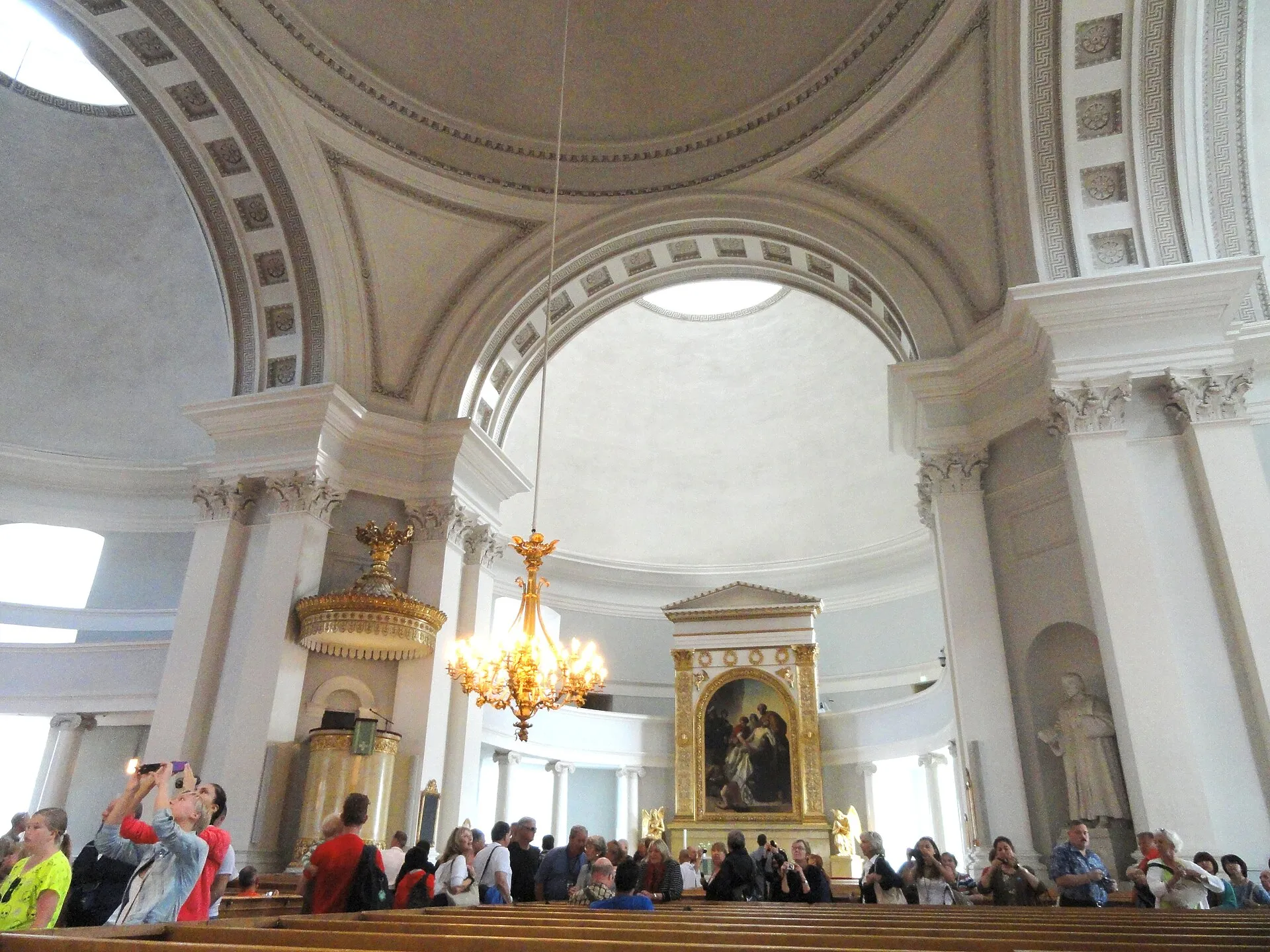
Interior of Helsinki Cathedral. Photo: Daderot, CC0, Wikimedia Commons.
The interior: Protestant restraint
The interior is plain: matte white walls and tall arched clear-glass windows, with none of the gilded icons of Orthodox churches or the stained glass of Catholic cathedrals. In the nave:
- The Altarpiece: Painted by Baltic-German artist Robert Wilhelm von Ekman in 1879, depicting the Entombment of Christ, framed by classical marble pilasters.
- The Statues of the Reformers: Life-sized plaster statues in the corners depict key figures of the Protestant Reformation: German reformer Martin Luther, his intellectual collaborator Philipp Melanchthon, and Mikael Agricola, the Finnish reformer who translated the New Testament into Finnish in 1548 and laid the foundation for written Finnish.
- The Main Organ: A 57-stop pipe organ built in 1967 by Danish organ builder Marcussen & Søn, set inside Carl Ludvig Engel’s original 1847 neoclassical gilded organ case.
The Cathedral Crypt
The vaulted brick Cathedral Crypt (Tuomiokirkon krypta) lies beneath the sanctuary, entered from Kirkkokatu 18. It was built as a cellar and heating space and converted into a cultural hall in the 1970s. From June to August it is Cafe Krypta, serving coffee, cinnamon buns and light lunches, with changing art exhibitions and summer concerts.
Visiting practicalities and photography tips
- Cost: The square is free at all times. From June to August you may be asked for a contribution to enter the cathedral; outside summer entry is free.
- The steps: The 47 granite steps are steep and wide. From December to March compacted snow and freezing rain make them very icy; use the side handrails or the sloping ramp behind the cathedral from Kirkkokatu.
- Photography:
- Morning: The south facade is lit from about 08:30 to 11:30. Stand at the base of the Alexander II statue looking north.
- Evening: Floodlights light the white columns against the dark sky.
- From the top step: Look south over the square towards South Harbour and the cruise ferries.
- Tram: Lines 2, 4, 5 and 7 stop at Senaatintori on the southern edge of the square, 2 minutes from Central Station on a Zone AB ticket.
What to see next around Senate Square
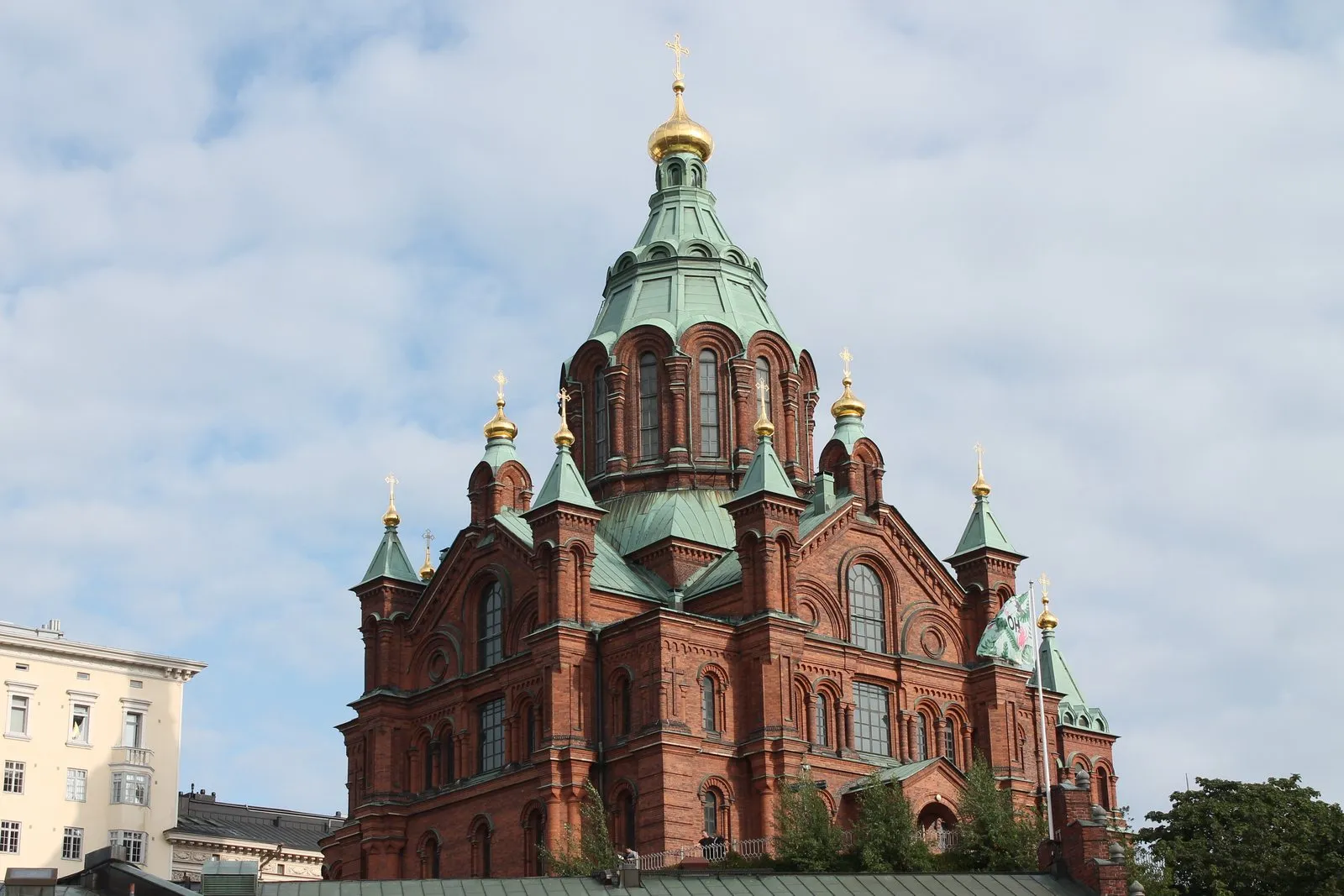
- Orthodox cathedral: 600 metres east across the canal in Katajanokka, the red-brick Russian-Byzantine Uspenski Cathedral.
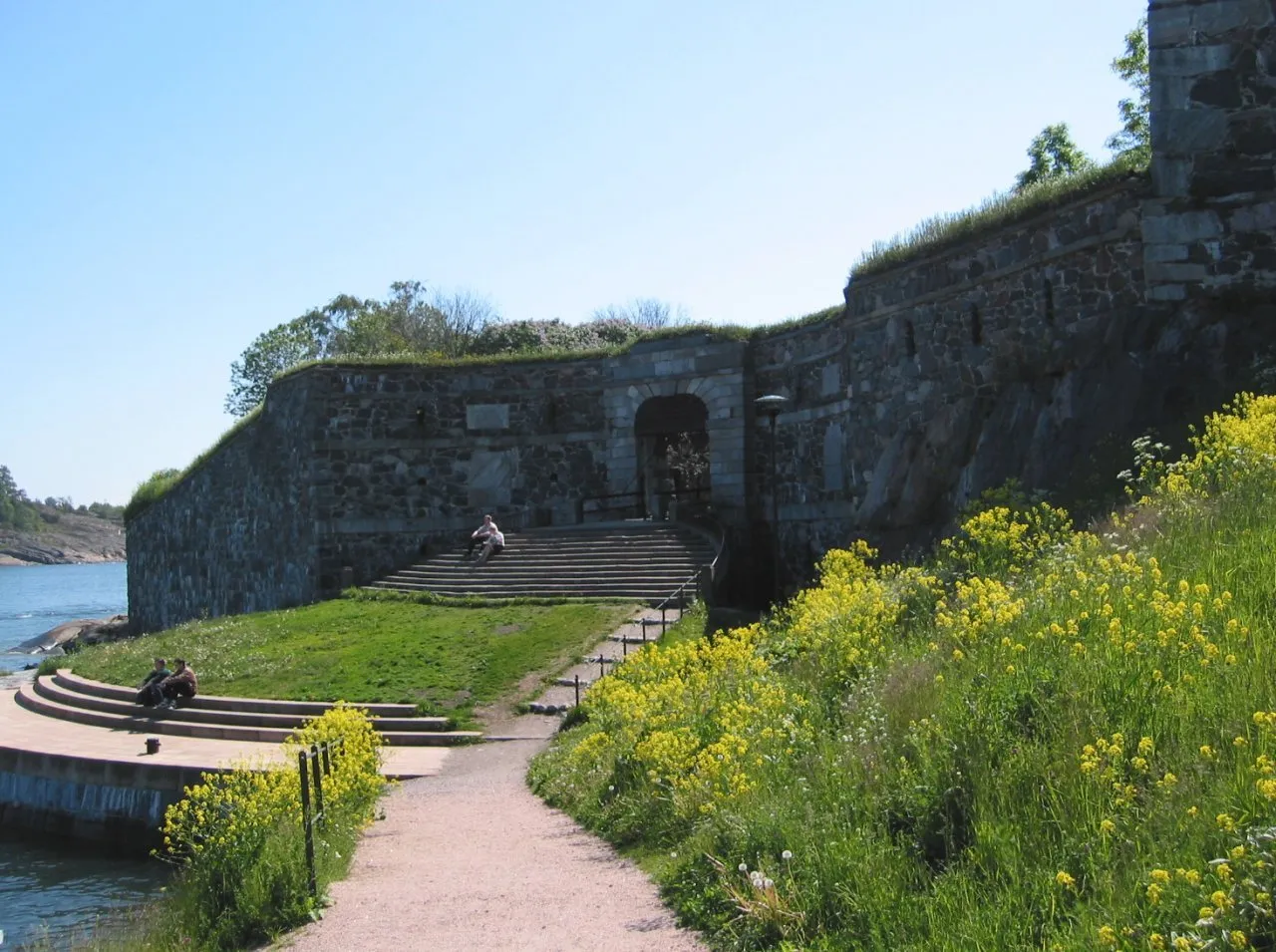
- The sea fortress: Market Square (Kauppatori) is three minutes south, for the HSL ferry; see the Suomenlinna ferry guide.
- Finnish Golden Age art: 500 metres west along Aleksanterinkatu, the Ateneum.
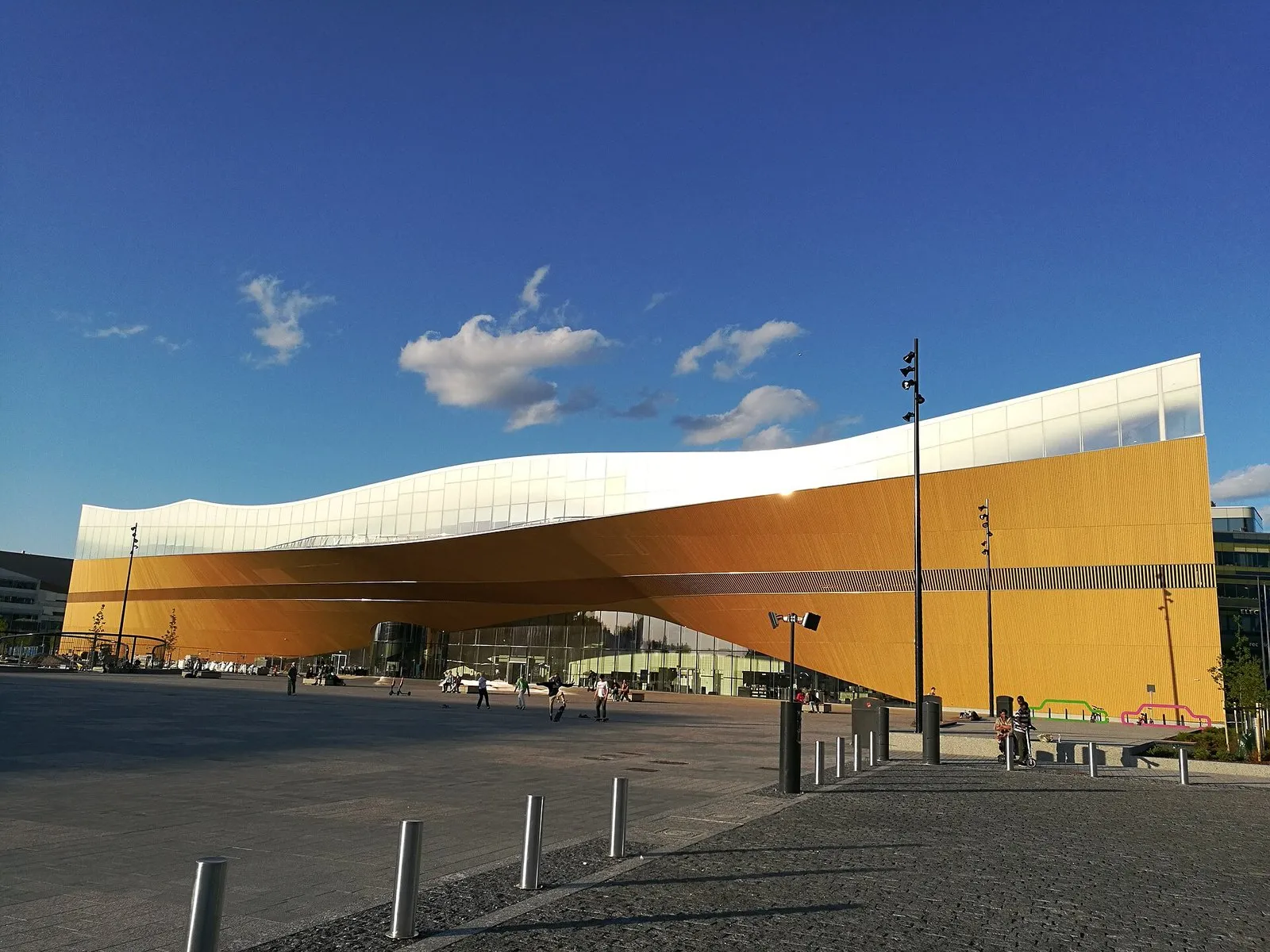
- Modern architecture: North past Central Station, the Oodi Central Library.
- Free sights: Free things to do in Helsinki.
Common questions
How much does it cost to enter Helsinki Cathedral?
Senate Square and the cathedral exterior are free. From June to August a contribution may be requested to enter the interior. Outside summer, and during services and organ recitals, entry is free.
What are the opening hours of Helsinki Cathedral?
Helsinki Cathedral is open daily year-round from 09:00 to 18:00 (extending until 21:00 or 22:00 in peak summer months). On Sundays, sightseeing access begins at 12:00 following morning church services. The cathedral crypt is open daily during summer from 11:00 to 17:00.
Who designed Senate Square and Helsinki Cathedral?
The German-born architect Carl Ludvig Engel, working from 1818 for Tsar Alexander I and the town planner Johan Albrecht Ehrenström. The cathedral was finished in 1852, after Engel's death in 1840, by Ernst Lohrmann, who added the four small corner cupolas.
Whose statue is in the middle of Senate Square?
Russian Emperor Alexander II, Grand Duke of Finland. Johannes Takanen and Walter Runeberg sculpted the bronze, unveiled in 1894, to mark the Tsar convening the Diet of Finland in 1863.
Can you sit on the steps of Helsinki Cathedral?
Yes. The 47 granite steps facing south onto Senate Square are a public gathering spot, and on sunny days from spring to autumn people sit there looking across Kruununhaka towards South Harbour.