In this guide
💡 The Short Version: Our judgement, not a ranking: pick Copenhagen for the canals, Rosenborg Castle and a city built for cycling, 15 minutes by metro from the airport. Pick Stockholm for Gamla Stan, the Royal Palace and the Vasa Museum. Pick Oslo for Munch’s The Scream, the Opera House roof and saunas on the fjord. Pick Helsinki for public saunas with a dip in the Baltic and the sea fortress of Suomenlinna. Pick Reykjavik for geothermal lagoons, the Golden Circle and the northern lights in winter. Reykjavik and Copenhagen have the highest Eurostat price levels of the five; Stockholm the lowest. Or book a tour: Copenhagen’s Classic City walking tourad is from DKK 142, Stockholm’s Gamla Stan walkad from SEK 150, and Reykjavik’s Golden Circle full-day tourad from 11,300 ISK (GetYourGuide).
⚠️ Mondays and December light. Most museums in Copenhagen, Stockholm, Oslo and Helsinki close on Mondays, among them the National Museum in Oslo and the Ateneum in Helsinki, and Rosenborg Castle from 2 November to 23 December. In late December the sun is up for about seven hours in Copenhagen and four in Reykjavik, so plan outdoor sightseeing for the middle of the day.
The five Nordic capitals side by side
Prices are each operator’s adult rate in local currency. The price level is Eurostat’s 2024 index for restaurants and hotels, with the EU27 average at 100.
| Capital | Currency and price level | Airport to centre | 24-hour transport | Top sight | On the ground |
|---|---|---|---|---|---|
| Copenhagen | DKK · 147.6 | Metro M2, 15 minutes, DKK 30 | City Pass Small, DKK 100 | Rosenborg Castle, DKK 140 online; Tivoli in season | Cycling, and the canals at Nyhavn |
| Stockholm | SEK · 116.7 | SL train, 38 minutes, SEK 200; Arlanda Express, 18 minutes, SEK 340 | SEK 180 | Vasa Museum, SEK 195 from October to April; Royal Palace, SEK 220 | Public boats to Djurgården and Vaxholm on an SL ticket |
| Oslo | NOK · 140.0 | Vy train, 23 minutes; Flytoget, 19 minutes, NOK 276 | NOK 137 | National Museum and MUNCH, NOK 220 each | Floating saunas on the harbour, from NOK 260 |
| Helsinki | Euro (€) · 126.8 | Commuter train, 28 to 32 minutes, on a zone ABC ticket | €10.60 (Zone AB) | Suomenlinna sea fortress, free; Ateneum, €23 | Public saunas: Löyly €29, Kotiharju €16 |
| Reykjavik | ISK · 167.3 | Flybus, about 45 minutes, 3,999 ISK | Strætó bus, 690 ISK a ride, capped at 2,070 ISK a day | Hallgrímskirkja tower, 1,500 ISK; Harpa | Sky Lagoon and the Blue Lagoon, both booked ahead |
What a day costs in each capital
Prices are the operators’ adult rates in 2026, in local currency. Each card’s own guide works out when it pays.
| Capital | Card or pass, 24 hours | Museum ticket | What the card covers |
|---|---|---|---|
| Copenhagen | Copenhagen Card Discover, DKK 589 | National Museum, DKK 135 online | Transport in zones 1 to 99 and the airport. It pays when the day holds about DKK 490 of tickets, and leaves out the Round Tower, the Marble Church dome, CopenHill and Malmö (is it worth it) |
| Stockholm | Go City All-Inclusive, SEK 949 | Vasa Museum, SEK 195 from October to April | No transport, and no ABBA The Museum or Moderna Museet. It pays only when the days include a boat tour (is it worth it) |
| Oslo | Oslo Pass, NOK 580 | National Museum or MUNCH, NOK 220 | 30 museums and transport in Ruter zones 1 to 3 plus the airport zones, including the Vy airport train but not Flytoget. It pays on a day with three paid sights (is it worth it) |
| Helsinki | Helsinki Card CITY, from €62 on GetYourGuide | Ateneum, €23 | More than 30 sights and zone AB transport, but not the airport train. It pays on a museum-heavy day (is it worth it) |
| Reykjavik | Reykjavik City Card, 6,100 ISK | National Museum, 3,300 ISK | 17 museums, all eight public pools, city buses and the Viðey ferry, but not the Blue Lagoon, Sky Lagoon, Hallgrímskirkja or Perlan (is it worth it) |
Longer stays change the sums. The Copenhagen Card is DKK 859 for 48 hours and DKK 1,039 for 72, the Oslo Pass NOK 845 and NOK 995, and the Reykjavik City Card 8,500 and 10,500 ISK. Stockholm’s SL ticket is SEK 360 for 72 hours, and Go City’s pass is SEK 1,349 for two days and SEK 1,699 for three.
Four of the five fine a passenger without a valid ticket: at least DKK 750 in Copenhagen, SEK 1,850 plus the fare in Stockholm, NOK 1,150 in Oslo and €100 plus the fare in Helsinki. Buy before you board.
Alcohol is priced and sold differently. In Oslo, wine, spirits and beer above 4.7% are sold only in the state-run Vinmonopolet shops, and supermarket tills lock at 20:00 on weekdays (money in Oslo). In Stockholm, take-away wine and spirits are sold in the state-run Systembolaget shops (where to eat in Stockholm). Hotel stays carry no tourist tax in Copenhagen, Stockholm, Oslo or Helsinki, and Reykjavik adds 800 ISK per room per night.
From the airport, and arriving late
The table above gives the quickest way in. These are the alternatives, and what runs after midnight.
- Copenhagen: the M2 metro runs all night, every 2 to 3 minutes by day, to Kongens Nytorv and Nørreport. A DSB train also reaches Central Station in about 15 minutes. Both are a DKK 30 three-zone ticket, and the metro machines take coins and cards but not notes (airport to the city).
- Stockholm: the Arlanda Express is SEK 340 for one adult and SEK 120 for each extra adult on the same train, so three adults pay SEK 580. The SL commuter train is SEK 600 for the same three, and takes about 38 minutes. The Flygbussarna coach is from SEK 129 and takes about 40 minutes to Cityterminalen (Arlanda to the city).
- Oslo: the Vy train leaves tracks 4 and 5 about three times an hour and is covered by the Oslo Pass. Flytoget saves 4 minutes for NOK 276, and a Ruter ticket or Oslo Pass on it brings a NOK 1,150 fine. The last Vy train leaves about 00:50, and Flybussen line FB5 runs overnight to the bus terminal (Gardermoen to Oslo).
- Helsinki: commuter trains I and P leave every 6 to 10 minutes. The airport is in zone C, so a zone AB ticket does not cover it; an ABC ticket is valid for 110 minutes and includes the tram or metro to your hotel. HSL bus 600 runs 24 hours and takes about 40 minutes (airport to the city).
- Reykjavik: Iceland has no railway. The Flybus meets every arriving flight and takes about 45 minutes to the BSÍ bus terminal for 3,999 ISK, or 5,299 ISK with a minibus on to your hotel. Strætó bus 55 is 2,400 ISK on a limited timetable, and a taxi is a fixed fare of about 21,000 to 22,500 ISK for up to four people (Keflavík to Reykjavik).
Daylight through the year
Sunrise and sunset on the solstices in 2026, local time.
| City | 21 December sunrise | 21 December sunset | Daylight on 21 December | Daylight on 21 June |
|---|---|---|---|---|
| Copenhagen | 08:37 | 15:38 | 7 hours 1 minute | 17 hours 32 minutes |
| Stockholm | 08:43 | 14:48 | 6 hours 5 minutes | 18 hours 37 minutes |
| Oslo | 09:18 | 15:12 | 5 hours 54 minutes | 18 hours 50 minutes |
| Helsinki | 09:23 | 15:12 | 5 hours 49 minutes | 18 hours 56 minutes |
| Reykjavik | 11:22 | 15:29 | 4 hours 7 minutes | 21 hours 8 minutes |
In June none of the five has midnight sun, but the nights stay light: Copenhagen’s sun sets at 21:57 and Stockholm’s at 22:08, and Reykjavik’s sets at 00:03 and rises at 02:55.
Which season suits which capital
Temperatures are mean daily highs. The market dates are the organisers’ for 2026 to 2027.
| Capital | Summer | Christmas | The seasonal catch |
|---|---|---|---|
| Copenhagen | 23°C in July and August; May is the sunniest month, with 262 hours of sun | Nytorv and Gammeltorv market 6 November to 21 December; Tivoli’s Christmas 13 November to 3 January | Tivoli is shut between its seasons, including 2 to 12 November, and on 24 December |
| Stockholm | 23.6°C in July, with 280 hours of sun | Skansen’s market, Fridays to Sundays from 27 November to 20 December; Lucia on 13 December | The city empties on Midsummer Eve, Friday 25 June 2027; Strömma’s Cinderella boats to Grinda and Sandhamn do not run until April 2027 |
| Oslo | Highs of 20°C to 23°C and nearly 19 hours of daylight, with swims at Sørenga | Jul i Vinterland at Spikersuppa, free, 7 November to 3 January; Korketrekkeren toboggan run when snow lies | Shops and most museums close on 17 May and over Easter |
| Helsinki | Highs of 18°C to 24°C and up to 19 hours of daylight | Christmas Market on Senate Square 27 November to 22 December; Lux Helsinki light festival 30 December to 6 January | Midsummer Eve and Day are national holidays, and major museums and many restaurants close from the Friday afternoon |
| Reykjavik | 14.9°C in July, with 20 to 21 hours of daylight; puffin boats run from 20 April to 20 August | The 13 Yule Lads arrive one a night from 12 December; public pools close at 13:00 on Christmas Eve and all day on 25 December | Highland F-roads begin opening in June; aurora season runs from late August to April |
The northern lights need three things at once: geomagnetic activity, a dark sky and no cloud. In Reykjavik, the places to escape the city glare are Grótta lighthouse, the wooded hill of Öskjuhlíð by Perlan and the Sun Voyager waterfront (northern lights in Reykjavik). For the markets, the Christmas market cities compared sets the dates for every city we cover side by side.
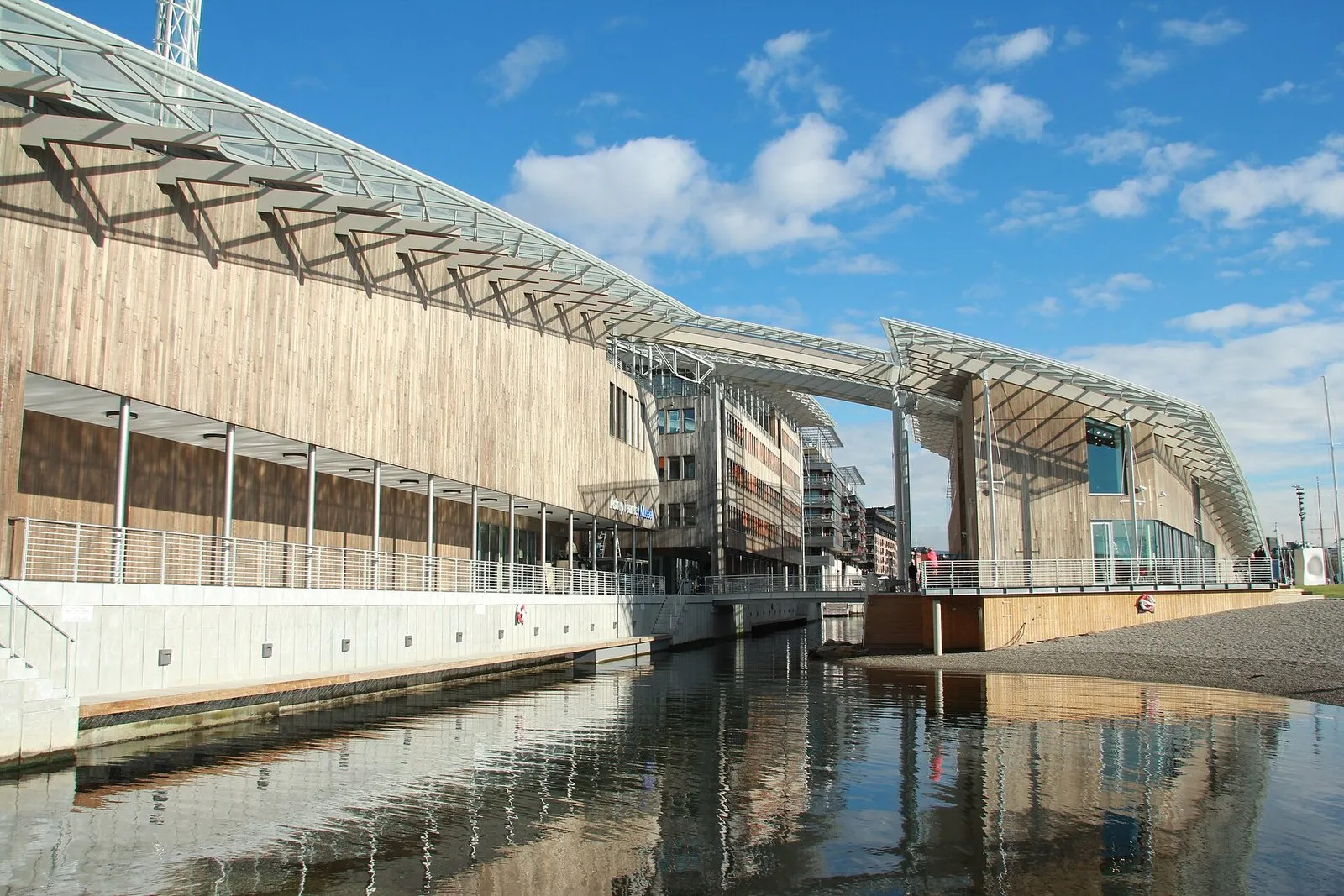 Tjuvholmen, Oslo. Photo: Sailko, Wikimedia Commons, CC BY 3.0.
The five cities in brief
- Copenhagen (Denmark): 15 minutes by metro from the airport, which runs all night. Nyhavn’s canal dates from the 1670s, and Rosenborg Castle holds the crown jewels in timed slots every 10 minutes that sell out in peak season. The three palaces are DKK 245 together on the Royal Palace Pass, against DKK 405 apart. Cycling is the way to move: keep right, put a hand out to turn, and avoid the big streets from 07:00 to 09:00 and 15:00 to 17:00. A bike is free on S-trains and buses but needs a ticket on the metro (Copenhagen guide, cycling in Copenhagen).
- Stockholm (Sweden): built on 14 islands. Gamla Stan’s medieval streets lead to the Royal Palace, where one SEK 220 ticket covers the Royal Apartments, the Treasury and the Tre Kronor Museum. On Djurgården the Vasa Museum holds the warship that sank in 1628; pre-booked tickets get no queue priority, so go at opening. Any SL ticket also covers the Djurgården ferry and the Waxholmsbolaget boat to Vaxholm, about an hour away. The Vasa, Skansen, the Royal Palace and ABBA The Museum are open on Mondays, when many Stockholm museums are not (Stockholm guide, archipelago day trip).
- Oslo (Norway): the Opera House roof is open to walk on at any hour, and the National Museum holds the 1893 Scream in Room 60 but is closed on Mondays. MUNCH sells timed tickets at NOK 220, or NOK 280 by day from 15 June to 15 September. The Viking Ship Museum is closed, and its replacement, the Museum of the Viking Age, is planned for late 2027. Oslo Badstuforening’s harbour saunas are open every day from 07:00 to 22:00, at NOK 260 for 90 minutes: bring two towels, and book early because reservations open 21 days ahead. The fjord islands are a 10-minute Ruter ferry (B1) from Aker Brygge to Hovedøya on a Zone 1 ticket, and metro line 1 reaches Holmenkollen in 25 minutes (Oslo guide, floating saunas, fjord islands).
- Helsinki (Finland): Helsinki Cathedral faces Senate Square, and a 15-minute public ferry from Market Square, every 15 to 20 minutes all year, reaches Suomenlinna, which is free to enter. Löyly has a smoke sauna and a wood-fired sauna with a ladder into the Baltic, at €29 for two hours; afternoon and weekend slots sell out days ahead. Allas Sea Pool beside Market Square is €19 on weekdays and €24 at weekends, and Kotiharju, wood-fired since 1928, is €16 and walk-in only. Finnish sauna culture is on UNESCO’s list of intangible cultural heritage (Helsinki guide, saunas, Suomenlinna).
- Reykjavik (Iceland): Hallgrímskirkja’s 73-metre tower, 1,500 ISK, looks over the city, and the eight public geothermal pools, 1,500 ISK for adults, have hot pots at 38°C to 44°C. The Blue Lagoon, from 11,990 ISK, sells nothing at the door. Sky Lagoon, from 14,990 ISK, is 13 minutes by road from the centre and admits no one under 12. The Golden Circle is a 240-kilometre loop of 7 to 9 hours through Þingvellir, Geysir and Gullfoss, and a full-day tour with the Kerið crater is from 11,300 ISK (Reykjavik guide, thermal pools, Golden Circle).
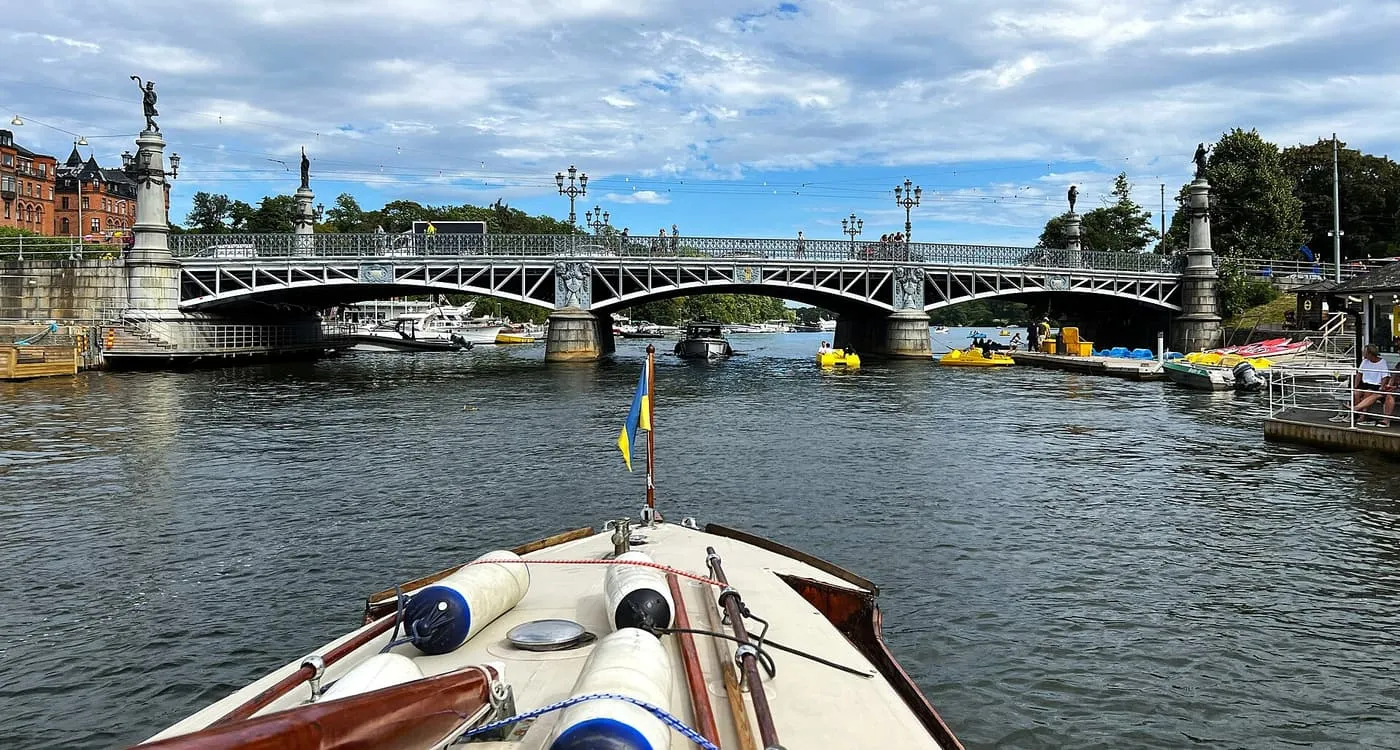 Djurgårdsbron, Stockholm. Photo: Arild Vågen, Wikimedia Commons, CC BY-SA 4.0.
Two capitals on one trip
| Pair | How | Time | What to know |
|---|---|---|---|
| Stockholm and Helsinki | Overnight ferry, Viking Line or Tallink Silja | Leaves Stockholm at 16:00 or 16:30 and arrives at 10:10 or 10:30; westbound leaves at 17:00 or 16:45 | Cabins are sold whole, so the price is per cabin; a sample is €86 for a two-night return in a Viking Line Inside Standard cabin. Finland is an hour ahead. Viking Line does not sail from 7 to 26 January 2027 |
| Oslo and Stockholm | SJ direct train | Under six hours | Central Station to Central Station (Oslo vs Stockholm) |
| Helsinki and Tallinn | Fast ferry from West Terminal 2 | 2 hours with Tallink, 2 hours 15 minutes with Eckerö Line | Bring a passport or EU identity card; a driving licence is not accepted (Tallinn day trip) |
| Copenhagen and Malmö | Train from Central Station | About 35 minutes, every 20 minutes | Carry a passport: Sweden has notified border controls from 12 November 2026 to 11 May 2027 (Malmö day trip) |
Reykjavik does not combine with the others by land or rail, since Iceland has no railway. The Stockholm and Helsinki ferries have their own terminals in each city, so Helsinki vs Stockholm lists them before you choose a hotel.
Which Nordic capital should you visit?
Each pick is our judgement, built on the figures above.
- A first weekend with the shortest transfer: Copenhagen. The metro takes 15 minutes to the centre, runs all night, and the three palaces are one DKK 245 pass.
- The lowest prices of the five: Stockholm, with Eurostat’s lowest 2024 price level for restaurants and hotels at 116.7, against 167.3 for Reykjavik. Helsinki is next at 126.8.
- A rainy-day museum trip: Oslo for The Scream and MUNCH at NOK 220 each, or Stockholm for the Vasa. The Oslo Pass pays on a day with three paid sights, and 18 to 24-year-olds pay NOK 100 at both Oslo museums, which makes the pass poor value for them.
- A trip on a Monday: Stockholm, where the Vasa, Skansen, the Royal Palace and ABBA The Museum are open, or Reykjavik, where the National Museum is open every day. Many museums in Copenhagen, Oslo and Helsinki close.
- Saunas and a swim in the sea: Helsinki for Löyly, Allas Sea Pool and Kotiharju, or Oslo for floating saunas with a ladder into the fjord, from NOK 260.
- Pools, lagoons and volcanic landscapes: Reykjavik. Eight public pools at 1,500 ISK, Sky Lagoon and the Blue Lagoon, plus the Golden Circle, South Coast and Snæfellsnes day trips.
- The northern lights: Reykjavik, from late August to April.
- Two capitals in one trip: Stockholm and Helsinki by overnight ferry, or Oslo and Stockholm by train in under six hours.
- Midsummer light: Reykjavik has 21 hours of daylight on 21 June and Helsinki 18 hours 56 minutes, but expect closures on Midsummer Eve in Stockholm and Helsinki.
- A December trip: Copenhagen, with seven hours of daylight on 21 December, Tivoli’s Christmas and a market free to enter; Reykjavik has four hours of daylight.
For two of them on one trip, see Oslo vs Stockholm and Helsinki vs Stockholm, which covers the overnight ferry between the two. For all five cities and the Christmas markets, see the Scandinavian city breaks guide.
Where to stay
- Copenhagen: Indre By or Nyhavn for a first visit, with Kongens Nytorv metro serving Nyhavn on lines M1 to M4. The M2 goes to the airport and the M1 does not. Where to stay in Copenhagen
- Stockholm: Norrmalm round T-Centralen, or Gamla Stan. The Arlanda Express ends at Central Station and all the metro lines meet at T-Centralen; Djurgården has the museums but no metro. Where to stay in Stockholm
- Oslo: Sentrum along Karl Johans gate, or Oslo S, where the Vy train from Gardermoen arrives in 23 minutes. Bjørvika is beside MUNCH and the harbour saunas. Where to stay in Oslo
- Helsinki: Kluuvi and the Esplanade for a first visit. For the Estonia ferries, the West Harbour suits Tallink and Eckerö Line and Katajanokka suits Viking Line. Where to stay in Helsinki
- Reykjavik: downtown Miðborg (101), ten minutes’ walk from Hallgrímskirkja and Harpa. Laugardalur suits families and drivers who want free parking beside the largest thermal pool. Where to stay in Reykjavik
Common questions
What is the difference between Scandinavia and the Nordic countries?
Scandinavia is Denmark, Sweden and Norway. The Nordic countries add Finland and Iceland, so Helsinki and Reykjavik are Nordic capitals but not Scandinavian ones.
Which Nordic capital is the most expensive?
Reykjavik, then Copenhagen. Eurostat's 2024 price level for restaurants and hotels, with the EU27 average at 100, is 167.3 for Iceland, 147.6 for Denmark, 140.0 for Norway, 126.8 for Finland and 116.7 for Sweden. Reykjavik hotels also add an accommodation tax of 800 ISK per room per night; Copenhagen, Stockholm, Oslo and Helsinki charge no tourist tax.
How much daylight do the Nordic capitals get in winter and summer?
On 21 December 2026 Copenhagen gets 7 hours 1 minute of daylight, Stockholm 6 hours 5 minutes, Oslo 5 hours 54 minutes, Helsinki 5 hours 49 minutes and Reykjavik 4 hours 7 minutes. On 21 June the range is 17 hours 32 minutes in Copenhagen to 21 hours 8 minutes in Reykjavik, where the sun sets just after midnight and rises before 03:00.
Can you visit two Nordic capitals in one trip?
Stockholm and Helsinki are linked by an overnight ferry, leaving Stockholm at 16:00 or 16:30 and arriving at 10:10 or 10:30. Oslo and Stockholm are under six hours apart on a direct SJ train. Copenhagen is about 35 minutes by train from Malmö in Sweden, and Helsinki is two hours by fast ferry from Tallinn in Estonia. Reykjavik is the exception, because Iceland has no railway.
How much is a 24-hour transport ticket in each Nordic capital?
DKK 100 for a City Pass Small in Copenhagen, SEK 180 in Stockholm, NOK 137 in Oslo and €10.60 in Helsinki. In Reykjavik a Strætó ride is 690 ISK, and fares cap at 2,070 ISK a day.