In this guide
💡 The Short Version: The POLIN Museum of the History of Polish Jews (Muzeum Historii Żydów Polskich POLIN) is located at Mordechaja Anielewicza 6 in the heart of pre-war Jewish Warsaw (polin.pl). The museum is closed on Tuesdays, open 10:00 to 18:00 (until 20:00 on Saturdays), and free on Thursdays. Tickets are 45 PLN (35 PLN reduced). Last entry to the core exhibition is two hours before closing (16:00 on most days; 18:00 on Saturdays). Or book a tour: Warsaw: POLIN Museum of the History of Polish Jews Ticketad (from 45 PLN, 4.7 stars from 1,513 reviews) sells entry to the POLIN Museum in advance.
⚠️ Two-hour last entry cutoff: The core exhibition closes to new visitors two hours before the museum does: 16:00 Sunday to Friday, 18:00 on Saturday. After that you can only enter the temporary exhibition (last entry 17:30; 19:30 on Saturday), the shop and the restaurant.
Ticket prices, concessions and free days
Buy online at bilety.polin.pl or at the ticket desk on the day. Prices are the museum’s own (polin.pl); Thursday admission to the core and temporary exhibitions is free.
| Ticket | Price | What it covers |
|---|---|---|
| Core exhibition, adult | 45 PLN | Core exhibition, audio guide, temporary exhibition and Legacy Gallery |
| Core exhibition, reduced | 35 PLN | The same, for pupils, students under 26 with ID, seniors over 65 and disability card holders |
| Museum for 1 zloty | 1 PLN | Core exhibition, audio guide and Legacy Gallery, for ages 7 to 26 in education, with a Polish school or university student card |
| Family ticket | 95 PLN | Up to 2 adults and 4 children aged up to 18, with audio guide, temporary exhibition and Legacy Gallery |
| Group ticket (10 or more) | 30 PLN | Same entry for groups |
| Temporary exhibition only | 30 PLN (25 PLN reduced) | The current temporary exhibition |
| Thursday | Free | Core and temporary exhibitions |
| Warsaw Pass | Free | Core exhibition, temporary exhibition, audio guide and Legacy Gallery |
The audio guide, included in the ticket, comes in 15 languages: English, Belarusian, Chinese, Czech, French, German, Hebrew, Italian, Japanese, Lithuanian, Polish, Portuguese, Russian, Spanish and Ukrainian. A guide for your own group costs 350 PLN in languages other than Polish (250 PLN in Polish).
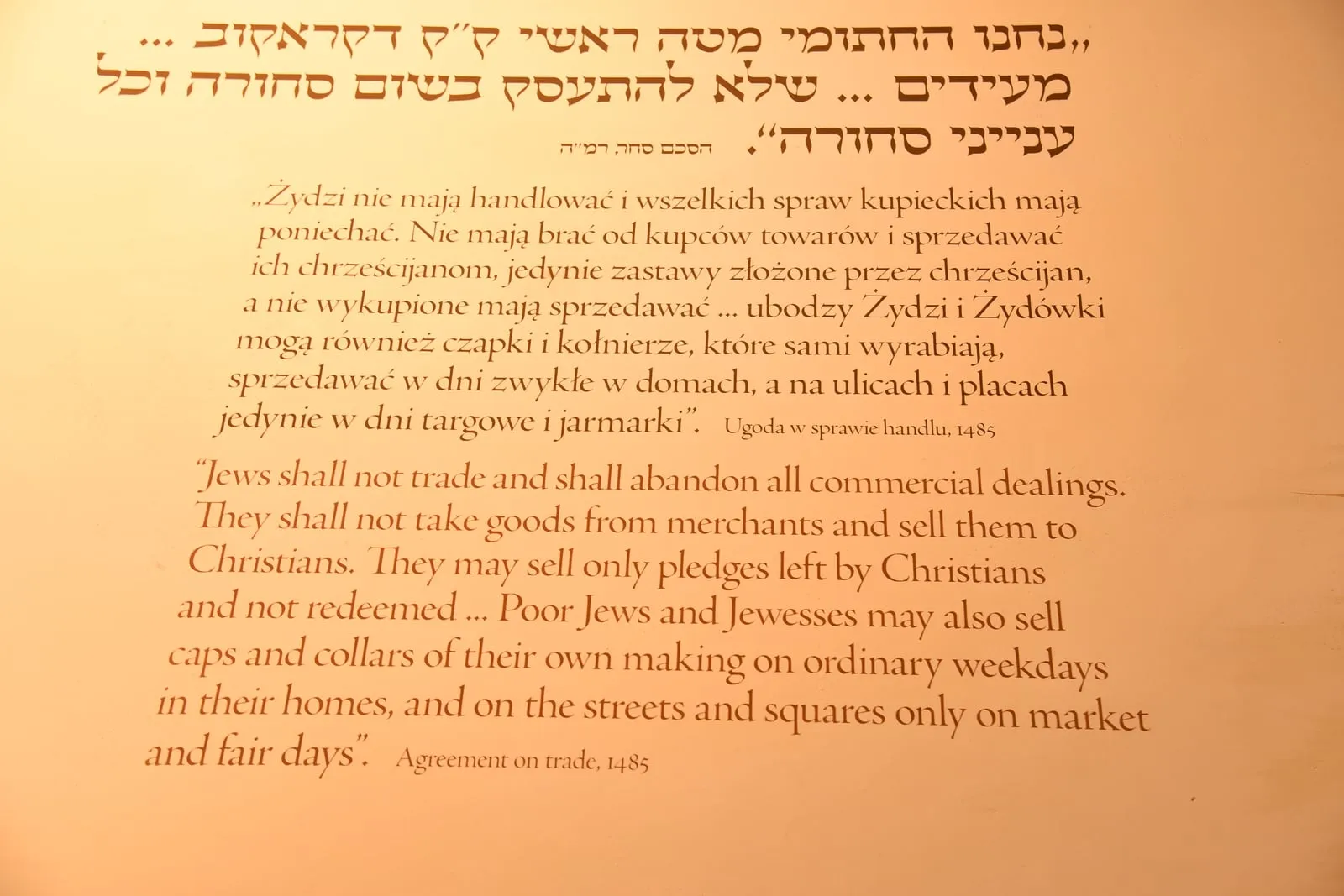
A POLIN exhibition panel. Photo: Rakoon, Wikimedia Commons, CC0.
Tours and guided walks
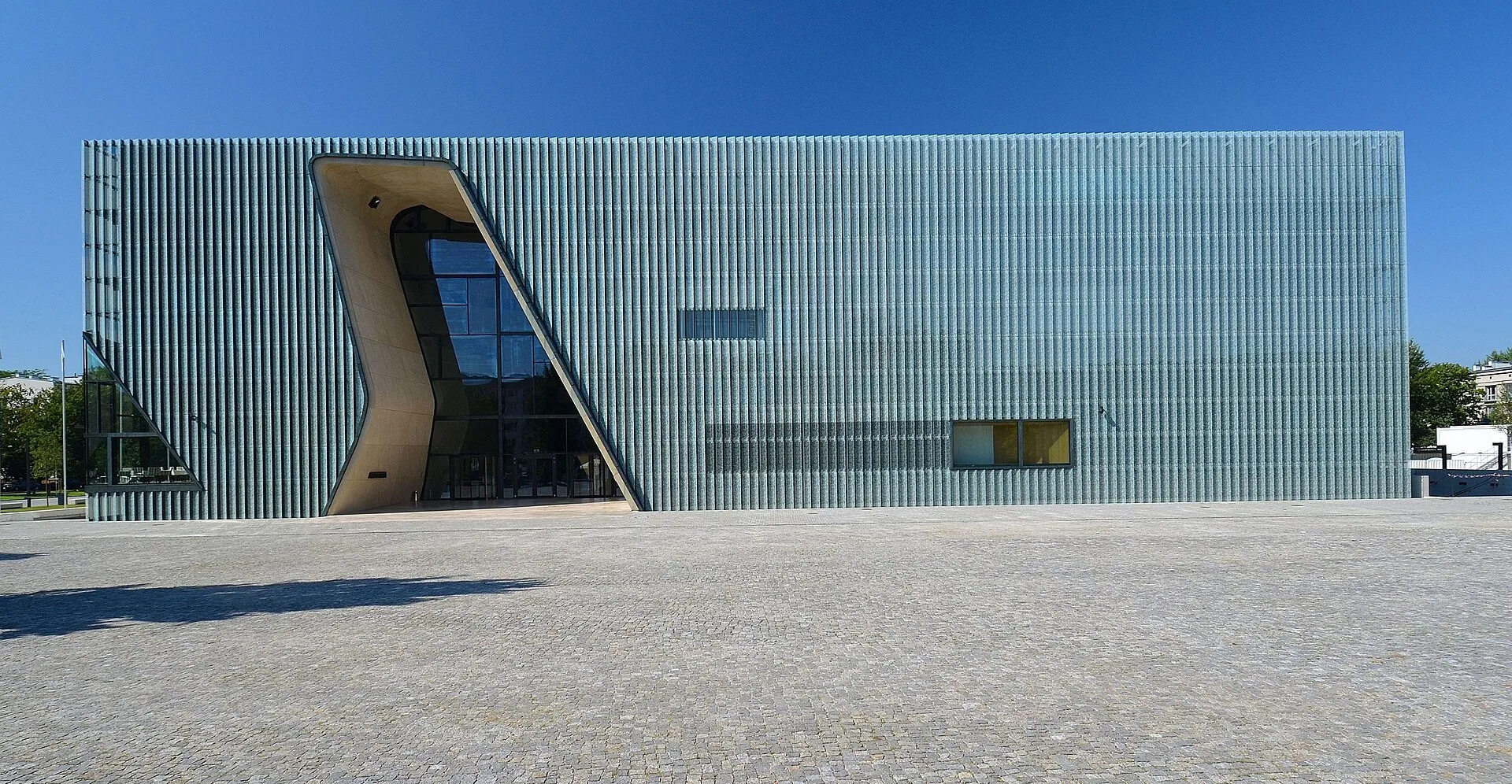
POLIN was European Museum of the Year in 2016. Its architecture—designed by Finnish architect Rainer Mahlamäki—has a glass facade etched with Hebrew and Latin letters spelling Polin (“here rest” in Hebrew), split by a curved entrance canyon. A walking tour covers the streets of Muranów around the museum.
Warsaw: POLIN Museum of the History of Polish Jews Ticket
From 45 PLN · 4.7 stars from 1,513 reviews · museum entry
Warsaw: POLIN Museum of the History of Polish Jews Ticketad: entry to the POLIN Museum, covering 1,000 years of Polish Jewish history through exhibitions and interactive installations.
Skip-the-Line Polin Museum Warsaw Jewish History Tour
From 520 PLN · 5.0 stars from 15 reviews · 2 to 4 hours · private guide, skip-the-line entry
Skip-the-Line Polin Museum Warsaw Jewish History Tourad: a private guided tour of the POLIN Museum with skip-the-line entry, covering more than 1,000 years of Jewish history in Poland.
Jewish Warsaw & Stories from the Ghetto - Walking Tour
From 39 PLN · 4.9 stars from 650 reviews · 2 hours · walk through the former ghetto
Jewish Warsaw & Stories from the Ghetto - Walking Tourad: a walking tour of Jewish Warsaw, from the start of Jewish life in the city to the story of the Warsaw Ghetto in the Second World War.
Museum ticket, tour or walk
| Option | Price | What it is |
|---|---|---|
| Self-guided visit with audio guide | 45 PLN, free on Thursdays | Bought from the museum; you set the pace |
| Walking tour of the ghetto and Muranów | From 39 PLN | 2 hours around the memorial sites and streets outside the museum |
| Private skip-the-line tour | From 520 PLN | A guide inside the museum, 2 to 4 hours |
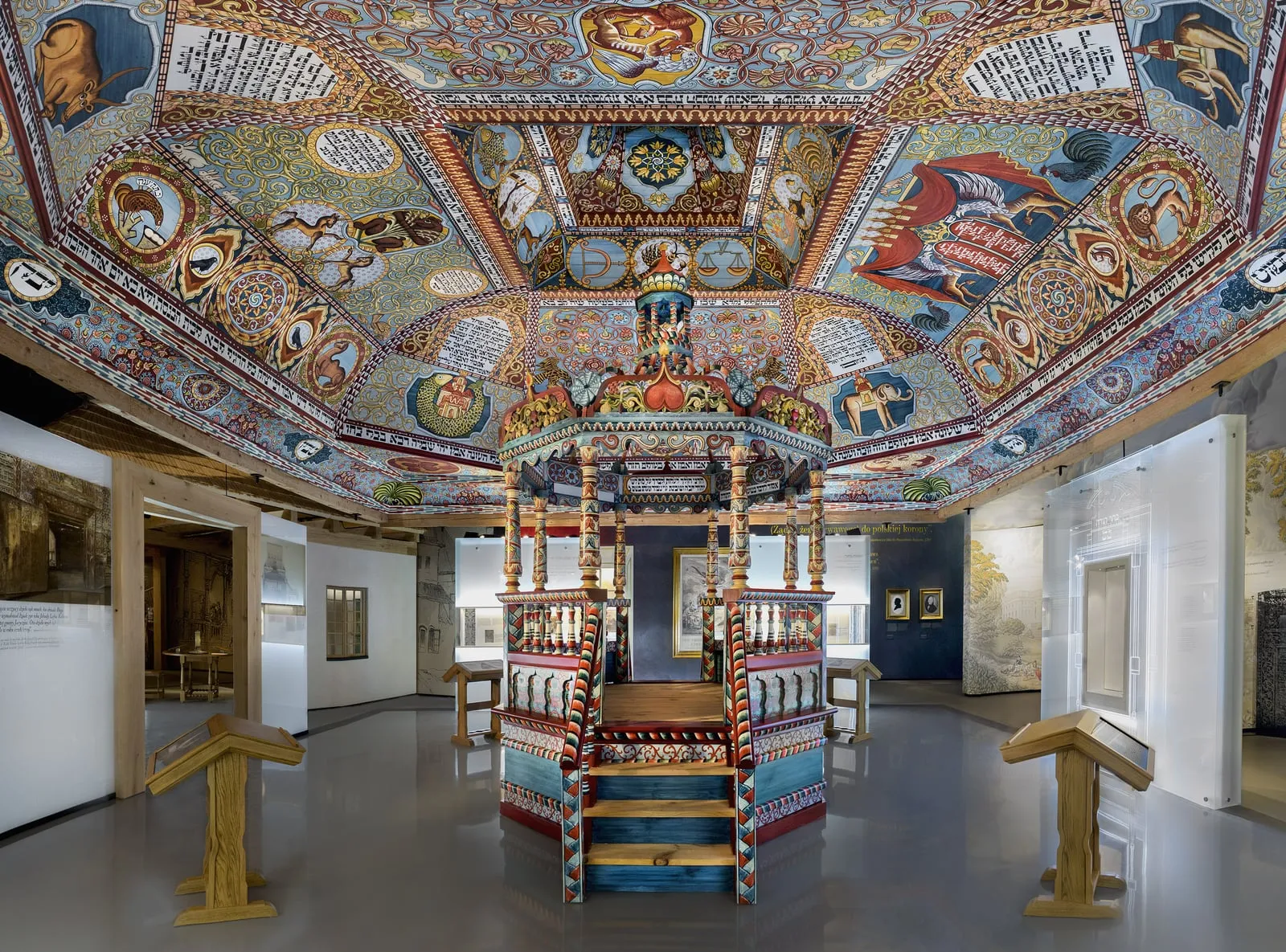
The hand-painted timber ceiling and cupola of the Gwoździec wooden synagogue. Photo: Magdalena Starowieyska, Dariusz Golik, Wikimedia Commons, CC BY-SA 3.0 pl.
The core exhibition
The core exhibition has eight galleries and spans 1,000 years of Polish Jewish history. It was curated by an international team led by Professor Barbara Kirshenblatt-Gimblett. The main galleries:
1. Forest (Las)
The journey opens with the medieval legend of Jewish merchants travelling east through dense forests, hearing the Hebrew words Po-lin (“here you shall rest”), interpreting Poland as a haven from persecution in Western Europe.
2. First Encounters (965–1500) & Paradisus Iudaeorum (1569–1648)
Traces Jewish settlements under royal charters of protection, such as the 1264 Statute of Kalisz. By the late 16th century the Polish-Lithuanian Commonwealth had a large Jewish community that governed itself through the Council of Four Lands (Va’ad Arba’ Aratzot).
3. The Gwoździec Synagogue Reconstruction
A full-scale timber reconstruction of the roof, cupola and bimah of the 17th-century wooden synagogue of Gwoździec, destroyed in the Second World War. It was built by hand with traditional carpentry tools, natural pigments and rabbit-skin glue, and the painted ceiling carries zodiac signs and biblical scenes.
4. The Jewish Street (Ulica)
Recreates an early 20th-century Warsaw street with shopfronts, theatre billboards, political posters (Zionist, Bundist and religious) and cinema newsreels. Before the war more than 350,000 Jews lived in Warsaw, a third of the city’s population.
5. The Holocaust (Zagłada)
Grey concrete walls close in on a gallery covering the Nazi occupation, the building of the Warsaw Ghetto walls, starvation in the ghetto, the 1943 Warsaw Ghetto Uprising led by Mordechaj Anielewicz, and deportations to the Treblinka extermination camp. Exhibits include the milk cans in which Emanuel Ringelblum buried the clandestine Oneg Shabbat archive.
6. Post-War Years and the Legacy Gallery
Covers the post-war period, the Kielce pogrom, the 1968 antisemitic campaign run by the communist regime, and the revival of Jewish communal life in democratic Poland.
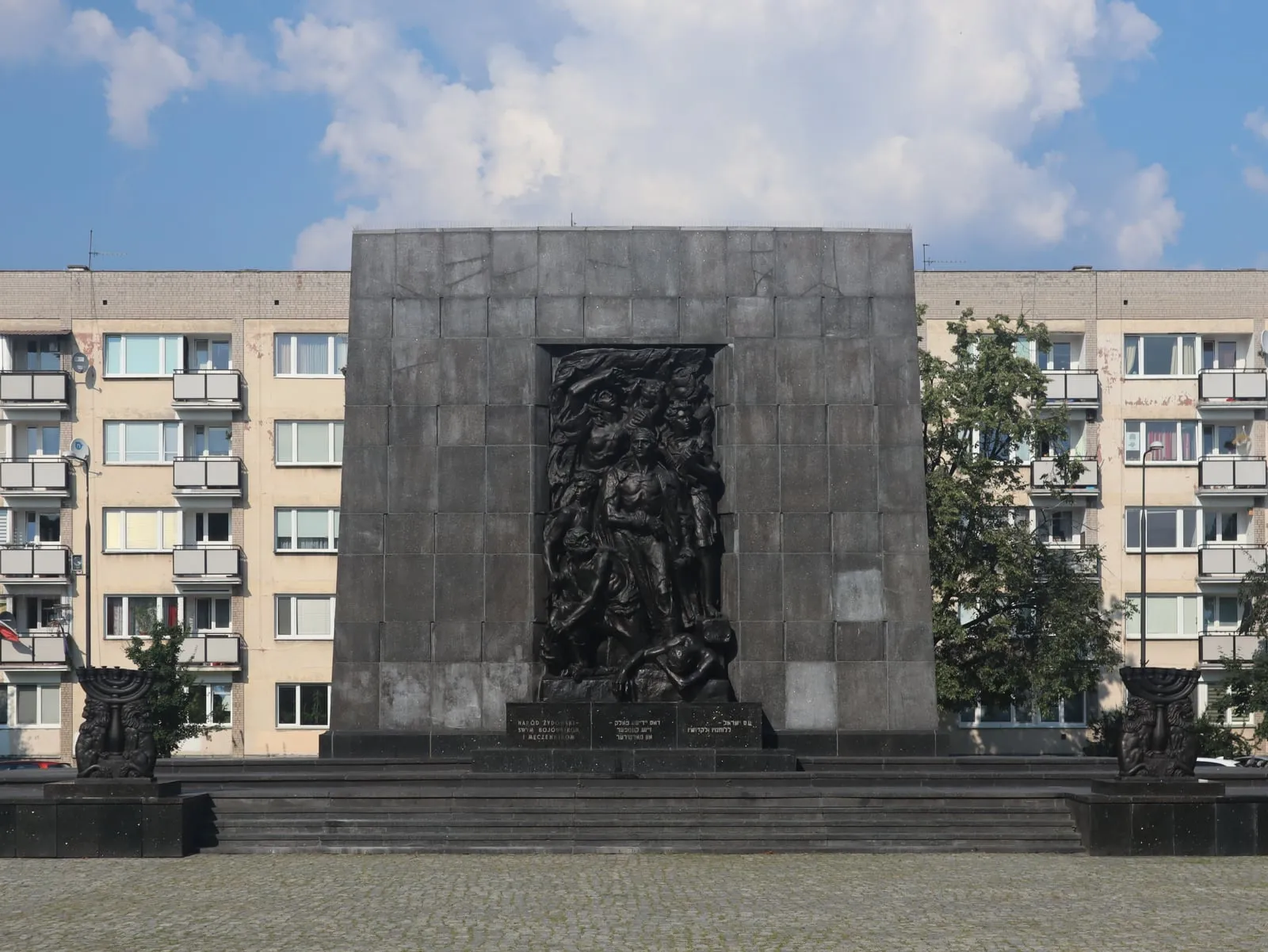
The Monument to the Ghetto Heroes facing the entrance of POLIN. Photo: Cybularny, Wikimedia Commons, CC0.
Opening hours and visiting timetable
| Day | Opening Hours | Core Exhibition Last Entry | Notes |
|---|---|---|---|
| Monday | 10:00 – 18:00 | 16:00 | |
| Tuesday | CLOSED ALL DAY | — | Weekly closure |
| Wednesday | 10:00 – 18:00 | 16:00 | |
| Thursday | 10:00 – 18:00 | 16:00 | Free admission |
| Friday | 10:00 – 18:00 | 16:00 | |
| Saturday | 10:00 – 20:00 | 18:00 | Late opening |
| Sunday | 10:00 – 18:00 | 16:00 |
POLIN is also closed on 24 and 25 December and 31 December (polin.pl).
Visitor amenities and dining
- Restaurant Warsze: On the ground floor, open during museum hours, serving Jewish and Polish dishes.
- Museum shop: Books in English, Polish and Hebrew on Jewish history, genealogy, art and philosophy.
- Accessibility: Lifts serve all exhibition floors, and induction loops assist visitors with hearing loss.
Getting there
POLIN is located at Mordechaja Anielewicza 6 in Muranów, 2 km north of Warszawa Centralna.
- Trams: Routes 15, 18, and 35 stop at Muranów on Andersa Street (300 metres east). Routes 17 and 33 stop at Anielewicza on Aleja Jana Pawła II (400 metres west).
- Metro: Line M1 to Ratusz Arsenał station, followed by a 10-minute walk north along Andersa or a two-stop tram ride to Muranów.
- Buses: Lines 111 and 180 stop directly outside the museum at the Nalewki-Muzeum stop.
- Fares: A standard 20-minute ticket or 75-minute single transfer ticket covers public transit across Zone 1; consult our guide to public transport in Warsaw.
What to see next
- Warsaw Uprising Museum: The 1944 uprising, in Wola to the south-west.
- Warsaw Old Town and Barbican: Walk east across Krasiński Square into the rebuilt Old Town.
- Praga District and Polish Vodka Museum: Across the river: pre-war tenement courtyards and the Koneser vodka factory.
- Free things to do in Warsaw: Free museum days, day by day.
- Warsaw in 1 or 2 days: Itineraries that pair Muranów with the Royal Route.
- Warsaw travel guide: Sights, transport, food and seasonal advice.
Common questions
How much are tickets to the POLIN Museum?
45 PLN for adults and 35 PLN reduced, including the audio guide, the temporary exhibition and the Legacy Gallery. Children and young people aged 7 to 26 in Polish education pay 1 PLN, and a family ticket (up to 2 adults and 4 children) is 95 PLN.
When is admission free at the POLIN Museum?
Every Thursday admission to the core and temporary exhibitions is free. Warsaw Pass holders also go in free on any open day.
What days is the POLIN Museum closed?
The museum is closed on Tuesdays. It is also closed on 24 and 25 December and 31 December.
What are the opening hours for POLIN?
Monday and Wednesday to Friday, and Sunday, from 10:00 to 18:00, with last entry to the core exhibition at 16:00. On Saturdays it is open from 10:00 to 20:00, with last entry at 18:00.
How long does a visit to POLIN take?
The core exhibition has eight galleries running from the Middle Ages to the present. Last entry is two hours before closing, so arrive at least two hours before then. Folding stools can be borrowed free at the ticket desk.
Where is the POLIN Museum located?
At Ulica Mordechaja Anielewicza 6 in the Muranów district, situated on the square directly opposite Nathan Rapoport's 1948 Monument to the Ghetto Heroes.